Key Takeaways
- TCM views cold extremities through the Kidney, Spleen, and Liver organ systems, with yang deficiency being the most common underlying pattern — the body lacks the warming energy to push qi and blood to the limbs.
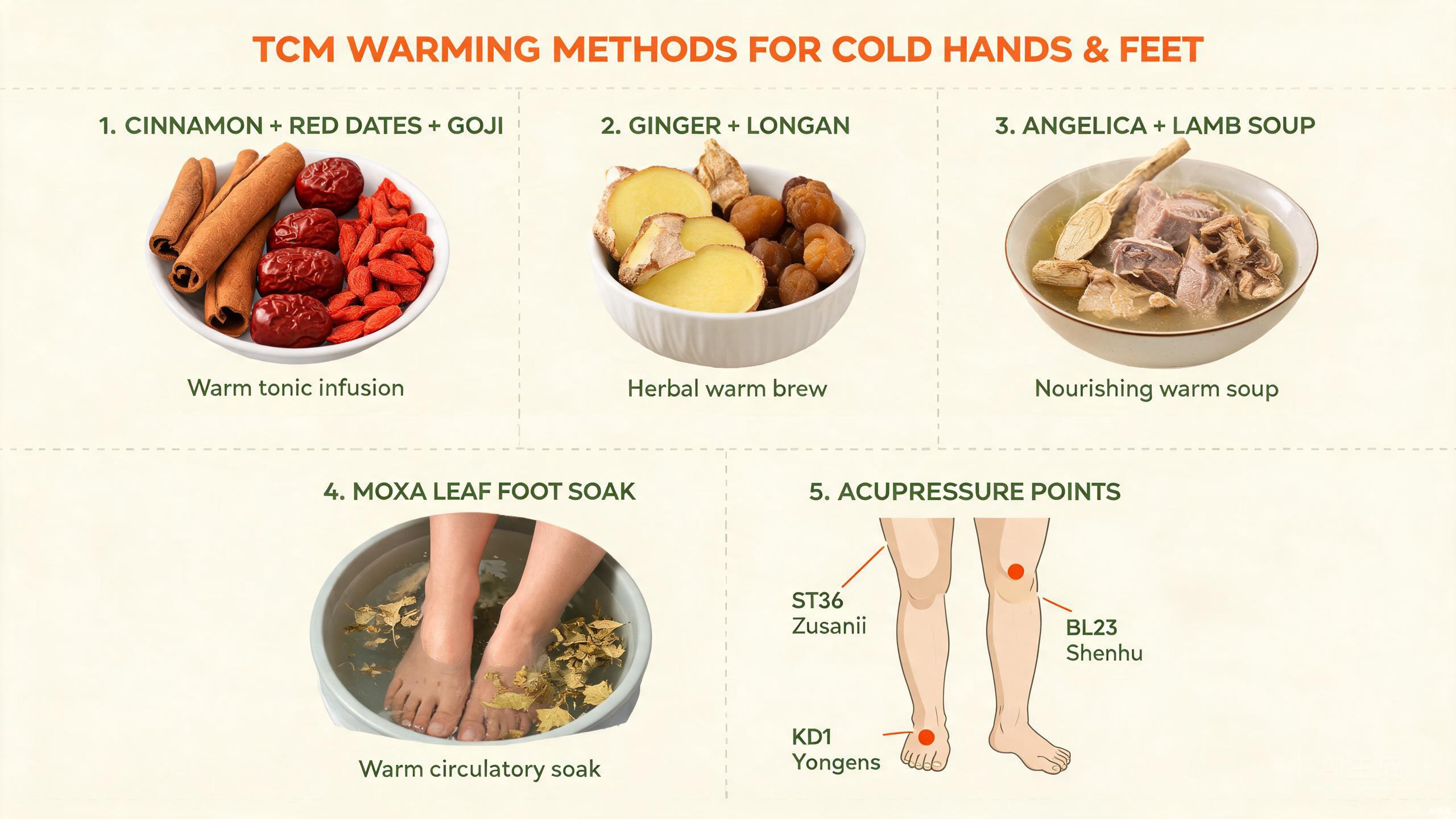
- Five traditional recipes — from cinnamon date goji tea to angelica ginger lamb soup and two warming foot soaks — use ingredients available at Western supermarkets, Amazon, or iHerb.
- Three acupressure points, Zusanli (ST36), Shenshu (BL23), and Yongquan (KD1), are traditionally used to strengthen kidney yang, support qi, and draw warmth to the extremities.
- Diabetic individuals must use extra caution with hot water foot soaks due to reduced sensation and burn risk — always test temperature with a thermometer and keep water below 42°C (108°F).
- These are traditional wellness practices, not a treatment for any medical condition. Persistent coldness, numbness, or color changes in the extremities require evaluation by a qualified healthcare provider.
This article is for educational purposes only and is not medical advice. The foods, teas, and practices described here are traditional wellness practices rooted in Chinese culture. They are not a substitute for professional medical care, diagnosis, or treatment. Cold hands and feet can result from many causes — including poor circulation, anemia, hypothyroidism, Raynaud's phenomenon, peripheral artery disease, and diabetes-related neuropathy — that require proper medical evaluation. Never stop, delay, or replace prescribed treatment based on information in this article. Some foods and herbs may interact with medications — always inform your doctor about everything you consume. These statements have not been evaluated by the FDA and are not intended to diagnose, treat, cure, or prevent any disease. Read our full disclaimer →
Cold hands and feet are among the most common everyday discomforts, especially during colder months. While often dismissed as a minor nuisance, persistently cold extremities can signal an underlying imbalance in the body's ability to generate and distribute warmth. Traditional Chinese Medicine (TCM) has a clear and time-tested framework for understanding this phenomenon, rooted in the concept of yang — the body's warming, active, outward-moving energy.
In TCM, cold hands and feet are not viewed as a problem of the hands and feet themselves, but rather as a sign that the body's internal "furnace" is not generating enough heat, or that the pathways carrying warmth to the extremities are blocked. The five recipes below use foods, teas, and foot soaks that have been enjoyed for generations to warm the body from within, support healthy circulation, and nourish the organ systems responsible for generating yang energy. All ingredients are available at Western supermarkets, Asian markets, Amazon, or iHerb.
If you are new to TCM concepts, our introduction to Traditional Chinese Medicine and guide to yin and yang are helpful starting points. For related topics, see our guides on TCM foods for blood circulation and TCM warming spices.
How TCM Views Cold Extremities
Traditional Chinese Medicine explains cold hands and feet through the interplay of three organ systems and the balance of yang and qi in the body. Understanding this framework is the key to choosing the right warming foods and practices.
Yang is the body's warming energy. In the yin-yang system, yang represents heat, activity, movement, and the outward and upward directions. When yang is sufficient, the body generates enough warmth to maintain a comfortable temperature throughout, including in the hands and feet — the parts of the body farthest from the core. When yang is deficient, the body conserves heat for the vital organs in the torso, leaving the extremities cold. This is why cold hands and feet are often accompanied by a preference for warm drinks, sensitivity to cold weather, and a tendency toward a pale complexion.
The Kidney system is the root of yang. In TCM, the Kidneys are the source of the body's fundamental yang energy, known as ming men huo or "the fire of the gate of life." This fire is the pilot light that powers all metabolic warmth. Kidney yang deficiency — from aging, chronic overwork, excessive cold exposure, or constitutional weakness — is the most common root cause of cold extremities. Signs include cold hands and feet (especially in winter), lower back soreness and knee weakness, frequent clear urination (especially at night), low energy, and a general feeling of coldness. See our guide to TCM for night urination for more on kidney yang deficiency.
The Spleen supports yang through digestion. The Spleen in TCM is responsible for transforming food into qi and blood. It is also the organ that generates the "middle burner fire" that keeps the digestive system warm and functional. When spleen yang is deficient — from eating too many cold, raw, or damp-producing foods, or from worry and overthinking — the body's ability to generate warmth from food is compromised. Signs include cold hands and feet accompanied by poor appetite, bloating after eating, loose stools, and fatigue after meals.
The Liver ensures smooth qi flow. Even when the body has enough yang, cold extremities can occur if qi and blood are not flowing smoothly to the limbs. In TCM, the Liver is responsible for the smooth flow of qi throughout the body. Emotional stress, frustration, and suppressed emotions cause liver qi to stagnate, which can block the flow of warming energy to the hands and feet. This pattern often presents as cold hands and feet that worsen with stress, along with sighing, breast tenderness, irritability, and a feeling of tightness in the chest. See our herbal tea for anxiety guide for more on stress-related patterns.
TCM identifies four primary patterns associated with cold extremities:
- Kidney Yang Deficiency (Shen Yang Xu) — the most common pattern. The body's root yang is insufficient, failing to warm the extremities. Signs include cold hands and feet (worse in winter), lower back and knee coldness and weakness, frequent clear urination at night, low libido, fatigue, and a pale complexion. Often seen in older adults or after chronic illness.
- Spleen Yang Deficiency (Pi Yang Xu) — the digestive fire is too weak to generate warmth. Signs include cold hands and feet with poor appetite, bloating, loose stools, preference for warm drinks and food, and fatigue that worsens after eating. Often triggered by a diet high in cold, raw, or sweet foods.
- Qi and Blood Deficiency (Qi Xue Liang Xu) — there is not enough qi and blood to reach and warm the extremities. Signs include cold hands and feet with a pale complexion, dizziness on standing, dry skin, brittle nails, and scanty menstruation. Often related to poor nutrition, blood loss, or digestive weakness. See our TCM for anemia guide for more.
- Qi Stagnation (Qi Zhi) — stress blocks the flow of qi to the limbs. Signs include cold hands and feet that worsen with emotional stress, sighing, chest tightness, and irritability. The coldness is often intermittent rather than constant. This pattern is common in younger, stressed individuals.
Understanding these patterns helps explain why TCM recommends different warming foods for different situations. The recipes below are matched to the patterns they traditionally address.
5 Food Therapy Recipes for Warming the Body
Each recipe below is matched to a specific TCM pattern. Choose the one that best fits your situation, and use it consistently for two to four weeks. All ingredients are available at Western supermarkets, Asian markets, Amazon, or iHerb.
1. Cinnamon Date Goji Tea (桂皮红枣枸杞茶)
Best for: Kidney and Spleen yang deficiency
TCM nature and flavor: Cinnamon bark (rou gui): pungent, sweet, hot. Enters the Kidney, Spleen, Heart, and Liver channels. Red dates (hong zao / jujube): sweet, warm. Enters the Spleen and Stomach channels. Goji berries (gou qi zi): sweet, neutral. Enters the Liver and Kidney channels.
Traditional use: Cinnamon bark is one of TCM's most important yang-warming herbs, traditionally used to warm the kidneys, strengthen spleen yang, and dispel cold. It is said to "lead fire back to its source," meaning it helps direct warming energy to the kidney system, the root of the body's heat. Red dates support qi and blood production and add natural sweetness, while goji berries nourish the kidney and liver to provide a gentle, balanced foundation. This tea is ideal for the constitutional coldness pattern where the whole body tends to feel chilly, especially in the lower back and abdomen.
Ingredients:
- 1 to 2 grams cinnamon bark (about 1 small stick or 1/4 teaspoon ground) — available at supermarkets, Amazon, or iHerb
- 5 to 6 dried red dates (jujubes), pitted
- 10 grams dried goji berries (about 1 tablespoon)
- 10 oz water
Preparation: If using a cinnamon stick, break it into small pieces. Rinse the red dates and goji berries. In a pot, combine cinnamon, red dates, and water. Bring to a boil, then reduce heat and simmer for 10 minutes. Add the goji berries in the last 5 minutes. Strain into a cup (or drink directly if using a stick). Drink 1 cup per day, preferably in the morning to align with the body's natural yang-rising cycle. The tea is sweet, warm, and aromatic. For more on cinnamon in TCM, see our TCM warming spices guide.
Precautions: Cinnamon bark is warming and should be avoided if you have signs of internal heat (red face, dry mouth, constipation, irritability). Cassia cinnamon (the common variety) contains coumarin, which in very high doses may affect the liver; use in moderation and prefer Ceylon cinnamon if consuming regularly. Avoid during pregnancy. If you take blood thinners or diabetes medication, consult your doctor.
2. Ginger Date Longan Tea (生姜红枣桂圆茶)
Best for: Spleen yang deficiency and qi and blood deficiency
TCM nature and flavor: Fresh ginger (sheng jiang): pungent, warm. Enters the Lung, Spleen, and Stomach channels. Red dates (hong zao): sweet, warm. Enters the Spleen and Stomach channels. Dried longan (gui yuan / longan aril): sweet, warm. Enters the Heart and Spleen channels.
Traditional use: This is one of the most beloved warming teas in Chinese households, especially during colder months and for women's wellness. Fresh ginger is traditionally used to warm the middle burner, disperse cold, and support digestion. Red dates tonify qi and blood. Dried longan is traditionally valued for nourishing the heart and spleen, supplementing blood, and calming the mind. Together, these three ingredients create a tea that warms from the center outward, supports blood production, and gently calms — making it ideal for cold extremities accompanied by fatigue, pale complexion, or poor sleep. See our longan tea guide for more on this ingredient.
Ingredients:
- 3 to 4 slices fresh ginger (about 10 grams), unpeeled
- 6 dried red dates (jujubes), pitted
- 10 grams dried longan (about 1 tablespoon) — available on Amazon or iHerb
- 10 oz water
- Optional: a small amount of brown sugar or honey to taste
Preparation: Rinse the red dates and longan. Lightly crush the ginger slices with the flat of a knife to release their oils. In a pot, combine ginger, red dates, longan, and water. Bring to a boil, then reduce heat and simmer for 10 to 15 minutes. Strain into a cup. Add brown sugar or honey if desired. Drink 1 cup per day, preferably in the morning or early afternoon. The tea is warm, sweet, and deeply comforting. For more on ginger, see our TCM ginger medicine guide.
Precautions: This tea is warming and nourishing. Avoid if you have active internal heat, a sore throat, or a fever. Longan is sweet and warm; if you monitor your blood sugar, use sparingly or consult your healthcare provider. Avoid drinking late in the evening, as the warming energy may interfere with sleep for some people.
3. Angelica Ginger Lamb Soup (当归生姜羊肉汤)
Best for: Kidney and Spleen yang deficiency with blood deficiency
TCM nature and flavor: Lamb: sweet, warm. Enters the Spleen and Kidney channels. Angelica root (dang gui / dong quai): sweet, pungent, warm. Enters the Heart, Liver, and Spleen channels. Fresh ginger (sheng jiang): pungent, warm. Enters the Lung, Spleen, and Stomach channels.
Traditional use: This is one of the most famous classical TCM food therapy recipes, originating from the Jingui Yaolue (Essentials from the Golden Cabinet) written by Zhang Zhongjing around 200 CE. It is a quintessential winter warming recipe. Lamb is the most warming common meat in TCM, traditionally used to tonify kidney yang, warm the middle burner, and supplement qi and blood. Angelica root (dong quai) is one of TCM's premier blood-nourishing herbs, traditionally used to nourish and invigorate blood, warm the channels, and dispel cold. Ginger warms the digestion and helps the body process the rich lamb. Together, this soup is a deep, nourishing remedy for the coldness pattern that includes both yang deficiency and blood deficiency — cold extremities with pale complexion, fatigue, and lower back weakness.
Ingredients:
- 1 lb lamb (bone-in chops or stewing pieces) — available at supermarkets and butcher shops
- 15 grams sliced dried angelica root (dang gui) — available on Amazon or iHerb (search "dong quai" or "dang gui")
- 30 grams fresh ginger (about a 2-inch piece), sliced
- 8 cups water
- A pinch of sea salt
- Optional: 6 dried red dates, pitted, for sweetness
Preparation: Blanch the lamb in boiling water for 5 minutes, then rinse to remove impurities. In a large pot, combine the lamb, angelica root, ginger, red dates (if using), and water. Bring to a boil, then reduce heat and simmer for 90 minutes to 2 hours until the lamb is very tender and the broth is rich. Add salt to taste. Remove the angelica root slices before serving (or leave them in if you prefer the stronger flavor). Drink 1 bowl of broth and eat the lamb, 2 to 3 times per week during colder months. The broth is deeply warming and nourishing.
Precautions: This is a strongly warming soup. Avoid if you have internal heat signs (fever, sore throat, constipation, irritability). Angelica root may interact with blood thinners — consult your doctor if you take warfarin or similar medications. Avoid during pregnancy and menstruation with heavy flow. If you have gout or high uric acid, use lamb sparingly.
4. Moxa Leaf and Cassia Twig Foot Soak (艾叶桂枝泡脚方)
Best for: Kidney yang deficiency with cold feet and poor sleep
TCM nature and flavor: Moxa leaf (ai ye / mugwort): bitter, pungent, warm. Enters the Liver, Spleen, and Kidney channels. Cassia twig (gui zhi): pungent, sweet, warm. Enters the Heart, Lung, and Bladder channels. Safflower (hong hua): pungent, warm. Enters the Heart and Liver channels.
Traditional use: Foot soaks are a cornerstone of TCM home therapy for warming the body. The feet are rich in acupuncture points connected to the kidney and other organ systems, and soaking them in warm herbal water draws heat and circulation downward to the extremities. Moxa leaf (mugwort) is traditionally used to warm the channels, disperse cold, and support circulation. Cassia twig is traditionally used to warm the channels, unblock the vessels, and promote yang circulation to the extremities. Safflower is traditionally used to invigorate blood circulation. Together, this foot soak addresses the root pattern of cold feet by warming from the bottom up. It is particularly effective when done before bed, as the warmth promotes relaxation and may support better sleep. See our mugwort foot soak guide and TCM foot soak guide for more.
Ingredients:
- 10 grams dried moxa leaf (ai ye / mugwort) — available on Amazon or iHerb
- 10 grams dried cassia twig (gui zhi) — available on Amazon or iHerb (search "cassia twig" or "gui zhi")
- 5 grams dried safflower (hong hua) — available on Amazon or iHerb
- 1 large pot of water (enough to cover ankles)
Preparation: Place the moxa leaf, cassia twig, and safflower in a large pot with water. Bring to a boil, then reduce heat and simmer for 15 to 20 minutes to extract the herbs. Let the liquid cool slightly until it reaches a comfortable temperature — test with a thermometer and ensure it is between 38°C and 42°C (100°F to 108°F). Pour into a foot basin and soak your feet for 15 to 20 minutes, adding hot water as needed to maintain temperature. Do this 3 to 4 times per week, ideally in the evening before bed. After soaking, dry your feet thoroughly and wear warm socks.
Precautions: Diabetics must use extra caution — reduced foot sensation increases burn risk. Always test water temperature with a thermometer, never with your feet. Keep the water below 42°C (108°F). If you have neuropathy, peripheral artery disease, open wounds, or skin infections on your feet, consult your healthcare provider before using foot soaks. Avoid foot soaks during pregnancy (moxa and safflower are traditionally contraindicated during pregnancy). Do not soak within 30 minutes of a meal. If you feel dizzy or uncomfortable, stop immediately.
5. Ginger Scallion Foot Soak (生姜葱白泡脚方)
Best for: Early-stage cold with cold extremities, or simple daily warming
TCM nature and flavor: Fresh ginger (sheng jiang): pungent, warm. Enters the Lung, Spleen, and Stomach channels. Scallion whites (cong bai): pungent, warm. Enters the Lung and Stomach channels.
Traditional use: This is the simplest and most accessible foot soak in the TCM home therapy repertoire. Both ginger and scallion whites are common kitchen ingredients that are traditionally used to disperse cold, warm the channels, and promote sweating. In TCM, this combination is traditionally used at the first sign of a cold — when you feel chilly, have a runny nose with clear mucus, or have cold extremities — to "release the exterior" and push the cold out before it penetrates deeper. Even without a cold, this foot soak is a gentle, everyday warming practice that supports circulation to the feet and promotes overall comfort. It is the most beginner-friendly option, using ingredients available at any grocery store.
Ingredients:
- 30 grams fresh ginger (about a 3-inch piece), sliced and lightly crushed
- 5 scallion (green onion) whites, including the pale green portion
- 1 large pot of water (enough to cover ankles)
Preparation: Place the ginger slices and scallion whites in a large pot with water. Bring to a boil, then reduce heat and simmer for 10 minutes. Let the liquid cool slightly until it reaches a comfortable temperature — test with a thermometer and ensure it is between 38°C and 42°C (100°F to 108°F). Pour into a foot basin and soak your feet for 15 to 20 minutes. Do this daily or 3 to 4 times per week, ideally in the evening. After soaking, dry your feet thoroughly and wear warm socks. For more ginger-based remedies, see our TCM ginger medicine guide and ginger foot soak guide.
Precautions: Same precautions as the moxa foot soak. Diabetics must use extra caution — always test water temperature with a thermometer. Avoid if you have open wounds, skin infections, or peripheral artery disease without consulting your healthcare provider. Do not use if you have a fever (foot soaks are for cold-type patterns only, not heat-type). Avoid soaking within 30 minutes of a meal.
Hot water foot soaks can cause serious burns, especially in people with reduced sensation in their feet. If you have diabetes, peripheral neuropathy, or any condition that reduces foot sensation, always use a thermometer to verify water temperature before soaking, and keep the water below 42°C (108°F). Never judge temperature by feel if you have neuropathy. Limit soaking time to 15 to 20 minutes. If you notice any redness, blistering, or skin changes after soaking, contact your healthcare provider. See our TCM foot soak guide for complete safety instructions.
Three Acupressure Points for Warming the Body
In addition to food therapy and foot soaks, TCM uses acupressure to support the organ systems responsible for generating and distributing warmth. The three points below are traditionally used to strengthen kidney yang, support qi production, and draw warming energy to the extremities. They are simple to find and can be pressed daily as part of a wellness routine.
1. Zusanli (ST36) — The "Leg Three Miles"
Location: On the outer lower leg, about 3 cun (approximately four finger-widths) below the kneecap, one finger-width to the outside of the shin bone (tibia).
How to find it: Place your hand on your knee with your fingers pointing down the leg. The point is located about four finger-widths below the bottom of your kneecap, and one finger-width to the outside (the little-toe side) of your shin bone. You may feel a slight depression in the muscle. Pressing here often produces a dull ache that may radiate downward.
How to press: Using your thumb or two fingers, press firmly into the point. Hold for 2 to 3 minutes on each leg while breathing slowly and deeply. You can also use small circular motions. Apply moderate to firm pressure — this is a strong point that responds well to deeper pressure. Pressing Zusanli daily is one of the most recommended self-care practices in TCM.
Traditional use: Zusanli is arguably the most important acupressure point in all of TCM for general wellness and longevity. It is traditionally used to strengthen the spleen, tonify qi and blood, support digestion, and warm the body. For cold extremities, ST36 addresses the root by strengthening the body's ability to generate qi and warmth from food. The name "Leg Three Miles" comes from the traditional saying that pressing this point gives you the energy to walk another three miles — a testament to its qi-strengthening reputation. See our acupressure safety guide for general precautions.
Precautions: Generally safe for daily use. Avoid pressing with excessive force if you have a leg injury or varicose veins in the area.
2. Shenshu (BL23) — The "Kidney Shu"
Location: On the lower back, about 1.5 cun (approximately two finger-widths) to the side of the spine, at the level of the waist — roughly between the second and third lumbar vertebrae.
How to find it: Find the top of your hip bones (iliac crest). The point is located on the back at roughly the same level, about two finger-widths to either side of the spine. You can find it by placing your hands on your waist with thumbs pointing toward the spine — the thumbs naturally land near the Shenshu area. Pressing inward may reveal a tender or sore spot.
How to press: Because this point is on the back, the easiest way to stimulate it is to make loose fists and gently tap or rub the area with the backs of your hands. Alternatively, you can lean back against a wall or a tennis ball placed on the point. Apply pressure for 2 to 3 minutes. Another traditional method is to rub the lower back briskly with both palms until the area feels warm — this is a simple and effective way to warm the kidney area daily.
Traditional use: Shenshu is the "back-shu" point of the Kidney, meaning it is the point on the back where kidney energy is most directly accessible. It is traditionally used to strengthen kidney yang, warm the lower back, and support the body's root warmth. For cold extremities rooted in kidney yang deficiency, BL23 addresses the source directly. It is also traditionally used for lower back soreness, knee weakness, and frequent urination — all signs of kidney yang deficiency. See our guide to TCM for lower back pain for related content.
Precautions: Use gentle pressure on the lower back. If you have acute back pain, sciatica, or a herniated disc, consult your healthcare provider before applying pressure to this area.
3. Yongquan (KD1) — The "Gushing Spring"
Location: On the sole of the foot, in the depression that appears when the toes are curled, at the junction of the front third and back two-thirds of the sole.
How to find it: Sit and place one foot on the opposite knee. Curl your toes downward — you will see a depression form on the sole, roughly at the center-front area. This is Yongquan. It is the only major acupuncture point on the sole of the foot.
How to press: Using your thumb, press firmly into the point. The sole of the foot is thick-skinned, so you can use firm pressure. Hold for 2 to 3 minutes on each foot. Alternatively, you can roll a small ball (such as a tennis ball or a massage ball) under the foot, concentrating on this area. Rubbing the soles of the feet briskly with the palms until warm is another traditional technique, often done before bed.
Traditional use: Yongquan is the first point on the Kidney meridian and is traditionally used to nourish kidney yin, anchor ascending yang, and draw energy downward. While it is primarily a yin-nourishing point, its ability to draw energy to the feet makes it valuable for cold extremities. In TCM theory, cold feet can result from yang "floating" upward (manifesting as a warm head and upper body with cold lower body), and Yongquan helps anchor this energy back down. Pressing KD1 before bed is a traditional practice for supporting sleep and drawing warmth to the feet. See our dedicated Yongquan (KD1) guide for more.
Precautions: Generally safe for daily use. The sole of the foot is sensitive; start with moderate pressure and adjust to comfort.
For a simple daily routine: in the morning, press Zusanli (ST36) on both legs for 2 to 3 minutes each to strengthen your qi for the day. In the evening, rub your lower back (Shenshu, BL23) with both palms until warm, then press or rub Yongquan (KD1) on both feet for 2 to 3 minutes each before bed. Combined with a warming foot soak 3 to 4 times per week, this routine supports the body's warming system from multiple angles. Consistency matters more than duration — daily gentle practice over several weeks is more effective than occasional long sessions.
Lifestyle Tips for Warming the Body
TCM is a whole-person system. Foods, foot soaks, and acupressure work best when combined with supportive daily habits. In fact, TCM texts emphasize that lifestyle is just as important as food for preserving yang energy and preventing cold accumulation. The following areas are emphasized in classical TCM for maintaining body warmth:
- Keep the lower back, abdomen, and feet warm. The Kidney system is located in the lower back, and TCM considers cold a major enemy of kidney yang. Keep your lower back, abdomen, and feet warm, especially in cold weather. Avoid sitting on cold surfaces, wearing cropped tops, or walking barefoot on cold floors. Wear warm socks and consider a light scarf around the lower back in winter. See our winter wellness guide for seasonal practices.
- Eat warm, cooked foods. TCM strongly recommends cooked, warm foods over cold, raw foods for people with cold constitutions. Soups, stews, porridges, and stir-fries are ideal. Avoid excessive ice water, cold salads, ice cream, and raw sushi if you tend toward coldness. Warm breakfasts — like congee or oatmeal — set a warming tone for the day. See our TCM for stomach cold guide for more.
- Exercise moderately and regularly. Movement generates yang. Gentle, consistent exercise like tai chi, qigong, brisk walking, or light jogging helps circulate qi and blood to the extremities. The key is to move enough to feel warm but not so intensely that you become exhausted. Overtraining is considered depleting in TCM. Aim for 30 minutes of moderate movement most days.
- Avoid excessive air conditioning. Direct air conditioning, especially on the back of the neck and lower back, is considered a major source of "external cold" in modern TCM practice. Set your AC to a moderate temperature, avoid sitting directly under vents, and wear an extra layer in overly air-conditioned spaces.
- Manage stress and emotions. Emotional stress causes liver qi to stagnate, which blocks the flow of warming energy to the extremities. The cold hands and feet that accompany stress are a direct manifestation of this pattern. Building in genuine rest, relaxation practices, and emotional balance all help qi flow smoothly. See our herbal tea for anxiety guide and meditation guide for practical starting points.
- Get enough sleep. In TCM, sleep is the time when yin is nourished and yang is conserved. Chronic sleep deprivation depletes both yin and yang, making the body more susceptible to cold. Going to bed before 11:00 PM is recommended, as the TCM body clock associates the period before midnight with deep restorative rest. See our TCM insomnia types guide for better sleep practices.
For more on how TCM understands the body's energy systems, see our guide to qi, blood, and body fluids and our yin and yang guide.
Comparison of the Five Recipes
| Recipe | TCM Pattern | Key Action | Frequency |
|---|---|---|---|
| Cinnamon Date Goji Tea | Kidney & Spleen Yang Def. | Warm kidney yang, dispel cold | 1 cup daily |
| Ginger Date Longan Tea | Spleen Yang + Blood Def. | Warm middle, nourish blood | 1 cup daily |
| Angelica Ginger Lamb Soup | Kidney Yang + Blood Def. | Deep warming, nourish blood | 2 to 3 times per week |
| Moxa Leaf & Cassia Twig Foot Soak | Kidney Yang Def. (cold feet) | Warm channels, promote circulation | 3 to 4 times per week |
| Ginger Scallion Foot Soak | Early cold / daily warming | Disperse cold, warm extremities | Daily or 3 to 4 times per week |
Frequently Asked Questions
What does TCM say about cold hands and feet?
In Traditional Chinese Medicine, cold hands and feet are most commonly attributed to yang deficiency, particularly Kidney and Spleen yang deficiency, which means the body lacks the warming energy needed to push qi and blood to the extremities. Another common pattern is qi stagnation, where stress blocks the smooth flow of energy. TCM food therapy traditionally uses warming ingredients like ginger, cinnamon, red dates, angelica root, and lamb to support internal warmth and circulation. These are traditional wellness practices, not medical treatments. For a deeper understanding, see our yin and yang guide and zang-fu organ guide.
Which Chinese medicine foods may support circulation and warmth?
Five traditional TCM food therapy recipes for cold extremities include cinnamon date goji tea, ginger date longan tea, angelica ginger lamb soup, moxa leaf and cassia twig foot soak, and ginger scallion foot soak. These recipes use warming ingredients available at Western supermarkets, Asian markets, Amazon, or iHerb. Teas and soups are best for internal warming, while foot soaks directly warm the extremities and support circulation. They are traditional wellness foods, not treatments for any medical condition.
Can TCM acupressure help with cold hands and feet?
TCM acupressure on points like Zusanli (ST36) below the knee, Shenshu (BL23) on the lower back, and Yongquan (KD1) on the sole of the foot is traditionally used to strengthen kidney yang, support qi production, and promote circulation to the extremities. Gentle, regular pressure on these points may complement overall wellness. However, acupressure is not a treatment for circulatory disorders. If you experience severe coldness, numbness, color changes (white or blue fingers), or pain in your extremities, consult your healthcare provider promptly, as these may indicate Raynaud's phenomenon, peripheral artery disease, or other conditions. See our acupressure safety guide for general precautions.
Are foot soaks safe for everyone with cold extremities?
TCM foot soaks with ginger, scallion, or moxa are traditional warming practices that may support circulation. However, people with diabetes should be especially cautious with hot water foot soaks due to reduced sensation and increased risk of burns. Always test water temperature with a thermometer, keep it below 42°C (108°F), and limit soaking to 15 to 20 minutes. If you have neuropathy, peripheral artery disease, open wounds, or are pregnant, consult your healthcare provider before using foot soaks. Never judge water temperature by feel if you have reduced foot sensation. See our TCM foot soak guide for complete safety instructions.
Precautions and When to Seek Help
While TCM food therapy and acupressure may support general wellness, cold extremities can indicate serious medical conditions that require professional evaluation:
- Seek prompt medical attention if you experience sudden severe coldness with color changes (white, blue, or red fingers or toes), numbness, or pain in the extremities. These may indicate Raynaud's phenomenon, blood vessel blockage, or other circulatory conditions.
- See your doctor if cold hands and feet are persistent, worsening, or accompanied by other symptoms such as fatigue, weight changes, hair loss, dry skin, or irregular heartbeat. These may indicate hypothyroidism, anemia, or other systemic conditions.
- Diabetic foot care. If you have diabetes, any foot care — including foot soaks — should be discussed with your healthcare provider. Diabetes can cause neuropathy (reduced sensation) and poor circulation, making burns and foot injuries more dangerous. Inspect your feet daily for cuts, blisters, or changes in color.
- Medication interactions. If you take blood thinners (warfarin), blood pressure medication, diabetes medication, or hormone therapy, consult your healthcare provider before adding angelica root (dong quai), cinnamon bark, or goji berries to your routine.
- Pregnancy precautions. Many warming herbs and foot soaks are traditionally contraindicated during pregnancy, especially moxa leaf, safflower, angelica root, and cassia twig. Always consult your healthcare provider before using any herbal remedies during pregnancy.
- Not a substitute. TCM food therapy is complementary. It sits alongside — never in place of — professional medical care.
For related topics, see our guides on TCM foods for blood circulation, TCM warming spices, and TCM for anemia.
The Bottom Line
Traditional Chinese Medicine offers a gentle, food-based tradition for supporting body warmth and circulation. By understanding whether your pattern is rooted in kidney yang deficiency, spleen yang deficiency, qi and blood deficiency, or qi stagnation, you can choose foods and practices that work with your body's specific needs. Cinnamon date goji tea warms kidney yang from the root. Ginger date longan tea warms the middle and nourishes blood. Angelica ginger lamb soup provides deep, classical nourishment for the cold-deficient body. Moxa leaf and cassia twig foot soak draws warmth directly to cold feet. And the simple ginger scallion foot soak offers everyday warming with kitchen ingredients. Paired with three acupressure points — Zusanli (ST36), Shenshu (BL23), and Yongquan (KD1) — and lifestyle habits like keeping warm, eating cooked foods, moderate exercise, and stress management, these traditional practices form a whole-person approach to warming the body naturally.
But they are traditions — not treatments, and not a replacement for medical care. Persistent or severe coldness, numbness, or color changes in the extremities require evaluation by a qualified healthcare provider. Use these traditional practices only as complementary wellness habits, alongside your doctor's guidance.
This article shares traditional wellness practices for educational purposes only. It is not a substitute for medical advice, diagnosis, or treatment. The foods, teas, foot soaks, and acupressure practices described here are not intended to treat, cure, or prevent any disease, including but not limited to Raynaud's phenomenon, peripheral artery disease, hypothyroidism, anemia, diabetic neuropathy, or any circulatory disorder. If you have persistent cold extremities, numbness, color changes, pain, or other concerning symptoms, consult your healthcare provider promptly for proper evaluation. Diabetics must exercise extra caution with foot soaks — always verify water temperature with a thermometer. These statements have not been evaluated by the FDA. Never stop or adjust prescribed treatment without your doctor's explicit guidance. Read our full disclaimer →