Key Takeaways
- In TCM, the mind and emotions are governed by the Shen (神), the spirit that resides in the Heart. When the Shen is unsettled, the result is insomnia, anxiety, and racing thoughts.
- TCM meditation differs from Western mindfulness: it focuses on regulating Qi and Blood, balancing Yin and Yang, and gathering energy in the Dantian (the body's energy center below the navel).
- Four core techniques — Dantian focus, breath visualization, five-tone meditation, and body scanning — give you a complete toolkit for any state of mind.
- The best practice times are early morning (to set the day's tone) and just before bed (to settle the Shen for sleep).
- Start with just 10 minutes a day and build gradually. Consistency matters far more than duration.
1. What Is the Shen, and Why Does It Need Settling?
In Western medicine, the mind is understood as a function of the brain. In Traditional Chinese Medicine, the picture is quite different. The mind, consciousness, and emotional life are governed by the Shen (神) — a concept that translates roughly as "spirit" or "mind-spirit." The Shen does not live in the brain; it resides in the Heart. This is why, in TCM, emotional and mental disturbances are always understood as Heart disturbances, and why the classic symptoms of an unsettled Shen — insomnia, anxiety, palpitations, racing thoughts, vivid or disturbing dreams — are treated by calming and nourishing the Heart.
When the Shen is settled and well-nourished, you sleep deeply, think clearly, feel emotionally stable, and have a calm, present quality of awareness. When the Shen is disturbed — by chronic stress, overwork, poor sleep, emotional shock, or the relentless overstimulation of modern screens and information — it becomes restless. In TCM terms, this is called "Heart Fire" or "Heart Yin deficiency with empty heat." The spirit cannot settle into its home in the Heart, and so it wanders, producing the all-too-familiar experience of lying in bed with a mind that will not stop.
Meditation, in the TCM tradition, is the primary tool for settling the Shen. Unlike Western mindfulness, which emphasizes observing thoughts and staying present, TCM meditation works directly with the body's energy system. It gathers scattered Qi back to its source, regulates the breath to calm the Heart, and uses focused attention on specific internal points to anchor the spirit. The result is not just mental calm but a tangible shift in the body's energy — a feeling of warmth, weight, and settled stillness that begins in the lower abdomen and spreads outward.
2. What You Need: Setting Up Your Practice
One of the great beauties of TCM meditation is that it requires nothing to buy and no special equipment. You need only your body, your breath, and a few minutes of quiet.
| Item | Purpose | Notes |
|---|---|---|
| A quiet space | Free from noise, interruptions, and screens | A corner of your bedroom or living room. Silence your phone. Even 10 minutes of true quiet is enough. |
| A comfortable cushion (zafu) or firm chair | To support an upright but relaxed seated posture | A firm meditation cushion or folded blanket on the floor is traditional. A straight-backed chair works equally well if sitting on the floor is uncomfortable. |
| Loose, comfortable clothing | To allow free breathing and unrestricted circulation | Remove tight belts, watches, and shoes. Natural fabrics are ideal. Anything that leaves a mark on your skin is too tight. |
| A timer (optional) | To track your session without checking a clock | Set a gentle alarm for 10, 15, or 20 minutes. Your phone timer works — just put it face down and on silent. |
The Seated Posture
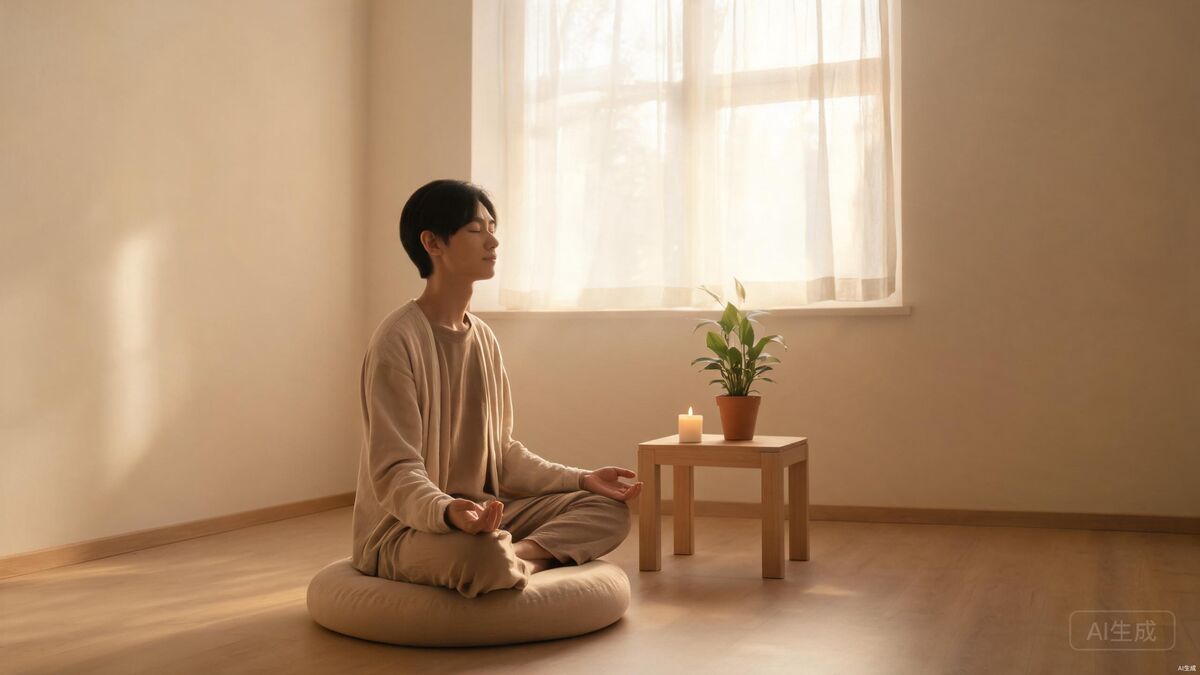
Your posture matters more than you might think. In TCM, the body's posture directly affects the flow of Qi. A slumped posture compresses the chest and blocks the breath; an overly rigid posture creates tension that blocks energy flow. The ideal posture is upright but relaxed — what the Chinese call "like a mountain."
- Sit on your cushion or chair with your hips slightly higher than your knees.
- Lengthen the spine as if a string is gently pulling the crown of your head upward.
- Relax the shoulders down and back. Let the chest be open but not pushed forward.
- Rest the hands in your lap, palms up, one hand resting in the other, thumbs lightly touching. This is called the "cosmic mudra" and helps circulate energy.
- Tuck the chin slightly to lengthen the back of the neck.
- Let the tongue rest lightly on the roof of your mouth, just behind the upper front teeth. This connects the body's two main energy pathways (the Ren and Du meridians).
- Close the eyes gently, or lower the gaze to a 45-degree angle in front of you.
3. The Four TCM Meditation Techniques
These four techniques form a complete system. You do not need to master all four at once — start with the first (Dantian focus) and add others as you feel ready. Each technique addresses a different aspect of the mind-body system.
Technique 1: Dantian Focus (意守丹田)
This is the foundational technique of all TCM meditation and qigong. The Lower Dantian is located about two to three finger-widths below the navel and one to two inches deep inside the abdomen. In TCM theory, it is the body's primary energy center — the place where the three treasures of essence (Jing), energy (Qi), and spirit (Shen) are stored and refined.
How to practice:
- Settle into your posture and take three slow, deep breaths to release surface tension.
- Place your attention gently on the area below your navel, inside your lower abdomen. Do not press or concentrate hard — simply rest your awareness there, as if you are watching a candle flame from across the room.
- Feel the slight rise and fall of your lower abdomen as you breathe naturally. Let the breath be slow, deep, and quiet — breathing into the belly, not the chest.
- When your mind wanders (and it will), simply notice and bring your attention back to the Dantian. Do not judge yourself. The act of returning is the practice.
- Continue for 10 to 15 minutes. Over time, you may feel a warm, heavy, or pleasantly full sensation in the lower abdomen — this is Qi gathering, a sign the practice is working.
Benefits: Gathers scattered energy back to its source, grounds the mind, builds the body's Qi reserves, and directly counters the "fire above, cold below" pattern that causes insomnia.
Technique 2: Breath Visualization (呼吸观想)
This technique uses the breath as a vehicle to move Qi through the body. It is particularly effective for anxiety, restlessness, and any condition where energy is stuck in the head or chest.
How to practice:
- Begin with Dantian focus for a minute or two to settle in.
- As you inhale slowly through the nose, visualize a stream of clean, bright, cool energy entering through your nose and flowing downward along the front of your body to the Dantian. Picture it as a gentle waterfall of light.
- As you exhale slowly through the nose, visualize warm, dark, used energy rising from the Dantian and flowing upward along the spine, over the top of the head, and out through the nose, carrying tension, heat, and worry with it.
- Continue this cycle: cool clean energy down the front on the inhale, warm used energy up the back on the exhale. This is a simplified version of the "microcosmic orbit," the classic Taoist energy circulation.
- Practice for 10 to 15 minutes. The rhythm should be slow and smooth — aim for an exhale that is longer than the inhale, which activates the parasympathetic nervous system.
Benefits: Moves stagnant Qi out of the head and chest, cools Heart Fire, regulates the nervous system, and teaches you to direct energy with your mind.
Technique 3: Five-Tone Meditation (五音冥想)
In TCM, the five sounds of the Chinese tonal system correspond to the five Yin organs — Liver, Heart, Spleen, Lungs, and Kidneys. Each sound vibrates at a frequency that resonates with and balances its corresponding organ. This technique uses silent mental repetition of the tones to harmonize the organ system.
| Sound | Organ | Emotion It Releases |
|---|---|---|
| Shhhh (嘘, Xu) | Liver | Anger, frustration, resentment |
| Haaaa (呵, He) | Heart | Overexcitement, agitation, anxiety |
| Hoooo (呼, Hu) | Spleen | Worry, overthinking, brooding |
| Sssss (呬, Si) | Lungs | Sadness, grief, letting go |
| Chooo (吹, Chui) | Kidneys | Fear, insecurity, willpower depletion |
How to practice:
- Sit comfortably and breathe naturally. You will work through all five sounds in sequence, or you can focus on the one that matches your current emotional state.
- For each sound, inhale deeply through the nose, then exhale slowly through the mouth while making the sound — either aloud (softly, like a whisper) or silently in your mind.
- As you exhale the sound, visualize the corresponding organ releasing its trapped emotion as a dark cloud, leaving the body. As you inhale, visualize clean bright energy filling the organ.
- Repeat each sound 3 to 6 times. The whole cycle takes 10 to 15 minutes.
Benefits: Releases specific trapped emotions from the organs, harmonizes the five-element system, and provides a structured way to process emotional states that simply sitting with thoughts cannot address.
Technique 4: Body Scanning (身体扫描)
This technique moves your awareness systematically through the body, releasing tension and gathering Qi. It is the most physically grounding of the four and is excellent for people who feel "ungrounded," scattered, or disconnected from their bodies.
How to practice:
- Begin in your seated posture (or lying down if you prefer). Take three deep breaths.
- Bring your attention to the top of your head. Notice any tension there. As you exhale, let it release.
- Slowly move your attention downward: forehead, eyes, jaw, neck, shoulders, arms, hands, chest, abdomen, lower back, hips, legs, feet. Pause at each area for one or two breaths, noticing tension and releasing it on the exhale.
- When you reach the feet, let your attention rest at the soles of the feet (the Bubbling Spring point, the starting point of the Kidney meridian) for several breaths. Feel a connection to the earth beneath you.
- Finally, let your attention rest at the Dantian for a few breaths to gather the energy before you finish.
- Practice for 10 to 20 minutes. This technique can also be done lying in bed as a sleep aid.
Benefits: Releases deep physical tension, grounds scattered energy, draws awareness out of the head and into the body, and is an excellent natural sleep aid when practiced in bed.
4. TCM Meditation vs. Western Mindfulness
If you have practiced Western mindfulness apps like Headspace or Calm, you will notice both similarities and differences with TCM meditation. Understanding these differences helps you get the most from each tradition.
| Aspect | Western Mindfulness | TCM Meditation |
|---|---|---|
| Primary goal | Observe thoughts non-judgmentally; stay present | Settle the Shen; regulate Qi and Blood; balance Yin and Yang |
| Focal point | Often the breath, or open awareness | The Dantian (lower abdomen) and specific energy pathways |
| Relationship to thoughts | Notice thoughts, let them pass, return to breath | Draw energy away from the head and down to the Dantian |
| Body involvement | Body is observed but not actively directed | Energy is actively guided through visualization and breath |
| Medical framework | Neuroscience; stress reduction; mental health | Five elements; organ-emotion correspondences; meridians |
| Best for | General stress, emotional regulation, present-moment awareness | Insomnia, anxiety with racing thoughts, energy imbalances, grounding |
Neither tradition is better than the other — they are complementary tools. Many practitioners use Western mindfulness during the day for general stress management and TCM meditation in the evening for its specific sleep and energy-balancing benefits.
5. When to Practice: The Best Times
- Early morning (5:00–7:00 AM): In the TCM body clock, this is the time of the Large Intestine meridian, when the body is naturally eliminating and the day's Yang energy is rising. A morning meditation sets a calm, grounded tone for the entire day and takes advantage of the body's natural upward energy.
- Before bed (30–60 minutes before sleep): This is the most valuable time for most modern people. The day's Yang energy is descending into Yin (night), and a meditation practice supports this natural transition. The Dantian focus and breath visualization specifically draw heat and energy away from the head — the root cause of most sleep-onset insomnia.
If you can only practice once a day, choose the evening session. The sleep benefits are the most immediately noticeable, and good sleep amplifies every other aspect of your health. Avoid practicing immediately after a heavy meal (wait at least an hour) or when you are very hungry.
6. A Progressive Practice Plan
The most common mistake beginners make is trying to meditate for too long, too soon, and then giving up. Here is a realistic, progressive plan that builds the habit sustainably.
| Week | Duration | Technique | Goal |
|---|---|---|---|
| Week 1 | 10 min, once daily (evening) | Dantian focus only | Build the habit. Just sit and breathe into the belly. Do not worry about "doing it right." |
| Week 2 | 12 min, once daily (evening) | Dantian focus | Notice the warm, settled feeling in the lower abdomen. Begin to catch the mind wandering sooner. |
| Week 3 | 15 min, once daily (evening) | Dantian focus + breath visualization | Add the downward-upward breath cycle. Start to feel energy moving. |
| Week 4 | 15 min, twice daily (morning + evening) | Add morning session with Dantian focus | Establish the twice-daily rhythm. Morning session sets the day; evening session prepares for sleep. |
| Week 5+ | 15–20 min, twice daily | Rotate all four techniques as needed | Use the technique that matches your state: Dantian for general grounding, breath visualization for anxiety, five-tone for emotional processing, body scan for sleep. |
The key insight is this: consistency beats duration. Ten minutes every day for a month will transform your sleep and mental state far more than an hour-long session once a week. The Shen settles through repetition, not through heroic effort.
7. What to Expect
In the first week, you may feel frustrated that your mind wanders constantly. This is completely normal — the untrained mind wanders dozens of times per minute. The practice is not to stop the wandering but to notice it and return, gently, again and again. Each return strengthens the Shen's ability to settle.
By the second or third week, most people notice their sleep improving. They fall asleep faster, wake less during the night, and feel more rested in the morning. The racing-thoughts-at-bedtime pattern begins to ease as the energy learns to gather in the Dantian rather than staying stuck in the head.
By the fourth week, many people report a subtle but real shift in their baseline state — a greater sense of calm during the day, less reactivity to stress, and a feeling of "groundedness" that was not there before. This is the Shen becoming more settled and stable, not just during meditation but throughout daily life.
Frequently Asked Questions
How is TCM meditation different from Western mindfulness meditation?
The main difference is the goal and the mechanism. Western mindfulness emphasizes observing thoughts non-judgmentally, staying present in the moment, and developing awareness of the breath and body as a witness. TCM meditation focuses on settling the Shen (the spirit that resides in the Heart), regulating the flow of Qi and Blood through the body's meridian system, and balancing Yin and Yang. Rather than simply observing, TCM meditation actively directs attention to specific internal locations — most importantly the Dantian, the body's energy center below the navel — and uses the breath to guide energy downward and inward. While both reduce stress, TCM meditation is specifically designed to nourish and rebalance the body's internal energy system, making it particularly effective for insomnia and the pattern of "fire above, cold below" that plagues modern, overstimulated people.
What is the best time of day to practice TCM meditation?
The two best times are early morning and just before bed. Morning meditation, ideally between 5:00 and 7:00 AM (the Large Intestine time in the TCM body clock), takes advantage of the body's rising Yang energy and sets a calm, grounded tone for the entire day. Evening meditation, practiced 30 to 60 minutes before sleep, helps settle the Shen and draw energy downward — directly addressing the most common TCM insomnia pattern of fire stuck in the head while the feet are cold. If you can only practice once a day, choose the evening, as the sleep benefits are the most immediately noticeable for most people. Avoid meditating right after a heavy meal or when extremely hungry, as both states distract the mind.
Where is the Dantian and why focus on it?
The Lower Dantian is located about two to three finger-widths below the navel and about one to two inches deep inside the abdomen. In TCM and qigong theory, it is the body's primary energy center — the place where prenatal essence (Jing), acquired nutrition from food, and energy from the breath all combine to form Qi. Focusing your attention on the Dantian during meditation gathers scattered energy back to its source, grounds the mind in the body, and builds the body's energy reserves over time. It is the single most important focal point in all of TCM meditation. When energy concentrates in the Dantian, the head cools, the heart calms, and the Shen settles — which is exactly why Dantian focus is the first and most fundamental technique for insomnia and anxiety.
Can TCM meditation help with insomnia?
Yes — TCM meditation is one of the most effective natural remedies for insomnia, especially the type where the mind races and refuses to quiet down at night. In TCM, this pattern is called Heart Fire or unsettled Shen — the spirit cannot settle into its home in the Heart, so it wanders, producing the experience of lying awake with a busy mind. The Dantian focus and breath visualization techniques directly address this by drawing energy and heat downward, away from the head, cooling the Heart, and anchoring the Shen. Practiced nightly for 10 to 15 minutes before bed, most people notice improved sleep within one to two weeks. The body-scan technique is also excellent when practiced lying in bed itself — many people fall asleep before they finish the scan.
This article is for educational purposes only and does not constitute medical advice. TCM meditation is a complementary self-care practice and is not intended to diagnose, treat, cure, or prevent any disease. Meditation is not a substitute for professional mental health treatment. If you experience severe anxiety, depression, insomnia, or any mental health condition, consult a qualified healthcare provider or mental health professional. If you have a history of trauma or psychiatric conditions, seek guidance from a qualified teacher before beginning meditation. Read our full disclaimer →