Key Takeaways
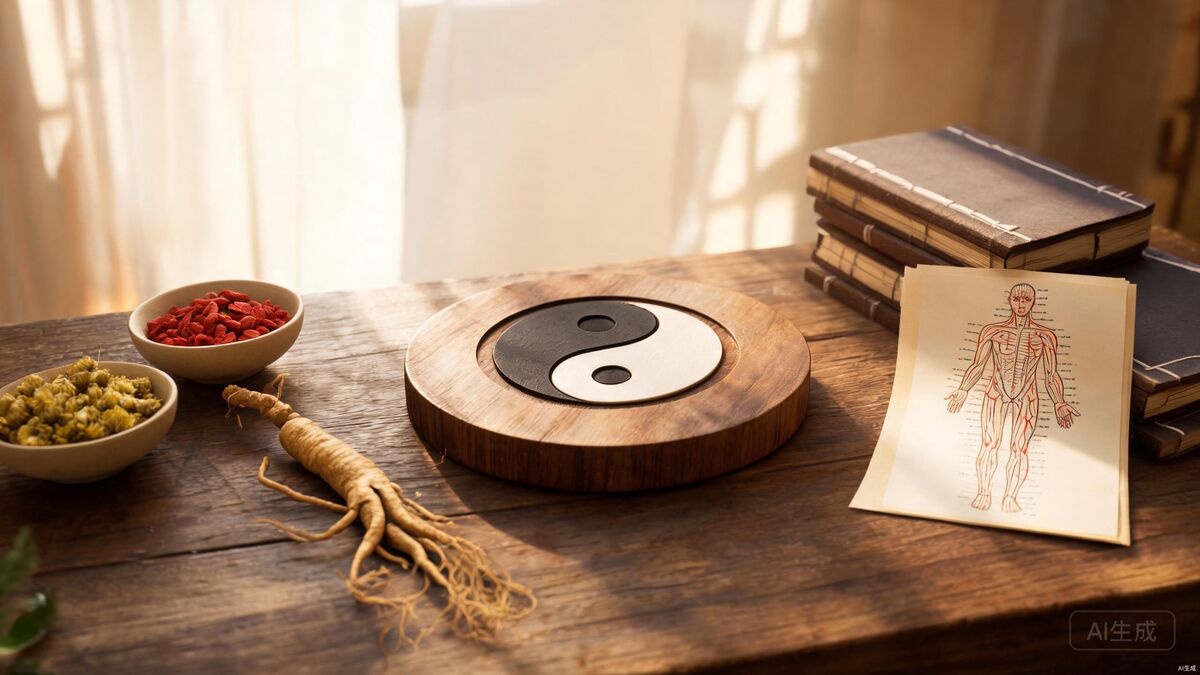
- TCM (Traditional Chinese Medicine) is a complete medical system with over 5000 years of history that views the body as an interconnected whole, where health is the balance of opposing forces and disease is imbalance.
- Its core theories are yin-yang, the five elements, qi-blood-body fluids, the meridian system, and the zang-fu organs — together they explain how the body works and why it falls ill.
- TCM diagnoses through the Four Examinations — observation, listening/smelling, inquiry, and palpation — looking for patterns of disharmony rather than isolated diseases.
- Treatment branches include acupuncture, herbal medicine, tuina massage, cupping, moxibustion, qigong, and food therapy, most of which can be adapted for home self-care.
- TCM and Western medicine are complementary — TCM excels in prevention, chronic imbalances, and lifestyle wellness, while Western medicine excels in acute care and precise diagnosis.
1. What Is Traditional Chinese Medicine?
Traditional Chinese Medicine — commonly abbreviated as TCM — is a comprehensive system of medicine that originated in China and has been continuously practiced, refined, and documented for over 5000 years. Unlike a collection of folk remedies, TCM is a sophisticated medical philosophy with its own coherent logic, language, diagnostic methods, and treatment strategies. It views the human body not as a machine made of separate parts, but as an interconnected whole — a living system in which body, mind, emotions, and environment constantly influence one another.
At the heart of TCM is a simple but powerful idea: health is balance, and disease is imbalance. When the body's internal forces are in harmony — with each other and with the external environment — you experience vitality, resilience, and wellbeing. When that harmony is disrupted, by poor diet, emotional stress, overwork, climate, or lifestyle, patterns of disharmony arise and manifest as symptoms. The task of TCM is to identify the pattern, understand its root, and restore balance using natural methods that work with the body's own healing intelligence.
What makes TCM distinctive is its emphasis on patterns rather than diseases. Where Western medicine might diagnose "insomnia" or "irritable bowel syndrome," TCM asks deeper questions: Is the insomnia from Heart blood deficiency, Liver fire, or Kidney yin deficiency? Is the digestive trouble from Spleen qi deficiency, damp-heat, or Liver overacting on the Stomach? Two people with the same Western diagnosis may have entirely different TCM patterns — and therefore entirely different treatments. This personalized, pattern-based approach is one of TCM's greatest strengths.
A Brief History of TCM
TCM's roots stretch back to at least 2500 BCE, with archaeological evidence of early medical practices including stone needles (precursors to acupuncture) and herbal remedies. The first major medical text, the Huangdi Neijing (Yellow Emperor's Inner Canon), compiled around 200 BCE, laid the theoretical foundation — yin-yang, the five elements, meridians, and the zang-fu organs — that still guides TCM today. Over the following centuries, master physicians expanded the system: Zhang Zhongjing codified herbal formula prescriptions in the 2nd century; Sun Simiao, the "King of Medicine," wrote extensively on medical ethics and practice in the 7th century; and Li Shizhen compiled the Bencao Gangmu (Compendium of Materia Medica) in the 16th century, documenting over 1800 medicinal substances.
In the 20th century, TCM was systematized and standardized in China, and it spread worldwide as both a complement and alternative to Western medicine. Today, the World Health Organization recognizes TCM, and acupuncture is practiced in hospitals and clinics across the globe. The enduring relevance of a 5000-year-old system speaks to the depth of its insights into human health.
2. The Core Theories of TCM
Everything in TCM — diagnosis, treatment, and self-care — rests on five interconnected theories. Understanding these gives you the framework to make sense of every remedy and practice on this site.
Yin and Yang (阴阳)
Yin and yang is the most fundamental concept in all of Chinese thought. It describes how every phenomenon in the universe — including every function in the human body — exists as a dynamic balance of two opposing yet complementary forces. Yin is the cooling, moistening, resting, inward, and material aspect. Yang is the warming, drying, active, outward, and functional aspect. Night is yin, day is yang. Rest is yin, activity is yang. Body fluids and blood are yin, qi and metabolic fire are yang.
Health is the dynamic balance of yin and yang. When yin is deficient, yang goes relatively unchecked — you feel hot, restless, and dry (a "false heat"). When yang is deficient, yin dominates — you feel cold, sluggish, and watery. When either is excessive, it overwhelms the other. Every symptom in TCM can be understood as a message about the yin-yang balance, and every treatment aims to restore it. This concept is explored in depth in our dedicated yin-yang guide.
The Five Elements (五行)
The Five Elements theory (also called the Five Phases) describes the dynamic relationships between the major organ systems and their corresponding emotions, seasons, flavors, colors, and tissues. The five elements are Wood, Fire, Earth, Metal, and Water. Each element corresponds to a pair of organs and governs specific functions.
| Element | Organs | Emotion | Season | Flavor |
|---|---|---|---|---|
| Wood | Liver, Gallbladder | Anger | Spring | Sour |
| Fire | Heart, Small Intestine | Joy | Summer | Bitter |
| Earth | Spleen, Stomach | Worry | Late Summer | Sweet |
| Metal | Lungs, Large Intestine | Grief | Autumn | Pungent |
| Water | Kidneys, Bladder | Fear | Winter | Salty |
The elements interact through two cycles. In the generating (sheng) cycle, each element nourishes the next: Wood feeds Fire, Fire creates Earth (ash), Earth bears Metal, Metal collects Water (condensation), and Water nourishes Wood. In the controlling (ke) cycle, each element restrains another: Wood parts Earth, Earth dams Water, Water extinguishes Fire, Fire melts Metal, Metal chops Wood. These cycles explain why, for example, chronic anger (Wood) can weaken digestion (Earth overacting), or why prolonged grief (Metal) can deplete the Kidneys (Water, the child of Metal). This relational thinking is what makes TCM truly holistic.
Qi, Blood, and Body Fluids (气血津液)
These are the three fundamental vital substances that sustain life. Qi (气) is the vital energy that powers every function — movement, digestion, breathing, thinking, immunity. It is produced by the Spleen and Stomach from food, distributed by the Lungs, and stored and regulated by the Kidneys. Blood (血) in TCM is broader than the Western concept — it is the nourishing, moistening substance that flows through the vessels, and it also has a calming, grounding effect on the mind. Body fluids (津液) include all the fluids of the body — sweat, saliva, tears, digestive juices, and synovial fluid.
Each substance can be deficient (too little), stagnant (not flowing), or rebellious (flowing the wrong way). Qi deficiency causes fatigue and weakness; qi stagnation causes pain, bloating, and emotional frustration; rebellious qi causes coughing, nausea, and hiccups. Blood deficiency causes dizziness, dry skin, and poor sleep; blood stasis causes sharp, fixed pain and dark clots. Understanding these patterns is the key to choosing the right foods and therapies.
Meridians (经络)
Meridians, or channels, are the pathways through which qi and blood flow throughout the body. TCM identifies 12 principal meridians, each connected to a specific organ, plus additional extraordinary vessels. Along these meridians lie the acupoints — specific points where qi can be accessed and influenced. This is the basis of acupuncture and acupressure: by stimulating points along a meridian, you can regulate the flow of qi in the corresponding organ and throughout the body. Meridians connect the surface of the body to the internal organs, which is why pressing a point on your hand can relieve a headache, or a point on your leg can calm your stomach.
Zang-Fu Organs (脏腑)
In TCM, organs are not just anatomical structures — they are functional systems with physical, emotional, and energetic dimensions. The five Zang (Yin) organs — Heart, Liver, Spleen, Lungs, and Kidneys — store vital substances and are considered the deeper, more important organs. The six Fu (Yang) organs — Gallbladder, Small Intestine, Stomach, Large Intestine, Bladder, and San Jiao (Triple Burner) — transform and transport, and are more involved in digestion and elimination.
| Zang (Yin) Organ | Paired Fu (Yang) Organ | Key TCM Function |
|---|---|---|
| Heart | Small Intestine | Governs blood and blood vessels; houses the mind (Shen) |
| Liver | Gallbladder | Ensures smooth flow of qi; stores blood |
| Spleen | Stomach | Transforms food into qi and blood; governs muscles |
| Lungs | Large Intestine | Governs qi and respiration; regulates water passages |
| Kidneys | Bladder | Store essence (Jing); root of yin and yang; govern water |
Each organ also has an associated emotion, sense, tissue, and season — which is why, in TCM, prolonged worry weakens the Spleen, chronic anger harms the Liver, and deep fear depletes the Kidneys. This is also why emotional and physical health are inseparable in the TCM worldview.
3. How TCM Diagnoses: The Four Examinations
TCM diagnosis relies on the Four Examinations (四诊) — a systematic method of gathering information about the body's state. Rather than relying on lab tests, the TCM practitioner uses their senses to build a complete picture of the patient's pattern of disharmony.
| Examination | What It Involves | Key Signs |
|---|---|---|
| Observation (望) | Looking at the overall appearance, complexion, spirit, tongue, and posture | Tongue color and coating, facial color, body build, demeanor |
| Listening/Smelling (闻) | Listening to the voice, breathing, and cough; noting body and breath odors | Weak or strong voice, wheezing, foul or sweet breath |
| Inquiry (问) | Asking detailed questions about symptoms, history, lifestyle, emotions, sleep, digestion, and preferences | Cold/heat preference, sleep quality, appetite, pain characteristics, emotional state |
| Palpation (切) | Feeling the pulse and palpating the abdomen and meridians | Pulse depth, rate, strength, and quality; abdominal tenderness |
The information gathered is then organized into patterns of disharmony using the Eight Principles (ba gang) — a diagnostic framework that classifies every condition along four axes: interior/exterior, cold/heat, deficiency/excess, and yin/yang. For example, a cold with chills and a clear runny nose is an exterior cold pattern, while chronic fatigue with a pale tongue and cold limbs is an interior deficiency cold pattern. This pattern-based approach is what allows TCM to personalize treatment — two people with the same symptom may receive very different therapies because their underlying patterns differ.
4. The Branches of TCM Treatment
TCM offers a rich toolkit of treatment methods, each with its own strengths. Most can be used individually or in combination, and many are practical for home use with proper guidance.
| Treatment Branch | What It Is | Best For |
|---|---|---|
| Acupuncture (针灸) | Insertion of thin needles at specific acupoints to regulate qi flow | Pain, stress, digestive issues, women's health, neurological conditions |
| Herbal Medicine (中药) | Formulas of medicinal herbs, minerals, and animal substances tailored to the individual's pattern | Internal imbalances, chronic conditions, immune support, deficiency patterns |
| Tuina Massage (推拿) | Therapeutic bodywork along meridians and acupoints | Musculoskeletal pain, digestive issues, stress, children's conditions |
| Cupping (拔罐) | Suction cups applied to the skin to draw blood to the surface, release tension, and move stagnant qi and blood | Muscle tension, respiratory congestion, blood stasis, detoxification |
| Moxibustion (艾灸) | Warming acupoints with burning moxa (mugwort) to tonify qi, warm cold, and strengthen yang | Cold patterns, yang deficiency, menstrual cramps, immune weakness, breech pregnancy |
| Qigong (气功) | Gentle movement, breathing, and meditation exercises that cultivate and circulate qi | Stress management, daily wellness, chronic fatigue, mental clarity |
| Food Therapy (食疗) | Using the energetic properties of foods to prevent and treat imbalance — the most accessible branch | Daily wellness, mild imbalances, recovery, prevention, constitution management |
Among these, food therapy is the most practical for daily home use. Because food is eaten every day, its cumulative effect is powerful, and it carries the least risk. The TCM Home focuses heavily on making food therapy, herbal teas, acupressure, and qigong accessible to everyone — these are the branches you can practice safely on your own.
5. TCM vs. Western Medicine: Complementary Systems
TCM and Western medicine are often portrayed as opposites, but they are better understood as complementary systems with different strengths. Understanding the difference helps you use each wisely.
| Aspect | Western Medicine | Traditional Chinese Medicine |
|---|---|---|
| View of the body | A machine of separate systems and organs | An interconnected whole of energy, substances, and functions |
| Focus | Disease, pathogen, or structural abnormality | Pattern of disharmony and overall balance |
| Diagnosis | Lab tests, imaging, biopsies — precise and objective | Four Examinations — observational and holistic, pattern-based |
| Treatment | Pharmaceuticals, surgery, targeted therapies | Acupuncture, herbs, diet, massage, lifestyle — multi-modal |
| Strength | Acute illness, trauma, infections, surgical needs, precise diagnosis | Prevention, chronic conditions, lifestyle wellness, sub-health states |
| Approach to symptoms | Suppress or eliminate the symptom | Read the symptom as a message and address the root pattern |
The two systems shine in different situations. If you have a bacterial infection, a broken bone, or a heart attack, Western medicine is unmatched. But if you have chronic fatigue that blood tests say is "normal," recurring tension headaches, or digestive troubles with no clear cause, TCM's pattern-based approach can often identify and address imbalances that Western medicine may not yet classify as disease. Many people use both — Western medicine for acute and structural issues, and TCM for prevention, chronic imbalances, and daily wellness. The best healthcare is integrative, drawing on the strengths of each system.
6. How to Start Bringing TCM Into Your Daily Life
You do not need to see a practitioner or buy expensive herbs to begin benefiting from TCM. Its most powerful principles are practical, low-cost, and immediately applicable. Here is how to start.
- Eat warm, cooked meals at regular times. This is the single most impactful TCM habit. The Spleen thrives on warmth and rhythm. Replace cold smoothies and raw salads with soups, stews, congees, and stir-fries, and eat at consistent times. See our qi-boosting foods guide for recipes.
- Drink therapeutic teas. Replace coffee or sugary drinks with simple herbal teas suited to your needs — ginger tea for warmth and digestion, chrysanthemum tea for heat and eye strain, rose tea for stress. Browse our herbal tea guides to find yours.
- Learn basic acupressure. A few key points can relieve headaches, tension, insomnia, and digestive discomfort. Try our acupressure for insomnia or acupressure for headaches guides.
- Practice gentle movement. Qigong and the Eight Brocades are simple sequences of movement and breath that cultivate qi and reduce stress. Start with our Eight Brocades guide.
- Observe your body. Begin reading your tongue each morning, notice your temperature preferences, and track your energy patterns. Self-awareness is the foundation of all TCM self-care. Start with our tongue diagnosis guide and our nine body types guide.
The beauty of TCM is that it is a way of living, not just a way of treating illness. When you eat warm meals, go to bed before midnight, manage your stress with breath and movement, and choose foods that suit your constitution, you are practicing TCM. These small daily choices, sustained over time, are what build real, resilient health — the kind that prevents illness rather than just reacting to it. Start with one or two habits, and let your understanding grow naturally.
Frequently Asked Questions
What does TCM stand for and what is it?
TCM stands for Traditional Chinese Medicine, a complete medical system with over 5000 years of history. It views the body as an interconnected whole governed by the balance of yin and yang, the flow of qi (vital energy), and the harmony of the five elements. TCM diagnoses imbalances through four examinations — observation, listening, inquiry, and palpation — and treats them with acupuncture, herbal medicine, tuina massage, cupping, moxibustion, qigong, and food therapy. Its goal is to restore balance and support the body's natural healing ability rather than simply suppressing symptoms. Unlike Western medicine, which often targets a specific disease or pathogen, TCM treats the whole person and the underlying pattern of disharmony.
How is TCM different from Western medicine?
Western medicine focuses on identifying and targeting specific diseases, pathogens, and structural abnormalities, using precise diagnostics, pharmaceuticals, and surgery. TCM focuses on restoring overall balance and patterns of disharmony, treating the whole person rather than an isolated symptom. Western medicine is reductive and precise — excellent for acute illness, trauma, infections, and conditions requiring surgery or targeted drugs. TCM is holistic and pattern-based — especially strong in chronic conditions, prevention, sub-health states, and lifestyle-based wellness. The two are complementary: many people use TCM for daily wellness, chronic imbalances, and recovery while relying on Western medicine for acute care, precise diagnosis, and emergencies. The best approach is integrative, using each system where it shines.
What are the main branches of TCM treatment?
The main branches of TCM treatment are acupuncture (inserting thin needles at meridian points to regulate qi), Chinese herbal medicine (formulas of medicinal substances tailored to the individual's pattern), tuina massage (therapeutic bodywork along meridians and points), cupping (suction cups to release tension and move stagnant blood), moxibustion (warming points with burning mugwort to tonify qi and warm cold), qigong (gentle movement and breathing exercises that cultivate qi), and food therapy (using the energetic properties of foods as medicine). These can be used individually or in combination. Food therapy, herbal teas, acupressure, and qigong are the most accessible for home self-care, while acupuncture, strong herbal formulas, and cupping are best done with professional guidance.
Can I practice TCM at home by myself?
Yes, many aspects of TCM are safe and practical for home use. Food therapy, herbal teas, acupressure (finger pressure on points), qigong exercises, and self-observation methods like tongue diagnosis are all suitable for daily self-care. Start with simple, low-risk practices: drink ginger tea for cold symptoms, practice acupressure for tension relief, eat warm cooked meals to support digestion, and observe your tongue each morning. However, acupuncture, strong herbal formulas, and cupping on sensitive areas are best done with professional guidance. If you have a medical condition, are pregnant, or take medication, consult a licensed TCM practitioner or your doctor before beginning any new practice. The TCM Home is designed to make the safe, home-applicable branches of TCM accessible to everyone.
This article is for educational and informational purposes only and is not a substitute for professional medical advice, diagnosis, or treatment. The information about Traditional Chinese Medicine presented here is intended to help you understand the system and make informed wellness choices — it is not intended to diagnose, treat, cure, or prevent any disease. TCM therapies, including herbal formulas and acupuncture, should be performed under the guidance of a qualified practitioner, especially if you have a medical condition, are pregnant, or take prescription medication. Always consult your healthcare provider before making significant changes to your diet, lifestyle, or treatment approach. Read our full disclaimer →