Key Takeaways
- The tongue is a mirror of internal health in TCM — its body color reflects the state of qi and blood, its coating reveals the condition of the Stomach and digestion, and its shape shows organ strength and fluid balance.
- For accurate reading, examine your tongue in the morning before eating or brushing, in natural daylight, and always under the same conditions for consistent comparison.
- Five key tongue body colors — pale, red, deep red, purple, and normal pink — each point to a different internal pattern, from deficiency to heat to blood stasis.
- The coating reveals digestion and pathogenic factors: white thin (normal or cold), white thick (dampness), yellow (heat), gray-black (extreme cold or heat), and no coating (yin deficiency).
- Tongue diagnosis is a self-care awareness tool, not a substitute for professional diagnosis — use it to notice trends and guide daily wellness, not to self-diagnose disease.
1. Why the Tongue Matters in TCM
In Traditional Chinese Medicine, the tongue is considered one of the most reliable windows into the body's internal state. The logic is simple: the tongue is richly supplied with blood vessels, it is connected to the internal organ meridians, and it is the only internal organ you can see simply by opening your mouth. Its color, coating, shape, and moisture change in response to the condition of your qi, blood, and organs — sometimes before you feel any symptoms.
For over a thousand years, TCM practitioners have used tongue diagnosis (舌诊, she zhen) as a core part of the Four Examinations — observation, listening/smelling, inquiry, and palpation. Among these, the tongue and the pulse are the two most important objective signs. While pulse diagnosis takes years to master, tongue diagnosis is remarkably accessible. With a mirror, good light, and a basic understanding of what to look for, you can begin reading your own tongue at home.
This guide will teach you what a healthy tongue looks like, how to examine yours properly, what the five main tongue body colors mean, how to interpret the coating and shape, and how to translate your findings into practical wellness choices. Think of it as learning a new language — the language your body speaks through your tongue.
2. How to Examine Your Tongue: The Basics
Accurate tongue reading depends on consistent conditions. Many factors — food, beverages, brushing, lighting, and time of day — can alter what you see. Follow these guidelines to get the most reliable observations.
The Best Time and Conditions
- Observe in the morning, right after waking and before brushing your teeth, eating, drinking, or rinsing. Overnight, the tongue settles into its most natural state, undisturbed by food and drink.
- Use natural daylight whenever possible. Stand near a window. Indoor lighting — especially warm yellow or cool blue bulbs — distorts color significantly. If you must use artificial light, use a daylight-balanced bulb.
- Avoid colored foods and drinks before examining. Coffee, tea, curries, colored candies, and deeply pigmented fruits (like blueberries) can stain the coating. Smoking also alters tongue color.
- Be consistent. Examine at the same time and under the same light each day. This makes it possible to track changes over time, which is far more meaningful than any single observation.
What to Observe: Four Elements
A complete tongue reading examines four elements in order. Train yourself to look at each one separately before forming an overall impression.
| Element | What It Reveals | What to Look For |
|---|---|---|
| Tongue Body Color | The state of qi, blood, and organ vitality | Pale, pink, red, deep red, or purple |
| Tongue Coating (苔) | The condition of the Stomach, digestion, and presence of pathogenic factors | Color (white, yellow, gray, black), thickness, and distribution |
| Tongue Shape | Organ strength and fluid metabolism | Thin or swollen, teeth marks (scalloped edges), cracks, or prickles |
| Tongue Moisture & Spirit | Fluid balance and overall vitality | Dry, normal, or overly wet; how lively the tongue appears |
A healthy tongue is pale pink (淡红) in color, with a thin, white, evenly distributed coating. It is of normal size — not swollen, not shrunken — with no teeth marks on the edges and no deep cracks. It is slightly moist, neither dry nor dripping. This is the tongue of balanced qi and blood, strong digestion, and harmonious organ function. Most people, however, show at least mild deviations — and that is exactly what makes tongue diagnosis useful for early self-awareness.
3. Tongue Body Color: Five Key Patterns
The body color is the single most important feature of tongue diagnosis. It reflects the state of qi and blood and the presence of heat or cold. Here are the five colors you are most likely to see, what each means, and what it suggests for your wellness.
| Tongue Color | TCM Pattern | What It Means | Wellness Focus |
|---|---|---|---|
| Pale (淡白) | Qi/Blood deficiency or Yang deficiency | The body lacks the energy and nourishment to color the tongue. Often accompanied by fatigue, cold limbs, dizziness, and a pale complexion. | Tonify qi and blood with warm, nourishing foods |
| Red (红) | Heat pattern | Heat in the body makes the tongue red. May indicate excess heat (from infection, inflammation, or rich diet) or deficiency heat from yin depletion. | Clear heat; eat cooling, hydrating foods |
| Deep Red (绛) | Heat entering the nutritive/blood level | A more intense heat than simple red. Seen in severe fevers, deep inflammation, or advanced yin deficiency with runaway internal heat. | Clear heat and protect yin; seek professional care |
| Purple (紫) | Blood stasis (瘀) | Blood is not flowing smoothly — it has stagnated. May appear as overall purple or as dark purple spots. Often linked to pain, menstrual clots, or chronic conditions. | Invigorate blood circulation; move qi |
| Normal Pink (淡红) | Healthy / balanced | The ideal color. Indicates abundant qi and blood, harmonious organs, and balanced temperature. | Maintain current lifestyle and diet |
Pale tongue: If your tongue is paler than normal — closer to white or a washed-out pink — your body is signaling deficiency. When qi and blood are insufficient, the tongue simply does not have enough nourishment to show its healthy color. If you also feel tired, get cold easily, bruise easily, or feel dizzy when standing, the focus should be on building qi and blood. Favor warm, sweet, nourishing foods like qi-boosting foods (Chinese yam, chicken, rice), blood-nourishing foods (red dates, goji berries, beef), and avoid cold, raw foods that weaken the Spleen.
Red tongue: A red tongue body points to heat. If the redness is concentrated at the tip, it may indicate Heart heat (often linked to stress, insomnia, or anxiety). Redness on the sides suggests Liver heat. A uniformly red tongue with a yellow coating suggests excess heat — perhaps from a rich, spicy diet, a lingering infection, or emotional frustration. The wellness focus shifts to cooling: chrysanthemum tea, mung beans, celery, cucumber, and reducing spicy, fried, and alcohol-heavy foods.
Deep red tongue: This is a more serious sign than simple redness. It indicates that heat has penetrated deeply into the body's nutritive and blood levels. This is seen in high fevers, severe infections, or long-standing yin deficiency that has allowed empty heat to escalate. If you see a deep red tongue accompanied by fever, agitation, or bleeding tendencies, seek professional medical care rather than relying on self-care alone.
Purple tongue: A purple tongue or purple spots indicate blood stasis — blood that has thickened or slowed and is no longer flowing freely. Blood stasis often manifests as fixed, stabbing pain, dark menstrual clots, easy bruising, or a feeling of fullness in the chest. The wellness focus is on invigorating blood circulation: rose tea, turmeric, ginger, regular movement, and emotional expression to keep qi flowing. See our blood-nourishing foods guide for complementary support.
4. The Tongue Coating: Color and Thickness
While the body color reflects the deeper state of qi and blood, the coating (舌苔) reveals the condition of the Stomach and the presence of pathogenic factors like cold, heat, dampness, and phlegm. A healthy coating is thin, white, and evenly distributed — it shows that the Stomach is producing just the right amount of fluid and that digestion is functioning well. When the coating changes, it tells you what is happening in your digestive system and what pathogens may be present.
| Coating Type | TCM Meaning | Common Accompanying Signs |
|---|---|---|
| White, thin (白薄) | Normal, or early-stage cold pattern | Healthy digestion, or slight chill and clear nasal discharge |
| White, thick (白厚) | Dampness or phlegm-damp accumulation | Heaviness in the body, bloating, sticky or sluggish stools, mental fogginess |
| Yellow (黄) | Heat pattern — heat in the Stomach or intestines | Bad breath, thirst, dry lips, constipation, irritability |
| Gray/Black (灰黑) | Extreme cold or extreme heat (depends on moisture) | With dry coating: extreme heat. With wet coating: extreme cold. Either way, a serious sign. |
| No coating / mirror tongue (无苔/镜面舌) | Yin deficiency — Stomach yin is depleted | Dry mouth, especially at night, low-grade afternoon fever, hunger with no appetite, thin body |
A thick white coating is one of the most common findings in modern people. It signals that the Spleen is struggling to transform fluids, and dampness has accumulated. You may feel heavy, sluggish, and foggy. The remedy is to reduce dampness: favor ginger, adzuki beans, coix seed (job's tears), and Chinese yam, and reduce cold, sweet, greasy, and dairy foods. See our dampness-removing foods guide for a complete approach.
A yellow coating means heat has entered the digestive system. This often comes from too much spicy, fried, or barbecued food, or from emotional stress generating Liver fire that overflows into the Stomach. Cool the heat with mung bean soup, chrysanthemum tea, and plenty of lightly cooked vegetables, and cut back on heating foods.
A mirror tongue (no coating, smooth and shiny like a mirror) is a hallmark of yin deficiency. The Stomach's moistening yin has been depleted — often by chronic stress, overheating, poor sleep, or a diet of drying, spicy foods. The focus shifts to nourishing yin: lily bulb, pear, tremella mushroom, and adequate rest.
5. Tongue Shape: What the Form Reveals
Beyond color and coating, the physical shape of the tongue offers important clues about organ strength and fluid metabolism. Look at the overall size, the edges, the surface, and the tip.
| Shape Feature | TCM Meaning |
|---|---|
| Swollen / enlarged (胖大) | Spleen qi deficiency or yang deficiency with dampness — the tongue retains fluid and puffs up |
| Thin / shrunken (瘦薄) | Yin deficiency or qi and blood deficiency — the tongue lacks the substance to fill out |
| Teeth marks on edges (齿痕) | Spleen deficiency with dampness — the swollen tongue presses against the teeth, leaving scalloped impressions |
| Cracks (裂纹) | Yin deficiency or dehydration — cracks indicate the moistening yin is insufficient; deep central cracks often relate to the Stomach |
| Prickles / thorns (芒刺) | Excess heat — raised red points on the surface indicate heat in the corresponding organ area |
Teeth marks (scalloped edges) are extremely common and are a classic sign of Spleen deficiency with dampness. The tongue swells slightly from retained fluid and presses against the teeth. If you see teeth marks, the priority is to strengthen the Spleen and drain dampness — warm, cooked, easily digested meals, and avoidance of cold, raw, and damp-producing foods.
Cracks can be congenital (present from birth and harmless) or acquired. Acquired cracks, especially a deep crack down the center, often indicate Stomach yin deficiency — the digestive system has been overworked and its moistening aspect depleted. Nourishing yin with foods like lily bulb porridge and pear, and eating regular, gentle meals, helps restore the coating and smooth the surface.
6. How to Self-Examine Your Tongue at Home
Now let's put it all together. Here is a step-by-step self-examination you can do every morning in about two minutes. Keep a simple journal or phone notes to track what you see over weeks — trends matter far more than any single observation.
- Prepare. Upon waking, before brushing, eating, or drinking, go to a window with natural daylight. Have a hand mirror ready or stand in front of a bathroom mirror near a window.
- Open naturally. Open your mouth and extend your tongue gently and naturally. Do not strain, stretch, or force it out — an over-extended tongue turns red and distorts the color. Relax the tongue flat.
- Observe the body color first. Look at the overall color of the tongue body. Is it pale pink (healthy), pale (deficiency), red (heat), deep red (severe heat), or purple (blood stasis)? Note it down.
- Examine the coating. Look at the center and back of the tongue. What color is the coating — white, yellow, gray, or absent? Is it thin or thick? Is it evenly distributed or patchy? The root (back) of the tongue naturally has a slightly thicker coating; this is normal.
- Check the shape. Look at the size — is it swollen, thin, or normal? Look at the edges for teeth marks. Look at the surface for cracks or raised red prickles.
- Note moisture. Is the tongue dry, slightly moist (healthy), or excessively wet and glossy? Dry suggests fluid depletion; overly wet suggests dampness.
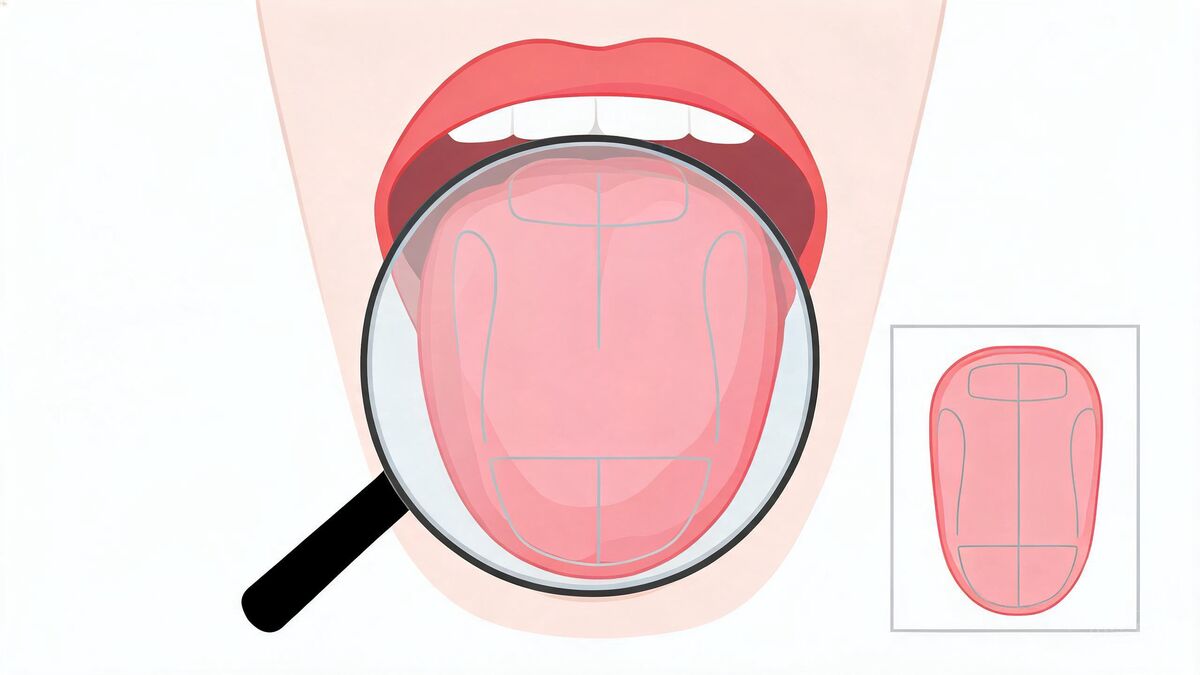
- Check specific zones. In TCM, the tongue maps to organs: the tip relates to the Heart, the sides to the Liver and Gallbladder, the center to the Spleen and Stomach, the back to the Kidneys, and the root to the intestines. Look for color or coating changes concentrated in one zone.
- Record and compare. Write down what you see. Over a few weeks, you will notice patterns — and you will see how your tongue responds to changes in diet, sleep, and stress.
A few cautions: do not examine your tongue right after drinking coffee, tea, or colored juice, as these stain the coating. Do not examine immediately after vigorous exercise, as exertion temporarily reddens the tongue. And remember that a single day's reading is not conclusive — look for persistent patterns over a week or more before drawing conclusions.
7. Common Tongue Patterns and Wellness Guidance
Here is a quick reference linking the most common tongue patterns to practical wellness steps. Use these as starting points, then refine based on how your body responds.
| Common Pattern | What You See | Wellness Focus |
|---|---|---|
| Spleen Qi Deficiency | Pale tongue, teeth marks on edges, thin white coating | Warm, cooked, easily digested meals; Chinese yam, rice porridge, chicken; avoid cold and raw foods |
| Dampness Accumulation | Swollen tongue, thick white coating, teeth marks | Drain dampness: ginger, adzuki beans, coix seed; reduce sweets, dairy, and greasy foods |
| Stomach Heat | Red tongue, yellow coating, possible thirst and bad breath | Cooling foods: mung beans, chrysanthemum tea, celery; reduce spicy, fried, alcohol |
| Yin Deficiency | Red or normal tongue with little or no coating, possible cracks, dry | Nourish yin: lily bulb, pear, tremella, goji berries; prioritize sleep and rest |
| Blood Stasis | Purple tongue body or purple spots | Invigorate blood: rose tea, turmeric, ginger; regular exercise; manage stress and express emotions |
| Yang Deficiency (Cold) | Pale, swollen, wet tongue with thin white coating | Warm the body: ginger tea, lamb, walnuts, moxibustion; avoid cold foods and drinks |
Remember that the tongue often shows a combination of patterns rather than a single, textbook sign. You might see a pale tongue (deficiency) with a thick white coating (dampness) and teeth marks (Spleen deficiency) — all pointing to the same underlying issue. The tongue tells a story, and learning to read it is a gradual process of becoming more attuned to your body.
Frequently Asked Questions
What is the best time to examine your tongue in TCM?
The best time is first thing in the morning, right after waking and before brushing your teeth, eating, or drinking anything. Overnight, the tongue settles into its most natural state. Food, colored beverages, and brushing all alter the coating and color, so observing before these influences gives the most accurate reading. Always use natural daylight near a window, as artificial light distorts color. Be consistent — examine at the same time and under the same conditions each day so your observations are comparable over time. Tracking trends across days and weeks is far more meaningful than any single reading.
What does a pale tongue mean in Chinese medicine?
A pale tongue indicates qi and blood deficiency or yang deficiency. The body lacks the vital energy and nourishment to give the tongue its healthy pink color. Common accompanying signs include fatigue, dizziness, cold limbs, a pale complexion, and a tendency to bruise easily. The wellness focus is on tonifying qi and blood with warm, nourishing foods like red dates, Chinese yam, chicken, beef, and rice porridge, and avoiding cold, raw foods that further weaken the Spleen. See our qi-boosting foods and blood-nourishing foods guides for specific recipes and dietary principles.
What does a thick white tongue coating mean?
A thick white coating indicates dampness or phlegm accumulation, most often related to Spleen deficiency. When the Spleen is too weak to properly transform and transport fluids, they accumulate as dampness, which rises to the tongue as a thick white coating. Common accompanying signs include a heavy feeling in the body, sluggishness, bloating, mental fogginess, and sticky or sluggish stools. The wellness focus is on reducing dampness with warming, drying foods like ginger, adzuki beans, coix seed (job's tears), and Chinese yam, while limiting cold, sweet, greasy, and dairy foods that generate more dampness. Our dampness-removing foods guide offers a complete dietary approach.
Can tongue diagnosis replace a doctor's visit?
No. Tongue diagnosis is a valuable self-awareness and wellness-tracking tool, but it does not replace professional medical diagnosis or treatment. Many factors — lighting, food, beverages, medications, and even the time of day — can temporarily change the tongue's appearance. A single reading is never conclusive. If you notice persistent or concerning changes, if your tongue shows signs of severe patterns (such as a deep red tongue with fever, or a gray-black coating), or if you have symptoms that worry you, consult a qualified healthcare provider or a licensed TCM practitioner for a proper evaluation. Use tongue diagnosis to guide your daily self-care, not to self-diagnose disease.
This article is for educational and informational purposes only and is not a substitute for professional medical advice, diagnosis, or treatment. Tongue diagnosis as described here is a traditional self-awareness practice intended to help you notice general wellness trends — it is not a diagnostic tool for identifying or treating any disease. Many factors can temporarily alter the appearance of the tongue, and tongue signs alone cannot confirm any medical condition. If you notice persistent or concerning changes, or if you experience symptoms that worry you, please consult a qualified healthcare provider or a licensed TCM practitioner. Always seek professional medical advice before making significant changes to your diet, lifestyle, or wellness routine. Read our full disclaimer →