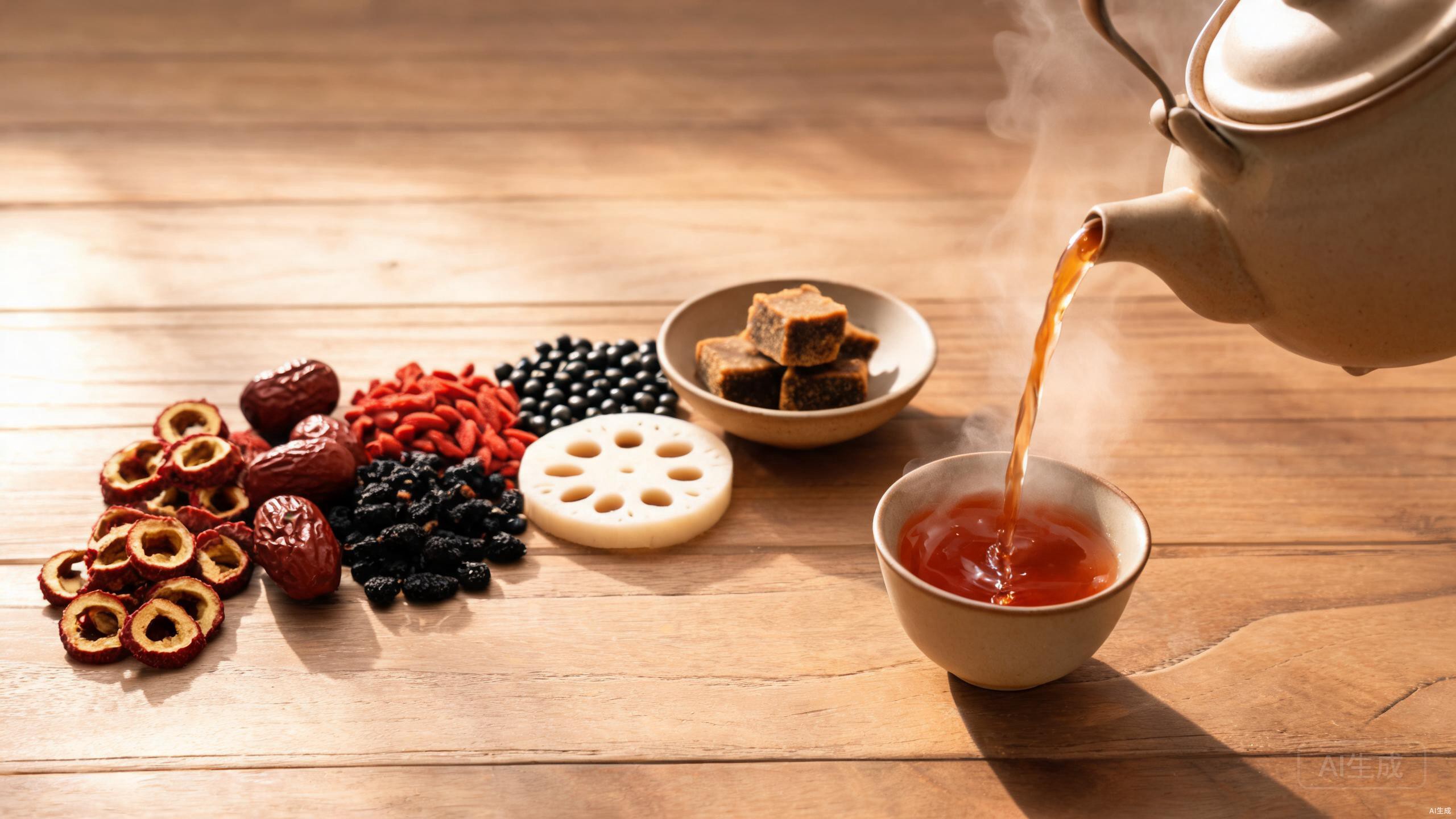
Key Takeaways
- In TCM, sluggish circulation is understood through the concept of blood stasis (Yu Xue) — blood that has stopped flowing freely — which commonly arises from qi stagnation, cold congealing the vessels, or external trauma.
- Seven everyday foods and teas — hawthorn, red dates, goji berries, cassia seed, lotus root, pear, brown sugar, adzuki beans, black beans, and mulberries — are traditionally used to invigorate blood and support circulation.
- Hawthorn is the single most referenced everyday food in TCM for blood flow; it appears in four of the recipes below and pairs naturally with red dates and brown sugar.
- The "blood stasis" body type benefits from warm, cooked foods, gentle movement, and emotional balance — cold and raw foods are traditionally minimized.
- Three acupressure points — Hegu (LI4), Taichong (LR3), and Xuehai (SP10) — are traditionally used to encourage the movement of qi and blood.
- These are traditional dietary practices, not medical treatments. Consult your healthcare provider before making dietary changes, especially if you take blood thinners or heart medication.
This article is for educational purposes only and is not medical advice. The foods and practices described here are traditional dietary practices rooted in Chinese culture. They are not a substitute for professional medical care and are not intended to diagnose, treat, cure, or prevent any disease. Poor circulation can be a sign of serious cardiovascular disease, blood clots, or other conditions that require medical evaluation. Many blood-invigorating foods — especially hawthorn — may interact with blood thinners, blood pressure medication, and heart medication. If you have a health condition, take medication, or are considering significant dietary changes, consult your healthcare provider first. These statements have not been evaluated by the FDA.
Good circulation is something most people take for granted — until they notice cold hands and feet, a dull complexion, easy bruising, or a nagging ache that never quite resolves. In Traditional Chinese Medicine (TCM), healthy blood flow is considered essential to wellness: blood carries nourishment to every tissue, and when it moves freely, the body functions smoothly. When it does not, TCM describes a pattern called blood stasis (Yu Xue).
This guide explores how TCM understands blood stasis, shares seven traditional teas and foods that generations of East Asian families have used to support circulation, and offers complementary acupressure and diet guidance. If you are new to these concepts, our introduction to Traditional Chinese Medicine and guide to qi, blood, and body fluids provide helpful background.
How TCM Understands Blood Stasis
In TCM theory, blood does not move on its own. It is pushed by qi (the body's vital energy), warmed by yang, and kept flowing through vessels that can be tightened by cold or damaged by trauma. When any of these forces fails, blood can slow, pool, or become "stuck." This is blood stasis — blood that has lost its smooth, continuous flow and is instead obstructed or congested in a particular area.
Classical TCM texts describe three main causes of blood stasis, each with a different root:
- Qi stagnation leading to blood stasis (气滞血瘀). Qi is the "commander of blood" — when qi moves, blood moves. Emotional stress, frustration, anger, and pent-up feelings are said to constrain the Liver, the organ responsible for the smooth flow of qi. When Liver qi stagnates, it eventually drags blood along with it, producing stasis. This is the most common form in modern life and is strongly linked to stress and sedentary habits.
- Cold congealing blood (寒凝血瘀). Cold causes contraction and slowing — just as water freezes and thickens in winter. When external cold penetrates the body, or when a person habitually consumes cold, raw foods and drinks, the vessels tighten and blood flow becomes sluggish. This type often worsens in cold weather and improves with warmth, and it is closely related to patterns such as a cold uterus.
- External trauma and injury (外伤血瘀). A blow, sprain, surgery, or chronic repetitive strain can damage the vessels locally, causing blood to leak and pool outside its normal pathways. This produces the familiar bruise, swelling, and fixed pain that follow an injury. TCM also considers longstanding unhealed trauma a source of deeper, chronic stasis.
Other contributors include qi deficiency (too little energy to push blood forward) and heat (which can dry and thicken blood). But the three patterns above are the most frequently discussed in everyday TCM dietary therapy.
Common Signs of Blood Stasis
TCM identifies a cluster of signs that, when they appear together, suggest blood is not flowing freely. You do not need all of them to have the pattern:
- Fixed, stabbing pain — pain that stays in one spot and has a sharp or piercing quality, rather than moving around.
- A dark or dusky complexion — the face may look dull, dark, or subtly purplish, especially around the mouth.
- Purplish lips and nails — a bluish or purple tint rather than a healthy pink.
- Easy bruising and dark spots — bruises appear from minor bumps, and age spots or dark patches may be prominent.
- Cold hands and feet — blood is not reaching the extremities efficiently.
- Varicose veins or spider veins — visible signs of pooled or sluggish blood.
- A purplish tongue — particularly with dark spots or enlarged, dark veins underneath. See our tongue diagnosis guide for context.
- Menstrual clots and pain — dark, clotted menstrual blood with cramping that eases as flow establishes is a classic sign in women. See our TCM for PMS guide.
These signs overlap with many medical conditions. If they are new, persistent, or concerning, a healthcare provider should evaluate them. TCM dietary therapy is a complementary tradition, not a diagnostic or treatment tool.
The Blood Stasis Body Type: Characteristics and Diet
Among the nine TCM body constitutions, the blood stasis body type (Yu Xue Zhi) describes people with a longstanding tendency toward sluggish circulation. Typical characteristics include a darker or dull complexion, dry and rough skin, easy bruising, dark circles, a tendency to fixed pains, forgetfulness, and irritability. People with this constitution often feel worse under stress and in cold weather.
TCM dietary advice for this body type focuses on foods that move blood while avoiding foods that slow it:
- Emphasize warm, cooked foods. Soups, stews, congee (see our congee guide), and lightly stir-fried dishes are preferred. Warmth keeps the vessels open and supports the Spleen's role in producing and moving blood.
- Include blood-invigorating foods regularly. Hawthorn, black beans, adzuki beans, mulberries, eggplant, black fungus, and rose-scented foods (see our rose tea guide) are traditional choices.
- Limit cold, raw, and frozen foods. Ice-cold drinks, large salads, and frozen desserts are thought to congeal blood and worsen stasis, especially during menstruation or in cold seasons.
- Reduce greasy, heavy, and overly sweet foods. These generate dampness and phlegm, which further obstruct circulation — a principle explored in our TCM remedies for cholesterol guide.
- Move gently every day. Qi stagnation feeds blood stasis, so gentle, consistent movement such as qigong or walking is considered as important as diet. Emotional expression and stress management matter too.
Because blood stasis is closely tied to weight and metabolism, these principles also complement our TCM for weight management guide, which addresses the dampness and stagnation that often accompany excess weight.
Seven TCM Foods and Teas for Blood Circulation
The following seven recipes use ingredients available at Western supermarkets, Asian grocers, Amazon, and iHerb. They are not medicines, and they are not a replacement for prescribed treatment. TCM favors gentle, consistent practice over dramatic interventions. For sourcing and safety basics, see our herbal tea safety guide.
1. Hawthorn Red Date Goji Tea (山楂红枣枸杞茶)
TCM principle: Invigorate blood, resolve stasis, nourish qi and blood. Enters: Spleen, Stomach, Liver, Kidney channels.
Ingredients: 10 g dried hawthorn slices (about 8 slices), 5 dried red dates (jujubes, pitted), 1 tablespoon dried goji berries, 3 cups water. Optional: a small piece of rock sugar.
Method: Rinse the hawthorn, red dates, and goji berries. Slit the red dates open to release their flavor. Combine all ingredients with 3 cups of water in a small pot. Bring to a boil, then reduce to a gentle simmer for 10 minutes. Strain into a cup and drink warm, ideally after meals. The softened dates and goji berries can be eaten. Drink 1 cup daily.
Suitable for: People with mild signs of blood stasis — dull complexion, cold hands, occasional fixed aches — and those who eat rich meals and want traditional digestive and circulatory support.
Precautions: Hawthorn may interact with heart medications, statins, and blood thinners; consult your healthcare provider if you take any prescription medication. Avoid on an empty stomach if you have gastric ulcers or acid reflux. Red dates are high in natural sugars; diabetics should use in moderation. See our dedicated hawthorn tea guide for more detail.
2. Hawthorn and Cassia Seed Tea (山楂决明子茶)
TCM principle: Invigorate blood, clear the Liver, brighten the eyes, support healthy lipids. Enters: Liver, Stomach, Large Intestine channels.
Ingredients: 10 g dried hawthorn slices, 1 tablespoon cassia seeds (Jue Ming Zi), 3 cups water.
Method: Lightly toast the cassia seeds in a dry pan over low heat for 2 to 3 minutes until fragrant. Rinse the hawthorn and toasted cassia seeds. Combine with 3 cups of water in a pot, bring to a boil, then simmer for 10 minutes. Strain and drink warm. Drink 1 cup daily, in the afternoon.
Suitable for: Those who sit at screens for long hours and experience eye strain, headaches, or a feeling of pressure — signs of Liver heat and qi stagnation that often accompany blood stasis. Cassia seed is also traditionally associated with supporting healthy lipids.
Precautions: Cassia seed has a gentle laxative effect; avoid if you have chronic diarrhea. As above, hawthorn requires caution with heart and blood-thinning medications. Not suitable during pregnancy without professional guidance. This tea pairs well with the principles in our TCM eye health guide.
3. Lotus Root and Pear Juice (莲藕雪梨汁)
TCM principle: Cool heat, generate fluids, mildly invigorate blood, moisten dryness. Enters: Heart, Stomach, Lung channels.
Ingredients: 1 cup fresh lotus root (peeled and cubed), 1 ripe pear (cored and cubed), 1/2 cup water. Optional: a few drops of lemon juice to prevent browning.
Method: Run the lotus root and pear through a juicer, or blend them with the water in a high-speed blender and strain through a fine sieve. Drink immediately while fresh. If you cannot find fresh lotus root, lotus root powder (available on Amazon and iHerb) can be stirred into warm water with pear juice instead. Drink 1 small glass, 2 to 3 times per week.
Suitable for: Those with blood stasis that includes dryness and mild heat — dry skin, dry cough, a feeling of warmth, and constipation. The cooling nature of this juice balances the warmer hawthorn-based recipes.
Precautions: This juice is cooling; avoid it if you have a cold constitution with loose stools, abdominal cold, or during the early stage of a cold. Because raw juice carries a higher food-safety risk, use fresh, thoroughly washed produce and avoid it if you are pregnant or immunocompromised.
4. Hawthorn and Brown Sugar Water (山楂红糖水)
TCM principle: Invigorate blood, resolve stasis, warm the channels, relieve pain. Enters: Spleen, Stomach, Liver channels.
Ingredients: 10 g dried hawthorn slices, 1 to 2 tablespoons dark brown sugar or traditional Chinese brown sugar (Hong Tang), 2 cups water, 2 thin slices fresh ginger (optional, for warmth).
Method: Rinse the hawthorn and combine with the water (and ginger, if using) in a small pot. Bring to a boil, then simmer for 10 minutes. Turn off the heat, stir in the brown sugar until dissolved, and strain. Drink warm, 1 cup per day. This is a classic recipe traditionally consumed during and just before menstruation.
Suitable for: Women with menstrual cramps, clots, and dark blood — classic cold-type blood stasis — and anyone with cold hands and feet and a dull complexion. Brown sugar is traditionally considered both warming and blood-invigorating.
Precautions: High in sugar; diabetics should avoid or use sparingly. Avoid during heavy menstrual bleeding, as the blood-invigorating effect may increase flow. As always, hawthorn requires caution with heart and blood-thinning medications. For related warming guidance, see our TCM warming spices guide.
5. Three Red Soup (三红汤)
TCM principle: Nourish blood, tonify qi, mildly invigorate circulation. Enters: Spleen, Heart, Liver channels.
Ingredients: 1/4 cup dried adzuki (red) beans, 6 dried red dates (pitted), 1 tablespoon dried goji berries, 4 cups water. Optional: a small piece of rock sugar.
Method: Soak the adzuki beans for 4 hours or overnight, then drain. Combine the beans and red dates with 4 cups of water in a pot. Bring to a boil, then simmer for 40 to 60 minutes until the beans are very soft. Add the goji berries in the last 10 minutes (overcooking goji makes it bitter). Sweeten lightly with rock sugar if desired. Eat 1 bowl warm. Drink 2 to 3 times per week.
Suitable for: Those whose blood stasis is combined with blood deficiency — fatigue, pallor, dizziness, and poor sleep alongside the stasis signs above. This soup both nourishes and gently moves blood, making it ideal for recovery after illness or menstruation. It complements our blood-nourishing foods guide and TCM for blood deficiency guide.
Precautions: Generally very safe as a food. Adzuki beans can cause bloating in sensitive individuals; thorough cooking and a slice of ginger help. Diabetics should monitor blood sugar, as dates and rock sugar add natural sweetness.
6. Vinegar-Soaked Black Beans (醋泡黑豆)
TCM principle: Activate blood, nourish kidney, support hair and vitality. Enters: Spleen, Kidney, Liver channels.
Ingredients: 1 cup dried black beans (not black soybeans specifically, though both work), enough rice vinegar or apple cider vinegar to cover, a clean glass jar with a lid.
Method: Dry-roast the black beans in a pan over medium heat for 8 to 10 minutes, stirring constantly, until the skins split and they smell nutty. Let them cool completely. Place the cooled beans in the glass jar and pour in enough vinegar to cover them by about an inch. Seal and let sit at room temperature for 2 to 3 days, then refrigerate. Eat 10 to 15 beans per day, chewed thoroughly. They can be taken on their own or added to salads and rice.
Suitable for: Those with longstanding blood stasis and early signs of kidney decline — lower-back weakness, thinning or graying hair, and reduced vitality. Black beans are traditionally said to "activate blood" and nourish the kidneys, while vinegar is thought to enhance absorption.
Precautions: The acidity may irritate the stomach; avoid on an empty stomach if you have gastritis or ulcers. Vinegar may interact with diabetes and diuretic medications; consult your healthcare provider if relevant. Because black beans are blood-invigorating in TCM theory, check with your doctor if you take blood thinners.
7. Mulberry and Goji Tea (桑葚枸杞茶)
TCM principle: Nourish yin and blood, mildly invigorate circulation, brighten the eyes. Enters: Heart, Liver, Kidney channels.
Ingredients: 2 tablespoons dried mulberries, 1 tablespoon dried goji berries, 3 cups water. Optional: 3 dried red dates.
Method: Rinse the mulberries, goji berries, and dates. Combine with 3 cups of water in a pot, bring to a boil, then simmer gently for 8 to 10 minutes. Strain into a cup and drink warm. The softened mulberries and goji berries can be eaten. Drink 1 cup daily, ideally in the late afternoon or evening.
Suitable for: Those with blood stasis complicated by yin deficiency and dryness — dry eyes, dry skin, dizziness, premature graying, and poor sleep. Mulberries are among the finest yin-and-blood nourishing fruits in TCM, gently supporting circulation without being harsh or drying.
Precautions: Mulberries are cooling and moistening; reduce the amount if you have loose stools or internal dampness (a heavy feeling, thick tongue coating). Diabetics should use in moderation due to natural sugars. Dried mulberries are widely available on Amazon and iHerb.
Comparison of the Seven Circulation Recipes
| Recipe | Key Ingredients | Traditional Function | Best For | Typical Frequency |
|---|---|---|---|---|
| Hawthorn Red Date Goji Tea | Hawthorn, red dates, goji | Invigorate blood, nourish qi and blood | Everyday circulation support | 1 cup daily |
| Hawthorn and Cassia Seed Tea | Hawthorn, cassia seed | Invigorate blood, clear Liver heat | Eye strain, screen fatigue | 1 cup daily |
| Lotus Root and Pear Juice | Lotus root, pear | Cool heat, moisten dryness | Stasis with dryness and heat | 2–3 times weekly |
| Hawthorn and Brown Sugar Water | Hawthorn, brown sugar | Warm channels, relieve pain | Menstrual cramps, cold hands | 1 cup daily (cyclically) |
| Three Red Soup | Adzuki beans, red dates, goji | Nourish blood, gently move blood | Stasis with deficiency | 2–3 times weekly |
| Vinegar-Soaked Black Beans | Black beans, vinegar | Activate blood, nourish kidney | Chronic stasis, hair and vitality | 10–15 beans daily |
| Mulberry and Goji Tea | Mulberries, goji berries | Nourish yin and blood | Stasis with dryness and poor sleep | 1 cup daily |
A simple daily rotation: start the morning with hawthorn red date goji tea, snack on a spoonful of vinegar-soaked black beans at lunch, and wind down with mulberry and goji tea in the evening. This balances warming and nourishing recipes without overdoing any single ingredient. For another classic blood-moving tea, see our safflower tea guide.
Three Acupressure Points for Blood Circulation
In TCM, foods and acupressure work hand in hand. The following three points are traditionally used to encourage the movement of qi and blood. Press each point firmly but gently with the thumb for 1 to 2 minutes per side, breathing slowly. These are wellness practices, not medical treatments. For safety guidance, see our acupressure safety guide.
Hegu — Large Intestine 4 (LI4, 合谷)
Location: On the back of the hand, in the fleshy web between the thumb and index finger. Press where it feels most tender when you squeeze the thumb and index finger together.
TCM principle: Hegu is the most widely used point on the body for moving qi and relieving pain. As the command point of the face and head, it is traditionally used for headaches, jaw tension, and any pain where qi and blood are stuck. It is considered the "master point" for promoting circulation throughout the upper body.
Precautions: Hegu is strictly avoided during pregnancy because it is traditionally said to promote uterine contractions. See our detailed Hegu LI4 guide.
Taichong — Liver 3 (LR3, 太冲)
Location: On the top of the foot, in the depression between the big toe and second toe, about two finger-widths up from the webbing. Press where it feels most tender.
TCM principle: Taichong is the classic point for soothing Liver qi and releasing stagnation — the root cause of the most common type of blood stasis (qi stagnation leading to blood stasis). It is traditionally used for stress, frustration, chest tightness, and menstrual pain. Together with Hegu, it forms a famous pair known as the "Four Gates," used to open circulation throughout the body.
Precautions: This point can be quite tender, especially when stagnant; press gently at first. See our Taichong LR3 guide for full instructions.
Xuehai — Spleen 10 (SP10, 血海)
Location: On the inner thigh, about two thumb-widths above the top inner corner of the kneecap, in the slight hollow of the thigh muscle. Press while seated with the knee bent.
TCM principle: The name Xuehai translates to "Sea of Blood," and this point is considered the premier point for anything related to blood — both nourishing and moving it. It is traditionally used for menstrual disorders, skin conditions with dark spots or rashes, and any pattern of blood stasis or blood heat. It is particularly valued in women's wellness.
Precautions: Generally safe for self-massage. As with all acupressure, avoid pressing on broken or bruised skin, and stop if you feel sharp pain. Browse our full acupressure guide index for related points.
When to See a Doctor
The foods and practices in this article are complementary wellness traditions, not medical treatments. Poor circulation can signal serious disease, so you should see a healthcare provider promptly if you experience any of the following:
- Sudden swelling, warmth, redness, or pain in one leg — possible signs of a blood clot
- Chest pain, pressure, or tightness; shortness of breath; or pain radiating to the arm or jaw
- Sudden numbness, weakness, difficulty speaking, or drooping on one side of the face
- Sores on the legs or feet that do not heal
- Skin that turns pale, blue, or cold in a limb
- A diagnosed cardiovascular condition, diabetes, or a clotting disorder
If you take blood thinners, blood pressure medication, statins, or heart medication, speak with your doctor before adding hawthorn, black beans, garlic, or other blood-invigorating foods to your routine, as interactions are possible. Never stop or adjust prescribed medication without your doctor's explicit guidance.
Frequently Asked Questions
What is blood stasis in Chinese medicine?
In Chinese medicine, blood stasis (Yu Xue) is a pattern where blood flow becomes sluggish or obstructed, so blood accumulates in one area instead of circulating freely. It commonly arises from qi stagnation (often linked to stress and emotional tension), cold congealing the vessels, or external trauma. Typical signs include a dull or stabbing fixed pain, a dark or purplish complexion, purplish lips, dark spots or easy bruising, and a purplish tongue. TCM does not equate blood stasis with any single Western diagnosis; it is a pattern of symptoms. If you have circulation concerns, consult your healthcare provider for proper evaluation.
Which TCM foods are best for blood circulation?
The most valued blood-invigorating foods in TCM include hawthorn (Shan Zha), black beans, mulberries, lotus root, red dates (jujubes), goji berries, brown sugar, and adzuki (red) beans. These are traditionally combined into teas and soups such as hawthorn red date goji tea, three red soup, and vinegar-soaked black beans. These are traditional dietary practices, not medical treatments, and they are best enjoyed as part of a balanced whole-food diet alongside gentle daily movement.
Can hawthorn tea improve blood flow?
Hawthorn is the most widely referenced everyday food in TCM for invigorating blood and supporting circulation, and it has been consumed as a tea in East Asia for centuries. It is traditionally used to resolve stasis and aid the digestion of rich, greasy meals. However, hawthorn may interact with heart medications, statins, and blood thinners. If you take any prescription medication, are pregnant, or are nursing, consult your healthcare provider before adding hawthorn tea to your routine.
Are blood-invigorating foods safe with blood thinners?
If you take blood-thinning medications (such as warfarin) or antiplatelet drugs, consult your healthcare provider before adding blood-invigorating foods such as hawthorn, black beans, or garlic to your routine. In TCM theory these foods promote blood movement, and several may have mild properties that interact with anticoagulants. Always inform your doctor about all foods, herbs, and supplements you use, and never stop or adjust prescribed medication without your doctor's explicit guidance.
The Bottom Line
Healthy blood flow sits at the heart of TCM wellness. The concept of blood stasis — blood slowed by qi stagnation, cold, or trauma — offers a framework for understanding the cold hands, dull complexion, fixed aches, and menstrual difficulties that many people experience. The seven recipes in this guide, from hawthorn red date goji tea to vinegar-soaked black beans, draw on everyday ingredients that generations of East Asian families have used to gently support circulation, complemented by the blood stasis body type diet and three classic acupressure points.
But these are traditions — not treatments, and not a replacement for medical care. Poor circulation can be a warning sign of serious disease, and several of these foods, especially hawthorn, can interact with medications. If you have any concern about your circulation, your most important step is to work with a qualified healthcare provider. Use these traditional practices only as complementary dietary habits, with your doctor's knowledge and guidance.
This article shares traditional dietary and wellness practices for educational purposes only. It is not a substitute for medical advice, diagnosis, or treatment. The foods described here are not intended to treat, cure, or prevent any disease. If you have a cardiovascular condition, a bleeding or clotting disorder, or take medication such as blood thinners or heart medication, consult your healthcare provider before making any dietary changes. Some foods, particularly hawthorn, may interact with medications. These statements have not been evaluated by the FDA. Never stop or adjust prescribed medication without your doctor's explicit guidance. Read our full disclaimer →