Key Takeaways
- In TCM, cold uterus (gong han) describes a pattern of kidney yang deficiency or cold accumulating in the uterus, often linked to cold hands and feet, lower abdominal coldness, and menstrual discomfort.
- Warming foods — classified as warm or hot in nature — are traditionally used to warm the meridians, support kidney yang, and promote healthy blood circulation.
- Longan and red date tea warms and nourishes the heart and spleen; brown sugar ginger tea warms the meridians and scatters cold.
- Angelica, ginger, and mutton soup is the classic TCM warming soup for women's winter comfort.
- These foods are traditional wellness practices, not medical treatments. Consult your healthcare provider for persistent symptoms.
This article is for wellness education only and is not medical advice. The foods and practices described here are traditional Chinese dietary therapy, not a replacement for professional medical care. If you experience persistent pelvic pain, severe menstrual cramps, irregular cycles, or difficulty conceiving, consult your healthcare provider. Some herbs, including angelica (dong quai), may interact with medications or are traditionally avoided during pregnancy.
Many women are all too familiar with the feeling: cold hands and feet that never seem to warm up, a lower abdomen that feels chilly to the touch, menstrual cramps that grip like ice, and dark menstrual blood accompanied by clots. In Traditional Chinese Medicine (TCM), this cluster of signs is described as cold uterus — known in Chinese as gong han (宫寒).
While Western medicine does not use this term, TCM offers a rich framework of warming foods and daily habits that have been passed down through generations of women. These practices are not about treating disease — they are about restoring warmth, supporting circulation, and bringing the body back into balance through the kitchen. Here is a practical guide to understanding cold uterus from a TCM perspective and five traditional food remedies you can make at home.
What Is Cold Uterus in TCM?
In TCM theory, the uterus is not merely a reproductive organ — it is closely connected to the kidney, spleen, and liver meridians. The kidney stores essence (jing) and governs reproduction, while kidney yang provides the warming fire that keeps the lower body and uterus comfortable. When kidney yang is insufficient, or when external cold penetrates the body and settles in the lower abdomen, the result is what TCM calls cold uterus.
Two main mechanisms are traditionally described:
- Kidney Yang Deficiency (肾阳不足) — The internal warming fire is too weak. This may develop from chronic overwork, excessive exposure to cold, a constitutionally cold body type, or aging. The body cannot maintain warmth in the lower abdomen, and circulation slows.
- Cold Invading the Uterus (寒客胞宫) — External cold enters the body and lodges in the uterus. This may happen from sitting on cold surfaces, walking barefoot on cold floors, swimming in cold water during menstruation, or consuming too many cold and raw foods.
In both cases, the guiding principle is the same: cold causes contraction and stagnation. When the uterus is cold, blood flow becomes sluggish, which TCM describes as "cold congealing blood." This is why the symptoms so often involve pain, clots, and a feeling of coldness.
Common Signs Associated with Cold Uterus
It is important to note that these signs are descriptive of a TCM pattern, not a medical diagnosis. If you recognize several of the following, TCM tradition suggests that warming foods and habits may be supportive:
- Cold hands and feet that persist even in warm environments
- A cold sensation in the lower abdomen, sometimes relieved by warmth
- Menstrual cramps that feel better with a heating pad or warm compress
- Dark menstrual blood with visible clots
- Irregular or delayed menstrual cycles
- A pale complexion and general fatigue or low energy
- Frequent clear urination, especially at night
- Lower back soreness and knee weakness, particularly in cold weather
In TCM, the principle is simple: warmth promotes flow, cold causes stagnation. This is why heating pads, warm foot soaks, and cooked warming foods are the first line of traditional support for cold patterns. For more on this foundational concept, see our guide to hot vs. cold constitutions.
5 Warming Food Remedies for Cold Uterus
The following five recipes use ingredients that are widely available in Western supermarkets, Asian grocers, or online shops like Amazon and iHerb. Each one is classified as warm or hot in nature according to TCM, making them traditionally appropriate for supporting a cold uterus pattern.
1. Longan and Red Date Tea (Gui Yuan Hong Zao Cha)
TCM nature and flavor: Sweet, warm. Enters the Heart and Spleen meridians.
Traditional use: Warms and nourishes the heart and spleen, replenishes qi and blood, calms the spirit. Longan (dried longan aril) is one of the most beloved tonic fruits in TCM for women, traditionally used to support blood nourishment and ease the fatigue that often accompanies cold patterns. Red dates (jujubes) strengthen spleen qi and harmonize the formula.
Ingredients:
- 10 to 15 grams dried longan aril (about 1 tablespoon)
- 5 to 6 dried red dates (jujubes), pitted
- 2 cups water
- Optional: a small pinch of goji berries
Preparation: Rinse the dried longan and red dates. Place them in a small pot with 2 cups of water. Bring to a gentle boil, then reduce the heat and simmer for 10 to 15 minutes. The tea will turn a deep amber color with a naturally sweet, fruity aroma. Strain into a cup and drink warm. You may eat the softened longan and red dates as well. Drink 1 cup daily, ideally in the morning or afternoon.
Dried longan aril and dried red dates (jujubes) are widely available on Amazon and iHerb, as well as in Asian grocery stores and well-stocked health food shops. Look for dried longan labeled "longan aril" or "gui yuan," and red dates labeled "dried jujube" or "hong zao."
Precautions: Longan is warming and relatively rich. If you tend to run hot, have a sore throat, or are experiencing a cold or fever, pause this tea until you recover. Avoid drinking it late at night, as it may be mildly stimulating for some people.
2. Angelica, Ginger, and Mutton Soup (Dang Gui Sheng Jiang Yang Rou Tang)
TCM nature and flavor: Sweet, warm, slightly spicy. Enters the Liver, Spleen, and Kidney meridians.
Traditional use: Warms the meridians and scatters cold, nourishes blood and invigorates circulation. This is one of the most famous TCM food therapy recipes for women, originating from the classical text Jingui Yaolue (Essentials from the Golden Cabinet, circa 200 CE). Angelica root (dong quai) is the premier blood-nourishing herb in TCM, ginger warms the middle and scatters cold, and mutton (lamb) is classified as warm in nature, making it an ideal warming protein for cold patterns.
Ingredients:
- 1 pound lamb (bone-in chops or stewing cuts), cut into chunks
- 10 to 15 grams dried angelica root slices (dong quai / dang gui)
- 30 grams fresh ginger (about a thumb-sized piece), sliced
- 6 dried red dates, pitted
- 6 cups water
- Salt to taste
Preparation: Blanch the lamb in boiling water for 2 to 3 minutes, then drain and rinse to remove impurities. Place the lamb, angelica root, ginger slices, red dates, and water in a large pot. Bring to a boil, then reduce to a low simmer. Cover and simmer gently for 1.5 to 2 hours, until the lamb is very tender and the broth is rich and aromatic. Add salt to taste. Drink the broth warm and eat the lamb. This soup is traditionally consumed once or twice a week during colder months.
Lamb is available at any supermarket or butcher. Dried angelica root slices (dong quai) are available on Amazon, iHerb, and online TCM herb shops — search for "dang gui slices" or "angelica sinensis root." Look for pale, plump slices with a distinctive sweet-spicy aroma.
Precautions: Angelica root (dong quai) is traditionally avoided during pregnancy and by women with heavy menstrual bleeding, as it invigorates blood circulation. If you take blood-thinning medication, consult your healthcare provider before using angelica root, as it may interact with anticoagulants. This soup is best avoided during acute colds or fevers.
3. Walnut and Goji Berry Porridge (Hei Tao Gou Qi Zhou)
TCM nature and flavor: Sweet, warm. Enters the Kidney, Liver, and Lung meridians.
Traditional use: Tonifies kidney yang, warms and nourishes the lower body, supports the lower back and knees. Walnuts are classified as warm in nature in TCM and are traditionally associated with kidney yang support. Goji berries nourish liver and kidney yin and blood, creating a balanced combination that warms without being overly drying. This gentle porridge is an excellent everyday option.
Ingredients:
- 1/2 cup white rice (or a mix of white and brown rice)
- 30 grams walnuts (about 10 halves), roughly chopped
- 1 tablespoon dried goji berries
- 4 cups water
- Optional: a small pinch of salt or a drizzle of honey
Preparation: Rinse the rice and place it in a pot with the water. Bring to a boil, then reduce to a low simmer. After 20 minutes, add the chopped walnuts. Continue to simmer for another 15 to 20 minutes, stirring occasionally, until the porridge reaches a soft, creamy consistency. Add the goji berries in the last 5 minutes (they cook quickly and can become bitter if overcooked). Add a pinch of salt or honey to taste. Eat warm, 1 bowl daily, ideally for breakfast.
Precautions: Walnuts are warming and slightly oily. If you have loose stools or digestive dampness, reduce the quantity. This porridge is generally gentle and suitable for daily use. For more porridge ideas, see our complete congee guide.
4. Brown Sugar Ginger Tea (Hong Tang Jiang Cha)
TCM nature and flavor: Sweet, warm (brown sugar); spicy, warm (ginger). Enters the Spleen, Stomach, and Lung meridians.
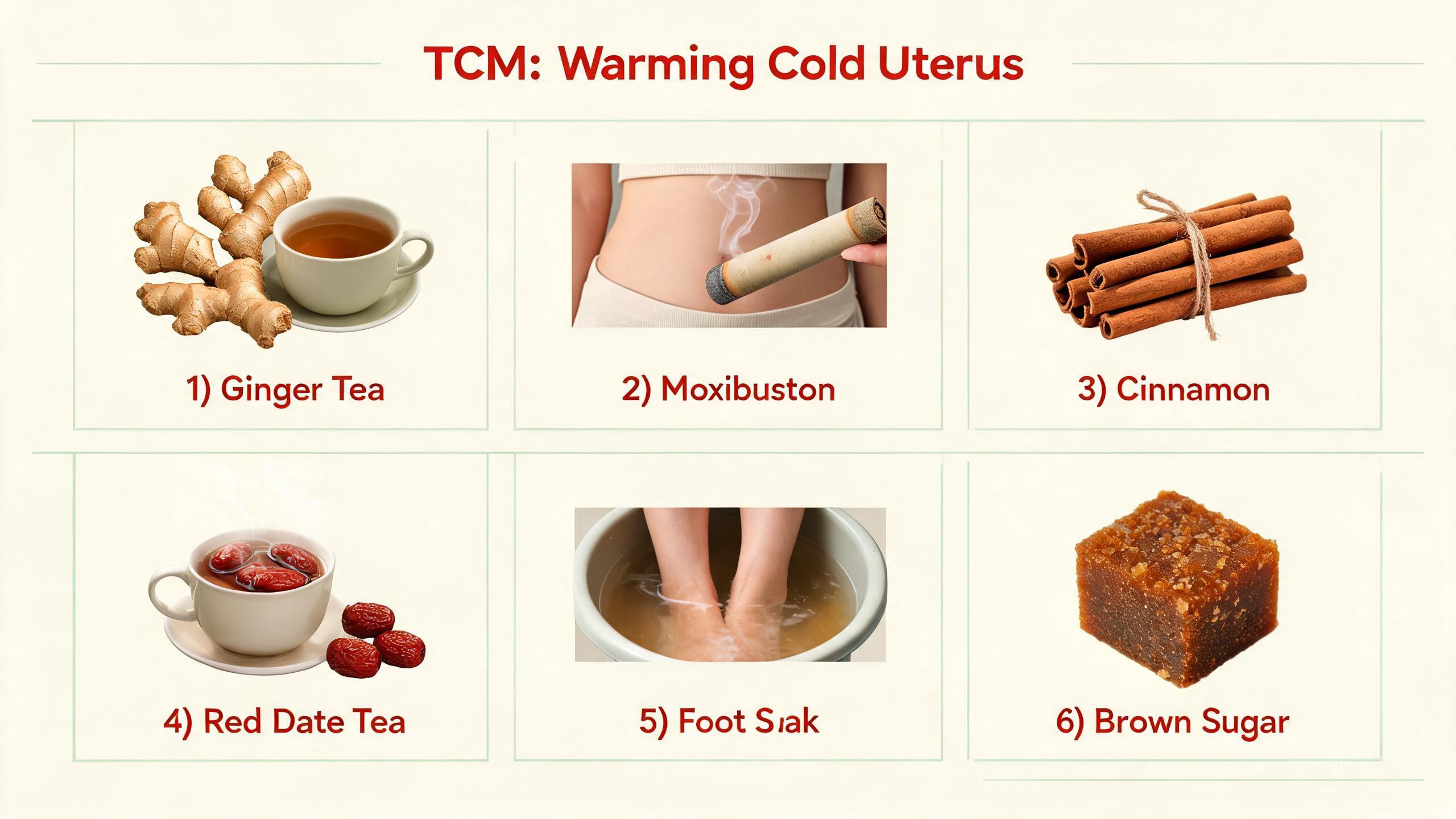
Traditional use: Warms the meridians and scatters cold, supports blood circulation, and eases the cramping discomfort that often accompanies cold patterns. This is perhaps the most widely known TCM remedy for menstrual comfort in China. Fresh ginger warms the middle and scatters cold, while brown sugar (which is less refined than white sugar and retains warming properties in TCM) nourishes blood and invigorates circulation. The combination is simple, affordable, and deeply comforting.
Ingredients:
- 30 grams fresh ginger (about a thumb-sized piece), sliced
- 1 to 2 tablespoons dark brown sugar (or unrefined cane sugar)
- 2 cups water
Preparation: Slice the fresh ginger thinly (do not peel — the skin is traditionally left on). Place the ginger slices and water in a small pot. Bring to a boil, then reduce the heat and simmer for 10 minutes. Add the brown sugar and stir until dissolved. Strain and drink warm. Traditionally, this tea is consumed once daily during the first one to two days of the menstrual cycle, or whenever cold symptoms in the lower abdomen are most noticeable.
For extra warmth, add 2 to 3 dried red dates to the pot while simmering. The dates add natural sweetness and strengthen the spleen. You can also add a pinch of dried tangerine peel (chen pi) to support digestion. For more on ginger tea, see our ginger tea guide.
Precautions: Ginger tea is warming. If you have a heat-related condition (sore throat, mouth ulcers, or feel hot and flushed), reduce or avoid it. Brown sugar is still sugar — use in moderation, especially if you monitor your blood sugar. This tea is traditionally avoided during pregnancy in large amounts, though small culinary amounts of ginger are generally considered safe. Consult your healthcare provider if pregnant.
5. Chives Stir-Fried with Walnuts (Jiu Cai Chao Hei Tao)
TCM nature and flavor: Spicy, warm (chives); sweet, warm (walnuts). Enters the Kidney, Liver, and Stomach meridians.
Traditional use: Warms and tonifies kidney yang, supports the lower back and knees, promotes blood circulation. Chives are one of the few vegetables classified as warm in nature in TCM, and they are traditionally associated with kidney yang support. Paired with walnuts, which also warm the kidneys, this simple stir-fry is a flavorful way to add warming foods to your regular meals.
Ingredients:
- 1 bunch fresh chives (about 200 grams), cut into 2-inch pieces
- 30 grams walnuts (about 10 halves)
- 1 tablespoon cooking oil
- A pinch of salt
- Optional: a few slices of fresh ginger
Preparation: If using raw walnuts, lightly toast them in a dry pan over medium heat for 2 to 3 minutes until fragrant, then set aside. Heat the oil in a wok or skillet over medium-high heat. Add the ginger slices if using, then add the chives. Stir-fry quickly for 1 to 2 minutes — chives cook very fast and should remain bright green. Add the toasted walnuts and a pinch of salt. Toss for another 30 seconds and serve immediately. Eat as a side dish with rice, 2 to 3 times per week.
Precautions: Chives are warming and can be slightly irritating to the stomach if eaten in very large quantities. If you have gastritis or acid reflux, eat in smaller portions. This dish is best enjoyed fresh and warm — avoid eating it cold.
Quick Comparison of the Five Warming Foods
| Remedy | TCM Nature | Primary Traditional Use | Best Time |
|---|---|---|---|
| Longan & Red Date Tea | Warm, sweet | Nourish heart blood, warm spleen | Morning or afternoon |
| Angelica Ginger Mutton Soup | Warm, spicy | Warm meridians, nourish blood | Lunch, 1-2x per week |
| Walnut & Goji Porridge | Warm, sweet | Tonify kidney yang | Breakfast |
| Brown Sugar Ginger Tea | Warm, spicy-sweet | Warm meridians, scatter cold | First 1-2 days of cycle |
| Chives with Walnuts | Warm, spicy | Tonify kidney yang | Lunch or dinner, 2-3x per week |
Daily Habits to Support Warming
Food therapy works best when combined with warming lifestyle habits. TCM tradition emphasizes the following daily practices for women with a cold constitution:
- Keep your feet, lower back, and abdomen warm. In TCM, cold often enters through the feet and the lower back. Wear warm socks, avoid walking barefoot on cold floors, and keep your midsection covered. A warm ginger foot soak before bed is a traditional way to warm the whole body from the ground up.
- Avoid cold and raw foods. Ice water, salads, smoothies, and ice cream are considered cooling in TCM. Favor warm, cooked foods — soups, stews, porridges, and stir-fries. This is especially important during and just before menstruation.
- Use warmth on the lower abdomen. A heating pad, hot water bottle, or warm salt pack on the lower abdomen for 15 to 20 minutes daily may support circulation and comfort. For a traditional approach, see our moxibustion guide.
- Avoid prolonged exposure to cold and damp. Do not sit on cold surfaces, avoid swimming in cold water during menstruation, and dry your hair promptly after washing.
- Stay gently active. Movement generates warmth and promotes qi and blood circulation. Gentle practices like qigong for women or a brisk daily walk can help maintain warmth without depleting energy.
When to Seek Professional Help
While warming foods and habits are gentle, traditional wellness practices, they are not a substitute for medical evaluation. Please consult your healthcare provider if you experience any of the following:
- Severe or worsening pelvic pain, especially outside of menstruation
- Menstrual periods that are consistently absent, extremely heavy, or very irregular
- Difficulty conceiving after 12 months of trying (or 6 months if over 35)
- Fever, chills, or unexplained weight changes
- Any sudden or unusual changes in your menstrual pattern
TCM food therapy can be a supportive complement to professional care, but it should never delay medical evaluation. If you are interested in exploring TCM more deeply, a licensed TCM practitioner can assess your individual pattern and recommend a personalized approach. For related women's health topics, see our guides on TCM for PMS symptoms and TCM postpartum support.
The Bottom Line
Cold uterus is a TCM pattern, not a medical diagnosis — but the warming foods and habits associated with it have brought comfort to generations of women. Longan and red date tea, angelica ginger mutton soup, walnut and goji porridge, brown sugar ginger tea, and chives with walnuts are five accessible recipes that use ingredients you can find at a Western supermarket or order online. Combined with warmth, cooked foods, and gentle movement, these traditional practices offer a simple, nourishing way to support your body through every season — especially the cold ones.
This article shares traditional wellness practices for educational purposes only. It is not a substitute for medical advice, diagnosis, or treatment. The foods and practices described here are not intended to treat, cure, or prevent any disease and are not a replacement for professional gynecological or medical care. Always consult your healthcare provider before adding new herbs or making dietary changes, especially if you are pregnant, nursing, taking medication, or managing a health condition. These statements have not been evaluated by the FDA.