Key Takeaways
- In TCM, the Liver "opens into the eyes" — clear vision is said to reflect the condition of liver blood and liver yin, while the Kidneys contribute essence (jing) to eye health.
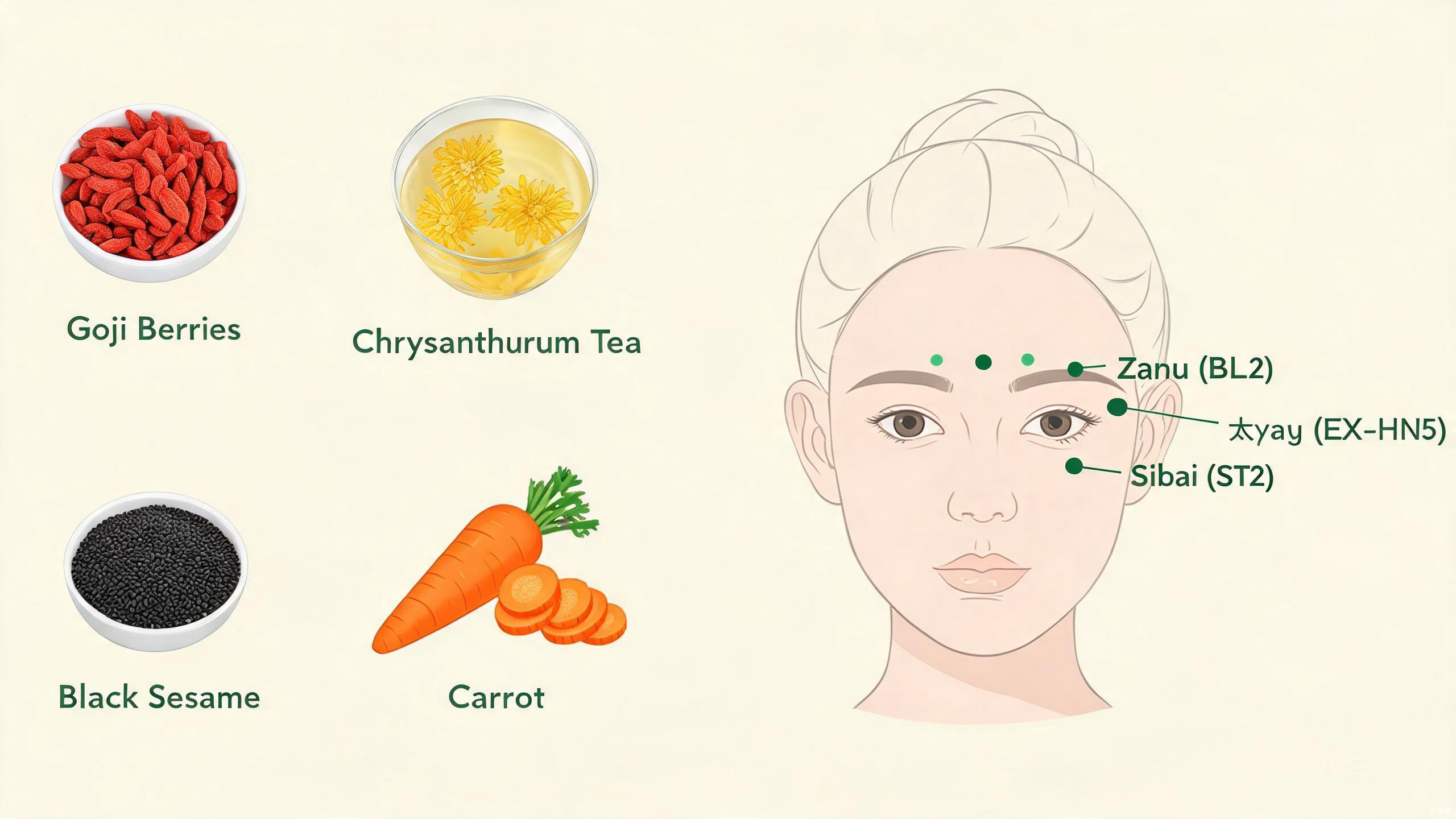
- Five everyday foods — goji berries, chrysanthemum, black sesame, carrot, and mulberry — are traditionally used to nourish the liver and kidneys and support eye comfort.
- Simple acupressure around the eyes and gentle eye exercises are traditional TCM companions to dietary support.
- Screen-time habits — breaks, lighting, hydration, and sleep — matter as much as food in the TCM whole-person approach to eye wellness.
- These are traditional wellness practices, not a treatment for eye disease. Always consult an eye care professional for vision changes.
This article is for educational purposes only and is not medical advice. The foods, teas, and practices described here are traditional wellness practices rooted in Chinese culture. They are not a substitute for professional eye care or medical treatment. Never stop, delay, or replace prescribed treatment based on information in this article. If you experience vision changes, eye pain, sudden flashes of light, or any concerning eye symptoms, see an eye care professional promptly. Some foods and herbs may interact with medications — always inform your doctor about everything you consume. These statements have not been evaluated by the FDA and are not intended to diagnose, treat, cure, or prevent any disease.
If you spend your days in front of screens, you have probably felt it: that gritty, tired, slightly burning sensation in your eyes by late afternoon. You are not alone. Eye strain from digital devices has become one of the most common wellness complaints of modern life. Long before computers existed, Traditional Chinese Medicine (TCM) developed a rich tradition of supporting eye health through food, tea, gentle exercise, and lifestyle habits.
In TCM, eye health is not viewed in isolation. The eyes are seen as a window into the internal organs — especially the Liver and Kidneys. The foods below have been enjoyed for generations as part of a balanced lifestyle to nourish those organs and, in turn, support clear, comfortable vision. They are not medicines and not a replacement for eye care, but they are simple, delicious additions to a wellness routine.
If you are new to TCM concepts, our introduction to Traditional Chinese Medicine is a helpful starting point before diving in.
How TCM Views the Eyes
One of the most famous sayings in TCM is: "The Liver opens into the eyes" (肝开窍于目, Gan Kai Qiao Yu Mu). In plain English, this means the eyes are considered the external expression of the Liver organ system's internal state. When liver blood and liver yin are abundant and flowing smoothly, the eyes are clear, moist, and bright. When the liver is deficient or overheated, the eyes may feel dry, tired, blurry, or irritated.
This is why a TCM practitioner, hearing a complaint about dry or tired eyes, will often ask questions about sleep, stress, digestion, and emotional state — all of which relate to the Liver in TCM theory. The Liver is responsible for the smooth flow of qi and emotions, and it stores blood. Late nights, frustration, and prolonged screen use are all said to "consume liver blood" and "generate liver heat," which can show up in the eyes.
But the Liver is not the only organ involved. TCM also connects the Kidneys to the eyes through the concept of essence (精, jing). Kidney essence is the foundational reserve that the body draws on for growth, reproduction, and aging. The eyes, especially as we age, are said to depend on kidney essence for sustained clarity. This is why foods that nourish both the liver and kidneys — like goji berries and black sesame — are so central to the TCM approach to eye wellness.
TCM also maps different parts of the eye to different organs. The sclera (white of the eye) is associated with the Lungs, the iris with the Liver, the pupil with the Kidneys, the inner and outer corners with the Heart, and the eyelids with the Spleen. This five-region mapping reflects the Five Elements theory that underpins much of TCM. To learn more about how TCM understands the organs, see our guide to the Zang-Fu organ systems.
Common TCM patterns associated with eye discomfort include:
- Liver Blood Deficiency — dry eyes, blurry vision, floaters, dizziness, pale complexion. Often linked to overwork, poor sleep, or inadequate nutrition.
- Liver Yin Deficiency — dry, gritty eyes with a sensation of heat, especially in the afternoon or evening. Often associated with aging or chronic stress.
- Liver Heat Rising — red, bloodshot, irritated eyes, often with headache or irritability. Commonly linked to screen strain and emotional frustration.
- Kidney Essence Deficiency — progressive blurring, especially with age, often with lower back weakness or ringing in the ears.
Understanding these patterns helps explain why TCM recommends specific foods. Foods that nourish blood and yin are chosen for the first two patterns; cooling foods for the third; and kidney-nourishing foods for the fourth. The balance of yin and yang is central to choosing the right foods for the right situation.
Five Everyday TCM Foods for Eye Health
The following five foods are staples of East Asian kitchens and tea cabinets. Each has a place in TCM tradition as a food that may support eye wellness when enjoyed as part of a balanced lifestyle. They are not medicines, and they are not a replacement for professional eye care.
1. Goji Berries (枸杞, Gou Qi Zi)
TCM nature: Sweet, neutral. Enters: Liver and Kidney channels.
Goji berries are the single most famous TCM food for the eyes. They are traditionally used to "nourish liver and kidney yin" and "brighten the eyes" (明目, ming mu). This means they are chosen to address the patterns of Liver Blood Deficiency, Liver Yin Deficiency, and Kidney Essence Deficiency described above. Modern nutrition has also taken interest in goji berries because they contain zeaxanthin, a carotenoid concentrated in the retina of the eye. In TCM, goji berries are eaten daily in small amounts — a handful in tea, congee, or soup — rather than in large doses.
How to prepare: Rinse 1 tablespoon of dried goji berries and add them to hot water as tea (steep 5 to 8 minutes), or stir them into warm congee, oatmeal, or soup just before serving. They can also be combined with chrysanthemum for the classic "goji-chrysanthemum tea" described below. A small handful (about 10 to 15 grams) per day is a traditional amount.
Caution: Goji berries are generally safe as a food. If you take blood-thinning medication (such as warfarin), consult your doctor, as goji may interact with these drugs. Avoid large amounts if you have a fever or active infection. See our herbal tea safety guide for general guidance.
2. Chrysanthemum (菊花, Ju Hua)
TCM nature: Sweet, bitter, slightly cold. Enters: Lung and Liver channels.
If goji berries are the nourishing half of the eye-health duo, chrysanthemum is the clearing half. Chrysanthemum is traditionally used to "clear liver heat," "calm liver yang," and "brighten the eyes." For the pattern of Liver Heat Rising — with red, strained, irritated eyes from hours of screen work — chrysanthemum is the classic daily brew. Its gentle, cooling nature is said to "disperse heat from the eyes." The pairing of chrysanthemum and goji is one of the most beloved tea combinations in all of TCM: the chrysanthemum clears, the goji nourishes.
How to prepare: Steep 5 to 8 dried chrysanthemum flowers (the small white or yellow variety sold as tea) in 8 oz of hot water (90°C) for 5 minutes. Add a small handful of goji berries for the classic blend. Drink 1 to 2 cups per day. See our complete chrysanthemum tea guide for sourcing and brewing details.
Caution: Generally safe for daily use. Because chrysanthemum is cooling, avoid it if you have a cold with chills or a weak, cold digestion. Consult your doctor if you take blood thinners or have pollen allergies.
3. Black Sesame (黑芝麻, Hei Zhi Ma)
TCM nature: Sweet, neutral. Enters: Liver and Kidney channels.
Black sesame is a deeply nourishing food in TCM, traditionally used to "nourish kidney essence" and "nourish liver blood." Because the eyes depend on both kidney essence (for long-term clarity) and liver blood (for daily moistness), black sesame addresses both foundations at once. It is also traditionally associated with healthy hair and skin — all of which reflect, in TCM terms, the state of the liver and kidneys. Black sesame is rich in vitamin E, calcium, and healthy oils, which aligns with its traditional use as a longevity food.
How to prepare: Lightly toast 2 tablespoons of black sesame seeds in a dry pan until fragrant (1 to 2 minutes). Grind them fresh in a small blender or mortar and pestle — the body absorbs the nutrients much better from ground seeds. Stir the ground sesame into warm rice porridge, oatmeal, or yogurt, or blend with a little hot water and honey for a quick black sesame drink. Enjoy daily in small amounts.
Caution: Black sesame is a food and generally safe. Because it is oily and slightly moistening, reduce the amount if you have loose stools or weak digestion. If you have a sesame allergy, avoid entirely.
4. Carrot (胡萝卜, Hu Luo Bo)
TCM nature: Sweet, neutral. Enters: Lung, Spleen, and Liver channels.
Carrots are one of the few foods on this list that bridge TCM and modern nutrition seamlessly. In TCM, carrots are traditionally said to "nourish liver blood" and support the eyes, fitting neatly into the Liver Blood Deficiency pattern. In modern nutrition, carrots are famous for their beta-carotene (provitamin A), which the body uses to produce rhodopsin — a pigment essential for vision in low light. The TCM recommendation to eat carrots for the eyes and the modern understanding of vitamin A thus point in the same direction. Carrots are gentle, affordable, and easy to include in any diet.
How to prepare: Carrots are best absorbed with a little fat. Stir-fry sliced or grated carrots with a small amount of oil and garlic, or roast them with olive oil. Carrot juice (alone or with a little ginger) is another traditional option. A small carrot daily, or several times a week, is a simple, sustainable habit.
Caution: Carrots are extremely safe as a food. Eating very large amounts over a long period can cause a harmless yellowing of the skin (carotenemia), which fades when intake is reduced.
5. Mulberry (桑葚, Sang Shen)
TCM nature: Sweet, sour, cold. Enters: Heart, Liver, and Kidney channels.
Mulberries are a seasonal fruit in China, fresh in early summer and available dried year-round. In TCM, they are traditionally used to "nourish blood and yin" and "benefit vision." Mulberries enter three channels — Heart, Liver, and Kidney — making them a food that supports the full network of organs connected to the eyes. Their cooling nature is suited to the Liver Heat and Liver Yin Deficiency patterns. Mulberries are also traditionally valued for supporting healthy hair color and skin, reflecting their blood- and yin-nourishing properties. Modern nutrition notes their high anthocyanin content, the same class of pigments found in blueberries.
How to prepare: Enjoy dried mulberries as a snack (a small handful), steep them in hot water as tea (1 to 2 teaspoons, steeped 8 minutes), or stir them into yogurt, oatmeal, or congee. Fresh mulberries, when in season, can be eaten directly. A small daily amount is traditional.
Caution: Mulberries are a food and generally safe. Because they are cooling and moistening, reduce the amount if you have a weak, cold digestion or loose stools.
Comparison of the Five Foods
| Food | TCM Nature | Traditional Use | Preparation | Typical Frequency |
|---|---|---|---|---|
| Goji Berries (Gou Qi Zi) | Sweet, neutral | Nourish liver and kidney yin, brighten eyes | Steep in tea, add to congee or soup | 1 small handful daily |
| Chrysanthemum (Ju Hua) | Sweet, bitter, slightly cold | Clear liver heat, brighten eyes | Steep flowers as tea | 1–2 cups daily |
| Black Sesame (Hei Zhi Ma) | Sweet, neutral | Nourish kidney essence and liver blood | Toast, grind, stir into porridge | 1–2 tablespoons daily |
| Carrot (Hu Luo Bo) | Sweet, neutral | Nourish liver blood, support vision | Stir-fry, roast, or juice with oil | Several times weekly |
| Mulberry (Sang Shen) | Sweet, sour, cold | Nourish blood and yin, benefit vision | Snack, steep as tea, add to oats | 1 small handful daily |
The Classic Goji-Chrysanthemum Tea for Eye Strain
Among the five foods above, the goji and chrysanthemum combination is the one most readers ask about. It is the signature TCM tea for eye strain from screen use. Here is a simple, traditional method for making it at home.
- Gather your ingredients. You will need 1 tablespoon of dried goji berries and 5 to 8 dried chrysanthemum flowers (the small tea-grade variety, not garden chrysanthemums).
- Rinse briefly. Place the goji berries and chrysanthemum in a small bowl and rinse with cool water, then drain. This removes any dust from drying.
- Combine in a teapot or mug. Place both ingredients in a teapot, a glass teapot (so you can see the flowers bloom), or a large mug.
- Pour hot water. Bring water to a boil, then let it rest for about 30 seconds so it is just off the boil (around 90°C). Pour 8 oz over the goji and chrysanthemum.
- Cover and steep. Cover and let steep for 5 to 8 minutes. The chrysanthemum flowers will open, and the goji berries will plump and turn a brighter red.
- Enjoy warm. Sip the tea slowly. You can eat the softened goji berries at the bottom for their full nourishing benefit. The tea is lightly sweet and floral, with no need for added sugar.
- Re-steep once. You can add more hot water for a second, lighter cup. After the second steep, start fresh.
This tea is best enjoyed mid-morning or mid-afternoon, especially after a long stretch of screen work. The warmth and the act of pausing are part of the wellness practice — not just the ingredients. For more simple kitchen remedies, see our everyday TCM kitchen remedies guide.
Acupressure and Eye Exercises for Eye Health
In TCM, dietary support is just one piece of the eye-health picture. Gentle acupressure and eye exercises are traditional companions that many people find soothing, especially after screen use. These practices are not a treatment for eye disease, but they can be a calming part of a daily wellness routine.
Here are four simple points and movements often recommended in TCM-influenced eye routines:
- Cuanzhu (BL2) — at the inner end of the eyebrow, just above the inner corner of the eye. Gently press with your thumbs for 10 to 15 seconds. Traditionally used to ease eye strain and frontal tension.
- Sibai (ST2) — just below the eye, in the depression of the cheekbone. Gently press with your index fingers for 10 to 15 seconds. Traditionally associated with relaxing the muscles around the eye.
- Taiyang (EX-HN5) — the "sun point," in the soft depression at the temples. Gently press in small circles for 20 seconds on each side. Traditionally used to ease eye fatigue and headache.
- Fengchi (GB20) — at the base of the skull, in the hollows on either side of the neck. Gently press with your thumbs for 15 to 20 seconds. Traditionally used to support the liver-eye connection and ease neck tension from screen use.
In addition, a simple eye exercise routine — the kind taught in Chinese schools — involves gently pressing points around the eyes in sequence, then closing the eyes and slowly rolling them in circles. Even a 2-minute version, done once or twice a day, can be a refreshing break. Always use clean hands and a gentle touch; never press hard on or around the eye itself.
Screen-Time Lifestyle Tips from a TCM Perspective
TCM is a whole-person system. Foods and acupressure work best when combined with supportive daily habits. The following four areas are emphasized again and again in classical TCM texts for overall eye and liver wellness:
- Take screen breaks. The modern "20-20-20 rule" (every 20 minutes, look at something 20 feet away for 20 seconds) aligns beautifully with TCM's emphasis on balance and rhythm. Resting the eyes prevents the buildup of "liver heat" from sustained focus. Use a timer if it helps.
- Protect your sleep. TCM associates the hours between 11 PM and 3 AM with Liver and Gallbladder recovery. Staying up late is said to "consume liver blood" — which, over time, can show up as dry, tired eyes. Prioritizing sleep during this window is considered essential for liver and eye health. A warm ginger foot soak before bed is a traditional way to encourage deep rest.
- Manage stress and frustration. In TCM, the Liver is the organ most affected by anger, frustration, and bottled-up feelings. Chronic emotional stress is said to generate "liver heat" and "liver fire," which can rise to the eyes and cause redness, strain, and irritation. Practices such as mindful breathing, journaling, and gentle movement help qi flow smoothly. See our meditation guide and our herbal tea for anxiety guide for practical starting points.
- Stay hydrated and eat warmly. The eyes need moisture, and TCM links dryness to blood and yin deficiency. Drink warm water or gentle teas throughout the day, and favor warm, cooked foods over cold, raw foods if your digestion tends to be sensitive. This supports the Spleen — the organ that produces qi and blood, which the Liver then stores. For more on this, see our guide to qi, blood, and body fluids.
When to See an Eye Care Professional
This cannot be emphasized enough: the foods, teas, and practices in this article are complementary wellness traditions, not medical treatments. You should see an eye care professional promptly if you experience any of the following:
- Sudden vision changes, blurring, or double vision
- Eye pain, redness that does not resolve, or discharge
- Flashes of light, new floaters, or a "curtain" over your vision
- Progressive difficulty reading, driving, or seeing at night
- Any eye injury or foreign object in the eye
Regular eye exams are also important, especially if you wear glasses, use screens heavily, or have a family history of eye conditions such as glaucoma or macular degeneration. TCM wellness practices can sit alongside — never in place of — professional eye care.
The Bottom Line
Traditional Chinese Medicine offers a gentle, food-based tradition for supporting eye health. Goji berries, chrysanthemum, black sesame, carrot, and mulberry are five everyday foods that generations of East Asian families have enjoyed as part of a balanced lifestyle. Paired with acupressure, screen breaks, restful sleep, and stress management, these simple practices form a whole-person approach to eye wellness.
But they are traditions — not treatments, and not a replacement for eye care. If you experience vision changes or any concerning eye symptoms, your most important step is to see an eye care professional. Use these traditional practices only as complementary habits, alongside regular eye exams and your doctor's guidance.
This article shares traditional wellness practices for educational purposes only. It is not a substitute for medical advice, diagnosis, or treatment. The foods and teas described here are not intended to treat, cure, or prevent any disease. If you have an eye condition, vision changes, or take medication, consult your healthcare provider and eye care professional before making any changes. These statements have not been evaluated by the FDA. Never stop or delay prescribed treatment without your doctor's explicit guidance.