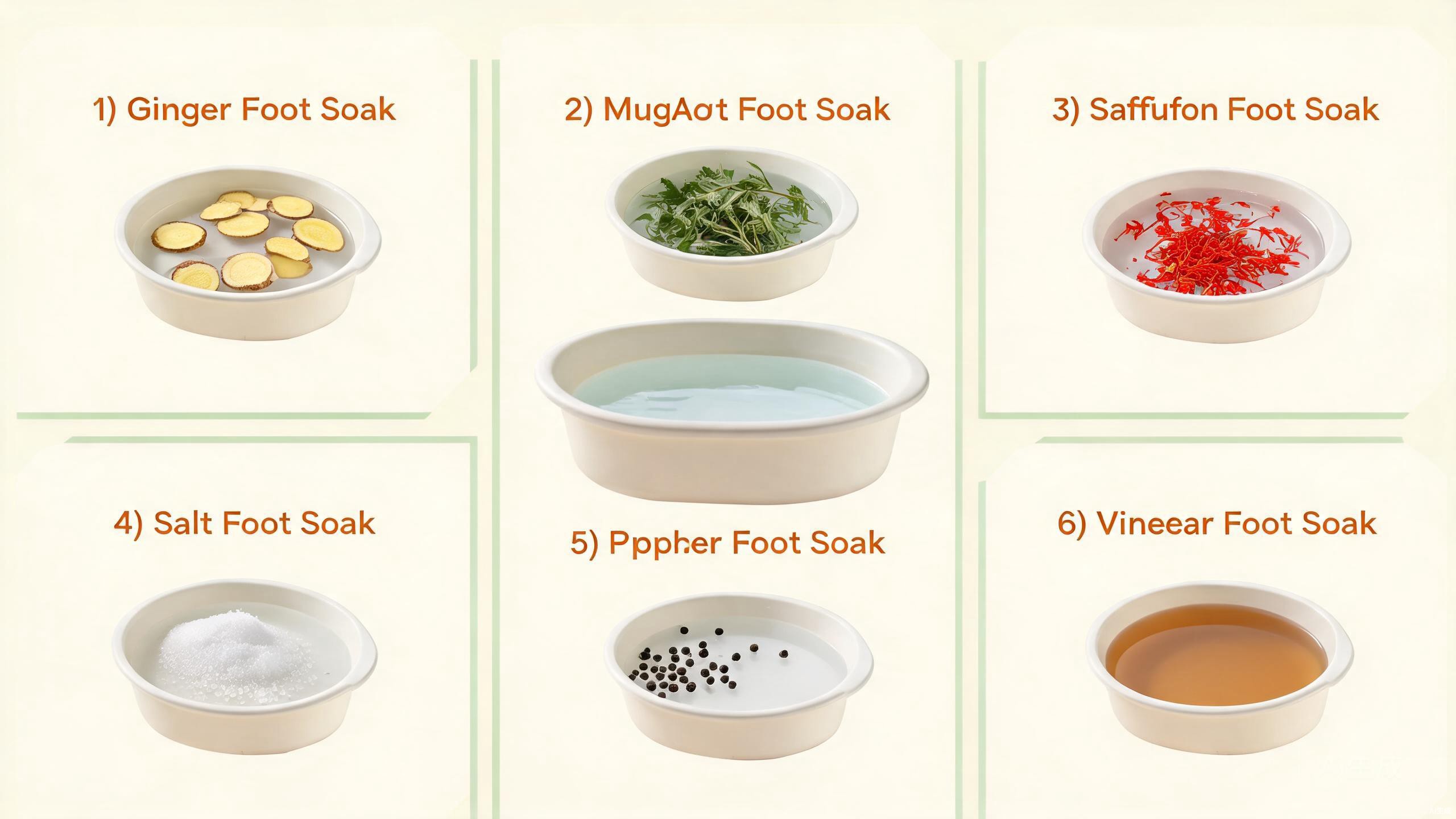
Key Takeaways
- In TCM, the feet are called the second heart — they are where six major meridians converge, and the kidney meridian begins at the sole.
- Ginger foot soak drives out cold and warms the body — ideal for cold hands and feet.
- Mugwort foot soak warms the meridians and is traditionally used for menstrual comfort and joint warmth.
- Salt water foot soak is the simplest recipe, traditionally used for its cleansing and soothing properties.
- Foot soaks are best done in the evening, 1 to 2 hours before bed. Diabetics, pregnant women, and those with foot wounds should take special precautions.
This article is for wellness education only and is not medical advice, diagnosis, or treatment. Foot soaks are a complementary wellness practice. If you have diabetes, neuropathy, heart disease, are pregnant, or have open wounds on your feet, consult your healthcare provider before foot soaking. Always test water temperature carefully to avoid burns. Read our full disclaimer →
Foot soaking is one of the most beloved and accessible practices in Traditional Chinese Medicine. It requires no special equipment, no difficult techniques, and no hard-to-find ingredients — just warm water, a basin, and a few common herbs or spices from your kitchen. Yet in TCM, this simple act is considered profoundly therapeutic, with roots stretching back thousands of years.
The Chinese have a saying: "the tree withers from its roots, and a person ages from their feet." In TCM theory, the feet are far more than the body's foundation — they are a convergence point for the body's energy system, a gateway to the internal organs, and a powerful tool for influencing overall health. This guide explains the theory behind TCM foot soaking and provides five herbal recipes you can make from ingredients available at any grocery store, Amazon, or iHerb.
The TCM Theory Behind Foot Soaking
TCM views the feet as a vital nexus of the body's meridian system — the network of channels through which qi (vital energy) and blood flow. Three core principles explain why soaking the feet is considered so beneficial:
- The feet are the "second heart." In TCM, the feet are furthest from the heart and most susceptible to cold and stagnation. Soaking in warm water dilates blood vessels, improves circulation, and helps the heart pump blood back from the lower extremities — reducing the workload on the heart and supporting overall circulation.
- Six major meridians converge in the feet. The three yin meridians of the foot (spleen, liver, kidney) begin at the toes, and the three yang meridians (stomach, gallbladder, bladder) end there. This means the feet are a crossroads where the energy of six major organ systems meets. Soaking with specific herbs can influence these channels directly.
- The kidney meridian begins at the sole. The Kidney channel — which in TCM governs the body's foundational essence, willpower, and aging — originates at Yongquan (KD1), the point at the center of the sole. Warming this point is traditionally believed to nourish kidney energy and support vitality. See our guide to Yongquan (KD1) for more on this important point.
When you soak your feet in warm, herb-infused water, the warmth opens the pores and the meridians, allowing the herbal properties to enter through the skin. This is why TCM foot soaks are not just about relaxation — they are a form of transdermal herbal therapy that can warm the body, move qi and blood, drain cold and dampness, and calm the mind.
5 Foot Soak Recipes for Wellness
Each recipe below uses ingredients you can find at a grocery store, Amazon, or iHerb. Choose the one that matches your needs, and prepare it fresh each time for best results.
1. Ginger Foot Soak
Best for: Cold hands and feet, catching a cold, warming the body in winter
Suitable for: People with a cold constitution, those who feel chilly, and anyone wanting to warm up before bed in cold weather.
TCM nature and flavor: Ginger (sheng jiang): pungent, warm. Enters the Spleen, Stomach, and Lung channels.
Traditional use: Ginger is one of the most warming foods in TCM. A ginger foot soak is traditionally used to drive out cold and warm the body, making it ideal for cold extremities, the early stage of a cold (wind-cold type), and general winter wellness. The warming nature of ginger opens the pores and promotes a light sweat, which in TCM helps release cold pathogens from the body's surface.
Materials: 1 large piece of fresh ginger (about 50 grams), sliced. Available at any grocery store.
Water temperature and time: Boil the ginger slices in 2 quarts of water for 10 minutes. Let cool to 40 to 42°C (104 to 108°F). Soak for 15 to 20 minutes, until you feel a slight warmth on the back of your neck or a light sweat.
Precautions: Avoid if you have a wind-heat cold (fever, sore throat, yellow mucus) — ginger's warmth can worsen heat. Do not use if you have foot wounds. See our ginger foot soak guide and TCM ginger medicine guide for more.
Keep a kettle of hot water nearby and add it gradually as the soak water cools, maintaining a comfortable warm temperature throughout the 20 minutes. This is the traditional Chinese method for getting the most from a foot soak.
2. Mugwort Foot Soak
Best for: Menstrual discomfort, joint coldness, warming the meridians, poor sleep
Suitable for: Women with cold-type menstrual cramps, people with cold and aching joints, and those who sleep poorly due to cold feet.
TCM nature and flavor: Mugwort (ai ye): bitter, pungent, warm. Enters the Liver, Spleen, and Kidney channels.
Traditional use: Mugwort is one of the most important warming herbs in TCM, closely associated with moxibustion. A mugwort foot soak is traditionally used to warm the meridians and scatter cold, making it valued for menstrual comfort (especially cold-type cramps), joint warmth, and promoting deep sleep. Its warming, penetrating nature reaches deep into the channels in a way that plain warm water cannot.
Materials: 30 to 50 grams of dried mugwort. Available from Amazon, iHerb, and Asian markets. Search for "dried mugwort" or "ai ye."
Water temperature and time: Boil the dried mugwort in 2 quarts of water for 10 to 15 minutes. Strain the liquid into your foot basin and let cool to 40 to 42°C. Soak for 15 to 20 minutes. See our mugwort foot soak guide and moxibustion guide for more.
Precautions: Avoid during pregnancy. Mugwort is warming — avoid if you have a yin deficiency with heat signs (night sweats, dry mouth, red tongue). Do not use during an active fever.
3. Sichuan Peppercorn Foot Soak
Best for: Deep cold, dampness, foot odor, digestive cold
Suitable for: People with chronic cold feet, damp-body type, foot odor concerns, and those who feel cold in the abdomen and stomach.
TCM nature and flavor: Sichuan peppercorn (hua jiao): pungent, warm. Enters the Spleen, Stomach, and Kidney channels.
Traditional use: Sichuan peppercorn is a warming spice that is traditionally used to warm the middle and scatter cold. Unlike ginger, which warms the surface, Sichuan peppercorn has a deeper, more penetrating warmth that reaches the internal organs. A foot soak with Sichuan peppercorns is traditionally used for deep-seated cold, dampness in the lower body, and foot odor (the spice's natural antibacterial properties may help). It is also valued for warming the spleen and stomach through the foot's meridian connections.
Materials: 30 grams of whole Sichuan peppercorns. Available in the spice aisle of most supermarkets, Amazon, and Asian markets.
Water temperature and time: Boil the peppercorns in 2 quarts of water for 10 minutes. Let cool to 40 to 42°C. Soak for 15 to 20 minutes. The water will have a distinctive numbing, spicy aroma.
Precautions: Avoid during pregnancy. The numbing sensation of Sichuan peppercorn is normal and part of its therapeutic action. Do not ingest the soak water.
4. Safflower Foot Soak
Best for: Poor circulation, cold and numb feet, menstrual blood stasis, recovery from injury
Suitable for: People with poor peripheral circulation, numb or cold feet, and women with menstrual discomfort related to blood stagnation.
TCM nature and flavor: Safflower (hong hua): pungent, warm. Enters the Heart and Liver channels.
Traditional use: Safflower is one of TCM's most important blood-invigorating and stasis-resolving herbs. A safflower foot soak is traditionally used to activate blood circulation and unblock the channels, making it ideal for cold, numb feet, poor peripheral circulation, and menstrual discomfort caused by blood stagnation. It is also valued for supporting recovery from bruises and injuries (once the acute phase has passed).
Materials: 15 to 20 grams of dried safflower flowers. Available from Amazon, iHerb, and Chinese herb shops. Search for "dried safflower" or "hong hua."
Water temperature and time: Boil the safflower in 2 quarts of water for 10 minutes. Let cool to 40 to 42°C. Soak for 15 to 20 minutes. The water will turn a beautiful deep yellow to orange color.
Precautions: Safflower is strictly contraindicated during pregnancy — it can stimulate uterine contractions. Avoid if you take blood-thinning medication or have a bleeding disorder. See our safflower tea guide for more on this herb.
5. Salt Water Foot Soak
Best for: Daily wellness, foot fatigue, soothing and cleansing
Suitable for: Everyone — this is the simplest and most versatile foot soak, safe for regular daily use.
TCM nature and flavor: Salt: salty, cold. Enters the Kidney, Stomach, and Large Intestine channels.
Traditional use: In TCM, salt has a special relationship with the kidney meridian — its salty flavor "enters the kidney." A salt water foot soak is traditionally used to support kidney energy, soothe tired feet, and promote cleansing. The salt's natural properties may also help with foot odor and minor skin concerns. This is the most accessible foot soak of all, requiring only salt and warm water, and is suitable for those who are sensitive to or cannot obtain herbal ingredients.
Materials: 2 to 3 tablespoons of sea salt or Epsom salt. Available at any grocery store or pharmacy.
Water temperature and time: Dissolve the salt in 2 quarts of warm water (38 to 42°C). Soak for 15 to 20 minutes. Epsom salt (magnesium sulfate) is particularly popular for its muscle-relaxing properties.
Precautions: Very safe for regular use. If you have high blood pressure, use moderate amounts of salt. Avoid if you have open wounds on the feet, as salt water can sting.
Choosing the Right Foot Soak for Your Needs
| Your Need | Best Soak | Key Ingredient | Frequency |
|---|---|---|---|
| Cold hands and feet, winter warmth | Ginger Foot Soak | Fresh ginger | 3 to 5 times per week |
| Menstrual cold cramps, joint coldness | Mugwort Foot Soak | Dried mugwort | 2 to 3 times per week |
| Deep cold, foot odor, dampness | Sichuan Peppercorn Soak | Sichuan peppercorns | 2 to 3 times per week |
| Poor circulation, numb feet, blood stasis | Safflower Foot Soak | Dried safflower | 2 to 3 times per week |
| Daily wellness, tired feet, relaxation | Salt Water Soak | Sea salt or Epsom salt | Daily |
| Early stage cold (wind-cold type) | Ginger Foot Soak | Fresh ginger | Once, at first sign |
Best Time and Practice for Foot Soaking
Getting the timing and method right makes a significant difference in the effectiveness of your foot soak. TCM offers specific guidance:
- Best time: evening, 7 to 9 p.m. In the TCM organ clock, 7 to 9 p.m. is the time of the pericardium and is closely linked to the kidney meridian. Soaking at this hour is traditionally believed to nourish kidney energy and promote deep, restful sleep. See our best TCM teas for sleep guide for complementary sleep practices.
- Soak 1 to 2 hours before bed. This allows the warming effect to settle and supports the body's natural wind-down. Avoid soaking right before bed if it makes you feel too energized.
- Duration: 15 to 20 minutes. The goal is a light sweat on the back of the neck or forehead — this signals that the warming effect has reached the whole body. Do not soak for more than 30 minutes, as this can deplete energy.
- Water temperature: 38 to 42°C (100 to 108°F). Warm but not scalding. Always test with your hand first. Keep a kettle of hot water nearby to maintain temperature.
- Water level: above the ankles. Ideally, the water should cover the ankle bone, where many important acupoints are located. A deeper basin that reaches mid-calf is even better.
- After soaking: Dry your feet thoroughly, put on warm socks, and avoid walking on cold floors or going outside for at least 30 minutes. This prevents cold from re-entering through the opened pores.
- Avoid soaking: within 30 minutes of a full meal, when very hungry, or after drinking alcohol. These conditions can cause dizziness or discomfort during the soak.
Contraindications and Safety
While foot soaks are generally safe and beneficial, certain conditions require caution or avoidance:
The following groups should consult their healthcare provider before regular foot soaking, and in some cases should avoid it entirely:
- Diabetes with neuropathy: Nerve damage in the feet can reduce sensation, making it difficult to judge water temperature and increasing the risk of burns. If you have diabetic neuropathy, use a thermometer to verify water temperature (never above 38°C / 100°F) and consult your healthcare provider.
- Open wounds or infections: Do not soak if you have cuts, blisters, ulcers, or fungal infections on your feet, as soaking can worsen these conditions. Wait until fully healed.
- Pregnancy: Avoid mugwort and safflower foot soaks entirely during pregnancy, as these herbs can stimulate the uterus. Plain warm water or mild salt soaks are generally acceptable, but consult your healthcare provider first.
- Severe heart disease: Hot foot soaks can increase blood flow to the legs and temporarily affect blood pressure. If you have heart disease or very low blood pressure, use lukewarm (not hot) water and keep sessions short (10 minutes). Consult your doctor.
- Menstrual period: Some women find warm foot soaks soothing during menstruation, while others may experience increased flow. Avoid safflower soaks during heavy menstrual bleeding.
- Children: Foot soaks are not recommended for young children, whose skin is more sensitive. For older children, use lukewarm water only.
- General safety: Never use water that feels uncomfortably hot. Always test temperature with your wrist or a thermometer. Stop immediately if you feel dizzy, lightheaded, or uncomfortable.
For more on TCM home therapies, see our guides on cupping at home, gua sha for beginners, and meditation.
Frequently Asked Questions
How long should a TCM foot soak last?
A TCM foot soak typically lasts 15 to 20 minutes, or until you feel a slight sweat on the back of your neck or forehead. Avoid soaking for more than 30 minutes, as prolonged soaking can deplete energy. The water temperature should be between 38 and 42 degrees Celsius (100 to 108 degrees Fahrenheit) — warm but not scalding.
When is the best time to do a foot soak?
The best time is in the evening, 1 to 2 hours before bed, ideally between 7 and 9 p.m. This is the TCM kidney meridian time, and soaking at this hour is traditionally believed to support the kidneys and promote deep sleep. Avoid soaking within 30 minutes of eating a full meal or immediately after drinking alcohol.
Can I foot soak every day?
For most healthy adults, daily foot soaks during colder months are fine and traditionally encouraged. In warmer months, 3 to 4 times per week is sufficient. If you feel tired or dizzy after soaking, reduce frequency. Diabetics, pregnant women, and those with heart conditions should consult their healthcare provider before regular foot soaking.
Who should not do foot soaks?
Avoid foot soaks if you have diabetes with neuropathy (due to burn risk), open wounds or infections on the feet, severe heart disease, very low blood pressure, or are in the first trimester of pregnancy. Always test water temperature with your hand first, and never use water that feels uncomfortably hot.
The Bottom Line
Foot soaking is one of the simplest, most accessible, and most rewarding practices in TCM home therapy. By understanding that the feet are a convergence point for six major meridians and the starting point of the kidney channel, we can appreciate why this simple act has been valued for millennia. The five recipes in this guide cover the full range of needs: ginger for warming and cold-dispelling, mugwort for meridian-warming and menstrual comfort, Sichuan peppercorn for deep cold and dampness, safflower for blood circulation, and salt for daily wellness and cleansing. All ingredients are available from your grocery store, Amazon, or iHerb. Soak in the evening, 1 to 2 hours before bed, for 15 to 20 minutes at a comfortable warm temperature, and give yourself this daily gift of warmth, circulation, and rest. Always respect the contraindications — especially if you have diabetes, are pregnant, or have heart conditions — and consult your healthcare provider when in doubt.
This article is for educational and informational purposes only and is not a substitute for professional medical advice, diagnosis, or treatment. These statements have not been evaluated by the FDA. Always consult a qualified healthcare provider before beginning any new wellness practice, especially if you are pregnant, nursing, taking medication, or have a medical condition. Read our full disclaimer →