Key Takeaways
- TCM views lower back pain through four patterns: kidney deficiency, cold-damp invasion, blood stasis, and overwork strain.
- The core principle: the Kidney governs the lower back — kidney weakness underlies most chronic lower back ache.
- Five acupressure points — BL23, BL40, Yaoyan, GV4, and BL60 — may support circulation and ease discomfort.
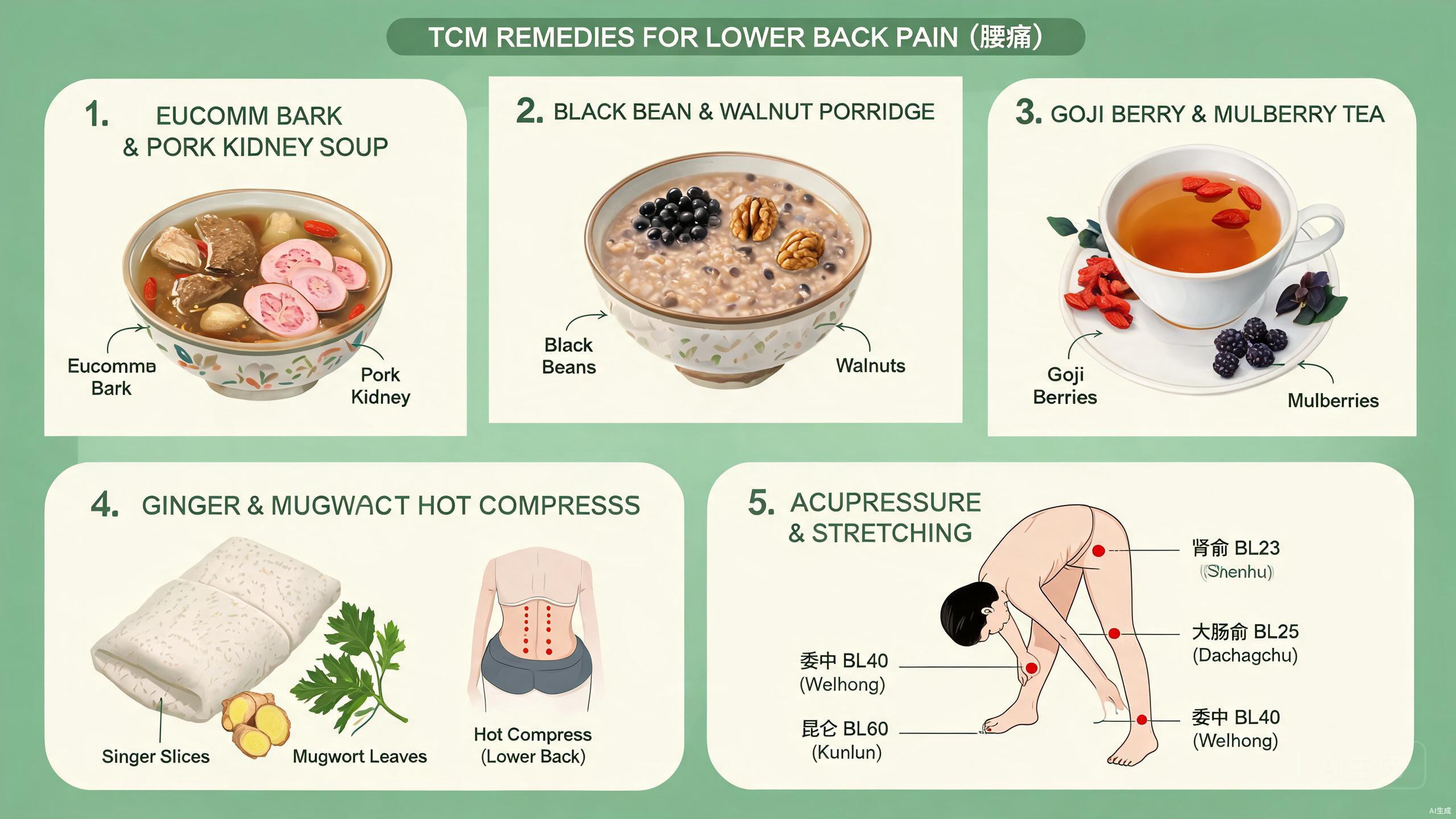
- Four recipes — eucommia pork kidney soup, walnut black bean porridge, dong quai ginger lamb soup, and coarse salt hot compress — traditionally nourish the Kidney and warm the lower back.
- All ingredients are available at Western supermarkets, Amazon, or iHerb. These are wellness practices, not medical treatments.
This article is for educational purposes only and is not medical advice. The practices described are traditional wellness practices, not a substitute for professional medical care. Lower back pain can indicate serious conditions including herniated discs, kidney infections, spinal fractures, and nerve compression. Never stop or adjust prescribed medication based on this article. Some herbs and points are not suitable during pregnancy. Always consult your healthcare provider before beginning any new wellness practice. These statements have not been evaluated by the FDA.
Lower back pain affects an estimated 80 percent of adults at some point in their lives. Traditional Chinese Medicine (TCM) offers a complementary framework built on a key insight: the lower back is governed by the Kidney, and most chronic lower back pain reflects kidney weakness combined with circulatory stagnation. This guide covers four TCM patterns, five acupressure points, and four food therapy recipes. For related topics, see TCM for joint pain, bone and joint health, swelling and pain relief, and acupressure for back pain.
How TCM Views Lower Back Pain
In TCM, the lower back is the physical territory of the Kidney organ system. The Huangdi Neijing states: "The Kidney governs the bones" and "generates marrow." When kidney energy is abundant, the lower back is strong; when it depletes through aging or overwork, the lower back becomes vulnerable. TCM identifies four primary patterns:
Kidney Deficiency (Shen Xu)
The most common pattern in chronic lower back pain. The Kidneys store essence (jing), which declines with age. The pain is dull, deep, and aching, worsens with fatigue, and improves with rest and warmth. It often accompanies weak knees, frequent urination, and cold sensations in the lower back.
Cold-Damp Invasion (Han Shi)
External cold and dampness penetrate the body from cold environments or damp clothing. Cold causes contraction; dampness is heavy and sticky. Together they lodge in the lower back, producing heavy, stiff, aching pain that worsens in cold or damp weather and improves with warmth. This pattern often overlays kidney deficiency.
Blood Stasis (Yu Xue)
Blood stagnation from injury, trauma, or chronic qi stagnation. The TCM principle is "where there is no flow, there is pain". The pain is sharp, stabbing, and fixed in a specific spot, worsening with pressure and movement.
Overwork and Strain (Lao Sun)
Gradual damage from repetitive labor, poor posture, prolonged sitting, or heavy lifting. This combines local qi-blood stagnation with progressive kidney depletion. The pain is achy and fatiguing, worse after activity. Common in modern desk workers. For complementary movement, see our Ba Duan Jin qigong and Tai Chi basics guides.
In practice, lower back pain often involves multiple patterns. A qualified TCM practitioner uses tongue and pulse diagnosis to determine the dominant pattern and tailor the approach.
Five Acupressure Points for Lower Back Pain
Acupressure — applying firm, steady pressure to specific points — is one of the most accessible TCM self-care tools. The five points below strengthen the Kidney, unblock the Bladder meridian (which runs along the spine and down the backs of the legs), and promote circulation. For all points: use your thumb or knuckle, apply firm but tolerable pressure until you feel a dull ache (the Deqi sensation), hold for 1 to 3 minutes per side, and practice 2 to 3 times daily during flare-ups or once daily for prevention. For back points you cannot reach, use tennis balls against a wall or on the floor.
1. Shenshu (BL23) — The Kidney Transport Point
Location: On the lower back, about two finger-widths lateral to the spine at waist level (level with the second lumbar vertebra). Place your hands on your waist with thumbs toward the spine — the thumbs land near these points.
How to press: Lie on your back and place two tennis balls under the points, letting body weight provide steady pressure. Alternatively, make soft fists and rub up and down with the knuckles, or have a partner press with both thumbs using circular motion. A heated rice bag enhances the effect.
Pressure: Moderate to firm. Duration: 2 to 3 minutes per side. Frequency: 1 to 2 times daily.
What it does: Shenshu is the back-shu point of the Kidney — where Kidney energy gathers on the back. It tonifies the Kidney, strengthens the lower back, and benefits the bones. Essential for chronic, dull, deep lower back pain associated with kidney deficiency.
Precautions: Do not press directly on the spine. Avoid deep pressure during pregnancy.
2. Weizhong (BL40) — The Master Point for Back Pain
Location: At the center of the crease at the back of the knee, in the soft hollow of the popliteal fossa. Sit on a chair, cross one ankle over the opposite knee, and find the center of the horizontal crease between the tendons.
How to press: Use your thumbs to press firmly into the center of the crease with a slow circular motion. Press for 1 to 2 minutes on each knee. If very tender, that tenderness confirms the point is active — press through it gently until the ache softens.
Pressure: Moderate to strong. Duration: 1 to 2 minutes each knee. Frequency: 2 to 3 times daily during flare-ups.
What it does: Weizhong is the most famous point in Chinese medicine for back pain. The classic saying: "For back pain, seek Weizhong" (腰背委中求). The Bladder meridian passes through the knee and continues up the back, so releasing Weizhong clears stagnation along the entire channel governing the spine.
Precautions: Avoid pressing on varicose veins or swollen areas. Do not apply pressure if you have a blood clot.
3. Yaoyan (EX-B7) — The Waist Eyes
Location: In the two soft depressions just below the fourth lumbar vertebra, about four to five finger-widths from the spine. Find the natural dimples at the top of your buttocks — the points sit in or near those dimples.
How to press: Lie on your back and place tennis balls under the points, or have a partner press with both thumbs. You can also make fists and rub briskly in circles with the knuckles — this "rubbing the kidneys" technique is a traditional daily longevity practice.
Pressure: Moderate, using circular rubbing. Duration: 2 to 3 minutes. Frequency: 1 to 2 times daily.
What it does: Yaoyan is a local point that directly relaxes the lumbar muscles and gluteal attachment. Especially good for the aching, heavy, fatigued lower back from standing, lifting, or chronic weakness.
Precautions: Avoid deep pressure during pregnancy. If the area is acutely inflamed, use the leg points instead.
4. Mingmen (GV4) — The Gate of Life
Location: On the posterior midline of the spine at waist level, in the depression below the spinous process of the second lumbar vertebra — directly between the two Shenshu (BL23) points.
How to press: Do not press directly on the bone. Instead, use a warm palm rub — rub both palms together briskly until warm, then place them flat over the lower back with the center over Mingmen. A heated rice bag or hot water bottle also works well.
Pressure: Light to moderate — this point responds more to warmth than pressure. Duration: 1 to 2 minutes. Frequency: 1 to 2 times daily.
What it does: Mingmen ("Gate of Life") is the source of Kidney Yang — the body's warming fire. It warms and strengthens the lower back, tonifies Kidney Yang, and dispels cold. Ideal for cold-type pain that feels cold to the touch and worsens in winter. For more warming therapies, see our moxibustion guide and moxa for cold-type conditions.
Precautions: Never press directly on the bony spine. Avoid during pregnancy. Do not apply heat if the area is hot, red, or inflamed.
5. Kunlun (BL60) — The Kunlun Mountains
Location: On the outer ankle, in the depression between the highest point of the lateral malleolus (outer ankle bone) and the Achilles tendon. Slide your finger from the ankle bone backward toward the heel to find the hollow.
How to press: Use your thumb to press inward and slightly upward toward the ankle bone. Apply moderate pressure with gentle circular motion for 1 to 2 minutes on each ankle. Support the foot with your other hand.
Pressure: Moderate. Duration: 1 to 2 minutes each ankle. Frequency: 1 to 2 times daily.
What it does: Kunlun relieves back pain, unblocks the meridian, and drains stagnation downward. As the last major point on the Bladder meridian, it draws stagnant energy downward and out, relieving pressure along the entire channel. Excellent for stiff lower back pain that radiates down the legs.
Precautions: Avoid during pregnancy — Kunlun is traditionally used to promote labor. Do not press on sprained or swollen ankles.
Quick Comparison of the Five Points
| Point | Location | Primary Traditional Use | Duration | Key Precaution |
|---|---|---|---|---|
| Shenshu (BL23) | Lower back, 2 finger-widths from spine | Tonify Kidney, strengthen lower back | 2–3 min | Avoid deep pressure in pregnancy |
| Weizhong (BL40) | Center of back of knee crease | Master point for all back pain | 1–2 min each | Avoid if blood clot present |
| Yaoyan (EX-B7) | Dimples at top of buttocks | Local lumbar muscle relaxation | 2–3 min | Avoid deep pressure in pregnancy |
| Mingmen (GV4) | Spine at waist level (midline) | Warm Kidney Yang, dispel cold | 1–2 min | Do not press on bone; use warmth |
| Kunlun (BL60) | Depression behind outer ankle | Drain stagnation, relieve radiating pain | 1–2 min each | Avoid during pregnancy |
Press the points in order: Weizhong (BL40) on both knees to open the channel, Kunlun (BL60) on both ankles to drain stagnation, warm palm over Mingmen (GV4), then tennis-ball pressure on Shenshu (BL23) and Yaoyan. Total time: 10 to 15 minutes. A warm ginger foot soak afterward may further support circulation.
Four Food Therapy Recipes for Lower Back Pain
In TCM, food and medicine share the same origin. The four recipes below traditionally nourish the Kidney, warm the lower back, dispel cold-damp, and promote circulation. All ingredients are available at Western supermarkets, Amazon, or iHerb. For more, see our everyday TCM kitchen remedies and bone broth guide.
1. Eucommia and Pork Kidney Soup (杜仲猪腰汤)
TCM nature: Warm, nourishing. Enters: Kidney and Liver channels.
This famous recipe is based on the TCM principle of "like nourishes like" — consuming an animal kidney to nourish the human Kidney. Eucommia bark (Du Zhong) is a premier kidney-strengthening herb, traditionally used to tonify Kidney Yang, strengthen tendons and bones, and soothe the lower back.
Ingredients: 1 pork kidney (butchers or Asian markets), 10–15g eucommia bark (Amazon or iHerb), 3 slices fresh ginger, 4 cups water, pinch of salt.
How to prepare: Halve the kidney, remove the white membrane, slice thinly, and soak in water with rice wine for 15 minutes. Place eucommia bark in a cloth bag. Combine kidney, eucommia bag, ginger, and water. Boil, then simmer 30 to 40 minutes. Remove the bag, add salt, and drink the soup. Consume 1 to 2 times weekly.
Precautions: Consult your doctor if you take blood pressure medication. Those with gout should limit organ meats.
2. Walnut and Black Bean Porridge (核桃黑豆粥)
TCM nature: Sweet, warm. Enters: Kidney and Spleen channels.
Walnuts are a traditional kidney tonic, said to warm the kidneys and strengthen the lower back. Black beans are associated with the Kidney through their dark color (per five elements theory). Together in a rice porridge, they create a gentle, warming everyday food.
Ingredients: 1/2 cup white rice, 1/4 cup dried black beans, 6–8 walnut halves (chopped), 5 cups water, pinch of salt.
How to prepare: Soak black beans overnight. Combine rice, beans, walnuts, and water. Boil, then simmer 45 to 60 minutes until thick and tender. Add salt. Eat warm, ideally in the morning. Consume 2 to 3 times weekly.
Precautions: Walnuts are a tree nut allergen. Black beans may cause bloating; soaking and thorough cooking help.
3. Dong Quai Ginger Lamb Soup (当归生姜羊肉汤)
TCM nature: Warm, blood-invigorating. Enters: Kidney, Liver, and Spleen channels.
This celebrated recipe originates from the classical text Jingui Yaolue (circa 200 CE). Dong quai (Angelica sinensis) is the premier blood-nourishing herb in TCM. Ginger dispels cold. Lamb is the warmest common meat, traditionally used to tonify Kidney Yang.
Ingredients: 1/2 pound lamb (bone-in preferred), 10–15g dong quai root (Amazon or iHerb), 5–6 slices fresh ginger, 6 cups water, 1 tablespoon rice wine (optional), pinch of salt.
How to prepare: Cut lamb into chunks, blanch 2 to 3 minutes, drain. Combine lamb, dong quai, ginger, rice wine, and water. Boil, then simmer 1.5 to 2 hours until lamb is tender. Add salt. Drink broth and eat lamb. Consume 1 to 2 times weekly in colder months.
Precautions: Not recommended during pregnancy or menstruation — dong quai may increase bleeding. Avoid with blood-thinning medications.
4. Coarse Salt Hot Compress (粗盐热敷)
TCM nature: Warm, penetrating. External application.
Coarse salt retains heat for a long time. When warmed and applied to the lower back, it provides deep, penetrating warmth that may help dispel cold, relax muscles, and promote circulation. In TCM, salt is associated with the Kidney, making it especially appropriate for lower back use.
Ingredients: 2 to 3 cups coarse salt (rock salt or coarse sea salt), a clean cotton cloth or pillowcase.
How to prepare: Heat salt in a dry pan over medium heat for 5 to 8 minutes, stirring constantly. Pour into a cotton cloth, fold into a flat pouch. Test temperature on your wrist first. Lie face down and place the warm pouch over the lower back. Rest for 15 to 20 minutes. Use 1 to 2 times daily, especially in the evening.
Precautions: Always test temperature to avoid burns. Do not use on broken skin. Not for hot, red, or inflamed areas.
When to See a Doctor
These practices are complementary wellness traditions, not medical treatments. Seek medical attention if you experience:
- Pain after a fall or accident with deformity or inability to move
- Pain radiating down the leg with numbness, tingling, or weakness (possible herniated disc)
- Loss of bladder or bowel control or groin numbness (medical emergency)
- Fever, chills, or unexplained weight loss with back pain
- Pain that worsens at night or persists beyond a few weeks
Consult your doctor before adding new herbs — particularly dong quai with blood thinners. See our herbal tea safety guide and acupressure safety guide for more information.
The Bottom Line
TCM for lower back pain offers a systematic, individualized framework. By understanding whether your pain reflects kidney deficiency, cold-damp, blood stasis, or overwork strain, you can choose acupressure points and foods that address the underlying pattern. Five minutes of acupressure on Weizhong and Kunlun, a warm palm over Mingmen, or a coarse salt compress before bed — these small, consistent practices may gradually support circulation and strengthen the Kidney.
But these are traditions, not treatments. Work with a qualified healthcare provider to identify the cause. For broader guides, see TCM for joint pain and our TCM self-massage guide.
Frequently Asked Questions
How long does it take for acupressure to help with lower back pain?
Many people feel relief within 15 to 30 minutes, especially from leg points like Weizhong (BL40) and Kunlun (BL60). For chronic pain, consistent practice two to three times daily for one to two weeks typically brings noticeable improvement. Acupressure works cumulatively — regular practice may produce better results than occasional use.
Can I do acupressure for lower back pain every day?
Yes, it is generally safe to practice daily. For acute flare-ups, press two to three times daily; for prevention, once daily suffices. Each session takes 10 to 15 minutes. If muscles feel sore, take a day off. Stop immediately if you feel sharp or shooting pain. Combine with gentle movement like Ba Duan Jin qigong for best results.
Is it safe to press lower back acupressure points during pregnancy?
Caution is essential. Kunlun (BL60) is traditionally used to promote labor and must be avoided during pregnancy. Avoid deep pressure on lower back points (BL23, Yaoyan, GV4), especially in the third trimester. Weizhong (BL40) with light pressure is generally safer. Always consult your obstetrician first. See our acupressure safety guide for details.
Where can I buy TCM herbs like eucommia bark and dong quai?
Both are widely available on Amazon and iHerb as dried herbs, tea bags, or powder extracts, and at Asian grocery stores. Walnuts, black beans, lamb, ginger, and coarse salt are available at any Western supermarket. Look for reputable brands that test for quality. Always consult your healthcare provider before taking new herbs, especially if you take medication or are pregnant.
This article shares traditional wellness practices for educational purposes only — not medical advice, diagnosis, or treatment. The practices described are not intended to treat, cure, or prevent any disease. Dong quai is not recommended during pregnancy or menstruation. Kunlun (BL60) must be avoided during pregnancy. If you experience sudden, severe, or persistent lower back pain, leg numbness, weakness, fever, or loss of bladder or bowel control, seek medical attention immediately. Consult your healthcare provider before making any changes, especially if you take blood thinners or blood pressure medication. These statements have not been evaluated by the FDA. Read our full disclaimer →