Key Takeaways
- A core TCM principle states that "the Kidney governs the bones" (shen zhu gu) — bone strength is believed to depend on the health and reserve of Kidney essence.
- The Liver governs the tendons (gan zhu jin) — joint flexibility and tendon health are linked to Liver blood nourishment.
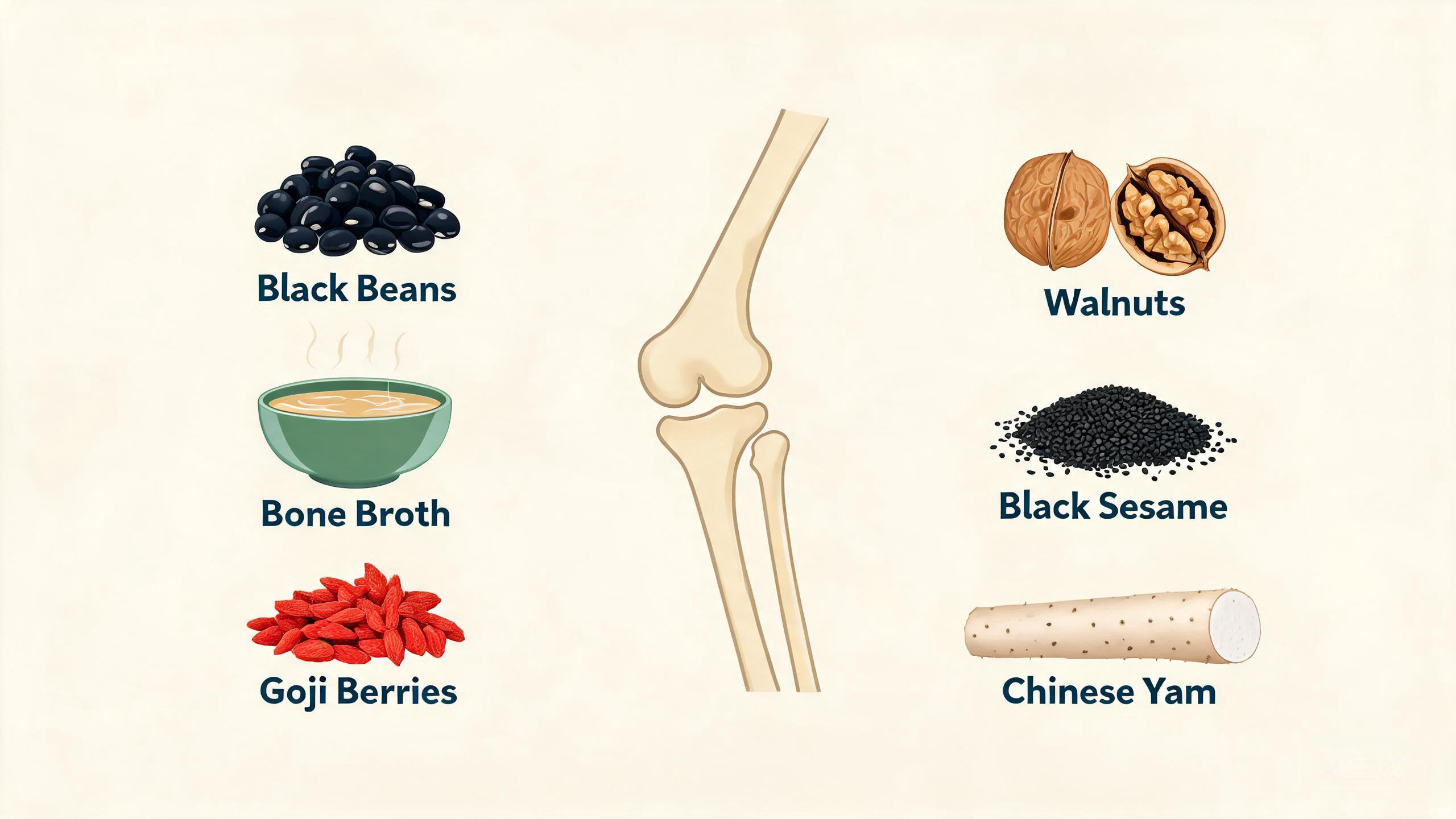
- Five everyday foods — black beans, walnuts, bone broth, black sesame soy milk, and shrimp shell powder — are traditionally used to nourish the Kidney and support skeletal strength.
- Bone broth reflects the TCM "like nourishes like" principle — the idea that consuming animal bones can nourish human bones.
- These are traditional dietary practices, not medical treatments. They do not replace calcium supplements or prescribed treatment for osteoporosis.
This article is for educational purposes only and is not medical advice. The foods and practices described here are traditional dietary practices rooted in Chinese culture. They are not a substitute for professional medical care. TCM dietary foods are not a replacement for calcium supplements, vitamin D, prescribed medications, or medical treatment for conditions such as osteoporosis, osteopenia, arthritis, or other bone and joint diseases. If you have been diagnosed with a bone or joint condition, or if you are concerned about your bone density, work closely with your healthcare provider on a comprehensive management plan. Some foods may interact with medications or may not be appropriate for certain conditions (such as gout or high cholesterol). Always inform your doctor about all dietary changes you are making. These statements have not been evaluated by the FDA and are not intended to diagnose, treat, cure, or prevent any disease.
Bone and joint health becomes increasingly important as we age. In Traditional Chinese Medicine, the skeletal system is not viewed as an isolated structure of calcium and collagen. Instead, it is intimately connected to the body's internal organ systems — particularly the Kidney and the Liver. This connection, established in classical texts over 2,000 years ago, forms the foundation of TCM's dietary approach to supporting bone strength, joint mobility, and skeletal wellness throughout life.
If you are new to TCM concepts, our introduction to Traditional Chinese Medicine and our guide to Zang-Fu organ systems provide helpful background before diving in.
How TCM Views Bones and Joints
Two fundamental principles in TCM theory govern the health of the skeletal and musculoskeletal system. Understanding these principles is key to understanding why certain foods are traditionally associated with bone health.
The Kidney Governs the Bones (Shen Zhu Gu, 肾主骨)
This is one of the most important and frequently cited principles in TCM. The classical text known as the Huangdi Neijing (Yellow Emperor's Inner Canon), written over 2,000 years ago, states clearly: "The Kidney governs the bones" and "The Kidney generates marrow." In TCM theory, the Kidneys store essence (jing) — the body's constitutional reserve that governs growth, reproduction, and aging. This essence is said to transform into marrow, which fills the bones and gives them their strength and density.
When kidney essence is abundant, the bones are strong and the teeth are firm. When kidney essence depletes — whether through natural aging, chronic illness, or overwork — the bones may become weaker, the teeth may loosen, and the joints may lose their resilience. This TCM concept aligns, in a broad sense, with the modern understanding that bone density declines with age and that hormonal changes (which TCM associates with the Kidney system) play a central role in bone metabolism. For more on the Kidney system, see our guides on Zang-Fu organs and yin and yang.
The Liver Governs the Tendons (Gan Zhu Jin, 肝主筋)
The second key principle is that "the Liver governs the tendons." In TCM, the term "tendons" (jin, 筋) encompasses tendons, ligaments, and to some extent the fascia and connective tissue that support joint function. The Liver is responsible for storing blood and ensuring the smooth flow of qi throughout the body. When Liver blood is abundant, the tendons are supple and flexible, and joints move with ease. When Liver blood is deficient — which can happen with aging, poor nutrition, or overwork — the tendons may become stiff, joints may feel tight or restricted, and cramps or spasms may occur.
This means that TCM approaches joint health from two directions: nourishing the Kidney to support bone strength, and nourishing the Liver to support tendon and ligament flexibility. The foods described below address both of these systems. To understand how qi and blood circulation relates to joint and musculoskeletal health, see our guide on qi, blood, and body fluids.
Five Everyday TCM Foods for Bone and Joint Health
The following five foods are staples of East Asian kitchens and have been valued in TCM tradition for centuries as foods that may support the organ systems involved in bone and joint health. They are not medicines, and they are not a replacement for calcium supplements, prescribed medications, or medical treatment. TCM emphasizes gentle, consistent dietary nourishment over time — not dramatic interventions.
1. Black Beans (黑豆, Hei Dou)
TCM nature: Sweet, neutral. Enters: Kidney and Spleen channels.
Black beans are one of the most important kidney-nourishing foods in TCM dietary therapy. TCM classifies them as sweet and neutral — a gentle, nourishing food that is traditionally used to "tonify the Kidney," "invigorate blood," and "support water metabolism." In the context of bone health, black beans are valued because of their direct association with the Kidney system: since the Kidney governs the bones, foods that nourish the Kidney are considered supportive of skeletal strength. The dark color of black beans is also significant in TCM theory — dark-colored foods (black beans, black sesame, black rice) are traditionally associated with the Kidney, following the five elements theory, which connects colors to specific organ systems. Nutritionally, black beans are rich in protein, calcium, magnesium, iron, and other minerals that support bone health.
How to prepare: Soak 1/2 cup of dried black beans overnight. Drain and rinse. Simmer in water for 45 to 60 minutes until tender. Add to soups, stews, or rice dishes. A traditional bone-supporting recipe combines black beans with pork bones and a few slices of ginger in a long-simmered soup. Alternatively, cook black beans into a congee with rice. Consume 2 to 3 times per week as part of a regular diet. For more kitchen-based TCM practices, see our guide to everyday TCM kitchen remedies.
Precautions: Black beans are a common food and are generally very safe. Like all legumes, they can cause bloating or gas in some individuals. Soaking and thorough cooking help reduce this. If you have gout, consult your healthcare provider about legume consumption, as beans contain purines.
2. Walnuts (核桃, He Tao)
TCM nature: Sweet, warm. Enters: Kidney, Lung, and Large Intestine channels.
Walnuts appear on this list as well as in our guide to TCM anti-aging foods, because their association with the Kidney system makes them relevant to multiple aspects of health. TCM classifies walnuts as sweet and warm — traditionally used to "tonify Kidney yang," "nourish essence," and "strengthen the lower back and legs." In the context of bone health, walnuts are valued for their kidney-nourishing properties: since the Kidney governs the bones and generates marrow, foods that tonify Kidney essence are considered supportive of skeletal strength. Walnuts are also traditionally recommended for lower back pain and weak knees — symptoms that TCM associates with kidney deficiency. Nutritionally, walnuts are rich in omega-3 fatty acids, which support the body's natural anti-inflammatory processes and may benefit joint health.
How to prepare: Eat 5 to 8 walnut halves per day as a snack. Alternatively, crush walnuts and add to oatmeal, yogurt, salads, or congee. For a traditional kidney-nourishing congee, combine crushed walnuts, black beans, and rice, and simmer into a porridge. Walnuts can also be ground and mixed with black sesame powder for a nutrient-dense spread or drink. Consume daily as part of a regular diet.
Precautions: Walnuts are a common allergen. If you have a tree nut allergy, avoid walnuts entirely. Because walnuts are warm and rich in oils, consume them in moderation if you tend toward internal heat, loose stools, or skin breakouts. Store walnuts in a cool, dry place or refrigerator to prevent rancidity.
3. Bone Broth (骨头汤, Gu Tou Tang)
TCM nature: Sweet, warm, nourishing. Enters: Kidney and Liver channels.
Bone broth is one of the most traditional and intuitively logical foods in TCM for supporting bone health. Its use is based on the TCM principle of "like nourishes like" (yi xing bu xing, 以形补形) — the idea that consuming a specific organ or tissue from an animal can nourish the corresponding organ or tissue in the human body. In this case, consuming animal bones is said to nourish human bones. TCM classifies bone broth as sweet, warm, and deeply nourishing — traditionally used to "tonify Kidney essence," "strengthen bones," "nourish joints," and "benefit the marrow." Long-simmered bone broth is a staple of Chinese home cooking, particularly during winter months when warming, nourishing foods are emphasized. It is rich in collagen, gelatin, calcium, phosphorus, and other minerals that are extracted from the bones during the long cooking process.
How to prepare: Place 1 to 2 pounds of animal bones (pork, beef, or chicken) in a large pot. Add water to cover. Bring to a boil, then skim off any foam. Add a few slices of ginger, 1 tablespoon of rice wine or vinegar (vinegar helps extract minerals from the bones), and optional vegetables such as carrots, daikon, or Chinese yam. Simmer on very low heat for 4 to 8 hours (the longer, the better). Strain the broth. Drink as a warm soup, or use as a base for congee, noodle soups, and stews. Consume 2 to 3 cups per week. Add black beans or walnuts to the broth for enhanced kidney-nourishing effects.
Precautions: Bone broth is rich and warming. If you have gout, high uric acid, or high cholesterol, consult your healthcare provider before consuming bone broth regularly, as it contains purines and fats. Use bones from reputable, high-quality sources. If you have a history of cardiovascular disease, skim the fat from the broth before consuming. Bone broth is a food, not a medication, and does not replace prescribed treatment.
4. Soy Milk with Black Sesame (黑芝麻豆浆, Hei Zhi Ma Dou Jiang)
TCM nature: Sweet, neutral (soy milk); sweet, neutral (black sesame). Enters: Kidney and Liver channels.
This combination brings together two kidney-nourishing foods into a single, convenient drink. Soy milk has been a staple of Chinese diets for over 2,000 years. TCM classifies soybeans as sweet and neutral — traditionally used to "tonify Spleen and Stomach," "nourish blood," and "clear heat." Black sesame, as discussed in our TCM anti-aging foods guide, is one of the most revered kidney-nourishing foods in TCM, traditionally used to "nourish Liver and Kidney," "benefit essence and blood," and "darken the hair." When combined, soy milk and black sesame create a drink that addresses both the Kidney (bone strength) and the Liver (tendon and ligament flexibility) — the two organ systems most relevant to musculoskeletal health. Nutritionally, this combination provides calcium, protein, magnesium, and healthy fats, making it a practical daily source of bone-supporting nutrients.
How to prepare: If using a soy milk maker, add soaked soybeans and 1 tablespoon of toasted, ground black sesame to the machine and process according to instructions. If using store-bought unsweetened soy milk, warm 1 cup and stir in 1 tablespoon of toasted, ground black sesame and a small amount of honey or dates for sweetness. Drink 1 cup per day, preferably in the morning. For best absorption, ensure the black sesame is freshly ground.
Precautions: If you have a soy allergy, avoid soy milk entirely and substitute with rice milk or oat milk. If you have a sesame allergy, omit the black sesame. Those with thyroid conditions should consult their healthcare provider about soy consumption. Choose unsweetened soy milk to avoid excess sugar. Store-bought soy milk with added calcium can provide additional bone-supporting benefits.
5. Shrimp Shell Powder (虾皮, Xia Pi)
TCM nature: Sweet, salty, warm. Enters: Kidney and Liver channels.
Dried small shrimp with their shells (xia pi, sometimes translated as "dried baby shrimp") are a common ingredient in Chinese cooking and a surprisingly rich source of calcium. TCM classifies shrimp as sweet, salty, and warm — traditionally used to "tonify Kidney yang," "strengthen the lower back and legs," and "nourish blood." The shells of shrimp are of particular interest for bone health because they are composed largely of calcium carbonate and chitin, making them one of the most concentrated natural calcium sources in the traditional Chinese diet. In TCM theory, shrimp's association with Kidney yang tonification connects it to the warming, strengthening aspect of the Kidney system, which is said to govern bone strength and the structural integrity of the body. Many Chinese families add dried shrimp to congee, stir-fries, and dumpling fillings as both a flavoring and a nutritional boost.
How to prepare: Rinse 1 to 2 tablespoons of dried shrimp (xia pi) to remove excess salt. Soak in warm water for 10 minutes, then drain. Add to congee, stir-fries, egg dishes, or dumpling fillings. For a calcium-rich seasoning, toast dried shrimp in a dry pan until crisp, then grind into a fine powder. Sprinkle the powder over rice, vegetables, or soups as you would use a seasoning. Consume 1 to 2 tablespoons (with shells) 2 to 3 times per week.
Precautions: Dried shrimp is high in sodium and cholesterol. If you have high blood pressure, high cholesterol, or cardiovascular disease, consume it in moderation and choose low-sodium varieties if available. If you have a shellfish allergy, avoid shrimp entirely. If you have gout, consult your healthcare provider, as shrimp contains purines. The calcium in shrimp shells is not as easily absorbed as calcium from dairy or supplements — this is a traditional food, not a replacement for prescribed calcium supplementation.
Comparison of the Five Bone and Joint Health Foods
| Food | TCM Nature | Traditional Use | Preparation | Typical Frequency |
|---|---|---|---|---|
| Black Beans (Hei Dou) | Sweet, neutral | Tonify kidney, support bones | Simmer in soups or congee | 2–3 times weekly |
| Walnuts (He Tao) | Sweet, warm | Tonify kidney yang, strengthen back | Eat as snack or add to congee | 5–8 halves daily |
| Bone Broth (Gu Tou Tang) | Sweet, warm, nourishing | Tonify kidney essence, strengthen bones | Long-simmer bones, drink as soup | 2–3 cups weekly |
| Black Sesame Soy Milk (Hei Zhi Ma Dou Jiang) | Sweet, neutral | Nourish kidney and liver, provide calcium | Blend soy milk with ground sesame | 1 cup daily |
| Shrimp Shell Powder (Xia Pi) | Sweet, salty, warm | Tonify kidney yang, natural calcium | Add to dishes or grind as seasoning | 1–2 tbsp, 2–3 times weekly |
Joint-Friendly Exercise Tips from a TCM Perspective
In TCM, dietary nourishment and physical movement are inseparable. The classical texts repeatedly emphasize that qi and blood must circulate freely for the body to function well. For bone and joint health specifically, TCM recommends exercises that promote circulation, flexibility, and balance without placing excessive stress on the joints. The following practices are particularly valued:
- Tai Chi (Tai Ji Quan). Perhaps the most famous TCM-associated exercise, tai chi is a slow, flowing sequence of movements that improves balance, flexibility, and joint mobility. Research has shown that regular tai chi practice can help reduce the risk of falls in older adults — a major concern for bone health. Tai chi is gentle on the joints and can be practiced well into advanced age. The emphasis on weight shifting, slow turns, and mindful movement makes it ideal for maintaining joint function.
- Qigong (Qi Gong). Qigong encompasses a broad family of practices that combine gentle movement, breathing, and mental focus. Many qigong routines are specifically designed to circulate qi through the joints and tendons. The Eight Brocades (Ba Duan Jin) is one of the most accessible and widely practiced routines, and includes movements that specifically target the spine, shoulders, and lower back.
- Swimming and water exercise. While not traditionally Chinese, swimming aligns perfectly with TCM principles because it provides full-body movement with minimal joint impact. The buoyancy of water supports the body weight, allowing joints to move through their full range without stress. Swimming is particularly valuable for those with arthritis or joint pain that makes weight-bearing exercise difficult.
- Walking. TCM considers walking to be one of the best daily exercises. It is gentle, accessible, and promotes the smooth flow of qi and blood. A daily walk of 20 to 30 minutes, ideally outdoors, supports both joint health and overall vitality.
- Gentle stretching. Regular, gentle stretching maintains tendon and ligament flexibility — supporting the Liver's role in governing the tendons. Stretching should be slow and held, not forceful or ballistic. Morning stretching routines help prepare the body for the day. For complementary mind-body practices, see our meditation guide.
A simple weekly routine for bone and joint support: include black beans or bone broth in your diet 2 to 3 times per week, drink a cup of black sesame soy milk each morning, snack on a handful of walnuts daily, and sprinkle shrimp shell powder on meals 2 to 3 times per week. Pair this with 20 to 30 minutes of tai chi, qigong, walking, or swimming each day. A warm ginger foot soak in the evening can further support circulation to the lower extremities. This is a sustainable, lifelong approach — not a quick fix.
When to See a Doctor
The foods and practices in this article are complementary dietary traditions, not medical treatments. You should see a healthcare provider if you experience any of the following:
- Bone pain, particularly in the back, hips, or wrists, that is persistent or worsening
- Joint pain, swelling, stiffness, or redness that does not improve
- A fracture from a minor fall or injury (a possible sign of low bone density)
- Loss of height or a stooped posture
- Joint instability or a feeling that a joint may "give way"
- Any new or worsening musculoskeletal symptoms
If you have been diagnosed with osteoporosis, osteopenia, arthritis, or any other bone or joint condition, follow your healthcare provider's recommendations for treatment, including any prescribed medications, calcium and vitamin D supplementation, and exercise guidelines. TCM dietary foods may be used as complementary habits alongside, never in place of, prescribed medical care. If you take any medication, particularly for blood pressure, cholesterol, or gout, speak with your doctor before making significant dietary changes.
The Bottom Line
Traditional Chinese Medicine offers a unique, food-based tradition for supporting bone and joint health. By understanding the core TCM principles — that the Kidney governs the bones and the Liver governs the tendons — you can appreciate why certain foods have been valued for centuries in connection with skeletal wellness. Black beans, walnuts, bone broth, black sesame soy milk, and shrimp shell powder are five everyday foods that generations of East Asian families have incorporated into their diets as part of a whole-person approach to musculoskeletal health. Paired with gentle, joint-friendly exercise like tai chi and swimming, these simple practices form a holistic approach to maintaining bone strength and joint mobility over a lifetime.
But these are traditions — not treatments, and not a replacement for medical care. TCM dietary foods do not replace calcium supplements, prescribed medications, or professional medical treatment for bone and joint conditions. If you have concerns about your bone or joint health, your most important step is to work with a qualified healthcare provider. Use these traditional dietary practices only as complementary habits, with your doctor's knowledge and guidance.
This article shares traditional dietary practices for educational purposes only. It is not a substitute for medical advice, diagnosis, or treatment. The foods described here are not intended to treat, cure, or prevent any disease. TCM dietary foods are not a replacement for calcium supplements, vitamin D, prescribed medications, or medical treatment for osteoporosis, arthritis, or other bone and joint conditions. If you have a health condition or take medication, consult your healthcare provider before making any dietary changes. Some foods, particularly bone broth and shrimp, may not be appropriate for those with gout, high cholesterol, or certain allergies. These statements have not been evaluated by the FDA. Never stop or adjust prescribed medication without your doctor's explicit guidance.