Key Takeaways
- TCM views aging through two key systems: Kidney essence (jing) depletion — the body's constitutional reserve — and Spleen qi decline, which affects energy production and nutrient absorption.
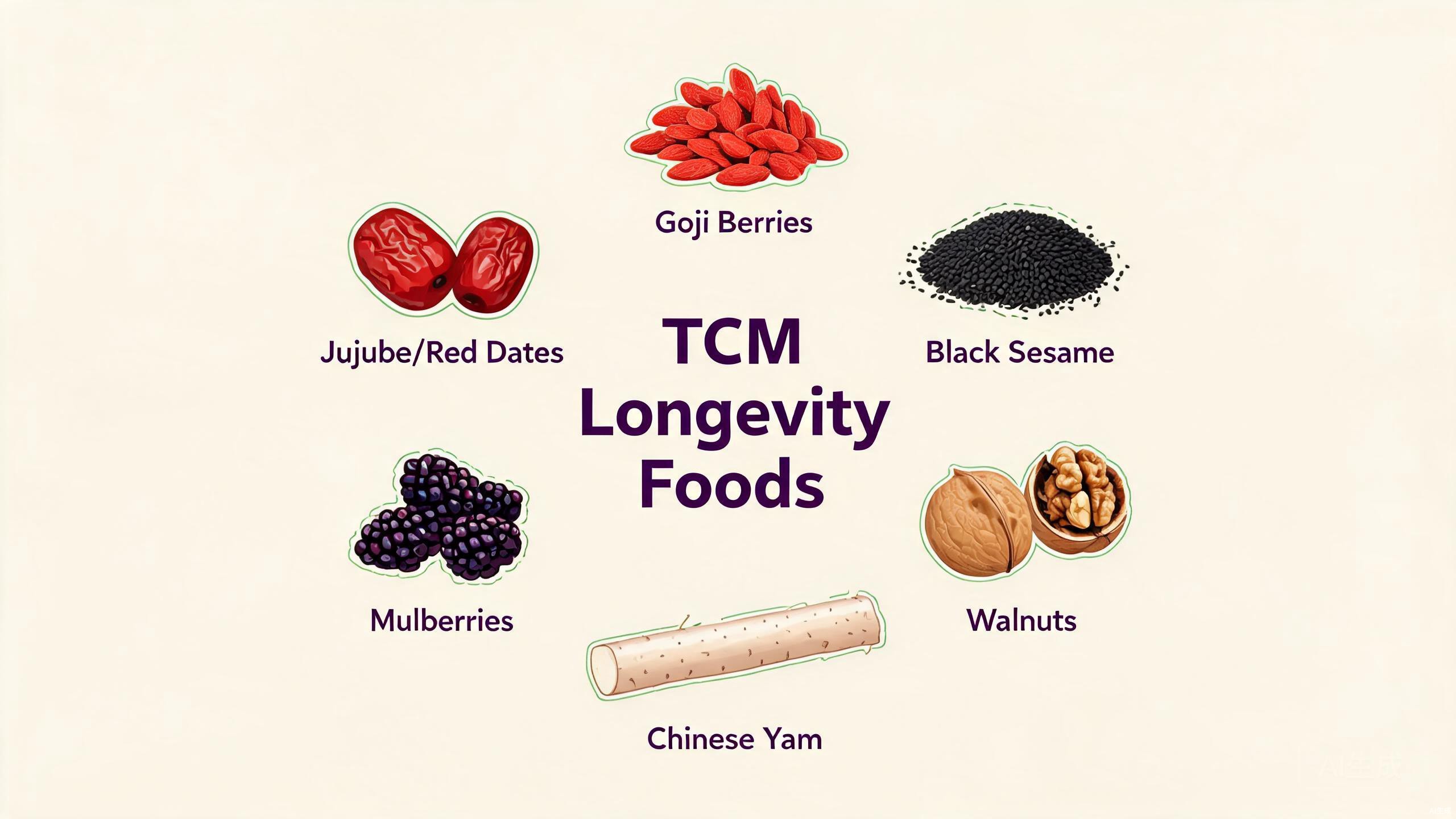
- Five everyday foods — goji berries, black sesame, Chinese yam, walnuts, and red dates — are traditionally used to nourish these systems and support overall vitality.
- Black sesame and walnuts are traditionally associated with nourishing kidney essence; red dates and Chinese yam support spleen qi and blood.
- TCM anti-aging is about consistent, gentle nourishment over time — not quick fixes or extreme interventions.
- These are traditional dietary practices, not medical treatments. Consult your healthcare provider before making significant dietary changes.
This article is for educational purposes only and is not medical advice. The foods and practices described here are traditional dietary practices rooted in Chinese culture. They are not a substitute for professional medical care. TCM does not claim to stop, reverse, or cure aging. The concept of "anti-aging" in TCM refers to traditional dietary and lifestyle practices aimed at supporting the body's natural vitality over time — not to any medical intervention. If you have a health condition, take medication, or are considering significant dietary changes, consult your healthcare provider first. Some foods, particularly goji berries, may interact with certain medications. These statements have not been evaluated by the FDA and are not intended to diagnose, treat, cure, or prevent any disease.
Aging is a natural process that every culture has sought to understand and navigate with grace. In Traditional Chinese Medicine, the question is not how to stop aging, but how to age well — to maintain vitality, energy, and well-being throughout the later decades of life. For thousands of years, TCM has identified specific everyday foods that are traditionally used to nourish the organ systems most involved in the aging process. These are not exotic elixirs or secret formulas. They are simple, accessible foods that generations of East Asian families have incorporated into daily meals.
If you are new to TCM concepts, our introduction to Traditional Chinese Medicine provides helpful background before diving in.
How TCM Views Aging
Traditional Chinese Medicine views aging through the lens of two fundamental systems: Kidney essence (jing) and Spleen qi. Understanding these two concepts is key to understanding the TCM approach to longevity.
Kidney Essence (Jing, 精)
In TCM theory, the Kidneys are considered the "root of life." They store essence (jing) — a concept that refers to the body's constitutional reserve, inherited from parents at conception and gradually depleted throughout life. Kidney essence governs growth, reproduction, bone development, brain function, and the aging process itself. According to classical TCM texts, essence naturally declines in a predictable pattern: it peaks in early adulthood, begins to wane in the late 30s and 40s, and continues to diminish through later life.
As kidney essence depletes, the classical texts describe signs that we would recognize today as common markers of aging: graying hair, loose teeth, weakened bones, declining memory, reduced sexual function, and a general loss of vitality. While this decline is natural and inevitable, TCM tradition holds that certain foods and lifestyle practices can help "nourish" the kidneys and support the body's reserve — not to stop aging, but to age with greater vitality.
To learn more about the Kidney system and its role in TCM, see our guide to Zang-Fu organs.
Spleen Qi and Blood Nourishment
The second pillar of TCM aging theory is the Spleen. In TCM, the Spleen (which includes the digestive system as a whole) is responsible for transforming food into qi and blood — the energy and nourishment that fuel every function in the body. As we age, Spleen qi naturally declines, which can manifest as reduced appetite, weaker digestion, lower energy, and a decreased ability to absorb nutrients from food.
This is why TCM places enormous emphasis on supporting the Spleen through diet. Foods that are easy to digest, warming, and nourishing are preferred, especially in later life. Blood nourishment is also closely linked to aging, particularly for women. In TCM, blood is seen as the physical manifestation of nourishment — it moistens the skin, supports the hair, and anchors the mind. As blood production declines with age, dryness, thinning hair, dull complexion, and poor sleep may result.
To understand the broader framework of how TCM views these vital substances, see our guides on qi, blood, and body fluids and yin and yang.
Five Everyday TCM Foods for Longevity and Vitality
The following five foods are staples of East Asian kitchens and have been valued in TCM tradition for centuries as foods that may support the organ systems involved in aging. They are not medicines, and they are not a replacement for professional medical care. TCM emphasizes gentle, consistent nourishment over time — not dramatic interventions.
1. Goji Berries (枸杞, Gou Qi Zi)
TCM nature: Sweet, neutral. Enters: Liver, Kidney, and Lung channels.
Goji berries, also known as wolfberries, are perhaps the most famous TCM food in the Western world. These small, sweet, red berries have been cultivated in China for over 2,000 years and are a staple of both the kitchen and the traditional pharmacy. TCM classifies goji berries as sweet and neutral — a gentle, nourishing food that is traditionally used to "nourish Liver and Kidney yin," "benefit essence," "brighten the eyes," and "moisten the lungs." In the context of aging, goji berries are valued for their association with supporting vision (which TCM links to Liver blood), nourishing the skin (linked to yin and blood), and supporting overall vitality. Modern research has identified goji berries as one of the most antioxidant-rich foods available, particularly high in zeaxanthin, a carotenoid that supports eye health.
How to prepare: Rinse 10 to 20 grams (about 1 to 2 tablespoons) of dried goji berries. Add them to hot water and steep as tea for 5 to 10 minutes. Eat the softened berries along with drinking the tea. Goji berries can also be added to congee (rice porridge), soups, and stir-fries. They pair particularly well with chrysanthemum flowers for a nourishing daily tea — see our chrysanthemum tea guide for brewing details.
Precautions: Goji berries are generally very safe when consumed in moderate amounts. If you take blood-thinning medications (such as warfarin) or blood pressure medications, consult your healthcare provider before consuming goji berries regularly, as they may interact with these medications. Avoid consuming very large amounts at once. For general guidance on safe tea and herb practices, see our herbal tea safety guide.
2. Black Sesame (黑芝麻, Hei Zhi Ma)
TCM nature: Sweet, neutral. Enters: Liver and Kidney channels.
Black sesame seeds are one of the most revered longevity foods in TCM. Unlike the white sesame seeds common in Western cooking, black sesame seeds have a distinct nutritional profile and a long history of use in Chinese dietary therapy. TCM classifies them as sweet and neutral — traditionally used to "nourish Liver and Kidney," "benefit essence and blood," "darken the hair," and "moisten the intestines." In the context of aging, black sesame is particularly valued for its association with kidney essence nourishment. Classical TCM texts describe black sesame as a food that helps support the hair (preventing premature graying), the skin (moistening dryness), and the bowels (relieving constipation, a common concern in older adults). Black sesame is rich in calcium, iron, magnesium, and vitamin E, and is traditionally ground into a paste or powder for better absorption.
How to prepare: Toast 2 tablespoons of black sesame seeds in a dry pan over low heat for 2 to 3 minutes until fragrant. Grind in a mortar, blender, or coffee grinder. Mix the ground sesame into warm water, milk, or soy milk with a small amount of honey. Alternatively, use black sesame paste as a spread on toast or mix into oatmeal. Consume 1 to 2 tablespoons of ground black sesame daily. For more everyday food-based TCM practices, see our guide to everyday TCM kitchen remedies.
Precautions: Black sesame is a common food and is generally very safe. If you have a sesame allergy, avoid it entirely. Because sesame is rich in oils, consume it fresh and store ground sesame in the refrigerator to prevent rancidity. If you have a history of kidney stones, consult your healthcare provider, as sesame contains oxalates.
3. Chinese Yam (山药, Shan Yao)
TCM nature: Sweet, neutral. Enters: Spleen, Lung, and Kidney channels.
Chinese yam, also known as shan yao or dioscorea, is one of the gentlest and most versatile tonic foods in all of TCM. Unlike many nourishing foods that target a single organ system, Chinese yam is traditionally said to tonify three organs simultaneously: the Spleen (supporting digestion and energy), the Lung (supporting respiratory health), and the Kidney (supporting essence and the aging process). This makes it an ideal daily food for supporting overall vitality. TCM classifies Chinese yam as sweet and neutral — mild enough for daily, long-term consumption. In the context of aging, it is particularly valued for its ability to support the Spleen (whose decline is a hallmark of aging in TCM theory) while simultaneously nourishing the Kidneys. Many Chinese families include Chinese yam in their regular diet as a vegetable, soup ingredient, or congee addition.
How to prepare: Peel and slice fresh Chinese yam (available in Asian markets). Stir-fry with a little oil, ginger, and salt for a simple side dish. Alternatively, cut into chunks and add to soups or congee. For a nourishing tonic soup, combine Chinese yam with goji berries and red dates in chicken broth and simmer for 1 hour. Dried Chinese yam slices are also available and can be simmered in water as a tea. Consume 2 to 3 times per week as part of a regular diet.
Precautions: Chinese yam is very well tolerated and is one of the safest tonic foods in TCM. Some people may experience mild skin irritation when handling raw Chinese yam due to its natural enzymes — wear gloves if this occurs. If you have a history of food allergies, introduce it gradually. Chinese yam is a food, not a medication, and does not replace prescribed treatments.
4. Walnuts (核桃, He Tao)
TCM nature: Sweet, warm. Enters: Kidney, Lung, and Large Intestine channels.
Walnuts have been cultivated in China for over 2,000 years and are a staple of both the kitchen and the traditional pharmacy. TCM classifies walnuts as sweet and warm — traditionally used to "tonify Kidney yang," "nourish the brain," "warm the lungs," and "moisten the intestines." In the context of aging, walnuts are particularly valued for two reasons. First, their association with the Kidney makes them a traditional food for supporting kidney essence. Second, TCM draws a direct connection between the walnut's brain-like appearance (a walnut half resembles a brain hemisphere) and its traditional use for supporting brain health and memory — an example of the "like nourishes like" principle that appears throughout TCM dietary therapy. Modern nutrition research has confirmed that walnuts are rich in omega-3 fatty acids, particularly alpha-linolenic acid (ALA), which supports brain and cardiovascular health.
How to prepare: Eat 5 to 8 walnut halves per day as a snack. Alternatively, crush walnuts and sprinkle over oatmeal, yogurt, or salads. For a traditional brain-supporting congee, combine crushed walnuts with rice and a few red dates, and simmer into a porridge. Walnuts can also be blended into a warm drink with black sesame and soy milk. For a warming evening habit, see our guide to ginger foot soak for a complementary circulation-supporting practice.
Precautions: Walnuts are a common allergen. If you have a tree nut allergy, avoid walnuts entirely. Because walnuts are warm and rich in oils, consume them in moderation if you have a tendency toward internal heat, loose stools, or skin breakouts. Store walnuts in a cool, dry place or refrigerator to prevent rancidity.
5. Red Dates (红枣, Hong Zao)
TCM nature: Sweet, warm. Enters: Spleen and Stomach channels.
Red dates, also known as jujubes, are one of the most widely used foods in all of Chinese dietary therapy. These small, wrinkled, reddish-brown fruits are entirely different from the dates found in Middle Eastern cuisine — they are the dried fruit of the jujube tree and have a sweet, slightly caramel-like flavor. TCM classifies red dates as sweet and warm — traditionally used to "tonify Spleen qi," "nourish blood," "calm the spirit," and "harmonize" other herbs in formulas. In the context of aging, red dates are valued for their dual action: they support the Spleen (whose decline affects digestion and energy) and nourish blood (whose decline affects the skin, hair, sleep, and overall vitality). Red dates are considered so fundamental to Chinese dietary therapy that they appear in countless soups, teas, and congees as both a food and a gentle tonic. The concept of blood nourishment is particularly relevant for women's health and the aging process.
How to prepare: Rinse 5 to 8 dried red dates. For tea, slice each date open (this releases more flavor and nutrients), then steep in hot water for 10 minutes. For soup or congee, add whole pitted red dates and simmer for 30 to 60 minutes. Red dates pair beautifully with goji berries, Chinese yam, and walnuts in tonic soups. A classic daily vitality tea combines 5 red dates with 1 tablespoon of goji berries — steep in hot water for 10 minutes and drink warm. Consume 5 to 10 dates per day.
Precautions: Red dates are very safe as a food. Because they are warm and sweet, consume them in moderation if you have signs of internal heat (such as a red face, thirst, or constipation) or if you have diabetes, as they contain natural sugars. If you take medication for diabetes, consult your healthcare provider about incorporating red dates into your diet.
Comparison of the Five Anti-Aging Foods
| Food | TCM Nature | Traditional Use | Preparation | Typical Frequency |
|---|---|---|---|---|
| Goji Berries (Gou Qi Zi) | Sweet, neutral | Nourish liver/kidney yin, support vision | Steep as tea or add to soups | 10–20g daily |
| Black Sesame (Hei Zhi Ma) | Sweet, neutral | Nourish kidney essence, darken hair | Toast, grind, mix into drinks | 1–2 tbsp daily |
| Chinese Yam (Shan Yao) | Sweet, neutral | Tonify spleen qi, nourish kidney | Stir-fry, soup, or congee | 2–3 times weekly |
| Walnuts (He Tao) | Sweet, warm | Tonify kidney yang, nourish brain | Eat as snack or add to congee | 5–8 halves daily |
| Red Dates (Hong Zao) | Sweet, warm | Tonify spleen qi, nourish blood | Steep as tea or simmer in soup | 5–10 dates daily |
Anti-Aging Lifestyle Tips from a TCM Perspective
In TCM, foods are just one piece of the longevity puzzle. The classical texts repeatedly emphasize that no food can compensate for poor lifestyle habits. The following four areas are considered essential for supporting vitality throughout life:
- Regular, restful sleep. TCM considers sleep to be the single most important practice for nourishing essence and blood. The hours between 11 PM and 3 AM are associated with Liver and Gallbladder recovery — the time when the body is said to detoxify, repair, and replenish. Chronic late nights are considered one of the fastest ways to deplete essence and accelerate the visible signs of aging. Prioritizing a consistent sleep schedule, ideally asleep before 11 PM, is foundational. A warm ginger foot soak before bed is a traditional practice for encouraging deep, restful sleep.
- Gentle, consistent exercise. TCM favors movement that circulates qi and blood without exhausting the body. Tai chi, qigong, walking, and swimming are ideal. The emphasis is on consistency over intensity — 20 to 30 minutes of gentle movement daily is far more valuable than sporadic intense workouts. Over-exercising, especially in older adults, is considered depleting rather than nourishing. For a complementary mind-body practice, see our meditation guide.
- Emotional balance. TCM views emotions as a direct influence on the body's organ systems. Chronic anger depletes the Liver, worry depletes the Spleen, fear depletes the Kidney, and grief depletes the Lung. Over time, unresolved emotional stress is considered a major contributor to premature aging. Practices such as mindful breathing, journaling, spending time in nature, and maintaining social connections all support emotional well-being. To understand the broader framework of how TCM connects emotions and organs, see our guide to the five elements.
- Eating with the seasons. TCM emphasizes adjusting diet according to the season. In winter, warming, nourishing foods (like walnuts and red dates) support the body's need to conserve energy. In summer, lighter, cooling foods (like mung beans and chrysanthemum tea) help the body manage heat. This seasonal awareness is considered an important aspect of long-term vitality. For related reading, see our guide to TCM remedies for blood pressure support, which includes seasonal dietary guidance.
A simple daily anti-aging routine inspired by TCM: start the morning with a cup of goji berry and red date tea, include Chinese yam in a lunch or dinner dish 2 to 3 times per week, snack on a handful of walnuts in the afternoon, and add a tablespoon of ground black sesame to your evening meal. Pair this with consistent sleep before 11 PM and 20 minutes of gentle daily movement. This is a sustainable, lifelong approach — not a quick fix.
When to See a Doctor
The foods and practices in this article are complementary dietary traditions, not medical treatments. You should see a healthcare provider if you experience any of the following:
- Unexplained fatigue, weight loss, or decline in energy that persists over weeks
- Significant changes in memory, cognition, or mental function
- Joint pain, bone pain, or signs of osteoporosis
- Changes in vision, hair loss, or skin changes that concern you
- Any new or worsening symptoms that concern you
If you are currently taking any medication, particularly blood thinners, blood pressure medication, or diabetes medication, speak with your doctor before adding significant amounts of goji berries, red dates, or other foods to your routine, as interactions are possible. Always inform your healthcare provider about all dietary changes you are making.
The Bottom Line
Traditional Chinese Medicine offers a gentle, food-based tradition for supporting vitality and graceful aging. Goji berries, black sesame, Chinese yam, walnuts, and red dates are five everyday foods that generations of East Asian families have enjoyed as part of a balanced, nourishing diet. By understanding the TCM concepts of kidney essence and spleen qi, you can appreciate why these particular foods have been valued for centuries — not as cures, but as gentle, consistent nourishment that supports the body's natural processes over time.
But these are traditions — not treatments, and not a replacement for medical care. TCM does not claim to stop or reverse aging. If you have health concerns, your most important step is to work with a qualified healthcare provider. Use these traditional dietary practices only as complementary habits, with your doctor's knowledge and guidance.
This article shares traditional dietary practices for educational purposes only. It is not a substitute for medical advice, diagnosis, or treatment. The foods described here are not intended to treat, cure, or prevent any disease. TCM does not claim to stop, reverse, or cure aging. If you have a health condition or take medication, consult your healthcare provider before making any dietary changes. Some foods, particularly goji berries, may interact with medications. These statements have not been evaluated by the FDA. Never stop or adjust prescribed medication without your doctor's explicit guidance.