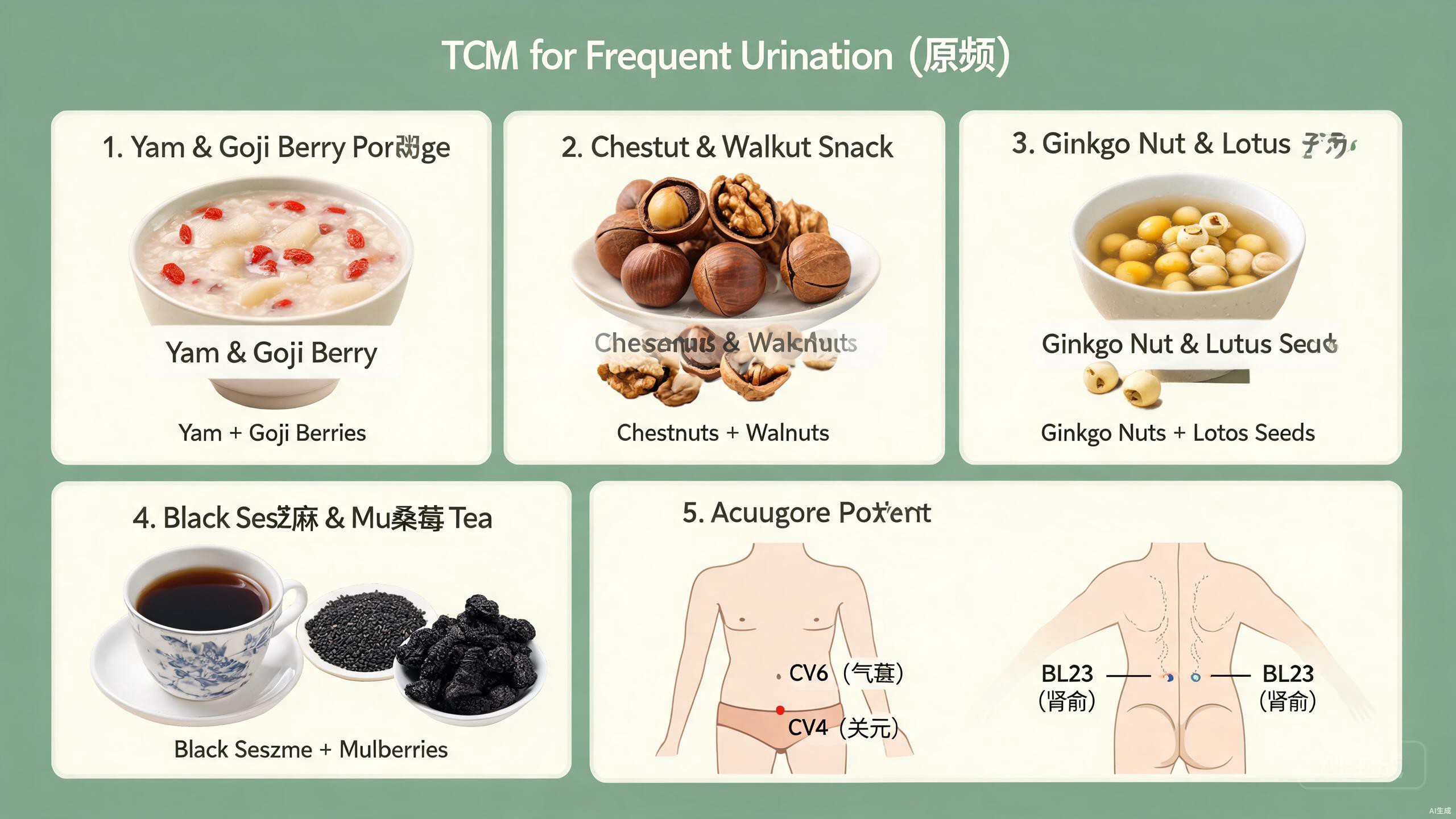
Key Takeaways
- TCM views frequent urination through three main patterns: bladder damp-heat, kidney qi deficiency, and spleen deficiency with dampness, each requiring different food therapy approaches.
- Five traditional food therapy recipes — from winter melon coix soup to walnut yam soup — use ingredients available at Western supermarkets, Amazon, or iHerb.
- Five acupressure points — Guanyuan (CV4), Zhongji (CV3), Shenshu (BL23), Sanyinjiao (SP6), and Yongquan (KD1) — are traditionally used to strengthen the kidneys, regulate the lower burner, and support bladder function.
- Moxibustion on Guanyuan, Zusanli, and Yongquan for 5 to 7 minutes each may complement kidney and bladder wellness, especially for deficiency-type patterns.
- These are traditional wellness practices, not a treatment for any medical condition. Frequent urination requires evaluation by a qualified healthcare provider.
This article is for educational purposes only and is not medical advice. The foods, teas, and practices described here are traditional wellness practices rooted in Chinese culture. They are not a substitute for professional medical care, diagnosis, or treatment. Frequent urination can indicate serious medical conditions including urinary tract infections, diabetes, prostate enlargement (BPH), kidney disease, overactive bladder, or bladder cancer. These require proper evaluation by a qualified healthcare provider. Never stop, delay, or replace prescribed treatment based on information in this article. Some foods and herbs may interact with medications — always inform your doctor about everything you consume. These statements have not been evaluated by the FDA and are not intended to diagnose, treat, cure, or prevent any disease. Read our full disclaimer →
Frequent urination — the need to urinate more often than usual — is a common concern that can disrupt daily life, work, and especially sleep. Whether it means waking multiple times at night, making constant trips to the bathroom during the day, or feeling a persistent urgency, this symptom affects millions of people. While it should always be evaluated by a healthcare provider to rule out medical conditions, Traditional Chinese Medicine (TCM) offers a rich tradition of food therapy, acupressure, and self-care practices that may support bladder wellness as part of a balanced lifestyle.
In TCM, frequent urination is not viewed as a single condition. Instead, it is understood through three distinct patterns involving the Bladder, Kidney, and Spleen organ systems. The five recipes, five acupressure points, and moxibustion technique below come from this tradition. All ingredients are available at Western supermarkets, Asian markets, Amazon, or iHerb.
If you are new to TCM concepts, our introduction to Traditional Chinese Medicine and guide to the Zang-Fu organ systems are helpful starting points. For related concerns, see our guides on TCM for night urination and TCM for prostate health.
How TCM Views Frequent Urination
Traditional Chinese Medicine has recognized and described frequent urination for thousands of years. The classical TCM term for the condition is piao or lin zheng, which encompasses various urinary symptoms including frequency, urgency, pain, and difficulty. TCM texts identify three primary patterns that cause frequent urination, each requiring a different therapeutic approach.
The Kidney system is the foundation of urinary regulation in TCM. The Kidney stores essence (jing) and governs the lower body, including the urogenital region. Kidney qi provides the "sealing" force that controls urination — when kidney qi is strong, fluid release is regulated and complete. When kidney qi or kidney yang is deficient — often due to aging, overwork, chronic illness, or excessive sexual activity — the kidneys lack the sealing and warming power to hold fluids, leading to frequent urination, especially at night. This is called kidney qi deficiency (shen qi xu). Signs include frequent urination (particularly nocturia), a weak stream, lower back soreness, knee weakness, cold extremities, and fatigue.
The Bladder is the partner organ to the Kidney. It stores and excretes urine, but its function depends on kidney qi to provide the transformation energy. When the bladder is obstructed by damp-heat — often caused by a diet high in spicy, greasy, or sweet foods, or by external damp-heat — it causes urinary urgency, frequency, burning, and sometimes pain. This is called bladder damp-heat (pang guang shi re). Signs include frequent urination with small amounts, urgency, burning sensation, dark or cloudy urine, and a feeling of heaviness in the lower abdomen.
The Spleen plays a supporting but important role. The Spleen is responsible for transforming and transporting fluids. When the Spleen is weak, it cannot properly manage fluids, and excess dampness overwhelms the bladder, causing frequent urination with clear, large volumes. This is called spleen deficiency with dampness (pi xu shi sheng). Signs include frequent urination with large volumes of clear urine, fatigue, poor appetite, loose stools, and a feeling of heaviness.
Three TCM Patterns of Frequent Urination
- Bladder Damp-Heat (Pang Guang Shi Re) — Heat and dampness accumulate in the bladder. Signs: frequent urination with small amounts, urgency, burning sensation, dark or cloudy urine, lower abdominal fullness. Often triggered by spicy, greasy, or sweet foods, alcohol, or humid weather. This pattern is considered "excess" type. See our summer heat clearing foods guide for related information.
- Kidney Qi Deficiency (Shen Qi Xu) — The kidneys lack the sealing force to hold fluids. Signs: frequent urination (especially at night), clear urine in large volumes, weak stream, lower back soreness, knee weakness, cold extremities, fatigue. Often seen in older adults or after chronic illness. This pattern is considered "deficiency" type. See our guides on TCM for night urination and TCM for prostate health.
- Spleen Deficiency with Dampness (Pi Xu Shi Sheng) — A weak Spleen cannot transform fluids, leading to dampness that overwhelms the bladder. Signs: frequent urination with clear, large volumes, fatigue, poor appetite, loose stools, pale complexion, feeling of heaviness. Often related to irregular eating habits and worry. See our TCM for digestion guide for more on Spleen patterns.
Understanding these patterns is essential because the food therapy approach is completely different for each. Damp-heat requires cooling, draining foods. Kidney deficiency requires warming, tonifying foods. Spleen deficiency requires strengthening, dampness-draining foods. Using the wrong type can worsen the condition.
5 Food Therapy Recipes for Bladder Wellness
Each recipe below is matched to a specific TCM pattern. Choose the recipe that best fits your pattern, and use it consistently for two to four weeks. All ingredients are available at Western supermarkets, Asian markets, Amazon, or iHerb.
1. Winter Melon and Coix Seed Soup (冬瓜薏米汤)
Best for: Bladder damp-heat type — urgency, burning, dark urine
TCM nature and flavor: Winter melon (dong gua): sweet, mild, cool. Enters the Lung, Spleen, and Bladder channels. Coix seed (yi yi ren / Job's tears): sweet, bland, slightly cool. Enters the Spleen, Lung, and Kidney channels.
Traditional use: This is the primary TCM food therapy recipe for the damp-heat pattern of frequent urination. Winter melon is traditionally used to clear heat, promote urination, and reduce swelling. Its cooling nature helps clear the heat that accumulates in the bladder. Coix seed is valued for draining dampness and strengthening the Spleen. Together, they address both the heat and the dampness in the bladder, making this soup ideal for the damp-heat pattern characterized by urgency, burning, and dark urine. This is the same combination used for prostate damp-heat patterns — see our TCM for prostate health guide.
Ingredients:
- 2 cups winter melon, peeled and cubed (available at Asian markets; zucchini or chayote can substitute)
- 1/2 cup dried coix seed (Job's tears) — available on Amazon or iHerb
- 4 cups vegetable or chicken broth (low sodium)
- 3 slices fresh ginger
- A pinch of sea salt
Preparation: Soak the coix seed for 2 to 4 hours. In a pot, combine the soaked coix seed, broth, and ginger. Bring to a boil, then reduce heat and simmer for 30 minutes. Add the cubed winter melon and simmer for another 15 to 20 minutes. Add salt to taste. Drink 1 bowl per day, preferably in the morning or at lunch. For more on coix seed, see our dampness-removing foods guide.
Precautions: Both ingredients are cooling. If you have a cold constitution or kidney yang deficiency (cold extremities, clear urine, no burning), this recipe is not suitable for you — use recipe 2 or 3 instead. Coix seed is traditionally avoided in large amounts during pregnancy.
2. Gordon Euryale and Chinese Yam Porridge (芡实山药粥)
Best for: Kidney qi deficiency type — frequent urination, clear urine, lower back weakness
TCM nature and flavor: Gordon euryale seed (qian shi): sweet, astringent, neutral. Enters the Spleen and Kidney channels. Chinese yam (shan yao): sweet, neutral. Enters the Spleen, Lung, and Kidney channels.
Traditional use: This is the primary TCM food therapy recipe for the kidney deficiency pattern of frequent urination. Gordon euryale (also called fox nut or qian shi) is one of TCM's most important astringent foods, traditionally used to tonify the kidney, secure essence, and reduce urination. Its astringent quality helps "seal" the kidney's holding function, reducing excessive urination. Chinese yam is one of TCM's most gentle tonic foods, traditionally used to tonify the Spleen, nourish the Lung, and support the Kidney simultaneously. Together, they form a nourishing, stabilizing porridge that addresses the root of kidney deficiency-type frequent urination. This combination is particularly valued for chronic, long-standing frequent urination.
Ingredients:
- 30 grams dried Gordon euryale seeds (qian shi) — available on Amazon or iHerb
- 30 grams fresh Chinese yam, peeled and cubed (or 15 grams dried yam slices)
- 50 grams white rice (short or medium grain)
- 5 cups water
- A pinch of sea salt
Preparation: Soak the Gordon euryale seeds for 4 to 6 hours (they are very hard). Rinse the rice. In a pot, combine all ingredients with water. Bring to a boil, then reduce heat and simmer for 45 to 60 minutes until the porridge is thick and the seeds are soft. Add salt to taste. Eat 1 bowl per day, ideally at breakfast, for 2 to 4 weeks. For more on Chinese yam, see our yam congee guide.
Precautions: Gordon euryale is astringent and may cause constipation in some people. If you are prone to constipation, increase water intake and add fiber to your diet. This recipe is for deficiency-type patterns only — do not use if you have damp-heat signs (burning, dark urine).
Gordon euryale seeds (qian shi) are small, round, brownish seeds from the euryale water lily. They are a staple of TCM food therapy for kidney deficiency and are available on Amazon and iHerb. They are very hard when dried and must be soaked for several hours before cooking. Fresh Chinese yam (shan yao, also called nagaimo) is available at Asian markets; dried yam slices are available on Amazon and iHerb. See our congee guide for more on healing porridge.
3. Walnut, Alpinia, and Chinese Yam Soup (胡桃益智山药汤)
Best for: Kidney deficiency with nighttime urination (nocturia)
TCM nature and flavor: Walnut (he tao ren): sweet, warm. Enters the Kidney, Lung, and Large Intestine channels. Chinese yam (shan yao): sweet, neutral. Enters the Spleen, Lung, and Kidney channels.
Traditional use: This soup is specifically designed for frequent nighttime urination (nocturia) rooted in kidney yang deficiency. In TCM, the Kidney governs the lower body and provides the warming, sealing energy that controls urination. At night, when yang energy naturally retreats, kidney yang deficiency becomes more pronounced, leading to the need to urinate multiple times during the night. Walnuts are traditionally used to tonify kidney yang, warm the lower back, and support the lungs. Their warming, kidney-tonifying nature makes them ideal for nocturia. Chinese yam provides gentle, balanced nourishment for the kidney and spleen. Together, this soup warms and tonifies the kidney system, supporting the sealing function that reduces nighttime urination.
Ingredients:
- 30 grams walnuts (about 10 to 12 halves), lightly toasted
- 1 cup fresh Chinese yam, peeled and cubed (or 30 grams dried yam slices)
- 6 dried red dates (jujubes), pitted
- 4 slices fresh ginger
- 4 cups water
- A pinch of sea salt
Preparation: Rinse all ingredients. In a pot, combine the walnuts, yam, red dates, ginger, and water. Bring to a boil, then reduce heat and simmer for 40 to 50 minutes until the yam is very soft. Add salt to taste. Drink 1 bowl per day, ideally in the late afternoon or early evening (not right before bed). For more on walnuts, see our TCM for men's vitality guide, and for more on nighttime urination, see our TCM for night urination guide.
Precautions: Walnuts are warm and rich. If you have damp-heat signs or active inflammation, avoid this recipe. Walnuts are calorie-dense — eat in moderation if watching your weight.
4. Lotus Seed and Chinese Yam Porridge (莲子山药粥)
Best for: Combined spleen and kidney deficiency — frequent urination with fatigue and poor digestion
TCM nature and flavor: Lotus seed (lian zi): sweet, astringent, neutral. Enters the Spleen, Kidney, and Heart channels. Chinese yam (shan yao): sweet, neutral. Enters the Spleen, Lung, and Kidney channels.
Traditional use: When frequent urination is accompanied by fatigue, poor appetite, loose stools, and a general feeling of weakness, both the Spleen and Kidney are likely deficient. This porridge addresses both systems simultaneously. Lotus seeds are traditionally used to tonify the Spleen, nourish the Kidney, calm the Heart, and secure essence. Their astringent quality helps reduce excessive urination, while their sweet, neutral nature makes them safe for long-term use. Combined with Chinese yam, which nourishes all three — Spleen, Lung, and Kidney — this porridge provides comprehensive support for the fluid-regulating systems of the body. It is one of the most gentle and well-tolerated TCM food therapy recipes.
Ingredients:
- 20 grams dried lotus seeds (with the bitter green core removed) — available on Amazon or iHerb
- 30 grams fresh Chinese yam, peeled and cubed (or 15 grams dried yam slices)
- 50 grams white rice
- 5 dried red dates (jujubes), pitted (optional, for sweetness)
- 5 cups water
- A pinch of sea salt
Preparation: Soak the lotus seeds for 2 to 4 hours. Rinse the rice. In a pot, combine all ingredients with water. Bring to a boil, then reduce heat and simmer for 45 to 60 minutes until the porridge is thick and the lotus seeds are soft. Add salt to taste. Eat 1 bowl per day, ideally at breakfast, for 2 to 4 weeks.
Precautions: Lotus seeds are generally safe and gentle. Like Gordon euryale, they are astringent and may cause constipation in some people. Ensure the bitter green core (plumule) is removed from the lotus seeds, as it is very bitter and can cause discomfort.
5. Chinese Yam and Wolfberry Soup (山药枸杞汤)
Best for: General kidney nourishment — long-term support for bladder wellness
TCM nature and flavor: Chinese yam (shan yao): sweet, neutral. Enters the Spleen, Lung, and Kidney channels. Wolfberry/goji (gou qi zi): sweet, neutral. Enters the Liver and Kidney channels.
Traditional use: This is a gentle, nourishing soup for long-term kidney support. Rather than targeting a specific acute pattern, it provides broad nourishment for the kidney and liver systems. Chinese yam tonifies the Spleen, Lung, and Kidney simultaneously, while goji berries nourish liver and kidney yin and support essence. Together, they form a balanced soup that supports the body's overall fluid-regulating capacity. This soup is particularly suitable as a maintenance recipe after the acute pattern has been addressed, or as a gentle daily support for people with mild kidney deficiency who want to support bladder wellness long-term.
Ingredients:
- 1 cup fresh Chinese yam, peeled and cubed (or 30 grams dried yam slices)
- 1/4 cup dried goji berries — available on Amazon or iHerb
- 6 dried red dates (jujubes), pitted
- 4 cups water or vegetable broth
- A pinch of sea salt
Preparation: Rinse all ingredients except goji berries. In a pot, combine the yam, red dates, and water. Bring to a boil, then reduce heat and simmer for 30 minutes. Add the goji berries in the last 10 minutes (they cook quickly and become mushy if overcooked). Add salt to taste. Drink 1 bowl per day, 2 to 3 times per week. For more on goji berries, see our goji tea guide.
Precautions: Goji berries may interact with blood thinners — consult your doctor if you take warfarin or similar medications. This soup is nourishing and warming — avoid if you have active damp-heat signs.
Five Acupressure Points for Bladder Wellness
In addition to food therapy, TCM uses acupressure to support the organ systems involved in urinary regulation. The five points below are traditionally used to strengthen the Kidney, regulate the lower burner, and support bladder function. They are simple to find and can be pressed daily as part of a wellness routine.
1. Guanyuan (CV4) — The "Gate of the Source"
Location: On the midline of the lower abdomen, 3 cun (approximately four finger-widths) below the navel.
How to find it: Lie on your back. Place four fingers together horizontally below your navel. Guanyuan (CV4) sits on the midline at the level of the index finger's lower edge.
How to press: Using the pads of two or three fingers or the heel of your palm, press gently but firmly inward. Hold for 2 to 3 minutes while breathing slowly.
Traditional use: Guanyuan is one of the most important points for tonifying kidney qi, warming the lower burner, and supporting the urogenital system. For frequent urination rooted in kidney deficiency, CV4 may help strengthen the kidney's sealing function. See our TCM for prostate health guide for more on this point.
Precautions: Do not press during pregnancy. Use gentle pressure on the abdomen.
2. Zhongji (CV3) — The "Supreme Pole"
Location: On the midline of the lower abdomen, 4 cun (approximately five finger-widths) below the navel, just above the pubic bone.
How to find it: Lie on your back. Place five fingers together horizontally below your navel. Zhongji (CV3) sits on the midline at the level of the bottom finger, just above the pubic bone.
How to press: Using the pads of two or three fingers, press gently inward. Hold for 2 to 3 minutes.
Traditional use: Zhongji is the front-mu (alarm) point of the Bladder and is traditionally used to regulate the bladder, clear damp-heat, and promote urination. For frequent urination rooted in bladder damp-heat, CV3 helps regulate bladder function directly.
Precautions: Do not press during pregnancy. Use gentle pressure. Avoid if you have an acute urinary tract infection.
3. Shenshu (BL23) — The "Kidney Shu"
Location: On the lower back, about 1.5 cun (approximately two finger-widths) to the side of the spine, at the level of the waist (between the 2nd and 3rd lumbar vertebrae).
How to find it: Stand or sit upright. Find the highest point of your hip bone (iliac crest). The point is on the back, at the same level, about two finger-widths to the side of the spine. You may feel a slight depression when you press.
How to press: Using your thumbs or the heels of your hands, press firmly into the points on both sides of the spine simultaneously. Hold for 2 to 3 minutes. Alternatively, ask a partner to press both points for you.
Traditional use: Shenshu is the back-shu point of the Kidney and is one of the most important points for tonifying kidney qi and yang, strengthening the lower back, and supporting the urogenital system. For frequent urination rooted in kidney deficiency, BL23 directly nourishes the kidney system.
4. Sanyinjiao (SP6) — The "Three Yin Intersection"
Location: On the inner lower leg, about 3 cun (approximately four finger-widths) above the highest point of the inner ankle bone, just behind the inner edge of the shin bone.
How to find it: Place four fingers together across the inside of your leg, with the bottom finger on top of your inner ankle bone. The point lies just behind the shin bone at the level of the top edge of your fourth finger.
How to press: Using your thumb, press into the point at a slight angle toward the shin bone. Apply moderate pressure for 2 to 3 minutes on each leg.
Traditional use: Sanyinjiao is the meeting point of the Spleen, Kidney, and Liver meridians. It is traditionally used to strengthen the Spleen, nourish the Kidney, and regulate fluid metabolism. For frequent urination, SP6 addresses both the Spleen (fluid management) and the Kidney (fluid sealing) simultaneously.
Precautions: Sanyinjiao (SP6) is strictly contraindicated during pregnancy. For more on this point, see our dedicated Sanyinjiao (SP6) guide.
5. Yongquan (KD1) — The "Gushing Spring"
Location: On the sole of the foot, in the depression that appears when the toes are curled, approximately in the front third of the foot.
How to find it: Curl your toes. A depression appears on the sole, about one-third of the way from the toes to the heel. The point is in the center of this depression.
How to press: Using your thumb, press firmly into the point. You may feel a distinct ache. Hold for 2 to 3 minutes on each foot. Alternatively, use a massage ball or your knuckle. This point is usually quite tender.
Traditional use: Yongquan is the first point on the Kidney meridian and is the only point on the sole of the foot. It is traditionally used to anchor ascending yang, nourish kidney yin, and draw excess heat and energy downward. For frequent urination, especially when accompanied by insomnia, anxiety, or a feeling of heat rising to the head (signs of kidney yin deficiency with empty heat), KD1 helps anchor the energy and support the kidney system. See our Yongquan (KD1) guide for more.
For a simple daily routine, press Guanyuan (CV4) and Zhongji (CV3) for 2 to 3 minutes each while lying in bed in the morning. Press Shenshu (BL23) for 2 to 3 minutes (or have a partner press both sides) in the afternoon. Press Sanyinjiao (SP6) on both legs for 2 minutes each in the evening. End with Yongquan (KD1) on both feet for 2 to 3 minutes each before bed. Consistency matters more than duration. For more guidance, see our acupressure safety guide.
Moxibustion for Bladder Wellness
Moxibustion is a TCM therapy that involves warming specific acupressure points with dried mugwort (ai ye). It is particularly valuable for deficiency-type patterns, as it provides direct warming and tonifying energy. For frequent urination rooted in kidney yang deficiency, moxibustion on specific points can complement food therapy and acupressure.
How to Perform Moxibustion
Points: Guanyuan (CV4) on the lower abdomen, Zusanli (ST36) below the knee, and Yongquan (KD1) on the sole of the foot.
Duration: 5 to 7 minutes per point, per session.
Method: Use a moxa stick (a cigar-shaped roll of dried mugwort). Light one end until it glows red. Hold the lit end about 1 to 2 inches above the skin, moving it slowly in small circles or up-and-down strokes. The skin should feel comfortably warm, never hot or burning. After 5 to 7 minutes, move to the next point. Extinguish the moxa stick completely in a sand-filled container when finished.
Frequency: 2 to 3 times per week, preferably in the morning or afternoon.
Do not use moxibustion if you have damp-heat signs (burning urination, dark urine, fever, or active inflammation), as moxa is warming and will worsen heat conditions. Do not use during pregnancy. Avoid moxibustion on the face, over large blood vessels, or on numb skin. Ensure proper ventilation — moxa smoke can irritate the lungs. If you have asthma or respiratory sensitivity, use smokeless moxa sticks. Never leave a lit moxa stick unattended. See our moxibustion guide and acupressure safety guide for detailed safety instructions.
Lifestyle Tips for Bladder Wellness
TCM is a whole-person system. Foods, acupressure, and moxibustion work best when combined with supportive daily habits. The following practices are emphasized in classical TCM for urinary wellness:
- Avoid holding urine. In TCM, holding urine allows damp-heat to accumulate in the bladder and damages the kidney's sealing function. Respond promptly to the urge to urinate, and ensure you empty your bladder completely each time.
- Avoid prolonged sitting. In TCM, prolonged sitting stagnates qi and blood in the lower burner and weakens the Spleen. If you work at a desk, stand up and walk for 2 to 3 minutes every hour. See our TCM for prostate health guide for more on this topic.
- Avoid staying up late. In TCM, the kidney system is most active during certain hours of the night, and staying up late depletes kidney yin. Aim to sleep before 11 PM and get 7 to 8 hours of sleep. See our TCM for insomnia guide for sleep support.
- Keep warm, especially the lower back, abdomen, and feet. The Kidney system is located in the lower back, and TCM considers cold a major enemy of kidney yang. Keep these areas warm, especially in cold weather. Avoid sitting on cold surfaces. A warm ginger foot soak in the evening warms the kidney system through the KD1 point.
- Reduce caffeine, alcohol, and spicy foods. In TCM, these are the primary dietary causes of damp-heat in the bladder. Caffeine and alcohol are diuretics that strain the kidney system. Spicy and greasy foods introduce heat and dampness that can settle in the bladder.
- Manage stress and emotions. In TCM, fear and anxiety deplete kidney qi, while worry weakens the Spleen. Practice relaxation, adequate rest, and gentle exercise. See our herbal tea for anxiety guide and meditation guide for practical starting points.
For more on how TCM understands the body's energy systems, see our guide to qi, blood, and body fluids.
Comparison of the Five Recipes
| Recipe | TCM Pattern | Key Action | Frequency |
|---|---|---|---|
| Winter Melon & Coix Soup | Bladder Damp-Heat | Clear heat, drain dampness | 1 bowl daily |
| Gordon Euryale & Yam Porridge | Kidney Qi Deficiency | Tonify kidney, secure essence, reduce urination | 1 bowl daily |
| Walnut & Yam Soup | Kidney Yang Def. (nocturia) | Warm kidney yang, reduce nighttime urination | 1 bowl daily |
| Lotus Seed & Yam Porridge | Spleen + Kidney Def. | Tonify spleen and kidney, secure essence | 1 bowl daily |
| Yam & Wolfberry Soup | General kidney nourishment | Nourish kidney and liver, long-term support | 2 to 3 times per week |
Frequently Asked Questions
What does TCM say about frequent urination?
In Traditional Chinese Medicine, frequent urination is understood through three main patterns: damp-heat in the bladder, kidney qi deficiency, and spleen deficiency with dampness. When damp-heat accumulates in the bladder, it causes urgency, burning, and frequent urination with small amounts. When kidney qi is deficient, the kidneys lack the sealing force to hold fluids, causing frequent urination especially at night. When the spleen is weak, it cannot transform fluids properly, leading to dampness that overwhelms the bladder. TCM food therapy traditionally uses ingredients like winter melon, coix seed, Gordon euryale, Chinese yam, walnuts, and lotus seeds to address these different patterns. These are traditional wellness practices, not medical treatments. For a deeper understanding, see our zang-fu organ guide.
Which TCM foods may help with frequent urination?
Five traditional TCM food therapy recipes for frequent urination include winter melon and coix seed soup for damp-heat type, Gordon euryale and yam porridge for kidney deficiency type, walnut and yam soup for nighttime urination, lotus seed and yam porridge for combined spleen and kidney deficiency, and Chinese yam and wolfberry soup for general kidney nourishment. These recipes use ingredients like winter melon, coix seed, Gordon euryale seeds, Chinese yam, walnuts, lotus seeds, and goji berries that are available at Western supermarkets, Asian markets, Amazon, or iHerb. The key is matching the recipe to the correct TCM pattern — using a cooling recipe for a deficiency pattern, or a warming recipe for a damp-heat pattern, can worsen the condition. They are traditional wellness foods, not treatments for any medical condition.
Can acupressure and moxibustion help with frequent urination?
TCM acupressure on points like Guanyuan (CV4) on the lower abdomen, Zhongji (CV3) below the navel, Shenshu (BL23) on the lower back, Sanyinjiao (SP6) on the inner leg, and Yongquan (KD1) on the sole is traditionally used to strengthen kidney qi, support the lower burner, and regulate urination. Moxibustion (warming with mugwort) on Guanyuan, Zusanli, and Yongquan for 5 to 7 minutes each may also complement kidney and bladder wellness, especially for deficiency-type patterns. However, these practices are not a treatment for urinary tract infections, prostate conditions, diabetes, or other medical causes of frequent urination. If you experience persistent symptoms, consult your healthcare provider. See our moxibustion guide and acupressure safety guide for precautions.
What lifestyle changes help with frequent urination in TCM?
In TCM, the key lifestyle changes for managing frequent urination include avoiding holding urine, avoiding prolonged sitting, and avoiding staying up late, as all three weaken the kidney and bladder systems. Keeping the lower back, abdomen, and feet warm is essential, as cold damages kidney yang. Reducing caffeine, alcohol, and spicy foods helps prevent damp-heat. Managing stress and getting adequate rest supports the kidney system. These are traditional wellness suggestions, not medical advice. Always consult your healthcare provider for persistent or concerning urinary symptoms. See our guides on TCM for night urination and TCM for prostate health for related topics.
Precautions and When to Seek Help
While TCM food therapy, acupressure, and moxibustion may support general bladder wellness, frequent urination can indicate serious medical conditions that require professional evaluation:
- Seek prompt medical attention if you experience blood in the urine, severe pain during urination, fever, chills, or sudden inability to urinate. These may indicate urinary tract infection, kidney infection, bladder stones, or urinary retention.
- See your doctor if you experience persistent or worsening urinary frequency, urgency, or changes in urination patterns. These may indicate diabetes, prostate enlargement (BPH), overactive bladder, kidney disease, or other conditions that need proper diagnosis and treatment.
- Regular screening. Men over 50 (or over 45 with risk factors) should discuss prostate screening with their healthcare provider. People with diabetes should monitor blood sugar regularly. See our TCM for blood sugar guide.
- Medication interactions. If you take diuretics, blood pressure medication, diabetes medication, or prostate medication, consult your healthcare provider before adding diuretic foods (winter melon, coix seed) or tonic foods (walnuts, goji berries) to your routine.
- Pregnancy. Sanyinjiao (SP6) acupressure and moxibustion on the lower abdomen are strictly contraindicated during pregnancy. Frequent urination during pregnancy is common but should be discussed with your healthcare provider.
- Not a substitute. TCM food therapy is complementary. It sits alongside — never in place of — professional medical care.
For related topics, see our guides on TCM for night urination, TCM for prostate health, and TCM for edema diet.
The Bottom Line
Traditional Chinese Medicine offers a gentle, food-based tradition for supporting bladder wellness. By understanding whether your frequent urination is rooted in bladder damp-heat, kidney qi deficiency, or spleen deficiency with dampness, you can choose foods and teas that work with your body's specific needs. Winter melon and coix seed soup clears damp-heat from the bladder. Gordon euryale and yam porridge tonifies the kidneys and reduces urination. Walnut and yam soup warms kidney yang for nighttime urination. Lotus seed and yam porridge strengthens both the Spleen and Kidney. And yam and wolfberry soup provides gentle, long-term kidney nourishment. Paired with five acupressure points — Guanyuan (CV4), Zhongji (CV3), Shenshu (BL23), Sanyinjiao (SP6), and Yongquan (KD1) — moxibustion, and lifestyle habits like avoiding holding urine, not sitting too long, and keeping warm, these traditional practices form a whole-person approach to bladder wellness.
But they are traditions — not treatments, and not a replacement for medical care. Frequent urination requires evaluation by a qualified healthcare provider. Use these traditional practices only as complementary wellness habits, alongside your doctor's guidance.
This article shares traditional wellness practices for educational purposes only. It is not a substitute for medical advice, diagnosis, or treatment. The foods, teas, and acupressure practices described here are not intended to treat, cure, or prevent any disease, including but not limited to urinary tract infections, diabetes, prostate enlargement (BPH), overactive bladder, kidney disease, interstitial cystitis, or bladder cancer. If you have frequent urination — especially with pain, blood, fever, or changes in pattern — consult your healthcare provider promptly for proper evaluation. These statements have not been evaluated by the FDA. Never stop or adjust prescribed treatment without your doctor's explicit guidance. Read our full disclaimer →