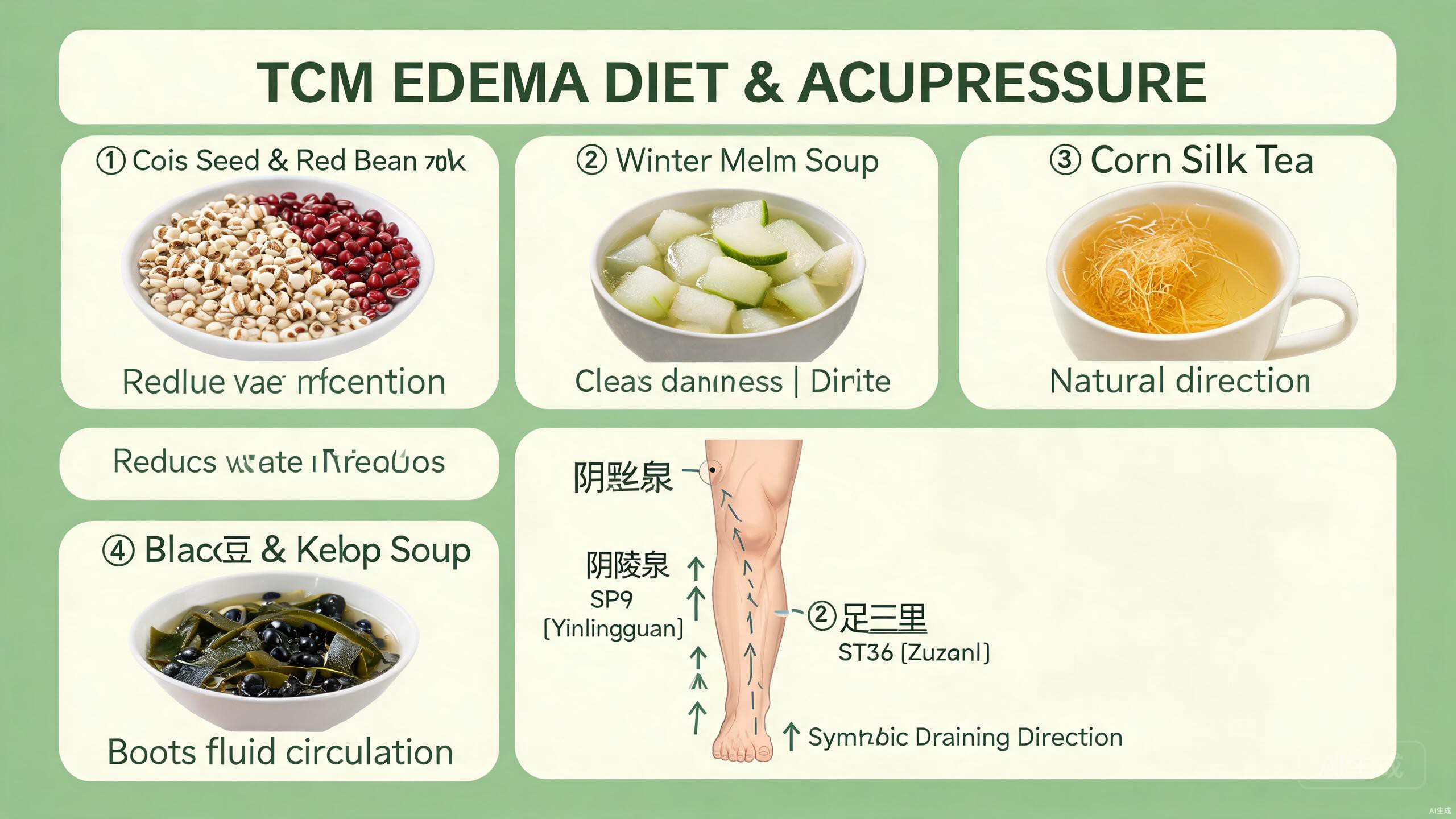
Key Takeaways
- TCM views edema through the Spleen and Kidney organ systems, with spleen failure to transport, kidney failure to transform qi, and water-dampness accumulation being the core patterns.
- Five traditional food therapy recipes — from adzuki bean coix porridge to corn silk tea — use ingredients available at Western supermarkets, Amazon, or iHerb.
- Four acupressure points — Zhongwan (CV12), Zusanli (ST36), Yinlingquan (SP9), and Sanyinjiao (SP6) — are traditionally used to strengthen the Spleen, support fluid metabolism, and drain dampness.
- Dietary precautions include reducing salt and sugar intake, and avoiding long-term heavy use of dampness-draining foods if you have a yin-deficient constitution.
- These are traditional wellness practices, not a treatment for any medical condition. Edema can indicate serious medical conditions and requires evaluation by a qualified healthcare provider.
This article is for educational purposes only and is not medical advice. The foods, teas, and practices described here are traditional wellness practices rooted in Chinese culture. They are not a substitute for professional medical care, diagnosis, or treatment. Edema — especially persistent, asymmetric, or sudden swelling — can indicate serious medical conditions including heart disease, kidney disease, liver disease, venous insufficiency, deep vein thrombosis, or medication side effects. These require prompt evaluation by a qualified healthcare provider. Never stop, delay, or replace prescribed treatment based on information in this article. Some foods and herbs may interact with medications — always inform your doctor about everything you consume. These statements have not been evaluated by the FDA and are not intended to diagnose, treat, cure, or prevent any disease. Read our full disclaimer →
Swelling in the legs, ankles, feet, hands, or face is a common concern that can affect comfort, mobility, and quality of life. Whether it appears at the end of a long day, during warm weather, or as a persistent companion, edema — the medical term for fluid retention — has many possible causes that should always be evaluated by a healthcare provider. Traditional Chinese Medicine (TCM) offers a rich tradition of food therapy and self-care practices that may support healthy fluid balance as part of a balanced lifestyle.
In TCM, edema is not viewed as a problem of the skin or the limbs alone. Instead, it is understood as a sign that the Spleen cannot properly transport fluids and the Kidney cannot properly transform and excrete water, leading to water-dampness accumulating in the tissues. The five recipes and four acupressure points below come from this tradition. All ingredients are available at Western supermarkets, Asian markets, Amazon, or iHerb.
If you are new to TCM concepts, our introduction to Traditional Chinese Medicine and guide to the Zang-Fu organ systems are helpful starting points. For a broader look at fluid-related concerns, see our guides on TCM for water retention and TCM for swelling and pain relief.
How TCM Views Edema
Traditional Chinese Medicine has recognized and described edema for thousands of years. The classical TCM term for edema is shui zhong, which literally means "water swelling." TCM texts dating back over two thousand years describe the condition in remarkable detail and identify the Spleen and Kidney as the two organ systems most responsible for fluid metabolism.
The Spleen is the central organ of fluid management in TCM. It is responsible for transforming and transporting — taking in food and drink, extracting the useful nutrients, and distributing the clear fluids throughout the body. When the Spleen is strong, fluids are processed efficiently, and the body remains balanced. When the Spleen is weak — due to poor diet, overwork, worry, or chronic illness — it cannot properly transform fluids. Instead of being distributed and excreted, fluids accumulate as internal dampness, which can settle in the tissues and manifest as swelling. This is called spleen deficiency with dampness (pi xu shi sheng).
The Kidney is the deeper root of fluid metabolism. In TCM, the Kidney governs water and provides the qi transformation (qi hua) energy needed to vaporize and excrete fluids through urination. When kidney qi or kidney yang is strong, water is transformed and excreted properly. When kidney yang is deficient — often due to aging, chronic illness, or exposure to cold — the body lacks the "fire" needed to transform water, and fluids accumulate. This is called kidney deficiency with water flooding (shen xu shui fan). Signs include swelling that is worse in the lower body, cold extremities, frequent urination (especially at night), and lower back weakness. See our guide to TCM for night urination for more on kidney-related fluid patterns.
TCM identifies three primary patterns associated with edema:
- Spleen Deficiency with Dampness (Pi Xu Shi Sheng) — the most common pattern. A weak Spleen cannot transport fluids, leading to generalized swelling that is often worse in the upper body (face, hands) in the morning and the lower body (legs, ankles) in the evening. Signs include fatigue, poor appetite, loose stools, and a feeling of heaviness. Often related to irregular eating habits, overwork, or worry. See our TCM for digestion guide for more on Spleen patterns.
- Kidney Yang Deficiency (Shen Yang Xu) — the Kidney lacks the warming, transforming energy to manage water. Signs include swelling worse in the lower body (legs, ankles, feet), cold hands and feet, frequent nighttime urination, lower back soreness, and a feeling of coldness. Often seen in older adults or after chronic illness.
- Damp-Heat Accumulation (Shi Re Yun Jie) — dampness combines with heat, causing swelling that is firm, warm to the touch, and may be accompanied by redness, thirst, and dark urine. This pattern is less common for general edema but may be seen in acute conditions. See our guide to summer heat clearing foods for related information.
Understanding these patterns helps explain why TCM recommends different foods for different situations. The recipes below are grouped by the pattern they traditionally address.
5 Food Therapy Recipes for Edema
Each recipe below is matched to a specific TCM pattern. Choose the one that best fits your situation, and use it consistently for two to four weeks. All ingredients are available at Western supermarkets, Asian markets, Amazon, or iHerb.
1. Adzuki Bean and Coix Seed Porridge (赤小豆薏米粥)
Best for: Spleen deficiency with dampness — general fluid retention
TCM nature and flavor: Adzuki bean (chi xiao dou): sweet, sour, neutral. Enters the Heart and Small Intestine channels. Coix seed (yi yi ren / Job's tears): sweet, bland, slightly cool. Enters the Spleen, Lung, and Kidney channels.
Traditional use: This is perhaps the most famous TCM food therapy combination for edema. Adzuki beans are traditionally used to promote urination, reduce swelling, and drain dampness. Their red color connects them to the Heart channel in TCM theory, and they are particularly valued for swelling that affects the lower body. Coix seed (Job's tears) is one of TCM's most important dampness-draining grains, traditionally used to strengthen the Spleen, drain dampness, and promote urination. Together, they form a gentle but effective combination that addresses both the dampness (the symptom) and the Spleen weakness (the root). This porridge is a staple of Chinese food therapy for anyone dealing with fluid retention.
Ingredients:
- 30 grams dried adzuki beans (about 2 tablespoons) — available on Amazon, iHerb, and most supermarkets
- 30 grams dried coix seed (Job's tears) — available on Amazon or iHerb
- 50 grams white rice (about 1/4 cup, short or medium grain)
- 5 cups water
- A pinch of sea salt
Preparation: Soak the adzuki beans and coix seed separately for 4 to 6 hours (or overnight) until softened. Rinse the rice. In a pot, combine the soaked beans, coix seed, rice, and water. Bring to a boil, then reduce heat and simmer for 45 to 60 minutes, stirring occasionally, until the porridge is thick and the beans are very soft. Add salt to taste. Eat 1 bowl per day, ideally at breakfast or lunch, for 2 to 4 weeks. The porridge has a mild, slightly nutty flavor. For more on coix seed, see our dampness-removing foods guide.
Precautions: Both ingredients are cooling. If you have a cold constitution with cold extremities and diarrhea, add 3 slices of fresh ginger to warm the recipe. Coix seed is traditionally avoided in large amounts during pregnancy. If you take diuretic medication, consult your healthcare provider before adding diuretic foods to your routine.
2. Winter Melon and Carp Soup (冬瓜鲤鱼汤)
Best for: Spleen and Kidney deficiency with water-dampness — lower body swelling
TCM nature and flavor: Winter melon (dong gua): sweet, mild, cool. Enters the Lung, Spleen, and Bladder channels. Carp (li yu): sweet, neutral. Enters the Spleen and Kidney channels.
Traditional use: This is a classic TCM food therapy soup for edema, especially when swelling is concentrated in the lower body. Winter melon is traditionally used to clear heat, promote urination, and reduce swelling. Its high water content and mild diuretic properties make it one of the most effective foods for fluid retention. Carp has been valued in Chinese food therapy for centuries for its ability to strengthen the Spleen, support the Kidney, and promote urination — in TCM, it is considered one of the best foods for edema, particularly when kidney deficiency is involved. The combination of the cooling winter melon and the nourishing carp creates a balanced soup that drains dampness without depleting the body.
Ingredients:
- 200 grams winter melon, peeled and cubed (available at Asian markets; zucchini or chayote can substitute)
- 1 whole carp (about 1 lb) or 1 lb carp fillets (available at Asian markets; substitute with freshwater fish like tilapia)
- 4 slices fresh ginger
- 2 scallions, cut into pieces
- 6 cups water
- A pinch of sea salt
Preparation: Clean the fish thoroughly. In a pot, sear the fish briefly with ginger and scallions until lightly browned. Add water and bring to a boil, then reduce heat and simmer for 30 minutes. Add the cubed winter melon and simmer for another 15 to 20 minutes until the melon is translucent and tender. Strain the broth if desired. Add salt to taste. Drink 1 bowl of broth and eat the fish and melon, 2 to 3 times per week. For more on winter melon, see our summer heat clearing foods guide.
Precautions: Winter melon is cooling. If you have a cold constitution, add extra ginger. If you have gout or high uric acid, be cautious with fish broth. Always ensure fish is thoroughly cooked.
Winter melon (dong gua) is a large, green-skinned melon with white flesh, available at Asian markets year-round. It has a very mild flavor and high water content, making it ideal for soups. If unavailable, chayote or zucchini can substitute, though they are less traditionally associated with dampness-draining properties. Carp is available at Asian markets; any mild freshwater fish can substitute.
3. Coix Seed, Adzuki Bean, and Red Date Porridge (薏苡仁赤小豆红枣粥)
Best for: Spleen deficiency with dampness and mild blood deficiency — chronic fluid retention with fatigue
TCM nature and flavor: Coix seed: sweet, bland, slightly cool. Adzuki bean: sweet, sour, neutral. Red date (hong zao / jujube): sweet, warm. Enters the Spleen and Stomach channels.
Traditional use: This is a variation of the classic adzuki-coix porridge, enhanced with red dates (jujubes). The addition of red dates makes this version particularly suitable for people whose edema is accompanied by fatigue, pale complexion, and general weakness — signs that the Spleen deficiency has led to mild blood deficiency. Red dates are one of TCM's most important tonic foods, traditionally used to tonify the Spleen, nourish blood, and harmonize the other ingredients. In TCM food therapy, adding red dates to a dampness-draining recipe helps protect the Spleen from being over-drained, making the recipe suitable for longer-term use.
Ingredients:
- 30 grams dried coix seed (Job's tears)
- 30 grams dried adzuki beans
- 50 grams white rice
- 6 dried red dates (jujubes), pitted — available on Amazon or iHerb
- 5 cups water
- A pinch of sea salt
Preparation: Soak the coix seed and adzuki beans for 4 to 6 hours. Rinse the rice. In a pot, combine all ingredients with water. Bring to a boil, then reduce heat and simmer for 45 to 60 minutes until thick and creamy. Add salt to taste. Eat 1 bowl per day, ideally at breakfast, for 2 to 4 weeks. The red dates add a natural sweetness that makes this porridge more palatable than the basic version. For more on red dates, see our red date congee guide.
Precautions: Similar to recipe 1. Red dates are warm and sweet, so this version is slightly more suitable for people with a cold constitution. If you have diabetes, be aware that red dates contain natural sugars.
4. Poria and Tangerine Peel Tea (茯苓陈皮茶)
Best for: Spleen deficiency with phlegm-dampness — fluid retention with chest fullness
TCM nature and flavor: Poria (fu ling): sweet, bland, neutral. Enters the Heart, Spleen, and Kidney channels. Tangerine peel (chen pi): acrid, bitter, warm. Enters the Spleen and Lung channels.
Traditional use: This tea addresses the transformation of dampness into phlegm, a more sticky and obstructive form of internal dampness. Poria is a medicinal mushroom traditionally used to drain dampness, strengthen the Spleen, and calm the mind. It is one of the most frequently used herbs in TCM and is valued for its gentle, balancing nature. Tangerine peel is traditionally used to regulate qi, resolve phlegm, and strengthen the Spleen. Together, they form a tea that not only drains dampness but also helps the Spleen function more efficiently, preventing dampness from reforming. This tea is particularly suitable for people whose edema is accompanied by a feeling of fullness in the chest and abdomen, fatigue, and a thick sensation in the mouth.
Ingredients:
- 10 grams dried poria slices (fu ling) — available on Amazon or iHerb
- 5 grams dried tangerine peel (chen pi) — available on Amazon or iHerb
- 3 cups water
- Optional: 3 dried red dates for sweetness
Preparation: Rinse the poria and tangerine peel. In a pot, combine all ingredients with water. Bring to a boil, then reduce heat and simmer gently for 20 to 30 minutes. Strain into a cup. Drink 1 to 2 cups per day, preferably in the morning or afternoon. The tea is mild, earthy, and slightly aromatic. The poria and tangerine peel can be re-steeped once. For more on tangerine peel, see our tangerine peel tea guide.
Precautions: Poria is a mild diuretic. If you take prescription diuretics, consult your healthcare provider. Tangerine peel is warming — if you have signs of internal heat (dry mouth, constipation), reduce the amount. See our herbal tea safety guide for general guidance.
5. Corn Silk Tea (玉米须茶)
Best for: Mild fluid retention — simple, daily support for water balance
TCM nature and flavor: Corn silk (yu mi xu): sweet, mild, neutral. Enters the Liver, Gallbladder, and Bladder channels.
Traditional use: Corn silk — the fine, thread-like strands found inside an ear of corn — is one of the most accessible and gentle dampness-draining foods in TCM. It is traditionally used to promote urination, drain dampness, and support liver and gallbladder function. In Chinese folk medicine, corn silk tea is a common household remedy for mild fluid retention, especially during summer when heat and humidity can worsen swelling. Corn silk is also valued in modern nutrition for its potassium content and gentle diuretic properties. This is one of the simplest TCM food therapy recipes you can make, as the main ingredient is free if you buy fresh corn.
Ingredients:
- 15 grams dried corn silk (yu mi xu) — available on Amazon or iHerb (or save the silk from 2 ears of fresh corn)
- 3 cups water
- Optional: a small amount of honey to taste
Preparation: If using fresh corn silk, rinse thoroughly. If using dried corn silk, it is ready to use. In a pot, combine the corn silk and water. Bring to a boil, then reduce heat and simmer for 10 to 15 minutes. Strain into a cup. Drink 1 to 2 cups per day, preferably in the morning or afternoon. The tea has a mild, slightly sweet, corn-like flavor. For a refreshing summer version, let it cool and serve chilled.
Precautions: Corn silk is a mild diuretic. If you take prescription diuretics or blood pressure medication, consult your healthcare provider before using it regularly. Corn silk may lower blood sugar — if you have diabetes and take medication, monitor your blood sugar closely.
Four Acupressure Points for Fluid Balance
In addition to food therapy, TCM uses acupressure to support the organ systems involved in fluid metabolism. The four points below are traditionally used to strengthen the Spleen, support the Kidney, and drain dampness. They are simple to find and can be pressed daily as part of a wellness routine.
1. Zhongwan (CV12) — The "Central Stomach"
Location: On the midline of the upper abdomen, midway between the base of the sternum (breastbone) and the navel.
How to find it: Place your hand flat on your upper abdomen with the little finger at the base of your sternum. The point is at the midline, approximately at the level of the middle of your palm.
How to press: Lie on your back. Using the pads of two or three fingers or the heel of your palm, press gently but firmly inward. Hold for 2 to 3 minutes while breathing slowly and deeply. You may feel a mild ache or warmth — this is normal.
Traditional use: Zhongwan is the front-mu (alarm) point of the Stomach and a major meeting point on the Conception Vessel. It is traditionally used to strengthen the Spleen and Stomach, regulate digestion, and transform dampness. For edema rooted in Spleen deficiency, CV12 helps restore the Spleen's ability to manage fluids.
Precautions: Do not press firmly on a full stomach. Use gentle pressure on the abdomen. Avoid during pregnancy.
2. Zusanli (ST36) — The "Leg Three Miles"
Location: On the outer lower leg, about 3 cun (approximately four finger-widths) below the kneecap, one finger-width to the outside of the shin bone.
How to find it: Place four fingers below the bottom of your kneecap, on the outer side of the shin. The point is at the level of the bottom finger, just outside the shin bone.
How to press: Using your thumb or the pads of two fingers, press firmly into the point for 2 to 3 minutes on each leg. This point is often tender, especially in people with digestive weakness.
Traditional use: Zusanli is the most important tonification point in TCM, traditionally used to strengthen the Spleen and Stomach, tonify qi, and support overall vitality. For edema, ST36 addresses the root by building the Spleen's ability to transform and transport fluids.
3. Yinlingquan (SP9) — The "Yin Mound Spring"
Location: On the inner lower leg, just below the knee, behind the inner edge of the shin bone (tibia).
How to find it: Run your hand along the inner edge of your shin bone, from the ankle upward. Just below the knee, you will feel a depression just behind the shin bone. The point is in this depression.
How to press: Using your thumb, press into the point at a slight angle toward the shin bone. Apply moderate pressure for 2 to 3 minutes on each leg. This point is often quite tender, especially in people with fluid retention.
Traditional use: Yinlingquan is the most important point on the Spleen meridian for draining dampness and promoting urination. It is considered the "dampness point" in TCM and is traditionally used for edema, urinary difficulty, and any condition involving fluid accumulation. For edema, SP9 directly addresses the dampness itself.
4. Sanyinjiao (SP6) — The "Three Yin Intersection"
Location: On the inner lower leg, about 3 cun (approximately four finger-widths) above the highest point of the inner ankle bone, just behind the inner edge of the shin bone.
How to find it: Place four fingers together across the inside of your leg, with the bottom finger resting on the top of your inner ankle bone. The point lies just behind the shin bone at the level of the top edge of your fourth finger.
How to press: Using your thumb, press into the point at a slight angle toward the shin bone. Apply moderate pressure for 2 to 3 minutes on each leg.
Traditional use: Sanyinjiao is the meeting point of three major Yin meridians — the Spleen, Kidney, and Liver. It is traditionally used to strengthen the Spleen, nourish the Kidney, and regulate fluid metabolism. For edema, SP6 addresses both the Spleen (the fluid manager) and the Kidney (the fluid transformer) simultaneously, making it one of the most comprehensive points for water balance.
Precautions: Sanyinjiao (SP6) is strictly contraindicated during pregnancy. For more on this point, see our dedicated Sanyinjiao (SP6) guide.
For a simple daily routine, press Zhongwan (CV12) for 2 to 3 minutes in the morning while lying in bed. Then press Yinlingquan (SP9) and Zusanli (ST36) on both legs for 2 to 3 minutes each, either morning or evening. End with Sanyinjiao (SP6) on both legs for 2 minutes each in the evening. Consistency matters more than duration. For more guidance, see our acupressure safety guide.
Lifestyle and Dietary Tips for Water Balance
TCM is a whole-person system. Foods and acupressure work best when combined with supportive daily habits. The following areas are emphasized in classical TCM for managing fluid retention:
- Reduce salt intake. In TCM, excess salt is considered damaging to the Kidney. While a small amount of salt is necessary, too much draws water into the tissues and strains the Kidney's ability to manage fluids. Avoid heavily salted, pickled, and processed foods. Use natural seasonings like ginger, scallion, and herbs instead of salt when possible.
- Reduce sugar and sweets. In TCM, sweets and sugar weaken the Spleen and contribute to dampness. Excess sugar creates internal dampness that can settle as fluid retention. Favor naturally sweet foods like red dates and yams over refined sugar.
- Eat warm, cooked foods. TCM considers raw and cold foods difficult for the Spleen to process, as they require extra energy to warm and digest. Favor soups, stews, porridges, and steamed vegetables. See our congee guide for warming, easy-to-digest options.
- Stay active. In TCM, movement promotes the flow of qi and blood, which helps the body process and transport fluids. Gentle, regular exercise — walking, tai chi, or qigong — is ideal. Avoid excessive sweating, which can deplete fluids and qi.
- Keep warm, especially the lower back, abdomen, and feet. Cold contracts and slows the flow of qi and blood. Keep these areas warm, especially in cold weather. A warm ginger foot soak in the evening promotes circulation and fluid movement.
- Avoid prolonged standing or sitting. Both positions cause fluid to pool in the lower body. If you must stand or sit for long periods, take breaks to walk and elevate your legs when possible.
Most dampness-draining foods (adzuki beans, coix seed, winter melon, corn silk, poria) are cooling and diuretic in nature. For people with a yin-deficient constitution — characterized by dry skin, dry mouth, night sweats, heat sensations, and a thin frame — long-term heavy use of these foods may further deplete yin and worsen dryness. If you have these signs, use dampness-draining foods in moderation, add warming ingredients like ginger or red dates to balance them, and consult a qualified TCM practitioner for personalized guidance. See our yin-yang guide to learn more about constitution types.
Comparison of the Five Recipes
| Recipe | TCM Pattern | Key Action | Frequency |
|---|---|---|---|
| Adzuki Bean & Coix Porridge | Spleen Def. + Dampness | Drain dampness, strengthen Spleen | 1 bowl daily |
| Winter Melon & Carp Soup | Spleen/Kidney Def. (lower body) | Promote urination, nourish Spleen/Kidney | 2 to 3 times per week |
| Coix Adzuki Red Date Porridge | Spleen Def. + Blood Def. | Drain dampness, nourish blood | 1 bowl daily |
| Poria Tangerine Peel Tea | Spleen Def. + Phlegm-Dampness | Drain dampness, resolve phlegm, regulate qi | 1 to 2 cups daily |
| Corn Silk Tea | Mild fluid retention | Promote urination, drain dampness | 1 to 2 cups daily |
Frequently Asked Questions
What does TCM say about edema and water retention?
In Traditional Chinese Medicine, edema is understood through the Spleen and Kidney organ systems. The Spleen is responsible for transforming and transporting fluids, while the Kidney governs water metabolism and qi transformation. When the Spleen fails to transport fluids properly, or when the Kidney lacks the qi to transform and excrete water, dampness accumulates in the body and manifests as swelling. TCM food therapy traditionally uses ingredients like adzuki beans, coix seed, winter melon, poria, and corn silk to drain dampness, strengthen the Spleen, and support the Kidney. These are traditional wellness practices, not medical treatments. For a deeper understanding, see our zang-fu organ guide.
Which TCM foods may help with edema?
Five traditional TCM food therapy recipes for edema include adzuki bean and coix seed porridge, winter melon and carp soup, coix seed adzuki red date porridge, poria and tangerine peel tea, and corn silk tea. These recipes use ingredients like adzuki beans, coix seed (Job's tears), winter melon, dried poria, tangerine peel, and dried corn silk that are available at Western supermarkets, Asian markets, Amazon, or iHerb. The porridge recipes address Spleen deficiency, the soup addresses combined Spleen and Kidney deficiency, and the teas provide gentle daily support. They are traditional wellness foods, not treatments for any medical condition.
Can acupressure help with water retention?
TCM acupressure on points like Zhongwan (CV12) on the upper abdomen, Zusanli (ST36) below the knee, Yinlingquan (SP9) on the inner leg, and Sanyinjiao (SP6) on the inner lower leg is traditionally used to strengthen the Spleen, support fluid metabolism, and drain dampness. Gentle, regular pressure on these points may complement overall wellness. Yinlingquan (SP9) in particular is considered the most important point for draining dampness in TCM. However, acupressure is not a treatment for edema. If you experience persistent or severe swelling, consult your healthcare provider promptly, as edema can indicate serious medical conditions. See our acupressure safety guide for general precautions.
Are there dietary precautions for edema in TCM?
In TCM, dietary management of edema emphasizes reducing salt and sugar intake, as both contribute to fluid retention and dampness. Favor warm, cooked, easily digested foods and avoid raw, cold, greasy, and very sweet foods. People with a yin-deficient constitution (characterized by dryness, heat sensations, and night sweats) should not consume large amounts of dampness-draining ingredients long-term, as these are mostly cooling and diuretic and may further deplete yin. Adding warming ingredients like ginger or red dates can help balance the cooling nature of dampness-draining foods. These are traditional wellness suggestions, not medical advice. Always consult your healthcare provider for persistent edema. See our yin-yang guide to learn about constitution types.
Precautions and When to Seek Help
While TCM food therapy and acupressure may support general fluid balance, edema can indicate serious medical conditions that require professional evaluation:
- Seek prompt medical attention if you experience sudden or severe swelling, especially in one leg (which may indicate deep vein thrombosis), swelling accompanied by chest pain or difficulty breathing (which may indicate heart failure), or swelling with fever and redness (which may indicate infection).
- See your doctor if you experience persistent or worsening swelling, swelling that does not improve with rest and elevation, or swelling accompanied by changes in urination, fatigue, or weight gain. These may indicate heart disease, kidney disease, liver disease, thyroid disorders, or medication side effects that need proper diagnosis.
- Medication interactions. If you take diuretics, blood pressure medication, diabetes medication, or heart medication, consult your healthcare provider before adding diuretic foods (adzuki beans, coix seed, corn silk, poria) to your routine, as they may enhance the effects of your medication.
- Pregnancy. Sanyinjiao (SP6) acupressure is strictly contraindicated during pregnancy. Edema during pregnancy should always be evaluated by your healthcare provider, as it can be a sign of preeclampsia.
- Not a substitute. TCM food therapy is complementary. It sits alongside — never in place of — professional medical care.
For related topics, see our guides on TCM for water retention, TCM for swelling and pain relief, and TCM for night urination.
The Bottom Line
Traditional Chinese Medicine offers a gentle, food-based tradition for supporting healthy fluid balance. By understanding whether your edema is rooted in Spleen deficiency, Kidney yang deficiency, or damp-heat accumulation, you can choose foods and teas that work with your body's specific needs. Adzuki bean and coix seed porridge drains dampness and strengthens the Spleen. Winter melon and carp soup nourishes while promoting urination. Poria and tangerine peel tea resolves phlegm-dampness. And corn silk tea provides simple, daily support for water balance. Paired with four acupressure points — Zhongwan (CV12), Zusanli (ST36), Yinlingquan (SP9), and Sanyinjiao (SP6) — and lifestyle habits like reducing salt and sugar, eating warm foods, and staying active, these traditional practices form a whole-person approach to fluid wellness.
But they are traditions — not treatments, and not a replacement for medical care. Edema can indicate serious medical conditions that require evaluation by a qualified healthcare provider. Use these traditional practices only as complementary wellness habits, alongside your doctor's guidance.
This article shares traditional wellness practices for educational purposes only. It is not a substitute for medical advice, diagnosis, or treatment. The foods, teas, and acupressure practices described here are not intended to treat, cure, or prevent any disease, including but not limited to heart disease, kidney disease, liver disease, venous insufficiency, lymphedema, or deep vein thrombosis. If you have edema — especially persistent, sudden, or asymmetric swelling — consult your healthcare provider promptly for proper evaluation. These statements have not been evaluated by the FDA. Never stop or adjust prescribed treatment without your doctor's explicit guidance. Read our full disclaimer →