Key Takeaways
- TCM sitting meditation (jingzuo) is rooted in three classical principles: stillness stores the spirit, keep the spirit within, and tranquil emptiness.
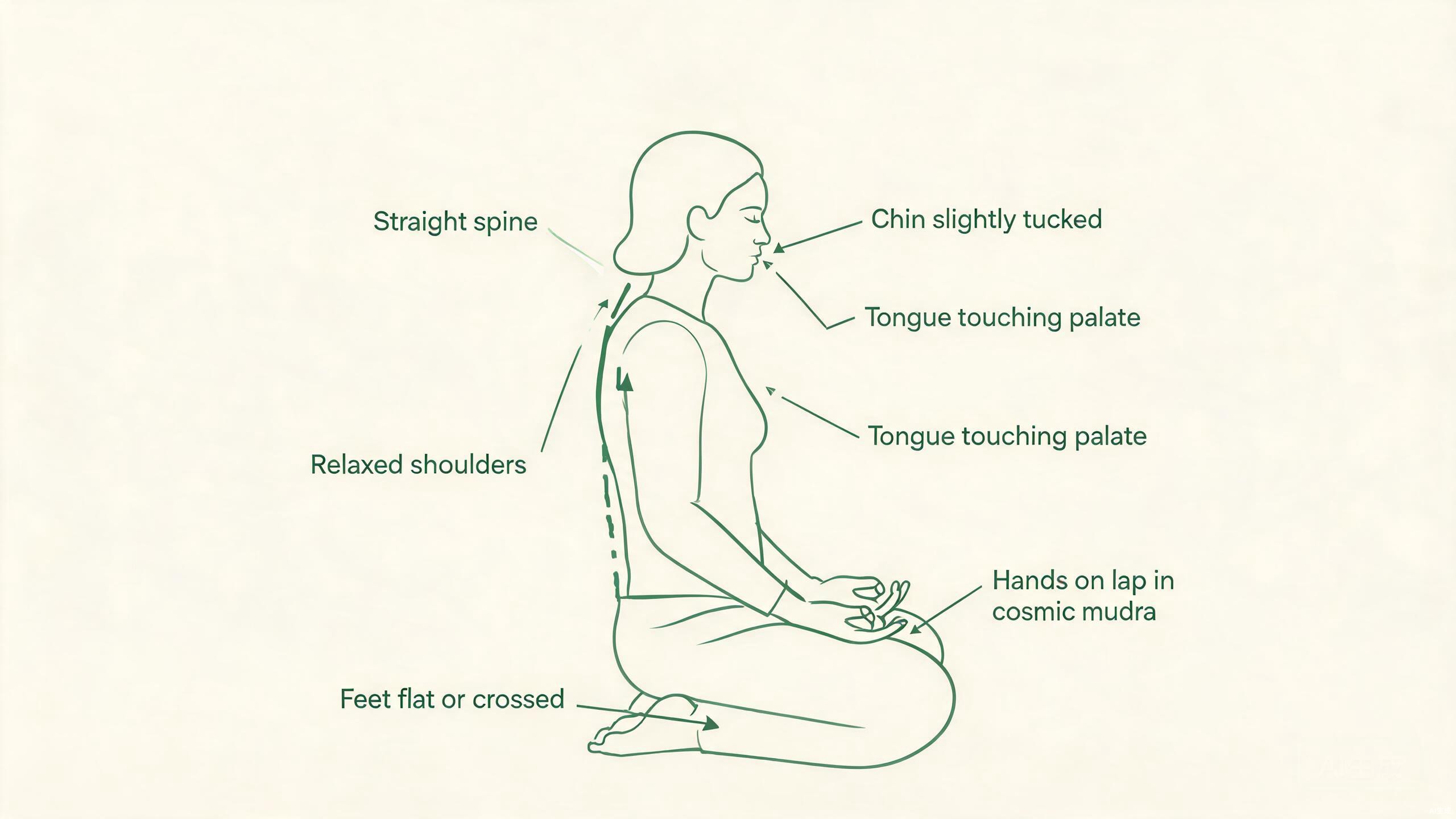
- Correct posture — an upright spine, slight chin tuck, and tongue resting on the palate — forms the physical foundation of the practice.
- Breath progresses from natural breathing to abdominal breathing and eventually reverse abdominal breathing.
- Gentle attention on the lower Dantian (three finger-widths below the navel) anchors the mind and gathers qi.
- Daily sessions of 15 to 30 minutes, morning and evening, yield the best results when practiced consistently.
- Avoid meditating immediately after meals, during intense emotional states, or in drafty, cold environments.
This article is for wellness education only and is not medical advice. The meditation practices described here are traditional self-care methods and are not intended to diagnose, treat, cure, or prevent any disease. If you have a medical or psychological condition, consult your healthcare provider before beginning any meditation practice. If you experience persistent anxiety, depression, or other mental health concerns, seek support from a qualified professional.
Long before mindfulness became a global wellness trend, the Chinese medical tradition had its own sophisticated system of meditation. Known as jingzuo — literally "stillness sitting" or "quiet sitting" — this practice has been cultivated for over two thousand years by physicians, Daoist sages, and Buddhist monks alike. Unlike many modern mindfulness approaches that emphasize open, non-judgmental awareness of thoughts, TCM sitting stillness places equal emphasis on the body, the breath, and the internal focus of attention. The goal is not simply to observe the mind but to actively restore the body's internal balance and preserve its most precious resource: the spirit, or shen.
This guide covers the five essential dimensions of TCM sitting meditation — posture, breath, Dantian focus, timing, and precautions — so that you can begin a safe and sustainable practice at home. If you are new to TCM concepts, our guides to yin and yang and TCM emotional wellness provide helpful background.
How TCM Views Sitting Stillness
The theoretical foundation of TCM meditation rests on three classical phrases from the Huangdi Neijing (Yellow Emperor's Inner Canon), the foundational text of Chinese medicine written over two thousand years ago:
- Jing ze shen cang — "When still, the spirit is stored." In TCM theory, the spirit (shen) is housed by the Heart. When the body is in motion and the mind is agitated, the spirit scatters and qi is consumed. When the body is still and the mind is calm, the spirit is preserved and qi accumulates. This is the core rationale for sitting meditation.
- Jing shen nei shou — "Keep the spirit within." Rather than allowing attention to flow outward to screens, tasks, and worries, the practitioner gently draws awareness inward. This does not mean suppressing thoughts but rather refusing to chase them, allowing the mind to settle naturally.
- Tian dan xu wu — "Tranquil, content, and empty." This phrase describes the ideal internal state during meditation: not blank or forceful, but quietly content and free of striving. It is the mental equivalent of still water — clear because nothing disturbs it.
From these principles, TCM developed a meditation tradition that is uniquely integrative. The body is not treated as an obstacle to be ignored but as an essential partner in the practice. The breath is not merely a focus of attention but a tool for regulating qi. And the mind is not forced into emptiness but allowed to settle through correct posture, natural breathing, and gentle internal focus.
1. Basic Posture: The Foundation of Stillness
In TCM meditation, posture is not a superficial detail — it is the physical foundation upon which everything else rests. The classical texts describe the ideal posture as "upright but not stiff, relaxed but not collapsed." When the body is correctly aligned, qi can flow freely through the meridians, the breath deepens naturally, and the mind finds it easier to settle.
Choosing Your Seated Position
There are two traditional seated positions, and both are equally valid:
- Cross-legged sitting (pan zuo): Sit on a firm cushion on the floor with legs crossed. The full lotus (both feet on opposite thighs) is the classical position but requires significant hip flexibility. The half lotus (one foot on the opposite thigh) or simple cross-legged position (both feet tucked under the knees) are more accessible for most modern practitioners. The cushion should raise the hips slightly above the knees to prevent the lower back from rounding.
- Chair sitting (yi zi zuo): Sit upright on a firm chair with feet flat on the floor, hip-width apart. The knees should be at or slightly below hip level. This position is fully traditional — many Chinese meditation masters have practiced exclusively in chairs — and is recommended for anyone with knee, hip, or back issues.
The Four Alignment Points
Regardless of which seated position you choose, four alignment points are essential:
- Spine upright (ji zhui zheng zhi): Imagine a gentle thread pulling the crown of your head upward. The spine should be naturally elongated — neither slumped forward nor arched backward. This alignment opens the Governing Vessel (Du Mai), the yang meridian that runs along the spine, allowing qi to rise and circulate freely.
- Chin slightly tucked (xia he wei shou): Draw the chin slightly inward and downward, lengthening the back of the neck. This prevents the head from tilting back (which causes mental agitation) or jutting forward (which causes drowsiness). The tuck should be subtle — imagine holding a small mandarin orange under your chin.
- Tongue on the palate (she ding shang e): Rest the tip of the tongue gently against the roof of the mouth, just behind the upper front teeth. This is known as "building the bridge" — it connects the Governing Vessel (which ends at the upper gum) with the Conception Vessel (which begins at the lower gum), creating a complete circuit for qi circulation. The contact should be light; do not press hard.
- Shoulders relaxed, chest soft (chen jian zhui zhou, han xiong ba bei): Let the shoulders drop naturally and allow the elbows to hang. The chest should be soft and slightly hollowed — not puffed out (which creates tension) and not collapsed (which restricts breathing). This alignment opens the lungs and allows the breath to sink into the abdomen.
Spend the first two to three minutes of each session simply settling into your posture. Do not rush to begin breathing techniques. Let the body find its natural alignment, make small adjustments, and allow the muscles to release. A well-settled posture makes everything that follows easier.
Hand Position (Shou Yin)
Rest the hands in your lap. The most common position is to place the right hand, palm up, in your lap and the left hand, palm up, on top of it. Bring the tips of the thumbs gently together so they form a loose oval. This is called the Dharmachakra mudra and helps seal the body's energy circuit. The hands should rest comfortably without any tension in the arms or wrists.
2. Breath Regulation: The Bridge Between Body and Mind
In TCM, the breath is far more than a physiological process — it is the direct mechanism by which we regulate qi. The classical texts state: "When the breath is long and fine, the mind is stable; when the breath is rough and short, the mind is scattered." TCM meditation progresses through three stages of breathing, each building on the last.
Stage One: Natural Breathing (Zi Ran Hu Xi)
What it is: Simply observing the breath without trying to change it. Notice the natural rhythm of inhalation and exhalation — the cool air entering the nostrils, the warm air leaving, the rise and fall of the chest and abdomen.
How to practice: For the first 3 to 5 minutes of your session, do nothing except breathe naturally and be aware of breathing. If your mind wanders, gently return to the breath. This stage calms the nervous system and prepares the body for deeper practice.
Purpose: To transition from the active, outward state of daily life to an inward, receptive state. Never skip this stage — forcing deep breathing before the body is ready creates tension and counteracts the goal of the practice.
Stage Two: Abdominal Breathing (Fu Shi Hu Xi)
What it is: Also called diaphragmatic breathing. In this stage, the diaphragm descends fully on inhalation, causing the abdomen to gently expand. On exhalation, the abdomen naturally retracts.
How to practice: Once natural breathing has settled the mind, begin to direct the breath downward. On inhalation, imagine the breath sinking to the lower abdomen (the Dantian area, about three finger-widths below the navel). The belly should gently rise. On exhalation, the belly naturally falls. The breath should be slow, fine, deep, and even — the four classical qualities of meditative breathing.
Purpose: Abdominal breathing activates the vagus nerve, shifts the body into parasympathetic (rest and digest) mode, and begins to gather qi in the Dantian. In TCM theory, it also "leads the fire down" — drawing excess heat and energy from the head (where they cause racing thoughts) into the lower body (where they can be stored).
Stage Three: Reverse Abdominal Breathing (Ni Fu Shi Hu Xi)
What it is: An advanced technique in which the abdominal movement is reversed: the abdomen draws inward on inhalation and expands outward on exhalation. This is the breathing method used in martial arts and advanced qigong.
How to practice: This stage should only be attempted after abdominal breathing has become natural and effortless — typically after several months of consistent practice. On inhalation, gently draw the lower abdomen inward while expanding the chest slightly. On exhalation, let the abdomen expand outward. The movement should be subtle and smooth, never forced.
Purpose: Reverse breathing is said to strengthen the Dantian, increase the circulation of qi through the meridians, and build internal power. It is not necessary for general wellness and should be learned gradually, ideally under the guidance of an experienced teacher. For most practitioners, abdominal breathing is sufficient.
TCM describes the ideal meditative breath as having four qualities: slow (slow rhythm, roughly 4 to 6 breaths per minute), fine (so quiet that a feather held before the nose would barely move), deep (the breath reaches the lower abdomen, not just the chest), and even (inhalation and exhalation are balanced and smooth). Do not try to achieve all four at once — let them develop naturally over weeks of practice.
3. Focus on Dantian: Anchoring the Mind
Once the posture is settled and the breath is regulated, the next step is to direct the mind. In TCM meditation, the primary point of focus is the Dantian — the body's central energy center. The term Dantian means "field of elixir," referring to the place where qi is cultivated and stored, like a field where medicinal herbs grow.
Location of the Lower Dantian
The lower Dantian — the most important of the three Dantian points — is located approximately three finger-widths (cun) below the navel and about two finger-widths inward, in the center of the lower abdomen. In TCM measurement, "three cun below the umbilicus" is the classical landmark. It is not on the surface of the skin but rather in the center of the abdominal cavity, an internal space rather than a point on the body.
How to Focus on the Dantian
The TCM instruction for Dantian focus is famously paradoxical: "use intention, not force" (yi nian er fei li). This means:
- Light, not heavy: The attention should rest on the Dantian like a butterfly landing on a flower — present but barely touching. Do not concentrate intensely or stare inward with mental effort. That kind of forceful concentration creates tension in the abdomen and head.
- Continuous, not grasping: The attention should be like a thin thread — unbroken but not pulling. You are simply aware of the Dantian area, feeling the gentle movement of the breath there, without trying to "achieve" anything.
- Accompanying the breath: On each inhalation, be aware of the breath sinking to the Dantian and the area gently expanding. On each exhalation, be aware of the Dantian area gently settling. The breath and the attention work together.
What Happens When You Focus on the Dantian
In TCM theory, sustained gentle attention on the Dantian causes qi to gather there, like water collecting in a basin. Over time, this gathered qi is said to nourish the whole body, strengthen the kidneys (which in TCM are the root of both yin and yang energy), and anchor the spirit. Practically, many people report a growing sensation of warmth, fullness, or gentle pulsing in the lower abdomen after several weeks of practice. These sensations are natural signs of qi accumulation and should not be chased or amplified — simply observed.
Mind-wandering is completely normal, especially in the beginning. When you notice that your attention has drifted — to a memory, a plan, a bodily sensation — simply acknowledge it without judgment and gently return to the Dantian. This act of noticing and returning is the practice. Over time, the gaps between wanderings will naturally lengthen. Never become frustrated with yourself; frustration itself scatters qi.
4. Timing and Frequency: Building a Sustainable Practice
One of the most common questions about meditation is how long and how often to practice. TCM offers clear, time-tested guidance that emphasizes consistency over intensity.
The Traditional Schedule
The classical recommendation is to practice twice daily: once in the morning and once in the evening.
- Morning practice (chen qi): Practicing shortly after waking, before breakfast, takes advantage of the body's fresh state. The mind is relatively clear after sleep, and the morning is associated in TCM with the rising of yang energy — an ideal time to gather and direct qi for the day ahead. Even 15 minutes of morning meditation can set a calmer, more grounded tone for the entire day.
- Evening practice (wan qi): Practicing before bed, about 30 to 60 minutes after dinner, helps the body transition from the active yang state of the day to the restful yin state of night. Evening meditation is particularly valuable for those who struggle with sleep, as it draws energy downward, calms the spirit, and prepares the body for rest. Pair it with a calming tea from our herbal tea for anxiety guide for enhanced effect.
Duration: Start Small, Build Gradually
| Experience Level | Session Length | Sessions Per Day | Focus |
|---|---|---|---|
| Beginner (Weeks 1–2) | 10–15 minutes | 1–2 | Natural breathing, posture |
| Intermediate (Weeks 3–6) | 15–20 minutes | 2 | Abdominal breathing, Dantian focus |
| Established (Months 2–3) | 20–30 minutes | 2 | Deepening stillness, integrating all stages |
| Advanced (3+ months) | 30–45 minutes | 2 | Exploring reverse breathing if appropriate |
The golden rule is gradual progression (xun xu jian jin). Never force yourself to sit longer than feels comfortable. If your legs go numb, your back aches, or your mind becomes agitated, end the session. It is far better to sit for 10 minutes with genuine calm than to endure 30 minutes of physical and mental tension. Consistency — showing up every day, even for a short time — produces far greater results than occasional long sessions.
Creating the Right Environment
The space where you meditate matters. Choose a quiet, clean, well-ventilated room where you will not be disturbed. The temperature should be comfortable — not too cold (which causes shivering and qi contraction) and not too hot (which causes drowsiness). Avoid sitting in a direct draft or under a fan, as TCM considers cold wind (feng) a primary cause of illness. A thin blanket over the legs and shoulders is traditional and helps maintain warmth. Dim, natural light is ideal; avoid harsh overhead lighting.
5. Precautions and Contraindications
TCM meditation is generally safe and beneficial, but it is not appropriate in every situation. The classical texts list several specific contraindications that are important to understand.
When Not to Meditate
- Immediately after a full meal: Wait at least 30 to 60 minutes after eating before meditating. Sitting still with a full stomach impairs digestion (the Spleen and Stomach need movement to function well) and can cause bloating, reflux, or drowsiness. A light snack is fine; a heavy meal is not.
- During intense emotional agitation: If you are in the grip of strong anger, grief, fear, or excitement, do not force yourself to sit. Instead, take a walk, do some gentle qigong movements, or drink a calming tea first. Meditation from a state of strong emotion can amplify the feeling rather than release it. Wait until the intensity has subsided, then sit.
- When extremely fatigued: If you are exhausted, meditation will likely turn into sleep. While this is not harmful, it is not meditation. Take a short nap or rest first, then meditate when you are rested.
- During acute illness: If you have a fever, acute infection, or are in significant pain, rest and recover first. Meditation is a wellness practice, not a treatment for acute illness.
Common Experiences and How to Handle Them
| Experience | What It Means | What to Do |
|---|---|---|
| Drowsiness or sleepiness | Common in beginners; the body is overtired or the posture is too relaxed | Open your eyes slightly, straighten the spine, or meditate at a different time of day |
| Racing thoughts | The mind is releasing accumulated mental activity | Do not fight it. Return gently to the breath and Dantian. Consider more breathing techniques to help settle the mind |
| Warmth or tingling in the hands or Dantian | Normal sign of qi circulation | Simply observe. Do not try to amplify or direct the sensation |
| Twitching or subtle involuntary movements | Qi is moving through areas of stagnation | Let it happen naturally. Do not try to produce or control these movements |
| Dizziness or lightheadedness | Breathing may be too deep or forced, or blood pressure is shifting | Return to natural breathing, open your eyes, and rest. Do not continue if it persists |
| Emotional release (tears, sadness) | Stagnant emotions are being released | Allow it to pass naturally. Do not suppress it, but do not amplify it either |
Special Populations
Pregnant women can practice gentle TCM meditation with their healthcare provider's approval. Avoid reverse abdominal breathing and any breath-holding. Focus on natural, relaxed breathing. People with mental health conditions — including anxiety disorders, depression, PTSD, or psychosis — should consult their mental health provider before beginning meditation. While meditation can be a valuable complement to treatment, it is not a replacement for professional care, and some practices may be contraindicated for certain conditions.
Combining Meditation with Other TCM Practices
TCM meditation does not exist in isolation — it is part of an integrated system of wellness practices that reinforce each other. Consider combining your sitting practice with these complementary traditions:
- Calming herbal tea: A cup of chrysanthemum tea or rose tea before evening meditation helps clear heat from the Liver and settle the mind, making it easier to enter a state of stillness.
- Acupressure: Pressing Shenmen (HT7) on the wrist or Yintang between the eyebrows for one to two minutes before sitting can help calm the spirit and prepare the mind for meditation.
- Gentle movement: A few minutes of qigong or tai chi before sitting helps loosen the body, release physical tension, and circulate qi — making it much easier to settle into stillness. This is the traditional sequence in Chinese practice: move first, then sit.
- Warm foot soak: Soaking the feet in warm water for 10 minutes before evening meditation draws energy downward, grounds excess yang, and deepens the settling effect of the practice.
Frequently Asked Questions
What is the difference between TCM meditation and other forms of meditation?
TCM meditation (jingzuo) differs from many modern mindfulness practices in several ways. First, it places greater emphasis on physical posture — the alignment of the spine, the position of the tongue, and the settling of the shoulders are considered essential, not optional. Second, it uses specific breathing progression (natural to abdominal to reverse) rather than a single breathing technique. Third, it directs attention to a specific internal point — the Dantian — rather than using open awareness or body scanning. Finally, TCM meditation is explicitly integrated with the body's energy system (qi, meridians, organs), making it part of a larger medical framework rather than a standalone psychological technique.
Can I meditate lying down instead of sitting?
Lying-down meditation (yang wo) exists in the TCM tradition and can be useful in specific circumstances — for example, as a sleep aid or for those who physically cannot sit upright. However, sitting is the preferred position for general practice because the upright posture keeps the mind alert (preventing sleep) and allows qi to circulate through the Governing and Conception vessels. If you meditate lying down, be aware that you are more likely to fall asleep, which means you are resting rather than meditating. For most practitioners, sitting — even in a chair — is the better choice.
How long until I feel the benefits of TCM meditation?
Many people notice a sense of calm and mental clarity after their very first session. However, the deeper benefits — improved sleep, reduced reactivity to stress, greater emotional stability, and a felt sense of internal energy — typically emerge after two to four weeks of consistent daily practice. The traditional saying is: "One hundred days to build the foundation" — meaning that about three months of daily practice creates a genuine, lasting shift. Be patient and consistent. The practice works cumulatively, and the benefits compound over time.
Is it normal to feel physical sensations like warmth, tingling, or pressure during meditation?
Yes, these sensations are common and are traditionally interpreted as signs of qi circulation. Warmth in the hands or Dantian area, a gentle pulsing sensation, or a feeling of fullness in the lower abdomen are all normal. The key instruction is to observe without amplifying — do not try to intensify the sensations or direct them with forceful mental effort. Simply let them arise and pass naturally. If you experience anything uncomfortable — pressure in the head, dizziness, or chest tightness — stop, return to natural breathing, and rest. These usually indicate that the breathing was too forced or the concentration too intense.
The Bottom Line
TCM sitting stillness is one of the oldest and most refined meditation traditions in the world. Its power lies in its integration — it does not treat the mind as separate from the body but works with posture, breath, and attention as a unified system. By sitting with an upright spine, breathing slowly and deeply into the abdomen, resting gentle attention on the Dantian, and practicing consistently each morning and evening, you cultivate the three classical qualities at the heart of TCM meditation: stillness that stores the spirit, attention that keeps the spirit within, and a tranquil, content emptiness that allows the body's natural balance to restore itself.
Start small. Ten minutes a day, in a chair, with natural breathing and a simple awareness of the lower abdomen, is enough to begin. The practice will deepen on its own, week by week, if you simply show up. As the classical texts remind us: the goal is not to achieve a particular experience but to return, again and again, to the quiet center that has always been there — waiting beneath the noise of daily life.
This article is for educational and informational purposes only and is not a substitute for professional medical advice, diagnosis, or treatment. The meditation practices described here are traditional wellness methods and are not intended to diagnose, treat, cure, or prevent any disease. Always consult a qualified healthcare provider before beginning any new wellness practice, especially if you are pregnant, nursing, taking medication, or have a medical or psychological condition. Never disregard professional medical advice or delay seeking it because of something you have read on this site. Read our full disclaimer →