Key Takeaways
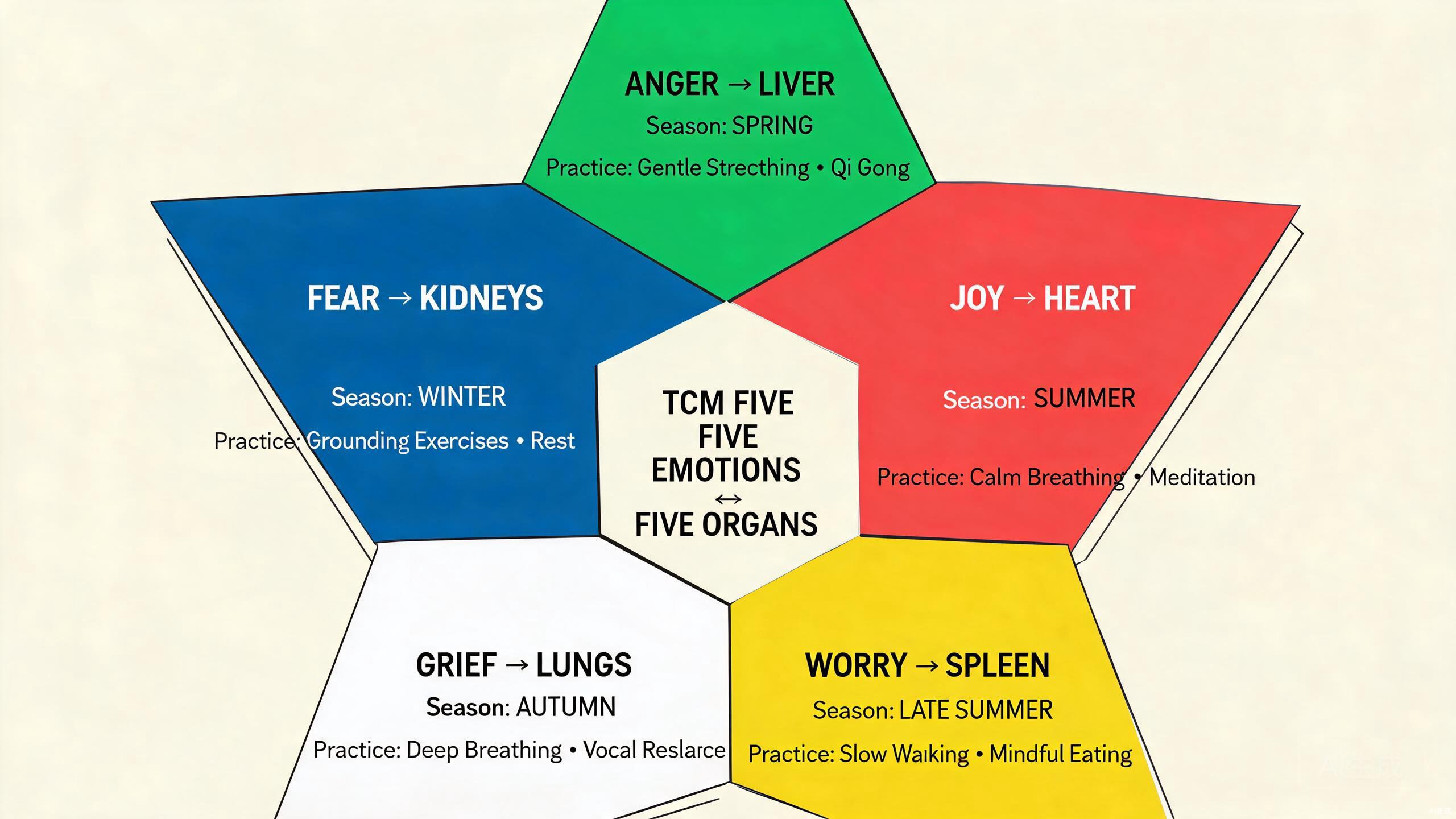
- In TCM theory, each of the five emotions corresponds to a specific organ: anger to the Liver, joy to the Heart, worry to the Spleen, grief to the Lungs, and fear to the Kidneys.
- Emotions in moderation are natural and healthy; it is excessive, prolonged, or suppressed emotion that may disrupt the flow of qi and affect the corresponding organ.
- Different emotional patterns call for different teas, acupressure points, and lifestyle adjustments — there is no one-size-fits-all approach.
- Daily practices such as qigong, acupressure, mindful journaling, and seasonal awareness may support emotional resilience.
- TCM practices are complementary. Persistent or severe emotional distress warrants support from a qualified mental health professional.
This article is for wellness education only and is not medical advice. The information here has not been evaluated by the U.S. Food and Drug Administration and is not intended to diagnose, treat, cure, or prevent any disease. TCM practices for emotional wellness are complementary and not a replacement for professional mental health care. If you experience persistent anxiety, depression, or other emotional difficulties, consult a qualified healthcare or mental health professional. If you are in crisis, contact your local emergency services immediately.
Modern psychology tends to separate emotions from the body — treating feelings as mental events to be managed through talk therapy or medication. Traditional Chinese Medicine (TCM) takes a radically different view. In TCM theory, emotions and organs are deeply interconnected: each of the five primary emotions is linked to a specific organ system, and prolonged or intense emotion can affect the body just as physical illness can affect the mood.
This does not mean that feeling angry or sad is inherently harmful. Emotions are natural responses to life. The concern in TCM is with emotions that are excessive, prolonged, or suppressed — held too long or expressed too intensely. If you are new to TCM, our guides to yin and yang and the five elements provide useful background for understanding this perspective.
The Five Emotions and Their Organs
The TCM framework known as the "five emotions and five organs" (Wu Zhi Wu Zang) maps each primary emotion to a specific zang organ. This is part of the broader zang-fu organ system that forms the theoretical backbone of Chinese medicine. Understanding these correspondences can help you recognize patterns in your own emotional and physical experience.
1. Anger and the Liver (Nu Shang Gan)
How it manifests: Tension headaches (especially at the temples or behind the eyes), tightness in the chest and ribs, sighing, irritability, jaw clenching, ringing in the ears, bitter taste in the mouth, irregular menstruation, digestive bloating that worsens with stress.
In TCM theory, the Liver is responsible for the smooth flow of qi throughout the body — including the smooth flow of emotions. When anger, frustration, or resentment is held in, Liver qi tends to stagnate. When it erupts, Liver qi rises upward, which is why anger-related symptoms often appear in the head and upper body. The Liver is also the organ most affected by chronic stress and unexpressed frustration.
How to harmonize: Movement is the primary medicine for Liver qi stagnation. Walking in nature, stretching, and especially qigong help restore the smooth flow of qi. Rose tea is the classic remedy for moving stagnant Liver qi — see our rose tea guide for brewing details. The key acupressure point is LR3 (Taichong), located on the top of the foot between the first and second toes. See our LR3 acupressure guide for instructions.
When frustration builds, try a 10-minute walk outdoors before reaching for a screen. In TCM, the Liver is associated with the wood element and the energy of spring — it thrives on movement, growth, and the outdoors.
2. Joy and the Heart (Xi Shang Xin)
How it manifests: Restlessness, insomnia, palpitations, anxiety with agitation, talking excessively, flushed face, difficulty concentrating, feeling "wired but tired."
The connection between joy and the Heart may seem counterintuitive — how can happiness be harmful? In TCM, the issue is not genuine contentment but excessive excitement: constant stimulation, overstimulation from screens, manic energy, or emotional highs that never settle. The Heart "houses the spirit" (shen) in TCM theory, and when it is overstimulated, the spirit becomes restless. This is why chronic overstimulation can lead to anxiety and sleep problems.
How to harmonize: Cultivate stillness. Meditation, slow breathing, and reducing sensory input (especially in the evening) help anchor the spirit. Chrysanthemum tea gently clears heat from the Heart and Liver — see our chrysanthemum tea guide. The key acupressure point is HT7 (Shenmen), located on the wrist crease. See our HT7 acupressure guide for details.
3. Worry and the Spleen (Si Shang Pi)
How it manifests: Fatigue after eating, bloating, poor appetite, overthinking that spirals, inability to "switch off" the mind, weak digestion, loose stools, pale complexion.
In TCM, the Spleen governs both digestion and thought. Just as it transforms food into energy, it is said to transform information into understanding. When worry and overthinking become habitual, the Spleen's energy is consumed — and when the Spleen is weak, the tendency to worry increases. This creates a feedback loop that is familiar to anyone who has ever lost their appetite during a period of intense stress.
How to harmonize: Eat warm, regular meals in a calm environment. Avoid eating while working or scrolling. Ginger and red date tea warms and supports the Spleen. Gentle, grounding movement like walking after meals helps. The key acupressure point is ST36 (Zusanli), which strengthens Spleen qi.
4. Grief and the Lungs (Bei Shang Fei)
How it manifests: Shallow breathing, frequent sighing, tightness in the chest, susceptibility to colds, dry skin, fatigue that feels "deflated," a sense of sadness that lingers in the chest.
The Lungs govern qi and respiration, and in TCM theory they are the organ most closely associated with grief and letting go. Just as the lungs take in and release air, grief is a process of holding and releasing. When grief is not fully processed — when it is held in the chest — the Lung qi may become constrained. Prolonged sadness can also weaken the body's defensive qi, making one more susceptible to respiratory illness.
How to harmonize: Conscious breathing is the primary practice. Deep, slow diaphragmatic breathing — especially outdoors in fresh air — helps restore Lung qi. Allow grief to move rather than suppressing it. Lily bulb tea nourishes Lung yin and is traditionally used for grief-related dryness and restlessness. The key acupressure point is LU9 (Taiyuan) on the wrist crease, which tonifies Lung qi.
5. Fear and the Kidneys (Kong Shang Shen)
How it manifests: Lower back and knee weakness, frequent urination, bedwetting (in children), deep fatigue, feeling of insecurity or lack of willpower, cold extremities, premature graying or hair loss.
The Kidneys in TCM are the root of the body's deepest energy — they store essence (jing) and govern willpower. Fear, particularly chronic fear or deep-seated anxiety, is said to "descend" and affect the Kidneys. This is why prolonged fear or shock can lead to symptoms in the lower back and lower body, and why chronic anxiety can feel so deeply exhausting. The Kidneys are also associated with the winter season and the body's deepest reserves of vitality.
How to harmonize: Warm, nourishing foods support Kidney energy: black sesame, walnuts, chestnuts, and slow-cooked stews. Adequate rest is essential. Practices that build a sense of safety and grounding — such as gentle yoga, tai chi, and spending time in nature — help restore the Kidneys. The key acupressure point is KI3 (Taixi), located behind the inner ankle bone, which tonifies Kidney yin and yang.
The Five Emotions and Five Organs: Summary Table
| Emotion | Organ | Signs of Imbalance | Harmonizing Food / Tea | Key Acupoint |
|---|---|---|---|---|
| Anger | Liver | Headaches, rib tension, irritability, sighing | Rose tea, chrysanthemum tea | LR3 (Taichong) |
| Joy (excess) | Heart | Insomnia, palpitations, restlessness | Chrysanthemum tea, lotus seed | HT7 (Shenmen) |
| Worry | Spleen | Bloating, fatigue, overthinking, poor appetite | Ginger + red date tea, congee | ST36 (Zusanli) |
| Grief | Lungs | Shallow breathing, chest tightness, frequent colds | Lily bulb tea, pear | LU9 (Taiyuan) |
| Fear | Kidneys | Lower back weakness, frequent urination, deep fatigue | Black sesame, walnuts, chestnuts | KI3 (Taixi) |
Daily Practices for Emotional Balance
Emotional wellness in TCM is not something you address only when feelings become overwhelming. It is cultivated through small, consistent daily practices. The following four form the foundation of a TCM-inspired emotional wellness routine.
1. Tea as Ritual
The act of brewing and sipping tea is itself a calming practice. Choose a tea that matches your emotional pattern: rose for frustration, chrysanthemum for irritability, ginger and red date for worry, lily bulb for grief. Our complete guide to herbal tea for anxiety covers seven calming TCM blends in detail.
2. Qigong and Gentle Movement
Qigong combines gentle movement, breathing, and focused attention. It is one of the most direct ways to regulate the flow of qi and settle the emotions. Even 10 minutes a day of simple qigong movements can make a noticeable difference. See our qigong for stress guide for beginner-friendly routines.
3. Acupressure
Daily acupressure on one or two relevant points takes only a few minutes. For general emotional balance, HT7 (Shenmen) on the wrist and LR3 (Taichong) on the foot are an excellent pair — one calms the spirit, the other moves stagnant qi. See our acupressure for anxiety guide for a broader set of points.
4. Journaling and Reflection
While journaling is not a traditional TCM practice, it aligns beautifully with the TCM principle of acknowledging and allowing emotions to move rather than suppressing them. A simple evening practice of writing down what you felt during the day — and where you felt it in your body — can help you identify which emotional patterns are most active for you.
Seasonal Emotional Wellness
TCM places great emphasis on living in harmony with the seasons. Each season is associated with an element, an organ, and an emotional quality. Adjusting your practices to the season can deepen their effect:
- Spring (Wood / Liver): The season of growth and movement. Anger and frustration may surface. This is the ideal time for outdoor walks, stretching, and rose tea. Support the Liver by expressing emotions rather than holding them in.
- Summer (Fire / Heart): The season of warmth and connection. Joy can tip into overstimulation. Protect your sleep, reduce screen time in the evening, and use chrysanthemum tea to clear excess heat.
- Late Summer (Earth / Spleen): The season of transition and digestion. Worry may increase. Eat warm, regular meals and avoid overthinking. Ginger tea supports the Spleen.
- Autumn (Metal / Lungs): The season of letting go. Grief may surface. Practice deep breathing outdoors, allow sadness to move, and drink lily bulb or pear tea to nourish the Lungs.
- Winter (Water / Kidneys): The season of stillness and storage. Fear and insecurity may arise. Rest deeply, eat warm stews, and conserve your energy. This is the time to rebuild your deepest reserves.
When Emotions Need Professional Support
TCM practices are supportive and complementary, but they are not a substitute for professional care. Emotional wellness exists on a spectrum, and it is important to recognize when to seek help:
- Persistent low mood or anxiety that lasts more than two weeks and interferes with daily life.
- Panic attacks that occur frequently or without clear triggers.
- Thoughts of self-harm or hopelessness. If you have these thoughts, contact a crisis line or emergency services immediately.
- Significant changes in sleep, appetite, energy, or ability to concentrate.
- Grief that does not ease over time or that feels unbearable.
A licensed therapist, counselor, or psychiatrist can provide evidence-based support that works alongside — not against — your wellness practices. Always inform your healthcare providers about any herbs, teas, or supplements you are using.
The Bottom Line
TCM offers a uniquely holistic view of emotional wellness — one that sees feelings not as isolated mental events but as expressions of the body's internal balance. By understanding how each emotion connects to a specific organ, you can begin to recognize your own patterns and choose practices that address the root rather than just the symptom. A cup of rose tea for frustration, a few minutes of acupressure for restlessness, a walk in spring air to move stagnant qi — these small, consistent acts are the heart of TCM emotional wellness. They do not replace professional care when it is needed, but they offer a daily, accessible way to live more in tune with your own emotional nature.