Key Takeaways
- In TCM, rose buds (Mei Gui Hua) are warm, sweet and slightly bitter, and enter the Liver and Spleen meridians — their core actions are to soothe the Liver, move Qi, invigorate Blood, and regulate menstruation.
- Rose tea is the go-to tea for PMS, mood swings, breast tenderness, and menstrual discomfort — the classic Liver Qi stagnation pattern.
- It is caffeine-free and gently warming, making it a perfect daily mood-balancing tea, especially in the week before your period.
- Brew with 5–8 g of dried rose buds, 90–95°C water, 5–8 minute steep; classic pairings are goji berries, red dates, and honey.
- Buy dried rose buds on Amazon, iHerb, at Asian grocery stores, or Middle Eastern markets — look for whole, deep-pink buds with a strong sweet scent.
1. What Is Rose Tea?
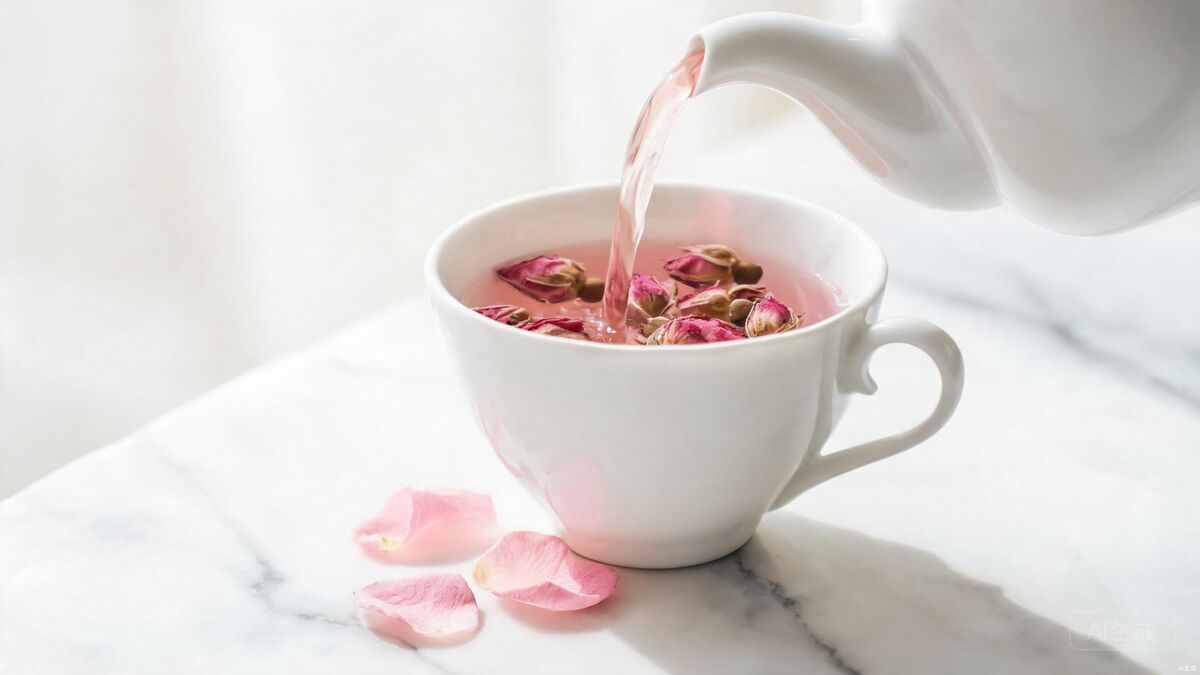
Rose tea (玫瑰花茶, méiguīhuā chá) is made by steeping the dried buds and flowers of Rosa rugosa or Rosa damascena in hot water. Unlike the rose petals used in Western desserts and perfumes, the roses used for Chinese tea are specifically cultivated for their fragrance and medicinal properties, then dried at peak bloom to preserve their volatile oils. The resulting brew is a beautiful pale pink liquor with an unmistakable, heady floral aroma and a delicate, slightly sweet flavor with a faintly warming finish.
Rose tea contains no caffeine, which makes it suitable any time of day and for the caffeine-sensitive. It is one of the most popular daily wellness teas for women in China, prized for its dual ability to lift the mood and ease menstrual discomfort — two things that, in TCM theory, are actually the same problem viewed from different angles.
It is important to use the right kind of rose. The roses brewed as tea are fragrant, semi-double or single-flowered varieties grown for scent, not the large, tight-petaled ornamental roses sold by florists (which are often treated with pesticides and are not food-safe). Dried rose buds for tea are widely available and inexpensive — see the Where to Buy section below.
2. TCM Properties: Nature, Flavor, and Meridians
Like every herb in Chinese medicine, rose is defined by its temperature, flavor, and the meridians it enters. These determine exactly when and how to use it.
Nature (Temperature): Warm
Rose buds are warm (温, wēn). This is a key difference from cooling teas like chrysanthemum, and it is exactly what makes rose so well suited to the conditions it treats. In TCM, Qi and Blood flow best when they are warm — cold causes stagnation and contraction. The warmth of rose gently opens and moves what has become stuck, which is the essence of Liver Qi stagnation. The warming nature also makes it comfortable for people who run cold, and ideal for the cooler seasons.
Flavor: Sweet and Slightly Bitter
Rose is sweet (甘) and slightly bitter (微苦). The sweet flavor harmonizes and gently tonifies, while the slight bitterness moves and drains. This combination allows rose to regulate Qi without being harsh, and to gently invigorate Blood without being overly dispersing. The sweetness also makes the tea pleasant on its own, though a touch of honey enhances it.
Meridian Affinity: Liver and Spleen
Rose enters the Liver and Spleen meridians (归肝、脾经). The Liver connection is the most important: in TCM, the Liver is responsible for the smooth flow of Qi throughout the body and for regulating emotions. When Liver Qi flows freely, you feel emotionally balanced, your digestion works smoothly, and your menstrual cycle is regular. When Liver Qi stagnates — from stress, frustration, anger, or unexpressed emotion — you experience exactly the symptoms rose tea treats: irritability, mood swings, chest and breast tightness, sighing, bloating, and menstrual pain. The Spleen connection supports digestion, which in TCM is easily disrupted by stagnant Liver Qi (the pattern called "Liver overacting on the Spleen").
Core Actions
- Soothes the Liver and resolves stagnation (疏肝解郁) — for emotional tension, irritability, sighing, and mood swings.
- Regulates Qi and invigorates Blood (理气活血) — for bloating, chest and hypochondriac distension, and dull aching pain.
- Regulates menstruation and relieves pain (调经止痛) — for PMS, menstrual cramps, and irregular cycles linked to Qi and Blood stagnation.
3. Health Benefits and Who It Helps
Rose tea's benefits cluster around the Liver and the menstrual cycle, but it has broader uses too. Here are the people it helps most.
PMS and Mood Swings
This is rose tea's signature use. In the days before a period, Liver Qi naturally builds up; if it stagnates, it produces the classic PMS picture: irritability, tearfulness, mood swings, breast tenderness, bloating, and a feeling of tension or fullness. Rose bud tea directly moves that stagnant Qi, lifting the mood and easing the physical and emotional tension. Drinking a cup or two daily in the week before your period is the traditional approach, and many women notice a real difference within one or two cycles.
Menstrual Cramps and Irregular Cycles
Menstrual pain in TCM is most often caused by Qi and Blood stagnation — the flow is obstructed, producing cramping, clots, and a dull, heavy ache. Rose gently invigorates Blood and moves Qi, helping the flow establish smoothly. It is especially helpful when cramps are accompanied by emotional tension, breast tenderness, and clots. For stronger menstrual pain, rose is often combined with other blood-moving herbs, but as a daily food-grade tea it is an excellent foundation.
Everyday Stress and Emotional Tension
You do not need to be on your period to benefit from rose tea. The same Liver-soothing action that helps PMS also helps everyday stress, frustration, and the "stuck" feeling that comes from suppressed emotion or a demanding schedule. If you tend to sigh a lot, feel a tightness in your chest or ribs, get irritable under pressure, or carry tension in your shoulders and jaw, rose tea is a gentle daily support. It pairs beautifully with a few minutes of gentle qigong to move the whole body's Qi.
Digestive Bloating and Discomfort
Because the Liver's smooth flow supports the Spleen's digestive function, Liver Qi stagnation often shows up as bloating, belching, variable appetite, and a feeling of fullness — especially when stressed. Rose tea regulates the Liver-Spleen relationship, easing this type of stress-related digestive discomfort. A cup after a tense, rushed meal can make a noticeable difference.
Mild Skin and Complexion Support
Rose is traditionally associated with a healthy, glowing complexion. In TCM terms, this is because it moves Blood — when Blood flows freely and reaches the skin, the complexion is rosy and clear. Stagnant Blood, by contrast, produces dullness, dark spots, and a sallow look. Rose is a popular ingredient in beauty teas for this reason, often blended with goji berries.
4. How to Brew Rose Tea
Rose tea is simple to brew, but the flowers are delicate — treat them gently to preserve their fragrance and active compounds.
Ingredients:
- 5–8 g dried rose buds (about 1–2 teaspoons, or 6–10 buds)
- 250 ml (1 cup) good-quality water
- Optional: 8–10 goji berries; 3–4 pitted red dates; 1 tsp honey (added after cooling below 60°C / 140°F)
Instructions:
- Rinse the dried buds briefly under cool water or in a strainer to remove any dust.
- Bring water to a boil, then let it rest for about 30 seconds so it is just off the boil (around 90–95°C / 195–205°F). Boiling water poured directly can scald the delicate petals and destroy some of the volatile oils that give rose its scent and mood-lifting effect.
- Place the buds (and goji or dates, if using) in a teapot, mug, or gaiwan. Pour the hot water over them.
- Cover and steep for 5 to 8 minutes. The buds will unfurl and release their color and fragrance.
- Strain into a cup and drink warm. Inhale the aroma before sipping — much of rose's calming effect comes through the sense of smell.
- You can re-steep the same buds 2 to 3 times, adding about 1 minute to each steep, until the fragrance fades.
Water Temperature Matters
The ideal temperature is 90–95°C (195–205°F) — water that has just boiled and rested for half a minute. Water straight off a rolling boil can scorch the petals and drive off the volatile oils; water that is too cool will not extract the active compounds fully. If you do not have a temperature-control kettle, simply boil, wait 30 seconds, and pour.
5. Classic Pairings
Rose blends beautifully with several accessible herbs. Here are the most useful combinations.
| Blend | Ingredients (per cup) | Best For |
|---|---|---|
| Rose + Goji | 5 g rose buds + 8–10 goji berries | Daily mood and complexion tea. Goji nourishes Liver Blood while rose moves it — a balanced beauty and wellness blend. |
| Rose + Red Dates | 5 g rose buds + 4–5 pitted red dates | PMS and menstrual support. Dates nourish Blood and tonify Spleen while rose moves Qi and eases pain. |
| Rose + Honey | 5 g rose buds + 1 tsp honey (added after cooling) | Soothing the throat and enhancing flavor. Honey also moistens and harmonizes. |
| Rose + Chrysanthemum | 3 g rose + 3 g chrysanthemum | Balanced Liver tea — rose warms and moves while chrysanthemum cools and clears, ideal when you feel both tense and hot. |
For everyday use, the rose and goji blend is the one to master — it is balanced, gently nourishing, and addresses both mood and complexion. For the premenstrual week, switch to rose and red dates for added Blood support.
6. Where to Buy Rose Buds
Dried rose buds for tea are widely available. Here is where to look and what to look for.
Amazon
Amazon carries many brands of dried rose buds. Search for "dried rose buds for tea," "rose bud tea," or "mei gui hua." Look for organic, food-grade buds sold in resealable bags. Read reviews for freshness and fragrance — good rose buds should smell strongly floral right through the packaging.
iHerb
iHerb stocks rose bud tea in both loose-bud and tea-bag form, often from brands like Prince of Peace or FUSIO. Organic options are available. iHerb ships internationally, which makes it useful if you have no Asian or Middle Eastern grocery nearby.
Asian Grocery Stores
Any Chinese, Korean, or pan-Asian supermarket will carry dried rose buds in the tea or dried-goods aisle, usually in cellophane bags. This is often the freshest and most affordable option.
Middle Eastern Markets
Middle Eastern and Iranian grocery stores carry excellent quality dried rose buds and rose petals, as rose water and rose tea are staples of Persian and Middle Eastern cuisine. These are often of very high quality and fragrance.
What to Look For
- Whole, unbroken buds — broken or crumbled buds have lost their volatile oils and will be weak.
- Deep pink to red color — faded, brownish buds are stale. Avoid bleached or unnaturally bright buds.
- Strong, sweet floral scent — the buds should smell fragrant through the bag. No scent means they are old or over-processed.
- Organic and sulfur-free where possible — sulfur is sometimes used to preserve color but gives a harsh smell and taste.
- Food-grade labeling — never use ornamental florist roses, which may be treated with pesticides.
7. Precautions and Contraindications
Rose tea is gentle and food-grade, but a few cautions apply.
- Heavy menstrual flow. Because rose mildly invigorates Blood, women with very heavy periods should use it cautiously during menstruation, or focus on it in the premenstrual week and pause during the heaviest days. For normal flow it is fine.
- Pregnancy. Rose's blood-moving action means it is not routinely recommended during pregnancy, especially in the first trimester. Consult your doctor or a qualified TCM practitioner before regular use if you are pregnant.
- Blood-thinning medication. Rose's mild blood-invigorating effect could theoretically interact with anticoagulants. If you take blood thinners or are scheduled for surgery, consult your doctor before regular use.
- Allergies. Rarely, people with allergies to roses or other members of the Rosaceae family may react. Start with a small amount if you have any floral allergies.
- Do not over-drink. 1 to 3 cups a day is plenty. Rose moves Qi, and excessive amounts over long periods are unnecessary and could feel too "moving" for some.
Seasonal and Cyclical Wisdom
Rose tea's warming, Qi-moving nature makes it particularly welcome in autumn and winter, when cold and inactivity can cause Qi to stagnate, and during the premenstrual week, when Liver Qi naturally builds up. In the heat of summer, you may prefer the cooling clarity of chrysanthemum tea instead, or blend the two for a balanced cup that moves Qi without overheating.
Frequently Asked Questions
Can I drink rose tea during my period?
Yes, for most women rose tea is safe and even helpful during menstruation. Because it gently invigorates Blood and moves Qi, it can relieve the cramping, bloating, and emotional tension that accompany many periods. However, if your flow is very heavy, drink a weaker cup and monitor — rose's blood-moving action could increase flow in a small number of people. If you experience heavy bleeding, pause rose tea during your period and enjoy it in the premenstrual week instead. For normal to light flow, a warm cup on the first day of your period can be genuinely soothing.
Is rose tea good for PMS mood swings?
Yes — it is one of the best TCM herbs for PMS mood swings. In Chinese medicine, premenstrual irritability, tearfulness, and breast tenderness are caused by Liver Qi stagnation, which naturally builds before the period. Rose bud tea directly moves stagnant Liver Qi, lifts the mood, and eases the emotional and physical tension of PMS. For the best effect, drink 1 to 2 cups daily in the week before your period. Many women notice a calmer, more even mood within one or two cycles of consistent use.
How many cups of rose tea per day is safe?
For most healthy adults, 1 to 3 cups a day is safe and effective. During the premenstrual week you can drink up to 3 cups daily. Outside of that window, 1 cup a day as a mood-balancing ritual is plenty. Because rose moves Qi and mildly invigorates Blood, very large amounts over long periods are unnecessary and could be too moving for people with heavy menstrual flow. As with any single herb, taking a break for a few days every couple of weeks is a sensible habit.
Where can I buy quality rose buds for tea?
Dried rose buds for tea are available on Amazon, iHerb, at Asian grocery stores, and at Middle Eastern markets. Look for organic, sulfur-free buds that are whole, unbroken, and deep pink to red, with a strong sweet floral scent. Avoid buds that smell dusty, chemical, or have no scent — these are stale or over-processed. Never use ornamental florist roses, which may be treated with pesticides. Store your rose buds in a sealed, opaque container away from light and heat to preserve their volatile oils.
This article is for educational and informational purposes only and is not a substitute for professional medical advice, diagnosis, or treatment. The herbal teas and practices described here are traditional self-care methods and are not intended to treat, cure, or prevent any disease. Always consult a qualified healthcare provider before beginning any new herbal practice, especially if you are pregnant, nursing, taking medication, or have a medical condition. Never disregard professional medical advice or delay seeking it because of something you have read on this site. Read our full disclaimer →