Key Takeaways
- In TCM theory, the breath is the primary mechanism for regulating qi — slow, deep, fine, and even breathing calms the mind and gathers energy.
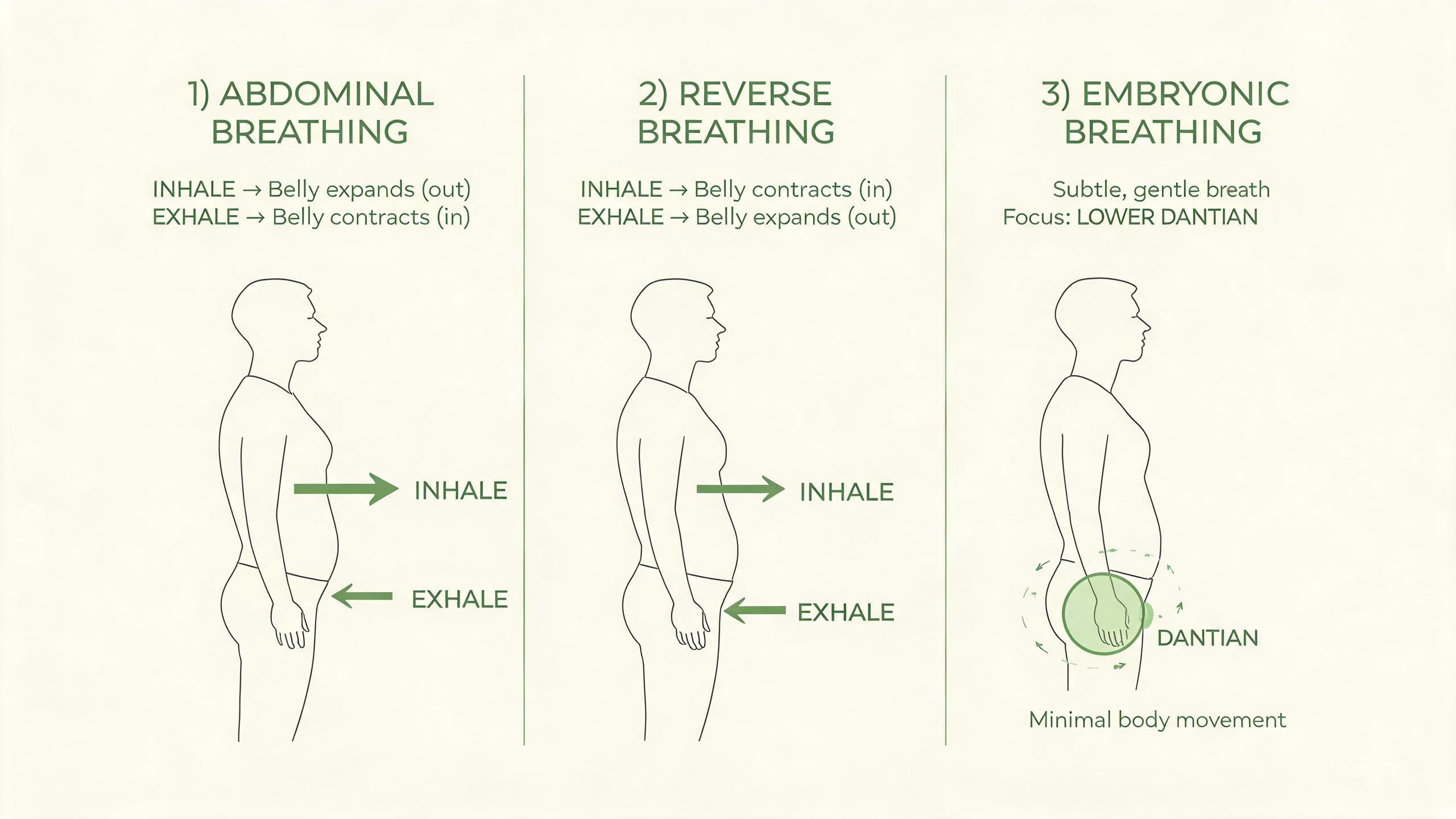
- Abdominal breathing is the foundation: the belly expands on inhalation and retracts on exhalation, activating the parasympathetic nervous system.
- The Six Healing Sounds (Liu Zi Jue) use specific exhalation sounds to clear excess heat and stagnant qi from each of the five zang organs.
- Dantian breathing combines deep breathing with focused awareness on the lower abdomen to gather and store energy.
- Reverse abdominal breathing is an advanced technique that builds internal power — only for experienced practitioners.
- Breath counting is a simple but powerful method for quieting a busy mind and entering meditation.
This article is for wellness education only and is not medical advice. The breathing techniques described here are traditional self-care practices and are not intended to diagnose, treat, cure, or prevent any disease. If you have respiratory conditions, cardiovascular disease, high blood pressure, or are pregnant, consult your healthcare provider before practicing breathing exercises. If you experience dizziness, chest pain, or anxiety during practice, stop immediately and rest.
Of all the tools in Traditional Chinese Medicine, the breath is the most immediate and accessible. You can change your breathing at any moment, without equipment, without cost, and without special training. It is no surprise, then, that TCM has developed a sophisticated system of breathing practices over thousands of years — practices designed not only to calm the mind but to regulate the body's vital energy (qi), strengthen the organs, and restore balance to the entire system.
The classical TCM text Huangdi Neijing states: "When the breath is regulated, the mind is regulated; when the mind is regulated, the breath is regulated." This reciprocal relationship — breath influencing mind, mind influencing breath — is the theoretical basis for all TCM breathing practices. If you are new to these concepts, our guides to yin and yang and TCM sitting meditation provide useful context.
Here are five of the most important TCM breathing techniques, each with its own principle, method, benefits, and ideal practitioners.
How TCM Understands the Breath
In TCM theory, breathing is not merely a mechanical exchange of oxygen and carbon dioxide. It is the process by which the body takes in air qi (zong qi) from the environment and combines it with food qi (gu qi) from digestion to produce the true qi (zhen qi) that circulates through the meridians and powers every function of the body. The Lungs are described as the "master of qi" and the "canopy of the five organs" — they govern not only respiration but the body's overall energy rhythm.
Because the breath directly affects qi, TCM considers the quality of breathing to be as important as the quantity of air. The ideal meditative breath is described as having four qualities:
- Slow (chi): The rhythm is unhurried, roughly 4 to 6 breaths per minute rather than the typical 12 to 16.
- Fine (xi): The breath is so quiet and subtle that it is barely perceptible — a feather held before the nose would barely move.
- Deep (chang): The breath reaches the lower abdomen (Dantian), not just the upper chest.
- Even (jun): Inhalation and exhalation are balanced in length, smooth and continuous without pauses or jerkiness.
Modern science echoes these ancient observations. Slow, deep, diaphragmatic breathing has been shown to stimulate the vagus nerve, reduce heart rate and blood pressure, lower cortisol levels, and shift the autonomic nervous system from sympathetic (fight or flight) to parasympathetic (rest and digest) dominance. The TCM techniques that follow are essentially structured ways of achieving this physiological shift — each with its own particular focus and benefit.
1. Abdominal Breathing (Fu Shi Hu Xi)
Principle: Also called diaphragmatic or "belly breathing," this is the foundational TCM breathing technique. The diaphragm — the dome-shaped muscle beneath the lungs — descends fully on inhalation, causing the abdomen to gently expand. On exhalation, the diaphragm rises and the abdomen naturally retracts. In TCM terms, abdominal breathing "leads the qi down to the Dantian" — drawing scattered energy from the head and chest into the body's central energy center.
Steps:
- Sit or lie comfortably with the spine naturally elongated. Place one hand on the chest and the other on the lower abdomen, below the navel.
- Breathe in slowly through the nose for a count of 4. Feel the hand on your abdomen rise while the hand on your chest stays relatively still.
- Breathe out slowly through the nose for a count of 6. Feel the hand on your abdomen fall.
- The exhale should be longer than the inhale — this is what activates the calming branch of the nervous system.
- Continue for 5 to 10 minutes, gradually lengthening the count to 5 in, 7 out, and eventually 6 in, 8 out.
Benefits: Abdominal breathing is the most immediately calming of all TCM techniques. It activates the parasympathetic nervous system, reduces anxiety and heart rate, improves oxygen exchange, massages the digestive organs, and begins the process of gathering qi in the Dantian. It is the essential first step before any other breathing practice.
Best for: Everyone. This is the starting point for all practitioners, regardless of experience. It is especially valuable for people with anxiety, stress, shallow chest breathing, digestive issues, or difficulty sleeping. See our TCM meditation guide for how abdominal breathing fits into a complete sitting practice.
Many people push their abdomen out forcefully on inhalation, as if inflating a balloon. This creates tension. The expansion should be natural and passive — the diaphragm does the work, and the belly simply follows. If you feel tightness in your abdominal muscles, you are trying too hard. Relax and let the breath do the moving.
2. The Six Healing Sounds (Liu Zi Jue)
Principle: The Six Healing Sounds are one of the oldest and most refined qigong practices in TCM. The theory is elegant: each of the five zang organs (Liver, Heart, Spleen, Lungs, Kidneys) and the Triple Burner can accumulate excess heat, stagnant qi, or trapped emotions. By producing a specific sound on a long, slow exhalation, you create a vibration that "vents" the excess from that organ — like opening a valve to release built-up pressure. The sounds are not spoken words but shaped exhalations, each with a distinct mouth position and tone.
The Six Sounds and Their Organs:
| Sound | Pinyin | Organ | Element | Clears |
|---|---|---|---|---|
| SSSS | Xu | Liver | Wood | Anger, frustration, eye tension, headaches |
| HOOO | He | Heart | Fire | Agitation, insomnia, palpitations, anxiety |
| HOO | Hu | Spleen | Earth | Worry, bloating, fatigue, overthinking |
| SSSS (sharp) | Si | Lungs | Metal | Grief, sadness, chest tightness, shallow breathing |
| CHOO | Chui | Kidneys | Water | Fear, insecurity, lower back weakness, fatigue |
| HEEE | Xi | Triple Burner | All | Overall stagnation, energy blockages, irritability |
Steps (for each sound):
- Stand or sit comfortably. Take a deep abdominal breath in through the nose.
- On the long exhalation, produce the sound gently — it should be audible but soft, like a whisper that carries weight. Do not shout or force it.
- As you exhale, imagine the excess heat, tension, or trapped emotion being released from the corresponding organ — flowing out with the breath like smoke dissolving into the air.
- Rest briefly between rounds. Practice each sound 3 to 6 times in sequence.
- The traditional order follows the generating cycle: Xu (Liver), He (Heart), Hu (Spleen), Si (Lungs), Chui (Kidneys), Xi (Triple Burner).
Benefits: The Six Healing Sounds are uniquely effective for releasing trapped emotions and clearing organ-specific stagnation. They are one of the few TCM practices that directly address the emotional dimension of organ health. Regular practice can reduce irritability (Liver), calm anxiety (Heart), ease digestive worry (Spleen), process grief (Lungs), and build a sense of safety (Kidneys). They are also an excellent complement to our TCM emotional wellness guide.
Best for: People carrying emotional tension, those with specific organ-related complaints, and anyone seeking a more active, expressive breathing practice. The Six Sounds are particularly powerful during seasonal transitions, when the corresponding organs are most active.
3. Dantian Breathing (Dan Tian Hu Xi)
Principle: Dantian breathing is abdominal breathing elevated to a higher level through the addition of focused intention. While abdominal breathing focuses on the mechanical movement of the belly, Dantian breathing directs the mind to the Dantian itself — the body's primary energy center, located approximately three finger-widths below the navel and two finger-widths inward. The principle is "where the mind goes, the qi follows" — by resting gentle attention on the Dantian during breathing, qi is drawn to and accumulated in that area.
Steps:
- Sit in an upright, relaxed posture with the tongue resting gently on the roof of the mouth.
- Place both hands, one on top of the other, over the lower abdomen just below the navel.
- Breathe slowly through the nose. On inhalation, feel the breath sinking to the Dantian — the area under your hands gently expanding outward in all directions, not just forward.
- On exhalation, feel the Dantian area gently settling. Do not force the abdomen to retract — let it happen naturally.
- Rest your attention lightly on the Dantian throughout. The focus should be like sunlight through a magnifying glass — warm and present but not burning.
- Practice for 10 to 20 minutes. Over time, you may feel warmth, fullness, or a gentle pulsing sensation in the Dantian — these are normal signs of qi accumulation.
Benefits: Dantian breathing goes beyond relaxation — it actively builds and stores energy. In TCM theory, consistent practice nourishes the Kidneys (the root of both yin and yang), strengthens the body's deepest reserves, and anchors the spirit. It is particularly effective for people who feel chronically depleted, scattered, or "wired but tired" — the nervous energy without the substance to sustain it.
Best for: Those who have mastered basic abdominal breathing and want to deepen their practice. Especially valuable for people with chronic fatigue, adrenal exhaustion, anxiety with depletion, or anyone who feels their energy is scattered and ungrounded. Dantian breathing is also the core practice in our TCM sitting meditation guide.
4. Reverse Abdominal Breathing (Ni Fu Shi Hu Xi)
Principle: In reverse abdominal breathing, the natural movement of the abdomen is inverted: the abdomen draws inward on inhalation and expands outward on exhalation. This is the breathing method used in martial arts, advanced qigong, and certain meditation traditions. The theory is that the reversed movement creates a pumping effect in the abdominal cavity, compressing and releasing the internal organs, strengthening the Dantian, and driving qi through the meridians with greater force.
Steps:
- Sit or stand in a stable posture. This technique should only be practiced after abdominal breathing has become completely natural and effortless.
- On inhalation through the nose, gently draw the lower abdomen inward and slightly upward, as if zipping up the core. The chest expands slightly.
- On exhalation through the nose, let the abdomen expand outward, as if pushing gently against an imaginary belt around the waist.
- The movements should be subtle and smooth — never forced or jerky. Think of the abdomen as a bellows: it compresses to draw energy in, then expands to push energy out.
- Start with just 3 to 5 minutes and build very gradually. Always return to natural abdominal breathing to close the session.
Benefits: Reverse breathing is said to strengthen the Dantian, increase the circulation of qi through the meridians, build internal power, and enhance the body's ability to direct energy intentionally. It is traditionally used by martial artists to develop explosive power and by advanced qigong practitioners to move qi through specific channels. It is not necessary for general wellness — abdominal and Dantian breathing provide ample benefits for most people.
Best for: Experienced practitioners who have been breathing abdominally for months and can do so without effort. Martial artists, qigong students, and those with a teacher's guidance. Not recommended for beginners, pregnant women, or those with cardiovascular conditions, high blood pressure, or respiratory illness. If you experience any dizziness, tension, or discomfort, stop immediately and return to natural breathing.
Reverse abdominal breathing is powerful and should be learned gradually, ideally under the guidance of an experienced teacher. Incorrect practice can cause energy to rise to the head, leading to headaches, dizziness, insomnia, or agitation. If you do not have access to a teacher, stick with abdominal and Dantian breathing — they are safe, effective, and sufficient for health and wellness.
5. Breath Counting (Shu Xi Fa)
Principle: Breath counting is a deceptively simple technique that is actually one of the most powerful methods for quieting a busy mind. The principle is straightforward: by counting each breath (or each exhalation), you give the mind a single, repetitive task that anchors it in the present moment. Every time the mind wanders, the count is restarted. This is the traditional TCM and Buddhist method for entering deep meditation — the counting itself is not the goal but the bridge to a state where counting becomes unnecessary.
Steps:
- Sit comfortably in meditation posture with the spine upright and the tongue on the palate.
- Begin with natural breathing — do not try to control the breath. Simply let it flow in and out through the nose.
- On each exhalation, count silently: "one." On the next exhalation: "two." Continue up to ten.
- When you reach ten, start over at one. If you lose count — and you will, many times — simply start over at one without frustration.
- If you notice your mind has wandered and you have lost track of the count, acknowledge it gently and return to one.
- Practice for 10 to 15 minutes. The goal is not to reach ten perfectly but to notice when the mind has wandered and return, again and again.
Benefits: Breath counting is the most accessible entry point to meditation for people whose minds are too busy for open-awareness practices. It trains concentration, develops the ability to notice mind-wandering, and naturally slows the breath. Over time, the counting itself fades into the background, and the practitioner enters a state of quiet, spacious awareness. It is also an excellent preparatory practice before TCM sitting meditation.
Best for: Beginners, people with racing thoughts, anyone who finds it difficult to "just sit" without a focus object, and those who want a simple, portable technique they can use anywhere — at a desk, on a train, before a stressful meeting.
Choosing the Right Technique for Your Needs
| Your Goal | Recommended Technique | Session Length |
|---|---|---|
| Immediate calm, reduce anxiety | Abdominal breathing | 5–10 minutes |
| Release specific emotions (anger, grief, fear) | Six Healing Sounds | 10–15 minutes |
| Build energy, overcome fatigue | Dantian breathing | 15–20 minutes |
| Deepen meditation, quiet busy mind | Breath counting | 10–15 minutes |
| Advanced energy cultivation | Reverse abdominal breathing | 3–5 minutes (with guidance) |
| Sleep preparation | Abdominal breathing + breath counting | 10 minutes before bed |
General Guidelines for All TCM Breathing Practice
- Always breathe through the nose unless a technique specifically calls for mouth exhalation (as in the Six Healing Sounds). Nasal breathing filters, warms, and humidifies the air, and in TCM theory it preserves the body's qi, which is lost through mouth breathing.
- Never force the breath. All TCM breathing should be slow, smooth, and comfortable. If you feel the urge to gasp, yawn repeatedly, or take a large catching breath, you are breathing too deeply or too slowly. Return to your natural rhythm and build more gradually.
- Practice on an empty or light stomach. Wait at least 30 minutes after a meal before practicing breathing exercises. A full stomach restricts diaphragmatic movement and can cause discomfort.
- Choose a clean, well-ventilated space. Fresh air is important — avoid stuffy rooms, air-conditioned drafts, or polluted environments. Outdoor practice in a garden or park is ideal when weather permits.
- Be consistent. Ten minutes daily is far more valuable than an hour once a week. The nervous system adapts to breathing practices through repetition, not intensity.
- Close gently. Always end a breathing session by returning to natural breathing for a minute or two. Rub your palms together until warm, then gently massage your face and abdomen. This helps distribute the qi you have cultivated and transitions you smoothly back to daily activity.
Combining Breathing with Other TCM Practices
Breathing techniques are most powerful when integrated with other TCM practices. Consider these combinations:
- Breathing + Qigong: The breathing methods in this guide are the internal foundation of all qigong and tai chi movements. Practicing breathing first, then adding gentle movement, creates a complete mind-body practice. See our Eight Brocades guide for a movement sequence that incorporates these breathing principles.
- Breathing + Herbal Tea: A cup of chrysanthemum tea before evening breathing practice helps clear Liver heat and makes it easier to settle the mind. For sleep preparation, try calming herbal tea followed by 10 minutes of abdominal breathing.
- Breathing + Acupressure: Pressing Shenmen (HT7) on the wrist for one minute before breathing practice helps calm the spirit and deepens the effect. For anxiety, combine with Yongquan (KD1) on the soles of the feet to ground rising energy.
Frequently Asked Questions
Which TCM breathing technique should I start with?
Always start with abdominal breathing. It is the safest, most accessible, and most immediately beneficial technique. Practice it daily for at least two to three weeks before adding any other method. Once abdominal breathing feels natural and effortless, you can explore Dantian breathing (if you want to build energy), the Six Healing Sounds (if you want to release specific emotions), or breath counting (if you want to deepen meditation). Reverse abdominal breathing should only be attempted after months of consistent practice, ideally with a teacher's guidance.
Can TCM breathing help with anxiety and panic attacks?
Yes. Abdominal breathing is one of the most effective immediate interventions for anxiety because it directly activates the parasympathetic nervous system, which counteracts the fight-or-flight response. During a panic attack or acute anxiety episode, extend your exhalation to be twice as long as your inhalation (for example, breathe in for 4 counts, out for 8). This rapidly slows the heart rate and signals safety to the brain. For ongoing anxiety management, practice abdominal breathing for 10 minutes twice daily. However, breathing techniques are complementary — if you experience persistent anxiety or panic disorder, consult a healthcare professional.
Is it normal to feel dizzy or lightheaded when practicing these techniques?
Mild lightheadedness can occur if you breathe too deeply, too quickly, or hold the breath unintentionally. This is caused by a temporary change in blood oxygen and carbon dioxide levels. If you feel dizzy, stop the technique immediately, return to your normal breathing pattern, and rest for a minute. To prevent dizziness, always start with natural breathing, progress to deeper breathing gradually, and never force the breath beyond what feels comfortable. The breath should always feel easy and pleasant — if it feels like effort, you are trying too hard.
Can I practice these breathing techniques while walking or doing daily activities?
Yes — with one important exception. Abdominal breathing and breath counting can be practiced during walking, light housework, or any low-intensity activity. This is called "moving meditation" and is an excellent way to integrate breathing practice into daily life. Simply maintain awareness of the breath sinking to the lower abdomen as you move. However, reverse abdominal breathing and the Six Healing Sounds require focused attention and should only be practiced in a seated or standing meditation posture. Never practice breathing techniques while driving or operating machinery.
The Bottom Line
The breath is the most powerful tool you have for regulating your own state — physically, mentally, and energetically. TCM has refined this understanding over thousands of years, developing specific techniques for different needs: abdominal breathing for calm, the Six Healing Sounds for emotional release, Dantian breathing for energy, reverse breathing for advanced cultivation, and breath counting for mental focus. Start with abdominal breathing. Practice it daily. Let it become as natural as... breathing. Then, when you are ready, explore the other techniques one at a time. The beauty of TCM breathing is that it meets you where you are — simple enough for a beginner to start today, deep enough to sustain a lifetime of practice.
This article is for educational and informational purposes only and is not a substitute for professional medical advice, diagnosis, or treatment. The breathing techniques described here are traditional wellness practices and are not intended to diagnose, treat, cure, or prevent any disease. Always consult a qualified healthcare provider before beginning any new breathing practice, especially if you have respiratory conditions, cardiovascular disease, high blood pressure, or are pregnant. Never disregard professional medical advice or delay seeking it because of something you have read on this site. Read our full disclaimer →