Key Takeaways
- TCM describes blood sugar imbalance through the classical concept of Xiao Ke ("wasting-thirst"), linked to yin deficiency with dryness-heat — not a single disease.
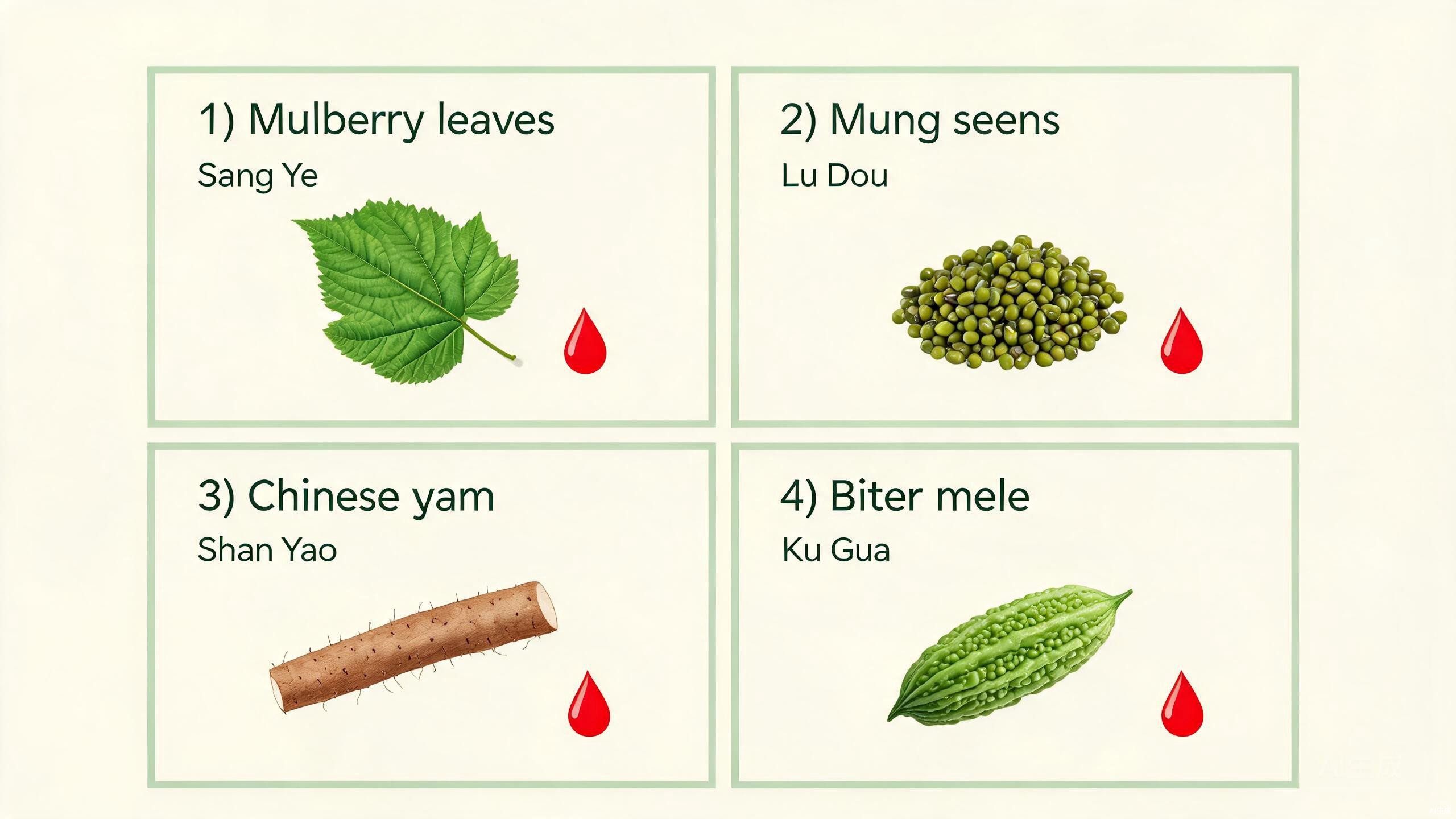
- Four everyday foods — mulberry leaves, mung bean, Chinese yam, and bitter melon — are traditionally used to support healthy blood sugar levels already within the normal range.
- Mulberry leaf tea is the most accessible daily practice; modern research highlights its DNJ content, while TCM values it for clearing heat and moistening the lungs.
- These foods are complementary wellness practices and must never replace prescribed medication or insulin.
- Always consult your healthcare provider before adding new foods or herbs to your routine, especially if you take blood sugar medication.
This article is for wellness education only and is not medical advice. The foods and practices described here are traditional Chinese dietary therapies that may support healthy blood sugar levels already within the normal range and overall metabolic wellness. They are not a treatment for diabetes or any medical condition and must never replace prescribed medication, insulin, or your doctor's treatment plan. Do not stop, reduce, or change any medication without first consulting your qualified healthcare provider. If you have diabetes, are pregnant, nursing, or take prescription medications, speak with your doctor before using any of these foods or herbs. Statements have not been evaluated by the U.S. Food and Drug Administration (FDA). This information is not intended to diagnose, treat, cure, or prevent any disease.
Maintaining balanced blood sugar is one of the foundations of long-term wellness. While modern medicine offers precise tools, Traditional Chinese Medicine (TCM) brings a different lens — one that sees metabolic health through patterns of balance. For centuries, TCM has offered gentle, food-based practices traditionally used to support healthy blood sugar levels and overall metabolic wellness.
This guide explores four everyday TCM foods — mulberry leaves, mung bean, Chinese yam, and bitter melon — and how they fit into the classical Chinese understanding of metabolic balance. These are not substitutes for medical care; they are traditional wellness practices that may complement a healthy lifestyle. If you're new to Chinese medicine, our introduction to TCM and guide to yin and yang provide helpful background.
How TCM Views Blood Sugar: The Concept of Xiao Ke
In classical Chinese medicine, there is no laboratory concept of "blood glucose." Instead, the patterns we now associate with blood sugar imbalance were described centuries ago as Xiao Ke (消港), often translated as "wasting-thirst" or "elimination-thirst" syndrome. Xiao Ke describes a cluster of signs — excessive thirst, frequent urination, and weight loss with increased appetite — that TCM associates with a core imbalance: yin deficiency complicated by dryness-heat.
Simply put, TCM sees this as a state where the body's cooling, moistening reserves (yin) have become depleted, allowing internal "fire" to rise unchecked. This heat dries the fluids, drives thirst, and disturbs normal metabolism. Rather than focusing only on one number, TCM asks: where is the heat coming from, and where is the yin most depleted?
Classical texts further divide Xiao Ke into three regions, the Three Wastings (三消):
- Upper Wasting (上消) — involves the Lung. The main sign is intense thirst and dry mouth. Cooling, lung-moistening foods such as mulberry leaf are traditionally chosen.
- Middle Wasting (中消) — involves the Stomach. The main signs are excessive hunger and a dry, hot feeling. Cooling foods that clear stomach heat, like mung bean and bitter melon, are favored.
- Lower Wasting (下消) — involves the Kidney. The main signs are frequent, copious urination and lower back weakness. Nourishing, gently tonifying foods such as Chinese yam are traditionally used.
For readers interested in how TCM organizes the body, our guide to the zang-fu organ systems explains these roles in more detail.
4 Everyday TCM Foods Traditionally Used for Blood Sugar Support
The following four foods are staples of Chinese kitchens and have been used for generations in food therapy (Shi Liao). Each is described with its TCM nature and flavor, traditional use, a simple preparation, and precautions. None are treatments; they are dietary choices that may support overall metabolic wellness.
1. Mulberry Leaves (Sang Ye 桑叶)
TCM nature & flavor: Cold; sweet, bitter. Enters the Lung and Liver channels.
Traditional use: Mulberry leaf clears heat, moistens the lungs, and disperses wind-heat. For the upper-wasting pattern — with its hallmark intense thirst and dry mouth — mulberry leaf tea has been a classic daily beverage. Modern research highlights a compound called 1-deoxynojirimycin (DNJ), studied for its role in how the body handles carbohydrates after meals.
Simple preparation: Steep 3 to 5 grams of dried leaves in 8 oz of hot water (90°C) for 5 to 7 minutes. Drink 1 to 2 cups per day. A step-by-step method appears below.
Precautions: Avoid on an empty stomach with cold-type digestion. Anyone taking blood sugar medication or insulin must consult their healthcare provider before regular use.
2. Mung Bean (Lu Dou 绿豆)
TCM nature & flavor: Cold; sweet. Enters the Heart and Stomach channels.
Traditional use: Mung bean is a favorite cooling and detoxifying food. It clears summer heat and relieves internal heat. For the middle-wasting pattern — heavy thirst, dry mouth, big appetite — mung bean clears stomach fire. It is especially popular in hot weather.
Simple preparation: Simmer half a cup of rinsed mung beans in 4 cups of water for 30 to 40 minutes. For a thinner version, follow our mung bean congee guide. Enjoy 1 to 2 small bowls per week.
Precautions: Because it is cold, those with a cold, weak spleen (loose stools, chilliness) should enjoy small amounts or pair it with warming ginger. Avoid overconsumption in cold weather.
3. Chinese Yam (Shan Yao 山药)
TCM nature & flavor: Neutral; sweet. Enters the Spleen, Lung, and Kidney channels.
Traditional use: Chinese yam is a gentle tonic that simultaneously tonifies the spleen (digestion), lungs (fluid regulation), and kidneys (essence and water metabolism). This suits the lower-wasting pattern, where kidney weakness shows as frequent urination and lower back fatigue. Modern analysis notes its mucin content and slow-digesting complex carbohydrates.
Simple preparation: Steam peeled slices for 15 to 20 minutes, or cook into congee. Our yam congee guide offers a soothing recipe. A serving of 100 to 150 grams, 3 to 4 times per week, is traditional.
Precautions: Gentle and well tolerated. Raw yam sap may mildly irritate the skin, so peel with care. If starchy foods bloat you, enjoy smaller portions.
4. Bitter Melon (Ku Gua 苦瓜)
TCM nature & flavor: Cold; bitter. Enters the Heart, Spleen, and Stomach channels.
Traditional use: The most intensely cooling food in this group. Its bitter flavor clears heat, purges fire, and supports natural detoxification. For middle-wasting patterns marked by thirst, hunger, and internal heat, bitter melon is a long-standing choice. Modern research has studied charantin and related constituents in relation to carbohydrate metabolism.
Simple preparation: Slice thinly, salt for 10 minutes, then rinse to soften bitterness. Stir-fry with garlic, or juice a small piece with cucumber. Eat 2 to 3 times per week.
Precautions: Avoid or minimize during pregnancy, with cold-type digestion, or in young children. Never use as a substitute for medication. Consult your healthcare provider if you take blood sugar medication.
Quick Comparison of the Four Foods
| Food | TCM Nature & Flavor | Traditional Effect | Preparation | Suggested Frequency |
|---|---|---|---|---|
| Mulberry Leaf (Sang Ye) | Cold, sweet/bitter | Clears heat, moistens lungs | Dried leaf tea | 1–2 cups daily |
| Mung Bean (Lu Dou) | Cold, sweet | Clears heat, detoxifies | Soup or congee | 1–2 bowls weekly |
| Chinese Yam (Shan Yao) | Neutral, sweet | Tonifies spleen, lung, kidney | Steamed or in congee | 3–4 times weekly |
| Bitter Melon (Ku Gua) | Cold, bitter | Clears heat, purges fire | Stir-fry or juice | 2–3 times weekly |
These four foods are not interchangeable. TCM selects food based on your pattern: mulberry leaf for upper-wasting thirst, mung bean and bitter melon for middle-wasting heat, and Chinese yam for lower-wasting kidney weakness. If unsure which fits you, start with the gentlest option — Chinese yam — and consult a qualified practitioner.
How to Make Mulberry Leaf Tea at Home
Mulberry leaf tea is the most practical daily practice in this guide. Making your own from fresh leaves is rewarding and simple:
- Collect. Harvest fresh, healthy leaves in late spring or early summer, ideally in the morning after dew has dried. Choose unblemished, medium-sized leaves. Food-grade dried leaves are a fine alternative.
- Wash. Rinse thoroughly under cool water to remove dust and residue. Pat dry.
- Steam (the key step). Steam the leaves over boiling water for 2 to 3 minutes. This softens the leaves, reduces bitterness, and preserves their green color. Let cool until comfortable to handle.
- Dry. Cut into strips, spread on a tray, and dry in a shaded, ventilated spot for 2 to 3 days, or in an oven at about 60°C (140°F) for 2 to 3 hours until crisp. Store in an airtight jar away from light.
- Brew. Steep 3 to 5 grams of dried leaf in 8 oz of hot water (90°C) for 5 to 7 minutes. Strain and enjoy warm, 1 to 2 cups per day. The flavor is mild, slightly grassy, and pleasant.
For safety guidance on herbal and food-based teas, see our herbal tea safety guide.
TCM Diet Principles for Blood Sugar Balance
Beyond specific foods, TCM food therapy emphasizes overall eating habits that may support healthy blood sugar levels already within the normal range:
- Eat at regular times, in regular amounts. TCM values rhythm. Consistent meals in moderate portions support steady digestion and a balanced metabolism. Skipping meals or overeating both strain the spleen.
- Limit sweet, greasy, and heavy foods. TCM classifies rich sweets and fried foods as damp-heat generating. Favor light, freshly cooked meals.
- Choose more whole and coarse grains. Brown rice, millet, oats, and barley digest more slowly. A warm bowl of congee is a cornerstone of TCM breakfast. See our complete congee guide for recipes.
- Pair cooling and warming foods thoughtfully. Balance cold-natured foods like mung bean with a warming element (a slice of ginger) so the spleen is not chilled. Read more in our dampness-removing foods guide and qi-boosting foods guide.
- Chew well and eat calmly. The spleen thrives on calm, unhurried meals. Eating while stressed weakens transformation over time.
Because metabolic wellness and body weight are closely linked in both TCM and modern science, you may also find our TCM approach to weight wellness useful.
When to See a Doctor
Food therapy is a complement to, not a replacement for, professional medical care. Seek prompt medical attention if you experience:
- Persistent excessive thirst, frequent urination, or unexplained weight loss.
- Fatigue, blurred vision, slow-healing wounds, or tingling in the hands and feet.
- Symptoms of very high or very low blood sugar — confusion, rapid breathing, fruity-smelling breath, sweating, shakiness, or fainting — these are emergencies.
- Any new or worsening symptoms while changing your diet or adding herbal foods.
If you have been diagnosed with diabetes or another metabolic condition, continue your prescribed treatment exactly as directed, and speak with your healthcare provider before adding any of the foods or practices in this guide.
The Bottom Line
TCM offers a holistic, food-first lens on metabolic wellness. Through the classical concept of Xiao Ke, it reminds us that blood sugar balance reflects the harmony of the lungs, stomach, and kidneys, and the balance of heat and moisture throughout the body. Four humble kitchen foods — mulberry leaves, mung bean, Chinese yam, and bitter melon — have been used for generations in this tradition, each matched to a different pattern of imbalance.
Used thoughtfully, alongside regular meals, mindful eating, and your doctor's guidance, these foods may support healthy blood sugar levels already within the normal range. They are gentle, accessible, and deeply rooted in centuries of food therapy. But they are not, and can never be, a substitute for medical care. Begin with one food, observe how your body responds, and always keep your healthcare provider informed — that is the true spirit of TCM working alongside modern wellness.