Key Takeaways
- TCM views prostate health through the Kidney, Bladder, and Liver organ systems, with damp-heat in the lower burner being the most common pattern associated with prostate discomfort.
- Six traditional food therapy recipes — from winter melon and coix seed soup to dandelion tea — use ingredients available at Western supermarkets, Amazon, or iHerb.
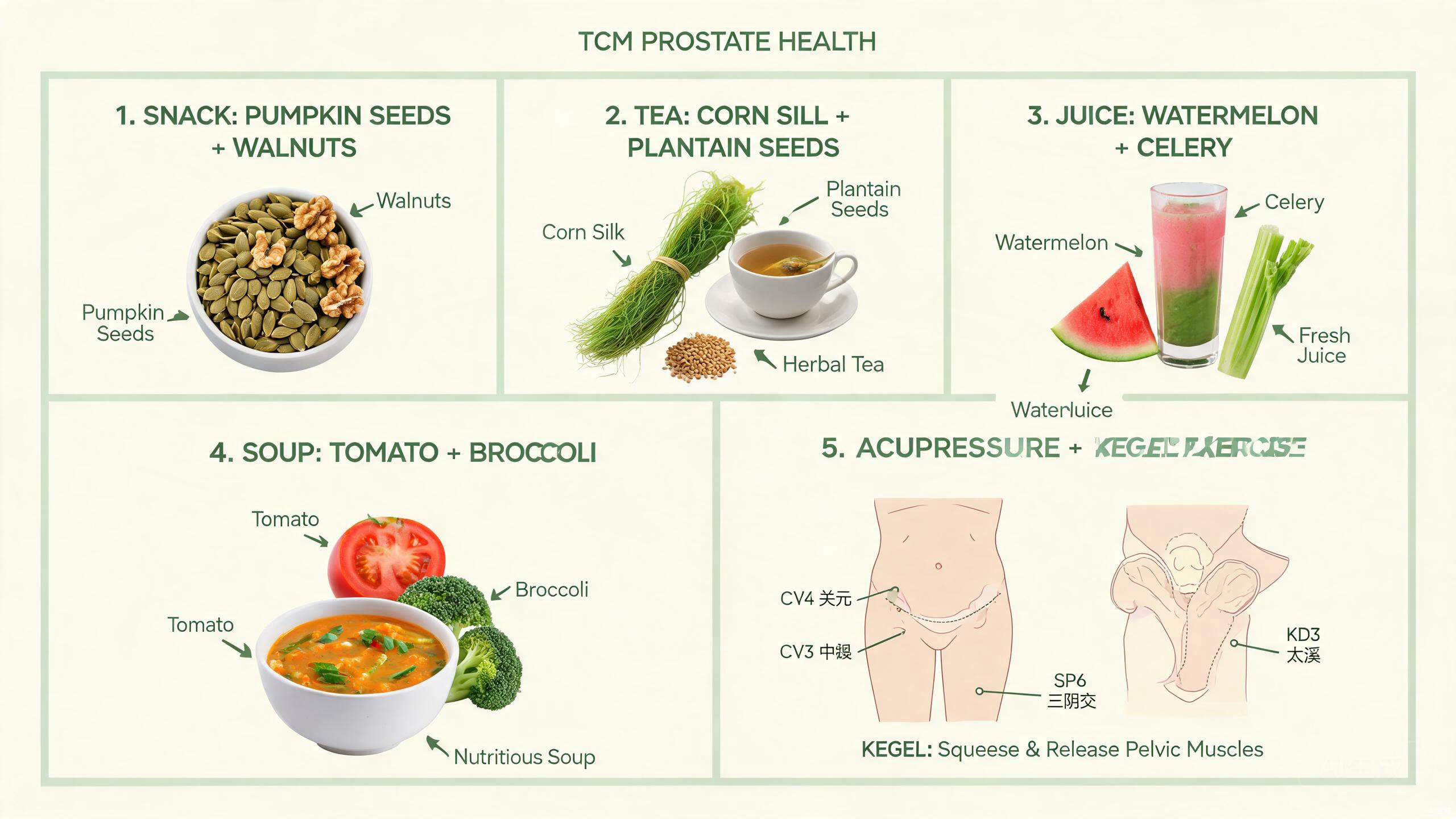
- Two acupressure points, Guanyuan (CV4) and Sanyinjiao (SP6), are traditionally used to support kidney qi and lower burner function.
- Lifestyle factors — avoiding prolonged sitting, moderate exercise, and dietary restrictions — are considered just as important as food in the TCM approach.
- These are traditional wellness practices, not a treatment for any medical condition. Prostate symptoms require evaluation by a qualified healthcare provider.
This article is for educational purposes only and is not medical advice. The foods, teas, and practices described here are traditional wellness practices rooted in Chinese culture. They are not a substitute for professional medical care, diagnosis, or treatment. Prostate symptoms — including frequent urination, difficulty urinating, pain, or blood in urine — can indicate serious medical conditions including prostate enlargement (BPH), prostatitis, or prostate cancer. These require prompt evaluation by a qualified healthcare provider. Never stop, delay, or replace prescribed treatment based on information in this article. Some foods and herbs may interact with medications — always inform your doctor about everything you consume. These statements have not been evaluated by the FDA and are not intended to diagnose, treat, cure, or prevent any disease. Read our full disclaimer →
As men age, prostate health becomes an increasingly important part of overall wellness. Frequent trips to the bathroom, a weak urinary stream, or a feeling of incomplete emptying are common concerns that can affect sleep, energy, and quality of life. While these symptoms should always be evaluated by a healthcare provider, Traditional Chinese Medicine (TCM) offers a rich tradition of food therapy and self-care practices that may support prostate wellness as part of a balanced lifestyle.
In TCM, there is no single word for "prostate" as a distinct organ. Instead, prostate function is understood through the interplay of the Kidney, Bladder, and Liver systems, and through the concept of damp-heat accumulating in the lower burner (the lower abdominal region). The six recipes below use foods and teas that have been enjoyed for generations to clear damp-heat, strengthen the kidneys, and support healthy fluid metabolism. All ingredients are available at Western supermarkets, Asian markets, Amazon, or iHerb.
If you are new to TCM concepts, our introduction to Traditional Chinese Medicine and guide to the Zang-Fu organ systems are helpful starting points. For a broader look at men's wellness, see our guide to TCM for men's vitality.
How TCM Views the Prostate
Traditional Chinese Medicine does not isolate the prostate as a separate organ. Instead, it understands prostate function through three interconnected organ systems and the patterns of imbalance that affect them.
The Kidney system is the foundation. In TCM, the kidneys store essence (jing) and govern the lower body, including the urogenital region. Kidney qi provides the "sealing" force that controls urination — when kidney qi is strong, fluid release is regulated and complete. When kidney qi weakens with age, overwork, or chronic stress, the body may struggle to manage fluids properly, leading to frequent urination, dribbling, or a weak stream. This concept overlaps closely with the TCM understanding of night urination.
The Bladder is the partner organ to the Kidney. It stores and excretes urine, but its function depends on kidney qi to provide the "transformation" energy needed to release fluid smoothly. When the bladder is obstructed by damp-heat or when kidney qi cannot support it, urinary symptoms arise.
The Liver plays a less obvious but critical role. In TCM, the Liver meridian passes through the groin and genital region. Emotional stress, frustration, or anger can cause liver qi to stagnate, which in turn blocks qi and blood circulation in the lower burner. This stagnation can contribute to a feeling of fullness, heaviness, or discomfort in the pelvic area.
TCM identifies four primary patterns associated with prostate discomfort:
- Damp-Heat in the Lower Burner (Xia Jiao Shi Re) — the most common pattern. Heat and dampness accumulate in the bladder and lower abdomen, causing urinary urgency, burning sensation, dark or cloudy urine, and a feeling of heaviness in the lower abdomen. Often triggered by a diet high in spicy, greasy, or alcoholic foods, or by external damp-heat weather.
- Kidney Qi Deficiency (Shen Qi Xu) — the kidneys lack the sealing and transforming power to regulate urination. Signs include frequent urination (especially at night), a weak stream, dribbling after urination, lower back soreness, and knee weakness. Often seen in older men or after chronic illness. See our guide to TCM for night urination for more on this pattern.
- Qi and Blood Stagnation (Qi Zhi Xue Yu) — emotional stress or prolonged sitting causes qi and blood to stagnate in the lower burner. Signs include a feeling of fullness or distension in the perineum, pain that worsens with stress, and urinary hesitation. Often related to the Liver meridian.
- Spleen Deficiency with Dampness (Pi Xu Shi Sheng) — a weak spleen cannot properly transform fluids, leading to internal dampness that settles in the lower body. Signs include urinary frequency with a pale complexion, fatigue, loose stools, and a feeling of heaviness. See our TCM for water retention guide for more on dampness patterns.
Understanding these patterns helps explain why TCM recommends different foods for different situations. The recipes below are grouped by the pattern they traditionally address.
6 Food Therapy Recipes for Prostate Wellness
Each recipe below is matched to a specific TCM pattern. Choose the one that best fits your situation, and use it consistently for two to four weeks. All ingredients are available at Western supermarkets, Asian markets, Amazon, or iHerb.
1. Winter Melon and Coix Seed Soup (冬瓜薏米汤)
Best for: Damp-heat in the lower burner
TCM nature and flavor: Winter melon (dong gua): sweet, mild, cool. Enters the Lung, Spleen, and Bladder channels. Coix seed (yi yi ren / Job's tears): sweet, bland, slightly cool. Enters the Spleen, Lung, and Kidney channels.
Traditional use: This is one of the most classic TCM food therapy combinations for clearing damp-heat and promoting urination. Winter melon is traditionally used to clear heat, promote urination, and reduce swelling, while coix seed is valued for draining dampness and strengthening the spleen. Together, they address both the heat and the dampness that accumulate in the lower burner, making this soup ideal for the damp-heat pattern associated with prostate discomfort.
Ingredients:
- 2 cups winter melon, peeled and cubed (available at Asian markets; zucchini or chayote can substitute)
- 1/2 cup dried coix seed (Job's tears) — available on Amazon or iHerb
- 4 cups vegetable or chicken broth (low sodium)
- 3 slices fresh ginger
- A pinch of sea salt
Preparation: Soak the coix seed for 2 to 4 hours until softened. In a pot, combine the soaked coix seed, broth, and ginger slices. Bring to a boil, then reduce heat and simmer for 30 minutes. Add the cubed winter melon and simmer for another 15 to 20 minutes until the melon is translucent and tender. Add salt to taste. Drink the broth and eat the melon and coix seed, 1 bowl per day, preferably in the morning or at lunch.
Precautions: Both ingredients are cooling. If you have a cold constitution with diarrhea or cold extremities, add extra ginger or reduce the portion. Coix seed is traditionally avoided in large amounts during pregnancy. For more on coix seed, see our dampness-removing foods guide.
2. Purslane Porridge (马齿苋粥)
Best for: Damp-heat with urinary burning or discomfort
TCM nature and flavor: Purslane (ma chi xian): sour, cold. Enters the Large Intestine and Liver channels.
Traditional use: Purslane is one of TCM's most valued heat-clearing and detoxifying wild vegetables. It is traditionally used to clear damp-heat, cool the blood, and reduce inflammation. For prostate patterns involving heat signs — such as a burning sensation during urination, dark urine, or pelvic discomfort — purslane's cooling nature is particularly relevant. In Chinese folk medicine, fresh purslane is also eaten as a vegetable in summer to prevent heat-related conditions.
Ingredients:
- 1 cup fresh purslane (or 30 grams dried purslane — available on Amazon or iHerb)
- 1/2 cup white rice (short or medium grain)
- 5 cups water
- A pinch of sea salt
Preparation: If using fresh purslane, wash thoroughly and chop roughly. If using dried purslane, soak for 20 minutes. Rinse the rice. In a pot, combine rice and water, bring to a boil, then reduce heat and simmer for 30 minutes. Add the purslane and cook for another 10 minutes until the porridge is thick and the purslane is tender. Add salt to taste. Eat 1 bowl per day, ideally in the morning. Fresh purslane can also be foraged in many regions, but only harvest from pesticide-free areas.
Precautions: Purslane is cold in nature. Avoid if you have a cold constitution, chronic diarrhea, or during pregnancy. If the porridge feels too cooling, add 2 to 3 slices of fresh ginger to balance it.
3. Plantain Herb with Pork Bladder Soup (车前草炖猪小肚)
Best for: Damp-heat with urinary frequency and urgency
TCM nature and flavor: Plantain herb (che qian cao): sweet, cold. Enters the Liver, Kidney, Lung, and Bladder channels. Pork bladder: neutral, sweet. Enters the Kidney and Bladder channels.
Traditional use: This is a classic folk recipe from southern China. Plantain herb (the broadleaf plantain, Plantago major, not the banana-like fruit) is one of TCM's premier diuretic and damp-heat-clearing herbs. It is traditionally used to promote urination, clear heat, and resolve dampness in the lower burner. In TCM's "like treats like" principle, pork bladder is used to support the human bladder's function. The combination is a time-honored approach to urinary frequency, urgency, and discomfort rooted in damp-heat.
Ingredients:
- 30 grams dried plantain herb — available on Amazon or iHerb (search "plantain leaf dried")
- 1 pork bladder (available at Asian or Latin American markets) — substitute with 8 oz pork ribs if unavailable
- 4 slices fresh ginger
- 6 cups water
- A pinch of sea salt
Preparation: If using pork bladder, clean thoroughly by rinsing with salt and water, then blanch in boiling water for 5 minutes. In a pot, combine the pork (bladder or ribs), dried plantain herb, ginger, and water. Bring to a boil, then reduce heat and simmer for 60 to 90 minutes until the pork is very tender. Strain out the plantain herb before serving. Add salt to taste. Drink 1 bowl of the broth per day, ideally at lunch or early evening. If using pork ribs instead of bladder, the recipe is equally nourishing though slightly less targeted.
Precautions: Plantain herb is cold and diuretic. If you take prescription diuretics or have kidney disease, consult your healthcare provider before using diuretic foods. Avoid if you have a cold constitution without heat signs.
Dried plantain herb (che qian cao) is widely available on Amazon and iHerb. It is the leaf of the broadleaf plantain plant (Plantago major), a common lawn weed — not the starchy banana-like fruit. If you prefer, you can forage fresh plantain leaves from pesticide-free areas, but purchasing dried, prepared herb ensures quality and safety.
4. Astragalus and Poria Tea (黄芪茯苓茶)
Best for: Spleen deficiency with dampness and mild kidney qi deficiency
TCM nature and flavor: Astragalus (huang qi): sweet, warm. Enters the Spleen and Lung channels. Poria (fu ling): sweet, bland, neutral. Enters the Heart, Spleen, and Kidney channels.
Traditional use: This tea addresses the root of chronic dampness by strengthening the spleen's ability to transform fluids. Astragalus is one of TCM's most important qi-tonifying herbs, traditionally used to lift spleen qi, support energy, and improve fluid metabolism. Poria is a medicinal mushroom traditionally used to drain dampness, strengthen the spleen, and calm the mind. Together, they form a gentle, supportive tea that may help the body manage fluids more efficiently over time — relevant for prostate patterns where weak digestion contributes to dampness settling in the lower body.
Ingredients:
- 10 grams sliced dried astragalus root — available on Amazon or iHerb
- 10 grams dried poria slices (fu ling) — available on Amazon or iHerb
- 3 cups water
- Optional: 3 dried red dates (jujubes) for sweetness
Preparation: Rinse the astragalus and poria. In a pot, combine all ingredients with water. Bring to a boil, then reduce heat and simmer gently for 20 to 30 minutes. Strain into a cup. Drink 1 to 2 cups per day, preferably in the morning or afternoon. The tea is mild, slightly sweet, and earthy. The astragalus slices can be re-steeped once more. For more on astragalus, see our astragalus tea guide and astragalus soup recipe.
Precautions: Astragalus is warming and tonifying. Avoid if you have an acute infection, fever, or active inflammation, as TCM considers it inappropriate to "tonify" during acute illness. If you take immunosuppressant medication, consult your doctor. See our herbal tea safety guide for general guidance.
5. Dandelion Tea (蒲公英茶)
Best for: Damp-heat with heat signs (thirst, dark urine, pelvic warmth)
TCM nature and flavor: Dandelion (pu gong ying): bitter, sweet, cold. Enters the Liver and Stomach channels.
Traditional use: Dandelion is one of the most accessible heat-clearing herbs in both TCM and Western herbal traditions. In TCM, it is traditionally used to clear heat, detoxify, and reduce swelling, particularly in the lower body. Its bitter-cold nature makes it well-suited for damp-heat patterns where heat is prominent — urinary burning, dark urine, or a feeling of warmth in the pelvic region. Dandelion is also traditionally associated with supporting liver function, which ties into the Liver meridian's role in prostate health. Modern nutrition recognizes dandelion as a source of antioxidants and potassium.
Ingredients:
- 1 to 2 teaspoons dried dandelion root (loose leaf or tea bags) — available on Amazon, iHerb, and most supermarkets
- 8 oz hot water (90°C / 195°F)
- Optional: a small amount of honey to taste
Preparation: Place the dandelion root in a cup or teapot. Pour hot water over the herb, cover, and steep for 8 to 10 minutes. Strain and drink warm. Enjoy 1 to 2 cups per day, preferably in the morning or afternoon (not right before bed, as dandelion is mildly diuretic). The tea has a roasted, slightly bitter flavor. Roasted dandelion root tea is a popular coffee alternative and is widely available from brands like Traditional Medicinals and Yogi.
Precautions: Dandelion is cold and diuretic. Avoid if you have a cold constitution without heat signs. If you take diuretic medication, blood pressure medication, or have gallbladder issues, consult your healthcare provider before using dandelion regularly. Dandelion may interact with certain antibiotics.
6. Chinese Yam and Goji Black Chicken Soup (山药枸杞炖乌鸡)
Best for: Kidney qi deficiency (chronic urinary frequency, lower back weakness, fatigue)
TCM nature and flavor: Chinese yam (shan yao): sweet, neutral. Enters the Spleen, Lung, and Kidney channels. Goji berries (gou qi zi): sweet, neutral. Enters the Liver and Kidney channels. Black chicken (silky chicken): sweet, warm. Enters the Liver, Kidney, and Spleen channels.
Traditional use: When prostate discomfort is rooted in kidney qi deficiency rather than damp-heat, the approach shifts from clearing to nourishing. This soup is a classic TCM kidney-tonifying recipe. Chinese yam is one of the most gentle and versatile tonic foods, traditionally used to tonify the spleen, nourish the lung, and support the kidney simultaneously. Goji berries nourish liver and kidney yin and support essence. Black chicken (silky fowl) is prized in TCM for its warming, blood-nourishing, and kidney-tonifying properties — it is darker and richer in iron than regular chicken. Together, this soup provides deep nourishment for the kidney system, supporting the "sealing" function that regulates urination.
Ingredients:
- 1 whole black chicken (silky chicken) or 1 lb regular chicken pieces with bone — black chicken available at Asian markets
- 1 cup fresh Chinese yam, peeled and cubed (or 30 grams dried yam slices from Amazon/iHerb)
- 1/4 cup dried goji berries — available on Amazon or iHerb
- 6 dried red dates (jujubes), pitted
- 4 slices fresh ginger
- 8 cups water
- A pinch of sea salt
Preparation: Blanch the chicken in boiling water for 5 minutes, then rinse. In a large pot, combine the chicken, ginger, red dates, and water. Bring to a boil, then reduce heat and simmer for 60 minutes. Add the Chinese yam and simmer for another 30 minutes. Add the goji berries in the last 10 minutes (they cook quickly). Add salt to taste. Drink 1 bowl of broth and eat the chicken and yam, 2 to 3 times per week. The broth is rich and nourishing. See our goji tea guide for more on goji berries and our yam congee guide for more on Chinese yam.
Precautions: This is a nourishing, warming soup. If you have active damp-heat signs (burning urination, dark urine), clear the heat first with recipes 1, 2, or 5 before using this tonic soup. Goji berries may interact with blood thinners — consult your doctor if you take warfarin or similar medications.
Two Acupressure Points for Prostate Wellness
In addition to food therapy, TCM uses acupressure — the practice of applying steady pressure to specific points on the body — to support the organ systems involved in prostate health. The two points below are traditionally used to strengthen kidney qi, regulate the lower burner, and promote healthy fluid metabolism. They are simple to find and can be pressed daily as part of a wellness routine.
1. Guanyuan (CV4) — The "Gate of the Source"
Location: On the midline of the lower abdomen, 3 cun (approximately four finger-widths) below the navel.
How to find it: Lie on your back. Place four fingers together horizontally below your navel, with the little finger resting just below the belly button. Guanyuan (CV4) sits on the midline at the level of the index finger's lower edge. You should feel a slight depression when you press gently.
How to press: Using the pads of two or three fingers (or the heel of your palm), press gently but firmly inward and slightly downward. Hold for 2 to 3 minutes while breathing slowly and deeply. You may feel a mild ache or warmth radiating — this is normal. Use moderate pressure; never press hard enough to cause sharp pain.
Traditional use: Guanyuan is one of the most important points on the Conception Vessel meridian for tonifying kidney qi, warming the lower burner, and supporting the urogenital system. It is traditionally used to support urinary regulation, strengthen kidney essence, and warm the lower abdomen. For prostate wellness, CV4 may help support the kidney's "sealing" function that controls urination.
Precautions: Do not press Guanyuan during pregnancy. If you have an acute urinary tract infection or fever, avoid this point. Always use gentle pressure on the abdomen.
2. Sanyinjiao (SP6) — The "Three Yin Intersection"
Location: On the inner lower leg, about 3 cun (approximately four finger-widths) above the highest point of the inner ankle bone, just behind the inner edge of the shin bone (tibia).
How to find it: Place four fingers together across the inside of your leg, with the bottom finger resting on the top of your inner ankle bone. The point lies just behind the shin bone at the level of the top edge of your fourth finger. Press gently inward and backward — you will usually feel a distinct ache.
How to press: Using your thumb, press into the point at a slight angle toward the shin bone. Apply moderate pressure for 2 to 3 minutes on each leg. This point is often tender, especially in people with digestive weakness or stress — the tenderness itself indicates stagnation that benefits from regular pressing.
Traditional use: Sanyinjiao is the meeting point of three major Yin meridians — the Spleen, Kidney, and Liver — which together govern blood, essence, and the emotional body. It is traditionally used to strengthen the spleen, nourish the kidneys, and soothe the liver. For prostate wellness, SP6 addresses multiple root causes at once: it supports the kidney's fluid-regulating function, strengthens the spleen to reduce dampness, and helps move liver qi that may be stagnating in the lower burner.
Precautions: Sanyinjiao (SP6) is strictly contraindicated during pregnancy — it is well documented in TCM to stimulate uterine contractions. Never press SP6 if you are pregnant or trying to conceive. For more on this point, see our dedicated Sanyinjiao (SP6) guide.
For a simple daily routine, press Guanyuan (CV4) for 2 to 3 minutes in the morning while lying in bed, then press Sanyinjiao (SP6) on both legs for 2 to 3 minutes each in the evening. Consistency matters more than duration — daily gentle pressure over several weeks is more effective than occasional long sessions. For more acupressure guidance, see our acupressure safety guide.
Lifestyle Tips for Prostate Wellness
TCM is a whole-person system. Foods and acupressure work best when combined with supportive daily habits. In fact, TCM texts often emphasize that lifestyle is more important than food for preserving kidney essence and preventing damp-heat accumulation. The following areas are emphasized in classical TCM for men's lower burner health:
- Avoid prolonged sitting. In TCM, prolonged sitting is said to stagnate qi and blood in the lower burner. Modern science also links prolonged sitting to prostate congestion. If you work at a desk, stand up and walk for 2 to 3 minutes every hour. Consider a standing desk or a walking meeting. Gentle stretching of the hips and pelvis also helps keep qi and blood flowing in the lower body.
- Exercise moderately and regularly. TCM values consistency over intensity. Walking, tai chi, qigong, swimming, and cycling (with a properly fitted saddle) are all excellent. Aim for 30 minutes of moderate movement most days. The key is gentle, regular activity that keeps qi and blood circulating without exhausting the body. Excessive, punishing workouts are considered depleting.
- Reduce spicy, greasy, and alcoholic foods. In TCM, spicy foods, greasy foods, and alcohol are the primary dietary causes of damp-heat. They introduce heat and dampness into the body, which can settle in the lower burner. Favor a diet of warm, cooked, easily digested foods — soups, stews, porridges, and steamed vegetables. See our congee guide for warming, easy-to-digest options.
- Stay warm, especially the lower back and abdomen. The Kidney system is located in the lower back, and TCM considers cold a major enemy of kidney yang. Keep your lower back, abdomen, and feet warm, especially in cold weather. Avoid sitting on cold surfaces. A warm ginger foot soak in the evening draws energy downward and promotes circulation.
- Manage stress and emotions. In TCM, frustration, anger, and suppressed emotions cause liver qi to stagnate, which blocks circulation in the lower burner. Building in genuine rest, practicing relaxation, and maintaining social connection all help qi flow smoothly. See our herbal tea for anxiety guide and meditation guide for practical starting points.
- Don't hold urine. Holding urine allows damp-heat to accumulate in the bladder. Respond promptly to the urge to urinate, and ensure you empty your bladder completely each time.
For more on how TCM understands the body's energy systems, see our guide to qi, blood, and body fluids.
Comparison of the Six Recipes
| Recipe | TCM Pattern | Key Action | Frequency |
|---|---|---|---|
| Winter Melon & Coix Seed Soup | Damp-Heat | Clear heat, drain dampness | 1 bowl daily |
| Purslane Porridge | Damp-Heat (with burning) | Cool blood, clear heat | 1 bowl daily |
| Plantain Herb with Pork Bladder Soup | Damp-Heat (urinary urgency) | Promote urination, clear damp-heat | 1 bowl daily |
| Astragalus & Poria Tea | Spleen Def. + Dampness | Tonify qi, drain dampness | 1 to 2 cups daily |
| Dandelion Tea | Damp-Heat (heat prominent) | Clear heat, detoxify | 1 to 2 cups daily |
| Chinese Yam & Goji Black Chicken Soup | Kidney Qi Deficiency | Nourish kidney, strengthen essence | 2 to 3 times per week |
Frequently Asked Questions
What does TCM say about prostate health?
In Traditional Chinese Medicine, the prostate is understood through the Kidney, Bladder, and Liver organ systems. The Kidney stores essence and governs the lower body, while the Bladder manages fluid excretion. Prostate discomfort is most commonly attributed to damp-heat accumulating in the lower burner, kidney qi deficiency, or qi and blood stagnation. TCM food therapy traditionally uses ingredients like coix seed, dandelion, and plantain herb to clear damp-heat, and foods like Chinese yam and goji berries to strengthen the kidneys. These are traditional wellness practices, not medical treatments. For a deeper understanding, see our zang-fu organ guide.
Which Chinese medicine foods may support prostate wellness?
Six traditional TCM food therapy recipes for prostate wellness include winter melon and coix seed soup, purslane porridge, plantain herb with pork bladder soup, astragalus and poria tea, dandelion tea, and Chinese yam and goji black chicken soup. These recipes use ingredients that are available at Western supermarkets, Asian markets, Amazon, or iHerb. Damp-heat-clearing recipes (winter melon, purslane, dandelion, plantain) are best for heat-type patterns, while the nourishing soup (Chinese yam, goji, black chicken) is best for deficiency-type patterns. They are traditional wellness foods, not treatments for any medical condition.
Can TCM acupressure help with prostate discomfort?
TCM acupressure on points like Guanyuan (CV4) on the lower abdomen and Sanyinjiao (SP6) on the inner leg is traditionally used to support kidney qi, regulate the lower burner, and promote healthy fluid metabolism. Gentle, regular pressure on these points may complement overall wellness. However, acupressure is not a treatment for prostate disease. If you experience persistent urinary symptoms, pain, or blood in urine, consult your healthcare provider promptly. See our acupressure safety guide for general precautions.
Is damp-heat the main TCM pattern for prostate issues?
Damp-heat in the lower burner is one of the most common TCM patterns associated with prostate discomfort, characterized by urinary urgency, burning sensation, dark or cloudy urine, and a feeling of heaviness in the lower abdomen. Other patterns include kidney qi deficiency (weak stream, frequent night urination, lower back weakness), qi and blood stagnation (stress-related pelvic fullness), and spleen deficiency with dampness (fatigue, pale complexion, loose stools). TCM food therapy matches different foods to different patterns. These concepts are traditional, not medical diagnoses, and should not replace evaluation by a qualified healthcare provider.
Precautions and When to Seek Help
While TCM food therapy and acupressure may support general wellness, prostate symptoms can indicate serious medical conditions that require professional evaluation:
- Seek prompt medical attention if you experience blood in urine or semen, severe pain in the lower back, pelvis, or genitals, difficulty urinating, or sudden inability to urinate. These may indicate infection, obstruction, or other serious conditions.
- See your doctor if you experience persistent or worsening urinary frequency, urgency, weak stream, or incomplete emptying. These may indicate benign prostatic hyperplasia (BPH), prostatitis, or other conditions that need proper diagnosis and treatment.
- Regular screening. Men over 50 (or over 45 with risk factors) should discuss prostate cancer screening with their healthcare provider, including PSA testing and digital rectal examination.
- Medication interactions. If you take diuretics, blood pressure medication, blood thinners, or prostate medication, consult your healthcare provider before adding diuretic foods (plantain, dandelion, coix seed) or tonic herbs (astragalus, goji) to your routine.
- Not a substitute. TCM food therapy is complementary. It sits alongside — never in place of — professional medical care.
For related topics, see our guides on TCM for men's vitality, TCM for water retention, and TCM for night urination.
The Bottom Line
Traditional Chinese Medicine offers a gentle, food-based tradition for supporting prostate wellness. By understanding whether your pattern is rooted in damp-heat, kidney qi deficiency, qi stagnation, or spleen weakness, you can choose foods and teas that work with your body's specific needs. Winter melon and coix seed soup, purslane porridge, and plantain herb soup clear damp-heat from the lower burner. Astragalus and poria tea strengthens the spleen to prevent dampness from forming. Dandelion tea cools heat and detoxifies. And Chinese yam and goji black chicken soup deeply nourishes the kidneys for deficiency-type patterns. Paired with two acupressure points — Guanyuan (CV4) and Sanyinjiao (SP6) — and lifestyle habits like avoiding prolonged sitting, moderate exercise, and reducing spicy and greasy foods, these traditional practices form a whole-person approach to men's lower burner health.
But they are traditions — not treatments, and not a replacement for medical care. Prostate symptoms require evaluation by a qualified healthcare provider. Use these traditional practices only as complementary wellness habits, alongside your doctor's guidance.
This article shares traditional wellness practices for educational purposes only. It is not a substitute for medical advice, diagnosis, or treatment. The foods, teas, and acupressure practices described here are not intended to treat, cure, or prevent any disease, including but not limited to benign prostatic hyperplasia (BPH), prostatitis, or prostate cancer. If you have prostate symptoms — including urinary frequency, urgency, pain, weak stream, or blood in urine — consult your healthcare provider promptly for proper evaluation. These statements have not been evaluated by the FDA. Never stop or adjust prescribed treatment without your doctor's explicit guidance. Read our full disclaimer →