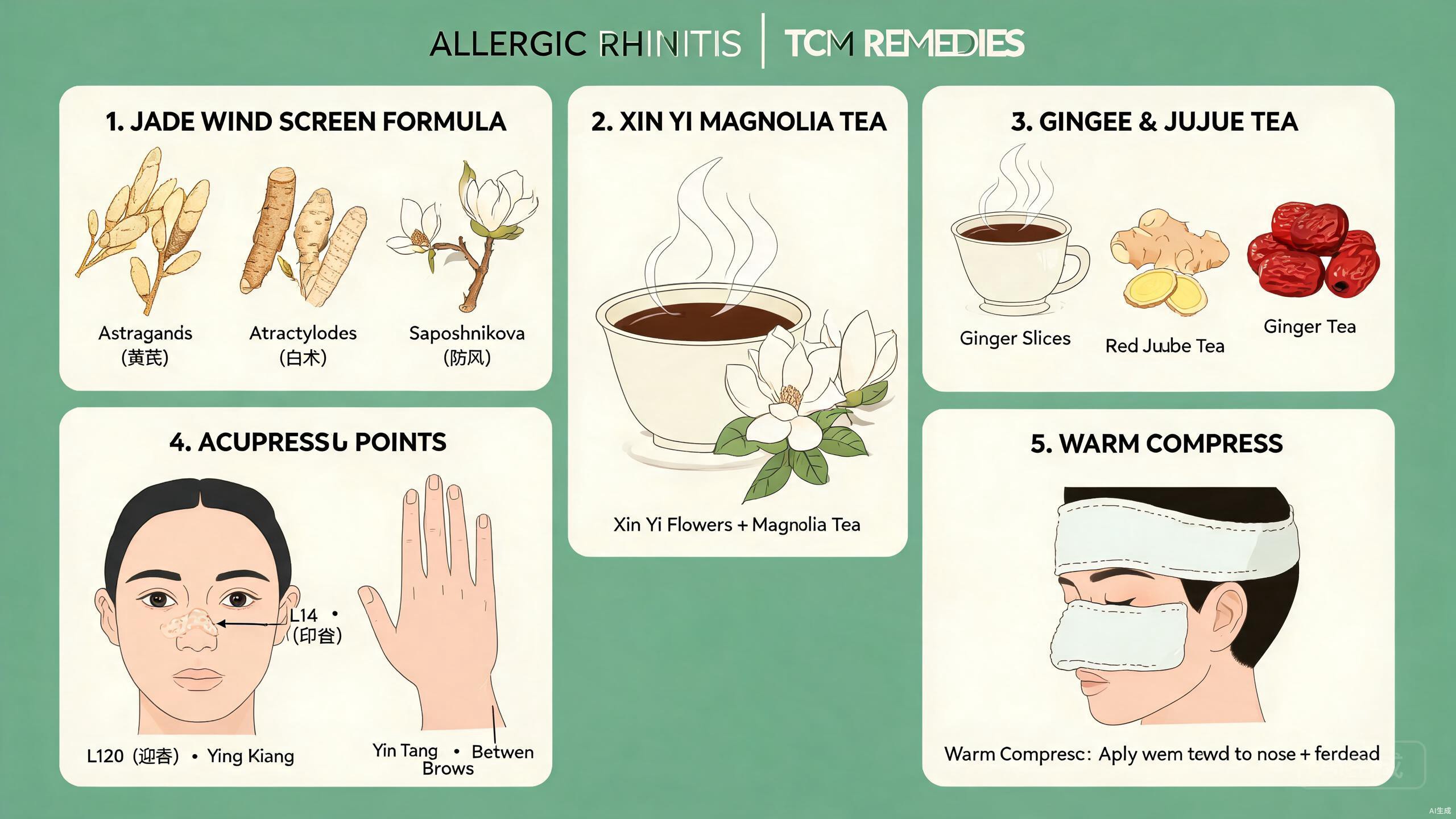
Key Takeaways
- TCM views allergic rhinitis through the Lung, Spleen, and Kidney organ systems — the Lung governs the protective wei qi (defensive energy) that guards the body's surface, while the Spleen nourishes the Lungs and the Kidney provides warming yang.
- The core TCM patterns associated with allergic rhinitis are lung and spleen qi deficiency, kidney yang insufficiency, and weakened defensive qi that fails to protect against external wind and cold.
- Five traditional food therapy recipes — from astragalus porridge to magnolia flower egg soup — use ingredients available at Western supermarkets, Asian markets, Amazon, or iHerb.
- Dietary restrictions matter: TCM traditionally advises avoiding raw, cold, spicy, greasy, and seafood foods that may weaken the spleen or trigger dampness and phlegm.
- These are traditional wellness practices, not a treatment for any medical condition. Severe or persistent allergy symptoms require evaluation by a qualified healthcare provider.
This article is for educational purposes only and is not medical advice. The foods, teas, and practices described here are traditional wellness practices rooted in Chinese culture. They are not a substitute for professional medical care, diagnosis, or treatment. Allergic rhinitis can significantly affect quality of life, and in some cases nasal symptoms can indicate more serious conditions including chronic sinusitis, nasal polyps, or structural issues. Severe allergies can also lead to asthma exacerbation. These require proper evaluation by a qualified healthcare provider. Never stop, delay, or replace prescribed treatment based on information in this article. Some foods and herbs may interact with medications — always inform your doctor about everything you consume. These statements have not been evaluated by the FDA and are not intended to diagnose, treat, cure, or prevent any disease. Read our full disclaimer →
Allergic rhinitis — with its relentless sneezing, runny nose, nasal congestion, and itchy eyes — is one of the most common chronic conditions worldwide. Whether triggered by pollen in spring, dust mites year-round, or pet dander at home, these allergy symptoms can disrupt sleep, concentration, and overall quality of life. While modern medicine offers antihistamines, nasal sprays, and immunotherapy, many people seek complementary approaches to support their body's natural resilience. Traditional Chinese Medicine (TCM) offers a distinctive perspective on allergies — one that focuses not on suppressing symptoms, but on strengthening the body's internal defenses so that it is less reactive to environmental triggers.
In TCM, allergic rhinitis is understood through the concept of wei qi (defensive qi) — the body's protective energy that circulates just beneath the skin and guards against external pathogens. When wei qi is strong, the body can encounter pollen, dust, and temperature changes without overreacting. When wei qi is weak — typically due to lung, spleen, or kidney deficiency — the body's defenses falter, and external "wind" and "cold" invade, producing the sneezing, congestion, and itching characteristic of allergic rhinitis. The five recipes below use foods that have been enjoyed for generations to strengthen wei qi, tonify the lungs and spleen, and clear nasal congestion. All ingredients are available at Western supermarkets, Asian markets, Amazon, or iHerb.
If you are new to TCM concepts, our guide to the Zang-Fu organ systems and overview of qi, blood, and body fluids are helpful starting points. For related respiratory topics, see our guides to TCM for cold and flu and TCM for cough relief.
How TCM Views Allergic Rhinitis
Traditional Chinese Medicine understands allergic rhinitis through three interconnected organ systems and the concept of defensive qi. The approach is fundamentally different from the Western allergy model: rather than focusing on the immune system's overreaction to specific allergens, TCM focuses on why the body's defenses are weak enough to allow that overreaction in the first place.
The Lung governs qi and controls the nose and skin (Fei Zhu Qi, Si Hu Bi). In TCM, the Lung is the most external of the internal organs — it opens directly to the outside world through the nose and communicates with the skin and body hair. The Lung disperses wei qi (defensive qi) to the body's surface, creating a protective shield against external pathogens like wind, cold, and allergens. When lung qi is strong, wei qi is abundant and the nose and skin are well-defended. When lung qi is deficient, wei qi weakens, and the body becomes vulnerable to external invasions — precisely what happens during an allergy flare-up. The sneezing, runny nose, and nasal itching of allergic rhinitis are, in TCM terms, the body's struggle to expel wind that has penetrated weakened defenses.
The Spleen is the source of qi and blood (Pi Wei Hou Tian Zhi Ben). In TCM's five-element theory, the Spleen (Earth) is the "mother" of the Lung (Metal). This means the Spleen nourishes and supports the Lung. The Spleen transforms food into qi and blood, which are then sent upward to the Lungs. When the Spleen is strong, the Lungs are well-nourished and wei qi is abundant. When the Spleen is weak — from poor diet, overthinking, or irregular eating habits — it cannot adequately support the Lungs. Spleen deficiency also produces internal dampness, which can manifest as phlegm in the nose and sinuses. This is why TCM places such strong emphasis on diet in the management of allergic rhinitis: what you eat directly affects your spleen function, which in turn affects your lung function and allergy susceptibility.
The Kidney provides the warming foundation (Shen Wei Xian Tian Zhi Ben). The Kidney stores essence (jing) and is the root of the body's yang energy. In TCM's five-element theory, the Kidney (Water) is the "mother" of the Lung (Metal) in a different sense — it provides the deep, warming energy that supports all the body's functions, including the Lung's ability to disperse wei qi. Kidney yang deficiency is particularly relevant for people whose allergies worsen in cold weather, who feel cold generally, or who have chronic, year-round allergies that never fully resolve. The Kidney is also the "root of qi" — the Lung's ability to hold and direct qi ultimately depends on the Kidney's ability to anchor it.
TCM identifies three primary patterns associated with allergic rhinitis:
- Lung and Spleen Qi Deficiency (Fei Pi Qi Xu) — the most common pattern. Signs include sneezing in the morning or upon waking, clear or watery nasal discharge, a tendency to catch colds easily, fatigue after eating, bloating, loose stools, and a pale complexion. Allergy symptoms often worsen with fatigue or stress and improve with rest. This pattern reflects the "mother-child" relationship: a weak Spleen cannot nourish the Lungs, leaving wei qi depleted.
- Kidney Yang Deficiency (Shen Yang Xu) — a deeper, more chronic pattern. Signs include year-round allergies that worsen in cold weather, clear nasal discharge, cold extremities, frequent urination (especially at night), lower back soreness, and a general feeling of coldness. Often seen in older adults or those with chronic illness. See our guide to TCM for night urination for more on kidney yang deficiency.
- Wind-Cold Invading the Lung (Feng Han Shu Fei) — an acute pattern representing an active allergy flare-up. Signs include sudden onset of sneezing, clear watery nasal discharge, nasal congestion, itchy eyes, and an aversion to cold. This pattern occurs when wei qi is weak and external wind-cold penetrates the body's defenses. It is often the immediate trigger during pollen season or exposure to dust and cold air.
Understanding these patterns helps explain why TCM recommends different foods for different situations — qi-tonifying foods for deficiency patterns, and warming or heat-clearing foods for acute flare-ups.
5 Food Therapy Recipes for Nasal Wellness
Each recipe below is matched to a specific TCM pattern. Choose the one that best fits your situation, and use it consistently for two to four weeks. For deficiency patterns, the qi-tonifying recipes (astragalus porridge, yam lily millet porridge) are best used preventively, before and during allergy season. For acute flare-ups, the heat-clearing and nasal-opening recipes (houttuynia, magnolia flower) are more appropriate. All ingredients are available at Western supermarkets, Asian markets, Amazon, or iHerb.
1. Astragalus Porridge (黄芪粥)
Best for: Lung and spleen qi deficiency (preventive use before allergy season)
TCM nature and flavor: Astragalus (huang qi): sweet, warm. Enters the Spleen and Lung channels. Rice: sweet, neutral. Enters the Spleen and Stomach channels.
Traditional use: Astragalus is arguably the most important herb in TCM for strengthening wei qi. It is traditionally used to tonify spleen and lung qi, lift the yang, strengthen the body's surface defenses, and promote sweating. In TCM theory, astragalus "secures the exterior" — meaning it tightens the body's protective shield so that external pathogens cannot easily penetrate. This makes it the premier preventive food for allergy season. Rice provides a gentle, easily digested base that supports the spleen. This simple porridge is ideal for people whose allergies are rooted in chronic lung and spleen qi deficiency, and is best started several weeks before allergy season begins. Modern research has also explored astragalus for its potential immunomodulatory properties.
Ingredients:
- 30 grams (about 10 to 12 slices) dried astragalus root — available on Amazon or iHerb
- 100 grams (about 1/2 cup) white rice (short or medium grain)
- 6 cups water
- A pinch of sea salt
- Optional: 3 dried red dates (jujubes), pitted, for sweetness
Preparation: Rinse the astragalus slices. In a pot, combine the astragalus, red dates (if using), and 4 cups of water. Bring to a boil, then reduce heat and simmer for 20 minutes to extract the astragalus. Strain and reserve the liquid, discarding the astragalus slices (they are too fibrous to eat). Rinse the rice. In a clean pot, combine the rice, the reserved astragalus liquid, and the remaining 2 cups of water. Bring to a boil, then reduce heat and simmer for 30 to 40 minutes, stirring occasionally, until the porridge is thick and creamy. Add salt to taste. Eat 1 bowl per day, ideally in the morning. For more on astragalus, see our astragalus tea guide and astragalus soup recipe.
Precautions: Astragalus is warming and tonifying. Avoid if you have an acute infection, fever, or active inflammation, as TCM considers it inappropriate to "tonify" during acute illness. If you take immunosuppressant medication, consult your doctor. See our herbal tea safety guide for general guidance.
2. Yam Lily Millet Porridge (山药百合小米粥)
Best for: Lung and spleen qi deficiency with dryness (dry nose, dry throat)
TCM nature and flavor: Chinese yam (shan yao): sweet, neutral. Enters the Spleen, Lung, and Kidney channels. Lily bulb (bai he): sweet, slightly cold. Enters the Heart and Lung channels. Millet (xiao mi): sweet, neutral. Enters the Spleen and Stomach channels.
Traditional use: This is a gentle, nourishing porridge that addresses both the deficiency and the dryness that often accompany allergic rhinitis. Chinese yam is one of the most versatile tonic foods, traditionally used to tonify the spleen, nourish the lung, and support the kidney simultaneously. It is rich in complex carbohydrates and minerals. Lily bulb is traditionally used to nourish lung yin, moisten the lungs, and calm the mind — making it especially valuable for the dry, irritated nasal passages and throat that often accompany chronic allergies. Millet is one of the most easily digested grains in TCM, traditionally used to nourish the spleen and stomach and build qi. Together, this porridge strengthens the digestive and respiratory foundations while providing gentle moistening for dry nasal passages. It is ideal as a daily breakfast during allergy season.
Ingredients:
- 100 grams (about 1/2 cup) yellow millet — available at supermarkets, Amazon, or iHerb
- 50 grams (about 1 cup) fresh Chinese yam, peeled and cubed (or 20 grams dried yam slices)
- 15 grams (about 1 tablespoon) dried lily bulb (bai he) — available on Amazon or iHerb
- 6 cups water
- A pinch of sea salt
Preparation: Rinse the millet. If using dried lily bulb, soak it in warm water for 15 minutes. In a pot, combine the millet, Chinese yam, lily bulb, and water. Bring to a boil, then reduce heat and simmer for 30 to 40 minutes, stirring occasionally, until the porridge is thick and the yam is tender. Add salt to taste. Eat 1 bowl per day, ideally in the morning. The porridge is mild, slightly sweet, and very comforting. For more on Chinese yam, see our yam congee guide.
Precautions: This porridge is gentle and generally suitable for daily use. Lily bulb is slightly cold; if you have a cold constitution with cold hands and feet or diarrhea, add 2 to 3 slices of fresh ginger to balance the temperature.
3. Silver Ear Lily Soup (银耳百合羹)
Best for: Lung yin deficiency with dryness and throat irritation
TCM nature and flavor: Tremella mushroom (yin er / silver ear): sweet, neutral. Enters the Lung and Stomach channels. Fresh lily bulb: sweet, slightly cold. Enters the Heart and Lung channels.
Traditional use: Tremella mushroom, also known as "silver ear" or "snow fungus," is one of TCM's most prized yin-nourishing and moistening foods. It is traditionally used to nourish lung yin, moisten the lungs, and generate fluids. Its gelatinous texture is believed to directly moisten dry mucous membranes — directly relevant for the dry, irritated nasal passages that accompany chronic allergic rhinitis, especially after repeated sneezing and nose-blowing. Fresh lily bulb adds additional lung-yin nourishment and helps calm the mind — valuable for the sleep disruption that allergies often cause. This soup is a beloved traditional dessert in China, enjoyed for both its texture and its wellness benefits. From a modern nutritional perspective, tremella is rich in polysaccharides that may support immune function.
Ingredients:
- 15 grams (about 1/2 cup) dried tremella mushroom — available on Amazon or iHerb
- 50 grams (about 1 cup) fresh lily bulb petals, or 15 grams dried lily bulb (bai he)
- 6 cups water
- 1 to 2 tablespoons rock sugar or honey to taste
- Optional: 10 goji berries for garnish
Preparation: Soak the dried tremella in warm water for 1 to 2 hours until fully expanded and soft. Trim off the hard yellow base and tear into small florets. If using dried lily bulb, soak for 15 minutes. In a pot, combine the tremella, lily bulb, and water. Bring to a boil, then reduce heat and simmer for 60 to 90 minutes, stirring occasionally, until the tremella is very soft and the liquid becomes thick and gelatinous. Add rock sugar or honey to taste in the last 10 minutes. Garnish with goji berries. Eat 1 bowl per day, ideally in the evening. The soup is sweet, smooth, and deeply moistening.
Precautions: This soup is gentle and suitable for most people. If you have excessive dampness or phlegm (thick nasal discharge, chest congestion), use this less frequently, as its moistening nature may be counterproductive for damp-type patterns. Diabetics should use minimal sweetener or omit it.
4. Houttuynia Cold Salad (凉拌鱼腥草)
Best for: Acute flare-up with thick nasal discharge and heat signs
TCM nature and flavor: Houttuynia (yu xing cao / fish mint): acrid, cold. Enters the Lung channel.
Traditional use: Houttuynia, also known as "fish mint" for its distinctive fishy aroma, is one of TCM's most important heat-clearing and detoxifying herbs for the Lung. It is traditionally used to clear lung heat, resolve toxicity, and reduce inflammation in the respiratory tract. While the qi-tonifying recipes above are for deficiency patterns, houttuynia addresses the opposite situation — when allergies have progressed to include thick, yellow, or green nasal discharge, a feeling of heat, and sinus inflammation. In these cases, the body has accumulated heat and possibly mild infection in the nasal passages. Houttuynia's cold, detoxifying nature is traditionally used to clear this heat. It is also used as a daily vegetable in southwestern China, where it is beloved for its unique flavor. Modern research has explored houttuynia for its antimicrobial properties.
Ingredients:
- 100 grams fresh houttuynia leaves and stems (or 30 grams dried houttuynia — available on Amazon or iHerb)
- 1 tablespoon rice vinegar or apple cider vinegar
- 2 cloves garlic, minced
- 1 teaspoon soy sauce or tamari
- 1 teaspoon sesame oil
- A pinch of sea salt
- Optional: 1 small chili, minced (if you tolerate spice)
Preparation: If using fresh houttuynia, wash thoroughly and cut into 5 cm (2 inch) segments. Blanch in boiling water for 30 seconds, then immediately plunge into ice water to preserve the texture and reduce the fishy aroma. Drain well. If using dried houttuynia, soak in warm water for 20 minutes, then drain. In a bowl, combine the houttuynia with the minced garlic, vinegar, soy sauce, sesame oil, and salt. Toss well. Let it marinate for 10 to 15 minutes before serving. Eat as a side dish, 2 to 3 times per week during acute flare-ups. The flavor is pungent and distinctive — an acquired taste that many people come to enjoy.
Precautions: Houttuynia is cold in nature. Avoid if you have a cold constitution, chronic diarrhea, or during pregnancy. Use only for acute heat-type patterns (thick discharge, inflammation), not for long-term preventive use. Some people are allergic to houttuynia itself — try a small amount first.
5. Magnolia Flower Egg Soup (辛夷花煮鸡蛋)
Best for: Nasal congestion and sinus pressure (acute and chronic)
TCM nature and flavor: Magnolia flower (xin yi hua): acrid, warm. Enters the Lung and Stomach channels. Egg: sweet, neutral. Enters the Heart and Spleen channels.
Traditional use: Magnolia flower is one of TCM's most important herbs for nasal and sinus conditions. It is traditionally used to open the nasal passages, disperse wind-cold, and relieve nasal congestion. In TCM, magnolia flower is considered a specific remedy for "bi yuan" — the traditional term for chronic nasal congestion and sinusitis. Its acrid, warm nature is particularly suited to wind-cold type allergy symptoms (clear discharge, congestion, sensitivity to cold). The egg in this recipe provides gentle nourishment and serves as a carrier for the herb's aromatic oils. This is a simple, traditional folk remedy that has been used in Chinese households for generations to ease nasal congestion during allergy season and colds alike. Magnolia flower's aromatic compounds are released during cooking and are believed to directly benefit the nasal passages when consumed warm.
Ingredients:
- 10 grams (about 1 tablespoon) dried magnolia flower buds (xin yi hua) — available on Amazon or iHerb
- 2 eggs
- 3 cups water
- A pinch of sea salt
- Optional: 1 teaspoon honey
Preparation: Rinse the magnolia flower buds. In a pot, combine the magnolia flower, water, and whole eggs in their shells. Bring to a boil, then reduce heat and simmer for 10 to 12 minutes until the eggs are hard-boiled. Remove the eggs, peel the shells, and return the peeled eggs to the pot. Simmer for another 5 minutes to allow the eggs to absorb the magnolia flavor. Strain the liquid to remove the flower buds. Serve the warm egg in a bowl of the strained magnolia broth, with a pinch of salt and optional honey. Eat 1 serving per day during acute congestion, for up to 1 to 2 weeks. The broth has a mild, slightly floral and warming flavor.
Precautions: Magnolia flower is warming and acrid. It is best for wind-cold type congestion (clear discharge, cold sensitivity). If your allergy symptoms include thick, yellow discharge and heat signs, use houttuynia salad (recipe 4) instead. Avoid magnolia flower during pregnancy. Do not use for extended periods (more than 2 weeks continuously) without consulting a qualified TCM practitioner.
The five recipes above serve two different purposes. Recipes 1 and 2 (astragalus porridge, yam lily millet porridge) are preventive — they strengthen lung and spleen qi to reduce future allergy reactivity. Start them several weeks before allergy season and use them daily throughout. Recipes 4 and 5 (houttuynia, magnolia flower) are relief-oriented — they address acute symptoms during flare-ups. Recipe 3 (silver ear lily soup) bridges both purposes, offering gentle moistening for chronic dryness. Choose based on your current situation, and always consult your healthcare provider for persistent symptoms.
Dietary Guidance: Foods to Avoid
In TCM, what you avoid is just as important as what you eat. The Spleen is easily damaged by certain foods, and a weakened Spleen directly undermines lung function and wei qi. During allergy season and for those with chronic allergic rhinitis, TCM traditionally advises limiting or avoiding the following:
- Raw and cold foods. Ice water, ice cream, cold smoothies, large salads, and raw vegetables are considered the primary enemies of the Spleen in TCM. Cold foods are believed to "extinguish the spleen fire" — the digestive warmth needed to transform food into qi. A weakened Spleen cannot properly nourish the Lungs, weakening wei qi. Instead, favor warm, cooked foods: soups, stews, steamed vegetables, and porridges. See our congee guide for warming, easy-to-digest options.
- Spicy and greasy foods. Chili, pepper, fried foods, and heavy sauces generate internal heat and dampness, which can aggravate nasal inflammation and produce thick phlegm. During acute flare-ups, these foods can worsen congestion and discharge.
- Seafood and shellfish. In TCM theory, many seafoods are considered allergenic and damp-producing. Shrimp, crab, and certain fish are believed to trigger allergic reactions in susceptible individuals. While this is a traditional concept, it aligns with the fact that shellfish are among the most common food allergens.
- Excessive dairy. Milk, cheese, and cream are considered damp-producing in TCM, potentially generating phlegm and worsening nasal congestion. If you consume dairy, favor small amounts of warm milk or fermented dairy like yogurt, which is easier to digest.
- Cold drinks during meals. Drinking ice water with meals dilutes digestive enzymes and cools the stomach, impairing the Spleen's ability to transform food. Drink warm water or tea instead, or at least room-temperature water.
Instead, TCM recommends a diet centered on warm, cooked, seasonal foods — think soups, stews, porridges, steamed root vegetables, and warm herbal teas. This approach supports the Spleen, which in turn strengthens the Lungs and wei qi. For more on TCM dietary principles, see our guide to warming spices and TCM for digestion.
Lifestyle Tips for Nasal Wellness
TCM is a whole-person system. Foods work best when combined with supportive daily habits. The following areas are emphasized in classical TCM for respiratory health:
- Keep warm, especially the neck and upper back. In TCM, the back of the neck is where "wind" enters the body. Protect this area with a scarf, especially in cold, windy, or air-conditioned environments. Avoid sitting directly under air conditioning vents or near fans.
- Practice gentle exercise. Walking, tai chi, and qigong support lung function by promoting deep, rhythmic breathing and smooth qi circulation. The breathing techniques guide offers specific exercises. Avoid exercising in cold, dry, or high-pollen air during allergy season.
- Manage stress and emotions. In TCM, worry and overthinking weaken the Spleen, while grief and sadness affect the Lungs. Chronic stress undermines both the digestive and respiratory systems. Building in genuine rest and relaxation supports the organ systems that underpin allergy resilience. See our guide to a calm mind and meditation guide.
- Nasal irrigation. While not traditionally Chinese, nasal saline rinses align well with TCM's emphasis on clearing the nasal passages. A neti pot or saline rinse can physically remove allergens and mucus — a practical complement to internal food therapy.
- Protect during seasonal transitions. TCM places great emphasis on the change of seasons, especially spring (when wood/liver energy rises and allergies peak) and autumn (when metal/lung energy is vulnerable). See our spring liver foods guide and autumn food therapy guide for seasonal wellness practices.
Comparison of the Five Recipes
| Recipe | TCM Pattern | Key Action | Frequency |
|---|---|---|---|
| Astragalus Porridge | Lung & Spleen Qi Def. | Strengthen wei qi, tonify qi | 1 bowl daily (preventive) |
| Yam Lily Millet Porridge | Lung & Spleen Def. with dryness | Tonify qi, moisten lungs | 1 bowl daily |
| Silver Ear Lily Soup | Lung Yin Def. (dryness) | Nourish yin, moisten mucosa | 1 bowl daily |
| Houttuynia Cold Salad | Acute heat (thick discharge) | Clear lung heat, detoxify | 2 to 3 times per week (acute) |
| Magnolia Flower Egg Soup | Wind-cold congestion | Open nasal passages, disperse wind | 1 serving daily (acute, up to 2 weeks) |
Frequently Asked Questions
What does TCM say about allergic rhinitis?
In Traditional Chinese Medicine, allergic rhinitis is understood through the Lung, Spleen, and Kidney organ systems. The Lung governs the protective wei qi that defends the body's surface against external invaders. When lung qi is deficient, the body's defenses are weak. The Spleen provides nourishment to the lungs, while the Kidney provides the warming yang energy that supports lung function. Allergic rhinitis is most commonly attributed to lung and spleen qi deficiency, kidney yang insufficiency, and weakened defensive qi that fails to protect against external wind and cold. TCM food therapy traditionally uses qi-tonifying foods like astragalus, Chinese yam, and lily. These are traditional wellness practices, not medical treatments. For a deeper understanding, see our zang-fu organ guide.
Which Chinese medicine foods may support allergic rhinitis relief?
Five traditional TCM food therapy recipes for allergic rhinitis include astragalus porridge, yam lily millet porridge, silver ear lily soup, houttuynia cold salad, and magnolia flower egg soup. These recipes use ingredients available at Western supermarkets, Asian markets, Amazon, or iHerb. Qi-tonifying recipes (astragalus, yam) are best for deficiency patterns and preventive use, while heat-clearing recipes (houttuynia) address acute congestion with thick discharge, and magnolia flower opens nasal passages for wind-cold type congestion. They are traditional wellness foods, not treatments for any medical condition.
Can TCM help with seasonal allergies naturally?
TCM approaches seasonal allergies by strengthening the body's defensive wei qi before and during allergy season. Foods like astragalus, Chinese yam, and lily are traditionally used to tonify lung and spleen qi, while warm, cooked foods are favored over cold, raw foods that may weaken the spleen. Dietary restrictions on seafood, spicy foods, and cold drinks are also emphasized. Starting qi-tonifying foods several weeks before allergy season is a traditional approach to building resilience. These traditional practices may complement overall wellness, but they are not a treatment for allergic rhinitis. If you experience severe or persistent allergy symptoms, consult your healthcare provider.
What foods should I avoid for allergic rhinitis according to TCM?
In TCM, foods that may aggravate allergic rhinitis include raw and cold foods (ice water, ice cream, raw salads), which are believed to weaken the spleen and produce internal dampness; spicy and greasy foods, which generate heat; seafood and shellfish, which are considered allergenic in TCM theory; and excessive dairy, which is thought to generate phlegm and dampness. Instead, TCM favors warm, cooked, easily digested foods like soups, stews, porridges, and steamed vegetables. These dietary concepts are traditional and should complement, not replace, guidance from your healthcare provider or allergist.
Precautions and When to Seek Help
While TCM food therapy may support general wellness, allergy symptoms can sometimes indicate more serious conditions that require professional evaluation:
- See your doctor if you experience persistent or worsening nasal symptoms, especially if accompanied by facial pain, pressure, thick or discolored discharge, or fever. These may indicate chronic sinusitis, nasal polyps, or infection that needs proper diagnosis and treatment.
- Asthma connection. Allergic rhinitis and asthma often coexist. If you experience wheezing, shortness of breath, chest tightness, or a persistent cough alongside your allergy symptoms, seek medical evaluation promptly, as these may indicate asthma that requires treatment.
- Severe reactions. If you experience swelling of the lips, tongue, or throat, difficulty breathing, or hives, seek emergency medical attention immediately, as these may indicate anaphylaxis — a life-threatening allergic reaction.
- Medication interactions. If you take allergy medications (antihistamines, nasal corticosteroids), asthma medications, or immunosuppressants, consult your healthcare provider before adding tonic herbs like astragalus to your routine, as they may interact with your treatment.
- Not a substitute. TCM food therapy is complementary. It sits alongside — never in place of — professional medical care, including proper allergy testing and management.
For related topics, see our guides on TCM for cold and flu, TCM for cough relief, and TCM immunity soups.
The Bottom Line
Traditional Chinese Medicine offers a distinctive, food-based tradition for supporting nasal wellness. Rather than focusing solely on symptom suppression, TCM asks why the body's defenses are weak enough to allow allergic overreaction in the first place. By understanding whether your pattern is rooted in lung and spleen qi deficiency, kidney yang insufficiency, or an acute wind-cold invasion, you can choose foods that work with your body's specific needs. Astragalus porridge and yam lily millet porridge strengthen the foundations — lung, spleen, and wei qi — and are best used preventively. Silver ear lily soup gently moistens dry nasal passages. Houttuynia clears heat during acute flare-ups. Magnolia flower egg soup opens congested nasal passages. Paired with dietary wisdom — avoiding cold, raw, spicy, and allergenic foods — and lifestyle habits like keeping the neck warm and practicing gentle breathing exercise, these traditional practices form a whole-person approach to allergy resilience.
But they are traditions — not treatments, and not a replacement for medical care. Severe or persistent allergy symptoms require evaluation by a qualified healthcare provider. Use these traditional practices only as complementary wellness habits, alongside your doctor's guidance.
This article shares traditional wellness practices for educational purposes only. It is not a substitute for medical advice, diagnosis, or treatment. The foods, teas, and practices described here are not intended to treat, cure, or prevent any disease, including allergic rhinitis, chronic sinusitis, nasal polyps, or asthma. If you have severe, persistent, or worsening allergy symptoms, or if you experience wheezing, difficulty breathing, or signs of a severe allergic reaction, seek medical attention promptly. These statements have not been evaluated by the FDA. Never stop or adjust prescribed treatment without your doctor's explicit guidance. Read our full disclaimer →