Key Takeaways
- In TCM, mental calmness is linked to the concept of shen (spirit), housed in the Heart. When the Heart is well nourished, the mind is calm and clear.
- The brain is connected to the Kidneys through essence (jing) — kidney essence nourishes the brain, which TCM calls the "sea of marrow."
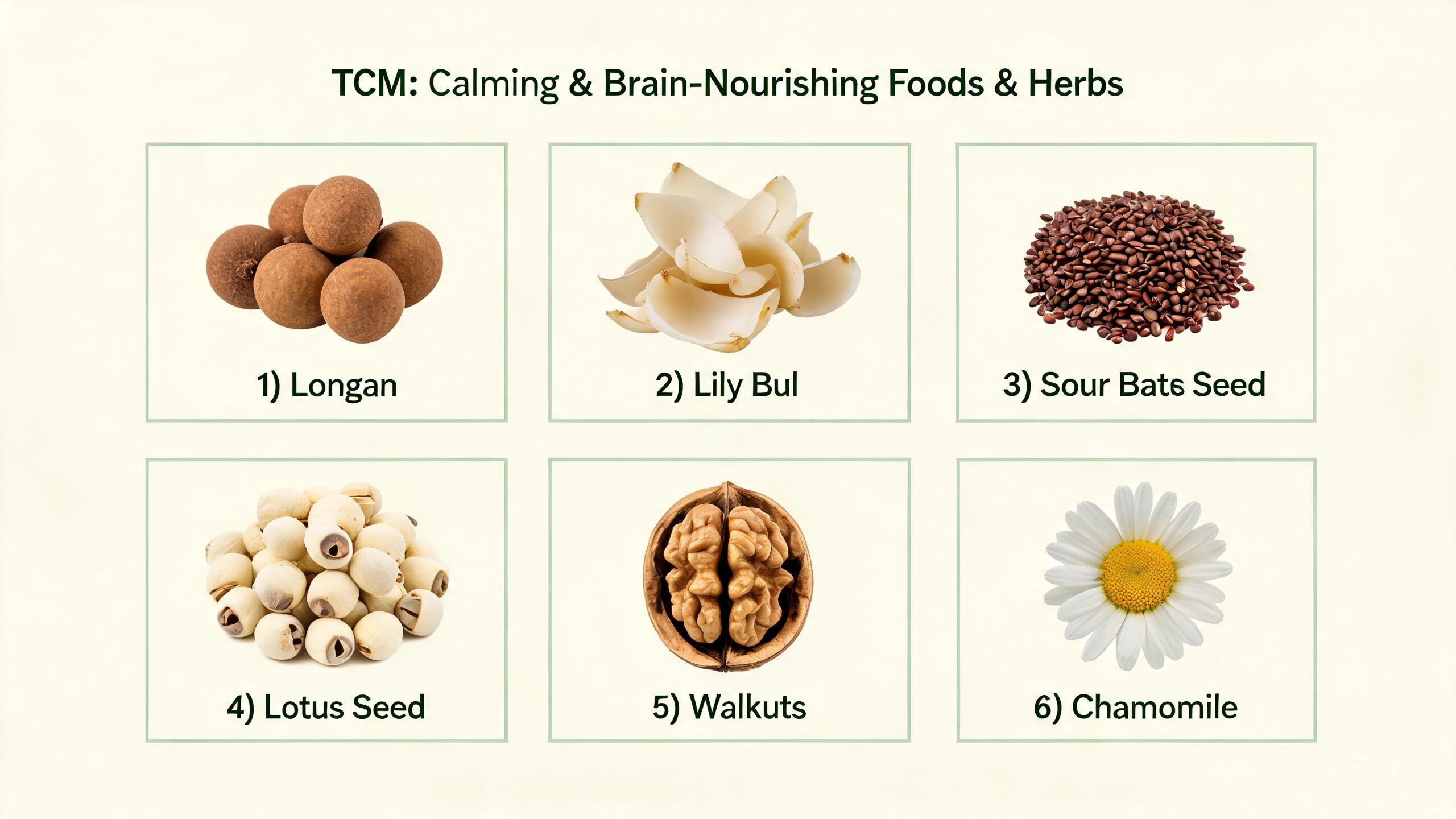
- Five everyday foods — walnuts, longan, lily bulb, lotus seeds, and sour date seed — are traditionally used to calm the spirit and nourish the brain.
- Lifestyle habits — meditation, a consistent sleep schedule, and stress management — are considered as important as food for mental wellness.
- These are traditional wellness practices, not a treatment for anxiety, depression, or insomnia. Always consult a healthcare provider for mental health concerns.
This article is for educational purposes only and is not medical advice. The foods, teas, and practices described here are traditional wellness practices rooted in Chinese culture. They are not a substitute for professional mental health care or medical treatment. The TCM concepts of "calming the mind" and "nourishing the brain" refer to general wellness and traditional balance, not to the treatment of anxiety, depression, insomnia, or any medical condition. Never stop, delay, or replace prescribed treatment based on information in this article. If you are experiencing persistent anxiety, depression, sleep problems, or any mental health concern, consult a qualified mental health professional or healthcare provider. Some foods and herbs may interact with medications — always inform your doctor about everything you consume. These statements have not been evaluated by the FDA and are not intended to diagnose, treat, cure, or prevent any disease.
In a world of constant notifications, endless to-do lists, and racing thoughts, finding calm can feel out of reach. You lie down to sleep and your mind keeps going. You try to focus and your thoughts scatter. This modern experience of mental restlessness is not new — Traditional Chinese Medicine has been addressing it for thousands of years, with a sophisticated framework that connects the mind, the heart, and the brain.
In TCM, mental calmness is not simply a matter of willpower. It is a reflection of the internal state of the body, especially the Heart and Kidneys. The foods below have been enjoyed for generations as part of a balanced lifestyle to support a calm, clear mind and restful sleep. They are not medicines and not a treatment for any mental health condition, but they are gentle, nourishing additions to a wellness routine.
If you are new to TCM concepts, our introduction to Traditional Chinese Medicine is a helpful starting point before diving in.
How TCM Views the Mind and Brain
TCM approaches mental wellness through two interconnected frameworks: the Heart-shen connection and the Kidney-essence-brain connection. Together, they explain why TCM treats mental calmness as a matter of both the "spirit" and the "substance" of the body.
The Heart and the Shen (Spirit)
In TCM, the Heart is the emperor of the organs, and it houses the shen (神), often translated as "spirit" or "mind." This does not mean a religious soul — it refers to the aspect of consciousness that includes thinking, awareness, sleep, and emotional presence. When the Heart is well nourished by blood and yin, the shen is "anchored" and settled. You feel calm, clear, and able to sleep deeply. When the Heart is deficient, overheated, or disturbed, the shen becomes restless — showing up as anxiety, insomnia, vivid dreams, scattered thoughts, or a feeling of being "ungrounded."
This is why a TCM practitioner hearing a complaint about insomnia or racing thoughts will ask about palpitations, dream quality, emotional state, and digestion — all of which relate to the Heart and the organs that produce the blood it stores.
The Kidneys, Essence, and the Brain
The second framework connects the Kidneys to the brain through essence (精, jing). TCM calls the brain the "sea of marrow" (脑为髓海), and considers it nourished by kidney essence. When kidney essence is abundant, memory, concentration, and mental clarity are strong. When kidney essence is depleted — through overwork, aging, chronic stress, or inadequate rest — the brain is said to be undernourished, showing up as poor memory, difficulty concentrating, mental fatigue, and a sense of being "spent."
The Heart and Kidneys are also said to "communicate" with each other. In a healthy state, the cooling, grounding energy of the Kidneys (kidney yin) rises to calm and anchor the Heart, while the warming energy of the Heart descends to support the Kidneys. This "heart-kidney communication" (心肾相交) is considered essential for restful sleep and a calm mind. When it breaks down — often due to stress, overwork, or aging — the result is the classic pattern of "heart-kidney disharmony," with a restless mind, difficulty falling asleep, and a feeling of heat or agitation.
Common TCM patterns associated with mental restlessness include:
- Heart Blood Deficiency — anxiety, insomnia, palpitations, poor memory, pale complexion. Often linked to overwork, poor nutrition, or blood loss.
- Heart Yin Deficiency — restlessness, insomnia with a feeling of heat, night sweats, dry mouth. Often associated with chronic stress or aging.
- Heart Fire — agitation, insomnia, mouth ulcers, red face, irritability. Often linked to prolonged emotional stress or frustration.
- Heart-Kidney Disharmony — difficulty falling asleep, vivid dreams, lower back weakness, ringing in the ears. Reflects the breakdown of heart-kidney communication.
- Kidney Essence Deficiency — poor memory, mental fatigue, dizziness, lower back and knee weakness. Associated with aging or chronic depletion.
Understanding these patterns helps explain why TCM recommends different foods for different situations. To learn more about the organs involved, see our guide to the Zang-Fu organ systems, and for the broader framework of balance, see our guide to yin and yang and our Five Elements guide.
Five Everyday TCM Foods for Calming the Mind and Nourishing the Brain
The following five foods are staples of East Asian kitchens and tea cabinets. Each has a place in TCM tradition as a food that may support mental calmness and brain wellness when enjoyed as part of a balanced lifestyle. They are not medicines, and they are not a treatment for any mental health condition.
1. Walnuts (核桃, He Tao)
TCM nature: Sweet, warm. Enters: Kidney, Lung, and Large Intestine channels.
Walnuts open this list for a delightful reason: in TCM, as in popular folklore, walnuts are said to nourish the brain. The connection is partly visual — a walnut half looks remarkably like a brain — but the TCM rationale goes deeper. Walnuts are traditionally used to "warm and tonify kidney yang" and to "nourish the brain," because the brain, as the "sea of marrow," is nourished by kidney essence. By supporting the kidneys, walnuts indirectly support the brain. In modern nutrition, walnuts are valued for their omega-3 fatty acids (especially alpha-linolenic acid), which aligns with their traditional use as a brain food. TCM recommends eating a small handful daily, not large amounts.
How to prepare: Eat 5 to 8 walnuts per day as a snack, or chop and stir into oatmeal, congee, or yogurt. A traditional brain-nourishing porridge: cook rice porridge with a handful of chopped walnuts and a tablespoon of goji berries. Lightly toasting the walnuts enhances their flavor and digestibility.
Caution: Walnuts are warming and oily. Reduce the amount if you have loose stools, active acne, or a tendency to feel overheated. If you have a nut allergy, avoid entirely.
2. Longan (桂圆, Gui Yuan)
TCM nature: Sweet, warm. Enters: Heart and Spleen channels.
Dried longan fruit (also called longan aril or gui yuan) is one of the most beloved heart-nourishing foods in TCM. It is traditionally used to "nourish the heart and spleen" and to "calm the spirit" (安神, an shen). For the patterns of Heart Blood Deficiency and Heart Yin Deficiency — with their signature anxiety, insomnia, and palpitations — longan is a classic choice. Its sweet, warming nature makes it especially suited to people who feel mentally depleted, anxious, and unable to settle. Longan is also traditionally used to support memory and concentration, reflecting its heart-brain connection. It is commonly brewed into tea, often with red dates, or added to sweet soups.
How to prepare: Rinse 1 tablespoon of dried longan and steep in hot water as tea for 8 to 10 minutes, or simmer with 6 red dates in 4 cups of water for 20 minutes. Longan can also be added to sweet rice porridge or soup. Drink 1 cup of tea per day, ideally in the afternoon or evening. See our herbal tea safety guide for general guidance.
Caution: Longan is warming and sweet. If you feel overheated, have a fever, or have Heart Fire symptoms (agitation, mouth ulcers), reduce or avoid it. If you have diabetes, use sparingly due to its natural sugar content.
3. Lily Bulb (百合, Bai He)
TCM nature: Sweet, slightly cold. Enters: Heart and Lung channels.
Lily bulb (the edible bulb of certain lily species, sold dried in Asian markets) is a gentle, cooling food in TCM. It is traditionally used to "clear heart heat" and "calm the mind," making it suited to the Heart Fire and Heart Yin Deficiency patterns — especially when restlessness is accompanied by dry mouth, a feeling of heat, or a dry cough. Unlike the warming longan, lily bulb is slightly cooling, making it the right choice when there is "heat" in the heart rather than "cold deficiency." It is also traditionally used to support restful sleep and ease irritability. Lily bulb has a mild, slightly sweet flavor and a soft, slightly starchy texture when cooked.
How to prepare: Rinse 1 to 2 tablespoons of dried lily bulb and soak in warm water for 30 minutes to rehydrate. Simmer in water or add to sweet soup with rock sugar and a few lotus seeds for a calming bedtime dessert. It can also be stir-fried with celery or added to congee. Enjoy 2 to 3 times per week, especially in the evening.
Caution: Lily bulb is a food and generally safe. Because it is slightly cooling, reduce the amount if you have a cold digestion with loose stools or a preference for very warm foods.
4. Lotus Seeds (莲子, Lian Zi)
TCM nature: Sweet, neutral, astringent. Enters: Heart, Spleen, and Kidney channels.
Lotus seeds are a versatile tonic food in TCM, traditionally used to "nourish the heart," "calm the mind," and "support the spleen and kidneys." What makes lotus seeds especially valuable for mental wellness is their astringent nature — they are said to "anchor" or "contain" the spirit, helping to settle a restless mind and reduce excessive dreaming. For the pattern of Heart Blood Deficiency with insomnia and vivid dreams, lotus seeds are a classic choice. They also support the Spleen (digestion) and Kidneys, addressing the foundations of blood and essence that underlie mental calmness. Lotus seeds have a mild, slightly sweet flavor and a pleasant, slightly chewy texture.
How to prepare: Soak 1 to 2 tablespoons of dried lotus seeds (with the green embryo removed for a sweeter taste, or left in for a more calming effect) for 1 hour. Simmer in water until tender (30 to 40 minutes). Add to sweet soup with rock sugar and lily bulb, or stir into congee. Enjoy 2 to 3 times per week.
Caution: Lotus seeds are a food and very safe. If you have constipation, use in moderation, as their astringent nature can be binding. If you have bloating, ensure they are thoroughly cooked.
5. Sour Date Seed (酸枣仁, Suan Zao Ren)
TCM nature: Sweet, sour, neutral. Enters: Heart, Liver, and Gallbladder channels.
Sour date seed is the single most important herb in TCM for calming the shen and supporting sleep. It is traditionally used to "nourish the heart and liver" and to "calm the spirit," and it is the go-to choice for insomnia, restless sleep, and anxiety-related sleep disturbance. TCM distinguishes between raw and roasted sour date seed: raw seeds are said to help with falling asleep (for excess/heat patterns), while roasted seeds are said to help with staying asleep (for deficiency patterns). For most general wellness use, roasted seeds are the gentler, more common choice. Sour date seed is slightly more "medicinal" than the other foods on this list — it is typically used as a tea or in soup rather than eaten directly — but it has been a part of daily wellness practice in China for centuries.
How to prepare: Lightly crush 1 tablespoon of roasted sour date seeds. Simmer in 2 cups of water for 15 to 20 minutes, then strain. Drink 1 cup in the evening, 1 to 2 hours before bed. It can be combined with lily bulb and lotus seeds for a calming bedtime tea. Start with a small amount and observe how you respond.
Caution: Sour date seed is generally safe in traditional culinary amounts but is more potent than the other foods on this list. If you take sedative medication, sleep medication, or any prescription for anxiety or depression, consult your healthcare provider before using sour date seed, as it may have additive effects. Do not use as a substitute for prescribed treatment. See our herbal tea safety guide for general guidance.
Comparison of the Five Foods
| Food | TCM Nature | Traditional Use | Preparation | Typical Frequency |
|---|---|---|---|---|
| Walnuts (He Tao) | Sweet, warm | Nourish kidney essence, support brain | Snack, stir into porridge | 5–8 nuts daily |
| Longan (Gui Yuan) | Sweet, warm | Nourish heart and spleen, calm spirit | Steep as tea, add to soup | 1 cup tea daily |
| Lily Bulb (Bai He) | Sweet, slightly cold | Clear heart heat, calm mind | Simmer in sweet soup or congee | 2–3 times weekly |
| Lotus Seeds (Lian Zi) | Sweet, neutral, astringent | Nourish heart, calm mind, anchor spirit | Simmer in soup or congee | 2–3 times weekly |
| Sour Date Seed (Suan Zao Ren) | Sweet, sour, neutral | Calms shen, supports sleep | Simmer crushed seeds as tea | 1 cup evening tea |
A Calming Bedtime Tea for Restful Sleep
Among the five foods above, the combination of sour date seed, lily bulb, and lotus seeds makes a classic TCM calming bedtime tea. Here is a simple, traditional method for making it at home.
- Gather your ingredients. You will need 1 tablespoon of roasted sour date seeds, 1 tablespoon of dried lily bulb, 1 tablespoon of dried lotus seeds, and 3 cups of water.
- Soak the lily bulb and lotus seeds. Place the dried lily bulb and lotus seeds in a bowl of warm water and soak for 30 minutes to rehydrate. Drain.
- Crush the sour date seeds. Place the roasted sour date seeds in a small bag or between two layers of cloth, and lightly crush them with a rolling pin or the back of a spoon. This helps release their properties during simmering.
- Combine in a pot. Place the crushed sour date seeds, rehydrated lily bulb, and lotus seeds in a small pot. Add 3 cups of water.
- Simmer gently. Bring to a boil, then reduce to a low simmer. Cover and simmer for 15 to 20 minutes. The liquid will take on a light, slightly golden color.
- Strain and sweeten. Strain the tea into cups. Add a small piece of rock sugar or a teaspoon of honey to taste, if desired. The tea is mild, slightly sweet, and very soothing.
- Enjoy warm, before bed. Sip slowly 1 to 2 hours before your intended sleep time. The lotus seeds and lily bulb can be eaten for their nourishing benefit.
This tea is best enjoyed as part of an evening wind-down routine — dim the lights, put away screens, and sip slowly. The ritual of preparing and drinking the tea is itself part of the calming practice. For more on building a calming evening routine, see our meditation guide and our ginger foot soak guide for a pre-bed warming practice.
Lifestyle Tips for Mental Wellness from a TCM Perspective
TCM is a whole-person system. Foods work best when combined with supportive daily habits. In fact, TCM texts often emphasize that lifestyle is more important than food for mental wellness. The following four areas are emphasized again and again in classical TCM texts for calming the mind and nourishing the brain:
- Meditation and mindful breathing. In TCM, the smooth flow of qi is essential for a calm mind, and meditation is one of the most direct ways to support this. Even 5 to 10 minutes of seated, quiet breathing each day can help "settle the shen." The practice does not need to be elaborate — simply sitting quietly, breathing slowly, and observing the breath is enough. See our meditation guide for practical starting points.
- A consistent sleep schedule. TCM places enormous importance on the timing of sleep. The hours between 11 PM and 3 AM are associated with the Liver and Gallbladder, and the hours between 11 PM and 1 AM with the Heart in some traditions. Going to bed before 11 PM is considered one of the most important habits for mental calmness and heart-kidney harmony. A warm ginger foot soak before bed is a traditional way to draw energy downward and encourage deep rest.
- Manage stress and process emotions. In TCM, each organ is associated with specific emotions. The Heart is associated with joy (and over-excitement), the Liver with anger and frustration, the Spleen with worry, the Lung with grief, and the Kidney with fear. Chronic, unprocessed emotions are said to disturb the corresponding organ and, over time, the shen. Building in time to process emotions — through journaling, talking with a trusted friend, or gentle movement — is considered essential. See our herbal tea for anxiety guide for gentle complementary practices.
- Gentle, regular movement. TCM values movement that keeps qi flowing smoothly without depleting the body. Tai chi, qigong, walking, and gentle yoga are all excellent. The key is consistency and moderation. Excessive, intense exercise, especially in the evening, can be stimulating rather than calming. Aim for movement that leaves you feeling settled and refreshed. For more on how TCM understands the body's energy, see our guide to qi, blood, and body fluids.
For more simple, food-based wellness practices, see our everyday TCM kitchen remedies guide.
When to Seek Professional Help
This point cannot be emphasized enough: the foods and practices in this article are traditional wellness support, not medical treatment. The TCM concepts of "calming the mind" and "nourishing the brain" refer to general wellness and traditional balance, not to the treatment of any medical condition.
You should consult a qualified healthcare provider or mental health professional if you experience any of the following:
- Persistent anxiety, worry, or panic that interferes with daily life
- Persistent sadness, loss of interest, hopelessness, or thoughts of self-harm
- Insomnia that lasts more than a few weeks or significantly affects your functioning
- Persistent difficulty concentrating, memory problems, or brain fog
- Any new, persistent, or worsening mental or emotional symptoms
If you have thoughts of self-harm, contact emergency services or a crisis helpline immediately. Mental health conditions are real, common, and treatable. TCM wellness practices can sit alongside — never in place of — professional mental health care. If you take any medication, especially sedatives, sleep medication, or medication for anxiety or depression, speak with your doctor before adding new foods or herbs to your routine, as interactions are possible.
The Bottom Line
Traditional Chinese Medicine offers a gentle, food-based tradition for supporting mental calmness and brain wellness. Walnuts, longan, lily bulb, lotus seeds, and sour date seed are five everyday foods that generations of East Asian families have enjoyed as part of a balanced lifestyle. Paired with meditation, a consistent sleep schedule, stress management, and gentle movement, these simple practices form a whole-person approach to a calm, clear mind.
But they are traditions — not treatments, and not a replacement for professional care. If you are experiencing anxiety, depression, insomnia, or any mental health concern, your most important step is to consult a qualified healthcare provider or mental health professional. Use these traditional practices only as complementary habits, alongside professional guidance.
This article shares traditional wellness practices for educational purposes only. It is not a substitute for medical advice, diagnosis, or treatment. The foods and practices described here are not intended to treat, cure, or prevent any disease, including but not limited to anxiety, depression, insomnia, or any mental health condition. If you have a mental health concern, take medication, or experience persistent symptoms, consult a qualified healthcare provider or mental health professional before making any changes. These statements have not been evaluated by the FDA. Never stop or adjust prescribed treatment without your doctor's explicit guidance. If you have thoughts of self-harm, contact emergency services or a crisis helpline immediately.