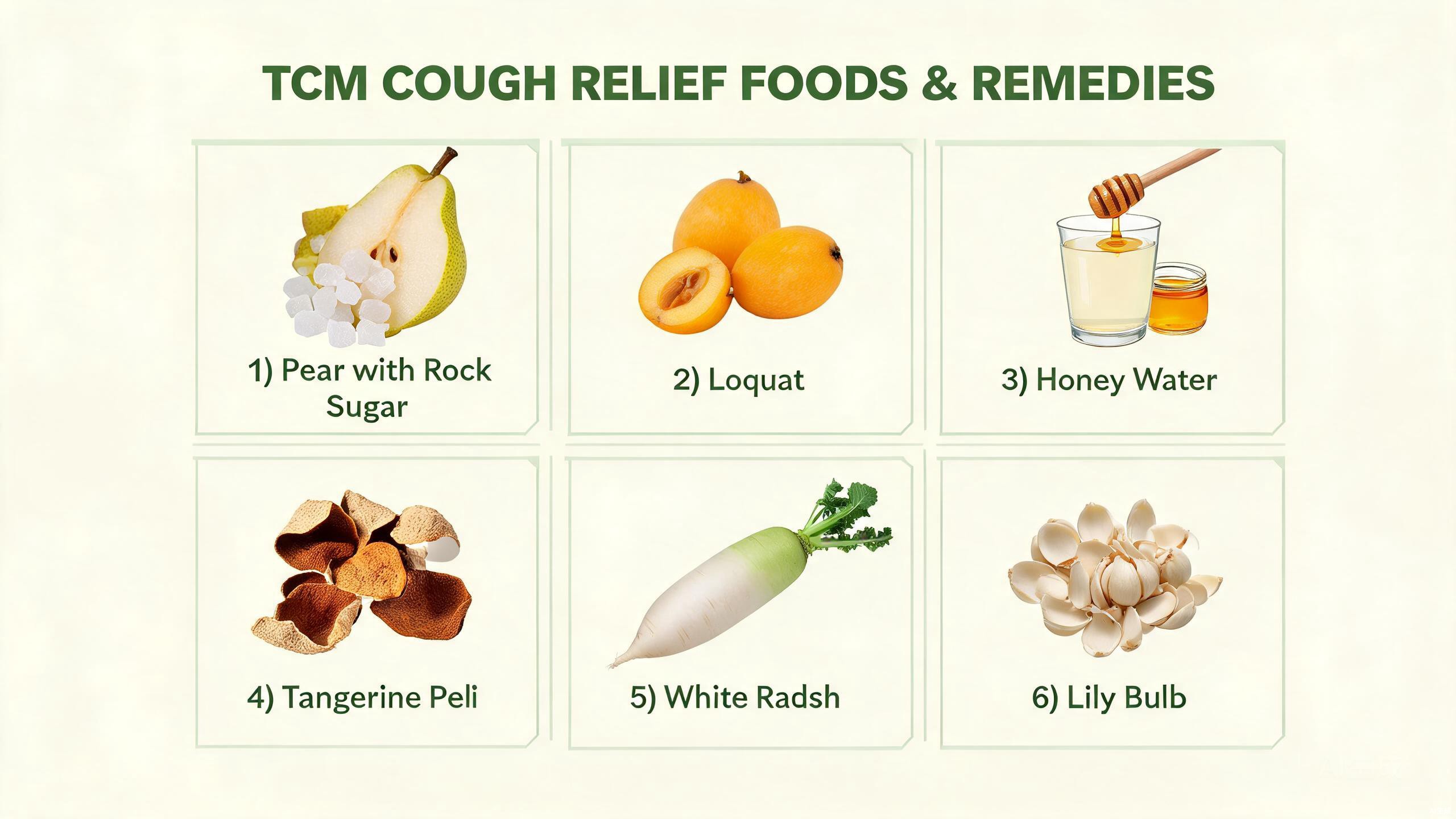
Key Takeaways
- TCM does not treat "a cough" as a single condition — it distinguishes between wind-cold, wind-heat, dry, and phlegm patterns, each calling for different food remedies.
- Five everyday foods — pear with rock sugar, ginger tea, tangerine peel, lily bulb, and radish — are traditionally used to support respiratory comfort for different cough types.
- Using the wrong remedy for your cough pattern may worsen symptoms: warming ginger is for cold coughs, cooling pear is for dry or heat coughs.
- These food remedies are not a substitute for medical care. A persistent cough should be evaluated by a healthcare provider.
- Always consult your healthcare provider before adding new herbs or foods to your routine, especially if you take medication or have a chronic condition.
This article is for educational purposes only and is not medical advice. The foods and practices described here are traditional wellness practices rooted in Chinese culture. They are not a substitute for professional medical care, diagnosis, or treatment. A cough can be a sign of a serious underlying condition, including infection, asthma, or other respiratory diseases. Do not rely on food remedies alone for a persistent, severe, or worsening cough. Never stop, adjust, or replace prescribed medication based on information in this article. If you are pregnant, nursing, or take medication, consult your healthcare provider before making dietary changes. These statements have not been evaluated by the FDA and are not intended to diagnose, treat, cure, or prevent any disease.
A cough is one of the most common reasons people reach for kitchen remedies. In almost every East Asian household, the first response to a cough is not a trip to the pharmacy — it is a pot of pear soup, a cup of ginger tea, or a handful of tangerine peel steeped in hot water. These traditions are so deeply woven into daily life that many people do not even think of them as "Traditional Chinese Medicine." They are simply what you do when someone in the family starts coughing.
But there is a sophistication to this tradition that is often missed. TCM does not treat every cough the same way. The most important principle in TCM cough care is pattern differentiation (辨证, bian zheng) — identifying the specific nature of the cough before choosing a remedy. A warming food given for a heat-type cough can make things worse, and vice versa. This article will help you understand the four main cough patterns in TCM and which traditional food remedy matches each one.
If you are new to TCM concepts, our introduction to Traditional Chinese Medicine provides helpful background before diving in.
How TCM Understands Coughs: The Four Patterns
In Western medicine, a cough is typically classified by its duration (acute, subacute, chronic) and its underlying cause (viral, bacterial, allergic, reflux, etc.). TCM takes a different approach. It looks at the qualities of the cough — the sound, the phlegm, the accompanying symptoms, and the body's overall thermal balance — to determine the "pattern" of imbalance. The Lung (肺, Fei) is always the primary organ involved in a cough, but the root cause may lie elsewhere.
TCM identifies four main cough patterns that are most relevant for home food remedies:
- Wind-Cold Cough (风寒咳嗽): The cough is dry or produces clear, watery phlegm. It comes with chills, mild fever, body aches, no sweat, a stuffy or runny nose with clear discharge, and a preference for warm drinks. The voice may sound "tight." This pattern is common in cold weather or after exposure to wind and cold. Warming foods are traditionally used.
- Wind-Heat Cough (风热咳嗽): The cough is loud and coarse, producing thick, yellow or sticky phlegm. It comes with a sore throat, fever, sweating, headache, and a feeling of heat. The mouth feels dry and the lips may be red. This pattern is common with viral respiratory infections. Cooling foods are traditionally used.
- Dry Cough (燥咳): The cough is dry, hacking, and persistent, with little or no phlegm. The throat feels dry and scratchy, and the cough often worsens at night or after talking. This pattern is common in autumn, in dry climates, or after a prolonged respiratory illness. Moistening foods are traditionally used.
- Phlegm Cough (痰咳): The cough produces significant amounts of phlegm — which may be white and watery (cold-phlegm) or yellow and thick (heat-phlegm). There is a feeling of chest fullness or oppression, and the cough may sound "rattling" or "bubbling." Phlegm-resolving foods are traditionally used, with warming or cooling choices depending on the phlegm type.
The Lung in TCM is called the "delicate organ" because it is the most externally exposed of all the Zang organs — it communicates directly with the outside air through the nose and throat. This makes it especially vulnerable to external pathogens like wind, cold, heat, and dryness. To learn more about how the Lung fits into the broader organ system, see our guide to Zang-Fu organs, and for the role of body fluids in respiratory health, our guide on qi, blood, and body fluids.
Five Food Remedies for Cough Support
The following five foods are among the most widely used kitchen remedies for coughs in East Asian households. Each is matched to a specific cough pattern. Getting the match right is essential — the same food that soothes one type of cough may worsen another. These are not medicines, and they are not a replacement for medical care.
1. Pear with Rock Sugar (冰糖雪梨, Bing Tang Xue Li)
TCM nature: Pear is sweet, slightly cold; rock sugar is sweet, neutral. Enters: Lung and Stomach channels.
Best for: Dry cough and wind-heat cough.
Pear with rock sugar is perhaps the most famous TCM cough remedy of all. The Asian pear (雪梨, snow pear) is classified in TCM as cooling and moistening — it is traditionally used to "clear lung heat," "moisten the lung," and "generate fluids." When a cough is dry, hacking, and accompanied by a scratchy throat, this sweet, soothing preparation is the classic choice. The rock sugar adds a gentle moistening sweetness and helps the pear's juices infuse into a syrupy broth. This remedy is specifically not appropriate for wind-cold coughs with chills and clear phlegm, as its cooling nature could worsen cold symptoms.
How to prepare: Wash one Asian pear (snow pear if available). Cut off the top third to create a "lid." Scoop out the core and seeds with a spoon to create a small hollow. Place 3 to 4 pieces of rock sugar (about 15 grams) inside the hollow. Replace the "lid." Place the pear upright in a small bowl and steam in a steamer for 30 to 40 minutes, until the pear is soft and the juices have formed a sweet syrup in the bowl. Eat the warm pear flesh and drink the syrup. For a simpler version, peel and cube the pear, simmer with rock sugar in water for 20 minutes, and drink as a warm sweet soup.
Caution: Pear is cooling. Avoid this remedy if your cough involves chills, clear watery phlegm, or cold symptoms. If you have weak, cold digestion or loose stools, consume in small amounts. Diabetics should consult their healthcare provider due to the sugar content.
2. Ginger Tea (姜茶, Jiang Cha)
TCM nature: Acrid, warm. Enters: Lung, Spleen, and Stomach channels.
Best for: Wind-cold cough.
Ginger is the go-to warming remedy in TCM. It is traditionally used to "warm the lung," "disperse cold," and "stop cough." When a cough comes with chills, body aches, clear nasal discharge, and a feeling of coldness, ginger tea is the traditional first response. The acrid, warm nature of ginger helps the body "release the exterior" — encouraging a light sweat that expels the wind-cold pathogen. Ginger is also valued for its ability to "warm the middle" and support digestion, which is why it pairs well with cold-weather illnesses that also cause nausea or poor appetite.
How to prepare: Slice 3 to 4 thin rounds of fresh ginger (about 1 tablespoon). Place in a small pot with 2 cups of water. Bring to a boil, then simmer for 5 to 10 minutes. Add a small amount of brown sugar or honey to taste (honey should only be added after the tea has cooled slightly, and must never be given to children under 1 year). Drink warm. For a stronger version, add 2 to 3 scallion whites (the white portion of green onions) during simmering — this is a classic combination for wind-cold patterns. Drink 2 to 3 cups per day at the onset of cold symptoms.
Caution: Ginger is warming. Avoid this remedy if your cough involves a sore throat, yellow phlegm, fever, or signs of heat. Ginger may interact with blood-thinning medications. If you take prescription medication, consult your healthcare provider. For more on safe tea practices, see our herbal tea safety guide.
3. Tangerine Peel (陈皮, Chen Pi)
TCM nature: Acrid, bitter, warm. Enters: Spleen and Lung channels.
Best for: Phlegm cough (especially cold-phlegm with white, watery secretions).
Aged tangerine peel is one of the most important food-as-medicine items in all of TCM. The Chinese name "chen pi" literally means "old peel" — the longer it ages, the more valued it becomes. TCM classifies it as warm, acrid, and bitter — a combination that is traditionally used to "resolve phlegm," "regulate qi," and "transform dampness." When a cough produces significant phlegm, especially the white, watery type associated with cold patterns, tangerine peel is the traditional remedy of choice. Its qi-regulating property also helps relieve the chest tightness and fullness that often accompany phlegm coughs. Tangerine peel is also widely used in cooking — it is a key ingredient in red braised dishes and Cantonese soups.
How to prepare: Place 1 piece of aged tangerine peel (about 3 to 5 grams) in a cup. Pour 8 oz of hot water (90°C) over it and steep for 5 to 8 minutes. The tea will be amber-colored with a distinctive citrusy, slightly bitter aroma. Drink warm. For a phlegm-resolving combination, add a small amount of fresh ginger and brown sugar. Tangerine peel can also be added to congee or soup during cooking — try adding a piece to chicken or pork rib soup for both flavor and traditional benefit.
Caution: Tangerine peel is warming and drying. It is less appropriate for dry coughs with no phlegm, where its drying nature could worsen throat irritation. If you have dry mouth and throat, use sparingly. Generally safe as a food and tea.
4. Lily Bulb (百合, Bai He)
TCM nature: Sweet, slightly cold. Enters: Lung and Heart channels.
Best for: Chronic dry cough (especially with lung yin deficiency).
Dried lily bulb is a gentle, nourishing food that is traditionally used to "moisten the lung" and "calm the mind." When a dry cough lingers for weeks or months after an acute illness has resolved, TCM often attributes this to "lung yin deficiency" — a state where the lung's moistening, cooling aspect has been depleted. The cough is dry, tickling, and worse at night, often accompanied by a dry mouth and throat. Lily bulb's sweet, slightly cold nature is perfectly suited to this pattern: it moistens without being heavy, and cools without being harsh. It is also traditionally used for insomnia and restlessness, since it enters the Heart channel — making it especially appropriate for nighttime coughs that disrupt sleep.
How to prepare: Soak 20 to 30 grams of dried lily bulb in warm water for 30 minutes to rehydrate. Simmer in water for 20 to 30 minutes until tender. For a lung-moistening sweet soup, combine rehydrated lily bulb with pear chunks, rock sugar, and water, and simmer for 20 minutes. Alternatively, add lily bulb to congee with a small amount of rock sugar for a gentle, nourishing breakfast. For a calming bedtime tea, simmer lily bulb with lotus seeds and a few goji berries.
Caution: Lily bulb is slightly cold and moistening. It is less appropriate for coughs with copious phlegm, especially the cold, watery type. If you have wind-cold symptoms, avoid lily bulb. Generally safe as a food for most people. Consult your healthcare provider if you take medication.
5. Radish (白萝卜, Bai Luo Bo)
TCM nature: Sweet, pungent, cool. Enters: Lung and Stomach channels.
Best for: Phlegm cough with heat signs (thick, yellow phlegm) and cough with digestive symptoms.
White radish (also called daikon) is one of the most versatile foods in TCM. It is traditionally used to "clear lung heat," "transform phlegm," and "move qi downward." When a cough produces thick, yellow phlegm — the heat-phlegm pattern — radish is a traditional food remedy that helps clear heat while resolving phlegm. Its qi-moving, downward-directing property also makes it valuable when a cough is accompanied by chest fullness, bloating, or digestive stagnation. In TCM, the Lung and the Large Intestine are paired organs, and radish's dual action on both respiratory and digestive systems reflects this connection. Radish soup with ginger is a traditional winter remedy in northern China.
How to prepare: Peel and cube half a white radish. Simmer with 2 slices of fresh ginger in 3 cups of water for 20 to 30 minutes, until the radish is translucent and tender. Season with a little salt. Drink the broth and eat the radish. For a sweeter version suitable for heat-phlegm coughs, simmer cubed radish with rock sugar and water for 20 minutes, and drink the sweet broth. Radish can also be grated raw and mixed with honey — let it sit for 30 minutes, then drink the resulting juice (a traditional remedy for sore throat with phlegm).
Caution: Radish is cooling and qi-moving. Avoid large amounts if you have cold, weak digestion or are experiencing diarrhea. Radish may reduce the effectiveness of certain supplements and herbs — if you take ginseng or other qi-tonifying herbs, avoid consuming radish at the same time. Consult your healthcare provider if you take medication.
Comparison of the Five Cough Remedies
| Food | TCM Nature | Best Cough Pattern | Preparation | Typical Frequency |
|---|---|---|---|---|
| Pear with Rock Sugar (Bing Tang Xue Li) | Sweet, slightly cold | Dry cough, wind-heat cough | Steam pear with rock sugar | Once daily, 3–5 days |
| Ginger Tea (Jiang Cha) | Acrid, warm | Wind-cold cough | Simmer ginger slices in water | 2–3 cups daily at onset |
| Tangerine Peel (Chen Pi) | Acrid, bitter, warm | Phlegm cough (cold-phlegm) | Steep aged peel as tea | 1–2 cups daily |
| Lily Bulb (Bai He) | Sweet, slightly cold | Chronic dry cough (yin deficiency) | Simmer in soup or porridge | Once daily, ongoing |
| Radish (Bai Luo Bo) | Sweet, pungent, cool | Phlegm cough with heat signs | Simmer as soup with ginger | Once daily, 3–5 days |
How to Make Steamed Pear with Rock Sugar
Among the five remedies, steamed pear with rock sugar is the one most readers ask about. Here is the traditional step-by-step method for making it at home.
- Choose the right pear. Use an Asian pear (snow pear / 雪梨) if available — it is rounder, juicier, and has a more cooling nature than Western pears. If unavailable, a firm Bosc pear works as a substitute.
- Wash and prepare. Wash the pear thoroughly. Cut off the top third to create a "lid." Set the lid aside.
- Create a hollow. Using a small spoon or melon baller, carefully scoop out the core and seeds, creating a small hollow in the center of the pear. Be careful not to pierce through the bottom.
- Add rock sugar. Place 3 to 4 pieces of yellow rock sugar (about 15 grams) into the hollow. You can also add a few Sichuan fagara peppercorns (1 to 2) for a traditional variation that enhances the warming aspect, or a few goji berries for added nourishment.
- Replace the lid. Put the "lid" back on top of the pear, covering the hollow.
- Steam. Place the pear upright in a small heatproof bowl (to catch the juices). Place the bowl in a steamer and steam over medium heat for 30 to 40 minutes, until the pear is soft and the juices have formed a sweet syrup in the bowl.
- Serve warm. Carefully remove from the steamer. Eat the warm, softened pear flesh and drink the syrup from the bowl. Best consumed warm, once per day.
For a more powerful lung-moistening effect, add 1 tablespoon of dried lily bulb (rehydrated) and a few goji berries into the hollow along with the rock sugar before steaming. This combines two of the five remedies in one soothing bowl — ideal for chronic dry coughs.
When to See a Doctor — This Is Not a Substitute for Medical Care
This section is intentionally prominent because it is the most important part of this article. TCM food remedies for coughs are complementary wellness traditions, not medical treatments. A cough can be a symptom of conditions ranging from a common cold to pneumonia, asthma, acid reflux, or even lung cancer. Food remedies cannot diagnose or treat these conditions. You should see a healthcare provider promptly if you experience any of the following:
- A cough lasting more than 2 to 3 weeks, or that keeps returning
- Coughing up blood or rust-colored phlegm
- Large amounts of thick, green, or foul-smelling phlegm
- High fever (above 39°C / 102°F), chills, or night sweats
- Chest pain, shortness of breath, wheezing, or difficulty breathing
- Unexplained weight loss, fatigue, or loss of appetite accompanying the cough
- A cough in an infant under 3 months, an elderly person, or someone with a compromised immune system
- Any cough that is severe, rapidly worsening, or causing concern
If you are currently taking medication — especially blood thinners, diabetes medication, or respiratory prescriptions — speak with your doctor before adding any new herbs, teas, or foods to your routine. Interactions are possible, and your doctor can help you make informed choices. For more everyday kitchen wisdom, see our guide to everyday TCM kitchen remedies.
The Bottom Line
Traditional Chinese Medicine offers a nuanced, pattern-based approach to cough support that has guided East Asian households for centuries. The key insight is that not all coughs are the same — a warming ginger tea that soothes a wind-cold cough can worsen a wind-heat cough, and a cooling pear remedy that helps a dry cough is inappropriate for a cold-phlegm cough. Understanding which pattern you have is the first and most important step.
The five foods in this guide — pear with rock sugar, ginger tea, tangerine peel, lily bulb, and radish — are gentle, accessible kitchen remedies that can offer comfort and support during common coughs. But they are traditions, not treatments. A persistent, severe, or worsening cough requires medical evaluation. Use these traditional practices only as complementary wellness habits, with your healthcare provider's knowledge and guidance. For more on the foundational concepts behind TCM's approach to health, explore our guides on yin and yang and the role of qi, blood, and body fluids.
This article shares traditional wellness practices for educational purposes only. It is not a substitute for medical advice, diagnosis, or treatment. The foods described here are not intended to treat, cure, or prevent any disease. A cough can be a sign of a serious medical condition. Do not rely on food remedies alone for a persistent, severe, or worsening cough — seek medical evaluation. If you are pregnant, nursing, or take medication, consult your healthcare provider before making dietary changes. These statements have not been evaluated by the FDA. Never stop or adjust prescribed medication without your doctor's explicit guidance.