Key Takeaways
- In TCM, spring corresponds to the Liver organ system and the Wood element — a time of upward growth and renewal, making it the ideal season to support liver wellness.
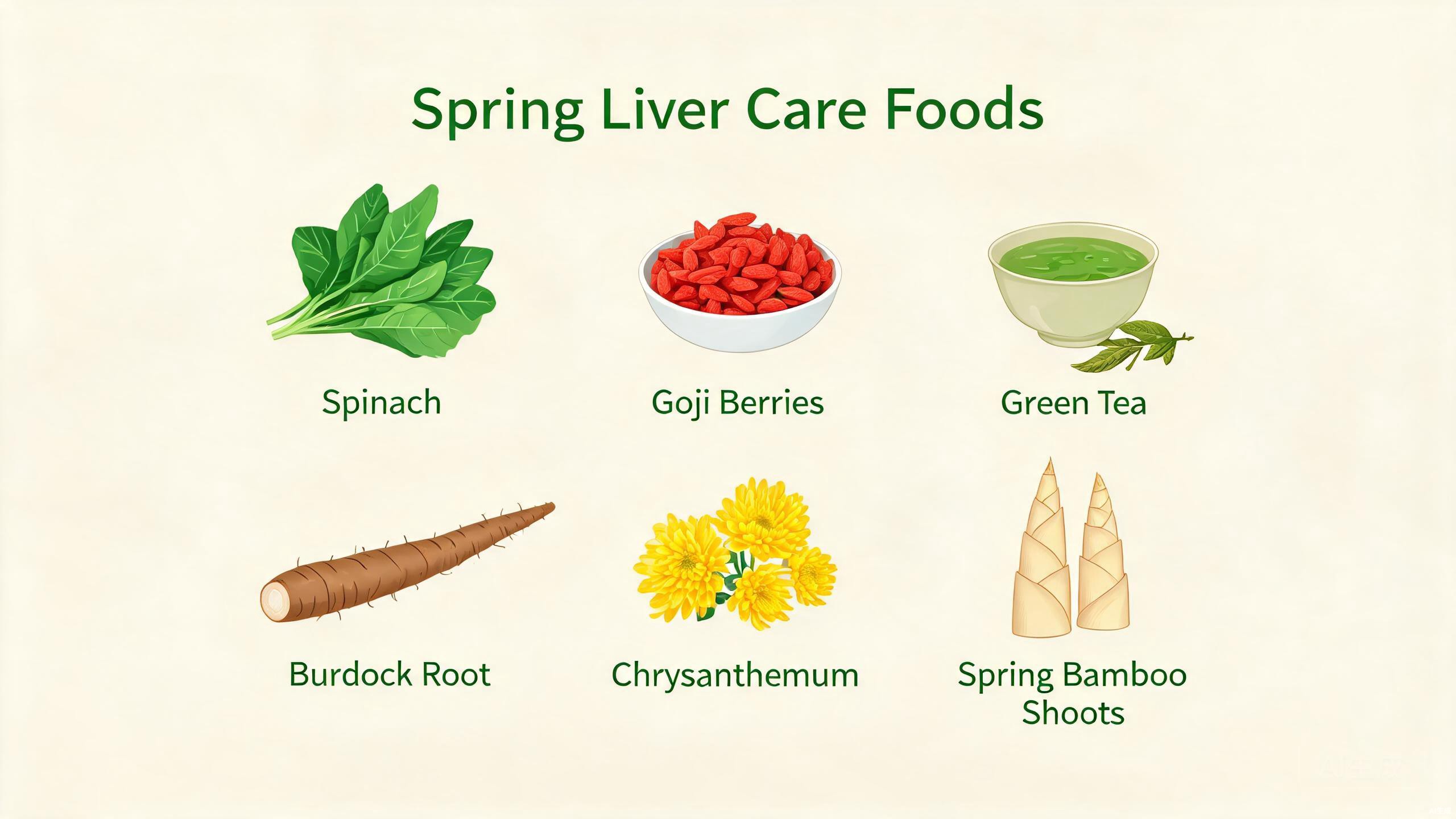
- Five everyday foods — spinach, goji berries, chrysanthemum, bean sprouts, and shepherd's purse — are traditionally used in spring to nourish the liver.
- Each food has a distinct TCM profile: some cool liver heat, some nourish liver blood and yin, and others promote the smooth flow of liver qi.
- Spring wellness is not just about food — emotional balance, outdoor movement, and adjusting sleep patterns all play a role in the seasonal approach.
- These are traditional wellness practices, not medical treatments. Always consult your healthcare provider before making dietary changes, especially if you take medication.
This article is for educational purposes only and is not medical advice. The foods and practices described here are traditional wellness practices rooted in Chinese culture. They are not a substitute for professional medical care, diagnosis, or treatment. Never stop, adjust, or replace prescribed medication based on information in this article. If you have a liver condition, are pregnant, nursing, or take medication, consult your healthcare provider before making dietary changes. Some foods and herbs may interact with medications — always inform your doctor about everything you consume. These statements have not been evaluated by the FDA and are not intended to diagnose, treat, cure, or prevent any disease.
When the first green shoots push through the soil and the days grow longer, something ancient stirs in the body — or at least, that is how Traditional Chinese Medicine has understood spring for thousands of years. In the TCM framework, each season is paired with an organ system and an element, and spring belongs to the Liver (肝, Gan) and the Wood element (木, Mu). Just as trees and plants burst upward with new vitality, the Liver in TCM is all about growth, movement, and the smooth, free-flowing circulation of qi (life energy) throughout the body.
This is why, in Chinese households, the arrival of spring is traditionally accompanied by a shift in the kitchen. Cooling, green, and slightly bitter foods make their way onto the table. Teas are brewed to clear heat. The emphasis is on foods that are said to "nourish the liver" (养肝, yang gan) and encourage the smooth flow of liver qi after the stillness of winter.
If you are new to these concepts, our introduction to Traditional Chinese Medicine is a helpful starting point before diving into seasonal eating.
How TCM Connects Spring With the Liver
The connection between spring and the Liver comes from the Five Elements theory (五行, Wu Xing), one of the foundational frameworks of TCM. In this system, the five elements — Wood, Fire, Earth, Metal, and Water — each correspond to a season, an organ pair, an emotion, a taste, and a color. Spring is the season of Wood, and the Liver and Gallbladder are the organs of the Wood element.
To understand why this matters for food choices, it helps to know what the Liver does in TCM — which is quite different from the Western medical concept of the liver as a detoxifying organ. In TCM, the Liver has three key functions:
- Ensuring the smooth flow of qi. The Liver is responsible for keeping energy moving freely throughout the body. When liver qi flows well, emotions are balanced, digestion is smooth, and the body feels energized. When it stagnates — often due to stress, frustration, or anger — symptoms like irritability, tightness in the chest, digestive upset, and menstrual discomfort can arise.
- Storing and regulating blood. The Liver is said to "store blood" and release it as needed for physical activity and rest. This function is closely tied to menstrual health, eye health, and the nourishment of tendons and nails.
- Governing the tendons and opening into the eyes. In TCM, the Liver's health is reflected in the flexibility of tendons and the brightness of the eyes. Dry, tired, or bloodshot eyes are traditionally seen as a sign that the Liver needs nourishment.
Spring is the season when Liver energy is at its most active and expansive. This is a double-edged sword: it is the best time to support and strengthen the Liver, but it is also when Liver imbalances are most likely to flare up. Many people notice increased irritability, allergies, headaches, or eye strain in spring — all of which TCM would associate with liver qi stagnation or liver heat.
To learn more about how the Liver fits into the broader organ system, see our guide to Zang-Fu organs, and for the bigger picture of seasonal harmony, our Five Elements guide goes into depth.
Five Spring Liver Foods in TCM
The following five foods are spring staples in East Asian kitchens and tea cabinets. Each has a distinct role in TCM tradition — some cool, some nourish, some move. Together, they represent a balanced approach to seasonal eating. They are not medicines, and they are not a replacement for any prescribed treatment.
1. Spinach (菠菜, Bo Cai)
TCM nature: Sweet, cooling. Enters: Liver, Stomach, and Large Intestine channels.
Spinach is one of the first green vegetables of spring, and in TCM it is prized for its ability to nourish liver blood and moisten the body. Because the Liver stores blood, foods that build blood are considered directly supportive of liver health. Spinach is also classified as cooling, which helps balance the upward, expansive energy of spring. It is traditionally recommended for signs of blood deficiency such as dry skin, pale complexion, brittle nails, and dizziness — all of which TCM links to the Liver.
How to prepare: Blanch fresh spinach in boiling water for 30 seconds, drain, then dress with sesame oil, a splash of light soy sauce, and toasted sesame seeds. This simple cold dish (凉拌菠菜) is a classic spring side dish in Chinese homes. Alternatively, add spinach to soups or stir-fry briefly with garlic. Avoid overcooking, which diminishes both nutrients and TCM therapeutic qualities.
Caution: Spinach is high in oxalates. If you have a history of kidney stones or calcium oxalate concerns, consult your healthcare provider. Brief blanching and discarding the cooking water reduces oxalate content. Spinach is generally safe as a regular vegetable for most people.
2. Goji Berries (枸杞, Gou Qi)
TCM nature: Sweet, neutral. Enters: Liver and Kidney channels.
Goji berries (also called wolfberries) are perhaps the most iconic liver-nourishing food in all of TCM. They are traditionally said to "nourish liver blood" and "enrich kidney yin," making them a go-to daily tonic for eye health, since the Liver opens into the eyes. In spring, when eye strain, allergies, and screen fatigue tend to intensify, goji berries are a gentle, sweet addition to teas, soups, and porridge. Their neutral temperature means they are suitable for most body types.
How to prepare: Add 1 tablespoon of dried goji berries to a cup of hot water and steep for 5 to 10 minutes. They pair especially well with chrysanthemum for a classic liver-supporting tea. You can also add a small handful to congee (rice porridge), chicken soup, or even sprinkle them over oatmeal. The berries soften as they soak and can be eaten along with the tea.
Caution: Goji berries may interact with blood-thinning medications such as warfarin. If you take any prescription medication, consult your healthcare provider before consuming goji berries regularly. See our herbal tea safety guide for more on safe consumption practices.
3. Chrysanthemum (菊花, Ju Hua)
TCM nature: Sweet, bitter, slightly cold. Enters: Lung and Liver channels.
Chrysanthemum is the quintessential spring and summer flower tea in TCM. It is traditionally used to "clear liver heat" and "brighten the eyes." When liver heat rises — often experienced as red, dry, or itchy eyes, headaches, irritability, or a flushed face — chrysanthemum is the cooling, calming brew of choice. Its slight bitterness is associated in TCM with a downward, clearing action that helps redirect energy that has risen too far.
How to prepare: Steep 5 to 8 dried chrysanthemum flowers in 8 oz of hot water (about 90°C) for 5 minutes. The resulting tea is pale yellow with a light, floral flavor. For a liver-nourishing combination, add a small handful of goji berries to the cup. Drink 1 to 2 cups per day. See our complete chrysanthemum tea guide for sourcing, brewing, and pairing details.
Caution: Because chrysanthemum is cooling, it is best avoided if you have a cold with chills, or if you generally run cold and have weak digestion. Consult your healthcare provider if you take blood-thinning medications, as chrysanthemum may have mild blood-thinning effects.
4. Bean Sprouts (豆芽, Dou Ya)
TCM nature: Sweet, slightly cold. Enters: Spleen, Stomach, and Liver channels.
Bean sprouts — whether mung bean sprouts or soybean sprouts — are a natural symbol of spring. They are, quite literally, seeds germinating and pushing upward, embodying the Wood element's energy of growth and expansion. In TCM, bean sprouts are valued for their ability to "promote the smooth flow of liver qi" and "clear heat." Their crisp, watery nature also makes them a gentle cooling food for the digestive system. After a winter of heavier, warming foods, sprouts are a light, refreshing way to transition the diet.
How to prepare: Stir-fry bean sprouts quickly over high heat for 1 to 2 minutes with a little oil, ginger, and a pinch of salt. They can also be added to soups at the very end of cooking, or blanched and served cold with a vinegar dressing. The key is to cook them briefly to preserve their crispness and cooling nature. Mung bean sprouts are more delicate; soybean sprouts are sturdier and better for soups.
Caution: Bean sprouts should always be thoroughly washed and cooked, as raw sprouts can carry bacteria. If you have a weakened immune system, ensure sprouts are fully cooked. They are otherwise a safe and common vegetable.
5. Shepherd's Purse (荠菜, Ji Cai)
TCM nature: Sweet, cooling. Enters: Liver, Stomach, and Bladder channels.
Shepherd's purse is a wild green that appears in fields and gardens across East Asia in early spring. It is one of the most beloved spring-foraged foods in Chinese tradition. In TCM, it is classified as cooling and is traditionally used to "cool the blood," "clear liver heat," and "stop bleeding." Its gentle, slightly sweet flavor makes it a versatile ingredient in dumplings, soups, and stir-fries. For spring, when liver heat can manifest as nosebleeds, bloodshot eyes, or irritability, shepherd's purse is a traditional food choice that embodies the season.
How to prepare: Blanch fresh shepherd's purse briefly, then chop and use as a filling for pork dumplings (a spring tradition in many Chinese families), or add to egg drop soup. It can also be stir-fried with a little garlic. Dried shepherd's purse is available year-round from Asian grocers and can be rehydrated for soups. A simple shepherd's purse and tofu soup is a light, nourishing spring dish.
Caution: Because shepherd's purse is cooling and has traditional associations with stopping bleeding, it should be avoided during pregnancy without consulting a healthcare provider. If you take blood-thinning medication, consult your doctor. When foraging wild shepherd's purse, ensure correct identification and avoid areas treated with pesticides.
Comparison of the Five Spring Liver Foods
| Food | TCM Nature | Traditional Use | Preparation | Typical Frequency |
|---|---|---|---|---|
| Spinach (Bo Cai) | Sweet, cooling | Nourish liver blood, moisten body | Blanch, cold dish, or stir-fry | Several times weekly |
| Goji Berries (Gou Qi) | Sweet, neutral | Nourish liver blood, brighten eyes | Steep in tea, add to soup or porridge | Daily, 1 tablespoon |
| Chrysanthemum (Ju Hua) | Sweet, bitter, slightly cold | Clear liver heat, brighten eyes | Steep flowers as tea | 1–2 cups daily |
| Bean Sprouts (Dou Ya) | Sweet, slightly cold | Promote liver qi flow, clear heat | Quick stir-fry or add to soup | Several times weekly |
| Shepherd's Purse (Ji Cai) | Sweet, cooling | Cool blood, clear liver heat | Dumpling filling, soup, stir-fry | Several times weekly in season |
How to Build a Spring Liver-Nourishing Day
Rather than thinking of these foods in isolation, it helps to imagine how they might fit into a typical spring day. Here is what a simple, TCM-inspired spring eating pattern could look like:
- Morning: Start the day with a cup of chrysanthemum and goji tea. The chrysanthemum clears overnight liver heat, while the goji berries gently nourish. A bowl of millet or oat porridge with a few goji berries stirred in is a warm, easy-to-digest breakfast.
- Lunch: A plate that includes a green vegetable — stir-fried spinach or blanched shepherd's purse — alongside a source of protein and a whole grain. Quick stir-fried bean sprouts make a light, refreshing side.
- Afternoon: If you feel eye strain or a slight headache from screen work, another cup of chrysanthemum tea can offer a gentle, calming pause. This is a traditional remedy for "computer eyes" in East Asian offices.
- Dinner: A light shepherd's purse and tofu soup, or a bowl of congee with goji berries. The emphasis in the evening is on warm, easy-to-digest foods that do not overburden the Liver during its recovery hours.
The TCM clock associates the hours between 1 AM and 3 AM with Liver energy. Going to sleep before this window allows the Liver to perform its traditional functions of storing and regulating blood. If you frequently wake between 1 and 3 AM, TCM would consider this a possible sign of liver qi stagnation — a reason to pay extra attention to spring wellness habits.
Spring Lifestyle Tips From a TCM Perspective
Food is only one part of the seasonal equation. TCM has always emphasized that lifestyle habits must align with the season for wellness practices to be effective. Spring is a time of expansion, movement, and renewal — and the following habits reflect that:
- Rise earlier and move outdoors. Classical TCM texts advise waking earlier in spring and taking walks in nature to absorb the rising yang energy of the season. The Wood element thrives on movement — tai chi, qigong, hiking, and stretching are all excellent spring activities. The key is gentle, consistent movement rather than intense exertion.
- Wear layers and protect from wind. Spring in TCM is associated with the "Wind" pathogen — the idea that sudden weather changes and drafts can disrupt the body's defenses. The neck and upper back are considered especially vulnerable. A light scarf during unpredictable spring weather is a simple, traditional protective habit.
- Support emotional flow. Because the Liver governs the smooth flow of qi and is most affected by anger, frustration, and suppressed emotions, spring is an ideal time to address emotional health. Practices like mindful breathing, journaling, and gentle movement help qi circulate. See our TCM emotional wellness guide and our meditation guide for practical starting points.
- Eat lighter and greener. After a winter of heavier, warming foods, spring is the time to lighten the diet. More greens, sprouts, and lightly cooked vegetables. Less heavy, greasy, or overly salty food. This transition mirrors the natural world — the body, like the land, is thawing and waking up.
- Support sleep with a foot soak. A warm ginger foot soak before bed is a traditional way to encourage deep, restful sleep — essential for the Liver's nighttime recovery functions. The warmth draws energy downward, counterbalancing spring's upward, expansive tendency.
When to See a Doctor
The foods and practices in this article are complementary wellness traditions, not medical treatments. You should see a healthcare provider if you experience any of the following:
- Persistent fatigue, jaundice (yellowing of skin or eyes), or abdominal pain — these may indicate a medical liver condition requiring diagnosis and treatment
- Severe or persistent headaches, vision changes, or dizziness
- Unexplained bleeding, bruising, or nosebleeds that do not stop
- Signs of allergic reaction to any food, including rash, swelling, or difficulty breathing
- Any new, persistent, or worsening symptoms
If you are currently taking medication — especially blood thinners, blood pressure medication, or liver-related prescriptions — speak with your doctor before adding any new herbs, teas, or foods to your routine. Interactions are possible, and your doctor can help you make informed choices.
The Bottom Line
Spring is the season of the Liver in Traditional Chinese Medicine — a time of growth, renewal, and upward energy. By incorporating simple, seasonal foods like spinach, goji berries, chrysanthemum, bean sprouts, and shepherd's purse into your daily meals, you are participating in a tradition that stretches back thousands of years. These foods nourish liver blood, clear liver heat, and encourage the smooth flow of qi that the Liver needs to thrive.
But they are traditions — not treatments, and not a replacement for medical care. Paired with outdoor movement, emotional balance, restful sleep, and a lighter diet, these spring foods form a whole-person approach to seasonal wellness. For more everyday kitchen wisdom, explore our guide to everyday TCM kitchen remedies. And to understand the foundational concepts behind seasonal eating, our guides on yin and yang and the role of qi, blood, and body fluids provide essential context.
This article shares traditional wellness practices for educational purposes only. It is not a substitute for medical advice, diagnosis, or treatment. The foods described here are not intended to treat, cure, or prevent any disease. If you have a liver condition, are pregnant or nursing, or take medication, consult your healthcare provider before making dietary changes. These statements have not been evaluated by the FDA. Never stop or adjust prescribed medication without your doctor's explicit guidance.