Key Takeaways
- TCM divides colds into two main types — wind-cold and wind-heat — and matching the remedy to the type is the core principle.
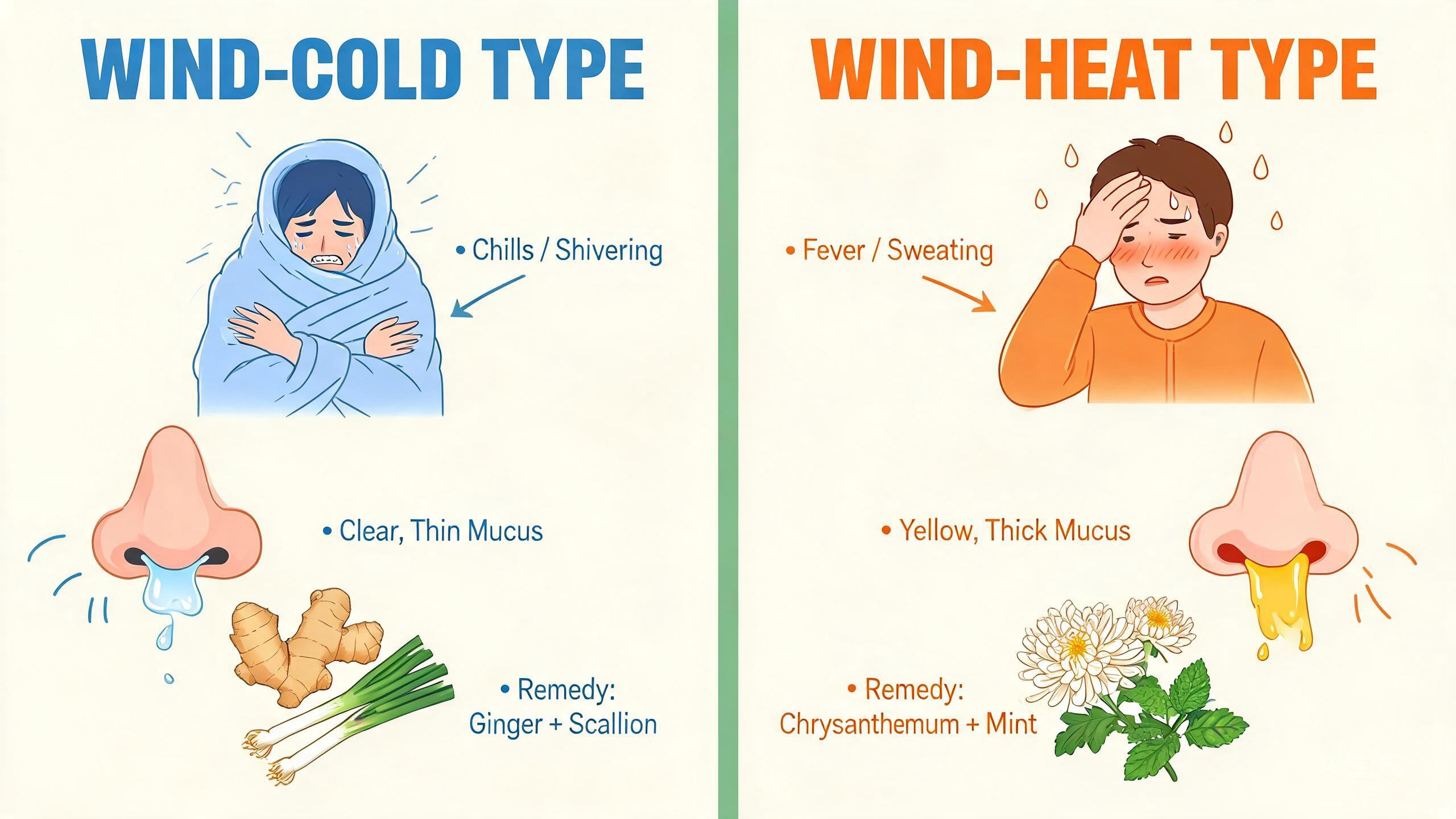
- Wind-cold features chills, body aches, clear mucus, and no sweat; warming remedies like ginger and scallion tea are traditionally used.
- Wind-heat features fever, sore throat, yellow mucus, and thirst; cooling remedies like chrysanthemum and mint tea are traditionally used.
- Prevention centers on nourishing the upright and avoiding pathogens — strong digestion, rest, and astragalus may support normal immune resilience.
- Recovery favors gentle, warming, easily digested foods — congee, bone broth, and pear soup — rather than heavy meals.
This article is for wellness education only and is not medical advice, diagnosis, or treatment. Colds and flu can sometimes be serious. The practices described are complementary wellness approaches, not a replacement for professional care. If you have a high fever, difficulty breathing, or worsening symptoms, consult your healthcare provider. Read our full disclaimer →
The common cold and flu are among the most frequent reasons people seek natural support. Yet many reach for the same remedy regardless of how the illness feels — and are surprised when it doesn't help. Traditional Chinese Medicine (TCM) takes a different view: not every cold is the same, and the right remedy depends on the pattern.
In TCM, colds and flu are caused by an external pathogen called wind, which often combines with either cold or heat. The result is two main types — wind-cold and wind-heat — that need nearly opposite care. Warming ginger tea soothes a wind-cold, for example, but can worsen a wind-heat. This guide explains how to tell the two apart, the foods and remedies traditionally matched to each, how TCM approaches prevention, and how to eat for a smooth recovery.
Wind-Cold Type (Wind-Cold)
Best recognized by: pronounced chills, body aches, clear watery mucus, and an absence of sweat.
Wind-cold usually appears after exposure to cold, wind, or a draft — a chilly commute, an over-air-conditioned room, or getting caught in the rain. The cold constricts the body's surface, trapping the pathogen. The classic picture is feeling cold and achy with a stiff neck, wanting to wrap up warm, and producing clear, runny mucus.
Key symptoms: strong chills with a mild fever, no sweating, body aches and a stiff neck, sneezing, clear watery nasal discharge, little or no thirst (or a preference for warm drinks), and a pale complexion.
Tongue signs: a thin white coating.
Recommended foods and remedies: the goal is to warm the body and encourage a light sweat to release the pathogen.
- Ginger tea — fresh ginger simmered with a little brown sugar is the classic warming brew. See our ginger tea guide for brewing details.
- Scallion tea — the white parts of 2 to 3 green onions (cong bai) boiled briefly with a few ginger slices; traditionally used to open the surface and release wind-cold.
- Ginger and date tea — a gentler warming option; see our ginger and date tea for cold recovery.
- Ginger foot soak — soaking the feet in warm ginger water draws cold out from the surface. Learn how in our ginger foot soak guide.
Acupressure and warmth: warm the back of the neck and upper back. Fengchi (GB20) at the base of the skull and Dazhui (GV14) just below the seventh neck vertebra are traditionally used to release wind. For wind-cold, gentle warming with moxa over these points is a classic practice — see our moxa for cold guide. (Note: a related acupressure approach for respiratory symptoms is covered in our acupressure for allergies guide.)
Wind-Heat Type (Wind-Heat)
Best recognized by: a sore or scratchy throat (often the first sign), fever with little chill, and yellow or thick mucus.
Wind-heat is more common in warm seasons or when a wind-cold lingers and "turns to heat." Here the pathogen carries heat, so the body responds with fever, thirst, and inflamed, sore tissues. The throat is usually the first and most bothered area. The strategy flips: instead of warming, you cool and clear heat.
Key symptoms: a high fever with little or no chill, a sore or scratchy throat (often the earliest sign), yellow or thick mucus, sweating, thirst, headache, and a red face.
Tongue signs: a red tongue tip, often with a yellow coating.
Recommended foods and remedies: the goal is to cool the body and soothe the throat.
- Chrysanthemum tea — a cooling flower tea traditionally used to clear heat; see our chrysanthemum tea guide.
- Mint tea (Bo He) — cooling and aromatic, traditionally used to release wind-heat and ease a sore throat. Steep fresh or dried mint for 5 minutes.
- Pear — cooling and moistening; steamed pear with a little rock sugar is a traditional way to soothe a heat-dry throat and cough.
- Plenty of warm (not hot or iced) water to support the body's clearing of heat.
Avoid warming ginger, cinnamon, and heavy tonics during a wind-heat cold — they can add fuel to the heat. Equally, avoid cooling chrysanthemum and mint during a wind-cold, which can deepen the chill. When unsure, mild warm water and rest are the safest middle ground until the pattern is clear.
Acupressure: Dazhui (GV14) to help clear heat, Quchi (LI11) at the outer elbow crease (a classic heat-clearing point), and Shaoshang (LU11) at the thumb base for a very sore throat. Gentle pressure for 1 to 2 minutes per point.
TCM Prevention Strategies: Nourish the Upright, Avoid Pathogens
TCM prevention rests on a simple principle: when upright qi is strong, pathogens cannot easily enter. Rather than fighting bugs after the fact, TCM focuses on keeping the body's defenses resilient and limiting exposure.
- Strengthen the Spleen and Stomach. Digestion is the source of upright qi. Favor warm, cooked, regular meals over cold, raw, or irregular eating. Congee and soups are ideal in cold season.
- Use supportive herbs in season. Astragalus (Huang Qi) is the classic herb for supporting normal immune resilience during cold season — see our astragalus tea guide and our immune-boosting soup. (Best used preventively, not during an active wind-heat cold.)
- Protect the back of the neck. Wind is said to enter at the base of the skull. A scarf in cold, windy, or over-air-conditioned weather is simple prevention.
- Rest before exhaustion. Many colds arrive after a period of overwork. Sleep before 11 p.m. and avoid pushing through fatigue.
- Match food to the season. Warming foods in winter; lighter, slightly cooling foods in summer. Avoid sweating heavily then exposing yourself to cold wind.
Recovery Foods: Gentle and Rebuilding
As symptoms ease, the body is still vulnerable. Recovery is not the time for a heavy meal — it's the time for soft, warm, easily digested foods that rebuild without burdening the Spleen.
- Congee (rice porridge). The cornerstone of TCM recovery food: warm, gentle on digestion, and easy to absorb. Add a little ginger or scallion for wind-cold recovery, or pear for wind-heat recovery. See our congee guide.
- Bone broth. Slow-simmered broth is traditionally used to nourish qi, blood, and kidney essence after illness. See our bone broth in TCM guide.
- Pear soup. Especially after a wind-heat cold with a lingering dry cough; pear moistens the lungs and clears residual heat. Simmer sliced pear with a little rock sugar.
Avoid greasy, very sweet, cold, or raw foods during recovery, and reintroduce normal food gradually over a few days.
TCM Remedies Timeline
Matching your practice to the stage of the illness helps you respond at the right time. The timeline below summarizes the traditional focus at each stage.
| Stage | Focus | Traditional Practice | Recovery Foods |
|---|---|---|---|
| Before illness (prevention) | Nourish upright qi | Astragalus tea, immune-boosting soup; warm cooked meals; rest; protect the neck | Warm soups, congee, seasonal eating |
| First 24 hours (onset) | Release the pathogen | Wind-cold: ginger/scallion tea, foot soak, moxa. Wind-heat: chrysanthemum/mint tea. Rest; encourage a light sweat only for wind-cold. | Light warm broth, plain congee |
| Days 2–3 (peak) | Match the type | Continue the matched tea; acupressure (GB20, GV14 for wind-cold; LI11, LU11 for wind-heat); rest and fluids | Congee, pear (wind-heat), ginger congee (wind-cold) |
| Days 4–5 (recovery) | Nourish and rebuild | Ease off specific teas; gentle movement; protect from wind; resume prevention habits | Congee, bone broth, pear soup; avoid heavy foods |
| After recovery | Rebuild reserves | Astragalus tea (if no active heat), bone broth; restore normal sleep and diet | Varied warm cooked meals |
When to See a Doctor
TCM practices are complementary and supportive, not a substitute for medical care. Colds and flu can sometimes become serious. Seek prompt medical attention if you experience any of the following:
- A high fever (above 39°C / 102°F) lasting more than three days.
- Difficulty breathing, shortness of breath, wheezing, or chest pain.
- A severe headache with a stiff neck, or sensitivity to light.
- Symptoms that improve and then suddenly worsen (a possible sign of secondary infection).
- Inability to keep fluids down, or signs of dehydration.
- You are in a higher-risk group — elderly, an infant, pregnant, or living with a chronic illness — or flu is circulating widely in your area.
Always keep your healthcare provider informed about any herbs or remedies you use alongside conventional care.
Frequently Asked Questions
Can TCM cure a cold?
TCM does not claim to cure a cold. Colds are usually viral and self-limiting. TCM practices are traditionally used to support the body's response, ease discomfort, and support recovery by matching remedies to the wind-cold or wind-heat pattern. They are complementary wellness approaches, not a replacement for medical care.
What is the best TCM tea for a cold?
There is no single best tea, because it depends on the type. For wind-cold, marked by chills, clear mucus, and no sweat, warming ginger tea with brown sugar or scallion tea is traditional. For wind-heat, marked by fever, sore throat, and yellow mucus, cooling chrysanthemum or mint tea is traditional. Using ginger for a wind-heat cold can worsen it, so matching the remedy to the pattern matters.
How does TCM prevent flu?
TCM prevention rests on nourishing the upright qi and avoiding pathogens. This means strengthening digestion with warm cooked food, resting before exhaustion, protecting the back of the neck from wind, and using supportive herbs like astragalus tea during cold season. These practices may support normal immune resilience.
Can I take TCM remedies with cold medicine?
Some herbs may interact with over-the-counter or prescription cold medication. If you take decongestants, pain relievers, or other drugs, consult your healthcare provider or pharmacist before adding herbal teas or new remedies, and keep your care team informed about everything you use.
The Bottom Line
The single most useful idea in TCM cold and flu care is to match the remedy to the type. Wind-cold wants warming — ginger, scallion, warmth, foot soaks, and moxa. Wind-heat wants cooling — chrysanthemum, mint, and pear. Getting this match right is often the difference between a remedy that helps and one that worsens things. For prevention, nourish the upright with warm food, rest, and astragalus in season, and protect the back of your neck from wind. For recovery, go gentle — congee and bone broth rebuild without burdening a still-tender digestion. And always seek medical care for high fever, breathing trouble, or symptoms that worsen instead of improving. With these principles, simple kitchen remedies and daily habits become a thoughtful, pattern-based approach to staying well through cold season.
This article is for educational and informational purposes only and is not a substitute for professional medical advice, diagnosis, or treatment. These statements have not been evaluated by the FDA. Always consult a qualified healthcare provider before beginning any new wellness practice, especially if you are pregnant, nursing, taking medication, or have a medical condition. Read our full disclaimer →