Key Takeaways
- TCM teaches that men's autumn wellness centers on kidney essence (kidney jing) and kidney yang, while women's centers on blood and the liver.
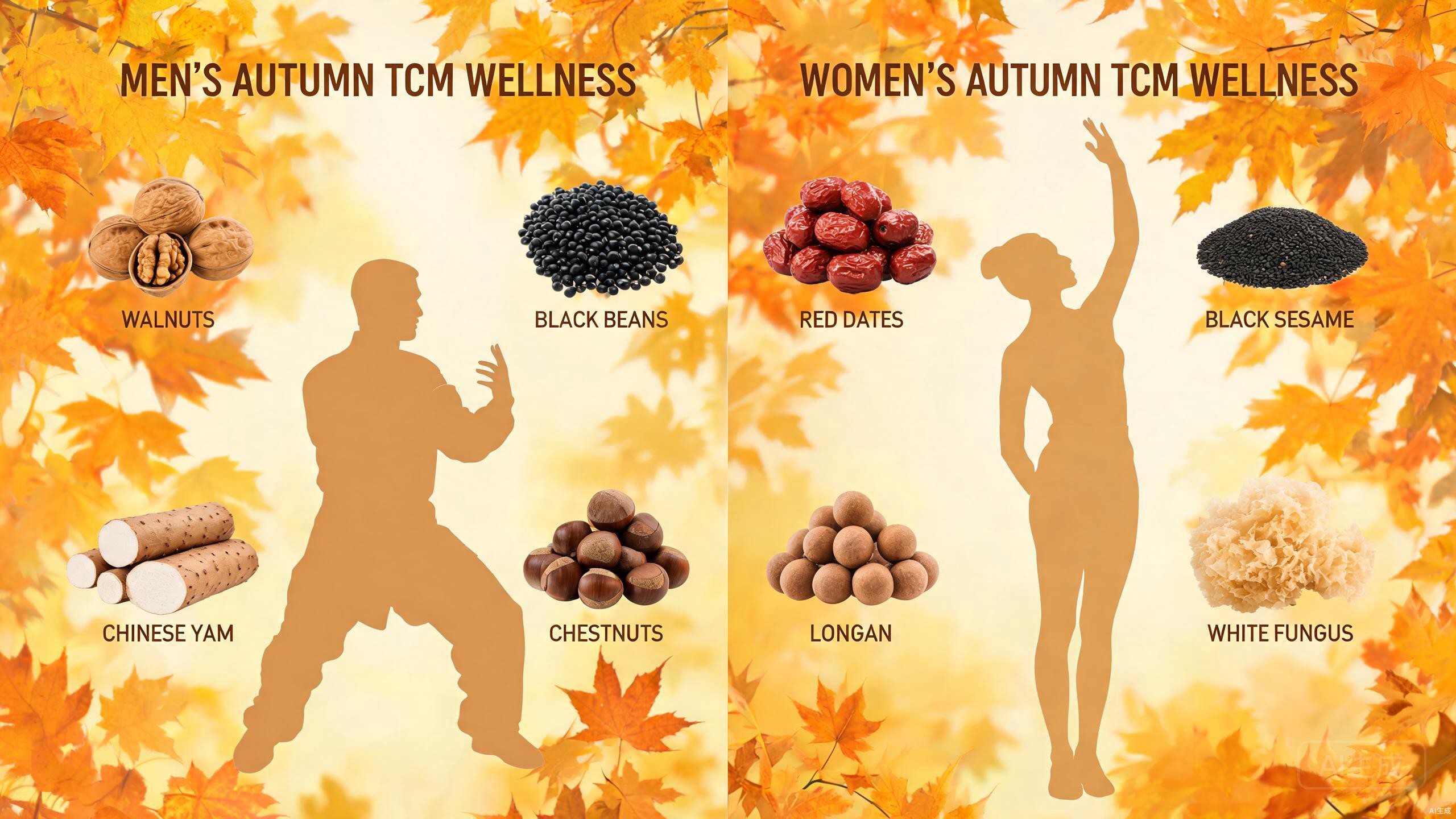
- Men benefit from walnuts, black beans, Chinese yam, and chestnuts — foods traditionally used to warm and nourish kidney energy without being too drying.
- Women benefit from red dates, longan, black sesame, white fungus, and lily bulb — foods traditionally used to nourish blood and yin against autumn dryness.
- Autumn dryness commonly affects women's skin and hair; TCM offers both internal and external approaches.
- The traditional practice of tie qiu biao (autumn nourishing) should be tailored: men focus on kidney-warming foods, women on blood-building foods rather than heavy meats.
- These are traditional wellness philosophies, not medical treatments. Always consult your healthcare provider.
This article is for educational purposes only and is not medical advice. The foods, teas, and practices described here are traditional wellness practices rooted in Chinese culture. They are not a substitute for professional medical care. Never stop, adjust, or replace prescribed medication based on information in this article. If you have any health condition — including hormonal, reproductive, cardiovascular, or mental health concerns — work closely with your healthcare provider. Some foods and herbs may interact with medications or may not be appropriate during pregnancy or nursing. Always inform your doctor about everything you consume. These statements have not been evaluated by the FDA and are not intended to diagnose, treat, cure, or prevent any disease.
Every autumn, as the air turns crisp and the leaves shift from green to gold, practitioners of Traditional Chinese Medicine (TCM) offer a deceptively simple piece of advice: the way you care for yourself in autumn should depend, in part, on whether you are a man or a woman. This is not about stereotypes. It reflects a centuries-old understanding that men and women tend to have different physiological tendencies — tendencies that become more visible when the seasons change.
In TCM theory, autumn is the season of "shou" (收) — gathering, collecting, and drawing energy inward. After the expansive, outward energy of summer, autumn asks the body to begin conserving. The dryness of the season also introduces a new challenge: autumn dryness (秋燥, qiu zao) can deplete moisture in the skin, lungs, and elsewhere. How men and women respond to these shifts, and what they need to stay balanced, differs in important ways.
If you are new to TCM, our introduction to Traditional Chinese Medicine and guides on the balance of yin and yang and the five elements provide helpful background before diving in.
Why Men and Women Need Different Autumn Care
The foundational TCM texts, including the Huangdi Neijing (Yellow Emperor's Inner Canon), describe distinct physiological rhythms for men and women. In classical TCM, men's health is understood to be governed primarily by kidney essence (肾精, shen jing) and kidney yang (肾阳, shen yang) — the deep, warming, foundational energy of the body. Women's health, by contrast, is understood to be governed primarily by blood (血, xue) and the liver (肝, gan), which in TCM is responsible for the smooth flow of qi and blood throughout the body.
This does not mean that men have no blood or that women have no kidney energy. It means that when imbalance appears, men tend to show it first in the kidney system, while women tend to show it first in the blood and liver systems. Autumn, with its gathering energy and drying climate, amplifies these tendencies. For men, autumn is an opportunity to conserve and nourish kidney energy. For women, autumn is a time to protect blood and yin from being depleted by dryness.
To understand the organ systems involved, see our guide on Zang-Fu organs and the role of qi, blood, and body fluids in TCM.
Autumn Wellness for Men
The TCM Theory: Kidney Essence and Kidney Yang
In TCM, the kidneys are considered the "root of life." They store kidney essence (jing), which is the foundational substance inherited from our parents and replenished (to a limited degree) by food and lifestyle. Kidney essence governs growth, reproduction, bone health, and the aging process. Kidney yang — the warming, active aspect of kidney energy — fuels metabolism, circulation, and vitality.
Autumn is the season of "gathering" (收), which makes it the ideal time for men to focus on conserving and nourishing kidney energy rather than expending it. In the five-element system, autumn corresponds to metal and the lungs, but the kidneys (water element) are the next in the generative cycle — autumn is the time to begin preparing the kidneys for winter, when their energy is at its peak. Think of it as laying the foundation before the deep cold arrives.
Signs that men may benefit from kidney-nourishing practices in autumn include lower back soreness, knee weakness, frequent urination (especially at night), fatigue, reduced motivation, and sensitivity to cold. These are traditional TCM observations, not medical diagnoses. If you experience any of these, consult your healthcare provider to rule out underlying conditions.
Foods Traditionally Used to Nourish Kidney Energy
The following foods are staples of the East Asian autumn kitchen. In TCM, they are classified as warming or neutral and are traditionally used to support kidney yang and kidney essence without being overly drying — an important quality in a season already marked by dryness.
- Walnuts (核桃, he tao): Classified as warm and sweet, walnuts are traditionally said to tonify kidney yang, strengthen the lower back, and moisten the intestines. A small handful daily is a common autumn habit. Walnuts are also rich in omega-3 fatty acids.
- Black beans (黑豆, hei dou): In TCM, black-colored foods are associated with the kidneys. Black beans are traditionally used to nourish kidney essence and support healthy fluid metabolism. They are also a good source of plant protein and fiber.
- Chinese yam (山药, shan yao): Neutral and sweet, Chinese yam is one of the most versatile tonic foods in TCM. It is traditionally used to tonify the spleen, lung, and kidney simultaneously — making it ideal for autumn when all three systems need support. It is easy to digest and can be added to soups, porridge, or stir-fries.
- Chestnuts (栗子, li zi): Warm and sweet, chestnuts are traditionally said to tonify kidney yang, strengthen the spleen, and support the lower back and legs. Roasted chestnuts are a beloved autumn street food across East Asia and a practical way to enjoy this kidney-warming food.
For more everyday kitchen wisdom, see our collection of everyday TCM kitchen remedies. And for men interested in supporting vitality more broadly, our TCM guide to men's vitality goes deeper.
Exercise: Strength, Tai Chi, and the Rule Against Over-Sweating
In TCM, autumn exercise for men should balance strength with gentleness. Moderate strength training supports muscle and bone — both governed by the kidneys in TCM theory. However, the key principle is moderation: excessive sweating is said to deplete kidney yin and body fluids, which are already under pressure from autumn dryness.
A balanced autumn routine for men might include:
- Strength training 2 to 3 times per week — focus on compound movements at moderate intensity, stopping before exhaustion.
- Tai chi or qigong daily — gentle, flowing movement that circulates qi without depleting fluids. Even 15 minutes a day is valuable. See our autumn exercise guide for seasonal movement suggestions.
- Brisk walking outdoors — enjoying the cool autumn air while keeping the body moving. Avoid exercising in cold wind, which TCM considers a pathogen that can enter through the back of the neck.
Precautions: Sleep, Overwork, and Kidney Essence
TCM offers several specific precautions for men in autumn:
- Sleep before 11 PM (子时, zi shi). In the TCM body clock, the hours from 11 PM to 1 AM correspond to the gallbladder, and 1 AM to 3 AM to the liver. These are considered the most important hours for the body to rest and restore. Sleeping before 11 PM ensures the body enters this recovery window. Chronic late nights are said to deplete kidney yin over time.
- Avoid overwork. In TCM, prolonged physical or mental overwork depletes kidney essence. Autumn is a time to moderate ambition slightly — not to stop working, but to avoid the relentless push that characterized summer energy.
- Moderate sexual activity. Classical TCM texts link excessive sexual activity to kidney essence depletion. Autumn, as a gathering season, is traditionally a time for moderation. This is a cultural and philosophical viewpoint, not a medical prescription.
Prostate Health and Urinary Function
Autumn dryness can affect urinary function, particularly in middle-aged and older men. In TCM, the kidneys govern water metabolism and the lower body fluids. When autumn dryness combines with declining kidney yang (a natural part of aging), men may notice increased urinary frequency, urgency, or a sense of incomplete emptying. Traditional supportive practices include drinking adequate warm water throughout the day (rather than cold beverages), avoiding sitting on cold surfaces, and keeping the lower back and abdomen warm.
These are traditional wellness observations. Prostate and urinary symptoms can reflect medical conditions that require professional evaluation. If you experience persistent urinary changes, pain, or blood in the urine, see your healthcare provider promptly.
Autumn Wellness for Women
The TCM Theory: Blood and the Liver
In TCM, women's health is said to be governed by blood. The classical phrase is "nv ren yi xue wei ben" — women take blood as their foundation. The liver, which in TCM stores blood and ensures its smooth flow throughout the body, is the organ most closely tied to women's cyclical health. When blood is abundant and the liver flows smoothly, a woman's skin, hair, mood, and cycle tend to be balanced. When blood is deficient or the liver is stagnant, problems arise.
Autumn poses two specific challenges for women. First, autumn dryness depletes body fluids and blood. In TCM, blood and fluids are closely related — when the body loses moisture to dry autumn air, blood can become relatively deficient. Second, autumn's contracting energy can impede the liver's natural flow, leading to emotional stagnation.
The TCM concept "fa wei xue zhi yu" (发为血之余) — "hair is the surplus of blood" — explains why autumn hair loss is so common in women. When blood is depleted by dryness, the body conserves what it has for vital organs, and hair (considered non-essential) may shed. This is a traditional explanation for a phenomenon many women notice each autumn.
Foods Traditionally Used to Nourish Blood and Yin
The following foods are autumn staples in TCM kitchens and are traditionally used to nourish blood, yin, and body fluids:
- Red dates (红枣, hong zao): Sweet and warm, red dates are perhaps the most beloved blood-nourishing food in all of TCM. They are traditionally used to tonify qi and blood, calm the mind, and support digestive health. Three to five dates daily, steeped in tea or added to porridge, is a common autumn habit.
- Longan (桂圆, gui yuan): Sweet and warm, longan is traditionally used to nourish heart blood and calm the mind. It pairs well with red dates in tea. Longan is warming, so it should be used in moderation if signs of heat (such as night sweats or a dry mouth) are present.
- Black sesame (黑芝麻, hei zhi ma): Sweet and neutral, black sesame is traditionally used to nourish liver and kidney yin, benefit blood, and moisturize the intestines. It is one of the most important foods for hair health in TCM. A teaspoon of ground black sesame daily, stirred into porridge or warm water, is a simple autumn practice.
- White fungus (银耳, yin er): Sweet and neutral, white fungus (also called snow fungus) is the premier yin-nourishing food of autumn. It is traditionally used to moisten the lungs, nourish yin, and support skin hydration. Simmered with rock sugar and red dates, it makes a nourishing autumn dessert soup.
- Lily bulb (百合, bai he): Sweet and slightly cold, lily bulb is traditionally used to moisten the lungs, clear heat, and calm the mind. It is particularly valued for soothing the dry cough that autumn dryness can bring.
For more on seasonal eating, see our autumn food therapy guide.
Skin Care: Internal and External Approaches
Autumn dryness is the enemy of skin hydration. In TCM, skin reflects the state of body fluids and blood. When internal moisture is depleted, no amount of external moisturizer can fully compensate. A two-pronged approach is traditional:
Internal nourishment: Regular consumption of white fungus soup, lily bulb porridge, and pear soup helps replenish yin and fluids from within. These foods are traditionally used to support the lung's function of "dispersing fluids to the skin" — a TCM concept describing how the lungs distribute moisture outward to the body's surface.
External care: TCM-informed skincare in autumn emphasizes gentle, non-stripping cleansers that do not disrupt the skin's natural barrier. Heavy, occlusive moisturizers may be needed as the air grows colder and drier. Avoid long, hot showers, which strip the skin of natural oils. For a deeper dive into TCM approaches to skin, see our TCM skin and beauty guide.
Hair Care: Black Sesame, Scalp Massage, and the Wooden Comb
Because TCM views hair as an extension of blood, autumn hair care begins internally. Blood-nourishing foods — especially black sesame, walnuts, and mulberries (桑葚, sang shen) — are traditionally consumed to support hair health. Mulberries are particularly valued in TCM for nourishing blood and yin and are in season during late spring and early summer, but dried mulberries can be enjoyed year-round.
External practices include:
- Scalp massage: Gently massaging the scalp with the fingertips for 3 to 5 minutes daily stimulates blood circulation to the hair follicles. In TCM, this also promotes the flow of qi and blood in the head.
- Avoid hot water: Washing hair with very hot water strips natural oils and can worsen dryness. Use lukewarm water instead.
- Use a wooden comb: Traditional TCM recommends wooden combs (particularly those made of peach wood or sandalwood) over plastic or metal, which can generate static and friction. Combing slowly from the crown outward, 50 to 100 strokes, is a daily ritual that doubles as a meditative practice.
For a comprehensive guide to TCM approaches to hair, see our TCM hair growth guide.
Emotional Wellness: Understanding "Bei Qiu" (Autumn Sadness)
The phrase "bei qiu" (悲秋) — literally "sadness of autumn" — captures a phenomenon that TCM has recognized for centuries: many people, and women in particular, experience a dip in mood as autumn deepens. The shortening days, cooler temperatures, and visible decay of the natural world can trigger feelings of melancholy.
In TCM theory, this has a specific explanation. The lungs correspond to autumn and metal, while the liver corresponds to spring and wood. In the five-element cycle, metal controls (restricts) wood. When autumn's metal energy is strong, it can over-suppress the liver — the organ responsible for the smooth flow of emotions. When liver qi is constrained, emotional stagnation, irritability, or sadness can result. Women, whose health is closely tied to the liver, may feel this effect more acutely.
Traditional supportive practices include:
- Rose tea (玫瑰花茶): Rose is traditionally used to move liver qi and ease emotional tension. A few dried rose buds steeped in hot water make a gentle, fragrant tea.
- Chrysanthemum tea: Chrysanthemum is traditionally used to clear liver heat and calm the mind. See our chrysanthemum tea guide for brewing details.
- Spending time in nature: TCM encourages aligning with the season rather than resisting it. A walk among autumn leaves, accepting the season's beauty, is itself a practice.
- Mindfulness and gentle movement: See our TCM emotional wellness guide and meditation guide for practical tools.
If feelings of sadness persist, deepen, or interfere with daily life, this may be a sign of seasonal affective disorder (SAD) or depression. These are medical conditions that require professional care. Please consult a mental health professional.
Menstrual Health: Warmth, Ginger, and Foot Soaks
Autumn's cooling temperatures can affect the menstrual cycle. In TCM, cold is considered a pathogen that can constrict blood flow — particularly in the lower abdomen. Women are traditionally advised to:
- Keep the abdomen warm. Avoid exposing the midriff to cold air. A warm water bottle on the lower abdomen during the premenstrual and menstrual phase is a simple traditional comfort.
- Avoid cold drinks and raw foods. TCM classifies cold beverages and raw foods as cooling to the digestive system. In autumn, when the body is already working to conserve warmth, excessive cold intake can impair digestion and blood circulation.
- Use a ginger foot soak. Soaking the feet in warm water with fresh ginger is a traditional autumn practice. The feet are considered a gateway to the body's meridians, and warming them is said to promote the flow of qi and blood throughout the body. See our ginger foot soak guide for a step-by-step method.
For women who experience premenstrual symptoms, our TCM guide to PMS offers additional seasonal strategies.
Tie Qiu Biao for Women: Blood, Not Heavy Meats
The traditional practice of "tie qiu biao" (贴秋膘) — literally "applying the autumn fat" — refers to the custom of eating nourishing foods in early autumn to rebuild strength after the depleting heat of summer. Historically, this often meant eating rich meats. However, TCM experts caution that for women, autumn nourishing should focus on blood-building foods, not heavy meats.
The reasoning is practical: after summer's heat, the spleen and stomach (the digestive organs in TCM) are often weakened. Heavy, greasy meats are difficult to digest and can actually burden the spleen, leading to stagnation rather than nourishment. For women, whose health centers on blood, the most beneficial autumn foods are those that are both nourishing and easy to assimilate — red date and longan tea, white fungus soup, Chinese yam porridge, and black sesame paste. These provide the building blocks for blood without overtaxing digestion.
Meat is not forbidden — lean chicken, fish, and moderate amounts of beef can be part of a balanced autumn diet. The caution is against the traditional "tie qiu biao" approach of eating large quantities of fatty meats, which is better suited to men doing heavy physical labor than to most modern women.
Comparison: Men's vs. Women's Autumn Priorities
| Aspect | Men's Autumn Focus | Women's Autumn Focus |
|---|---|---|
| Primary TCM system | Kidney essence (jing) and kidney yang | Blood (xue) and liver |
| Key seasonal challenge | Conserving kidney energy; avoiding overwork | Countering dryness; preventing blood depletion |
| Top foods | Walnuts, black beans, Chinese yam, chestnuts | Red dates, longan, black sesame, white fungus, lily bulb |
| Exercise emphasis | Strength training + tai chi; avoid excessive sweating | Gentle movement; yoga, walking, qigong |
| Sleep priority | Before 11 PM (gallbladder/liver time) | Before 11 PM; extra rest during menstruation |
| Emotional focus | Manage stress; moderate ambition | Address "bei qiu" (autumn sadness); support liver flow |
| Skin and hair | Moderate attention; general hydration | Primary focus; internal + external nourishment |
| Tie qiu biao approach | Kidney-warming foods; moderate protein | Blood-building foods; avoid heavy meats |
| Special caution | Prostate and urinary health | Menstrual warmth; abdominal cold avoidance |
A Shared Practice: The Autumn Routine
Despite their differences, men and women share many autumn wellness practices. The following routine works for both:
- Morning: Wake with the sun (earlier than in summer, but not before dawn). Drink a cup of warm water. Eat a warm breakfast — porridge with Chinese yam or red dates is ideal. Avoid cold breakfasts.
- Midday: The largest meal of the day, when digestive fire is strongest. Include seasonal vegetables, moderate protein, and a nourishing soup.
- Afternoon: A cup of chrysanthemum or rose tea. Gentle movement — a walk outdoors if the weather permits.
- Evening: A lighter dinner. A ginger foot soak before bed. Sleep before 11 PM.
For those who enjoy herbal tea, our herbal tea safety guide provides important information about choosing and using teas responsibly.
When to See a Healthcare Provider
The foods and practices in this article are traditional wellness habits, not medical treatments. You should consult a healthcare provider if you experience any of the following:
- Persistent fatigue, weakness, or unexplained weight changes
- Changes in urinary function, prostate symptoms, or reproductive health concerns
- Irregular, heavy, or painful menstrual cycles; sudden hair loss; or skin changes that do not improve
- Persistent low mood, anxiety, or loss of interest in activities you once enjoyed
- Any new or worsening symptoms
If you are pregnant, nursing, or taking any medication, consult your healthcare provider before adding new herbs, teas, or supplements to your routine.
The Bottom Line
Traditional Chinese Medicine offers a thoughtful, gender-aware approach to autumn wellness. For men, the season is an invitation to conserve and nourish kidney energy through warming foods, moderate exercise, and restful sleep. For women, it is a call to protect blood and yin from autumn dryness through nourishing foods, gentle skincare, emotional care, and warmth. The traditional practice of "tie qiu biao" can be adapted — kidney-warming foods for men, blood-building foods for women — rather than a one-size-fits-all feast of heavy meats.
These are time-honored practices rooted in centuries of observation. They are not a replacement for medical care. If you have any health concern, your first step should always be to consult a qualified healthcare provider. Use these traditional practices as complementary wellness habits, with your doctor's knowledge and guidance.
This article shares traditional wellness practices for educational purposes only. It is not a substitute for medical advice, diagnosis, or treatment. The foods, teas, and practices described here are not intended to treat, cure, or prevent any disease. Men's and women's health concerns — including hormonal, reproductive, urinary, cardiovascular, and mental health conditions — require professional medical evaluation. If you have any health condition or take medication, consult your healthcare provider before making any changes. These statements have not been evaluated by the FDA. Never stop or adjust prescribed medication without your doctor's explicit guidance.