Key Takeaways
- TCM says "hair is the surplus of blood" (发为血之余) and "the kidneys manifest in the hair" (其华在发) — meaning hair health reflects the state of your blood and kidney essence.
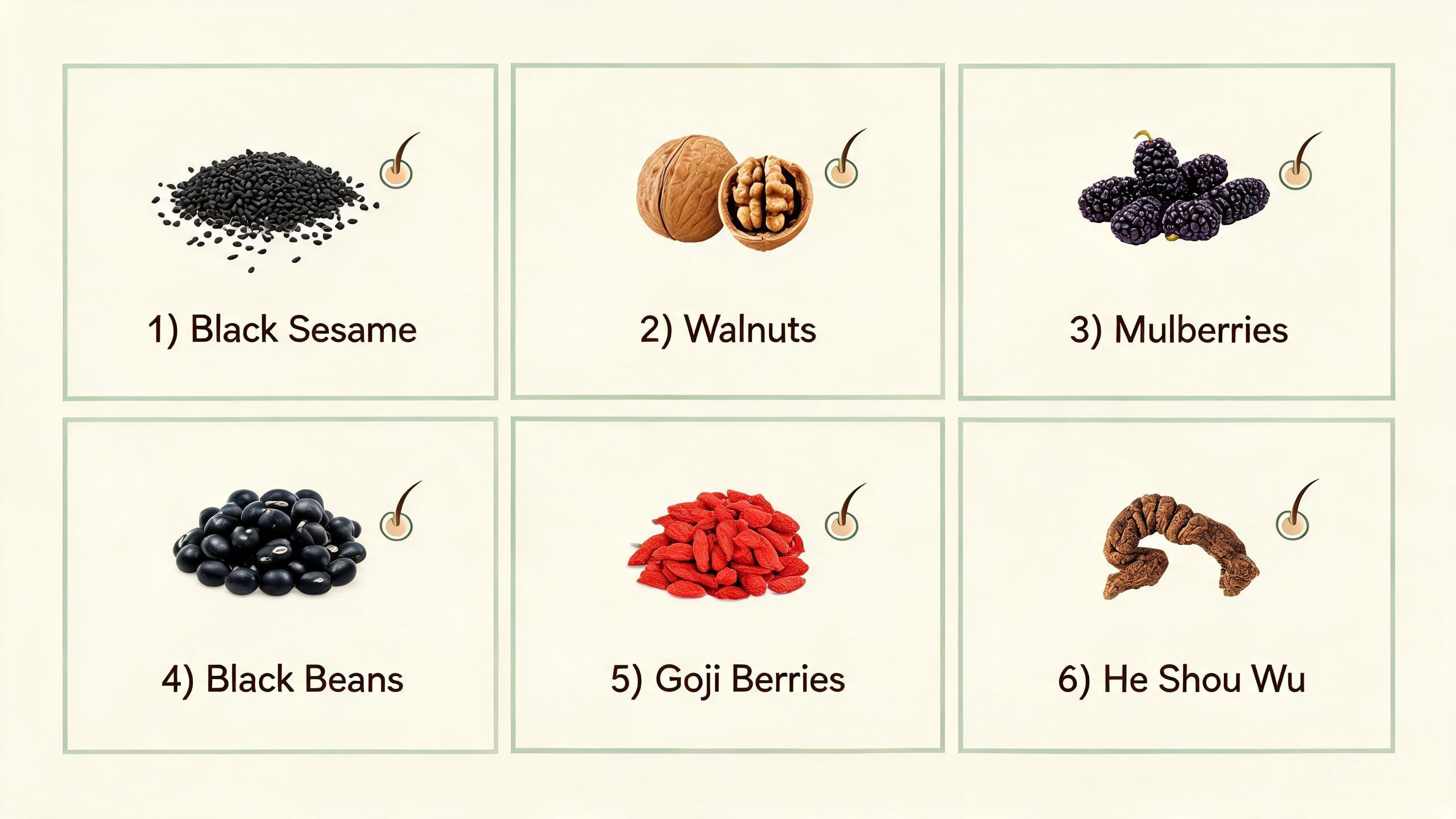
- Five everyday foods — black sesame, black beans, walnuts, mulberries, and He Shou Wu — are traditionally used to nourish the kidney and liver systems that support hair health.
- In TCM, black-colored foods are associated with the kidney organ system, which is why so many hair-nourishing foods in TCM are black or dark-colored.
- Scalp massage and acupressure are traditional TCM practices that stimulate qi and blood circulation to the scalp, complementing internal nourishment.
- These are traditional wellness practices, not medical treatments for hair loss. Significant hair loss requires medical evaluation to identify underlying causes.
This article is for educational purposes only and is not medical advice. The foods and practices described here are traditional wellness practices rooted in Chinese culture. They are not a substitute for professional medical care. Hair loss can be a symptom of underlying medical conditions — including thyroid disorders, iron deficiency, hormonal imbalances, autoimmune conditions, and medication side effects — that require proper diagnosis and treatment. Never stop, adjust, or replace prescribed medication based on information in this article. He Shou Wu (Polygonum multiflorum) has been associated with rare but serious liver injury in some reports. If you have any liver condition, take medication, or are pregnant, consult your healthcare provider before using He Shou Wu. These statements have not been evaluated by the FDA and are not intended to diagnose, treat, cure, or prevent any disease.
A reader wrote to us after noticing increasing hair thinning in their late thirties. After spending a small fortune on supplements and shampoos, they asked: "My grandmother always said to eat black sesame for healthy hair. Is there any real science or tradition behind that?" The answer is a resounding yes. TCM has a sophisticated, centuries-old framework for understanding hair health — one that connects the vitality of your hair directly to the state of your blood and your kidney essence. And at the center of this tradition is a simple, powerful idea: you nourish your hair by nourishing your body from within.
If you are new to TCM concepts, our introduction to Traditional Chinese Medicine provides helpful background before diving in.
How TCM Views Hair Health
In Traditional Chinese Medicine, hair is not viewed as an isolated feature to be managed with external products. It is seen as a direct reflection of two of the body's most fundamental resources: blood and kidney essence (精, jing). Two classical TCM sayings capture this connection perfectly:
- "Hair is the surplus of blood" (发为血之余, fa wei xue zhi yu). This means that after the body has used blood to nourish all the essential organs and systems, whatever remains is directed to the hair. If your blood is deficient — from poor nutrition, blood loss, overwork, or chronic stress — the body will prioritize essential functions over hair, and the hair will suffer. Thin, dry, brittle, or slowly growing hair is, in TCM, a sign that blood reserves are low.
- "The kidney's outward manifestation is in the hair" (其华在发, qi hua zai fa). In TCM, the kidney organ system stores "essence" (jing) — the body's deepest, most fundamental reserve of vital energy, partly inherited and partly replenished through food and lifestyle. The health of the kidneys is said to manifest outwardly in the hair. Abundant kidney essence means thick, lustrous, well-pigmented hair. Declining kidney essence — which naturally occurs with aging — is associated with graying, thinning, and hair loss.
These two principles mean that TCM does not approach hair problems as a surface issue. Instead, it asks: Is the blood sufficient? Is the kidney essence abundant? Is qi flowing freely to deliver blood and nutrients to the scalp? The answers guide the choice of foods and practices.
Several key TCM patterns are associated with hair concerns:
- Kidney Essence Deficiency. The most common pattern associated with age-related graying and thinning. Signs may include lower back ache, knee weakness, frequent urination, and fatigue. The TCM approach is to nourish kidney essence with foods like black sesame, black beans, and He Shou Wu.
- Liver and Kidney Yin Deficiency. Associated with dry, brittle hair, dry eyes, dizziness, and ringing in the ears. The approach is to nourish yin with moistening foods like mulberries and walnuts. To learn about the organs involved, see our guide on Zang-Fu organs.
- Blood Deficiency. Associated with thin, pale, slowly growing hair — often seen after childbirth, illness, or with poor nutrition. The approach is to nourish blood, often with foods like red dates, goji berries, and angelica.
- Qi and Blood Stagnation. When qi and blood do not flow freely to the scalp, hair follicles may not receive adequate nourishment. This is where scalp massage and acupressure come in — they are TCM's way of actively moving circulation to the scalp.
A distinctive feature of TCM hair nutrition is the emphasis on black-colored foods. In TCM's Five Element theory, the color black is associated with the Water element, which corresponds to the kidney organ system. Therefore, black foods — black sesame, black beans, mulberries (dark purple-black) — are traditionally believed to nourish the kidneys and, by extension, the hair. To understand this color-organ correspondence more deeply, see our guide on the balance of yin and yang and the Five Elements.
Five Everyday TCM Foods for Hair Growth
The following five foods are deeply embedded in TCM hair traditions. Each is traditionally used to nourish the kidney and liver systems that support hair health. They are not medicines, and they are not a replacement for medical evaluation of hair loss.
1. Black Sesame (黑芝麻, Hei Zhi Ma)
TCM nature: Sweet, neutral. Enters: Liver and Kidney channels.
Black sesame is perhaps the single most famous food in TCM for hair health. Its deep black color aligns perfectly with the TCM principle that black foods nourish the kidneys. Black sesame is traditionally classified as sweet and neutral, and its primary actions are to "nourish kidney essence," "nourish liver blood," and "moisten the intestines." For hair, this means it addresses both of the key TCM hair principles: it supports kidney essence (which governs hair pigmentation and vitality) and liver blood (which provides the raw material for hair growth). Many Chinese families eat a sweet black sesame paste (黑芝麻糊, hei zhi ma hu) as a daily snack or breakfast, and black sesame is a common ingredient in both savory and sweet dishes.
How to prepare: Dry-roast 2 tablespoons of black sesame seeds in a pan over medium-low heat for 3 to 5 minutes until fragrant and slightly popping. Grind the roasted seeds in a blender or with a mortar and pestle. Mix 1 tablespoon of the ground sesame with 1 teaspoon of honey and warm water to make a paste. Eat daily, or sprinkle ground black sesame over oatmeal, rice, or salads. Store ground sesame in an airtight container in the refrigerator for up to 1 week.
Caution: Black sesame is generally safe as a food. If you have a sesame allergy, avoid it entirely. Because it moistens the intestines, very large amounts may cause loose stools in some people. Consult your doctor if you take medication, as sesame may have mild effects on blood sugar and blood pressure.
2. Black Beans (黑豆, Hei Dou)
TCM nature: Sweet, neutral. Enters: Spleen and Kidney channels.
Black beans — specifically the black soybeans used in TCM, which are slightly different from the black turtle beans common in Latin American cuisine — are a staple food for kidney nourishment. In TCM, they are classified as sweet and neutral, entering both the Spleen (which supports digestion and blood production) and the Kidney (which stores essence and governs hair). Black beans are traditionally said to "nourish the kidney," "support water metabolism," and "invigorate blood." For hair health, their dual action on the kidney and spleen makes them particularly valuable — they support both the root cause (kidney essence) and the production of blood that feeds the hair. Black beans are also rich in protein, iron, and B vitamins, all of which are modern nutritional factors relevant to hair health.
How to prepare: Soak 1 cup of black soybeans overnight. Drain and rinse. Simmer in 4 cups of water for 1 to 1.5 hours until tender. Add a pinch of salt and eat as a side dish, or blend into a soup. Alternatively, dry-roast black beans and brew as a light tea: steep 2 tablespoons of roasted black beans in hot water for 10 minutes. Consume 2 to 3 times per week.
Caution: Black beans are generally safe as a food. Some people experience bloating or gas from beans — soaking and thorough cooking helps reduce this. If you have gout, consult your doctor about legume intake. For more everyday kitchen remedies using common foods, see our everyday TCM kitchen remedies guide.
3. Walnuts (核桃, He Tao)
TCM nature: Sweet, warm. Enters: Kidney, Lung, and Large Intestine channels.
Walnuts are prized in TCM for their warming, nourishing, and moistening properties. Their traditional actions include "nourishing the kidney," "warming the lungs," and "moistening the intestines." For hair health, the kidney-nourishing action is primary — walnuts are said to support kidney essence and kidney yang (the warming, activating aspect of kidney energy). Their moistening nature also benefits the hair shaft itself, supporting hair that is soft and supple rather than dry and brittle. In TCM, walnuts are often combined with black sesame for a synergistic kidney-nourishing effect. The distinctive brain-like shape of the walnut also aligns with the TCM principle of "like shapes like" — walnuts are traditionally said to nourish the brain and mind as well.
How to prepare: Eat 3 to 5 whole walnuts (6 to 10 halves) per day as a snack. Alternatively, make a traditional hair-nourishing powder: combine equal parts roasted black sesame and crushed walnuts, grind to a powder, and store in an airtight jar. Mix 1 to 2 tablespoons with warm water or milk each morning. Add honey to taste.
Caution: Walnuts are generally safe as a food. If you have a tree nut allergy, avoid walnuts entirely. Because walnuts are warm in nature, avoid eating very large amounts if you tend to run hot or have inflammatory skin conditions. Walnuts are calorie-dense — enjoy in moderation.
4. Mulberries (桑葚, Sang Shen)
TCM nature: Sweet, sour, cold. Enters: Heart, Liver, and Kidney channels.
Mulberries — the deep purple-black fruit of the mulberry tree — are one of the most valued fruits in TCM for nourishing yin and blood. Their traditional actions include "nourishing yin and blood," "enriching fluids," and "moistening dryness." For hair health, mulberries are particularly relevant because they nourish both liver blood (which feeds the hair) and kidney yin (which provides the body's deepest moistening reserve). Their dark color also aligns with the TCM principle of black foods nourishing the kidneys. Mulberries are traditionally associated with addressing premature graying — a sign of declining kidney essence and blood. They can be eaten fresh when in season (late spring to early summer) or used dried year-round in teas, congee, and soups.
How to prepare: Eat a small handful (about 20 to 30 grams) of fresh mulberries daily when in season. For year-round use, steep 1 tablespoon of dried mulberries in hot water for 10 minutes as a tea, or add to congee and soups. Dried mulberries can also be eaten as a snack, similar to raisins.
Caution: Mulberries are generally safe as a food. Because they are cold in nature, avoid eating very large amounts if you have cold, weak digestion with loose stools. Consult your doctor if you take diabetes medication, as mulberries may affect blood sugar levels.
5. He Shou Wu / Polygonum Multiflorum (何首乌, He Shou Wu)
TCM nature: Bitter, sweet, astringent, slightly warm. Enters: Liver and Kidney channels.
He Shou Wu (also known as Fo-Ti in some Western contexts) is the single most famous TCM herb for hair. Its name literally translates to "Mr. He's Black Hair," after a legendary TCM story about an old man named He whose gray hair reportedly turned black again after taking the herb regularly. In TCM, He Shou Wu is traditionally used to "nourish the liver and kidney," "essence and blood," and is specifically associated with supporting hair pigmentation (darkening) and growth. It is one of the most widely used herbs in TCM hair formulas. However, it is also the herb on this list that requires the most caution. There have been rare but serious reports of liver injury associated with He Shou Wu, particularly with raw (unprocessed) forms, high doses, or long-term use. The traditional processed form (制首乌, zhi shou wu), in which the root is steamed with black bean juice, is considered safer and is the form most commonly used in TCM practice.
How to prepare: Use only the processed (zhi) form of He Shou Wu from a reputable supplier. Simmer 6 to 10 grams of sliced, processed He Shou Wu in 3 cups of water for 30 minutes. Strain and drink as a tea, 2 to 3 times per week. He Shou Wu is rarely used alone in TCM — it is typically part of a formula prescribed by a qualified practitioner. Do not use raw (unprocessed) He Shou Wu.
Caution: He Shou Wu has been associated with rare but serious liver injury. Do not use if you have any liver condition, if you take medication that affects the liver, or if you are pregnant. Use only the processed (zhi) form, only in traditional amounts, and only from reputable suppliers. If you experience any signs of liver problems (yellowing of skin or eyes, dark urine, abdominal pain, nausea, or unusual fatigue), stop immediately and seek medical attention. Always consult your healthcare provider before using He Shou Wu.
Comparison of the Five Foods
| Food | TCM Nature | Traditional Use for Hair | Preparation | Key Precaution |
|---|---|---|---|---|
| Black Sesame (Hei Zhi Ma) | Sweet, neutral | Nourish kidney essence, darken hair | Roast and grind; eat as paste | Sesame allergy |
| Black Beans (Hei Dou) | Sweet, neutral | Nourish kidney, support hair pigmentation | Soak and simmer; or roast as tea | May cause bloating |
| Walnuts (He Tao) | Sweet, warm | Nourish kidney, moisten hair | Eat raw; grind with sesame | Tree nut allergy |
| Mulberries (Sang Shen) | Sweet, sour, cold | Nourish blood and yin, support growth | Eat fresh; steep dried as tea | Cold nature; avoid if cold digestion |
| He Shou Wu (He Shou Wu) | Bitter, sweet, astringent, slightly warm | Nourish liver and kidney, support hair darkening | Simmer processed form as tea | Rare liver injury risk; use processed form only |
How to Make the Classic Black Sesame Hair-Nourishing Paste
Among the five foods above, black sesame paste (黑芝麻糊, hei zhi ma hu) is the recipe most readers ask about. Here is a traditional step-by-step method for making it at home.
- Toast the sesame seeds. Place 1 cup of raw black sesame seeds in a dry skillet over medium-low heat. Toast for 5 to 8 minutes, stirring constantly, until the seeds become fragrant and begin to pop slightly. Do not burn — burned sesame tastes bitter. Remove from heat immediately and let cool.
- Toast rice (optional, for thickening). Toast 2 tablespoons of white rice or glutinous rice in the same dry skillet for 3 to 4 minutes until lightly golden. This gives the paste its characteristic thick, smooth texture.
- Grind to a fine powder. Place the toasted black sesame and rice in a high-speed blender or food processor. Blend for 2 to 3 minutes until the seeds release their oils and form a thick, dark paste. Stop to scrape down the sides as needed.
- Add walnuts (optional, for extra nourishment). Add 3 to 4 toasted walnut halves to the blender and pulse until incorporated. This combines two of the five hair-nourishing foods in one dish.
- Sweeten and store. Transfer the paste to a clean glass jar. For each serving, mix 2 tablespoons of the paste with 1 cup of hot water or warm milk. Add 1 teaspoon of honey or a small piece of rock sugar to taste. Stir until smooth and drink warm.
- Enjoy daily. Drink 1 cup each morning as a nourishing breakfast beverage. Store the paste in the refrigerator for up to 2 weeks.
For the smoothest texture, use a stone grinder or a high-powered blender. If using a standard blender, you may need to add a small amount of warm water to help the seeds break down. The paste will thicken as it cools — simply add more hot water when serving. You can also add a pinch of salt to enhance the nutty flavor.
Scalp Massage and Acupressure for Hair Health
In TCM, internal nourishment is only half the equation. The other half is ensuring that qi and blood actually reach the scalp. TCM has a long tradition of scalp massage and acupressure as supportive practices for hair health. These techniques are believed to stimulate circulation to the hair follicles, relax tension in the scalp, and promote the smooth flow of qi and blood.
Here are three traditional techniques you can practice at home:
- Daily scalp massage. Every morning or evening, use your fingertips (not your nails) to massage your entire scalp in small circular motions. Start at the hairline and work your way back to the nape of the neck, then massage from the ears upward to the crown. Apply moderate pressure — you should feel the scalp moving under your fingers, not just the hair. Massage for 3 to 5 minutes. This simple practice stimulates blood flow to the follicles and is one of the most universally recommended TCM hair practices.
- Acupoint: Baihui (GV20, Hundred Meetings). This point is located at the very top of the head, at the midpoint of the line connecting the tops of your ears. In TCM, Baihui is the meeting point of all yang meridians and is traditionally used to lift energy, calm the mind, and stimulate circulation to the head. Gently press and release this point with your middle finger for 1 to 2 minutes daily.
- Acupoint: Fengchi (GB20, Wind Pool). Located at the base of the skull, in the two hollows on either side of the back of the neck. In TCM, this point is associated with the gallbladder meridian and is traditionally used to relieve head tension, improve circulation to the head, and support hair health. Place your thumbs on these points and apply gentle, steady pressure for 1 to 2 minutes while breathing deeply.
For overall stress reduction — which is essential because stress impairs liver qi flow and can contribute to hair concerns — see our meditation guide for practical starting points. A warm ginger foot soak before bed can also help relax the body and improve sleep, which is when the body does much of its repair and renewal work.
Lifestyle Tips from a TCM Perspective
TCM is a whole-person system. Foods and acupressure work best when combined with supportive daily habits. The following areas are emphasized in classical TCM texts for hair health:
- Protect your sleep. In TCM, the hours between 11 PM and 3 AM are associated with the Liver and Gallbladder. During deep sleep, blood "returns to the Liver" to be stored and replenished. Because hair is the "surplus of blood," consistently sleeping during this window is considered one of the most powerful practices for hair health. Late nights and chronic sleep deprivation are viewed as major contributors to blood deficiency and premature graying.
- Manage stress and emotions. The Liver ensures the smooth flow of qi. Chronic stress, anger, and worry cause Liver qi to stagnate, which impairs blood circulation to the scalp. Emotional well-being is not a side note in TCM hair care — it is central.
- Eat a blood-building diet. In addition to the five foods above, TCM recommends a diet rich in blood-nourishing foods: red dates (jujubes), goji berries, dark leafy greens, bone broths, and moderate amounts of lean protein. The Spleen needs to be strong to transform food into blood, so warm, cooked, easily digestible meals are preferred over cold, raw foods.
- Avoid excessive heat styling and chemical treatments. While TCM texts predate modern hair products, the principle of protecting the hair from damaging external forces is consistent with TCM's emphasis on preservation and moderation. Excessive heat, harsh chemicals, and tight hairstyles that pull on the follicles can all contribute to hair damage and loss.
When to See a Doctor
This cannot be emphasized enough: the foods and practices in this article are complementary wellness traditions, not medical treatments. Hair loss can be a symptom of serious underlying medical conditions. You should see a healthcare provider or dermatologist if you experience any of the following:
- Sudden or rapid hair loss, hair falling out in clumps or patches
- Hair loss accompanied by scalp redness, scaling, itching, or pain
- Hair loss along with other symptoms such as fatigue, weight changes, menstrual changes, or skin changes (these may indicate thyroid issues, iron deficiency, or hormonal imbalances)
- Hair loss that began after starting a new medication
- Any hair loss that causes you distress or concern — a dermatologist can help identify the cause and recommend appropriate treatment
Common medical causes of hair loss include androgenetic alopecia (pattern hair loss), telogen effluvium (stress-related shedding), alopecia areata (autoimmune), thyroid disorders, iron deficiency anemia, polycystic ovary syndrome (PCOS), and medication side effects. These require proper medical diagnosis and may benefit from treatments that go beyond dietary approaches. If you are currently using prescribed hair loss treatments (such as minoxidil or finasteride), do not stop or adjust your treatment based on anything you read here.
The Bottom Line
Traditional Chinese Medicine offers a deeply holistic approach to hair health — one that connects the vitality of your hair to the abundance of your blood and kidney essence. Black sesame, black beans, walnuts, mulberries, and He Shou Wu are five traditional foods that generations of East Asian families have used to nourish the kidney and liver systems that support hair. The core TCM principle is both simple and profound: your hair is a mirror of your internal health, and the most powerful thing you can do for your hair is to nourish your body, manage your stress, and protect your sleep.
But these are traditions — not treatments, and not a replacement for medical care. Hair loss can signal underlying health issues that require proper diagnosis. He Shou Wu in particular requires careful, informed use due to rare but serious liver safety concerns. If you are experiencing hair loss or thinning, your most important step is to work with a qualified healthcare provider or dermatologist. Use these traditional practices only as complementary habits, with your doctor's knowledge and guidance.
This article shares traditional wellness practices for educational purposes only. It is not a substitute for medical advice, diagnosis, or treatment. The foods described here are not intended to treat, cure, or prevent any disease or hair condition. He Shou Wu has been associated with rare but serious liver injury. If you are experiencing hair loss, if you have any liver condition, or if you take any medication, consult your healthcare provider before making any changes. These statements have not been evaluated by the FDA. Never stop or adjust prescribed medication or hair loss treatments without your doctor's explicit guidance.