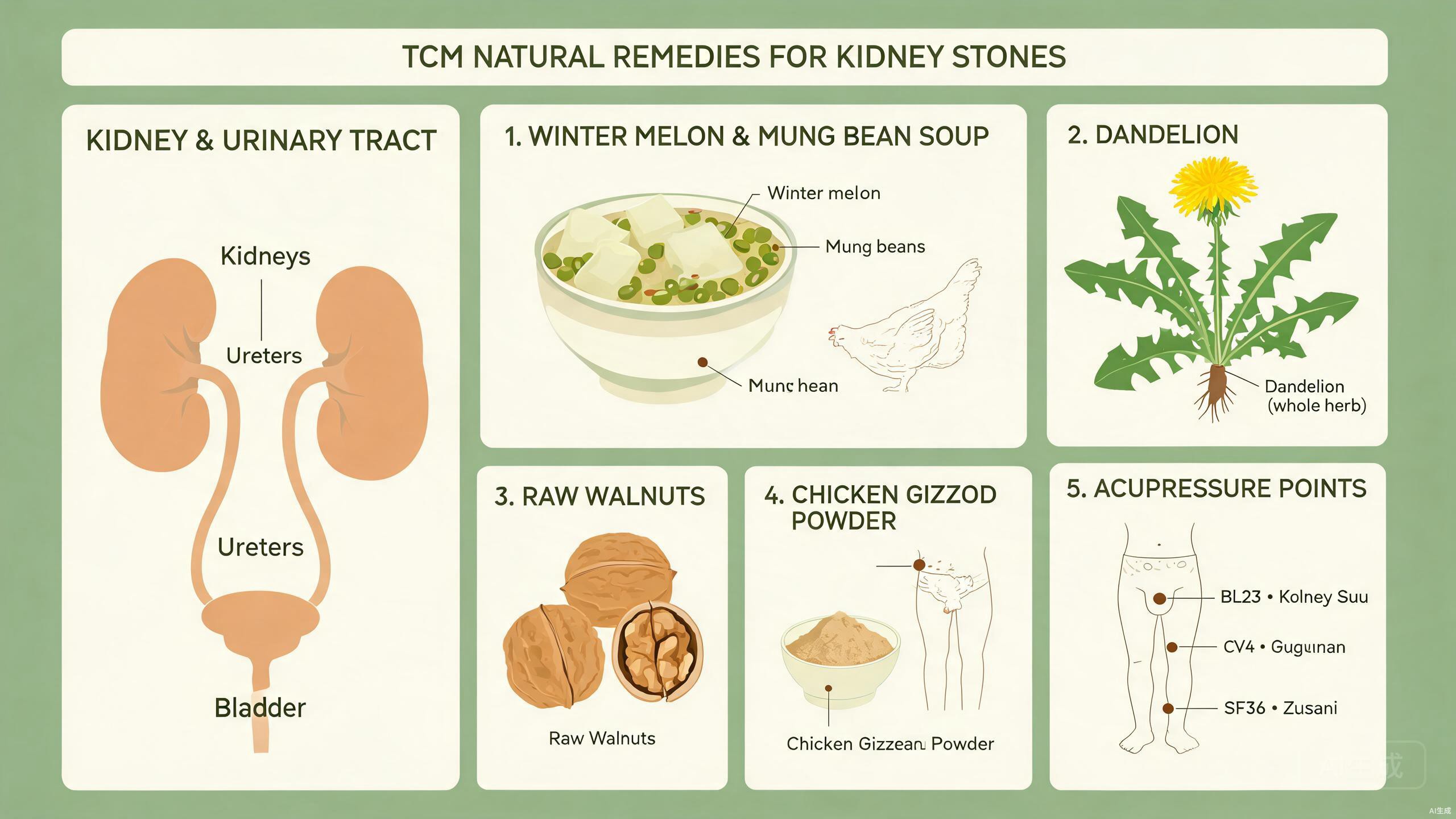
Key Takeaways
- TCM views kidney stones through the lens of damp-heat pouring downward, qi stagnation and blood stasis, and spleen-kidney deficiency, categorized as stone strangury (shi lin) or sand strangury (sha lin).
- Five traditional food therapy recipes — from winter melon cucumber mung bean soup to daily walnuts — use ingredients available at Western supermarkets, Amazon, or iHerb.
- Four acupressure points, Shenshu (BL23), Guanyuan (CV4), Sanyinjiao (SP6), and Zusanli (ST36), are traditionally used to support kidney qi and urinary function.
- Drinking at least 2000 ml of warm water daily and limiting high-oxalate foods are essential complements to any food therapy approach.
- These are traditional wellness practices, not a treatment for kidney stones. Severe pain, blood in urine, or fever require prompt medical evaluation.
This article is for educational purposes only and is not medical advice. The foods, teas, and practices described here are traditional wellness practices rooted in Chinese culture. They are not a substitute for professional medical care, diagnosis, or treatment. Kidney stone symptoms — including severe flank or back pain, blood in urine, difficulty urinating, nausea, vomiting, or fever — can indicate serious medical conditions that require prompt evaluation by a qualified healthcare provider. Never stop, delay, or replace prescribed treatment based on information in this article. Some foods and herbs may interact with medications — always inform your doctor about everything you consume. These statements have not been evaluated by the FDA and are not intended to diagnose, treat, cure, or prevent any disease. Read our full disclaimer →
Kidney stones are a painful and often recurring condition that affects millions of people worldwide. The sudden, sharp pain of a stone passing through the urinary tract is unforgettable, and many who experience it once are eager to prevent a recurrence. While medical evaluation and treatment are essential — especially during an acute episode — Traditional Chinese Medicine (TCM) offers a rich tradition of food therapy and self-care practices that may support urinary wellness as part of a balanced lifestyle.
In TCM, kidney stones are classified under the categories of shi lin (stone strangury) and sha lin (sand strangury), terms that have appeared in Chinese medical texts for over two thousand years. The five recipes below use foods and teas that have been enjoyed for generations to clear damp-heat, promote urination, and support the kidney and spleen organ systems. All ingredients are available at Western supermarkets, Asian markets, Amazon, or iHerb.
If you are new to TCM concepts, our guide to the Zang-Fu organ systems and overview of qi, blood, and body fluids are helpful starting points. For a related topic, see our guide to TCM for prostate health.
How TCM Views Kidney Stones
Traditional Chinese Medicine does not describe kidney stones as a standalone disease. Instead, it understands stone formation as the result of patterns of imbalance that affect the Kidney, Bladder, and Spleen organ systems. The word lin (strangury) refers to a group of urinary disorders characterized by frequent, urgent, painful, or obstructed urination. Shi lin specifically denotes the presence of stones or sand-like sediment in the urine.
TCM identifies three primary patterns associated with kidney stone formation:
- Damp-Heat Pouring Downward (Xia Zhu Shi Re) — the most common pattern. Heat and dampness accumulate in the lower burner and settle in the urinary tract, gradually crystallizing into stones over time. Signs include dark or cloudy urine, a burning sensation during urination, urinary urgency, lower back pain, and a feeling of heaviness in the lower abdomen. This pattern is often triggered by a diet high in spicy, greasy, or sweet foods, excessive alcohol consumption, or living in hot, humid environments.
- Qi Stagnation and Blood Stasis (Qi Zhi Xue Yu) — emotional stress, prolonged sitting, or physical trauma causes qi and blood to stagnate in the lower burner. Over time, stagnation creates a "bottleneck" where damp-heat and metabolic waste accumulate and form stones. Signs include sharp, stabbing pain in the lower back or flank that worsens with stress or movement, and pain that radiates toward the groin. This pattern is closely related to the Liver meridian's pathway through the pelvic region.
- Spleen and Kidney Deficiency (Pi Shen Liang Xu) — when the spleen is too weak to properly transform and transport fluids, and the kidneys lack the qi to "steam" and regulate fluid metabolism, dampness accumulates and gradually forms stones. This is often a chronic pattern seen in older adults or after prolonged illness. Signs include frequent urination (especially at night), a pale complexion, fatigue, cold extremities, lower back soreness, and a weak urinary stream. See our guides on TCM for night urination and TCM for water retention for more on deficiency patterns.
Understanding these patterns helps explain why TCM recommends different foods for different situations. The recipes below are grouped by the pattern they traditionally address. For more on how TCM understands metabolic waste and fluid balance, see our water retention guide and detox and cleansing guide.
5 Food Therapy Recipes for Urinary Wellness
Each recipe below is matched to a specific TCM pattern. Choose the one that best fits your situation, and use it consistently for two to four weeks. All ingredients are available at Western supermarkets, Asian markets, Amazon, or iHerb.
1. Winter Melon Cucumber Mung Bean Soup (冬瓜黄瓜绿豆薏米汤)
Best for: Damp-heat pouring downward
TCM nature and flavor: Winter melon (dong gua): sweet, mild, cool. Enters the Lung, Spleen, and Bladder channels. Mung bean (lu dou): sweet, cold. Enters the Heart and Stomach channels. Coix seed (yi yi ren / Job's tears): sweet, bland, slightly cool. Enters the Spleen, Lung, and Kidney channels. Cucumber (huang gua): sweet, cool. Enters the Stomach and Bladder channels.
Traditional use: This is a powerful combination of four cooling, damp-heat-clearing ingredients. Winter melon is traditionally used to clear heat, promote urination, and reduce swelling. Mung bean is one of TCM's most valued heat-clearing and detoxifying foods, traditionally used to clear summer heat and resolve toxins. Coix seed drains dampness and strengthens the spleen, while cucumber adds additional cooling and diuretic properties. Together, they address both the heat and the dampness that contribute to stone formation in the lower burner.
Ingredients:
- 2 cups winter melon, peeled and cubed (available at Asian markets; zucchini or chayote can substitute)
- 1 cup cucumber, peeled and cubed
- 1/2 cup dried mung beans — available at most supermarkets, Amazon, or iHerb
- 1/2 cup dried coix seed (Job's tears) — available on Amazon or iHerb
- 5 cups water
- 3 slices fresh ginger (to balance the cold nature)
- A pinch of sea salt
Preparation: Soak the mung beans and coix seed separately for 2 to 4 hours until softened. In a pot, combine the soaked mung beans, coix seed, water, and ginger slices. Bring to a boil, then reduce heat and simmer for 30 minutes. Add the cubed winter melon and cucumber, and simmer for another 15 to 20 minutes until all ingredients are tender. Add salt to taste. Drink the broth and eat the solids, 1 bowl per day, preferably at lunch. For more on mung beans, see our mung bean congee guide.
Precautions: This soup is strongly cooling. If you have a cold constitution with diarrhea, cold extremities, or a pale tongue, add extra ginger or reduce the portion. Coix seed is traditionally avoided in large amounts during pregnancy.
2. Dandelion Plantain Tea (蒲公英车前草茶)
Best for: Damp-heat with urinary burning or discomfort
TCM nature and flavor: Dandelion (pu gong ying): bitter, sweet, cold. Enters the Liver and Stomach channels. Plantain herb (che qian cao): sweet, cold. Enters the Liver, Kidney, Lung, and Bladder channels.
Traditional use: This tea combines two of TCM's most accessible damp-heat-clearing herbs. Dandelion is traditionally used to clear heat, detoxify, and reduce swelling, particularly in the lower body. Plantain herb (the broadleaf plantain, Plantago major, not the banana-like fruit) is one of TCM's premier diuretic and damp-heat-clearing herbs, traditionally used to promote urination, clear heat, and resolve dampness in the urinary tract. Together, they form a tea that directly targets the damp-heat pattern underlying stone formation, helping to flush the urinary system and reduce inflammation.
Ingredients:
- 1 teaspoon dried dandelion root or leaf — available on Amazon, iHerb, and most supermarkets
- 1 teaspoon dried plantain herb — available on Amazon or iHerb (search "plantain leaf dried")
- 2 cups water
- Optional: a small amount of honey to taste
Preparation: Place the dandelion and plantain herb in a teapot or French press. Bring water to a boil, then pour over the herbs. Cover and steep for 10 to 15 minutes. Strain and drink warm. Enjoy 1 to 2 cups per day, preferably in the morning or afternoon. The tea has an earthy, slightly bitter flavor. Roasted dandelion root tea is a popular coffee alternative and is widely available from brands like Traditional Medicinals and Yogi.
Precautions: Both herbs are cold and diuretic. Avoid if you have a cold constitution without heat signs. If you take prescription diuretics, blood pressure medication, or have kidney disease, consult your healthcare provider before using diuretic herbs regularly. See our herbal tea safety guide for general guidance.
3. Walnut Daily Snack (每日核桃)
Best for: Supporting stone passage and kidney nourishment
TCM nature and flavor: Walnut (he tao ren): sweet, warm. Enters the Kidney, Lung, and Large Intestine channels.
Traditional use: Among TCM food therapy traditions for urinary stones, the simple daily walnut is one of the most fascinating. Walnuts are traditionally used to tonify kidney yang, warm the lungs, and moisten the intestines. In folk practice, eating 4 to 5 raw walnuts daily is believed to help lubricate the urinary tract and support the passage of small stones or sand. The warming nature of walnuts also helps balance the cold, damp environment that contributes to stone formation, making this a unique complement to the cooling recipes above. Modern nutrition recognizes walnuts as a rich source of omega-3 fatty acids, magnesium, and antioxidants — nutrients that align with overall kidney wellness.
Ingredients:
- 4 to 5 raw walnuts (about 20 to 25 grams) — available at all supermarkets, Amazon, and iHerb
Preparation: Simply eat 4 to 5 raw walnuts per day, ideally in the morning or as an afternoon snack. Chew thoroughly. Raw walnuts are preferred over roasted or salted varieties. If the taste is too astringent, lightly toast them in a dry pan for 2 to 3 minutes. For variety, walnuts can be added to oatmeal, salads, or stir-fries. Consistency is key — the traditional practice involves daily consumption over several weeks.
Precautions: Walnuts are warming and rich in oils. If you have loose stools or digestive weakness, reduce to 2 to 3 walnuts per day. If you have a walnut allergy, avoid entirely. Walnuts are calorie-dense — stick to the recommended 4 to 5 per day. For more on kidney-nourishing foods, see our TCM for men's vitality guide.
4. Chicken Gizzard Powder with Honey (鸡内金粉)
Best for: Supporting digestion and traditionally aiding stone dissolution
TCM nature and flavor: Chicken gizzard lining (ji nei jin): sweet, neutral. Enters the Spleen, Stomach, Small Intestine, and Bladder channels.
Traditional use: Chicken gizzard lining is one of TCM's most unique food-as-medicine ingredients. The inner lining of the chicken's gizzard (the muscular stomach that grinds food) is dried and ground into a powder. In TCM, it is traditionally used to strengthen the spleen, aid digestion, and resolve accumulations. Remarkably, it is also traditionally used to help dissolve urinary stones and gallstones, based on the observation that the gizzard can break down hard materials in the chicken's digestive system. This "like treats like" principle is a hallmark of TCM food therapy. When combined with honey, the powder becomes more palatable and the honey adds a gentle moistening effect.
Ingredients:
- 1 teaspoon chicken gizzard lining powder (ji nei jin fen) — available on Amazon or iHerb (search "chicken gizzard powder" or "ji nei jin")
- 1 teaspoon raw honey
- 2 tablespoons warm water
Preparation: Mix the chicken gizzard powder with warm water to form a thin paste. Stir in the honey until dissolved. Drink on an empty stomach, once daily, preferably in the morning. The taste is mild and slightly earthy. Alternatively, the powder can be encapsulated if the taste is unappealing. Use consistently for 2 to 4 weeks.
Precautions: Chicken gizzard lining is generally considered safe as a food-based ingredient. If you have a poultry allergy, avoid. Those with severe spleen deficiency (chronic diarrhea, poor appetite) should start with a smaller dose. As this is a traditional remedy, consult your healthcare provider before use, especially if you have existing gallbladder or kidney conditions.
Chicken gizzard powder (ji nei jin fen) may sound unusual, but it is a standard ingredient in Chinese herbal pharmacies and is increasingly available online. It is simply the dried, ground inner lining of a chicken's gizzard — a part of the bird that is also eaten as food in many cultures. If you cannot find the powder, you can purchase dried chicken gizzard lining from Asian markets and grind it yourself using a coffee grinder or mortar and pestle.
5. Coix Seed and Winter Melon Soup (薏苡仁冬瓜汤)
Best for: Spleen deficiency with dampness (chronic pattern)
TCM nature and flavor: Coix seed (yi yi ren / Job's tears): sweet, bland, slightly cool. Enters the Spleen, Lung, and Kidney channels. Winter melon (dong gua): sweet, mild, cool. Enters the Lung, Spleen, and Bladder channels.
Traditional use: This simpler version of the first recipe focuses on the two most important ingredients for draining dampness and strengthening the spleen. Coix seed is traditionally used to drain dampness, strengthen the spleen, and promote urination, while winter melon clears heat and reduces swelling. For chronic stone formers whose root pattern is spleen deficiency with dampness, this gentle soup addresses the underlying weakness that allows dampness to accumulate in the first place. It is milder than recipe 1 and suitable for long-term use.
Ingredients:
- 1/2 cup dried coix seed (Job's tears) — available on Amazon or iHerb
- 2 cups winter melon, peeled and cubed (zucchini or chayote can substitute)
- 4 cups vegetable or chicken broth (low sodium)
- 3 slices fresh ginger
- A pinch of sea salt
Preparation: Soak the coix seed for 2 to 4 hours. In a pot, combine the soaked coix seed, broth, and ginger. Bring to a boil, then reduce heat and simmer for 30 minutes. Add the winter melon and simmer for another 15 to 20 minutes until tender. Add salt to taste. Drink 1 bowl per day, preferably at lunch. For more on coix seed, see our dampness-removing foods guide.
Precautions: Coix seed is slightly cooling. If you have a cold constitution, add extra ginger. Coix seed is traditionally avoided in large amounts during pregnancy.
Four Acupressure Points for Urinary Wellness
In addition to food therapy, TCM uses acupressure to support the organ systems involved in urinary health. The four points below are traditionally used to strengthen kidney qi, regulate the lower burner, promote healthy fluid metabolism, and support overall digestive strength. They are simple to find and can be pressed daily as part of a wellness routine.
1. Shenshu (BL23) — The "Kidney Transport Point"
Location: On the lower back, 1.5 cun (about two finger-widths) lateral to the lower border of the spinous process of the second lumbar vertebra (L2). This is roughly at waist level, on either side of the spine.
How to find it: Stand or sit upright. Find the lowest rib, then trace back to the spine — the second lumbar vertebra is just below this level. Place your hands on your lower back with thumbs pointing inward. Shenshu (BL23) is located in the soft tissue on either side of the spine at this level. You should feel a slight depression or tenderness when you press gently.
How to press: Using the heels of both hands or your thumbs, press firmly but gently inward and slightly upward on both points simultaneously. Hold for 2 to 3 minutes while breathing slowly. Alternatively, rub the area briskly with your palms until you feel warmth. Use moderate pressure; never press hard enough to cause sharp pain.
Traditional use: Shenshu is the primary back-shu point of the Kidney, making it one of the most important points for tonifying kidney qi, warming the lower back, and supporting the urogenital system. It is traditionally used to strengthen the kidneys' ability to regulate fluid metabolism and support the lower burner. For kidney stone wellness, BL23 addresses the kidney deficiency that underlies chronic stone formation.
Precautions: Do not press Shenshu if you have an acute kidney infection, fever, or severe lower back injury. Use gentle pressure on the lower back.
2. Guanyuan (CV4) — The "Gate of the Source"
Location: On the midline of the lower abdomen, 3 cun (approximately four finger-widths) below the navel.
How to find it: Lie on your back. Place four fingers together horizontally below your navel, with the little finger resting just below the belly button. Guanyuan (CV4) sits on the midline at the level of the index finger's lower edge.
How to press: Using the pads of two or three fingers or the heel of your palm, press gently but firmly inward and slightly downward. Hold for 2 to 3 minutes while breathing slowly and deeply. You may feel a mild ache or warmth radiating — this is normal.
Traditional use: Guanyuan is one of the most important points on the Conception Vessel meridian for tonifying kidney qi, warming the lower burner, and supporting the urogenital system. It is traditionally used to support urinary regulation and strengthen kidney essence.
Precautions: Do not press Guanyuan during pregnancy. If you have an acute urinary tract infection or fever, avoid this point.
3. Sanyinjiao (SP6) — The "Three Yin Intersection"
Location: On the inner lower leg, about 3 cun (approximately four finger-widths) above the highest point of the inner ankle bone, just behind the inner edge of the shin bone (tibia).
How to find it: Place four fingers together across the inside of your leg, with the bottom finger resting on the top of your inner ankle bone. The point lies just behind the shin bone at the level of the top edge of your fourth finger.
How to press: Using your thumb, press into the point at a slight angle toward the shin bone. Apply moderate pressure for 2 to 3 minutes on each leg. This point is often tender — the tenderness itself indicates stagnation that benefits from regular pressing.
Traditional use: Sanyinjiao is the meeting point of three major Yin meridians — the Spleen, Kidney, and Liver — which together govern blood, essence, and emotional balance. It is traditionally used to strengthen the spleen, nourish the kidneys, and soothe the liver. For urinary wellness, SP6 addresses multiple root causes at once: it supports the kidney's fluid-regulating function, strengthens the spleen to reduce dampness, and helps move liver qi that may be stagnating in the lower burner.
Precautions: Sanyinjiao (SP6) is strictly contraindicated during pregnancy — it is well documented in TCM to stimulate uterine contractions. Never press SP6 if you are pregnant or trying to conceive.
4. Zusanli (ST36) — The "Leg Three Miles"
Location: On the outer lower leg, about 3 cun (approximately four finger-widths) below the kneecap, one finger-width lateral to the shin bone (tibia).
How to find it: Place your hand on your knee with fingers pointing downward. The point is located just below the kneecap, slightly to the outside of the shin bone. You can often feel a small depression or slight muscle band under your fingers. Pressing here typically produces a pleasant ache that radiates downward.
How to press: Using your thumb or index finger, press firmly into the point for 2 to 3 minutes on each leg. You can also rub the area in small circles. This point is an excellent daily wellness point.
Traditional use: Zusanli is arguably the most famous acupressure point in all of TCM. It is traditionally used to strengthen the spleen and stomach, tonify qi and blood, and support overall vitality. For kidney stone wellness, ST36 addresses the spleen deficiency that allows dampness to form and settle in the lower body. A strong spleen properly transforms fluids, preventing the damp environment in which stones can develop.
Precautions: Zusanli is very safe for daily use. Avoid pressing on broken or injured skin.
For a simple daily routine: in the morning, rub Shenshu (BL23) on your lower back with both palms for 2 minutes; then press Guanyuan (CV4) for 2 minutes while lying down. In the evening, press Sanyinjiao (SP6) on both legs for 2 to 3 minutes each, then Zusanli (ST36) on both legs for 2 minutes. Consistency matters more than duration. For more guidance, see our acupressure safety guide and acupressure for common symptoms.
Lifestyle Tips for Urinary Wellness
TCM is a whole-person system. Foods and acupressure work best when combined with supportive daily habits. The following areas are emphasized in classical TCM for urinary and kidney health:
- Drink at least 2000 ml of water daily. This is the single most important habit for kidney stone prevention. TCM recommends warm or room-temperature water over ice-cold water, which is considered damaging to spleen yang. Spread your intake throughout the day rather than drinking large amounts at once. Herbal teas like dandelion or plantain can count toward your daily fluid intake.
- Limit high-oxalate foods. Foods like spinach, rhubarb, beet greens, chocolate, and excessive nuts can contribute to calcium oxalate stone formation. This does not mean eliminating them entirely, but enjoying them in moderation and ensuring adequate calcium intake from food sources, which binds oxalates in the gut.
- Reduce salty, greasy, and spicy foods. In TCM, excessive salt burdens the kidneys, while greasy and spicy foods generate damp-heat. Favor a diet of warm, cooked, easily digested foods — soups, stews, porridges, and steamed vegetables. See our congee guide for warming, easy-to-digest options.
- Reduce animal protein if needed. High intakes of animal protein (especially red meat) can increase uric acid and calcium excretion, contributing to certain stone types. TCM also considers excessive meat consumption to generate damp-heat. Balance your diet with plant-based proteins like beans, lentils, and tofu.
- Stay warm, especially the lower back and feet. The Kidney system is located in the lower back, and TCM considers cold a major enemy of kidney yang. Keep your lower back, abdomen, and feet warm. Avoid sitting on cold surfaces. A warm foot soak in the evening draws energy downward and promotes circulation.
- Exercise moderately and regularly. Walking, tai chi, qigong, and swimming all help keep qi and blood circulating, preventing stagnation in the lower burner. Aim for 30 minutes of moderate movement most days.
- Manage stress. In TCM, frustration and anger cause liver qi to stagnate, which blocks circulation in the lower burner and can contribute to stone formation. See our herbal tea for anxiety guide and meditation guide for practical starting points.
For more on how TCM understands the body's energy systems, see our guide to qi, blood, and body fluids.
Comparison of the Five Recipes
| Recipe | TCM Pattern | Key Action | Frequency |
|---|---|---|---|
| Winter Melon Cucumber Mung Bean Soup | Damp-Heat | Clear heat, drain dampness, detoxify | 1 bowl daily |
| Dandelion Plantain Tea | Damp-Heat (with burning) | Clear heat, promote urination | 1 to 2 cups daily |
| Walnut Daily Snack | Kidney support / stone passage | Tonify kidney, lubricate tract | 4 to 5 walnuts daily |
| Chicken Gizzard Powder with Honey | Accumulation / stone dissolution | Aid digestion, resolve accumulations | 1 teaspoon daily |
| Coix Seed Winter Melon Soup | Spleen Def. + Dampness | Drain dampness, strengthen spleen | 1 bowl daily |
Frequently Asked Questions
What does TCM say about kidney stones?
In Traditional Chinese Medicine, kidney stones fall under the category of "stone strangury" (shi lin) or "sand strangury" (sha lin). TCM attributes stone formation to three main patterns: damp-heat pouring downward into the urinary tract, qi stagnation and blood stasis obstructing the lower burner, or spleen and kidney deficiency that weakens fluid transformation. Food therapy traditionally uses ingredients like coix seed, mung bean, dandelion, and plantain herb to clear damp-heat, and walnuts and chicken gizzard lining to support stone passage. These are traditional wellness practices, not medical treatments. For a deeper understanding, see our zang-fu organ guide.
Which Chinese medicine foods may support kidney stone wellness?
Five traditional TCM food therapy recipes for urinary wellness include winter melon cucumber mung bean soup, dandelion plantain tea, daily raw walnuts, chicken gizzard powder with honey, and coix seed winter melon soup. These recipes use ingredients available at Western supermarkets, Asian markets, Amazon, or iHerb. Damp-heat-clearing recipes (mung bean, dandelion, plantain, winter melon) are best for heat-type patterns, while walnuts and chicken gizzard powder are traditionally used to support stone passage and dissolution. They are traditional wellness foods, not treatments for any medical condition.
Can TCM acupressure help with kidney stone discomfort?
TCM acupressure on points like Shenshu (BL23) on the lower back, Guanyuan (CV4) on the lower abdomen, Sanyinjiao (SP6) on the inner leg, and Zusanli (ST36) below the knee is traditionally used to support kidney qi, regulate the lower burner, and promote healthy fluid metabolism. Gentle, regular pressure on these points may complement overall wellness. However, acupressure is not a treatment for kidney stones and cannot dissolve or dislodge stones. If you experience severe pain, blood in urine, or fever, consult your healthcare provider promptly. See our acupressure safety guide for general precautions.
How much water should I drink for kidney stone prevention according to TCM?
TCM and modern medicine agree that adequate hydration is essential for urinary wellness. TCM recommends drinking at least 2000 ml (about 8 cups) of warm water daily to help flush the urinary tract and prevent damp-heat accumulation. Warm or room-temperature water is preferred over ice-cold water, which TCM considers damaging to spleen yang. Additionally, limiting high-oxalate foods like spinach, rhubarb, and excessive nuts, and reducing salty, greasy, and spicy foods, aligns with both TCM and dietary guidance for kidney stone prevention. For related guidance, see our TCM for water retention guide.
Precautions and When to Seek Help
While TCM food therapy and acupressure may support general wellness, kidney stone symptoms can indicate serious medical conditions that require professional evaluation:
- Seek immediate medical attention if you experience severe, unremitting pain in the flank, lower back, or abdomen; blood in urine; fever and chills; nausea and vomiting; or difficulty urinating. These may indicate an obstructing stone, infection, or other serious conditions.
- See your doctor if you have a history of recurrent kidney stones, persistent urinary symptoms, or a family history of stone disease. Proper diagnosis includes imaging (CT scan or ultrasound) and stone composition analysis to guide prevention.
- Watch for infection signs. Fever, chills, and cloudy or foul-smelling urine may indicate a urinary tract infection, which can be serious when combined with an obstructing stone. Seek medical care promptly.
- Medication interactions. If you take diuretics, blood pressure medication, blood thinners, or medications for gout or kidney disease, consult your healthcare provider before adding diuretic foods (dandelion, plantain, coix seed) to your routine.
- Not a substitute. TCM food therapy is complementary. It sits alongside — never in place of — professional medical care.
For related topics, see our guides on TCM for prostate health, TCM for water retention, and TCM gout diet.
The Bottom Line
Traditional Chinese Medicine offers a gentle, food-based tradition for supporting urinary wellness that complements — but never replaces — medical care. By understanding whether your pattern is rooted in damp-heat, qi stagnation, or spleen-kidney deficiency, you can choose foods and teas that work with your body's specific needs. Winter melon cucumber mung bean soup and dandelion plantain tea clear damp-heat from the lower burner. Coix seed winter melon soup strengthens the spleen to prevent dampness from forming. Daily walnuts and chicken gizzard powder are traditionally used to support stone passage and dissolution. Paired with four acupressure points — Shenshu (BL23), Guanyuan (CV4), Sanyinjiao (SP6), and Zusanli (ST36) — and lifestyle habits like drinking at least 2000 ml of warm water daily, limiting high-oxalate foods, and reducing salty and greasy foods, these traditional practices form a whole-person approach to urinary wellness.
But they are traditions — not treatments, and not a replacement for medical care. Kidney stones require evaluation and management by a qualified healthcare provider. Use these traditional practices only as complementary wellness habits, alongside your doctor's guidance.
This article shares traditional wellness practices for educational purposes only. It is not a substitute for medical advice, diagnosis, or treatment. The foods, teas, and acupressure practices described here are not intended to treat, cure, or prevent any disease, including kidney stones, urinary tract infections, or kidney disease. If you have kidney stone symptoms — including severe pain, blood in urine, fever, or difficulty urinating — consult your healthcare provider promptly for proper evaluation. These statements have not been evaluated by the FDA. Never stop or adjust prescribed treatment without your doctor's explicit guidance. Read our full disclaimer →