Key Takeaways
- Acupressure uses finger pressure on specific points along the body's meridians to relieve common symptoms — no needles, no equipment needed.
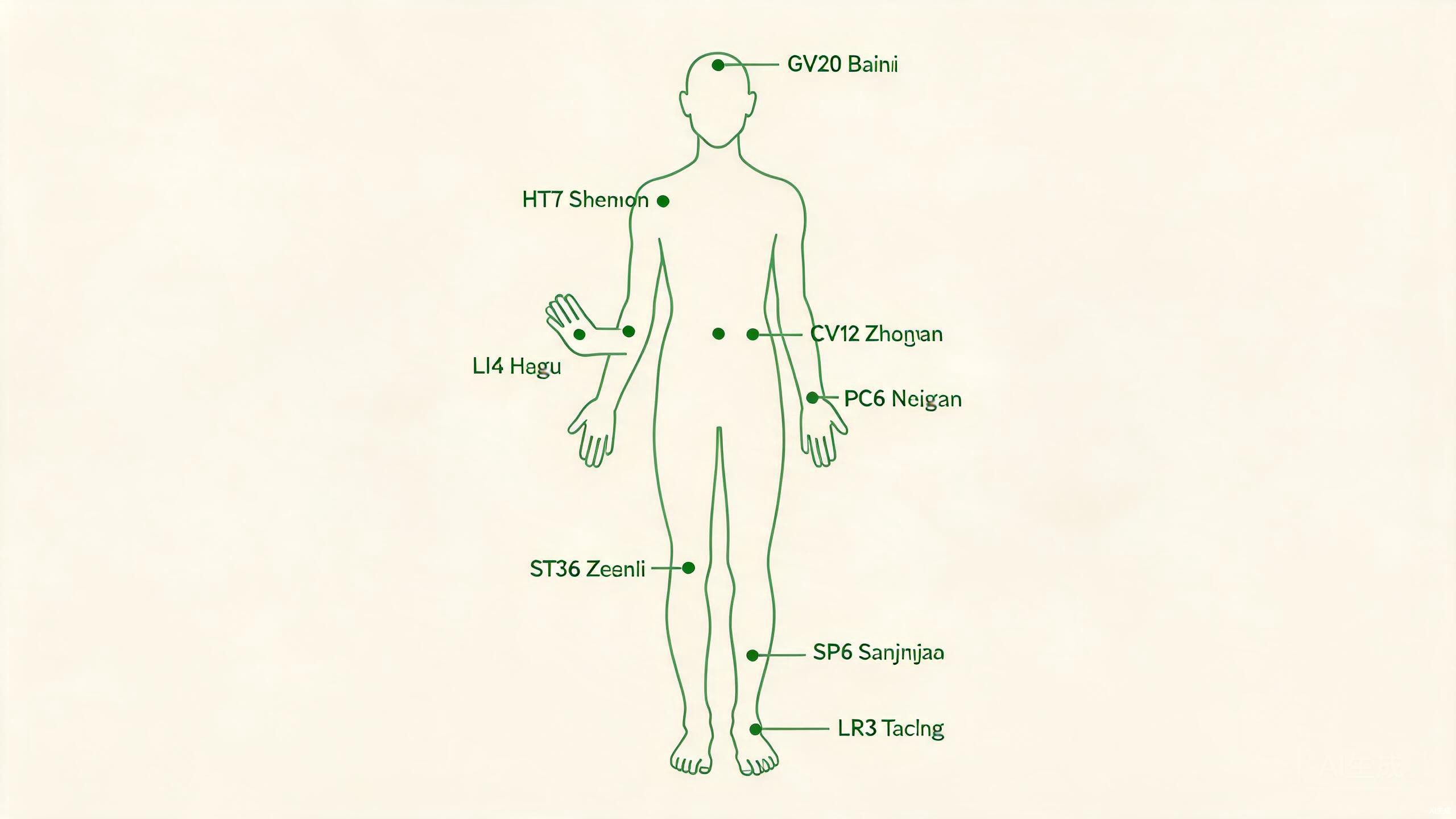
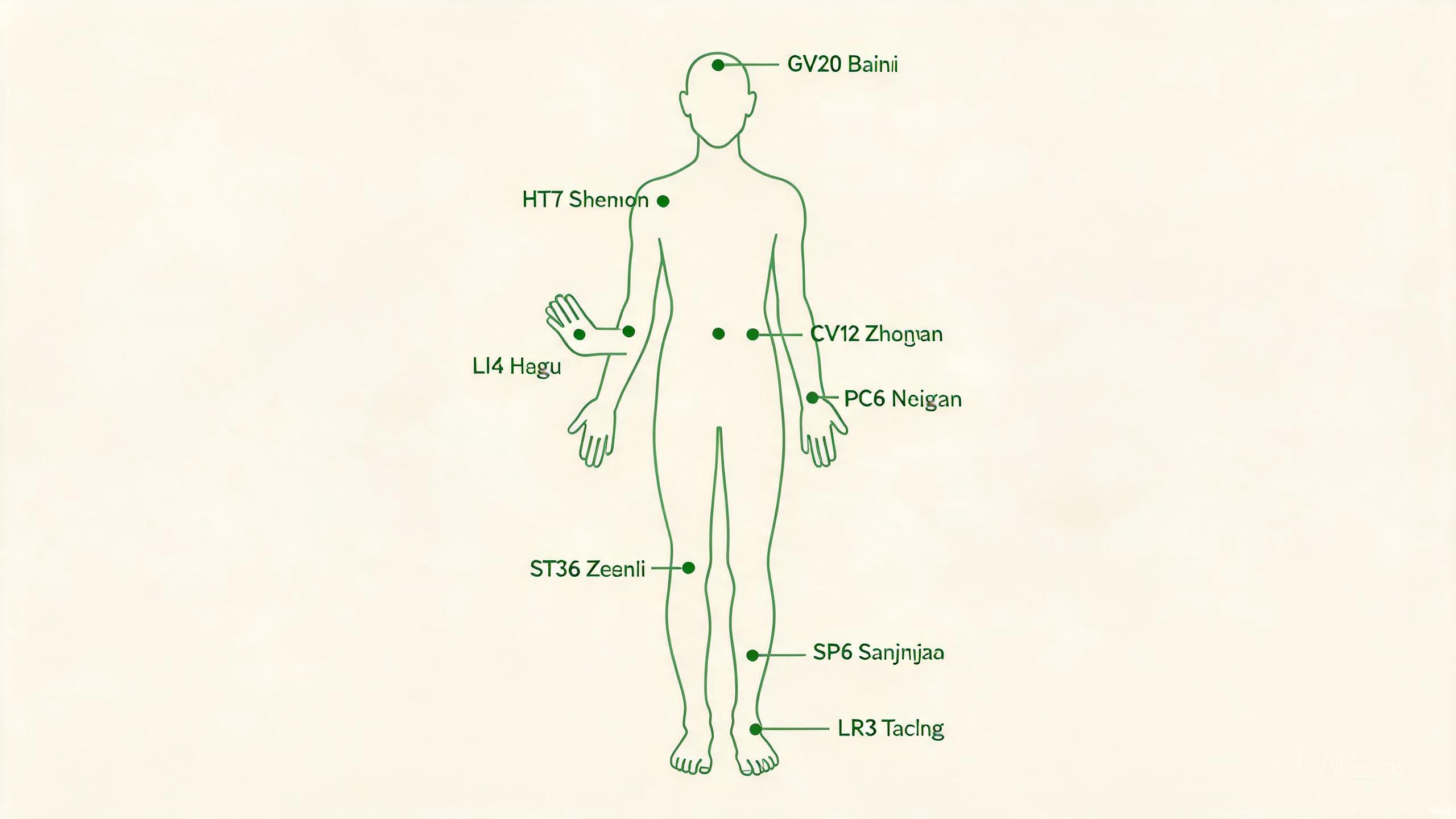
- The 10 points are organized into five practical groups: head and face, digestive, calming, pain relief, and emergency.
- Press each point with firm, steady pressure for 1 to 3 minutes, using the thumb or index finger. The correct sensation is a dull ache, not sharp pain.
- Pregnancy warning: Hegu (LI4) and Sanyinjiao (SP6) must be avoided during pregnancy as they can stimulate uterine contractions.
- Acupressure complements but does not replace medical care. Seek emergency help for serious symptoms.
This article is for wellness education only and is not medical advice. Acupressure is a complementary practice that may help relieve mild, common symptoms. It is not a substitute for professional medical care. If you have a serious medical condition, are pregnant, take medication, or experience severe or persistent symptoms, consult your healthcare provider before using acupressure. Emergency points are described for educational purposes — in a true emergency, call emergency services first.
Acupressure is one of the most accessible tools in the TCM toolkit. It requires nothing more than your own hands, can be performed anywhere, and has been used for thousands of years to relieve everyday ailments. The principle is simple: specific points on the body's surface connect to internal organs and meridians, and applying pressure to these points can influence the flow of qi and blood, helping to restore balance and relieve symptoms.
This guide covers 10 essential acupressure points that every household should know, organized into five practical groups. For each point, you will learn its precise location, how to press it, what symptoms it addresses, and any safety precautions. Before starting, read our acupressure safety guide for general safety guidelines.
How Acupressure Works: The Basics
In TCM theory, the body is traversed by a network of meridians — channels through which qi (vital energy) and blood flow. Along these meridians are specific points where the energy comes close to the surface and can be influenced. Acupressure uses finger pressure (rather than acupuncture needles) on these points to regulate qi flow, reduce stagnation, and promote the body's natural healing response.
Several principles make acupressure effective:
- Local effect: Pressing a point near the site of pain or tension increases blood flow and relaxes the muscles in that area.
- Distal effect: Pressing a point far from the problem area can still influence it through the meridian connection. For example, Hegu (LI4) on the hand affects the face and head.
- Systemic effect: Certain points have broad regulatory effects on the nervous system, calming the mind or boosting digestion overall.
For best results, press points on both sides of the body (the meridians run bilaterally), breathe slowly and deeply while pressing, and maintain consistent pressure for 1 to 3 minutes per point. For a deeper understanding of meridians, see our guide to zang-fu organs.
Head and Face Points: Taiyang and Yingxiang (LI20)
The head and face are the most common sites for everyday discomfort — headaches, sinus pressure, and nasal congestion. These two points address these issues directly.
1. Taiyang (EX-HN5) — The Temple Point
Best for: Tension headaches, migraine, eye strain, temporal pain
Location: In the depression at the temple, approximately one finger-width lateral to the outer end of the eyebrow. You will feel a small hollow depression when you press into the soft tissue between the eyebrow end and the hairline.
How to press: Use the pads of your index or middle fingers. Apply gentle, circular pressure in a clockwise direction for 1 to 2 minutes on each side. The pressure should be gentle — the temples are delicate. If you feel a pulse, avoid pressing directly on it.
Contraindications: Avoid if you have a skin infection or wound on the temple. Very light pressure only — the temporal area has thin tissue over blood vessels.
2. Yingxiang (LI20) — The Nasal Congestion Point
Best for: Nasal congestion, sinusitis, runny nose, loss of smell
Location: In the nasolabial groove (the smile line), beside the midpoint of the outer edge of the nostril. To find it, smile slightly and locate the crease that runs from the side of the nose to the corner of the mouth. The point is in this crease, level with the bottom of the nose.
How to press: Use your index fingers to press upward and inward, toward the base of the nose. Apply moderate pressure and hold for 30 seconds to 1 minute, then release and repeat. You may feel a sensation that opens the nasal passages.
Contraindications: Avoid if you have facial acne or skin irritation in the area. Safe for most people, including children over 5.
Digestive Points: Zhongwan (CV12) and Zusanli (ST36)
Digestive complaints are among the most common reasons people seek acupressure. These two points work together to strengthen digestion and relieve discomfort.
3. Zhongwan (CV12) — The Stomach Center Point
Best for: Stomach pain, bloating, indigestion, nausea, acid regurgitation
Location: On the midline of the abdomen, midway between the lower end of the sternum (breastbone) and the navel. To find it, place four fingers below the sternum — the point lies at the lower edge of the fourth finger on the midline.
How to press: Lie down or sit comfortably. Use the pads of three fingers (index, middle, ring) to press gently into the abdomen at this point. Apply mild, steady pressure for 2 to 3 minutes. The pressure should feel comfortable — never press hard enough to cause pain. Circular motions can help relieve bloating.
Contraindications: Avoid during pregnancy (abdominal points). Avoid after recent abdominal surgery. Do not press forcefully on a full stomach.
4. Zusanli (ST36) — The Longevity Point
Best for: General digestive weakness, fatigue, low immunity, leg weakness, nausea
Location: On the outer side of the lower leg, about four finger-widths below the kneecap and one finger-width lateral to the shin bone (tibia). You will feel a slight depression in the muscle, and the point is often tender when pressed. It is one of the most important and widely used points in all of TCM.
How to press: Use your thumb to press firmly downward and slightly inward toward the bone. Apply moderate to firm pressure for 2 to 3 minutes per leg. For a daily wellness practice, press both sides each morning. Zusanli is traditionally called the "leg three mile" point because pressing it was said to enable a tired traveler to walk another three miles.
Contraindications: Avoid over broken skin or bruises. Safe for daily use by most people. For a complete guide, see our detailed Zusanli (ST36) guide.
Zusanli is the single most important point for daily wellness in TCM. Pressing it for 3 minutes each morning is said to strengthen digestion, boost energy, and support immunity. It is suitable for people of all ages and is the most commonly recommended point for home practice.
Calming Points: Shenmen (HT7) and Neiguan (PC6)
These two wrist points are the premier calming and nausea-relief points in TCM. They are safe, easy to find, and extraordinarily versatile.
5. Shenmen (HT7) — The Spirit Gate
Best for: Anxiety, insomnia, palpitations, emotional agitation, racing thoughts
Location: On the wrist crease, on the pinky-finger side, in the small depression between the pisiform bone (the pea-shaped bone) and the ulnar artery. Turn your palm up, find the wrist crease, and move to the pinky side. Feel for the small pea-shaped bone — the point is just to the thumb side of it.
How to press: Use your thumb to press into the depression with moderate pressure. Hold for 1 to 3 minutes per wrist while breathing slowly (inhale 4 counts, exhale 6-8 counts). Best used before sleep and during moments of anxiety. For a complete guide, see our Shenmen (HT7) guide.
Contraindications: Avoid pressing directly on the pulse (ulnar artery). Generally safe, including during pregnancy. Avoid over sprains or wounds.
6. Neiguan (PC6) — The Inner Gate
Best for: Nausea, vomiting, motion sickness, morning sickness, chest tightness, anxiety with chest pressure
Location: On the inner forearm, three finger-widths above the wrist crease, between the two tendons (palmaris longus and flexor carpi radialis). To find it, place three fingers of your opposite hand across the inner wrist, starting from the crease. The point lies just beyond the third finger, between the two visible tendons.
How to press: Use your thumb to press firmly between the tendons, angled slightly toward the center of the forearm. Hold for 2 to 3 minutes per arm. For motion sickness, begin pressing 10 minutes before travel and continue as needed. This is one of the most studied acupressure points for nausea, with clinical evidence supporting its use.
Contraindications: Safe during pregnancy (it is one of the preferred points for morning sickness). Avoid over wounds or tendonitis. For a complete guide, see our Neiguan (PC6) guide.
Pain Relief Points: Hegu (LI4) and Weizhong (BL40)
These two points are the classic TCM pain relief points — one for the upper body and one for the lower body. Together, they cover the two most common pain complaints: headache/toothache and lower back pain.
7. Hegu (LI4) — The Great Eliminator
Best for: Headache, toothache, facial pain, neck pain, general upper body pain
Location: On the back of the hand, in the webbing between the thumb and index finger. To find it precisely, place the thumb of your opposite hand in the web between the thumb and index finger, with the thumb pad resting on the midpoint of the second metacarpal bone (the bone along the index finger). When you press, the point is at the highest point of the muscle bulge when you bring the thumb and index finger together.
How to press: Use your thumb to press firmly into the point, angled toward the index finger bone. Apply firm pressure (this is a fleshy area and can take strong pressure) for 1 to 3 minutes per hand. The correct sensation is a strong, dull ache that may radiate up the arm. This is one of the most effective points for headache relief.
Contraindications: ABSOLUTELY AVOID DURING PREGNANCY. Hegu is one of the primary points used to induce labor and must never be pressed by pregnant women. Also avoid over skin infections or wounds. For a complete guide, see our Hegu (LI4) guide.
Hegu (LI4) on the hand and Sanyinjiao (SP6) on the inner lower leg are strictly contraindicated during pregnancy. These points can stimulate uterine contractions and are traditionally used to induce labor. Pregnant women should avoid pressing these points entirely. If you are pregnant and have headaches, use Taiyang (temple point) or Shenmen (wrist) instead.
8. Weizhong (BL40) — The Back Pain Point
Best for: Lower back pain, acute back sprain (lumbar strain), leg cramps, knee stiffness
Location: At the center of the back of the knee, in the popliteal crease (the crease that forms when you bend your knee). The point is at the midpoint of this crease, between the two tendons you can feel on either side.
How to press: Sit down and bend the knee slightly. Use your thumbs to press into the center of the knee crease. Apply moderate to firm pressure for 1 to 2 minutes per leg. For acute lower back pain, press both knees simultaneously while seated. The sensation should be a strong ache, not sharp pain.
Contraindications: Avoid pressing over varicose veins in the popliteal area. Use lighter pressure if you have knee problems. Do not press on a fully straightened knee — always bend slightly.
Emergency Points: Renzhong (GV26) and Shixuan (EX-UE10)
These points are traditionally used in emergencies — specifically for fainting, loss of consciousness, and high fever. They are described here for educational purposes. In any medical emergency, your first action should be to call emergency services. These points are not a substitute for emergency medical care.
9. Renzhong (GV26) — The Revival Point
Traditionally used for: Fainting, loss of consciousness, shock, heatstroke
Location: In the philtrum — the vertical groove between the bottom of the nose and the upper lip. The point is located at the upper one-third of this groove, closer to the nose than to the lip.
How to press: Use your thumbnail or index fingernail to press firmly downward into the point. The pressure should be strong and sharp — this is an intentionally stimulating technique meant to rouse someone from unconsciousness. Press for 10 to 30 seconds. This point is also sometimes used for acute lower back pain by pressing firmly with a fingernail.
Contraindications: Do not rely on this point as a substitute for emergency medical care. If someone loses consciousness, call emergency services immediately. Do not press if the person has a suspected head or neck injury. Do not press on broken skin. If the person does not respond, begin CPR if trained.
10. Shixuan (EX-UE10) — The Ten Finger Tips
Traditionally used for: High fever, loss of consciousness, heatstroke, sore throat, convulsions
Location: These are ten points — one at the center of each fingertip, approximately 0.1 cun (a very small distance) from the free edge of the nail. The name "Shixuan" means "ten manifestations."
How to press: For simple stimulation without bloodletting, pinch each fingertip firmly between the thumb and index finger of your opposite hand, applying strong pressure for 5 to 10 seconds per finger. In clinical TCM, these points are also used with bloodletting (pricking the fingertip to release a few drops of blood), but bloodletting must only be performed by a qualified practitioner with sterile technique. Do not attempt bloodletting at home.
Contraindications: Pinching the fingertips is generally safe for adults. Do not attempt bloodletting at home — it requires sterile, single-use lancets and professional technique. As with all emergency points, call emergency services first in cases of unconsciousness, high fever with convulsions, or heatstroke.
If someone is unconscious, having a seizure, or has a dangerously high fever (especially in children), call emergency services immediately. While you wait, you may use acupressure on Renzhong or pinch the fingertips as a complementary measure, but it should never delay or replace emergency medical care. If someone is unresponsive and not breathing normally, begin CPR if you are trained.
Pregnancy Warnings: Points to Avoid
Pregnancy requires special caution with acupressure. Certain points are traditionally known to stimulate uterine contractions and must be avoided throughout pregnancy. The most important points to avoid are:
| Point | Location | Why Avoid |
|---|---|---|
| Hegu (LI4) | Web between thumb and index finger | Strongly stimulates uterine contractions; traditionally used to induce labor |
| Sanyinjiao (SP6) | Inner lower leg, 4 fingers above ankle | Stimulates contractions; also used to promote labor |
| Zhongwan (CV12) and abdominal points | Midline of abdomen | Direct pressure on the abdomen should be avoided during pregnancy |
| Sacral points (BL31-BL32) | Lower back/sacrum | Can stimulate pelvic organs and contractions |
| Points on the lower back and sacrum | Various | Generally avoided, especially in the first and third trimesters |
Safe points during pregnancy include: Shenmen (HT7) on the wrist, Neiguan (PC6) on the forearm, Zusanli (ST36) on the lower leg (outer side), Taiyang (temple), and Yingxiang (beside the nose). Always consult your obstetrician or a qualified TCM practitioner before using acupressure during pregnancy. For more details, see our acupressure safety guide.
Building a Home Acupressure Routine
You do not need to use all 10 points every day. Instead, build a simple routine based on your most common needs:
- Daily wellness (3 minutes): Press Zusanli (ST36) on both legs each morning to strengthen digestion and boost energy.
- Stress and sleep (5 minutes): Before bed, press Shenmen (HT7) and Neiguan (PC6) on both wrists to calm the mind and prepare for sleep.
- Headache first aid (3 minutes): At the first sign of a headache, press Taiyang (temples) and Hegu (LI4) — unless pregnant.
- Nausea relief (2 minutes): Press Neiguan (PC6) on both forearms for motion sickness or mild nausea.
- Back pain relief (3 minutes): Press Weizhong (BL40) in the back of both knees for acute lower back pain.
Remember: acupressure works best with consistency. Gentle, regular practice over weeks produces more meaningful results than occasional intense sessions. Combine acupressure with other TCM wellness practices — such as calming herbal teas or body self-assessment — for a holistic approach to everyday health.
Frequently Asked Questions
How hard should I press acupressure points?
Apply firm but comfortable pressure. The correct sensation is a dull ache or mild tenderness, not sharp pain. On a scale of 1 to 10, aim for about a 5 or 6 — you should feel the pressure clearly but it should not make you wince or hold your breath. Points on the hands and feet can take firmer pressure than points on the face or abdomen. If a point is very tender, start gently and gradually increase pressure. Never press so hard that you bruise.
How long does it take for acupressure to work?
For acute symptoms like headache, nausea, or hiccups, you may feel relief within 5 to 15 minutes of pressing. For chronic conditions like digestive weakness or anxiety, consistent daily practice for 1 to 2 weeks is typically needed before noticing significant change. Acupressure is cumulative — regular, gentle practice produces better results than occasional intense sessions.
Can I use acupressure points every day?
Yes, most acupressure points are safe to press daily. Points like Zusanli (ST36), Shenmen (HT7), and Neiguan (PC6) are commonly used as part of a daily wellness routine. Limit each session to 3 to 5 minutes per point, and avoid pressing the same point if the area becomes sore or bruised. Always work both sides of the body for balance.
Which acupressure points should pregnant women avoid?
Pregnant women must avoid Hegu (LI4) on the hand, Sanyinjiao (SP6) on the inner lower leg, points on the lower abdomen, and points on the sacral region, as these can stimulate uterine contractions. Points on the shoulders, wrists, and face are generally safer. Always consult your obstetrician or a qualified TCM practitioner before using any acupressure during pregnancy.
This article is for educational and informational purposes only and is not a substitute for professional medical advice, diagnosis, or treatment. Acupressure is a complementary wellness practice and is not intended to diagnose, treat, or cure any medical condition. The emergency points described are for educational purposes only — in a medical emergency, call emergency services immediately. Always consult a qualified healthcare provider before beginning any new wellness practice, especially if you are pregnant, nursing, taking medication, or have a medical condition. Read our full disclaimer →