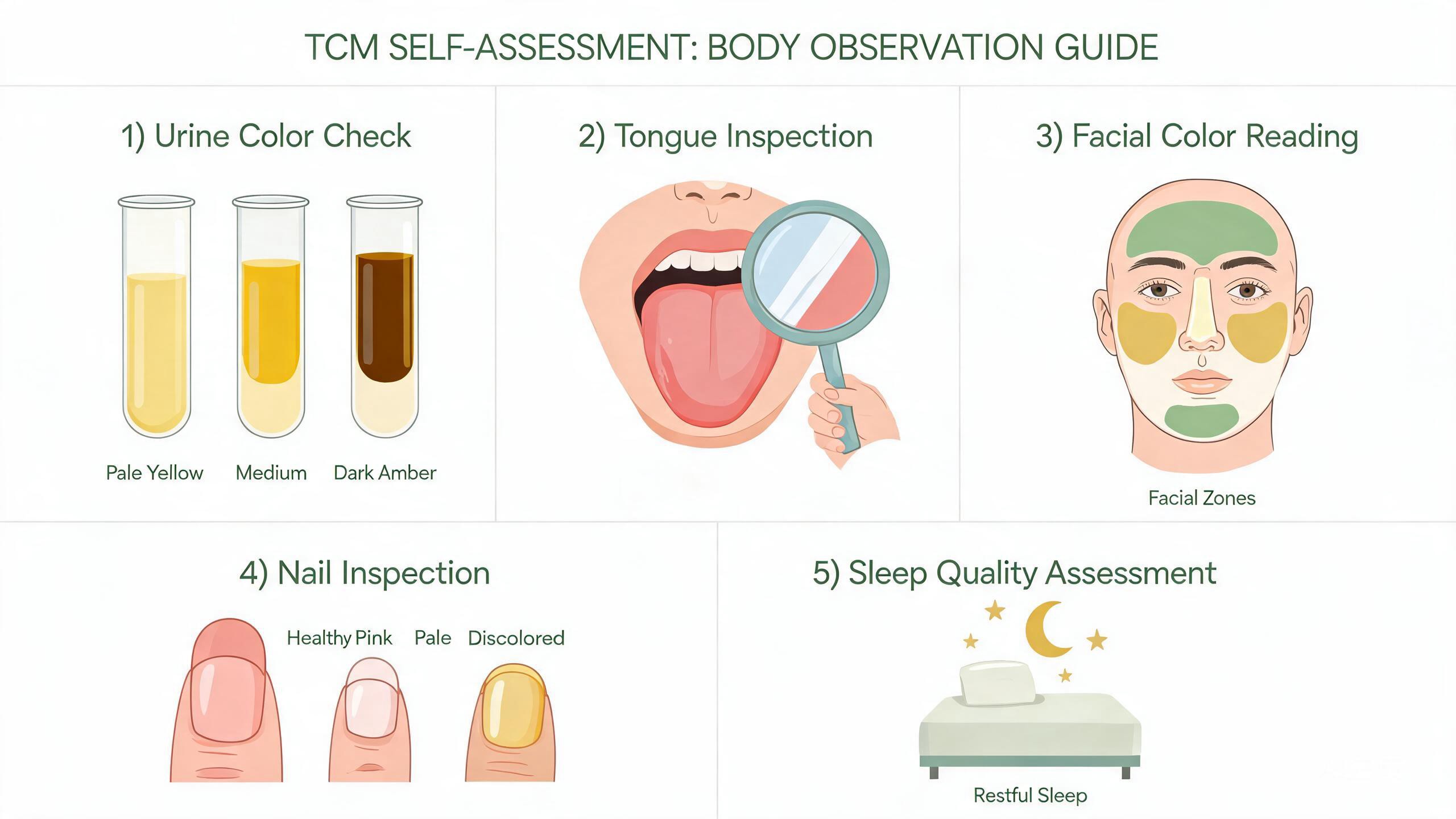
Key Takeaways
- TCM Wang Zhen (observation diagnosis) teaches that the body constantly broadcasts its internal state through visible external signs.
- Urine color reflects fluid metabolism and heat patterns — dark yellow suggests damp-heat, pale and copious suggests cold or yang deficiency.
- Mucus and phlegm reveal the nature of respiratory patterns — clear and thin indicates wind-cold, yellow and thick indicates wind-heat.
- Facial color mirrors organ health — red suggests heat, pale suggests deficiency, sallow yellow suggests spleen weakness.
- Nails and sleep quality offer additional windows into qi, blood, and organ balance.
- These observations are for wellness awareness only and cannot replace professional medical diagnosis.
This article is for wellness education only and is not medical advice. The self-assessment methods described here are based on Traditional Chinese Medicine observation traditions and are intended to help you develop greater body awareness. They cannot diagnose, treat, or cure any disease. If you notice persistent or concerning changes, or if you have a medical condition, consult a qualified healthcare provider. Do not self-diagnose or self-treat based on these observations alone.
One of the most remarkable principles in Traditional Chinese Medicine is that the body is constantly communicating its internal state through external signs. The color of your urine, the consistency of your mucus, the hue of your complexion, the texture of your nails, and the quality of your sleep all carry information about what is happening inside. This principle is called Wang Zhen (望诊) — observation diagnosis — and it is the first of the four diagnostic methods in TCM.
While a fully trained TCM practitioner spends years learning to read these signs in the context of a complete diagnostic framework, you can begin developing body awareness at home using five foundational observation methods. This guide walks you through each one, explaining what to look for, what the findings may suggest from a TCM perspective, and when to seek professional care.
How TCM Views Body Observation
In TCM theory, the body is understood as an integrated whole where internal organs manifest their state on the surface. The classic text Huangdi Neijing (Yellow Emperor's Inner Canon) states: "Observe the external to know the internal." This means that changes in the body's visible outputs — urine, mucus, skin color, nails — are not random. They reflect the relative balance of yin and yang, qi and blood, and the functional state of the organs.
It is important to understand that TCM observation does not work the same way as a laboratory test. A blood test gives you a number; TCM observation gives you a pattern. For example, dark yellow urine does not simply mean "you have condition X." In the TCM framework, it suggests a pattern of damp-heat or internal fire — an excess of heat that is concentrating fluids. This pattern might also show up as a yellow tongue coating, a feeling of heat, irritability, or thirst. The practitioner pieces together multiple signs to form a complete picture.
At home, you can use these observations as a daily wellness check — a way to notice when something feels off and to track patterns over time. Think of it as developing a conversation with your body. For foundational TCM concepts, our guide to yin and yang and our overview of zang-fu organs provide helpful background.
Urine Observation: What Color Tells You
Urine is one of the most direct reflections of the body's fluid metabolism and thermal state. In TCM, the kidneys govern water metabolism, while the bladder stores and excretes urine. The spleen and lungs also play roles in fluid distribution. Changes in urine color, volume, and clarity can therefore suggest patterns involving multiple organ systems.
How to Observe
Check your urine in a clear container or by looking at the toilet bowl against a white background. The best time for observation is the first morning void, as it is the most concentrated and reflects the body's overnight state. Note the color (pale yellow, dark yellow, clear, brown, red-tinged), the volume (copious or scanty), and any cloudiness or sediment.
Normal Appearance
Pale to light yellow, clear, and of moderate volume. Slight variation throughout the day is normal — darker after dehydration or intense exercise, lighter after drinking lots of water.
Abnormal Findings and TCM Interpretation
| Observation | TCM Pattern | Possible Meaning |
|---|---|---|
| Dark yellow or amber | Damp-Heat / Internal Fire | Heat is concentrating fluids; may accompany irritability, thirst, or constipation. Often from spicy food, insufficient water, or emotional stress. |
| Pale, clear, and copious | Cold Pattern / Yang Deficiency | The body lacks warming energy; fluids are not being transformed properly. May accompany cold limbs, fatigue, or frequent nighttime urination. |
| Cloudy or turbid | Dampness / Turbid Dampness | Fluid metabolism is impaired; dampness is accumulating. May accompany heavy limbs, sticky mouth, or abdominal bloating. |
| Red-tinged or bloody | Blood Stasis / Heat in Lower Jiao | Requires immediate medical evaluation. In TCM, may indicate heat injuring blood vessels or blood stasis in the lower abdomen. |
| Scanty and dark | Heat or Yin Deficiency | Fluids are depleted by heat or insufficient yin. May accompany dry mouth, night sweats, or fever. |
Important Notes
- Urine color is heavily influenced by hydration, diet (beets, supplements, food dyes), and medications. Always rule out these factors first.
- Red-tinged urine, painful urination, or sudden changes in urinary frequency require prompt medical evaluation — do not attempt to interpret these with TCM alone.
- Track patterns over several days rather than fixating on a single observation.
Mucus and Phlegm Observation: Reading Your Secretions
In TCM, the lungs are called the "delicate organ" because they are the most directly connected to the external environment through breath. The respiratory tract produces mucus as a protective mechanism, and the characteristics of that mucus — color, thickness, and quantity — provide valuable information about the nature of respiratory patterns.
How to Observe
If you have nasal discharge or are coughing up phlegm, observe the color (clear, white, yellow, green, gray), consistency (thin and watery, thick and sticky, jelly-like), and quantity (scanty or copious). Morning is often the best time to observe, as secretions accumulate overnight.
Normal Appearance
Minimal clear, thin mucus. The respiratory tract is moist but not congested. A small amount of clear nasal discharge in cold or dry weather is normal.
Abnormal Findings and TCM Interpretation
| Observation | TCM Pattern | Possible Meaning |
|---|---|---|
| Clear, thin, watery | Wind-Cold | External cold has invaded the lungs. May accompany sneezing, aversion to cold, clear nasal drip, and mild headache. The classic early cold pattern. |
| Yellow, thick, sticky | Wind-Heat | Heat is affecting the lungs. May accompany sore throat, fever, thirst, and rapid pulse. Often appears as a cold progresses. |
| White, sticky, copious | Phlegm-Dampness | Spleen function is impaired, producing internal dampness that congeals as phlegm. May accompany chest tightness, fatigue, and poor appetite. |
| Green or purulent | Heat Toxins / Bacterial Infection | Severe heat pattern. Requires medical evaluation, as this may indicate a bacterial respiratory infection. |
| Blood-streaked | Heat Injuring Vessels / Yin Deficiency | Requires medical evaluation. In TCM, may indicate lung heat or yin deficiency drying and damaging small blood vessels. |
| Dry, scanty, hard to expectorate | Lung Yin Deficiency / Dryness | Lung moisture is depleted. May accompany dry cough, dry throat, and night sweats. |
Important Notes
- The progression from clear to yellow mucus during a cold often reflects the natural course of the illness in TCM terms (wind-cold transforming to wind-heat).
- Persistent phlegm lasting weeks or months, especially if blood-streaked, requires medical evaluation.
- Chronic phlegm-dampness is often related to diet — excessive dairy, sweets, or fried foods can worsen this pattern. See our guide to dampness-removing foods for dietary support.
Facial Color Observation: The Face as a Health Mirror
In TCM, the face is considered a microsystem that reflects the state of the internal organs. Different zones of the face correspond to different organ systems: the forehead relates to the heart, the area between the eyebrows to the liver, the bridge of the nose to the spleen, the tip of the nose to the spleen and stomach, the cheeks to the lungs, and the chin to the kidneys. The overall facial color provides information about the body's qi, blood, and thermal balance.
How to Observe
Examine your face in natural daylight, ideally in the morning before applying skincare products. Look at the overall complexion first, then examine specific zones. Note the base color, any patches of different color, and whether the color looks vibrant or dull. Compare with a photo from a few months ago if possible.
Normal Appearance
A healthy TCM complexion is described as "containing red within yellow" — a warm, slightly rosy tone that is bright and moist. The skin should look vital, not dull or waxy. In people with darker skin tones, look for a natural glow and even tone rather than specific color hues.
Abnormal Findings and TCM Interpretation
| Facial Color | TCM Pattern | Possible Meaning |
|---|---|---|
| Red (flushed, especially face) | Heat Pattern | Excess heat in the body. May accompany irritability, thirst, rapid pulse. If only the cheeks are red, it may indicate yin deficiency with empty heat (often afternoon flush). |
| Pale or white | Deficiency / Cold | Qi or blood deficiency, or cold pattern. May accompany fatigue, dizziness, cold limbs, or shortness of breath. Sudden paleness with cold sweat requires emergency care. |
| Sallow yellow (萎黄) | Spleen Qi Deficiency | The spleen's function of transforming and transporting is impaired. May accompany poor appetite, bloating, fatigue, and loose stools. Often related to poor diet or overthinking. |
| Bluish or purplish (青紫) | Blood Stasis / Cold / Pain | Blood circulation is impaired. May accompany localized pain, menstrual clots, or chest tightness. A bluish tinge around the mouth and lips in children requires urgent medical evaluation. |
| Dark or blackish (暗黑) | Kidney Deficiency | Often seen as dark circles under the eyes or a generally dark, dull complexion. May accompany lower back weakness, frequent urination, or fatigue. Chronic illness can also produce this color. |
| Bright yellow (jaundice) | Damp-Heat in Liver/Gallbladder | Requires immediate medical evaluation. In TCM, indicates damp-heat obstructing the liver and gallbladder, causing bile to overflow. |
Important Notes
- Facial color is influenced by genetics, sun exposure, skincare, sleep, and emotional state. A single flushed or pale moment is not diagnostic.
- The most useful approach is to track your baseline and notice persistent changes from that baseline.
- Dark circles can reflect kidney deficiency in TCM, but they are also common with simple sleep deprivation, allergies, or genetics.
- For related reading, see our TCM tongue diagnosis guide, which complements facial observation.
Nail Observation: Windows to Your Organs
In TCM, the nails are considered the "surplus of the liver and blood." The liver stores blood and governs the tendons and nails, so nail health reflects the adequacy of liver blood and the smooth flow of qi and blood to the extremities. The shape, color, texture, and markings of the nails can all provide clues.
How to Observe
Examine your fingernails in natural light, without nail polish. Look at the color of the nail bed (the skin beneath the nail), the lunula (the white half-moon at the base), the surface texture (smooth or ridged), and any spots or discoloration. Press the nail briefly and release — note how quickly the pink color returns (capillary refill).
Normal Appearance
Pink nail beds, smooth surface, and visible lunula on the thumbs (and possibly index fingers). The nails should be flexible, not brittle. The lunula should occupy about one-fifth of the nail length. When pressed, color should return within 1-2 seconds.
Abnormal Findings and TCM Interpretation
| Observation | TCM Pattern | Possible Meaning |
|---|---|---|
| Pale or white nail beds | Blood Deficiency | Insufficient blood nourishing the nails. May accompany dizziness, pale lips, and scanty periods. Often related to poor nutrition or blood loss. |
| Red or dark red nails | Heat Pattern | Excess heat in the blood. May accompany irritability, hot temperament, or a red tongue tip. |
| Purplish nails | Blood Stasis | Blood circulation is impaired. May accompany cold hands, localized pain, or a purple tongue. |
| No visible lunula | Qi/Blood Deficiency or Cold | Some people naturally lack lunulae. If lunulae were previously visible and disappeared, it may suggest declining vitality or cold accumulation. |
| Large red lunulae | Heart Fire / Excess Heat | May accompany palpitations, insomnia, or anxiety. |
| Longitudinal ridges | Liver Blood / Yin Deficiency | Vertical lines running from base to tip. Often appears with aging, chronic stress, or poor nutrition. In TCM, reflects declining liver blood. |
| Transverse lines (Beau's lines) | Severe Qi Deficiency | Horizontal grooves indicating a period of severe illness or stress that temporarily halted nail growth. The nail records the event. |
| White spots | Qi Deficiency / Parasites (traditional) | Often simply minor trauma to the nail matrix. In TCM tradition, multiple spots may suggest qi deficiency or digestive weakness. |
| Brittle, splitting nails | Liver Blood / Yin Deficiency | Nails lack moisture and nourishment. May accompany dry eyes, dry skin, or brittle hair. |
Important Notes
- Nail changes develop slowly because nails grow approximately 3 mm per month. A transverse line at the halfway point of the nail reflects an event from approximately 3-4 months ago.
- Many nail changes are benign or caused by minor trauma, nutritional deficiencies, or fungal infections. If nails become thickened, discolored, or deformed, consult a dermatologist.
- Clubbing (nails that curve downward around the fingertips) is a medical sign that requires evaluation for heart or lung conditions.
Sleep Quality Self-Check: What Your Sleep Patterns Reveal
In TCM, sleep is governed by the relationship between the heart (which houses the Shen, or spirit) and the other organs. The heart anchors the spirit at night, and when this function is disturbed — by heat, deficiency, or stagnation in any organ — sleep problems arise. The specific nature of the sleep disturbance provides clues about which organ system is involved.
How to Assess
For one to two weeks, keep a simple sleep journal. Note: how long it takes to fall asleep, whether you wake during the night (and at what time), the quality of your dreams, whether you feel rested on waking, and any accompanying symptoms (palpitations, night sweats, vivid dreams, teeth grinding).
Normal Sleep
Falling asleep within 15-30 minutes, sleeping through the night with minimal waking, dreaming occasionally but not excessively, and waking feeling refreshed.
Abnormal Findings and TCM Interpretation
| Sleep Issue | TCM Pattern | Possible Meaning |
|---|---|---|
| Difficulty falling asleep (mind racing) | Heart Fire / Heart Yin Deficiency | The heart cannot anchor the spirit. May accompany palpitations, anxiety, a red tongue tip, or a feeling of inner heat. Often from stress, overwork, or emotional turmoil. |
| Waking easily, especially 1-3 AM | Liver Fire / Liver Qi Stagnation | The liver meridian is most active 1-3 AM. Waking during this window with a busy mind, frustration, or tension suggests liver imbalance. May accompany irritability or eye strain. |
| Excessive dreaming, restless sleep | Heart-Spleen Deficiency | Insufficient qi and blood to nourish the heart. May accompany fatigue, poor appetite, overthinking, and poor memory. Often from worry or inadequate nutrition. |
| Waking 3-5 AM with cough or nasal congestion | Lung Imbalance | The lung meridian peaks 3-5 AM. Waking with respiratory symptoms during this window suggests lung patterns. |
| Excessive sleepiness, hard to wake | Dampness Obstructing Spleen / Yang Deficiency | The body feels heavy and sluggish. Dampness clouds the head and spleen. May accompany heavy limbs, sticky mouth, or post-meal drowsiness. |
| Night sweats | Yin Deficiency (Heart or Kidney) | The body lacks cooling yin, so heat rises at night and forces sweat. May accompany a dry mouth, red cheeks, or hot palms and soles. |
| Teeth grinding | Stomach Heat / Parasites (traditional) / Liver Wind | Often stress-related. In TCM, may indicate stomach heat, liver wind, or in children, digestive parasites (a traditional interpretation). |
Important Notes
- The TCM organ clock (meridian time clock) assigns each organ a two-hour peak window. Waking consistently at the same time can be a clue to which organ system is involved.
- Sleep issues have many causes beyond TCM patterns — caffeine, screen use, sleep apnea, thyroid disorders, and medications all affect sleep. Rule out lifestyle factors first.
- For practical sleep support, see our guides on TCM teas for sleep and TCM insomnia types.
- Chronic insomnia lasting more than a few weeks warrants professional evaluation.
How to Use These Observations Responsibly
Now that you understand the five observation methods, here are guidelines for using them wisely:
- Look for patterns, not single moments. One day of dark yellow urine after a spicy meal is not a diagnosis. Look for consistent patterns over days or weeks.
- Consider context. Every sign must be interpreted in context. Facial flushing after exercise is normal; persistent redness with irritability is not.
- Use the body clock. The TCM organ clock can help you connect symptoms to organ systems. Waking at 2 AM and feeling frustrated points differently than waking at 4 AM with a cough.
- Track changes from your own baseline. Everyone's "normal" is different. The most valuable information comes from noticing when something deviates from your personal baseline.
- Do not self-treat based on observations alone. If you identify a pattern that concerns you, consult a qualified TCM practitioner who can perform a complete diagnosis, or see your healthcare provider for medical evaluation.
- Combine observations. A single sign is weak evidence. Multiple signs pointing to the same pattern (e.g., dark yellow urine, yellow tongue coating, red face, irritability all suggesting heat) provide stronger information.
For those interested in going deeper, our complete TCM tongue diagnosis guide adds another powerful observation method, and our guide to the nine TCM body types helps you understand your constitutional tendencies.
Frequently Asked Questions
Can I diagnose myself using TCM body observation?
No. The observation methods described in this article are for wellness self-awareness only and cannot replace professional medical diagnosis. TCM diagnosis requires years of training and involves combining multiple diagnostic methods — observation, listening, inquiry, and palpation — to form a complete pattern differentiation. If you notice persistent or concerning signs, consult a qualified healthcare provider or licensed TCM practitioner.
How often should I check these body signals?
A simple daily check of your urine color, facial appearance in the mirror, and sleep quality takes only a few minutes and can be part of your morning routine. Nail changes develop slowly and can be checked weekly. The goal is to develop body awareness, not to obsess over every change. If you notice a sudden or persistent change that lasts more than a few days, note it and discuss it with your healthcare provider.
Are these TCM observations scientifically validated?
Some TCM observations align with modern medical understanding — for example, dark yellow urine often does indicate dehydration, and pale nails can signal anemia. However, the TCM interpretations of these signs (such as attributing dark yellow urine to damp-heat rather than simply dehydration) are based on a different theoretical framework. These traditional observations should be used as complementary wellness awareness, not as a replacement for evidence-based medical testing.
What should I do if I notice abnormal signs?
If you notice a single mild change that resolves within a day or two, it may simply reflect temporary factors like diet, hydration, or sleep. If changes are persistent, accompanied by pain, fever, dramatic weight changes, or other symptoms, or if they cause you concern, consult a healthcare provider promptly. Do not attempt to self-treat based on these observations alone.
This article is for educational and informational purposes only and is not a substitute for professional medical advice, diagnosis, or treatment. The self-assessment methods described are based on Traditional Chinese Medicine traditions and are intended for wellness awareness only. They cannot diagnose, treat, or cure any disease. Always consult a qualified healthcare provider before beginning any new wellness practice, especially if you are pregnant, nursing, taking medication, or have a medical condition. Read our full disclaimer →