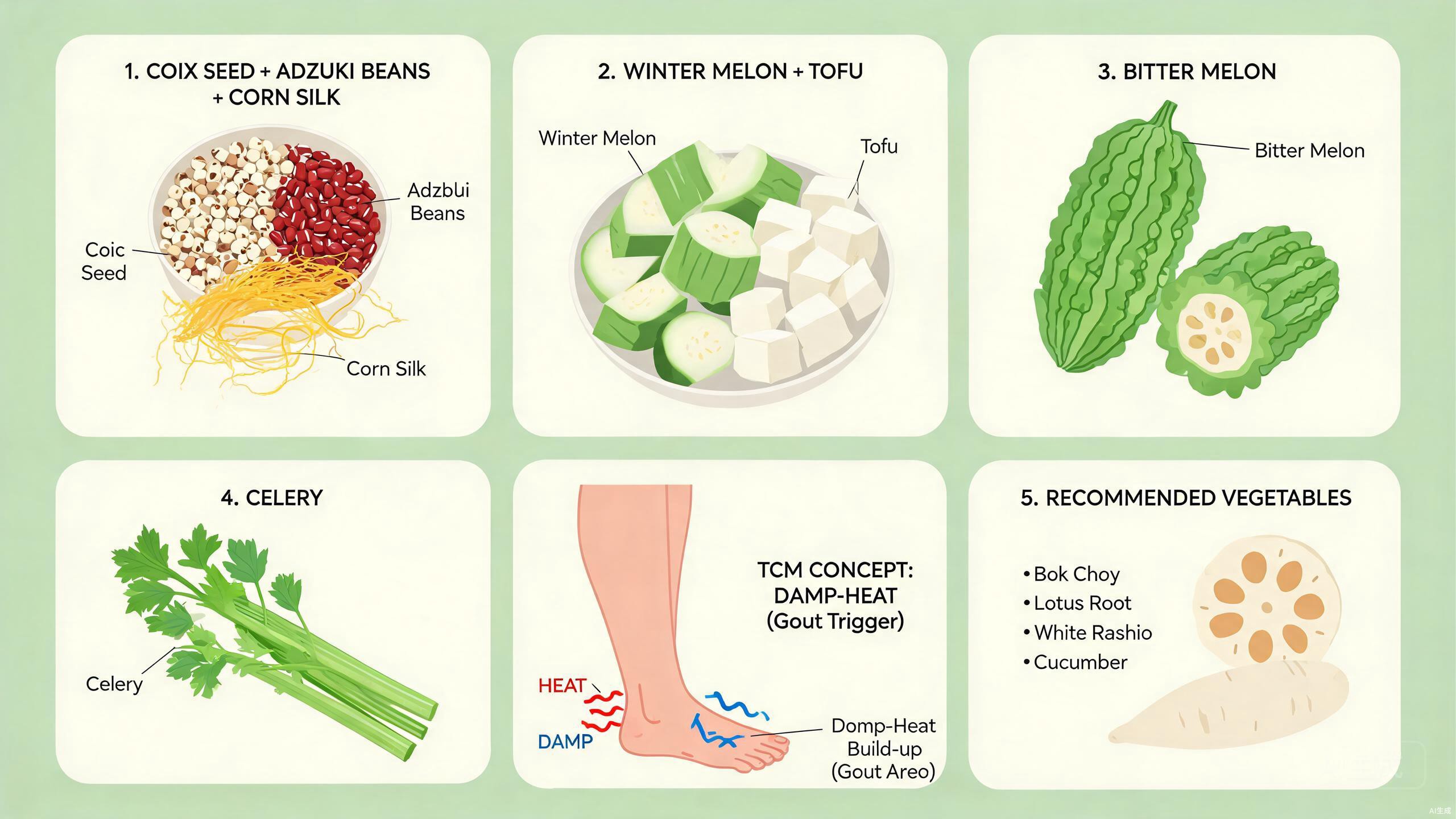
Key Takeaways
- TCM views gout through three primary patterns: damp-heat accumulation in the joints, phlegm and blood stasis blocking the meridians, and spleen-kidney deficiency impairing fluid metabolism — often triggered by a diet heavy in rich, fatty, and sweet foods.
- Five traditional food therapy recipes — from coix seed red bean corn silk tea to bitter melon pork soup — use ingredients available at Western supermarkets, Amazon, or iHerb.
- Recommended vegetables include celery, cucumber, cabbage, bitter melon, winter melon, tomato, carrot, broccoli, radish, and potato.
- Drink at least 2000 ml of water daily and avoid high-purine foods and alcohol, which TCM considers primary triggers for damp-heat.
- These are traditional wellness practices, not a treatment for gout. Joint pain and elevated uric acid require evaluation by a qualified healthcare provider.
This article is for educational purposes only and is not medical advice. The foods, teas, and practices described here are traditional wellness practices rooted in Chinese culture. They are not a substitute for professional medical care, diagnosis, or treatment. Gout is a medical condition involving elevated uric acid levels and acute joint inflammation. Symptoms — including sudden severe joint pain, swelling, redness, warmth, or tophi under the skin — require evaluation by a qualified healthcare provider. Untreated gout can lead to joint damage and kidney stones. Never stop, delay, or replace prescribed treatment based on information in this article. Some foods and herbs may interact with medications — always inform your doctor about everything you consume. These statements have not been evaluated by the FDA and are not intended to diagnose, treat, cure, or prevent any disease. Read our full disclaimer →
Gout is one of the oldest documented forms of arthritis, and its connection to diet has been recognized for centuries. Characterized by sudden, intense joint pain — most often in the big toe — gout occurs when uric acid crystals accumulate in the joints. While modern medicine manages gout with medication and dietary modification, Traditional Chinese Medicine (TCM) offers a complementary tradition of food therapy that may support overall wellness and healthy uric acid metabolism.
In TCM, gout is understood not as a single disease but as a manifestation of internal imbalance. The three primary patterns are damp-heat accumulation (湿热蕴结), phlegm and blood stasis blocking the meridians (痰瘀阻滞), and spleen-kidney deficiency (脾肾两虚). Classical TCM texts note that these patterns often arise from overindulgence in rich, fatty, greasy, and sweet foods (嗜食肥甘厚味) combined with alcohol, which generate internal damp-heat that settles in the joints. The five recipes below use foods traditionally valued for clearing damp-heat, draining dampness, and strengthening the spleen and kidneys. All ingredients are available at Western supermarkets, Asian markets, Amazon, or iHerb.
If you are new to TCM concepts, our introduction to Traditional Chinese Medicine and guide to the Zang-Fu organ systems are helpful starting points. For related dietary approaches, see our guides on dampness-removing foods and summer heat-clearing foods.
How TCM Views Gout and Uric Acid
Traditional Chinese Medicine does not use the modern term "uric acid." Instead, it understands gout-like symptoms through patterns of imbalance that affect the joints, the spleen's digestive function, and the kidneys' fluid-regulating role. According to research compiled from Chinese clinical TCM literature, three patterns are most commonly associated with gout:
1. Damp-Heat Accumulation in the Joints (湿热蕴结)
This is the most common pattern during acute gout flare-ups. Rich, fatty, sweet foods and alcohol generate internal heat and dampness. This damp-heat travels through the body and lodges in the joints, causing redness, swelling, heat, and severe pain — especially in the lower extremities. The big toe is frequently affected because dampness, being heavy in nature, tends to settle downward. Signs include a red, warm, swollen joint, thirst with little desire to drink, dark or scanty urine, and a feeling of heaviness.
2. Phlegm and Blood Stasis Blocking the Meridians (痰瘀阻滞)
When damp-heat persists over time, it congeals into phlegm and obstructs the flow of qi and blood. This stagnation hardens into nodules — the TCM understanding of tophi, the uric acid deposits that form under the skin in chronic gout. Signs include joint deformity, hard nodules under the skin, dull persistent pain, and joints that feel stiff or enlarged. This pattern reflects a more chronic stage of the condition.
3. Spleen-Kidney Deficiency (脾肾两虚)
In TCM, the spleen transforms and transports fluids, while the kidneys govern water metabolism and excrete waste. When both are weak — from chronic illness, aging, or long-term poor diet — the body cannot properly process and eliminate metabolic waste, allowing uric acid to accumulate. Signs include fatigue, poor appetite, loose stools, lower back soreness, frequent urination, and a tendency toward flare-ups after exertion. This pattern often underlies the root cause even when acute symptoms show damp-heat. For more on the spleen's role in fluid metabolism, see our TCM for water retention guide.
Understanding these patterns helps explain why TCM food therapy emphasizes clearing damp-heat, promoting urination, and strengthening the spleen and kidneys — rather than simply avoiding purines. The recipes below are grouped by the pattern they traditionally address.
5 Food Therapy Recipes for Uric Acid Wellness
Each recipe below is matched to a specific TCM pattern. Choose the one that best fits your situation, and use it consistently for two to four weeks. All ingredients are available at Western supermarkets, Asian markets, Amazon, or iHerb.
1. Coix Seed Red Bean Corn Silk Tea (祛湿降酸饮)
Best for: Damp-heat accumulation; daily supportive tea
TCM nature and flavor: Coix seed (yi yi ren / Job's tears): sweet, bland, slightly cool. Enters the Spleen, Lung, and Kidney channels. Adzuki bean (chi xiao dou): sweet, sour, neutral. Enters the Heart and Small Intestine channels. Gordon euryale seed (qian shi / fox nut): sweet, astringent, neutral. Enters the Spleen and Kidney channels. Corn silk (yu mi xu): sweet, mild, neutral. Enters the Liver, Gallbladder, and Bladder channels.
Traditional use: This is a classic TCM dampness-draining tea. Roasted coix seed and adzuki bean are one of the most celebrated pairings in Chinese food therapy for draining dampness, promoting urination, and supporting healthy fluid metabolism. Corn silk is traditionally used to promote urination and support the bladder and kidneys, while gordon euryale seed (fox nut) strengthens the spleen and consolidates the kidneys to prevent dampness from returning. Together, this combination addresses both the symptom (damp-heat) and the root (spleen-kidney weakness) — making it a well-rounded daily tea for uric acid wellness.
Ingredients:
- 10 grams roasted gordon euryale seed (fox nut / qian shi) — available on Amazon or iHerb
- 10 grams dried adzuki beans — available at Asian markets, Amazon, or iHerb
- 10 grams roasted coix seed (Job's tears) — available on Amazon or iHerb
- 10 grams dried corn silk — available on Amazon or iHerb (or save fresh silk from corn on the cob)
- 3 cups water
Preparation: Rinse all ingredients. Soak the adzuki beans for 2 to 3 hours until slightly softened. In a pot, combine the soaked adzuki beans, roasted coix seed, gordon euryale seed, corn silk, and water. Bring to a boil, then reduce heat and simmer gently for 30 to 40 minutes. Strain into a cup. Drink 1 to 2 cups per day, preferably in the morning or afternoon. The tea is mild, slightly sweet, and earthy. The cooked adzuki beans and coix seed can be eaten. For more on coix seed, see our dampness-removing foods guide.
Precautions: Coix seed is traditionally avoided in large amounts during pregnancy. If you have a cold constitution with diarrhea, use less coix seed or add ginger. See our herbal tea safety guide for general guidance.
2. Winter Melon Coix Tofu Soup (冬瓜薏苡仁豆腐汤)
Best for: Damp-heat with swelling and heaviness in the lower body
TCM nature and flavor: Winter melon (dong gua): sweet, mild, cool. Enters the Lung, Spleen, and Bladder channels. Coix seed: as above. Tofu: sweet, cool. Enters the Spleen, Stomach, and Large Intestine channels. Cilantro: pungent, warm.
Traditional use: Winter melon is one of TCM's premier heat-clearing and dampness-draining vegetables, traditionally used to promote urination, reduce swelling, and clear heat. Paired with coix seed for dampness-draining and tofu for gentle protein nourishment, this light soup is ideal for supporting the body's natural fluid metabolism during warm weather or after rich meals. A small amount of cilantro at the end adds a gentle aromatic quality that helps move qi.
Ingredients:
- 100 grams winter melon (about 1 cup), peeled and cubed — available at Asian markets; zucchini or chayote can substitute
- 50 grams firm tofu (about 2 oz), cubed — widely available at supermarkets
- 9 grams dried coix seed (Job's tears) — available on Amazon or iHerb
- 10 grams fresh cilantro, chopped
- 3 cups vegetable or chicken broth (low sodium)
- 2 slices fresh ginger
- A pinch of sea salt
Preparation: Soak the coix seed for 2 hours. In a pot, combine the soaked coix seed, broth, and ginger. Bring to a boil, then simmer for 25 minutes. Add the winter melon and tofu, and simmer for another 15 minutes until the melon is translucent. Stir in the cilantro just before serving. Add salt to taste. Drink 1 bowl per day, preferably at lunch. For more on congee-style cooking, see our congee guide.
Precautions: This soup is cooling. If you have a cold constitution, add extra ginger. Coix seed is traditionally avoided in large amounts during pregnancy.
3. Corn Silk Poria Pork Soup (玉米须茯苓瘦肉汤)
Best for: Spleen deficiency with dampness; chronic uric acid wellness support
TCM nature and flavor: Corn silk (yu mi xu): sweet, mild, neutral. Enters the Liver, Gallbladder, and Bladder channels. Poria (fu ling): sweet, bland, neutral. Enters the Heart, Spleen, and Kidney channels. Lean pork: sweet, neutral. Enters the Spleen, Stomach, and Kidney channels.
Traditional use: This soup addresses the root pattern of chronic uric acid imbalance by strengthening the spleen and supporting the kidneys simultaneously. Corn silk is a gentle, accessible herb traditionally used to promote urination, support the kidneys and bladder, and help the body eliminate metabolic waste through urine. Poria is a medicinal mushroom traditionally used to drain dampness, strengthen the spleen, and calm the mind. Together with nourishing lean pork, this soup provides sustained support for the body's fluid and waste metabolism.
Ingredients:
- 15 grams dried corn silk — available on Amazon or iHerb
- 15 grams dried poria slices (fu ling) — available on Amazon or iHerb
- 150 grams lean pork (about 5 oz), sliced thin
- 4 slices fresh ginger
- 5 cups water
- A pinch of sea salt
Preparation: Blanch the pork in boiling water for 3 minutes, then rinse. In a pot, combine the pork, corn silk, poria, ginger, and water. Bring to a boil, then reduce heat and simmer for 60 to 90 minutes until the pork is very tender. Strain out the corn silk and poria before serving (or leave poria in, as it is edible). Add salt to taste. Drink 1 bowl of broth per day, ideally at lunch or early evening.
Precautions: Corn silk is mildly diuretic. If you take prescription diuretics or have kidney disease, consult your healthcare provider before using diuretic foods. Poria is generally gentle but consult your doctor if you take immunosuppressant medication.
Dried corn silk is widely available on Amazon and iHerb. You can also save the silk from fresh corn on the cob — simply rinse it well and air-dry it, or use it fresh. Poria (fu ling) is a white medicinal mushroom available in dried slices or powder form on Amazon and iHerb. It has a mild, neutral flavor that works well in soups and porridges.
4. Bitter Melon Pork Soup (苦瓜瘦肉汤)
Best for: Damp-heat with prominent heat signs (thirst, dark urine, joint warmth)
TCM nature and flavor: Bitter melon (ku gua): bitter, cold. Enters the Heart, Spleen, and Stomach channels. Lean pork: sweet, neutral.
Traditional use: Bitter melon is one of the most powerful heat-clearing vegetables in TCM food therapy. Its bitter-cold nature is traditionally used to clear heat, detoxify, and cool the blood. For gout patterns where heat is prominent — red, warm joints, thirst, dark urine, and irritability — bitter melon's cooling quality is particularly relevant. Paired with lean pork, this soup becomes nourishing yet clearing, making it suitable during warmer months or after dietary indulgence. Modern nutrition also recognizes bitter melon as a source of vitamin C and antioxidants.
Ingredients:
- 1 small bitter melon (about 200 grams), halved, seeded, and sliced thin — available at Asian markets and many supermarkets
- 50 grams lean pork (about 2 oz), sliced thin
- 3 slices fresh ginger
- 4 cups water or low-sodium broth
- A pinch of sea salt
Preparation: To reduce bitterness, lightly salt the sliced bitter melon and let it sit for 10 minutes, then squeeze out the liquid and rinse. Blanch the pork for 3 minutes. In a pot, combine pork, ginger, and water. Bring to a boil, then simmer for 30 minutes. Add the bitter melon and simmer for another 10 minutes until tender. Add salt to taste. Drink 1 bowl per day. For a milder version, blanch the bitter melon for 2 minutes before adding to the soup.
Precautions: Bitter melon is cold in nature. Avoid if you have a cold constitution, chronic diarrhea, or during pregnancy. If you take blood-sugar-lowering medication, monitor your levels, as bitter melon may have a mild hypoglycemic effect. See our blood sugar guide for more.
5. Celery Apple Juice (芹菜苹果汁)
Best for: Daily damp-heat clearing; gentle supportive beverage
TCM nature and flavor: Celery (qin cai): sweet, bitter, cool. Enters the Liver and Stomach channels. Apple: sweet, sour, cool. Enters the Spleen, Stomach, and Lung channels. Honey: sweet, neutral. Enters the Spleen, Lung, and Large Intestine channels.
Traditional use: Celery is a widely accessible vegetable that TCM values for clearing heat, draining dampness, and calming the liver. It is one of the most commonly recommended everyday vegetables for damp-heat patterns. Apple adds natural sweetness, moisture, and a cooling quality. A touch of honey soothes the stomach and harmonizes the combination. This fresh juice is a simple, refreshing way to incorporate damp-heat-clearing foods into a daily routine — especially in warm weather. Modern nutrition highlights celery's water content and apple's antioxidant profile.
Ingredients:
- 2 stalks fresh celery, washed and cut into pieces
- 1 medium apple (any sweet variety), cored and quartered
- 1/2 cup water
- 1 teaspoon honey (optional, to taste)
Preparation: Add the celery, apple, and water to a blender or juicer. Blend until smooth. If using a blender, strain through a fine mesh for a lighter juice, or enjoy as a smoothie. Stir in honey to taste. Drink 1 glass per day, preferably in the morning or midday. Best consumed fresh. For variety, add a small piece of cucumber for extra cooling.
Precautions: Celery and apple are both cooling. If you have a cold constitution, add a small piece of fresh ginger to the blend. Avoid giving honey to children under 12 months.
Recommended Vegetables for Uric Acid Wellness
TCM food therapy emphasizes incorporating damp-heat-clearing, dampness-draining vegetables into daily meals. According to Chinese clinical nutrition research, the following vegetables are traditionally recommended for people managing uric acid levels. All are widely available at Western supermarkets:
- Cabbage — sweet, neutral; supports the spleen and stomach, gentle and easy to digest.
- Celery — sweet, bitter, cool; clears heat, drains dampness, calms the liver.
- Cucumber — sweet, cool; clears heat, promotes urination, rich in water.
- Bitter melon — bitter, cold; clears heat, detoxifies, cools the blood.
- Winter melon — sweet, mild, cool; promotes urination, reduces swelling, clears heat.
- Tomato — sweet, sour, slightly cool; generates fluids, clears heat, supports the stomach.
- Carrot — sweet, neutral; strengthens the spleen, supports digestion, gentle and nourishing.
- Broccoli — a nutrient-dense vegetable with cooling properties in TCM, supportive of overall wellness.
- Radish — pungent, sweet, cool; moves qi, clears heat, supports digestion and phlegm resolution.
- Potato — sweet, neutral; strengthens the spleen and qi, gentle and easy to digest.
For more on the TCM understanding of dampness and diet, see our dampness-removing foods guide and hot vs. cold constitution guide.
Comparison of the Five Recipes
| Recipe | TCM Pattern | Key Action | Frequency |
|---|---|---|---|
| Coix Seed Red Bean Corn Silk Tea | Damp-Heat + Spleen-Kidney | Drain dampness, promote urination | 1 to 2 cups daily |
| Winter Melon Coix Tofu Soup | Damp-Heat (swelling) | Clear heat, drain dampness, reduce swelling | 1 bowl daily |
| Corn Silk Poria Pork Soup | Spleen Def. + Dampness | Strengthen spleen, promote urination | 1 bowl daily |
| Bitter Melon Pork Soup | Damp-Heat (heat prominent) | Clear heat, detoxify, cool blood | 1 bowl daily |
| Celery Apple Juice | Damp-Heat (daily support) | Clear heat, drain dampness, refresh | 1 glass daily |
Daily Habits and Precautions
TCM is a whole-person system. Food therapy works best when combined with supportive daily habits. According to Chinese clinical guidance on gout and diet, the following are essential:
- Drink at least 2000 ml of water daily. Adequate hydration supports the kidneys in excreting uric acid. Warm or room-temperature water is preferred in TCM, as cold beverages can weaken spleen function. Herbal teas like corn silk tea count toward your daily intake.
- Avoid high-purine foods. TCM and modern nutrition agree on limiting organ meats (liver, kidney, sweetbreads), certain seafood (anchovies, sardines, mussels, scallops), and rich meat gravies. These generate damp-heat and burden the spleen.
- Avoid alcohol, especially beer. Alcohol is one of the primary damp-heat-generating substances in TCM. Beer is particularly problematic as it also contains purines. Limit or avoid alcohol, especially during flare-ups.
- Limit rich, fatty, and very sweet foods. In TCM, excessive greasy and sweet foods (肥甘厚味) are the classic dietary cause of damp-heat and phlegm. Favor a diet of warm, cooked, easily digested foods — soups, stews, porridges, and steamed vegetables. See our congee guide for ideas.
- Maintain a healthy weight. TCM associates excess weight with phlegm-dampness. Gradual, sustainable weight management supports overall metabolic wellness. See our TCM for weight loss guide for a holistic approach.
- Exercise moderately. Gentle, regular movement like walking, tai chi, or swimming keeps qi and blood circulating. Avoid sudden, intense exercise during acute flare-ups.
Frequently Asked Questions
What does TCM say about gout?
In Traditional Chinese Medicine, gout is most commonly attributed to damp-heat accumulating in the joints, phlegm and blood stasis blocking the meridians, and spleen-kidney deficiency that impairs fluid metabolism. Classical TCM texts note that overindulgence in rich, fatty, sweet foods and alcohol generates internal damp-heat that settles in the joints, causing redness, swelling, heat, and severe pain. TCM food therapy traditionally uses ingredients like coix seed, adzuki bean, corn silk, winter melon, and bitter melon to clear damp-heat and support healthy uric acid metabolism. These are traditional wellness practices, not medical treatments for gout. For a deeper understanding of TCM organ theory, see our zang-fu organ guide.
Which Chinese medicine foods may support uric acid wellness?
Five traditional TCM food therapy recipes for uric acid wellness include coix seed red bean corn silk tea, winter melon coix tofu soup, corn silk poria pork soup, bitter melon pork soup, and celery apple juice. These recipes use ingredients available at Western supermarkets, Asian markets, Amazon, or iHerb. Damp-heat-clearing recipes (bitter melon, celery, winter melon) are best for heat-type patterns, while the spleen-strengthening recipes (corn silk poria, coix seed red bean) address the root of chronic dampness. They are traditional wellness foods, not treatments for gout or any medical condition.
Can coix seed help with gout?
Coix seed (Job's tears) is one of the most commonly used TCM foods for clearing dampness and supporting healthy fluid metabolism. It is traditionally paired with adzuki bean and corn silk in food therapy recipes aimed at promoting urination and clearing damp-heat from the lower body. Coix seed is a traditional wellness food, not a treatment for gout. If you take medication for gout or have kidney issues, consult your healthcare provider before making dietary changes. For more on coix seed, see our dampness-removing foods guide.
What foods should people with gout avoid according to TCM?
In TCM, foods that generate damp-heat are traditionally discouraged for gout patterns, including rich fatty meats, organ meats, excessive alcohol (especially beer), spicy greasy foods, and very sweet foods. TCM also recommends drinking at least 2000 ml of water daily, limiting high-purine foods, and favoring vegetables like celery, cucumber, cabbage, bitter melon, winter melon, tomato, carrot, broccoli, radish, and potato. Warm, cooked, easily digested meals are preferred over raw or cold foods, which can weaken the spleen. These are traditional dietary guidelines, not medical prescriptions.
Precautions and When to Seek Help
While TCM food therapy may support general wellness, gout is a medical condition that requires professional evaluation and management:
- Seek prompt medical attention if you experience sudden, severe joint pain with redness, swelling, and warmth — especially in the big toe. Acute gout attacks require proper diagnosis and may need medication to control inflammation.
- See your doctor if you have persistent elevated uric acid levels, recurring flare-ups, joint deformity, or nodules under the skin (tophi). These may indicate chronic gout that needs ongoing medical management.
- Watch for kidney symptoms. High uric acid can lead to kidney stones. Seek immediate care for severe back or flank pain, blood in urine, or difficulty urinating.
- Medication interactions. If you take uric-acid-lowering medication (allopurinol, febuxostat), anti-inflammatory drugs, diuretics, or blood thinners, consult your healthcare provider before adding diuretic foods (corn silk, coix seed, celery) to your routine.
- Not a substitute. TCM food therapy is complementary. It sits alongside — never in place of — professional medical care.
For related topics, see our guides on TCM for water retention, TCM for weight loss, and TCM for cholesterol.
The Bottom Line
Traditional Chinese Medicine offers a food-based tradition for supporting uric acid wellness that complements — but never replaces — medical care. By understanding whether your pattern is rooted in damp-heat, phlegm-stasis, or spleen-kidney deficiency, you can choose foods that work with your body's specific needs. Coix seed red bean corn silk tea drains dampness and supports the spleen and kidneys. Winter melon coix tofu soup clears heat and reduces swelling. Corn silk poria pork soup strengthens the spleen to prevent dampness from forming. Bitter melon pork soup cools heat and detoxifies. And celery apple juice offers a refreshing daily boost of damp-heat-clearing nutrition. Paired with the habit of drinking at least 2000 ml of water daily, avoiding high-purine foods and alcohol, and incorporating recommended vegetables like celery, cucumber, cabbage, and winter melon, these traditional practices form a whole-person approach to metabolic wellness.
But they are traditions — not treatments, and not a replacement for medical care. Gout requires evaluation and management by a qualified healthcare provider. Use these traditional practices only as complementary wellness habits, alongside your doctor's guidance.
This article shares traditional wellness practices for educational purposes only. It is not a substitute for medical advice, diagnosis, or treatment. The foods, teas, and practices described here are not intended to treat, cure, or prevent any disease, including gout, hyperuricemia, or kidney stones. If you have gout symptoms — including sudden joint pain, swelling, redness, or warmth — consult your healthcare provider promptly for proper evaluation. These statements have not been evaluated by the FDA. Never stop or adjust prescribed treatment without your doctor's explicit guidance. Read our full disclaimer →