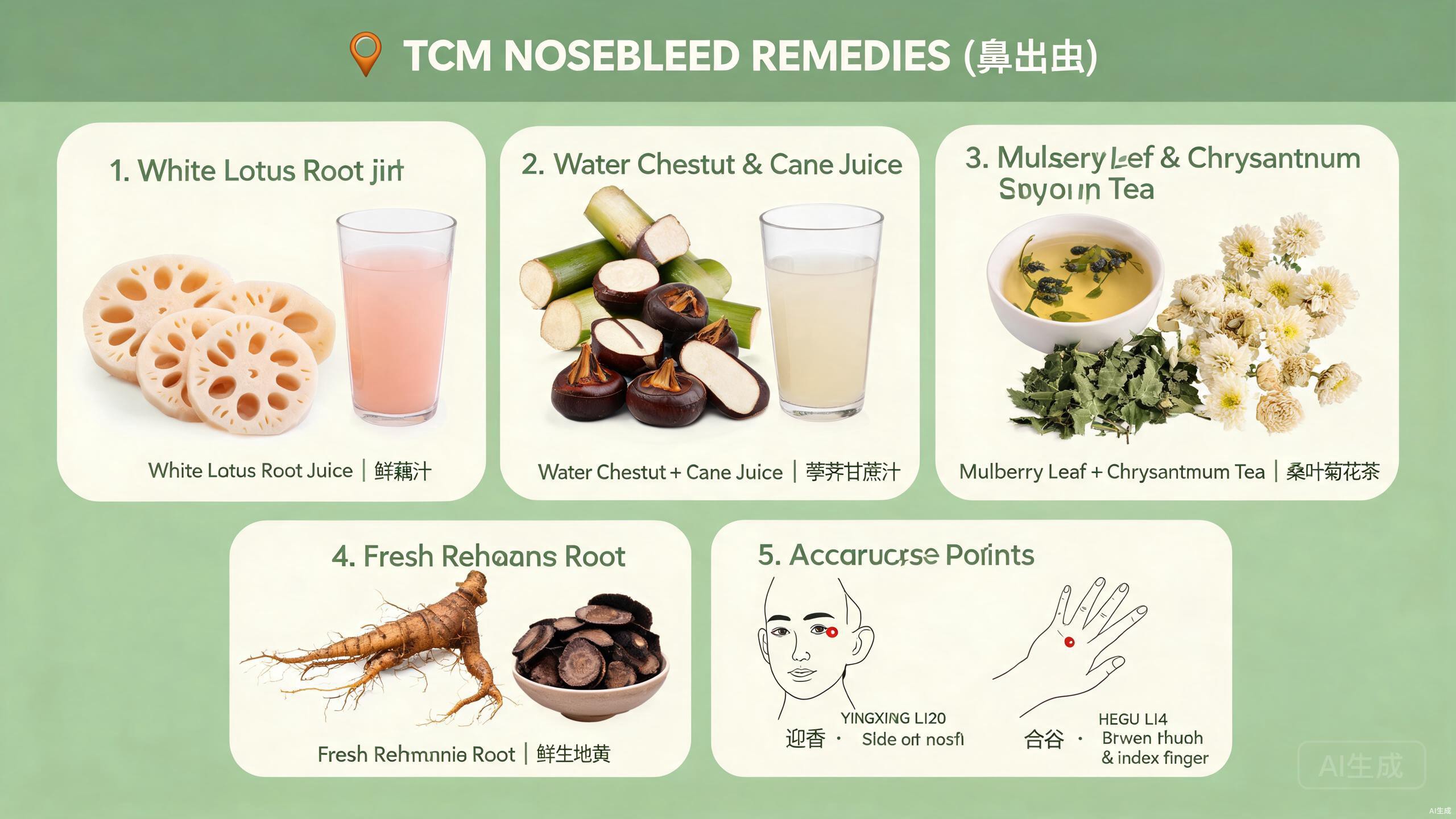
Key Takeaways
- TCM views nosebleeds through two main mechanisms: heat forcing blood to flow recklessly (excess patterns) and qi deficiency failing to hold blood in vessels (deficiency patterns).
- Four sub-patterns include lung-stomach heat excess, liver fire rising, yin deficiency with empty fire, and qi-blood deficiency — each requiring different foods.
- Five traditional food therapy recipes — from fresh reed rhizome drink to silver ear lily soup — use ingredients available at Western supermarkets, Amazon, or iHerb.
- During an active nosebleed, lean forward with head slightly down, pinch the nostrils for 10 to 15 minutes, and apply a cold compress — do not tilt the head back.
- These are traditional wellness practices, not a treatment for nosebleeds. Heavy, prolonged, or frequent bleeding requires prompt medical evaluation.
This article is for educational purposes only and is not medical advice. The foods, teas, and practices described here are traditional wellness practices rooted in Chinese culture. They are not a substitute for professional medical care, diagnosis, or treatment. Nosebleeds can sometimes indicate serious underlying conditions including high blood pressure, bleeding disorders, nasal tumors, or medication side effects. If a nosebleed does not stop after 20 minutes of continuous pressure, is very heavy, or occurs frequently, seek immediate medical attention. Never stop, delay, or replace prescribed treatment based on information in this article. Some foods and herbs may interact with medications — always inform your doctor about everything you consume. These statements have not been evaluated by the FDA and are not intended to diagnose, treat, cure, or prevent any disease. Read our full disclaimer →
Nosebleeds (epistaxis) are a common experience — most people will have at least one in their lifetime. While the majority are minor and self-limiting, frequent or heavy nosebleeds can be distressing and may signal underlying imbalances that deserve attention. Traditional Chinese Medicine (TCM) has understood nosebleeds for millennia, categorizing them as bi nv (nose bleeding) and attributing them to specific patterns of heat, fire, and deficiency that can be addressed through food therapy.
In TCM, the nose is the "opening" of the Lung, and the nasal region is traversed by meridians of the Stomach, Large Intestine, Liver, and Gallbladder. This means that imbalances in any of these organ systems can manifest as nasal bleeding. The five recipes below use foods and teas that have been enjoyed for generations to cool the blood, clear heat, nourish yin, and support the body's natural止血. All ingredients are available at Western supermarkets, Asian markets, Amazon, or iHerb.
If you are new to TCM concepts, our guide to the Zang-Fu organ systems and overview of qi, blood, and body fluids are helpful starting points. For related topics, see our guides on TCM for headaches and TCM for allergic rhinitis.
How TCM Views Nosebleeds
Traditional Chinese Medicine explains nosebleeds through two fundamental mechanisms. The first is heat or fire forcing blood to flow recklessly outside the vessels (re po xue wang xing). In TCM, blood normally flows within the vessels, guided and contained by the "qi that holds blood" (qi neng she xue). When excessive heat or fire accumulates in the body, it "heats up" the blood, making it expand and push outside the vessels. This is the most common cause of nosebleeds and corresponds to excess-type patterns.
The second mechanism is qi deficiency failing to hold blood in the vessels (qi bu nie xue). When the spleen qi is too weak to contain blood, or when yin deficiency creates "empty fire" that slowly damages the vessels, bleeding can occur even without excess heat. This corresponds to deficiency-type patterns and is often chronic, with small amounts of pale or slow bleeding.
TCM identifies four primary patterns associated with nosebleeds:
- Lung and Stomach Heat Excess (Fei Wei Re Sheng) — the most common pattern. Heat accumulates in the lung and stomach meridians, which both pass through the nasal region, and forces blood out of the nasal vessels. Signs include sudden nosebleeds with bright red blood, a dry mouth and throat, bad breath, thirst, constipation, and a red tongue with a yellow coating. Often triggered by dry weather, spicy food, or respiratory infections. See our TCM for bad breath guide for related stomach heat patterns.
- Liver Fire Rising Upward (Gan Huo Shang Yan) — emotional stress, frustration, or anger causes liver fire to rise along the liver meridian to the head and nasal region. Signs include nosebleeds triggered by anger or stress, blood that is bright red and may come in sudden bursts, irritability, a bitter taste in the mouth, bloodshot eyes, headaches, and a red tongue with yellow coating. This pattern is closely related to liver-fire headaches.
- Yin Deficiency with Empty Fire (Yin Xu Huo Wang) — when kidney or liver yin is depleted (from chronic stress, overwork, aging, or illness), the lack of cooling yin allows "empty fire" to rise and slowly damage the nasal vessels. Signs include chronic, recurring nosebleeds with small amounts of blood, dry mouth and throat (especially at night), dry nasal passages, night sweats, low-grade afternoon fever, and a red tongue with little or no coating. This is a chronic, deficiency-type pattern. See our TCM for dry eyes guide for related yin deficiency concepts.
- Qi and Blood Deficiency (Qi Liang Xue Xu) — when the spleen is too weak to generate sufficient qi and blood, the qi cannot properly hold blood within the vessels. Signs include nosebleeds with pale, thin blood that flows slowly, a pale complexion, fatigue, dizziness, shortness of breath, and a pale tongue. This pattern may be seen after prolonged illness, poor nutrition, or in conditions involving low platelet counts. See our TCM for anemia guide for related deficiency patterns.
Understanding these patterns helps explain why TCM recommends different foods for different types of nosebleeds. The recipes below are grouped by the pattern they traditionally address.
5 Food Therapy Recipes for Nasal Wellness
Each recipe below is matched to a specific TCM pattern. Choose the one that best fits your situation, and use it consistently for two to four weeks. All ingredients are available at Western supermarkets, Asian markets, Amazon, or iHerb.
1. Fresh Reed Rhizome and Rehmannia Drink (鲜茅根生地饮)
Best for: Lung and stomach heat excess
TCM nature and flavor: Reed rhizome (lu gen): sweet, cold. Enters the Lung and Stomach channels. Fresh rehmannia (sheng di huang): sweet, bitter, cold. Enters the Heart, Liver, and Kidney channels.
Traditional use: This is a classic TCM combination for clearing heat and cooling the blood. Reed rhizome (the stem of the common reed) is traditionally used to clear lung heat, generate fluids, and promote urination. Fresh rehmannia root is one of TCM's most important blood-cooling and yin-nourishing herbs, traditionally used to clear heat, cool the blood, and nourish yin. Together, they form a cooling drink that directly addresses the heat forcing blood out of the nasal vessels. The fresh forms of both ingredients are preferred for their stronger heat-clearing and fluid-generating properties.
Ingredients:
- 30 grams fresh reed rhizome (lu gen) — available at Asian markets; 15 grams dried reed rhizome available on Amazon or iHerb
- 30 grams fresh rehmannia root (sheng di huang) — available at Asian markets; 15 grams dried rehmannia available on Amazon or iHerb
- 3 cups water
- Optional: a small amount of honey to taste
Preparation: If using fresh ingredients, wash and cut into small pieces. In a pot, combine the ingredients with water. Bring to a boil, then reduce heat and simmer for 20 minutes. Strain and drink warm. Enjoy 1 to 2 cups per day, preferably in the morning or afternoon. The drink has a mild, slightly sweet, and earthy flavor.
Precautions: Both ingredients are cold in nature. Avoid if you have a cold constitution with diarrhea, or during menstruation. If you have spleen deficiency (poor appetite, loose stools, cold extremities), add a slice of fresh ginger to balance the coldness.
2. Lotus Root Node, White Radish, and Pear Soup (藕节白萝卜梨汤)
Best for: Lung heat with dryness
TCM nature and flavor: Lotus root node (ou jie): sweet, astringent, neutral. Enters the Lung, Stomach, and Liver channels. White radish (luo bo): sweet, pungent, cool. Enters the Lung, Stomach, and Large Intestine channels. Pear (li): sweet, slightly sour, cool. Enters the Lung and Stomach channels.
Traditional use: This soup combines three cooling, lung-moistening ingredients. Lotus root node (the joint between sections of lotus root) is a unique TCM ingredient specifically used to stop bleeding, particularly from the nose and lungs. White radish is traditionally used to clear lung heat, resolve phlegm, and promote digestion. Pear is traditionally used to clear lung heat, generate fluids, and moisten dryness. Together, they address the lung heat and dryness that damage nasal vessels, while the lotus root node specifically helps stop bleeding. This is an excellent soup for dry-season nosebleeds.
Ingredients:
- 1 section fresh lotus root with the node intact (about 200 grams) — available at Asian markets and many supermarkets
- 1 small white radish (daikon), peeled and cubed
- 1 Asian pear or Bosc pear, cored and cubed
- 4 cups water
- 3 slices fresh ginger
- A pinch of sea salt or a small amount of rock sugar
Preparation: Wash the lotus root thoroughly, keeping the nodes (joints) intact as these contain the most hemostatic properties. Slice the lotus root into rounds. In a pot, combine the lotus root, white radish, pear, ginger, and water. Bring to a boil, then reduce heat and simmer for 30 to 40 minutes until the vegetables are tender. Add salt or rock sugar to taste. Drink 1 bowl per day, preferably at lunch. For more on pear, see our TCM for cough relief guide.
Precautions: White radish is contraindicated in TCM when taking ginseng or other qi-tonifying herbs, as it is believed to reduce their effectiveness. If you take ginseng supplements, separate them from this soup by several hours.
3. Fresh Lotus Root Juice (鲜藕汁饮)
Best for: Acute heat-type nosebleeds (quick relief)
TCM nature and flavor: Lotus root (ou): sweet, neutral. Enters the Heart, Lung, and Stomach channels.
Traditional use: Fresh lotus root juice is one of the simplest and most direct TCM food therapies for nosebleeds. Lotus root is traditionally used to cool the blood, stop bleeding, and generate fluids. When juiced fresh, it retains its full cooling and hemostatic properties. In Chinese folk tradition, a small cup of fresh lotus root juice is given at the first sign of a nosebleed to help cool the blood and support the body's natural止血. Modern nutrition recognizes lotus root as a source of vitamin C, iron, and tannins (which have astringent properties).
Ingredients:
- 1 section fresh lotus root (about 300 grams) — available at Asian markets and many supermarkets
- 1/4 cup water
- Optional: a small amount of honey to taste
Preparation: Wash and peel the lotus root. Cut into small pieces. Place in a blender with the water and blend until smooth. Strain through a fine mesh sieve or cheesecloth to extract the juice. Drink 1/2 cup immediately, preferably at room temperature. For preventive use, drink 1/2 cup daily in the morning during nosebleed-prone seasons. The juice is mild, slightly starchy, and refreshing.
Precautions: Lotus root is generally safe as a food. If you have a cold constitution, warm the juice slightly or add a pinch of ginger. Ensure the lotus root is very fresh — avoid any with dark spots or soft areas.
Fresh lotus root is available at most Asian markets and increasingly at mainstream supermarkets. Look for firm, unblemished roots with intact nodes (the joints between sections). The nodes are the most hemostatic part in TCM, so do not discard them. If fresh lotus root is unavailable, dried lotus root node (ou jie) can be purchased on Amazon or iHerb and simmered as a tea.
4. Silver Ear and Lily Bulb Soup (银耳百合羹)
Best for: Yin deficiency with empty fire (chronic, recurring nosebleeds)
TCM nature and flavor: Silver ear mushroom (yin er / tremella): sweet, neutral. Enters the Lung and Stomach channels. Lily bulb (bai he): sweet, slightly bitter, slightly cold. Enters the Heart and Lung channels.
Traditional use: When nosebleeds are chronic and rooted in yin deficiency, the approach shifts from clearing excess heat to nourishing the depleted yin. Silver ear mushroom (also called snow fungus) is traditionally used to nourish yin, moisten the lungs, and generate fluids. In TCM, it is considered a gentle, daily tonic for lung and stomach yin. Lily bulb is traditionally used to nourish yin, moisten the lungs, and clear heart heat. Together, they form a soothing, nourishing soup that rebuilds the yin that has been depleted by chronic stress, overwork, or illness — addressing the root cause of recurring nosebleeds with dryness.
Ingredients:
- 1/4 cup dried silver ear mushroom (tremella) — available on Amazon or iHerb
- 20 grams dried lily bulbs (bai he) — available on Amazon or iHerb
- 6 cups water
- 1 tablespoon rock sugar or honey to taste
- Optional: 10 goji berries for added nourishment
Preparation: Soak the silver ear mushroom in warm water for 1 to 2 hours until it expands and becomes gelatinous. Trim the tough yellow base and tear into small pieces. Soak the dried lily bulbs for 30 minutes. In a pot, combine the silver ear, lily bulbs, and water. Bring to a boil, then reduce heat and simmer for 60 to 90 minutes until the silver ear is very soft and the liquid becomes slightly viscous. Add rock sugar and goji berries in the last 10 minutes. Eat 1 bowl per day, ideally in the evening. For more on this soup, see our TCM for dry mouth guide.
Precautions: This soup is nourishing and generally safe for long-term use. If you have dampness (thick tongue coating, bloating), reduce the portion. Goji berries may interact with blood thinners — consult your doctor if you take warfarin.
5. Day Lily and Pork Soup (黄花菜瘦肉汤)
Best for: Heat with blood-cooling and calming
TCM nature and flavor: Day lily bud (jin zhen cai / golden needle): sweet, cool. Enters the Liver and Bladder channels. Lean pork: sweet, neutral. Enters the Spleen, Stomach, and Kidney channels.
Traditional use: Day lily buds (also called golden needle vegetable or tiger lily buds) are a traditional Chinese food that is traditionally used to clear heat, cool the blood, and calm the mind. In TCM, day lily is also valued for its gentle calming effect on anxiety and restlessness — relevant because stress and emotional agitation often accompany or trigger nosebleeds. Combined with lean pork, which nourishes yin and moistens dryness, this soup provides a nourishing, blood-cooling meal that is particularly suited for those whose nosebleeds are accompanied by restlessness, irritability, or sleep difficulty.
Ingredients:
- 30 grams dried day lily buds (golden needle vegetable) — available on Amazon or iHerb
- 8 oz lean pork, sliced
- 4 slices fresh ginger
- 5 cups water
- A pinch of sea salt
Preparation: Soak the dried day lily buds in warm water for 30 minutes, then remove the tough stems. Blanch the pork in boiling water for 3 minutes, then rinse. In a pot, combine the pork, day lily buds, ginger, and water. Bring to a boil, then reduce heat and simmer for 45 to 60 minutes until the pork is very tender. Add salt to taste. Drink 1 bowl per day, preferably at lunch or dinner.
Precautions: Day lily buds must be properly soaked and cooked — do not eat them raw, as fresh (uncooked) day lily buds contain colchicine-like compounds that can cause digestive upset. Dried and thoroughly cooked day lily buds are safe and widely consumed as food in Chinese cuisine.
Four Acupressure Points for Nasal Wellness
In addition to food therapy, TCM uses acupressure to support nasal wellness. The four points below are traditionally used to clear heat, calm the liver, nourish yin, and support the body's natural止血. They can be pressed daily as part of a wellness routine, and some can be used gently during an active nosebleed to complement first aid.
1. Yingxiang (LI20) — The "Welcome Fragrance" Point
Location: On the face, in the nasolabial groove, about 0.5 cun (half a finger-width) lateral to the midpoint of the nostril.
How to find it: Look in a mirror. On either side of your nose, there is a natural groove between the nose and the cheek. The point is located in this groove, level with the bottom of your nostril. Pressing here should produce a mild ache.
How to press: Using your index fingers, press gently on both sides simultaneously for 1 to 2 minutes. Use light to moderate pressure — the face is sensitive. You can also massage in small circles. During an active nosebleed, gentle pressure on this point may help support natural止血.
Traditional use: Yingxiang is the primary local point for all nasal conditions. It is traditionally used to open the nose, dispel wind, and clear heat from the nasal passages. For nosebleeds, LI20 is the most direct point for addressing the local nasal region.
Precautions: Use gentle pressure on the face. Avoid pressing if the nose is actively swollen or injured.
2. Yintang (EX-HN3) — The "Hall of Impression"
Location: On the forehead, midway between the medial ends of the eyebrows, in the depression at the root of the nose.
How to find it: Look in a mirror. The point is exactly between your two eyebrows, at the bridge of your nose. You should feel a slight depression when you press gently.
How to press: Using your index finger or thumb, press gently but firmly into the point for 1 to 2 minutes. You can also massage in small upward circles. Use moderate pressure.
Traditional use: Yintang is an extra point traditionally used to calm the mind, dispel wind-heat, and clear the nasal region. For nosebleeds, Yintang helps calm the anxiety that often accompanies bleeding and supports the clearing of heat from the head and nasal region. See our dedicated Yintang guide for more.
Precautions: Generally very safe. Use moderate pressure.
3. Taixi (KD3) — The "Supreme Stream" Point
Location: On the inner ankle, in the depression between the highest point of the medial malleolus (inner ankle bone) and the Achilles tendon.
How to find it: Sit and cross your ankle over the opposite knee. Feel for the inner ankle bone. Just behind and below it, between the ankle bone and the Achilles tendon, you will find a depression. This is Taixi (KD3).
How to press: Using your thumb, press gently into the depression for 2 to 3 minutes on each foot. Use moderate pressure — this point is often tender in people with kidney yin deficiency.
Traditional use: Taixi is the source point of the Kidney meridian and is one of the most important points for nourishing kidney yin, clearing empty fire, and supporting the body's cooling systems. For nosebleeds rooted in yin deficiency with empty fire (chronic, recurring pattern with dryness), KD3 addresses the root cause by rebuilding the kidney yin that normally keeps fire in check.
Precautions: Generally safe. Avoid pressing during pregnancy without professional guidance.
4. Taichong (LR3) — The "Supreme Rushing" Point
Location: On the top of the foot, in the webbing between the first and second toes, about 1 to 2 inches up from the base of the toes.
How to find it: Between your big toe and second toe, slide your finger up from the webbing until you feel a tender spot where the bones of the two toes meet. This is Taichong (LR3).
How to press: Using your thumb, press firmly into the point for 1 to 2 minutes on each foot. This point is often quite tender in people under stress — the tenderness indicates liver fire that benefits from regular pressing.
Traditional use: Taichong is the source point of the Liver meridian and is one of the most important points for soothing liver qi, clearing liver fire, and regulating emotions. For nosebleeds triggered by stress, anger, or emotional agitation (the liver fire pattern), LR3 directly addresses the root cause by calming the liver fire that rises to the nasal region.
Precautions: Avoid pressing on open wounds or infections on the foot. Use moderate pressure.
For a simple daily routine: in the morning, press Yintang (EX-HN3) for 1 to 2 minutes and Yingxiang (LI20) for 1 to 2 minutes. In the evening, press Taixi (KD3) on both feet for 2 to 3 minutes, then Taichong (LR3) on both feet for 1 to 2 minutes. During an active nosebleed, gentle pressure on Yingxiang (LI20) may complement first aid measures. For more guidance, see our acupressure safety guide.
First Aid for Active Nosebleeds
While food therapy and acupressure support long-term nasal wellness, it is essential to know proper first aid for an active nosebleed. TCM and modern medicine agree on the following steps:
- Sit upright and lean slightly forward. Do not tilt your head back — this causes blood to flow down the throat, which can lead to nausea, vomiting, and airway obstruction. Leaning slightly forward with the head tilted down allows blood to drain out of the nose.
- Pinch the soft part of your nostrils. Using your thumb and index finger, pinch the soft, fleshy part of your nose (the alae) firmly together against the nasal bones. Hold continuously for 10 to 15 minutes without releasing to check. Breathe through your mouth.
- Apply a cold compress. Place a cold, damp cloth or ice pack wrapped in a towel on the bridge of your nose or the back of your neck. Cold causes blood vessels to constrict, which may help slow bleeding.
- Do not blow your nose. After the bleeding stops, avoid blowing your nose, picking at it, or bending over for several hours, as these actions can dislodge the clot and restart bleeding.
- Seek medical attention if bleeding does not stop after 20 minutes of continuous pressure, if bleeding is very heavy, if you feel dizzy or faint, or if you are swallowing large amounts of blood.
Lifestyle Tips for Nasal Wellness
- Keep nasal passages moist. Dry air is a major trigger for nosebleeds. Use a humidifier in dry seasons, especially in heated or air-conditioned rooms. A saline nasal spray can also help maintain moisture. In TCM, dryness is considered a pathogenic factor that damages the lung and nasal region.
- Avoid spicy and heating foods. If you are prone to heat-type nosebleeds, reduce chili, pepper, lamb, fried foods, and alcohol. These generate internal heat that can rise to the nasal region. Favor cooling foods like pear, lotus root, cucumber, and watermelon.
- Manage stress and emotions. If your nosebleeds are triggered by anger or stress (liver fire pattern), regular relaxation practices are essential. See our herbal tea for anxiety guide and meditation guide.
- Avoid picking or vigorous nose-blowing. These are the most common mechanical causes of nosebleeds. Blow gently, one nostril at a time.
- Stay hydrated. Drink adequate warm water throughout the day to maintain mucosal moisture. See our TCM for dry mouth guide for hydration tips.
Comparison of the Five Recipes
| Recipe | TCM Pattern | Key Action | Frequency |
|---|---|---|---|
| Fresh Reed Rhizome Rehmannia Drink | Lung-Stomach Heat | Clear heat, cool blood | 1 to 2 cups daily |
| Lotus Root White Radish Pear Soup | Lung Heat + Dryness | Cool blood, moisten lungs, stop bleeding | 1 bowl daily |
| Fresh Lotus Root Juice | Acute Heat-Type Bleeding | Cool blood, stop bleeding (quick) | 1/2 cup as needed |
| Silver Ear Lily Soup | Yin Def. + Empty Fire | Nourish yin, moisten lungs | 1 bowl daily |
| Day Lily Pork Soup | Heat + Restlessness | Cool blood, calm the mind | 1 bowl daily |
Frequently Asked Questions
What does TCM say about nosebleeds?
In Traditional Chinese Medicine, nosebleeds (bi nv) are understood through the Lung, Stomach, Liver, and Kidney organ systems. TCM identifies four primary patterns: lung and stomach heat excess (heat forces blood out of vessels), liver fire rising upward (stress-related), yin deficiency with empty fire (chronic recurring), and qi deficiency failing to hold blood (pale, slow bleeding). TCM food therapy traditionally uses ingredients like reed rhizome, fresh rehmannia, lotus root, silver ear mushroom, and lily bulb to cool blood, nourish yin, and stop bleeding. These are traditional wellness practices, not medical treatments. For a deeper understanding, see our zang-fu organ guide.
Which Chinese medicine foods may help with nosebleeds?
Five traditional TCM food therapy recipes for nasal wellness include fresh reed rhizome and rehmannia drink, lotus root white radish pear soup, fresh lotus root juice, silver ear lily soup, and day lily pork soup. These recipes use ingredients available at Western supermarkets, Asian markets, Amazon, or iHerb. Blood-cooling recipes (reed rhizome, rehmannia, lotus root) are best for heat-type nosebleeds, while yin-nourishing recipes (silver ear, lily) address chronic recurring patterns. They are traditional wellness foods, not treatments for any medical condition.
What should I do during an active nosebleed?
During an active nosebleed, sit upright and lean slightly forward with your head tilted down slightly (do not tilt your head back, as this causes blood to flow down the throat). Pinch the soft part of your nostrils firmly together for 10 to 15 minutes without releasing. Breathe through your mouth. Apply a cold compress to the bridge of your nose or forehead. Do not blow your nose or pick at it afterward. If bleeding does not stop after 20 minutes of continuous pressure, or if bleeding is very heavy, seek immediate medical attention.
When should I see a doctor for nosebleeds?
Seek immediate medical attention if a nosebleed does not stop after 20 minutes of continuous pressure, if bleeding is very heavy or from the back of the throat, if you are swallowing large amounts of blood, or if you feel dizzy or faint. Also see a doctor if nosebleeds are frequent (several per week), if you bruise easily or bleed from other sites, or if you take blood-thinning medications. Persistent or recurrent nosebleeds can indicate underlying conditions including high blood pressure, bleeding disorders, nasal tumors, or medication side effects that require proper medical evaluation. For related guidance, see our blood pressure guide.
Precautions and When to Seek Help
While TCM food therapy and acupressure may support general nasal wellness, nosebleeds can sometimes indicate serious conditions:
- Seek immediate medical attention if a nosebleed does not stop after 20 minutes of continuous pressure, if bleeding is profuse, if blood is flowing down the throat, or if you feel dizzy, faint, or pale. These may indicate posterior epistaxis or significant blood loss.
- See your doctor if nosebleeds are frequent (more than once a week), recurrent over months, or accompanied by easy bruising, bleeding gums, blood in urine or stool, or unusually heavy menstrual periods. These may indicate a bleeding disorder, low platelet count, or medication side effect.
- Check your blood pressure. High blood pressure is a common contributor to nosebleeds, especially in older adults. Have your blood pressure checked regularly.
- Medication interactions. If you take blood thinners (warfarin, aspirin, clopidogrel, apixaban, or similar medications), nosebleeds can be more severe and harder to stop. Do not stop taking prescribed blood thinners, but inform your doctor about any nosebleeds. Some cooling herbs may have mild blood-thinning effects — consult your healthcare provider before regular use.
- Not a substitute. TCM food therapy is complementary. It sits alongside — never in place of — professional medical care.
For related topics, see our guides on TCM for headaches, TCM for allergic rhinitis, and TCM for dry mouth.
The Bottom Line
Traditional Chinese Medicine offers a food-based tradition for supporting nasal wellness that complements — but never replaces — medical care. By understanding whether your nosebleeds are rooted in lung-stomach heat, liver fire, yin deficiency, or qi deficiency, you can choose foods and teas that work with your body's specific needs. Fresh reed rhizome and rehmannia drink clears heat and cools the blood. Lotus root white radish pear soup moistens the lungs while stopping bleeding. Fresh lotus root juice provides quick blood-cooling relief. Silver ear lily soup nourishes yin for chronic recurring patterns. And day lily pork soup cools blood while calming the mind. Paired with four acupressure points — Yingxiang (LI20), Yintang (EX-HN3), Taixi (KD3), and Taichong (LR3) — and proper first aid (lean forward, pinch nostrils for 10 to 15 minutes, apply cold compress), these traditional practices form a whole-person approach to nasal wellness.
But they are traditions — not treatments, and not a replacement for medical care. Heavy, prolonged, or frequent nosebleeds require evaluation by a qualified healthcare provider. Use these traditional practices only as complementary wellness habits, alongside your doctor's guidance.
This article shares traditional wellness practices for educational purposes only. It is not a substitute for medical advice, diagnosis, or treatment. The foods, teas, and acupressure practices described here are not intended to treat, cure, or prevent any disease, including epistaxis, hypertension, bleeding disorders, or any other medical condition. If you experience nosebleeds that do not stop after 20 minutes, are frequent or heavy, or are accompanied by other bleeding symptoms, consult your healthcare provider promptly for proper evaluation. These statements have not been evaluated by the FDA. Never stop or adjust prescribed treatment without your doctor's explicit guidance. Read our full disclaimer →