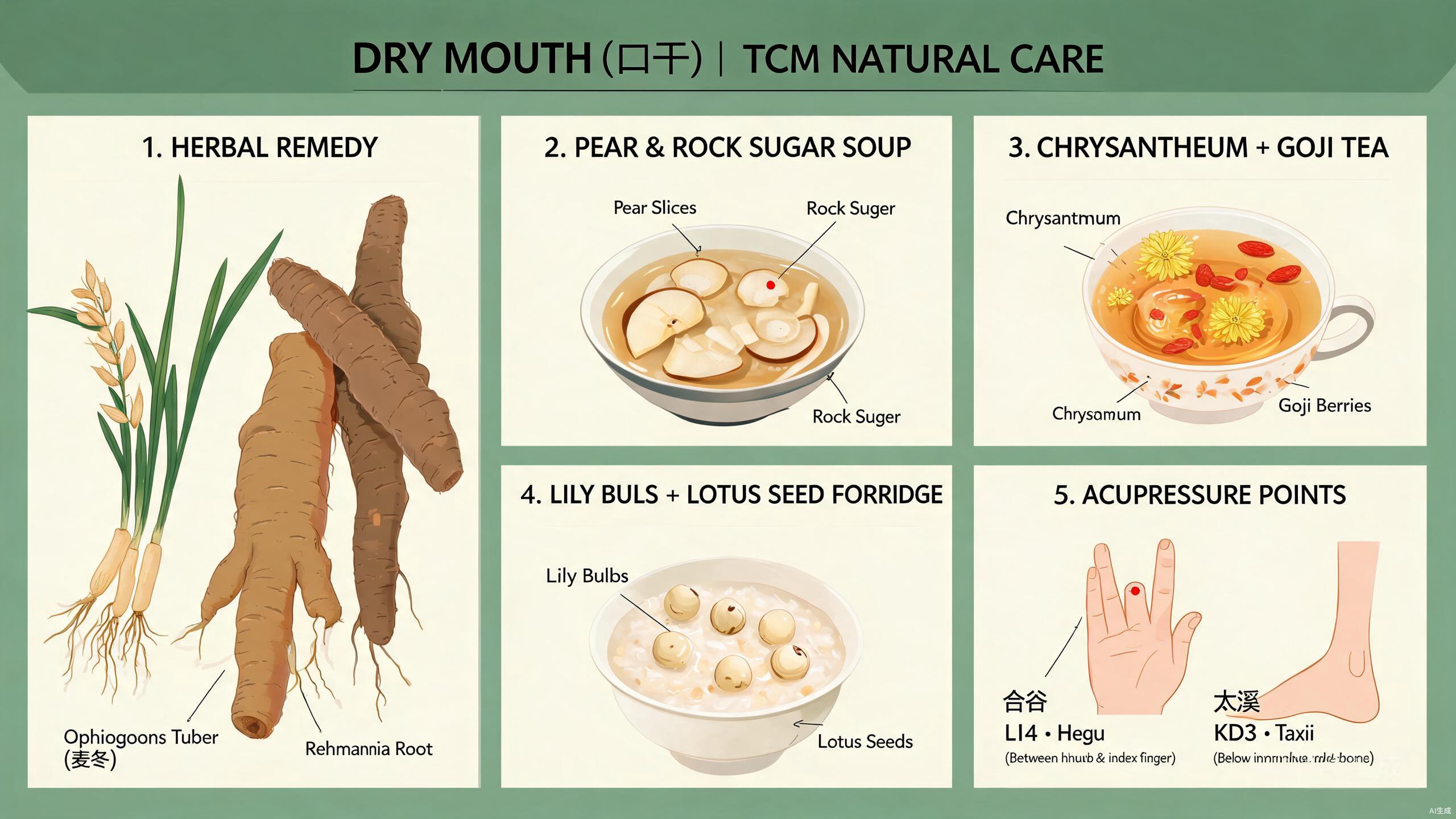
Key Takeaways
- TCM views dry mouth through four patterns: liver fire consuming fluids, stomach heat blazing, kidney yin deficiency, and damp-heat internal accumulation — each requiring different foods.
- Five traditional food therapy recipes — from chrysanthemum goji tea to silver ear lily soup — use ingredients available at Western supermarkets, Amazon, or iHerb.
- Four acupressure points, Zhongwan (CV12), Zusanli (ST36), Taixi (KD3), and Sanyinjiao (SP6), are traditionally used to strengthen digestion, nourish yin, and generate fluids.
- For yin deficiency dry mouth, drinking water alone is not enough — the body needs moistening foods that help retain and distribute fluids properly.
- These are traditional wellness practices, not a treatment for dry mouth. Persistent dryness may indicate medical conditions requiring professional evaluation.
This article is for educational purposes only and is not medical advice. The foods, teas, and practices described here are traditional wellness practices rooted in Chinese culture. They are not a substitute for professional medical care, diagnosis, or treatment. Persistent dry mouth (xerostomia) can indicate serious medical conditions including Sjogren's syndrome, diabetes, dehydration, or medication side effects. Chronic dry mouth can also increase the risk of dental decay and oral infections. Never stop, delay, or replace prescribed treatment based on information in this article. Some foods and herbs may interact with medications — always inform your doctor about everything you consume. These statements have not been evaluated by the FDA and are not intended to diagnose, treat, cure, or prevent any disease. Read our full disclaimer →
Dry mouth — that uncomfortable sensation of stickiness, thirst, and insufficient saliva — is more than a minor annoyance. It can affect speech, swallowing, taste, sleep quality, and dental health. While occasional dry mouth from dehydration or nervousness is normal, chronic dryness that persists despite drinking water may signal a deeper imbalance that deserves attention. Traditional Chinese Medicine (TCM) has understood dry mouth for millennia, categorizing it within broader patterns of fluid metabolism and organ function.
In TCM, the mouth is connected to multiple organ systems. The Spleen "opens into" the mouth and manifests in the lips, the Kidney governs body fluids, the Stomach provides the fluid pathway to the mouth, and the Liver's fire can consume fluids. This means that dry mouth is never treated as an isolated symptom — it is always understood as a manifestation of an internal pattern. The five recipes below use foods and teas that have been enjoyed for generations to clear heat, nourish yin, and generate fluids. All ingredients are available at Western supermarkets, Asian markets, Amazon, or iHerb.
If you are new to TCM concepts, our guide to the Zang-Fu organ systems and overview of qi, blood, and body fluids are helpful starting points. For related topics, see our guides on TCM for bad breath and TCM for canker sores.
How TCM Views Dry Mouth
Traditional Chinese Medicine explains dry mouth through the concept of jin ye (body fluids). In TCM, body fluids are classified into two types: jin (clear, thin fluids that moisten the skin, muscles, and mucous membranes) and ye (thick, dense fluids that lubricate the joints, brain, and bone marrow). Saliva is considered a form of jin that is generated and regulated by the Spleen, Stomach, and Kidney organ systems.
When body fluids are abundant and properly distributed, the mouth is naturally moist. When fluids are depleted by heat, fire, or deficiency — or when their distribution is blocked by dampness — dry mouth results. TCM identifies four primary patterns associated with dry mouth:
- Liver Fire Consuming Fluids (Gan Huo Shang Yan) — emotional stress, frustration, or anger generates liver fire that rises upward and "burns up" the body's fluids, including saliva. Signs include dry mouth with a bitter taste, irritability, bloodshot eyes, headaches (often on the sides of the head), a red tongue with yellow coating, and dryness that worsens with stress. This pattern is common in busy, stressed individuals. See our TCM for headaches guide for related liver fire patterns.
- Stomach Heat Blazing (Wei Re Kang Sheng) — excessive heat in the stomach, often from spicy food, alcohol, or rich greasy foods, dries up stomach fluids that normally rise to moisten the mouth. Signs include a dry mouth with strong thirst (especially for cold drinks), bad breath, gum swelling or bleeding, increased appetite, constipation, and a red tongue with a thick yellow coating. This pattern is common after dietary indulgence. See our TCM for bad breath guide for related stomach heat concepts.
- Kidney Yin Deficiency (Shen Yin Xu) — the most common pattern for chronic dry mouth. Kidney yin is the body's foundational cooling, moistening reserve. When it is depleted by overwork, aging, chronic stress, or prolonged illness, the body lacks the moisture to properly lubricate the mouth. Signs include chronic dry mouth (especially at night), dry eyes, dry throat, night sweats, lower back weakness, tinnitus (ringing in the ears), and a red tongue with little or no coating. This pattern is common in older adults and those under chronic stress. See our TCM for tinnitus guide for related kidney yin concepts.
- Damp-Heat Internal Accumulation (Shi Re Nei Yun) — this is a paradoxical pattern where the mouth feels dry despite the body having internal dampness. In TCM, when damp-heat blocks the spleen's ability to distribute fluids upward to the mouth, the mouth becomes dry while the rest of the body retains dampness. Signs include dry mouth with a sticky, heavy sensation, a thick greasy tongue coating, reduced appetite, bloating, a feeling of heaviness in the body, and dark or concentrated urine. This pattern is common in humid climates and in those with poor digestive function. See our dampness-removing foods guide for more on this concept.
Understanding these patterns is crucial because the treatment for each is quite different. Giving a warming, tonifying food to someone with stomach heat would worsen their dryness, while giving a strongly cooling food to someone with deficiency could damage their digestion. The recipes below are grouped by the pattern they traditionally address.
5 Food Therapy Recipes for Oral Moisture
Each recipe below is matched to a specific TCM pattern. Choose the one that best fits your situation, and use it consistently for two to four weeks. All ingredients are available at Western supermarkets, Asian markets, Amazon, or iHerb.
1. Chrysanthemum and Goji Tea (菊花枸杞茶)
Best for: Liver fire consuming fluids
TCM nature and flavor: Chrysanthemum (ju hua): sweet, bitter, slightly cold. Enters the Liver and Lung channels. Goji berries (gou qi zi): sweet, neutral. Enters the Liver and Kidney channels.
Traditional use: This is perhaps the most popular daily tea in China for eye and liver wellness, and it is equally valuable for dry mouth. Chrysanthemum is traditionally used to clear liver heat, disperse wind-heat, and brighten the eyes. In TCM, the liver and mouth are connected through the liver meridian's pathway and the liver's role in fluid distribution. When liver fire consumes fluids, chrysanthemum gently clears the heat. Goji berries are traditionally used to nourish liver and kidney yin, and benefit essence, addressing the underlying yin depletion. Together, they form a balanced tea that clears liver fire while nourishing the yin that has been damaged — ideal for stress-related dry mouth with a bitter taste.
Ingredients:
- 1 teaspoon dried chrysanthemum flowers — available on Amazon, iHerb, or tea shops
- 1 tablespoon dried goji berries — available on Amazon or iHerb
- 2 cups hot water (90°C / 195°F)
- Optional: a small amount of honey to taste
Preparation: Place the chrysanthemum and goji berries in a teapot or mug. Pour hot water over them, cover, and steep for 8 to 10 minutes. The goji berries will plump and soften. Drink warm, and eat the softened goji berries for their full nourishing benefit. Enjoy 1 to 2 cups per day, preferably in the morning or afternoon. The tea has a light, floral, and slightly sweet flavor. For more on goji berries, see our goji tea guide, and for chrysanthemum, see our TCM for dry eyes guide.
Precautions: Chrysanthemum is cooling. If you have a cold constitution, reduce the amount or add a slice of ginger. Goji berries may interact with blood thinners — consult your doctor if you take warfarin or similar medications.
2. Mung Bean Porridge (绿豆粥)
Best for: Stomach heat blazing
TCM nature and flavor: Mung bean (lu dou): sweet, cold. Enters the Heart and Stomach channels. Rice: sweet, neutral. Enters the Spleen and Stomach channels.
Traditional use: Mung bean is one of TCM's most important heat-clearing and detoxifying foods. It is traditionally used to clear summer heat, resolve toxins, and reduce thirst. For dry mouth caused by stomach heat, mung bean's cold nature directly counters the heat that is drying up stomach fluids. Combined with rice to form a porridge, the dish becomes gentle enough for daily consumption while still effectively clearing heat. This is a classic summer food in China, valued for its ability to cool the body and quench thirst.
Ingredients:
- 1/2 cup dried mung beans — available at most supermarkets, Amazon, or iHerb
- 1/2 cup white rice
- 6 cups water
- 3 slices fresh ginger (to protect the spleen from the cold nature)
- Optional: a small amount of rock sugar to taste
Preparation: Soak the mung beans for 2 to 4 hours. In a pot, combine the mung beans, rice, ginger, and water. Bring to a boil, then reduce heat and simmer for 45 to 60 minutes until the beans are soft and the porridge is thick. Add rock sugar to taste. Eat 1 bowl per day, ideally in the morning. For more on mung beans, see our mung bean congee guide and summer heat-clearing foods guide.
Precautions: Mung bean is cold in nature. If you have a cold constitution with diarrhea, cold extremities, or a pale tongue, add extra ginger or reduce the portion. Avoid consuming mung bean at the same time as ginseng or other warming tonics.
3. Silver Ear and Lily Bulb Soup (银耳百合羹)
Best for: Kidney yin deficiency (chronic dry mouth)
TCM nature and flavor: Silver ear mushroom (yin er / tremella): sweet, neutral. Enters the Lung and Stomach channels. Lily bulb (bai he): sweet, slightly bitter, slightly cold. Enters the Heart and Lung channels.
Traditional use: When dry mouth is chronic and rooted in yin deficiency, the approach shifts from clearing heat to nourishing the depleted yin. Silver ear mushroom (also called snow fungus) is traditionally used to nourish yin, moisten the lungs, and generate fluids. In TCM, it is considered a gentle, daily tonic for lung and stomach yin — the fluids that normally rise to moisten the mouth. Lily bulb is traditionally used to nourish yin, moisten the lungs, and clear heart heat. Together, they form a soothing, nourishing soup that rebuilds the body's fluid-retaining capacity. This is the quintessential TCM remedy for chronic dryness — of the mouth, throat, skin, and eyes.
Ingredients:
- 1/4 cup dried silver ear mushroom (tremella) — available on Amazon or iHerb
- 20 grams dried lily bulbs (bai he) — available on Amazon or iHerb
- 6 cups water
- 1 tablespoon rock sugar or honey to taste
- Optional: 10 goji berries for added nourishment
Preparation: Soak the silver ear mushroom in warm water for 1 to 2 hours until it expands and becomes gelatinous. Trim the tough yellow base and tear into small pieces. Soak the dried lily bulbs for 30 minutes. In a pot, combine the silver ear, lily bulbs, and water. Bring to a boil, then reduce heat and simmer for 60 to 90 minutes until the silver ear is very soft and the liquid becomes slightly viscous. Add rock sugar and goji berries in the last 10 minutes. Eat 1 bowl per day, ideally in the evening. The soup is soothing, mildly sweet, and has a silky texture.
Precautions: This soup is nourishing and generally safe for long-term use. If you have dampness (thick tongue coating, bloating), reduce the portion or add a slice of ginger.
4. Ophiopus Tea (麦冬茶)
Best for: Lung and stomach yin deficiency (dry mouth with dry throat)
TCM nature and flavor: Ophiopus (mai dong / dwarf lilyturf tuber): sweet, slightly bitter, slightly cold. Enters the Heart, Lung, and Stomach channels.
Traditional use: Ophiopus is one of TCM's most important yin-nourishing and fluid-generating herbs. It is traditionally used to nourish lung yin, nourish stomach yin, generate fluids, and clear heart heat. In TCM, ophiopus is specifically indicated for dry mouth and dry throat caused by yin deficiency — it both moistens the mucous membranes and helps the body retain fluids. Unlike strongly cold herbs, ophiopus is only slightly cold, making it suitable for longer-term use. As a simple tea, it is one of the most direct and effective TCM food therapies for oral dryness.
Ingredients:
- 10 to 15 pieces dried ophiopus tuber (mai dong) — available on Amazon or iHerb
- 2 cups hot water (90°C / 195°F)
- Optional: a small amount of honey to taste
- Optional: 5 goji berries for added nourishment
Preparation: Rinse the ophiopus pieces. Place in a teapot or mug with the goji berries if using. Pour hot water over them, cover, and steep for 10 to 15 minutes. The ophiopus will soften and expand. Drink warm, and you can re-steep the same herbs once more. Enjoy 1 to 2 cups per day, preferably in the morning or afternoon. The tea has a mild, slightly sweet, and moistening taste.
Precautions: Ophiopus is moistening. If you have dampness (thick tongue coating, bloating, sticky sensation), reduce the amount or combine with a small piece of dried tangerine peel (chen pi) to balance the moistening effect. See our tangerine peel tea guide for more on this combination.
5. Adzuki Bean and Coix Seed Tea (赤小豆薏米茶)
Best for: Damp-heat internal accumulation (dry mouth with sticky sensation)
TCM nature and flavor: Adzuki bean (chi xiao dou): sweet, sour, neutral. Enters the Heart and Small Intestine channels. Coix seed (yi yi ren / Job's tears): sweet, bland, slightly cool. Enters the Spleen, Lung, and Kidney channels.
Traditional use: This tea addresses the paradoxical pattern where the mouth is dry but the body is internally damp. In this situation, simply drinking more water or taking moistening foods would worsen the underlying dampness. Instead, the approach is to drain the damp-heat so that the spleen can resume its normal function of distributing fluids upward to the mouth. Adzuki bean is traditionally used to promote urination, reduce swelling, and resolve dampness. Coix seed drains dampness, strengthens the spleen, and clears heat. Together, they help the body eliminate the damp-heat that is blocking fluid distribution, allowing natural oral moisture to return.
Ingredients:
- 2 tablespoons dried adzuki beans — available at most supermarkets, Amazon, or iHerb
- 2 tablespoons dried coix seed (Job's tears) — available on Amazon or iHerb
- 3 cups water
Preparation: Rinse the adzuki beans and coix seed. In a pot, combine with water. Bring to a boil, then reduce heat and simmer for 30 to 40 minutes until the beans are soft. Strain and drink the liquid warm. Enjoy 1 to 2 cups per day, preferably in the morning or at lunch. You can also eat the softened beans and coix seed. The tea has a mild, slightly nutty, and earthy flavor. For more on coix seed, see our dampness-removing foods guide.
Precautions: Both ingredients are mild and generally safe. Coix seed is slightly cooling and traditionally avoided in large amounts during pregnancy. If you have a cold constitution, add a slice of ginger.
Four Acupressure Points for Oral Moisture
In addition to food therapy, TCM uses acupressure to support the organ systems involved in fluid generation and distribution. The four points below are traditionally used to strengthen the spleen and stomach, nourish kidney yin, and promote the body's natural fluid metabolism. They are simple to find and can be pressed daily as part of a wellness routine.
1. Zhongwan (CV12) — The "Central Venter"
Location: On the midline of the upper abdomen, 4 cun (approximately five finger-widths) above the navel, or midway between the sternum and the navel.
How to find it: Lie on your back. Place your hand horizontally across your upper abdomen with the bottom edge of your little finger at the navel. Zhongwan (CV12) is on the midline at the level of the top edge of your index finger. Alternatively, find the midpoint between the base of your sternum (breastbone) and your navel.
How to press: Using the pads of two or three fingers or the heel of your palm, press gently but firmly inward. Hold for 2 to 3 minutes while breathing slowly and deeply. You may feel a mild ache or warmth. Use gentle pressure on the abdomen.
Traditional use: Zhongwan is the front-mu (alarm) point of the Stomach and one of the most important points for digestive wellness. It is traditionally used to regulate the stomach, strengthen the spleen, and harmonize the middle burner. For dry mouth, CV12 addresses the stomach and spleen imbalances that underlie fluid generation — whether from stomach heat drying up fluids or spleen weakness failing to distribute them.
Precautions: Do not press Zhongwan if you have an acute abdominal condition, after a heavy meal (wait at least 1 hour), or during pregnancy.
2. Zusanli (ST36) — The "Leg Three Miles"
Location: On the outer lower leg, about 3 cun (approximately four finger-widths) below the kneecap, one finger-width lateral to the shin bone (tibia).
How to find it: Place your hand on your knee with fingers pointing downward. The point is just below the kneecap, slightly to the outside of the shin bone. You can often feel a small depression or muscle band under your fingers.
How to press: Using your thumb or index finger, press firmly into the point for 2 to 3 minutes on each leg. You can also rub the area in small circles. This is arguably the most important daily wellness point in all of TCM.
Traditional use: Zusanli is traditionally used to strengthen the spleen and stomach, tonify qi and blood, and support overall vitality. For dry mouth, ST36 addresses the spleen and stomach weakness that underlies poor fluid generation and distribution. A strong digestive system properly transforms food and fluids, ensuring that moisture reaches the mouth naturally.
Precautions: Very safe for daily use. Avoid on broken or injured skin.
3. Taixi (KD3) — The "Supreme Stream" Point
Location: On the inner ankle, in the depression between the highest point of the medial malleolus (inner ankle bone) and the Achilles tendon.
How to find it: Sit and cross your ankle over the opposite knee. Feel for the inner ankle bone. Just behind and below it, between the ankle bone and the Achilles tendon, you will find a depression. This is Taixi (KD3).
How to press: Using your thumb, press gently into the depression for 2 to 3 minutes on each foot. This point is often tender in people with kidney yin deficiency — the tenderness itself indicates the deficiency that benefits from regular pressing.
Traditional use: Taixi is the source point of the Kidney meridian and is one of the most important points for nourishing kidney yin, clearing empty fire, and generating fluids. In TCM, the kidneys are the root of all body fluids. For chronic dry mouth rooted in kidney yin deficiency, KD3 addresses the root cause by rebuilding the kidney yin that normally provides the body's cooling, moistening reserve.
Precautions: Generally safe. Avoid pressing during pregnancy without professional guidance.
4. Sanyinjiao (SP6) — The "Three Yin Intersection"
Location: On the inner lower leg, about 3 cun (approximately four finger-widths) above the highest point of the inner ankle bone, just behind the inner edge of the shin bone (tibia).
How to find it: Place four fingers together across the inside of your leg, with the bottom finger resting on the top of your inner ankle bone. The point lies just behind the shin bone at the level of the top edge of your fourth finger.
How to press: Using your thumb, press into the point at a slight angle toward the shin bone. Apply moderate pressure for 2 to 3 minutes on each leg. This point is often tender, especially in people with digestive weakness or stress.
Traditional use: Sanyinjiao is the meeting point of three major Yin meridians — the Spleen, Kidney, and Liver. It is traditionally used to strengthen the spleen, nourish the kidneys, and soothe the liver. For dry mouth, SP6 is uniquely valuable because it addresses all three organ systems involved in fluid metabolism simultaneously: it strengthens the spleen (fluid generation), nourishes the kidneys (fluid storage), and soothes the liver (fluid distribution). This makes it the most versatile single point for dry mouth regardless of the underlying pattern.
Precautions: Sanyinjiao (SP6) is strictly contraindicated during pregnancy — it is well documented in TCM to stimulate uterine contractions. Never press SP6 if you are pregnant or trying to conceive.
For a simple daily routine: in the morning, press Zhongwan (CV12) for 2 to 3 minutes while lying in bed, then Zusanli (ST36) on both legs for 2 to 3 minutes each. In the evening, press Taixi (KD3) on both feet for 2 to 3 minutes each, then Sanyinjiao (SP6) on both legs for 2 to 3 minutes each. Consistency matters more than duration. For more guidance, see our acupressure safety guide and acupressure for common symptoms.
Why Drinking Water Alone Is Not Enough
One of the most important insights from TCM for dry mouth is that drinking more water is not always the answer. This is particularly true for dry mouth caused by yin deficiency.
In TCM, yin represents the body's cooling, moistening, and fluid-retaining aspect. When yin is abundant, the body holds and distributes fluids efficiently — the mouth is naturally moist, the skin is supple, and the eyes are lubricated. When yin is depleted, the body loses its ability to retain and distribute fluids, even when large amounts of water are consumed. The water simply passes through without being properly utilized.
This is why someone with yin deficiency can drink eight or more glasses of water a day and still feel parched. The problem is not a lack of input but a lack of the body's capacity to hold and transform the input. In TCM, the solution is not more water but rather moistening foods that help rebuild yin — foods like silver ear mushroom, lily bulb, ophiopus, pear, and lotus root. These foods are considered jin-generating (fluid-generating) because they help the body rebuild its fluid-retaining infrastructure, not just provide temporary hydration.
This does not mean you should stop drinking water — adequate hydration is always important. But if you find that drinking water does not relieve your dry mouth, consider whether your pattern might involve yin deficiency, and add moistening foods to your routine. For more on this concept, see our guide to qi, blood, and body fluids and our water retention guide.
Comparison of the Five Recipes
| Recipe | TCM Pattern | Key Action | Frequency |
|---|---|---|---|
| Chrysanthemum Goji Tea | Liver Fire | Clear liver heat, nourish yin | 1 to 2 cups daily |
| Mung Bean Porridge | Stomach Heat | Clear heat, generate fluids | 1 bowl daily |
| Silver Ear Lily Soup | Kidney Yin Def. | Nourish yin, moisten, generate fluids | 1 bowl daily |
| Ophiopus Tea | Lung-Stomach Yin Def. | Nourish yin, moisten mucous membranes | 1 to 2 cups daily |
| Adzuki Coix Tea | Damp-Heat Internal | Drain damp-heat, restore fluid distribution | 1 to 2 cups daily |
Frequently Asked Questions
What does TCM say about dry mouth?
In Traditional Chinese Medicine, dry mouth is understood through the Liver, Stomach, Kidney, and Spleen organ systems. TCM identifies four primary patterns: liver fire consuming fluids (stress-related, with bitter taste), stomach heat blazing (thirst, bad breath, gum issues), kidney yin deficiency (chronic dryness worse at night, with dry eyes and lower back weakness), and damp-heat internal accumulation (dry mouth with sticky sensation and thick tongue coating). TCM food therapy traditionally uses ingredients like chrysanthemum, goji berries, mung bean, silver ear mushroom, lily bulb, and ophiopus to clear heat, nourish yin, and generate fluids. These are traditional wellness practices, not medical treatments. For a deeper understanding, see our zang-fu organ guide.
Which Chinese medicine foods may help with dry mouth?
Five traditional TCM food therapy recipes for oral moisture include chrysanthemum goji tea, mung bean porridge, silver ear lily soup, ophiopus tea, and adzuki bean coix tea. These recipes use ingredients available at Western supermarkets, Asian markets, Amazon, or iHerb. Heat-clearing recipes (chrysanthemum, mung bean) are best for heat-type dry mouth, yin-nourishing recipes (silver ear, lily, ophiopus) address chronic deficiency patterns, and dampness-draining recipes (adzuki, coix) help when dryness coexists with internal dampness. They are traditional wellness foods, not treatments for any medical condition.
Can TCM acupressure help with dry mouth?
TCM acupressure on points like Zhongwan (CV12) on the upper abdomen, Zusanli (ST36) below the knee, Taixi (KD3) at the inner ankle, and Sanyinjiao (SP6) on the inner leg is traditionally used to strengthen the spleen and stomach, nourish kidney yin, and generate fluids. Gentle, regular pressure on these points may complement overall wellness. However, acupressure is not a treatment for dry mouth. Persistent dry mouth can indicate medical conditions including Sjogren's syndrome, diabetes, or medication side effects that require proper medical evaluation. See our acupressure safety guide for general precautions.
Why does drinking water not always help with dry mouth in TCM?
In TCM, dry mouth from yin deficiency is not simply a lack of water — it is a lack of the body's ability to retain and distribute fluids. Yin is the cooling, moistening aspect of the body. When yin is depleted, drinking more water alone cannot fix the dryness because the body cannot hold or transform the water properly. Instead, TCM recommends nourishing yin with moistening foods like silver ear mushroom, lily bulb, ophiopus, and pear, which help the body rebuild its fluid-retaining capacity. This is why someone with yin deficiency can drink large amounts of water yet still feel dry. These concepts are traditional, not medical diagnoses. For more, see our qi, blood, and body fluids guide.
Precautions and When to Seek Help
While TCM food therapy and acupressure may support general oral wellness, persistent dry mouth can indicate serious medical conditions:
- See your doctor if dry mouth is persistent (lasting more than a few weeks), severe, or accompanied by other symptoms such as dry eyes, joint pain, unexplained weight loss, increased urination, or fatigue. These may indicate Sjogren's syndrome, diabetes, thyroid disorders, or other systemic conditions requiring medical diagnosis.
- Medication side effects. Dry mouth is a common side effect of many medications, including antidepressants, antihistamines, blood pressure medications, diuretics, and more. If you suspect a medication is causing dry mouth, discuss alternatives or adjustments with your prescribing doctor — do not stop taking prescribed medication on your own.
- Dental health. Chronic dry mouth increases the risk of tooth decay, gum disease, and oral infections because saliva plays a crucial role in oral hygiene. Maintain regular dental check-ups and discuss fluoride treatments or saliva substitutes with your dentist if dry mouth is ongoing.
- Hydration and environment. Ensure adequate daily water intake and use a humidifier in dry environments. Mouth breathing (often from nasal congestion) can also contribute to dry mouth — see our allergic rhinitis guide if nasal issues are a factor.
- Not a substitute. TCM food therapy is complementary. It sits alongside — never in place of — professional medical care.
For related topics, see our guides on TCM for bad breath, TCM for canker sores, and TCM for mouth ulcers.
The Bottom Line
Traditional Chinese Medicine offers a food-based tradition for supporting oral moisture that complements — but never replaces — medical care. By understanding whether your dry mouth is rooted in liver fire, stomach heat, kidney yin deficiency, or damp-heat accumulation, you can choose foods and teas that work with your body's specific needs. Chrysanthemum goji tea clears liver fire while nourishing yin. Mung bean porridge clears stomach heat and generates fluids. Silver ear lily soup deeply nourishes yin for chronic dryness. Ophiopus tea moistens mucous membranes directly. And adzuki coix tea drains damp-heat to restore proper fluid distribution. Paired with four acupressure points — Zhongwan (CV12), Zusanli (ST36), Taixi (KD3), and Sanyinjiao (SP6) — and the understanding that yin deficiency requires moistening foods rather than just more water, these traditional practices form a whole-person approach to oral wellness.
But they are traditions — not treatments, and not a replacement for medical care. Persistent dry mouth can indicate serious medical conditions that require proper evaluation. Use these traditional practices only as complementary wellness habits, alongside your doctor's guidance.
This article shares traditional wellness practices for educational purposes only. It is not a substitute for medical advice, diagnosis, or treatment. The foods, teas, and acupressure practices described here are not intended to treat, cure, or prevent any disease, including xerostomia, Sjogren's syndrome, diabetes, or any other medical condition. If you have persistent dry mouth, consult your healthcare provider for proper evaluation. These statements have not been evaluated by the FDA. Never stop or adjust prescribed treatment without your doctor's explicit guidance. Read our full disclaimer →