Key Takeaways
- TCM classifies headaches into five main patterns — wind-cold, wind-heat, liver yang rising, phlegm-turbidity, and blood stasis — each with different symptoms and remedies.
- Chuanxiong (Sichuan lovage root) is considered the most important TCM herb for headaches, traditionally used to "dispel wind and stop pain."
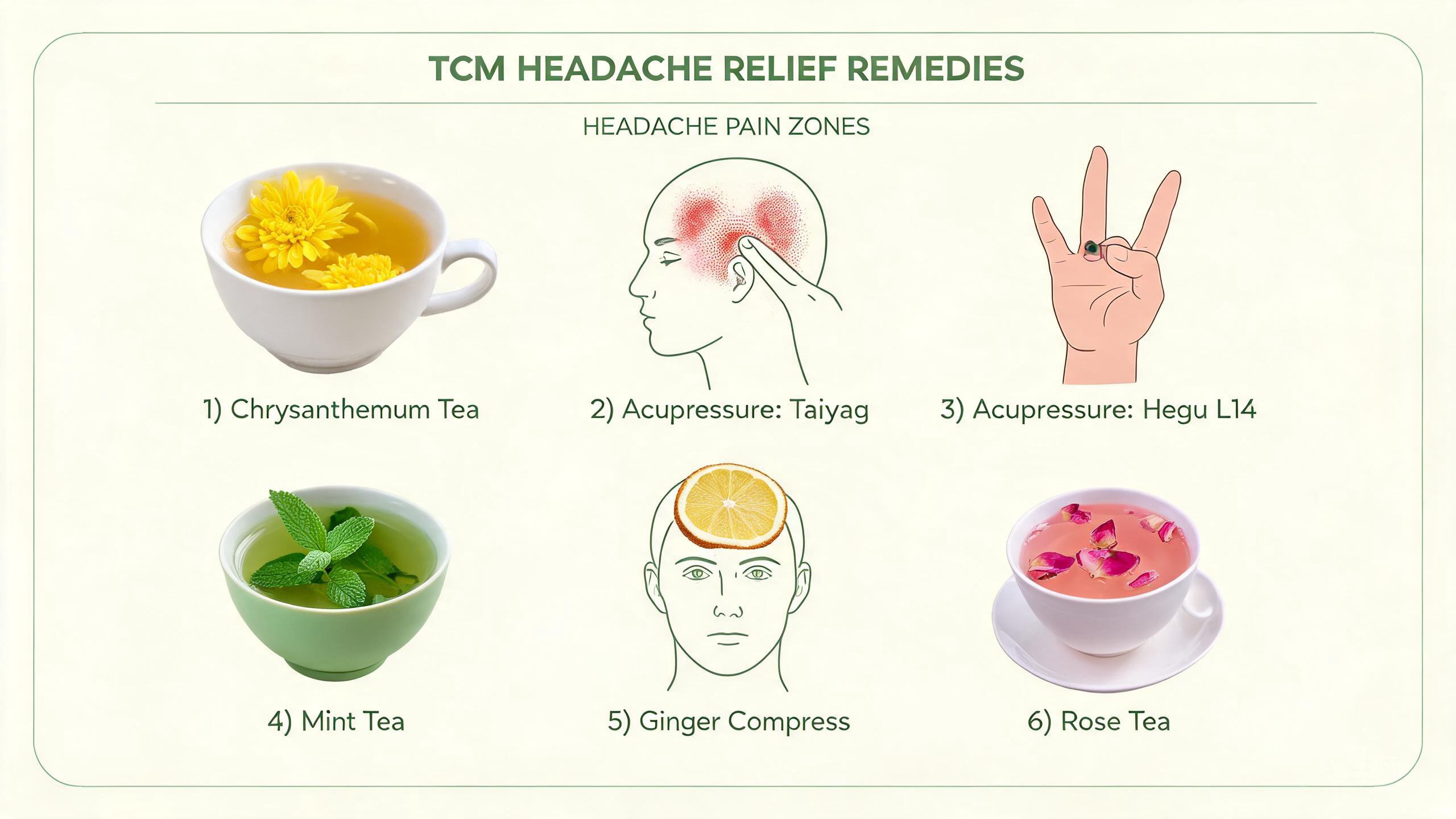
- Three acupressure points — Hegu (LI4), Fengchi (GB20), and Taiyang — are traditionally used for natural headache comfort.
- Matching the remedy to the headache pattern is key: warming ginger tea for cold-type headaches, cooling chrysanthemum tea for heat-type headaches.
- These are traditional wellness practices, not medical treatments. Severe or unusual headaches require immediate medical evaluation.
This article is for educational purposes only and is not medical advice. The foods and practices described here are traditional wellness practices rooted in Chinese culture. They are not a substitute for professional medical care, diagnosis, or treatment. Headaches can be symptoms of serious conditions, including stroke, brain tumors, meningitis, aneurysms, or severe hypertension. Never stop, adjust, or replace prescribed medication based on information in this article. If you are pregnant, nursing, have a pre-existing condition, or take medication, consult your healthcare provider before making dietary changes or practicing acupressure. Some herbs may interact with medications — always inform your doctor about everything you consume. These statements have not been evaluated by the FDA and are not intended to diagnose, treat, cure, or prevent any disease.
Headaches are among the most common forms of pain experienced by humans, and they come in an astonishing variety. A dull ache at the temples after a long day at the screen. A pounding pressure behind the eyes when stressed. A sharp, splitting pain that comes with a cold. A throbbing on one side that follows a sleepless night. Western medicine typically classifies these as tension headaches, migraines, or sinus headaches. Traditional Chinese Medicine takes a different approach — it identifies the underlying pattern of imbalance that is producing the headache, and then matches specific foods, teas, and acupressure points to that pattern.
This pattern-based approach is what makes TCM uniquely valuable for headache support. Rather than reaching for the same pain reliever regardless of the headache type, TCM asks: Is this headache caused by wind-cold? By liver heat rising? By blood stagnation? The answer determines which food therapy and which acupressure points may be most helpful. If you are new to TCM concepts, our introduction to Traditional Chinese Medicine provides helpful background.
How TCM Classifies Headaches
In TCM theory, the head is the meeting point of all yang channels and is often described as the "clear yang" (清阳) — the most refined, upward-reaching part of the body's energy. When this clear yang is disrupted — by external pathogens like wind, by internal imbalances like liver heat, or by stagnation of qi and blood — pain results. TCM identifies five main patterns of headache:
- Wind-Cold Headache (风寒头痛) — The pain often starts at the back of the head or neck and may spread to the whole head. It is accompanied by a feeling of cold, chills, stiff neck, nasal congestion, and clear nasal discharge. The pain worsens with wind and cold, and improves with warmth. This pattern often accompanies the onset of a common cold.
- Wind-Heat Headache (风热头痛) — The pain is typically distending and throbbing, often in the front of the head or temples. It is accompanied by a feeling of heat, fever or warm body, sore throat, yellow nasal discharge, thirst, and irritability. The pain worsens with heat and improves with cooling.
- Liver Yang Headache (肝阳头痛) — The pain is distending, throbbing, and often on the sides of the head (temporal). It is accompanied by irritability, dizziness, a feeling of pressure in the head, red face, bitter taste in the mouth, and sometimes blurred vision. This pattern is strongly linked to stress, anger, and emotional tension. It is the pattern most similar to what Western medicine calls tension and stress-related headaches.
- Phlegm-Turbidity Headache (痰浊头痛) — The pain feels heavy, foggy, and "wrapped," as if the head were bound by a tight band. It is accompanied by a feeling of heaviness in the body, nausea, chest oppression, and a thick greasy tongue coating. This pattern often follows poor diet, damp weather, or spleen weakness.
- Blood Stasis Headache (瘀血头痛) — The pain is fixed, sharp, and piercing, often in a specific location that does not change. It may be long-standing and resistant to usual remedies. This pattern is associated with poor blood circulation and may follow head trauma or chronic headaches.
By identifying which pattern best describes your headache, you can choose the most appropriate food therapy and acupressure approach. To learn more about TCM theory, see our guides on qi, blood, and body fluids and the balance of yin and yang. For our complete acupressure for headache guide, see acupressure for headache.
Five Food Therapies for Headache Support
The following five food therapies are drawn from the TCM tradition. Each is matched to a specific headache pattern, and all ingredients can be sourced from Western supermarkets, Amazon, iHerb, or Asian grocery stores. They are not medicines, and they are not a replacement for any prescribed treatment.
1. Chuanxiong and Angelica Fish Head Soup (川芎白芷鱼头汤)
TCM nature: Chuanxiong is pungent, warm; Angelica dahurica (Bai Zhi) is pungent, warm; fish head is sweet, warm. Enters: Liver, Gallbladder, and Stomach channels.
Chuanxiong (川芎, Chuan Xiong), also known as Sichuan lovage root, is widely regarded as the single most important herb in all of TCM for headaches. The classical saying is: "For headaches, one must use Chuanxiong." It is traditionally classified as a substance that "activates blood," "moves qi," and "dispels wind to stop pain." Its ability to reach the head and face — ascending to the "clear yang" — makes it uniquely suited for head and facial conditions of all types. Angelica dahurica (白芷, Bai Zhi) is a warming herb traditionally used to "dispel wind" and "open the nasal passages," making it especially useful for headaches accompanied by sinus congestion. Fish head provides a nourishing, protein-rich base that supports the body's overall reserves.
This soup is suitable for wind-cold headaches and general headache support. The warming, moving nature of both herbs helps dispel cold wind and promote circulation to the head. It is a traditional Cantonese remedy, often made with bighead carp (胖头鱼) heads, but any fresh fish head will work.
How to prepare: Clean and split 1 large fish head (salmon, cod, or any firm-fleshed fish). Pan-fry briefly in a little oil until lightly golden. Transfer to a pot, add 8 cups of water, 10 grams of Chuanxiong slices, 10 grams of Angelica dahurica (Bai Zhi) slices, 5 slices of fresh ginger, and a few red dates. Bring to a boil, then simmer for 45 to 60 minutes until the broth is milky. Season with salt and white pepper. Drink the broth and eat the fish. Dried Chuanxiong and Angelica dahurica slices are available on Amazon, iHerb, and at Asian herb shops. Fish heads are available at fish markets and many grocery stores.
Caution: Chuanxiong is warming and blood-moving. Avoid during pregnancy, menstruation with heavy bleeding, or if you take blood-thinning medications. Consult your healthcare provider before using this herb if you have a bleeding disorder or take anticoagulants. See our herbal tea safety guide for more.
If you cannot find Angelica dahurica (Bai Zhi), you can make a simpler version with just Chuanxiong, ginger, and fish head. The key headache-supporting ingredient is Chuanxiong — it is the one you should not skip.
2. Chrysanthemum and Cassia Seed Tea (菊花决明子茶)
TCM nature: Chrysanthemum is sweet, bitter, slightly cold; cassia seed is sweet, bitter, salty, slightly cold. Enters: Liver and Lung channels.
This is the quintessential tea for liver yang headaches — the stress-related, throbbing, temporal headaches that come with irritability, tension, and a feeling of pressure in the head. Chrysanthemum (菊花, Ju Hua) is TCM's primary herb for "clearing liver heat" and "calming the liver," which in practical terms means cooling the overheated, overactive, stressed mind. Cassia seed (决明子, Jue Ming Zi) complements this by "clearing liver heat," "brightening the eyes," and "moistening the intestines." Together, they address both the headache and the underlying liver imbalance that produces it.
This tea is particularly suited for people whose headaches are triggered by stress, anger, screen time, or lack of sleep — the modern "liver yang" triggers. It is cooling and calming, making it ideal for afternoon or evening use. From a modern perspective, chrysanthemum contains anti-inflammatory compounds, and cassia seeds may support healthy blood pressure. For more on chrysanthemum, see our complete chrysanthemum tea guide.
How to prepare: Lightly roast 1 tablespoon of cassia seeds in a dry pan for 2 minutes. Combine with 5 to 8 dried chrysanthemum flowers in a teapot. Pour 10 oz of hot water (90°C) over the herbs, cover, and steep for 7 to 10 minutes. Strain and drink warm. Drink 1 to 2 cups per day, ideally in the afternoon. Dried chrysanthemum flowers and cassia seeds are available on Amazon, iHerb, and at Asian grocery stores.
Caution: Both herbs are cooling. If you have a cold constitution (cold hands and feet, preference for very warm food), use sparingly. Cassia seeds may lower blood pressure — do not combine with blood pressure medication without consulting your healthcare provider. Avoid during pregnancy. See our herbal tea safety guide for more.
3. Peppermint Green Tea (薄荷绿茶)
TCM nature: Peppermint is pungent, cool; green tea is bitter, sweet, cool. Enters: Lung and Liver channels.
This is the ideal tea for wind-heat headaches — the throbbing, distending headaches accompanied by a feeling of heat, sore throat, and irritability. Peppermint (薄荷, Bo He) is traditionally classified as a substance that "disperses wind-heat," "clears the head," and "soothes the liver." Its volatile oils have a cooling, refreshing quality that directly targets the head and eyes. Green tea adds a cooling, antioxidant-rich base that supports the body's natural heat-clearing processes. The combination is both cooling and refreshing — think of it as nature's version of a cold compress, taken from the inside.
This tea is particularly suited for headaches that come with a feeling of internal heat, screen fatigue, or the early stages of a warm-type cold. The menthol in peppermint has been shown in modern research to have relaxing effects on smooth muscle and may support headache comfort through multiple pathways. Peppermint is one of the most accessible TCM herbs — it grows in many gardens and is available at every supermarket.
How to prepare: Place 1 teaspoon of dried peppermint leaves (or 5 to 6 fresh leaves) and 1 teaspoon of green tea leaves in a cup. Pour 8 oz of hot water (80°C) over the herbs, cover, and steep for 3 to 5 minutes. Strain and drink warm. Drink 1 to 3 cups per day. For a stronger headache-soothing effect, inhale the steam while steeping. Dried peppermint and green tea are available at all supermarkets.
Caution: Peppermint is cooling. If you have cold-type headaches (with chills), choose ginger tea instead. Peppermint may reduce milk production in nursing mothers — consult your healthcare provider if breastfeeding. Green tea contains caffeine; if you are caffeine-sensitive or have anxiety, use decaffeinated green tea or reduce the amount.
4. Ginger and Scallion Soup (生姜葱白汤)
TCM nature: Ginger is pungent, warm; scallion white is pungent, warm. Enters: Lung and Stomach channels.
This is the traditional remedy for wind-cold headaches — the headaches that come with a chill, stiff neck, and the beginning of a cold. Fresh ginger is traditionally used to "warm the middle" and "dispel cold," while the white part of the scallion (葱白, Cong Bai) is specifically classified as a substance that "releases the exterior" and "disperses wind-cold." In TCM, wind-cold invades the body through the back of the neck and head, which is why wind-cold headaches often start there. This warming soup helps "sweat out" the cold pathogen and restore the free flow of qi to the head.
This remedy is best taken at the very first sign of a wind-cold headache — the moment you feel a chill, a stiff neck, or the beginnings of a cold-related headache. The sooner it is taken, the more effective it traditionally is. It is also one of the simplest remedies in this guide, using only two common kitchen ingredients.
How to prepare: Slice 5 thin pieces of fresh ginger. Cut 2 to 3 scallions (green onions), using mainly the white parts. Combine with 2 cups of water in a small pot, bring to a boil, and simmer for 5 minutes. Drink warm, ideally while wrapped in a blanket to encourage a mild sweat. Drink 1 to 2 cups. Fresh ginger and scallions are available at every supermarket. For more on ginger, see our ginger tea guide.
Caution: This remedy is warming and should only be used for cold-type headaches. If you have a wind-heat headache (sore throat, fever, feeling hot), use peppermint green tea instead. Ginger may interact with blood-thinning medications — consult your healthcare provider. People with acid reflux should use ginger cautiously.
5. Gastrodia Tea (天麻茶)
TCM nature: Sweet, neutral. Enters: Liver channel.
Gastrodia elata (天麻, Tian Ma), also known as tall gastrodia tuber, is one of TCM's most valued herbs for headaches, dizziness, and conditions involving "liver wind" — the TCM concept for symptoms that come and go suddenly, like tremors, spasms, and certain types of headaches. It is traditionally classified as a substance that "calms the liver," "extinguishes wind," and "relieves pain." Unlike the other herbs in this guide, gastrodia is neutral in temperature, making it suitable for a wide range of headache patterns, particularly those accompanied by dizziness, vertigo, or a feeling of unsteadiness.
Gastrodia is particularly associated with the liver yang and liver wind headache patterns — the throbbing, stress-related headaches that may be accompanied by dizziness, blurred vision, or a sense of the head "swimming." It is one of the few TCM herbs specifically valued for its ability to address both headache and dizziness simultaneously. In modern research, gastrodia has been studied for its potential neuroprotective and calming effects.
How to prepare: Slice 3 to 5 grams of dried gastrodia tuber into thin pieces. Simmer in 10 oz of water for 15 to 20 minutes. Strain and drink warm. Drink 1 cup per day. For a more complete remedy, combine with 5 grams of Chuanxiong slices. Dried gastrodia slices are available on Amazon, iHerb, and at Asian herb shops. It is one of the more expensive TCM herbs, but a little goes a long way.
Caution: Gastrodia is generally considered safe in moderate amounts. If you take blood pressure medication, sedatives, or anticoagulants, consult your healthcare provider before using gastrodia, as it may have additive effects. Avoid during pregnancy. See our herbal tea safety guide for more on herb safety.
Three Acupressure Points for Headache Relief
Beyond food therapy, TCM offers a tradition of acupressure — the application of gentle, sustained pressure to specific points on the body. For headaches, three points are most commonly used. These can be self-administered safely at home. For a complete guide with detailed illustrations, see our acupressure for headache guide.
Taiyang (太阳穴) — The Temple Point
Location: The soft depression on each side of the head, approximately one finger-width behind the outer end of the eyebrow, in the temporal region. You will feel a slight dip when you press gently.
Traditional use: Taiyang is an "extra" point — not part of a standard meridian, but universally recognized in TCM for its effectiveness in relieving headache pain. It is traditionally used for temporal headaches, eye strain, and general head discomfort. Because it is located directly in the area where many tension and liver yang headaches produce pain, it is one of the most intuitively useful points for self-care.
How to massage: Using the pads of your index or middle fingers, gently press both temple points simultaneously. Apply steady, moderate pressure — enough to feel a mild ache, but not pain. Using small circular motions, massage slowly for 1 to 2 minutes while breathing deeply. Close your eyes and relax your jaw. This can be repeated several times throughout the day as needed.
Caution: Use gentle pressure only. The temples are sensitive areas. If you feel dizzy or the pain worsens, stop immediately.
Fengchi (风池穴, GB20) — The Wind Pool
Location: At the base of the skull, on both sides of the neck, in the hollow depression between the two vertical neck muscles. To find it, place your thumbs on the back of your head where the skull meets the neck — you will feel two natural depressions on either side of the spine.
Traditional use: Fengchi (which translates to "wind pool") is one of the most important points in all of TCM for conditions affecting the head. Its name reflects its traditional function: it is the point where "wind" — the external pathogen that causes colds and headaches — is said to enter and accumulate. This point is traditionally used for all types of headaches, especially those involving the back of the head and neck, as well as neck stiffness, eye strain, and the common cold.
How to massage: Interlock your fingers behind your head and use your thumbs to press firmly into the two depressions at the base of the skull. Tilt your head back slightly to create space. Apply steady, upward pressure (toward the ceiling) for 1 to 2 minutes while breathing deeply. You may feel a release of tension in the neck and a sensation of warmth or clearing in the head. For a detailed guide, see our acupressure for headache page.
Caution: Press upward and inward, not downward. If you feel dizziness, nausea, or sharp pain, reduce pressure or stop. Do not massage forcefully if you have neck injuries or cervical spine conditions.
Hegu (合谷穴, LI4) — The Joining Valley
Location: On the back of the hand, in the fleshy web between the thumb and index finger. To find it, hold your thumb and index finger together — the point is at the highest point of the muscle bulge that forms between them.
Traditional use: Hegu is arguably the most famous and widely used acupressure point in all of TCM. It is the primary point on the Large Intestine meridian and is traditionally used for "head and face" conditions of all types — including headaches, toothaches, facial pain, and sinus issues. Its distant location from the head makes it seem counterintuitive, but TCM theory explains this through the meridian system: the Large Intestine channel travels up the arm, across the shoulder, and to the face and head. Stimulating this distant point can influence the energy at the other end of the channel.
How to massage: Use the thumb of your opposite hand to press firmly into the web between your thumb and index finger. Apply steady, deep pressure for 1 to 2 minutes on each hand. You should feel a dull ache that may radiate up the arm. Breathe deeply. For a complete guide, see our detailed Hegu (LI4) guide.
Hegu (LI4) is traditionally contraindicated during pregnancy because it may stimulate uterine contractions. Do not use this point if you are pregnant. For everyone else, acupressure at this point is generally safe when performed with moderate pressure.
Matching Remedies to Headache Types
| Headache Pattern | Key Symptoms | Best Food Therapy | Best Acupressure Point |
|---|---|---|---|
| Wind-Cold | Cold feeling, stiff neck, chills, clear mucus | Ginger & Scallion Soup | Fengchi (GB20) |
| Wind-Heat | Throbbing, sore throat, fever, thirst | Peppermint Green Tea | Taiyang |
| Liver Yang | Temporal throbbing, irritability, dizziness | Chrysanthemum & Cassia Tea | Taiyang + Hegu (LI4) |
| Phlegm-Turbidity | Heavy, foggy head, nausea, chest oppression | Chuanxiong Fish Head Soup | Fengchi (GB20) |
| Blood Stasis | Fixed, sharp, piercing pain | Gastrodia Tea + Chuanxiong | Hegu (LI4) |
| General / All Types | Any headache | Chuanxiong Fish Head Soup | All three points |
Lifestyle Tips for Headache Prevention From a TCM Perspective
Food therapy and acupressure are most effective when combined with lifestyle habits that prevent headaches from developing in the first place. TCM offers the following traditional guidance:
- Protect the neck from wind. In TCM, wind is considered the primary external cause of headaches. Wearing a scarf, avoiding sitting in direct drafts or air-conditioning, and keeping the neck covered in cold or windy weather are all traditional preventive measures.
- Manage stress and emotions. The liver in TCM is the organ most affected by anger, frustration, and stress. Chronic emotional tension is one of the most common causes of liver yang headaches. Practices like meditation, tai chi, and calming teas like those in our herbal tea for anxiety guide can help.
- Get adequate rest. In TCM, lack of sleep depletes yin and blood, which allows liver yang to rise unchecked — a direct pathway to headaches. Our best TCM teas for sleep guide may help if sleep is an issue.
- Limit trigger foods. In TCM, excessively spicy, greasy, or alcohol-heavy foods can generate heat and dampness that contribute to headaches. Pay attention to what you eat before a headache and identify your personal triggers.
- Stay hydrated with warm fluids. Dehydration is a common headache trigger. Drink warm or room-temperature water throughout the day, and avoid ice-cold drinks, which TCM considers disruptive to the body's energy balance. See our guide to stomach cold for more on why warm drinks are preferred.
- Take screen breaks. In TCM, prolonged screen use strains the liver and eyes (the liver "opens into the eyes"), which can trigger liver yang headaches. Follow the 20-20-20 rule: every 20 minutes, look at something 20 feet away for 20 seconds. Chrysanthemum tea is traditionally used to support eye health.
When to Seek Immediate Medical Attention
The foods and practices in this article are complementary wellness traditions, not medical treatments. Some headaches are medical emergencies. Seek immediate medical attention if you experience any of the following:
- A sudden, severe headache that reaches maximum intensity within seconds (a "thunderclap" headache)
- Headache accompanied by a stiff neck, fever, and sensitivity to light (possible meningitis)
- Headache after a head injury, especially with confusion, drowsiness, or vomiting
- Headache with neurological symptoms: weakness, numbness, difficulty speaking, vision loss, or loss of coordination
- A headache that feels "different" from any headache you have had before
- Headaches that progressively worsen in frequency or intensity
- Headache with a rash, especially one that does not fade when pressed
- Any new headache in a person over 50, or in someone with a history of cancer or HIV
If you experience frequent or severe headaches, see a healthcare provider for proper diagnosis. Many headache types — including migraines, cluster headaches, and tension headaches — have effective medical treatments. TCM food therapies and acupressure may complement but should never replace medical care. For related guides, see our acupressure for headache and Hegu LI4 pages. For headaches related to digestion, see our guides on TCM for digestion and TCM for stomach cold.
The Bottom Line
Headaches are a universal human experience, and TCM offers a uniquely nuanced approach to them. Rather than treating all headaches the same, TCM identifies the underlying pattern — wind-cold, wind-heat, liver yang, phlegm-turbidity, or blood stasis — and matches specific food therapies and acupressure points to each pattern. This personalized approach is what makes the tradition so enduring.
The five food therapies in this guide cover the full spectrum: ginger and scallion soup for cold-type headaches, peppermint green tea for heat-type headaches, chrysanthemum and cassia tea for stress-related liver yang headaches, Chuanxiong fish head soup as a versatile all-purpose remedy, and gastrodia tea for headaches with dizziness. Combined with three simple acupressure points — Taiyang, Fengchi, and Hegu — you have a toolkit that addresses most common headache patterns using ingredients and techniques accessible to anyone.
But these are traditions — not treatments, and not a replacement for medical care. If your headaches are severe, unusual, or accompanied by any warning signs, seek medical evaluation immediately. The wisdom of TCM lies not in replacing medicine, but in offering accessible, daily practices that may support comfort and balance alongside professional care. A cup of chrysanthemum tea on a stressful afternoon. A gentle press of the temples when tension builds. A warming bowl of ginger soup at the first sign of a chill. These small, mindful acts — practiced consistently — are the heart of TCM self-care.
This article shares traditional wellness practices for educational purposes only. It is not a substitute for medical advice, diagnosis, or treatment. The foods, teas, and acupressure practices described here are not intended to treat, cure, or prevent any disease. Headaches can be symptoms of serious medical conditions — severe, sudden, or unusual headaches require immediate medical evaluation. If you are pregnant, nursing, or take medication, consult your healthcare provider before making dietary changes or practicing acupressure. These statements have not been evaluated by the FDA. Never stop or adjust prescribed medication without your doctor's explicit guidance.