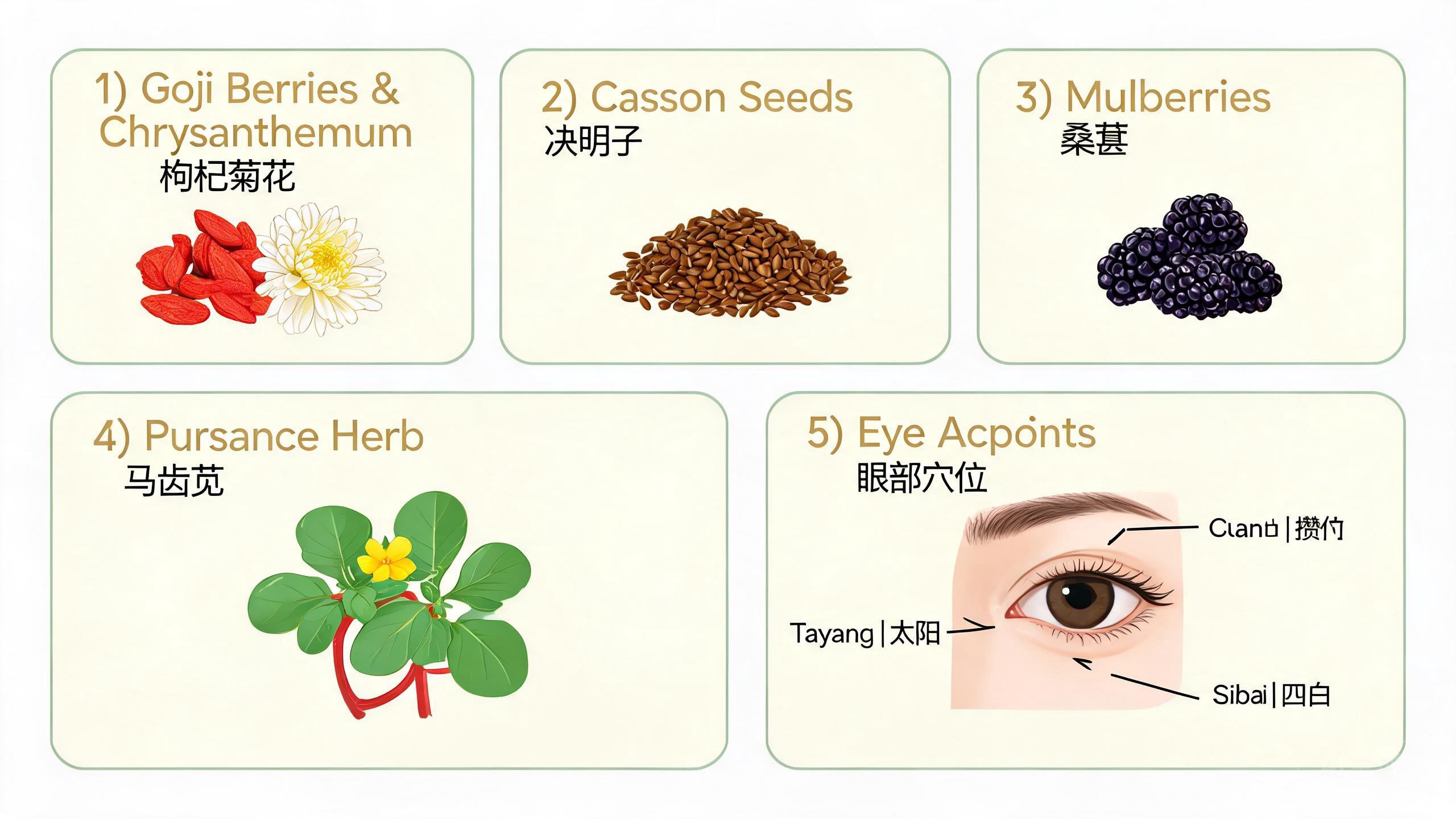
Key Takeaways
- TCM views eye wellness through the Liver and Kidney organ systems, with the principle that the Liver opens into the eyes and prolonged looking exhausts blood.
- Five traditional food therapy recipes — from goji chrysanthemum tea to goji mulberry porridge — use ingredients available at Western supermarkets, Amazon, or iHerb.
- Three acupressure points, Cuanzhu (BL2), Taiyang (EX-HN5), and Sibai (ST2), are traditionally used to support circulation around the eyes.
- The 20-20-20 rule — looking 20 feet away for 20 seconds every 20 minutes — aligns with the TCM principle of balancing visual work with rest.
- These are traditional wellness practices, not a treatment for any medical condition. Persistent dry eyes require evaluation by a qualified eye care professional.
This article is for educational purposes only and is not medical advice. The foods, teas, and practices described here are traditional wellness practices rooted in Chinese culture. They are not a substitute for professional medical care, diagnosis, or treatment. Dry eyes can result from many causes — including environmental factors, medications, autoimmune conditions like Sjogren's syndrome, and screen-related strain — that require proper evaluation by an eye care professional. Never stop, delay, or replace prescribed treatment based on information in this article. Some foods and herbs may interact with medications — always inform your doctor about everything you consume. These statements have not been evaluated by the FDA and are not intended to diagnose, treat, cure, or prevent any disease. Read our full disclaimer →
Dry, gritty, tired eyes have become one of the most common wellness complaints of the modern era. Hours spent staring at screens, air-conditioned offices, and seasonal winds all take a toll on eye comfort. While persistent dry eye symptoms should always be evaluated by an eye care professional, Traditional Chinese Medicine (TCM) offers a rich tradition of food therapy and self-care practices that may support eye wellness as part of a balanced lifestyle.
In TCM, the eyes are not viewed as an isolated organ. They are considered an extension of the Liver system, which is said to "open into the eyes," and they rely on the nourishing essence of the Kidneys. The classic TCM principle jiu shi shang xue — "prolonged looking exhausts blood" — directly connects visual overwork with depletion of the body's nourishing fluids. The five recipes below use foods and teas that have been enjoyed for generations to nourish liver and kidney yin, clear mild heat, and support eye comfort. All ingredients are available at Western supermarkets, Asian markets, Amazon, or iHerb.
If you are new to TCM concepts, our introduction to Traditional Chinese Medicine and guide to the Zang-Fu organ systems are helpful starting points. For a broader look at eye care, see our guide to TCM for eye health.
How TCM Views the Eyes
Traditional Chinese Medicine sees the eyes as a window into the health of the internal organ systems, particularly the Liver and Kidneys. Understanding this connection is the key to appreciating why certain foods and teas are traditionally recommended for eye comfort.
The Liver opens into the eyes. This is one of the most fundamental principles in TCM. The Liver system is responsible for the smooth flow of qi and blood throughout the body, and it is said to "supply" the eyes with the nourishment they need for clear, comfortable vision. When liver blood is abundant, the eyes are moist, bright, and comfortable. When liver blood is deficient — from prolonged visual work, insufficient sleep, poor diet, or emotional stress — the eyes become dry, tired, and easily strained. The classic saying jiu shi shang xue ("prolonged looking exhausts blood") captures this: the act of sustained visual focus depletes liver blood over time.
The Kidneys nourish the eyes. In TCM, the Kidneys store essence (jing), which is the foundational substance of life. Kidney essence produces marrow, and in the TCM view, the brain and eyes are nourished by this marrow. Kidney yin, the cooling and moistening aspect of the kidney system, provides the fluid foundation that keeps the eyes lubricated. When kidney yin is deficient — from aging, overwork, chronic stress, or inadequate rest — the eyes lose their internal moisture supply, leading to dryness, especially in the evening or after exertion.
TCM identifies several patterns associated with eye dryness and discomfort:
- Liver and Kidney Yin Deficiency (Gan Shen Yin Xu) — the most common pattern for chronic dry eyes. Signs include dry, gritty eyes, blurred vision (especially in the evening), dry mouth, scanty sleep, lower back soreness, and a feeling of heat in the palms and soles. Often seen in older adults, people under chronic stress, or those who spend long hours on screens. See our guide to yin and yang for more on deficiency patterns.
- Liver Heat Rising (Gan Re Shang Yan) — heat in the Liver system rises upward to affect the eyes. Signs include red, bloodshot, or burning eyes, light sensitivity, irritability, and a bitter taste in the mouth. Often triggered by stress, frustration, anger, or excessive consumption of spicy and fried foods. This pattern overlaps with the TCM understanding of stress and emotional wellness.
- Qi and Blood Deficiency (Qi Xue Liang Xu) — insufficient qi and blood fail to nourish the eyes. Signs include tired eyes that feel heavy, pale complexion, dizziness on standing, and poor sleep. Often related to poor digestion, inadequate nutrition, or recovery from illness. See our guide to qi, blood, and body fluids for more.
- External Wind-Heat (Wai Gan Feng Re) — environmental factors such as wind, dry air, or seasonal changes temporarily irritate the eyes. Signs include sudden onset of dry, itchy, or watery eyes, often accompanying a cold or allergy. This is typically a short-term pattern.
Understanding these patterns helps explain why TCM recommends different foods for different situations. The recipes below are matched to the patterns they traditionally address.
5 Food Therapy Recipes for Eye Comfort
Each recipe below is matched to a specific TCM pattern. Choose the one that best fits your situation, and use it consistently for two to four weeks. All ingredients are available at Western supermarkets, Asian markets, Amazon, or iHerb.
1. Goji Berry Chrysanthemum Tea (枸杞菊花茶)
Best for: Liver and Kidney yin deficiency with mild heat
TCM nature and flavor: Goji berries (gou qi zi): sweet, neutral. Enters the Liver and Kidney channels. Chrysanthemum (ju hua): sweet, bitter, slightly cold. Enters the Lung and Liver channels.
Traditional use: This is arguably the most famous TCM tea for eye wellness, enjoyed daily by millions across East Asia. Goji berries are traditionally used to nourish liver and kidney yin, support essence, and brighten the eyes. Chrysanthemum is traditionally valued for clearing liver heat, dispersing wind-heat, and supporting vision. Together, they address both the deficiency (goji nourishes) and the excess heat (chrysanthemum clears) that commonly coexist in screen-tired eyes. The combination is gentle enough for daily use and has a pleasant, slightly sweet floral flavor.
Ingredients:
- 10 grams dried goji berries (about 1 tablespoon) — available on Amazon, iHerb, and most supermarkets
- 5 grams dried chrysanthemum flowers (about 1 teaspoon) — available on Amazon or iHerb
- 8 oz hot water (90°C / 195°F)
- Optional: a few rock sugar crystals or a small amount of honey
Preparation: Rinse the goji berries and chrysanthemum flowers briefly. Place them in a cup or teapot. Pour hot water over the ingredients, cover, and steep for 5 to 8 minutes. The goji berries will soften and plump up — you can eat them after drinking the tea for full benefit. Drink 1 to 2 cups per day, preferably in the morning or afternoon. For more on goji berries, see our goji tea guide.
Precautions: Goji berries may interact with blood thinners such as warfarin — consult your doctor if you take anticoagulant medication. Chrysanthemum is in the same plant family as ragweed; if you have daisy or ragweed allergies, use with caution. Avoid chrysanthemum if you have diarrhea or a cold constitution without heat signs.
2. Cassia Seed Chrysanthemum Tea (决明菊花茶)
Best for: Liver heat rising with red, tired, or strained eyes
TCM nature and flavor: Cassia seed (jue ming zi): sweet, bitter, salty, slightly cold. Enters the Liver and Large Intestine channels. Chrysanthemum (ju hua): sweet, bitter, slightly cold. Enters the Lung and Liver channels. Hawthorn (shan zha): sour, sweet, slightly warm. Enters the Spleen, Stomach, and Liver channels.
Traditional use: Cassia seed is one of TCM's most important liver-heat-clearing and vision-supporting herbs. Its name jue ming zi literally means "seed of brightness." It is traditionally used to clear liver heat, support vision, and moisten the intestines. When combined with chrysanthemum, the heat-clearing effect on the eyes is amplified. Hawthorn is added to support digestion and help move stagnation, which is relevant because liver heat often arises from digestive sluggishness and emotional frustration. This tea is particularly suited for those whose eye discomfort is accompanied by irritability, a feeling of pressure behind the eyes, or a tendency toward constipation.
Ingredients:
- 10 grams roasted cassia seeds (about 2 teaspoons) — available on Amazon or iHerb (search "cassia seed tea" or "jue ming zi")
- 5 grams dried chrysanthemum flowers (about 1 teaspoon)
- 15 grams dried hawthorn slices (about 1 tablespoon) — available on Amazon or iHerb
- 12 oz water
Preparation: Lightly crush the cassia seeds. Combine cassia seeds, chrysanthemum, and hawthorn in a pot with water. Bring to a boil, then reduce heat and simmer for 10 minutes. Strain into a cup. Drink 1 cup per day, preferably in the morning or afternoon. The tea has a slightly roasted, tangy flavor. Roasted cassia seeds (rather than raw) are preferred as they are gentler on the stomach.
Precautions: Cassia seed has a mild laxative effect and is traditionally avoided during pregnancy and in people with chronic diarrhea. If you take blood pressure medication, consult your doctor, as cassia seed is traditionally associated with supporting healthy blood pressure. Avoid long-term continuous use; use for two to three weeks, then take a break.
3. Goji Mulberry Porridge (枸杞桑葚粥)
Best for: Liver and Kidney yin deficiency (chronic dry eyes with fatigue)
TCM nature and flavor: Goji berries (gou qi zi): sweet, neutral. Enters the Liver and Kidney channels. Mulberry (sang shen): sweet, sour, cold. Enters the Heart, Liver, and Kidney channels. Chinese yam (shan yao): sweet, neutral. Enters the Spleen, Lung, and Kidney channels. Red dates (hong zao / jujube): sweet, warm. Enters the Spleen and Stomach channels.
Traditional use: This porridge is a deeply nourishing recipe for the deficiency pattern that underlies many cases of chronic dry eyes. Goji berries nourish liver and kidney yin. Mulberries are traditionally used to nourish yin and blood, support the kidneys, and moisten dryness — they are particularly valued for their dark, cooling, fluid-rich nature. Chinese yam strengthens the spleen and kidneys simultaneously, while red dates support qi and blood production. Together, this porridge addresses the root deficiency rather than just the surface symptom, making it ideal for people whose eye dryness is accompanied by general fatigue, poor sleep, and lower back weakness.
Ingredients:
- 15 grams dried goji berries (about 1.5 tablespoons)
- 15 grams dried mulberries (about 1.5 tablespoons) — available on Amazon or iHerb
- 15 grams fresh Chinese yam, peeled and diced (or 10 grams dried yam slices from Amazon/iHerb)
- 45 grams dried red dates (about 5 to 6 jujubes), pitted and halved
- 1/2 cup white rice (short or medium grain) or rolled oats
- 5 cups water
Preparation: Rinse the rice. Soak the red dates in warm water for 15 minutes if they are very dry. In a pot, combine rice, red dates, Chinese yam, and water. Bring to a boil, then reduce heat and simmer for 30 minutes, stirring occasionally. Add the goji berries and mulberries in the last 10 minutes (they cook quickly and lose nutrients if overcooked). The porridge is ready when it is thick and creamy. Eat 1 bowl per day, ideally in the morning or as a light dinner. For more on Chinese yam, see our yam congee guide and our congee guide.
Precautions: This is a nourishing, gentle porridge suitable for most people. Mulberries are cooling; if you have a cold constitution with loose stools, reduce the amount slightly. Red dates are naturally sweet — if you monitor your blood sugar, use fewer dates or consult your healthcare provider.
4. Purslane Soup (马齿苋汤)
Best for: Liver heat with eye redness and a feeling of heat in the body
TCM nature and flavor: Purslane (ma chi xian): sour, cold. Enters the Large Intestine and Liver channels. Garlic: warm. Sesame oil: neutral, moistening.
Traditional use: Purslane is one of TCM's most valued heat-clearing wild vegetables. It is traditionally used to clear heat, cool the blood, and reduce inflammation. For eye patterns involving heat signs — such as red, burning, or bloodshot eyes, a feeling of warmth in the face, or irritability — purslane's cooling nature is particularly relevant. In Chinese folk tradition, fresh purslane is eaten as a vegetable in summer to prevent heat-related conditions. This simple soup pairs purslane with garlic for flavor balance and sesame oil for its moistening properties, creating a light, refreshing dish that supports eye comfort during hot weather or periods of elevated internal heat.
Ingredients:
- 2 cups fresh purslane (or 30 grams dried purslane — available on Amazon or iHerb)
- 2 cloves garlic, minced
- 1 tablespoon sesame oil (toasted sesame oil is traditional)
- 4 cups vegetable broth or water
- A pinch of sea salt
Preparation: If using fresh purslane, wash thoroughly and chop roughly. If using dried purslane, soak for 20 minutes. Heat the sesame oil in a pot over medium heat. Add the minced garlic and saute briefly until fragrant (30 seconds). Add the broth and bring to a boil. Add the purslane and simmer for 5 to 10 minutes until tender. Add salt to taste. Drink 1 bowl per day, ideally at lunch. Fresh purslane can also be foraged in many regions, but only harvest from pesticide-free areas.
Precautions: Purslane is cold in nature. Avoid if you have a cold constitution, chronic diarrhea, or during pregnancy. If the soup feels too cooling, add extra ginger or garlic to balance it. Purslane contains oxalates; if you have a history of kidney stones, consult your healthcare provider.
5. Goji Tribulus Tea (枸杞蒺藜茶)
Best for: Liver and Kidney yin deficiency with eye floaters or blurred vision
TCM nature and flavor: Goji berries (gou qi zi): sweet, neutral. Enters the Liver and Kidney channels. Tribulus (ci ji li / puncture vine): bitter, pungent, neutral. Enters the Liver channel.
Traditional use: Tribulus, known in TCM as ci ji li, is traditionally used to calm the liver, disperse wind, and support vision. It is particularly associated with addressing eye floaters, blurred vision, and a sensation of heaviness or itching in the eyes — symptoms that TCM attributes to internal wind stirring due to liver and kidney deficiency. Combined with goji berries, which nourish the underlying deficiency, this tea addresses both the root (yin deficiency) and the branch (wind-related symptoms). It is a gentle, daily tea suited for those whose eye discomfort includes visual disturbances beyond simple dryness.
Ingredients:
- 10 grams dried goji berries (about 1 tablespoon)
- 10 grams dried tribulus fruit (ci ji li) — available on Amazon or iHerb (search "tribulus terrestris dried" or "ci ji li")
- 10 oz water
Preparation: Rinse the goji berries and tribulus. In a pot, combine all ingredients with water. Bring to a boil, then reduce heat and simmer gently for 10 to 15 minutes. Strain into a cup. Drink 1 cup per day, preferably in the morning or afternoon. The tea is mild and slightly earthy. You can eat the softened goji berries afterward. See our goji tea guide for more on goji berries.
Precautions: Tribulus is generally gentle but may interact with blood pressure medication and hormone-related medications. If you are pregnant, nursing, or take prescription medications, consult your healthcare provider before using tribulus regularly. Avoid if you have qi deficiency with severe fatigue.
Three Acupressure Points for Eye Comfort
In addition to food therapy, TCM uses acupressure — the practice of applying steady pressure to specific points on the body — to support the areas around the eyes. The three points below are traditionally used to promote local circulation, ease eye strain, and support the organ systems connected to vision. They are simple to find and can be pressed daily as part of a wellness routine.
1. Cuanzhu (BL2) — The "Bamboo Drill"
Location: At the inner end of the eyebrow, in a small depression on the supraorbital notch, directly above the inner corner of the eye.
How to find it: Feel along the inner end of your eyebrow, near the bridge of your nose. You will find a small notch or depression where the bone curves. Press gently — you may feel a slight tenderness or a deep ache radiating upward.
How to press: Using your thumbs or index fingers, press gently but firmly into the point. Hold for 30 seconds to 1 minute while breathing slowly. Use light to moderate pressure — the area around the eyes is delicate. You can also use small circular motions. Repeat 3 to 5 times per session.
Traditional use: Cuanzhu is one of the most important points for eye wellness in TCM. It is traditionally used to dispel wind-heat, support vision, and ease eye strain. Because of its location directly above the inner eye, it is particularly relevant for frontal eye fatigue, tension headaches around the brow, and the heavy, tired sensation that comes from prolonged screen use. See our acupressure safety guide for general precautions.
Precautions: Always use clean hands before pressing points near the eyes. Never press directly on the eyeball. Use gentle pressure only.
2. Taiyang (EX-HN5) — The "Sun Point"
Location: In the depression about one finger-width behind the midpoint of the line connecting the outer end of the eyebrow and the outer corner of the eye, in the temple area.
How to find it: Place your index finger at the outer corner of your eye. Move it about one finger-width backward toward your ear. You will feel a small depression in the temporal bone — this is Taiyang. Pressing here often reveals a tender spot, especially after long periods of concentration.
How to press: Using your index or middle fingers, press both temples simultaneously with gentle, steady pressure. Hold for 30 seconds to 1 minute. You can also use slow, small circular motions. This point is excellent for relieving tension that builds up from squinting or prolonged focus. Repeat 3 to 5 times per session.
Traditional use: Taiyang is an extra point (not on a primary meridian) that is widely used in TCM and Chinese folk massage. It is traditionally used to relieve headaches, calm the mind, and ease eye strain. For eye wellness, it helps release the tension that accumulates in the temples from sustained visual focus and is particularly soothing after a long day of screen work. See our guide to TCM self-massage for more techniques.
Precautions: Use gentle pressure — the temple area has many blood vessels close to the surface. If you feel dizzy or uncomfortable, stop immediately.
3. Sibai (ST2) — The "Four White"
Location: On the face, approximately one finger-width below the lower border of the eye socket (infraorbital foramen), directly below the pupil when looking straight ahead.
How to find it: Look straight ahead. Place your index finger directly below your pupil, about one finger-width below the lower rim of the eye socket. Press gently inward and slightly upward. You will feel a slight depression and a possible tenderness or a sensation radiating toward the nose.
How to press: Using your index fingers, press gently into the point on both sides simultaneously. Hold for 30 seconds to 1 minute. Use light pressure — this area is close to the infraorbital nerve. Small, gentle circular motions are also effective. Repeat 3 to 5 times per session.
Traditional use: Sibai is a point on the Stomach meridian that is traditionally used to support vision, ease eye fatigue, and reduce facial tension. It is particularly relevant for the tired, aching sensation around the lower eyes and cheekbones that often accompanies prolonged screen use. In TCM facial massage routines, Sibai is frequently included for its dual benefit to eye comfort and facial circulation. See our gua sha for face guide for complementary facial techniques.
Precautions: Use very gentle pressure on this point, as the infraorbital nerve is close to the surface. Never press hard enough to cause pain. Avoid pressing if you have had recent facial surgery or dental work in the area.
For a simple daily routine, press all three points in sequence: start with Cuanzhu (BL2) for 30 seconds on each side, then Taiyang (EX-HN5) for 30 seconds on both sides simultaneously, and finish with Sibai (ST2) for 30 seconds on each side. The entire routine takes about 3 minutes and can be done morning and evening, or anytime your eyes feel strained. Consistency matters more than duration — daily gentle pressure over several weeks is more effective than occasional long sessions.
Lifestyle Tips for Eye Wellness
TCM is a whole-person system. Foods and acupressure work best when combined with supportive daily habits. In fact, the TCM principle jiu shi shang xue ("prolonged looking exhausts blood") places lifestyle at the center of eye wellness. The following areas are emphasized in classical TCM for maintaining eye comfort:
- Practice the 20-20-20 rule. Every 20 minutes of screen work, look at something 20 feet (about 6 meters) away for at least 20 seconds. This simple practice aligns perfectly with the TCM principle of balancing visual work with rest. It gives the eye muscles a chance to relax and reduces the sustained focus that depletes liver blood over time.
- Blink consciously. Screen use reduces blink rate by up to two-thirds. Make a conscious effort to blink fully and regularly. TCM views blinking as a way the body "redistributes" fluids across the eye surface — consistent with its emphasis on the smooth flow of qi and fluids.
- Protect your sleep. In TCM, the Liver system is most active in restoring blood between 1:00 AM and 3:00 AM. Going to bed before 11:00 PM allows the body to enter deep rest before this crucial period. Poor sleep directly depletes liver blood and worsens eye dryness. See our TCM insomnia types guide and meditation guide for better sleep practices.
- Stay hydrated. TCM views dry eyes as a local manifestation of systemic fluid depletion. Drink warm or room-temperature water throughout the day. Avoid excessive cold drinks, which TCM considers weakening to the spleen — the organ responsible for transforming fluids. See our qi, blood, and body fluids guide for more.
- Adjust screen ergonomics. Position screens slightly below eye level and at arm's length. Use a matte screen filter to reduce glare. Ensure adequate ambient lighting. Consider using a humidifier in dry environments, especially in winter or air-conditioned spaces.
- Manage stress and emotions. In TCM, frustration and anger cause liver qi to stagnate, which can generate heat that rises to the eyes. Building in genuine rest, relaxation practices, and emotional balance all help qi flow smoothly. See our herbal tea for anxiety guide for practical starting points.
Comparison of the Five Recipes
| Recipe | TCM Pattern | Key Action | Frequency |
|---|---|---|---|
| Goji Berry Chrysanthemum Tea | Yin Def. + Mild Heat | Nourish yin, clear heat | 1 to 2 cups daily |
| Cassia Seed Chrysanthemum Tea | Liver Heat Rising | Clear liver heat, support vision | 1 cup daily |
| Goji Mulberry Porridge | Yin Deficiency (chronic) | Nourish liver and kidney yin | 1 bowl daily |
| Purslane Soup | Liver Heat (with redness) | Cool blood, clear heat | 1 bowl daily |
| Goji Tribulus Tea | Yin Def. + Wind (floaters) | Nourish yin, calm liver wind | 1 cup daily |
Frequently Asked Questions
What does TCM say about dry eyes?
In Traditional Chinese Medicine, the Liver opens into the eyes and the Kidneys nourish them. Prolonged visual strain is said to exhaust Liver blood, while Liver and Kidney yin deficiency leaves the eyes undernourished and dry. TCM food therapy traditionally uses goji berries, chrysanthemum, cassia seed, and mulberries to nourish Liver and Kidney yin and support eye comfort. Other patterns include Liver Heat Rising (red, burning eyes) and Qi and Blood Deficiency (tired, heavy eyes). These are traditional wellness practices, not medical treatments. For a deeper understanding, see our zang-fu organ guide.
Which Chinese medicine foods may support eye comfort?
Five traditional TCM food therapy recipes for eye wellness include goji berry chrysanthemum tea, cassia seed chrysanthemum tea, goji mulberry porridge, purslane soup, and goji tribulus tea. These recipes use ingredients available at Western supermarkets, Asian markets, Amazon, or iHerb. Nourishing recipes (goji mulberry porridge) are best for deficiency-type patterns, while heat-clearing recipes (cassia tea, purslane soup) are best for heat-type patterns. They are traditional wellness foods, not treatments for any medical condition.
Can TCM acupressure help with dry eyes?
TCM acupressure on points like Cuanzhu (BL2) at the inner eyebrow, Taiyang (EX-HN5) at the temples, and Sibai (ST2) below the eye is traditionally used to support local circulation, ease eye strain, and promote relaxation. Gentle, regular pressure on these points may complement overall eye wellness. However, acupressure is not a treatment for dry eye disease or any eye condition. If you experience persistent eye pain, vision changes, light sensitivity, or signs of infection, consult your eye care professional promptly. See our acupressure safety guide for general precautions.
Is goji berry chrysanthemum tea good for dry eyes?
Goji berry and chrysanthemum tea is one of the most popular TCM beverages traditionally used to support eye wellness. Goji berries are traditionally said to nourish Liver and Kidney yin and support vision, while chrysanthemum is valued for clearing Liver heat. Together they form a gentle, daily tea that may help maintain eye comfort, especially for people who spend long hours on screens. The tea is widely available as pre-packaged tea bags or can be made from loose ingredients. These are traditional wellness practices, not medical treatments, and should not replace professional eye care. See our goji tea guide for more details.
Precautions and When to Seek Help
While TCM food therapy and acupressure may support general wellness, eye symptoms can indicate serious medical conditions that require professional evaluation:
- Seek prompt medical attention if you experience sudden vision changes, eye pain, light sensitivity, eye discharge, or signs of infection (redness, swelling, warmth). These may indicate corneal damage, infection, or other serious conditions.
- See your eye care professional if dry eyes persist for more than a few weeks despite lifestyle changes, or if they interfere with daily activities such as reading, driving, or working. Chronic dry eyes may indicate dry eye syndrome, meibomian gland dysfunction, or systemic conditions such as Sjogren's syndrome.
- Contact lens wearers should be especially attentive to eye comfort. Dry eyes increase the risk of corneal complications with contact lens use. Follow your optometrist's guidance on lens hygiene and wear schedule.
- Medication interactions. If you take blood thinners (warfarin), blood pressure medication, hormone therapy, or immunosuppressants, consult your healthcare provider before adding goji berries, cassia seed, or tribulus to your routine.
- Not a substitute. TCM food therapy is complementary. It sits alongside — never in place of — professional medical care.
For related topics, see our guides on TCM for eye health, herbal tea for anxiety, and congee guide.
The Bottom Line
Traditional Chinese Medicine offers a gentle, food-based tradition for supporting eye comfort. By understanding whether your pattern is rooted in liver and kidney yin deficiency, liver heat rising, or qi and blood deficiency, you can choose foods and teas that work with your body's specific needs. Goji berry chrysanthemum tea nourishes yin while clearing mild heat. Cassia seed chrysanthemum tea targets liver heat with a vision-supporting focus. Goji mulberry porridge deeply nourishes the deficiency that underlies chronic dry eyes. Purslane soup cools blood heat when the eyes are red and burning. And goji tribulus tea addresses both deficiency and the visual disturbances that accompany it. Paired with three acupressure points — Cuanzhu (BL2), Taiyang (EX-HN5), and Sibai (ST2) — and lifestyle habits like the 20-20-20 rule, conscious blinking, adequate sleep, and stress management, these traditional practices form a whole-person approach to eye wellness.
But they are traditions — not treatments, and not a replacement for medical care. Persistent or severe eye symptoms require evaluation by a qualified eye care professional. Use these traditional practices only as complementary wellness habits, alongside your doctor's guidance.
This article shares traditional wellness practices for educational purposes only. It is not a substitute for medical advice, diagnosis, or treatment. The foods, teas, and acupressure practices described here are not intended to treat, cure, or prevent any disease, including but not limited to dry eye syndrome, meibomian gland dysfunction, Sjogren's syndrome, or corneal conditions. If you have persistent eye symptoms — including dryness, pain, redness, vision changes, or light sensitivity — consult your eye care professional promptly for proper evaluation. These statements have not been evaluated by the FDA. Never stop or adjust prescribed treatment without your doctor's explicit guidance. Read our full disclaimer →