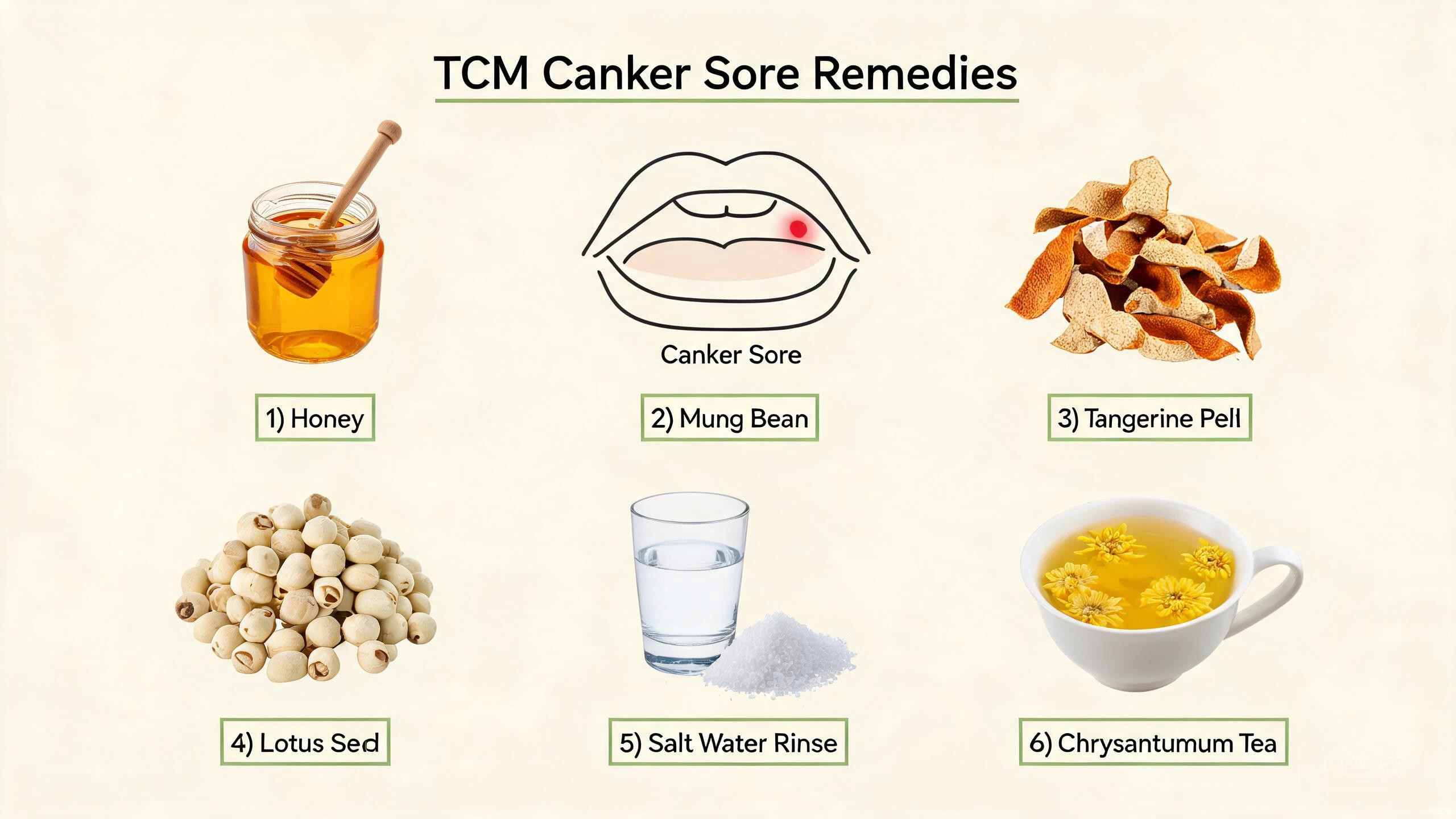
Key Takeaways
- TCM views canker sores through patterns like heart-spleen heat, yin deficiency fire, spleen-stomach damp-heat, and qi-blood deficiency — each requiring different foods.
- Lotus plumule tea is the classic TCM remedy for clearing heart fire — the pattern behind stress-related mouth ulcers.
- Mung bean soup is traditionally used to clear heat and support the body's natural detoxification processes.
- Honey application directly on the sore may soothe discomfort and support tissue healing.
- All ingredients are available at supermarkets, Amazon, or iHerb; none require a special herb shop visit.
This article is for wellness education only and is not medical advice, diagnosis, or treatment. Canker sores usually heal on their own, but persistent or unusual mouth lesions should be evaluated by a healthcare provider. The food therapy practices described are complementary wellness approaches, not a replacement for professional care. Read our full disclaimer →
Canker sores — those small, painful ulcers inside the mouth — are incredibly common. Most people experience them occasionally, and some deal with them recurrently. While they typically heal on their own within one to two weeks, the discomfort can make eating and talking miserable. Traditional Chinese Medicine (TCM) offers a different lens: rather than viewing canker sores as random annoyances, TCM sees them as signals of internal heat or deficiency that can be addressed through food.
In TCM theory, the mouth is the opening of the spleen, and the tongue is connected to the heart. When heat accumulates in these organs — from stress, rich foods, poor sleep, or overwork — it rises to the mouth and manifests as ulcers. The key insight is that not all canker sores have the same root cause. By identifying whether your sores come from heart fire, yin deficiency, damp-heat, or qi-blood deficiency, you can choose foods that address the underlying pattern. The five remedies below use ingredients available at any grocery store or online retailer.
How TCM Views Canker Sores
TCM identifies four primary patterns associated with canker sores. Understanding your pattern helps you choose the most effective food therapy.
- Heart-Spleen Heat Accumulation (Xin Pi Ji Re) — the most common pattern. Stress, overwork, and rich or spicy foods generate heat in the heart and spleen, which rises to the mouth. Signs: multiple sores, red and painful, with a burning sensation, thirst, irritability, dry mouth, and sometimes insomnia. A red tongue tip is a classic sign.
- Yin Deficiency Fire (Yin Xu Huo Wang) — chronic overwork, poor sleep, or aging depletes yin (the body's cooling, moistening aspect), allowing empty fire to rise. Signs: recurrent sores that are less red but slow to heal, dry mouth (especially at night), night sweats, and a red tongue with little or no coating. Sores tend to come and go over months.
- Spleen-Stomach Damp-Heat (Pi Wei Shi Re) — excessive greasy, sweet, or alcohol-heavy foods produce damp-heat in the digestive system. Signs: sores with a yellowish coating, a heavy feeling in the body, sticky mouth, poor appetite, bloating, and sometimes loose stools. Often worse in humid weather.
- Qi and Blood Deficiency (Qi Xue Liang Xu) — a weakened body cannot nourish and repair the mouth tissues. Signs: sores that are pale, shallow, and slow to heal, with fatigue, pale complexion, dizziness, and poor appetite. Often seen after illness or in chronically run-down individuals.
For background on TCM organ theory, see our guide to zang-fu organs. For related digestive topics, see our TCM for digestion guide.
5 Food Therapy Remedies for Canker Sores
Each remedy below addresses a specific pattern. Choose the one that matches your symptoms, and use it consistently for several days.
1. Lotus Plumule Tea (Lian Zi Xin Cha)
Best for: Heart-spleen heat pattern (multiple red sores, irritability, insomnia)
TCM nature and flavor: Bitter, cold. Enters the Heart, Pericardium, and Kidney channels.
Traditional use: Lotus plumule (lian zi xin) is the green germ found inside lotus seeds. In TCM, it is the premier herb for clearing heart fire — the excess heat that rises from stress and overwork to cause mouth ulcers, irritability, and insomnia. Its bitter, cold nature directly counters the hot, restless energy behind heart-fire canker sores. This tea is traditionally used when sores are numerous, red, and painful, especially when accompanied by a racing mind or poor sleep.
How to make: Steep 2 to 3 grams of dried lotus plumule in 8 oz of hot water (90°C) for 5 minutes. The tea is quite bitter — this bitterness is part of its therapeutic action. Drink 1 cup daily, preferably in the afternoon or evening. Add a small amount of honey if the bitterness is difficult. Dried lotus plumule is available from Amazon and iHerb.
Precautions: Because lotus plumule is cold in nature, avoid long-term use if you have a cold constitution (cold hands and feet, loose stools, pale tongue). Use for 5 to 7 days during a flare-up, then stop.
Lotus plumule is the tiny green shoot inside a lotus seed. It is removed during lotus seed processing and sold separately as a tea herb. Search for "lotus plumule tea" or "lian zi xin" on Amazon or iHerb. It is inexpensive and a little goes a long way.
2. Mung Bean Soup (Lu Dou Tang)
Best for: Heart-spleen heat and damp-heat patterns (sores with burning, thirst, sticky mouth)
TCM nature and flavor: Sweet, cool. Enters the Heart and Stomach channels.
Traditional use: Mung beans (lu dou) are one of the most important heat-clearing and detoxifying foods in TCM. They are traditionally used to clear summer heat, resolve toxicity, and cool the blood — making them ideal for mouth ulcers driven by internal heat. Unlike lotus plumule, which specifically targets heart fire, mung beans have a broader cooling effect that also addresses damp-heat, making them suitable when the pattern is mixed or unclear.
How to make: Rinse 1/2 cup of dried mung beans. Combine with 4 cups of water in a pot, bring to a boil, then simmer for 30 to 40 minutes until the beans split open and the liquid turns slightly cloudy. Drink the broth warm, 1 to 2 cups per day. You may add a small amount of rock sugar or honey to taste. Mung beans are available at most supermarkets (check the international or health food aisle), Amazon, and iHerb.
Precautions: Mung beans are cooling. Avoid if you have a cold, weak digestion with loose stools, or during the menstrual period if you tend to feel cold. Do not consume mung bean soup together with traditional Chinese tonics like ginseng.
3. Honey Application (Feng Mi Tu Mo)
Best for: All patterns (topical soothing for any canker sore)
TCM nature and flavor: Sweet, neutral. Enters the Spleen, Stomach, Lung, and Large Intestine channels.
Traditional use: Honey (feng mi) is traditionally used in TCM to moisten and promote tissue healing. Applied directly to a canker sore, honey forms a protective coating that may soothe pain and support the natural healing of the ulcerated tissue. Its neutral, sweet nature makes it suitable for all patterns — it neither adds heat nor cold, but simply nourishes and protects. This is one of the simplest and most accessible canker sore remedies.
How to make: Using a clean cotton swab, apply a small amount of raw, unfiltered honey directly to the canker sore. Hold in place for 1 to 2 minutes, then let it sit. Avoid eating or drinking for 15 minutes after application. Repeat 2 to 3 times daily until the sore heals. Raw honey (such as Manuka or local raw honey) is preferred for its natural properties.
Precautions: Never give honey to children under 12 months due to the risk of infant botulism. If you are allergic to bee products, do not use honey topically. If irritation worsens, discontinue use.
4. Watermelon Juice (Xi Gua Zhi)
Best for: Heart-spleen heat pattern (sores with intense burning, thirst, dark urine)
TCM nature and flavor: Sweet, cold. Enters the Heart, Stomach, and Bladder channels.
Traditional use: Watermelon (xi gua) is called the "melon that clears heat" in TCM. Its sweet, cold nature makes it one of the most effective everyday foods for clearing summer heat and heart fire. It is also diuretic — traditionally used to promote the elimination of heat through urine. For canker sores accompanied by a burning sensation, thirst, and dark or scanty urine (classic signs of heart heat), watermelon juice offers both direct cooling and a gentle detoxifying effect.
How to make: Blend 2 cups of fresh watermelon chunks (seeds removed) in a blender until smooth. Strain if desired. Drink 8 to 12 oz of fresh juice, once or twice daily. Best consumed at room temperature — not ice cold, which can weaken digestion. Watermelon is available at any grocery store, especially in summer.
Precautions: Watermelon is very cooling. Avoid if you have a cold, weak digestion, or feel cold easily. Do not consume excessive amounts, as it is diuretic and may cause frequent urination. Best used during active flare-ups rather than daily.
5. Coix Seed Porridge (Yi Yi Ren Zhou)
Best for: Spleen-stomach damp-heat and qi-blood deficiency patterns (sores with sticky mouth, slow healing)
TCM nature and flavor: Sweet, bland, slightly cool. Enters the Spleen, Lung, and Kidney channels.
Traditional use: Coix seed (yi yi ren, also known as Job's tears) is one of TCM's most valued foods for strengthening the spleen and draining dampness. When canker sores are driven by damp-heat — with a heavy, sticky feeling, yellowish sore coating, and poor digestion — the root problem is the spleen's inability to process fluids properly. Coix seed addresses this by supporting the spleen and promoting the elimination of dampness. For the qi-blood deficiency pattern, it can be combined with red dates to build blood and support tissue repair.
How to make: Soak 1/2 cup of dried coix seed for 4 hours (or overnight). Combine with 1/3 cup of white rice and 6 cups of water. Bring to a boil, then simmer for 60 minutes until creamy. Add a pinch of salt. Eat 1 bowl per day, preferably in the morning. For the qi-blood deficiency pattern, add 5 pitted dried red dates. See our congee guide for more porridge techniques.
Precautions: Coix seed is slightly cooling and traditionally avoided in large amounts during pregnancy. Available from Amazon, iHerb, and Asian markets.
Matching the Remedy to Your Pattern
| If Your Sores Feature... | TCM Pattern | Best Remedy | Duration |
|---|---|---|---|
| Multiple, red, painful, with irritability and insomnia | Heart-Spleen Heat | Lotus Plumule Tea | 5 to 7 days |
| Burning, thirst, sticky mouth, general heat | Heart-Spleen Heat / Damp-Heat | Mung Bean Soup | 3 to 5 days |
| Any sore needing direct soothing | All patterns (topical) | Honey Application | Until healed |
| Burning, thirst, dark urine, summer season | Heart Heat | Watermelon Juice | 2 to 3 days |
| Sticky coating, slow healing, poor digestion | Damp-Heat / Qi-Blood Def. | Coix Seed Porridge | 1 to 2 weeks |
| Recurrent, pale, slow healing, fatigue | Qi-Blood Deficiency | Coix Seed + Red Dates Porridge | 2 weeks |
Dietary and Lifestyle Tips
Food therapy works best when combined with supportive habits. TCM offers several practical principles for reducing canker sore frequency:
- Reduce heat-generating foods. Spicy food, fried food, excess coffee, and alcohol all feed internal heat. During a flare-up, favor cooling, mild foods like cucumber, celery, pear, and mung beans. See our summer heat-clearing foods guide.
- Prioritize sleep. In TCM, staying up late directly depletes yin and generates empty fire — the pattern behind recurrent sores. Aim to sleep before 11 p.m. See our best TCM teas for sleep guide.
- Manage stress. Heart fire is closely linked to emotional stress and overthinking. Daily qigong, walking, or meditation can help. See our qigong for stress guide and meditation guide.
- Avoid overly sour foods in excess. While some sour flavors support digestion, excessive sour and spicy foods can irritate existing sores and generate heat.
- Stay hydrated with warm water. Sip warm water throughout the day to support the body's clearing of heat. Avoid ice-cold drinks, which can weaken the spleen.
Precautions and When to Seek Help
Most canker sores are harmless and heal on their own. However, some mouth lesions require professional evaluation:
- See your doctor or dentist if a sore lasts longer than three weeks, is unusually large (more than 1 cm), is extremely painful, or keeps returning frequently.
- Seek prompt care if mouth sores are accompanied by high fever, difficulty swallowing, or sores that spread rapidly — these may indicate a viral infection or other condition.
- Distinguish canker sores from cold sores. Canker sores occur inside the mouth and are not contagious. Cold sores occur on the lips and are caused by the herpes simplex virus. This guide addresses canker sores only.
- Medication interactions. If you take immunosuppressive medication or have an autoimmune condition, consult your healthcare provider before using herbal remedies regularly.
- Not a substitute. TCM food therapy is complementary. Always work with your healthcare provider for persistent or concerning symptoms.
For related topics, see our guides on TCM for cold and flu (which can cause mouth sores) and TCM throat care.
Frequently Asked Questions
Can TCM cure canker sores?
TCM does not claim to cure canker sores. Canker sores are non-contagious mouth ulcers that usually heal on their own within one to two weeks. TCM food therapy is traditionally used to support oral comfort, reduce the frequency of flare-ups, and address underlying patterns such as heart fire or damp-heat. These practices are complementary, not a replacement for professional care.
What causes canker sores in TCM?
TCM attributes canker sores to several patterns. Heart-spleen heat accumulation from stress and rich foods is the most common. Yin deficiency fire from overwork or poor sleep causes recurrent sores, especially at night. Spleen-stomach damp-heat from greasy or sweet foods produces sores with a heavy, sticky feeling. Qi and blood deficiency leads to slow-healing sores in tired, run-down individuals.
Is honey good for canker sores?
In TCM, honey is traditionally used to moisten and support tissue healing. Applied directly to a canker sore, raw honey may help soothe discomfort and support the healing process. Use a small amount of raw, unfiltered honey on a clean cotton swab, 2 to 3 times daily. Avoid giving honey to children under 12 months.
How long do canker sores take to heal?
Most minor canker sores heal on their own within 7 to 14 days. TCM food therapy may support comfort during healing and, when used regularly, may help reduce the frequency of future flare-ups. If a sore lasts longer than three weeks, is unusually large, or is accompanied by fever, consult your healthcare provider.
The Bottom Line
TCM offers a pattern-based approach to canker sores that addresses why they appear, not just how to numb the pain. By identifying whether your sores come from heart-spleen heat, yin deficiency fire, damp-heat, or qi-blood deficiency, you can choose foods that work with your body's specific needs. Lotus plumule tea clears heart fire, mung bean soup broadly cools heat and damp-heat, honey application directly soothes and protects any sore, watermelon juice clears heart heat through its cooling and diuretic nature, and coix seed porridge strengthens the spleen and drains dampness for slow-healing, sticky-pattern sores. All ingredients are available from your local grocery store, Amazon, or iHerb. Pair your chosen remedy with adequate sleep, stress management, and a diet that avoids excess heat-generating foods, and you may find — as generations have before — that simple kitchen remedies offer meaningful support for oral comfort. Always consult your healthcare provider for persistent or unusual mouth lesions.
This article is for educational and informational purposes only and is not a substitute for professional medical advice, diagnosis, or treatment. These statements have not been evaluated by the FDA. Always consult a qualified healthcare provider before beginning any new wellness practice, especially if you are pregnant, nursing, taking medication, or have a medical condition. Read our full disclaimer →