Key Takeaways
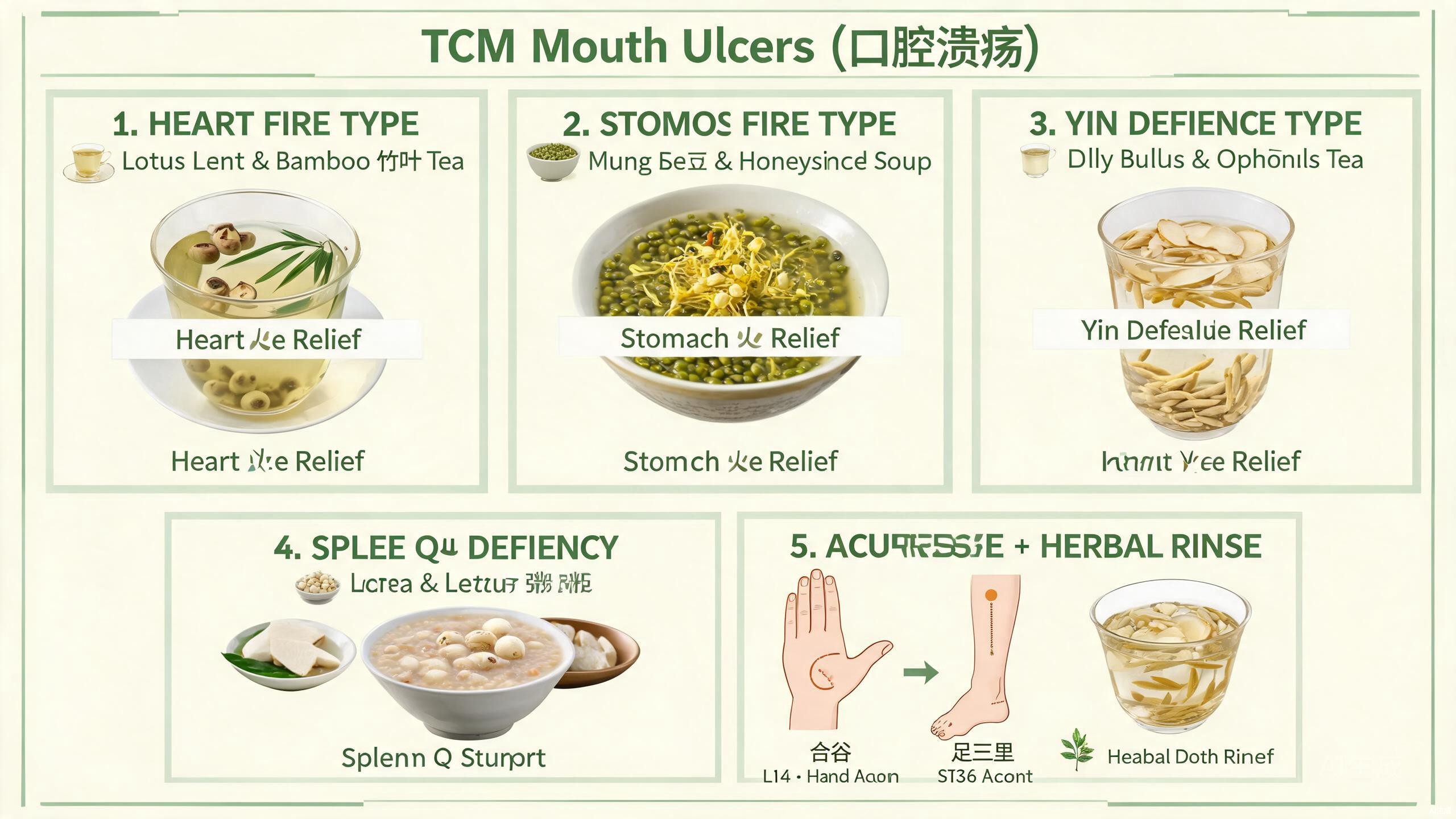
- TCM views mouth ulcers through three primary patterns: heart-stomach fire exuberance (red, swollen, painful ulcers), yin deficiency (recurrent ulcers with dry mouth), and spleen deficiency (ulcers with poor appetite and fatigue).
- Five traditional food therapy recipes — from yam lily lotus seed pork soup to mung bean lily lotus seed soup — use ingredients available at Western supermarkets, Amazon, or iHerb.
- A traditional honeysuckle and licorice mouth rinse may provide gentle topical support for oral comfort.
- Nutritional support with B vitamins, vitamin C, and zinc complements the TCM approach, as these nutrients are essential for oral mucosal health.
- Avoid spicy, greasy, and overly hot foods; choose a soft-bristled toothbrush to reduce mechanical irritation. These are traditional wellness practices, not a treatment for any medical condition.
This article is for educational purposes only and is not medical advice. The foods, teas, and practices described here are traditional wellness practices rooted in Chinese culture. They are not a substitute for professional medical care, diagnosis, or treatment. Mouth ulcers (canker sores) are usually minor, but persistent, unusually large, or frequently recurring ulcers can indicate underlying medical conditions including nutritional deficiencies, immune disorders, or oral cancer. Symptoms that require prompt evaluation include ulcers lasting more than two weeks, ulcers larger than 1 cm, high fever, difficulty swallowing, or ulcers that are painless. Never stop, delay, or replace prescribed treatment based on information in this article. Some herbs may interact with medications — always inform your doctor about everything you consume. These statements have not been evaluated by the FDA and are not intended to diagnose, treat, cure, or prevent any disease. Read our full disclaimer →
Mouth ulcers — those small, painful sores that appear on the inside of the lips, cheeks, or tongue — are a common and frustrating experience. While most mouth ulcers heal on their own within one to two weeks, their recurrence can signal internal imbalance. Traditional Chinese Medicine (TCM) views the mouth as a window into the body's internal state: the mouth is considered the opening of the spleen, the tongue connects to the heart, and the gums relate to the stomach and large intestine. When ulcers appear, TCM looks beyond the sore itself to the underlying pattern of heat, deficiency, or digestive disharmony.
In TCM, mouth ulcers are understood through three primary patterns: spleen-stomach disharmony (脾胃失和), heart-liver-stomach fire exuberance (心肝胃火旺盛), and yin-blood deficiency (阴血不足). Each pattern produces distinct symptoms and calls for different foods. The five recipes below — plus a traditional herbal mouth rinse — use foods traditionally valued for clearing heat, nourishing yin, and strengthening the spleen. All ingredients are available at Western supermarkets, Asian markets, Amazon, or iHerb.
If you are new to TCM concepts, our introduction to Traditional Chinese Medicine and guide to the Zang-Fu organ systems are helpful starting points. For related topics, see our guides on TCM for digestion and TCM for canker sores.
How TCM Views Mouth Ulcers
Traditional Chinese Medicine recognizes mouth ulcers through classical names like kou chuang (mouth sore) and kou yi (mouth ulcer). According to Chinese clinical TCM literature, the mouth and tongue are connected to several internal organs, and ulcers often reflect imbalances in these systems. TCM identifies three primary patterns:
1. Heart-Stomach Fire Type (心胃火盛型)
This is the most common pattern for acute mouth ulcers. In TCM, the heart opens to the tongue, and the stomach's meridian connects to the gums and upper lip. When heart fire and stomach fire blaze upward — often triggered by stress, poor sleep, spicy food, or emotional frustration — heat manifests in the mouth as painful sores. Signs include ulcers that are red, swollen, and painful, often multiple, with a burning sensation. Accompanying signs may include thirst, a bitter taste in the mouth, bad breath, irritability, constipation, and dark urine. This pattern is typically acute and intense.
2. Yin Deficiency Type (阴虚型)
When the body's yin (cooling, moistening aspect) is depleted — from chronic stress, overwork, insufficient sleep, aging, or prolonged illness — internal "empty fire" rises. Unlike the excess fire of the heart-stomach fire type, this is a deficiency heat that smolders chronically. Signs include recurrent ulcers that come and go, a dry mouth with desire for sips of cool water, dry throat, night sweats, red cheeks in the afternoon, and poor sleep. The ulcers may be less red and swollen than in the fire type but are persistent and frustrating. This pattern is common in people who burn the candle at both ends. For more on yin and yang, see our yin-yang guide.
3. Spleen Deficiency Type (脾虚型)
When the spleen is weak — from poor diet, irregular eating, overthinking, or chronic digestive issues — it cannot properly transform food into qi and blood. This deficiency allows dampness to accumulate and heat to simmer gently in the digestive tract, occasionally flaring into the mouth. Signs include ulcers accompanied by poor appetite, fatigue, and loose stools. The ulcers may be pale or shallow, with less intense pain than the fire type. There may be a feeling of heaviness, bloating after eating, and a pale complexion. This pattern is common in people with chronic digestive weakness. For more on the spleen, see our TCM for digestion guide.
Understanding these three patterns is essential because the same food can help or harm depending on the type. For example, strongly cooling mung beans are ideal for heart-stomach fire type ulcers but may further weaken someone with spleen deficiency. Conversely, warm, nourishing red date longan tea is perfect for yin-blood deficiency but may aggravate active fire. The recipes below are matched to each pattern.
5 Food Therapy Recipes for Oral Wellness
Each recipe below is matched to a specific TCM pattern. Choose the one that best fits your situation, and use it consistently for two to four weeks. All ingredients are available at Western supermarkets, Asian markets, Amazon, or iHerb.
1. Yam Lily Lotus Seed Pork Soup (山药百合莲子瘦肉汤)
Best for: Yin deficiency type; also supportive for spleen deficiency
TCM nature and flavor: Chinese yam (shan yao): sweet, neutral. Enters the Spleen, Lung, and Kidney channels. Lily bulb (bai he): sweet, slightly bitter, slightly cool. Enters the Heart and Lung channels. Lotus seed (lian zi): sweet, astringent, neutral. Enters the Spleen, Kidney, and Heart channels. Lean pork: sweet, neutral.
Traditional use: This nourishing soup is a cornerstone of TCM food therapy for yin deficiency. Chinese yam tonifies the spleen, nourishes the lung yin, and supports the kidneys — addressing the root of digestive and yin weakness simultaneously. Lily bulb nourishes lung yin, clears heart heat, and calms the mind, making it particularly relevant for ulcers linked to stress and poor sleep. Lotus seed strengthens the spleen, nourishes the heart, and calms the spirit. Together with nourishing lean pork, this soup provides gentle, sustained yin nourishment without being overly cooling or warming — making it suitable for both yin deficiency and mild spleen deficiency patterns.
Ingredients:
- 100 grams fresh Chinese yam (about 3.5 oz), peeled and sliced — available at Asian markets, or use 30g dried yam slices from Amazon/iHerb
- 30 grams dried lily bulb (bai he) — available on Amazon or iHerb
- 15 grams dried lotus seeds (with or without core; without core is milder) — available on Amazon or iHerb
- 100 grams lean pork (about 3.5 oz), sliced
- 3 slices fresh ginger
- 5 cups water
- A pinch of sea salt
Preparation: Soak the dried lily bulb and lotus seeds for 1 to 2 hours. Blanch the pork for 3 minutes. In a pot, combine the pork, ginger, water, soaked lily bulb, and lotus seeds. Bring to a boil, then reduce heat and simmer for 45 minutes. Add the Chinese yam and simmer for another 20 minutes until all ingredients are tender. Add salt to taste. Drink 1 bowl per day, ideally at lunch or early evening. For more on Chinese yam, see our yam congee guide and for lotus seed, see our lotus seed lily porridge guide.
Precautions: This soup is gentle and suitable for most people. If you have active heart-stomach fire (very red, painful, acute ulcers), add mung beans (recipe 5) or use the honeysuckle rinse first. Lotus seeds with the green core (embryo) are bitter and clearing; without the core, they are more nourishing.
2. Silver Ear Lily Soup (银耳百合羹)
Best for: Yin deficiency with dry mouth and throat
TCM nature and flavor: Tremella mushroom (yin er / silver ear): sweet, neutral. Enters the Lung and Stomach channels. Fresh lily bulb: sweet, slightly bitter, cool. Enters the Heart and Lung channels. Rock sugar: sweet, neutral.
Traditional use: Tremella (silver ear mushroom) is one of TCM's most beloved yin-nourishing and lung-moistening foods. Its gelatinous texture is traditionally associated with nourishing yin, generating fluids, and moisturizing dryness throughout the body — including the mucous membranes of the mouth and throat. Paired with lily bulb for heart-calming and lung-nourishing properties, and sweetened with rock sugar, this elegant dessert soup is ideal for the dry, recurrent ulcers of yin deficiency. Modern nutrition recognizes tremella as a source of polysaccharides with moisturizing properties.
Ingredients:
- 15 grams dried tremella mushroom (silver ear) — available on Amazon or iHerb
- 30 grams fresh lily bulb (or 15g dried) — available at Asian markets, Amazon, or iHerb
- 15 grams rock sugar (or honey to taste after cooking)
- 4 cups water
Preparation: Soak the dried tremella in warm water for 1 to 2 hours until fully expanded, then trim the tough yellow base and tear into small pieces. If using fresh lily bulb, separate the petals and rinse. If using dried, soak for 30 minutes. In a pot, combine the tremella and water. Bring to a boil, then reduce heat and simmer for 60 to 90 minutes until the tremella is soft and gelatinous and the liquid is slightly thickened. Add the lily bulb and cook for 15 more minutes. Add rock sugar and stir until dissolved. Enjoy 1 small bowl per day, ideally in the evening (it is gently calming and supports sleep).
Precautions: Tremella is generally gentle and safe. If you prefer, substitute honey for rock sugar, but add honey only after the soup has cooled to warm (high heat destroys honey's beneficial properties).
3. Winter Melon Coix Soup (冬瓜薏米汤)
Best for: Spleen deficiency with dampness and mild heat
TCM nature and flavor: Winter melon (dong gua): sweet, mild, cool. Enters the Lung, Spleen, and Bladder channels. Coix seed (yi yi ren / Job's tears): sweet, bland, slightly cool. Enters the Spleen, Lung, and Kidney channels.
Traditional use: This light soup addresses the spleen deficiency pattern by gently clearing heat and draining dampness without being too harsh on the digestive system. Winter melon clears heat, promotes urination, and reduces swelling, while coix seed drains dampness and strengthens the spleen. For mouth ulcers rooted in spleen weakness with mild heat and dampness, this soup provides gentle, supportive clearing that does not damage the spleen — unlike more aggressively cooling foods. The combination is a staple of everyday Chinese home cooking.
Ingredients:
- 200 grams winter melon (about 2 cups), peeled and cubed — available at Asian markets; zucchini or chayote can substitute
- 50 grams dried coix seed (Job's tears) — available on Amazon or iHerb
- 4 cups vegetable or chicken broth (low sodium)
- 2 slices fresh ginger
- A pinch of sea salt
Preparation: Soak the coix seed for 2 to 4 hours. In a pot, combine the soaked coix seed, broth, and ginger. Bring to a boil, then simmer for 30 minutes. Add the winter melon and simmer for another 20 minutes until translucent and tender. Add salt to taste. Drink 1 bowl per day, ideally at lunch. For more on congee and soup cooking, see our congee guide.
Precautions: Both ingredients are mildly cooling. If you have a cold constitution, add extra ginger. Coix seed is traditionally avoided in large amounts during pregnancy.
4. Red Date Longan Tea (红枣桂圆茶)
Best for: Yin-blood deficiency with poor sleep and fatigue (not for active fire type)
TCM nature and flavor: Red dates (hong zao / jujubes): sweet, warm. Enters the Spleen and Stomach channels. Longan (gui yuan / dried longan): sweet, warm. Enters the Heart and Spleen channels.
Traditional use: When mouth ulcers are rooted in blood deficiency and poor sleep — rather than active excess fire — this warming tea nourishes the heart and spleen. Red dates tonify the spleen, nourish blood, and calm the mind. Longan nourishes the heart blood, calms the spirit, and supports sleep. Together, this tea is traditionally used for people whose recurrent ulcers are accompanied by pale complexion, fatigue, poor sleep, anxiety, and a sense of depletion. It is important to note: this tea is warming and should be used only when the underlying pattern is deficiency, not active fire. For more on longan, see our longan tea guide.
Ingredients:
- 5 dried red dates (jujubes), pitted — available at Asian markets, Amazon, or iHerb
- 10 grams dried longan (about 1 tablespoon) — available at Asian markets, Amazon, or iHerb
- 3 cups water
Preparation: Rinse the red dates and longan. In a pot, combine all ingredients with water. Bring to a boil, then reduce heat and simmer gently for 20 minutes. Pour into a cup and drink warm. Eat the dates and longan if desired. Drink 1 cup per day, ideally in the afternoon or evening (it supports sleep). The tea is naturally sweet and warming.
Precautions: This tea is warming and tonifying. Do not use if you have active heart-stomach fire (red, swollen, painful, acute ulcers with thirst and bad breath) — it may worsen the condition. If you have blood sugar concerns, use fewer dates. See our blood sugar guide for more.
If your ulcers are red, swollen, painful, and acute (Heart-Stomach Fire type), choose recipes 3 (Winter Melon Coix Soup) or 5 (Mung Bean Lily Lotus Seed Soup), and use the Honeysuckle Licorice Rinse below. If your ulcers are recurrent with dry mouth (Yin Deficiency type), choose recipes 1 (Yam Lily Lotus Seed Pork Soup) or 2 (Silver Ear Lily Soup). If your ulcers come with fatigue, poor appetite, and pale skin (Spleen/Blood Deficiency type), choose recipe 4 (Red Date Longan Tea) or recipe 1.
5. Mung Bean Lily Lotus Seed Soup (绿豆百合莲子羹)
Best for: Heart-stomach fire type (acute, red, painful ulcers)
TCM nature and flavor: Mung bean (lu dou): sweet, cold. Enters the Heart and Stomach channels. Lily bulb (bai he): sweet, slightly bitter, slightly cool. Enters the Heart and Lung channels. Lotus seed (lian zi): sweet, astringent, neutral.
Traditional use: This cooling soup combines three of TCM's most valued heat-clearing and yin-nourishing foods. Mung bean clears heat, detoxifies, and cools the blood — directly addressing the excess fire blazing in the heart and stomach. Lily bulb nourishes yin and clears heart heat, calming the irritability that often accompanies fire-type ulcers. Lotus seed strengthens the spleen and calms the heart, providing a gentle counterbalance to mung bean's cold nature so the spleen is not damaged. Together, this soup clears the acute heat of heart-stomach fire while gently protecting the digestive system — a well-balanced recipe for active flare-ups.
Ingredients:
- 1/3 cup dried mung beans — widely available at supermarkets, Amazon, or iHerb
- 15 grams dried lily bulb (bai he) — available on Amazon or iHerb
- 15 grams dried lotus seeds (core removed for milder flavor) — available on Amazon or iHerb
- 4 cups water
- Optional: a small amount of rock sugar to taste
Preparation: Soak the mung beans, lily bulb, and lotus seeds for 1 to 2 hours. In a pot, combine all soaked ingredients with water. Bring to a boil, then reduce heat and simmer for 45 to 60 minutes until the mung beans are soft and splitting. Add rock sugar if desired. Drink 1 bowl per day, preferably in the morning or midday. For a lighter version, strain and drink just the liquid. For more on mung beans, see our mung bean congee guide.
Precautions: Mung beans are cold in nature. Avoid if you have a cold constitution with chronic diarrhea, or during the menstrual period if you tend toward cold. If the soup feels too cooling, add 2 slices of fresh ginger.
Honeysuckle Licorice Mouth Rinse (金银花甘草漱口方)
In addition to internal food therapy, TCM uses a traditional herbal mouth rinse to provide gentle topical support for oral comfort. This simple rinse combines two of TCM's most widely used heat-clearing herbs.
TCM nature and flavor: Honeysuckle (jin yin hua): sweet, cold. Enters the Lung, Heart, and Stomach channels. Licorice (gan cao): sweet, neutral. Enters all twelve channels (traditionally), especially the Heart, Lung, Spleen, and Stomach.
Traditional use: Honeysuckle is one of TCM's premier heat-clearing and detoxifying herbs, traditionally used to clear heat from the upper body, including the mouth and throat. Licorice harmonizes, soothes inflammation, and supports the mucous membranes. Used as a gentle mouth rinse, this combination may help soothe oral discomfort and support the natural healing environment of the mouth. Licorice root is also recognized in modern research for its potential soothing properties for oral mucosa.
Ingredients:
- 10 grams dried honeysuckle flowers (jin yin hua) — available on Amazon or iHerb
- 5 grams dried licorice root slices (gan cao) — available on Amazon or iHerb
- 2 cups water
Preparation: Rinse the honeysuckle and licorice. In a pot, combine with water. Bring to a boil, then reduce heat and simmer for 10 to 15 minutes. Strain and let cool to a comfortable, warm temperature. Use as a mouth rinse: swish gently in the mouth for 30 to 60 seconds, then spit out (do not swallow). Rinse 2 to 3 times per day, especially after meals. The rinse can be stored in the refrigerator for up to 24 hours and gently reheated.
Precautions: This rinse is for topical oral use only — do not swallow. Licorice may interact with certain medications, including blood pressure medications and blood thinners, if consumed internally in significant amounts. As a mouth rinse used briefly and spit out, the systemic absorption is minimal, but consult your healthcare provider if you have concerns. See our herbal tea safety guide for general guidance.
Nutritional Support for Oral Wellness
TCM food therapy and modern nutrition are complementary. While TCM addresses the underlying patterns, certain nutrients are essential for the health of the oral mucosa. According to both Chinese clinical guidance and modern nutritional science, the following are particularly important:
- B vitamins (especially B2, B6, B9/folate, and B12) — deficiency in B vitamins is one of the most common nutritional causes of mouth ulcers. Good food sources include whole grains, eggs, leafy greens, legumes, and nutritional yeast. If you eat a plant-based diet, pay special attention to B12 intake.
- Vitamin C — essential for tissue repair and immune function. Good sources include citrus fruits, kiwi, bell peppers, broccoli, and strawberries. TCM-classified cooling fruits like pear and watermelon also provide vitamin C.
- Zinc — supports wound healing and immune function. Good sources include pumpkin seeds, chickpeas, lentils, and lean meats. Zinc deficiency can delay healing of oral tissues.
- Iron — deficiency can contribute to recurrent mouth ulcers, especially in women. Good sources include leafy greens, lentils, and lean red meat. For more on blood-building foods, see our blood-nourishing foods guide and TCM for anemia guide.
If you suspect a nutritional deficiency, consult your healthcare provider for proper testing and guidance before starting supplements.
Comparison of the Five Recipes
| Recipe | TCM Pattern | Key Action | Frequency |
|---|---|---|---|
| Yam Lily Lotus Seed Pork Soup | Yin Deficiency / Spleen Def. | Nourish yin, strengthen spleen | 1 bowl daily |
| Silver Ear Lily Soup | Yin Deficiency (dry mouth) | Nourish yin, generate fluids | 1 bowl daily |
| Winter Melon Coix Soup | Spleen Def. + Damp-Heat | Clear heat, drain dampness | 1 bowl daily |
| Red Date Longan Tea | Blood Deficiency | Nourish blood, calm the mind | 1 cup daily |
| Mung Bean Lily Lotus Seed Soup | Heart-Stomach Fire | Clear heat, detoxify, nourish yin | 1 bowl daily |
Daily Habits and Precautions
TCM is a whole-person system. Food therapy works best when combined with supportive daily habits. According to Chinese clinical guidance on oral wellness, the following are essential:
- Avoid spicy, greasy, and overly hot foods. Spicy foods (chili, pepper, curry) and greasy fried foods generate internal heat that can flare mouth ulcers. Overly hot (temperature) foods and beverages can also mechanically irritate the oral mucosa. Favor warm, cooked, easily digested meals — soups, stews, and porridges. See our congee guide for ideas.
- Choose a soft-bristled toothbrush. Hard-bristled brushes and aggressive brushing can traumatize the delicate oral mucosa, creating micro-injuries where ulcers can form. Use gentle, circular motions and consider a soft or extra-soft toothbrush.
- Manage stress and sleep. In TCM, emotional stress and poor sleep are primary triggers for heart fire and yin deficiency — both common patterns for mouth ulcers. Prioritize adequate rest and incorporate relaxation practices. See our meditation guide and herbal tea for anxiety guide.
- Avoid very hard or crunchy foods that can mechanically irritate the mouth, especially during an active flare-up. Soft, cooling foods like pear, watermelon, and congee are gentler choices.
- Stay hydrated. Adequate water intake keeps the oral mucosa moist and supports overall fluid balance. Warm or room-temperature water is preferred in TCM.
- Support digestion. Since the mouth is the opening of the spleen, healthy digestion is foundational to oral wellness. Eat regular meals, chew thoroughly, and avoid eating too late at night. See our TCM for digestion guide.
Frequently Asked Questions
What does TCM say about mouth ulcers?
In Traditional Chinese Medicine, mouth ulcers are understood through three primary patterns: heart-stomach fire exuberance (red, swollen, painful ulcers with thirst and bad breath), yin deficiency (recurrent ulcers with dry mouth, poor sleep, and night sweats), and spleen deficiency (ulcers with poor appetite, fatigue, and loose stools). TCM considers the mouth to be the opening of the spleen and the tongue to connect to the heart. Mouth ulcers often reflect internal heat, yin depletion, or digestive weakness rather than a localized problem. TCM food therapy matches different foods to different patterns. These are traditional wellness concepts, not medical diagnoses. For a deeper understanding, see our zang-fu organ guide.
Which Chinese medicine foods may support oral wellness for mouth ulcers?
Five traditional TCM food therapy recipes for mouth ulcers include yam lily lotus seed pork soup, silver ear lily soup, winter melon coix soup, red date longan tea, and mung bean lily lotus seed soup. A traditional honeysuckle and licorice mouth rinse may also provide topical support. These recipes use ingredients available at Western supermarkets, Asian markets, Amazon, or iHerb. Heat-clearing recipes (mung bean, honeysuckle rinse) are best for fire-type ulcers, while nourishing recipes (yam, lily, tremella) are best for yin deficiency type. They are traditional wellness foods, not treatments for any medical condition.
Can honeysuckle and licorice mouth rinse help with mouth ulcers?
Honeysuckle (jin yin hua) and licorice (gan cao) are two of the most commonly used heat-clearing and detoxifying herbs in TCM. A mouth rinse made from these herbs is traditionally used to clear heat, soothe inflammation, and support oral comfort. Honeysuckle is traditionally used to clear heat and detoxify, while licorice harmonizes and soothes the mucous membranes. The rinse is used topically (swished and spit out, not swallowed). This is a traditional wellness practice, not a medical treatment for mouth ulcers. Consult your healthcare provider or dentist if ulcers persist, are unusually large, or are accompanied by fever.
What foods should people with mouth ulcers avoid according to TCM?
In TCM, foods that generate heat are traditionally discouraged for mouth ulcer patterns, including spicy foods (chili, pepper, curry), greasy fried foods, and overly hot (temperature) foods and beverages. TCM also recommends choosing a soft-bristled toothbrush to avoid mechanical irritation and avoiding very hard or crunchy foods that can traumatize the oral mucosa. Nutritional support with B vitamins, vitamin C, and zinc is also emphasized, as deficiencies in these nutrients can contribute to recurrent ulcers. These are traditional dietary guidelines, not medical prescriptions. Persistent or recurrent mouth ulcers should be evaluated by a healthcare provider to rule out underlying conditions.
Precautions and When to Seek Help
While TCM food therapy may support general wellness, mouth ulcers can sometimes indicate underlying medical conditions that require professional evaluation:
- See your healthcare provider if mouth ulcers last longer than two weeks, are unusually large (over 1 cm), are extremely painful, or recur frequently (more than three or four times per year). These may indicate nutritional deficiencies, immune disorders, hormonal changes, or other conditions.
- Seek prompt medical attention if ulcers are accompanied by high fever, difficulty swallowing, difficulty drinking fluids, or if ulcers are painless (painless ulcers can occasionally indicate more serious conditions).
- Watch for nutritional deficiencies. Recurrent mouth ulcers can be an early sign of deficiencies in B vitamins (especially B12 and folate), iron, or zinc. Ask your healthcare provider about testing if ulcers are frequent.
- Medication interactions. Licorice (when consumed internally, not just as a brief rinse) may interact with blood pressure medications, blood thinners, and diuretics. If you take these medications, consult your healthcare provider before consuming licorice tea or supplements regularly.
- Not a substitute. TCM food therapy is complementary. It sits alongside — never in place of — professional medical care.
For related topics, see our guides on TCM for digestion, TCM for canker sores, and TCM for throat care.
The Bottom Line
Traditional Chinese Medicine offers a pattern-based approach to oral wellness that complements — but never replaces — medical care. By understanding whether your mouth ulcers are rooted in heart-stomach fire, yin deficiency, or spleen deficiency, you can choose foods that work with your body's specific needs. Mung bean lily lotus seed soup and the honeysuckle licorice rinse clear heat for acute, red, painful ulcers. Yam lily lotus seed pork soup and silver ear lily soup nourish yin for dry, recurrent ulcers. Winter melon coix soup gently clears damp-heat while protecting the spleen. And red date longan tea nourishes blood for deficiency-type ulcers with fatigue and poor sleep. Paired with nutritional support (B vitamins, vitamin C, zinc), the habit of choosing a soft-bristled toothbrush, and avoiding spicy, greasy, and overly hot foods, these traditional practices form a whole-person approach to oral wellness.
But they are traditions — not treatments, and not a replacement for medical care. Persistent, severe, or frequently recurring mouth ulcers require evaluation by a qualified healthcare provider. Use these traditional practices only as complementary wellness habits, alongside your doctor's guidance.
This article shares traditional wellness practices for educational purposes only. It is not a substitute for medical advice, diagnosis, or treatment. The foods, teas, and practices described here are not intended to treat, cure, or prevent any disease, including mouth ulcers, oral infections, or any medical condition. If you have mouth ulcers that persist beyond two weeks, are unusually large or painful, recur frequently, or are accompanied by fever or difficulty swallowing, consult your healthcare provider promptly for proper evaluation. These statements have not been evaluated by the FDA. Never stop or adjust prescribed treatment without your doctor's explicit guidance. Read our full disclaimer →