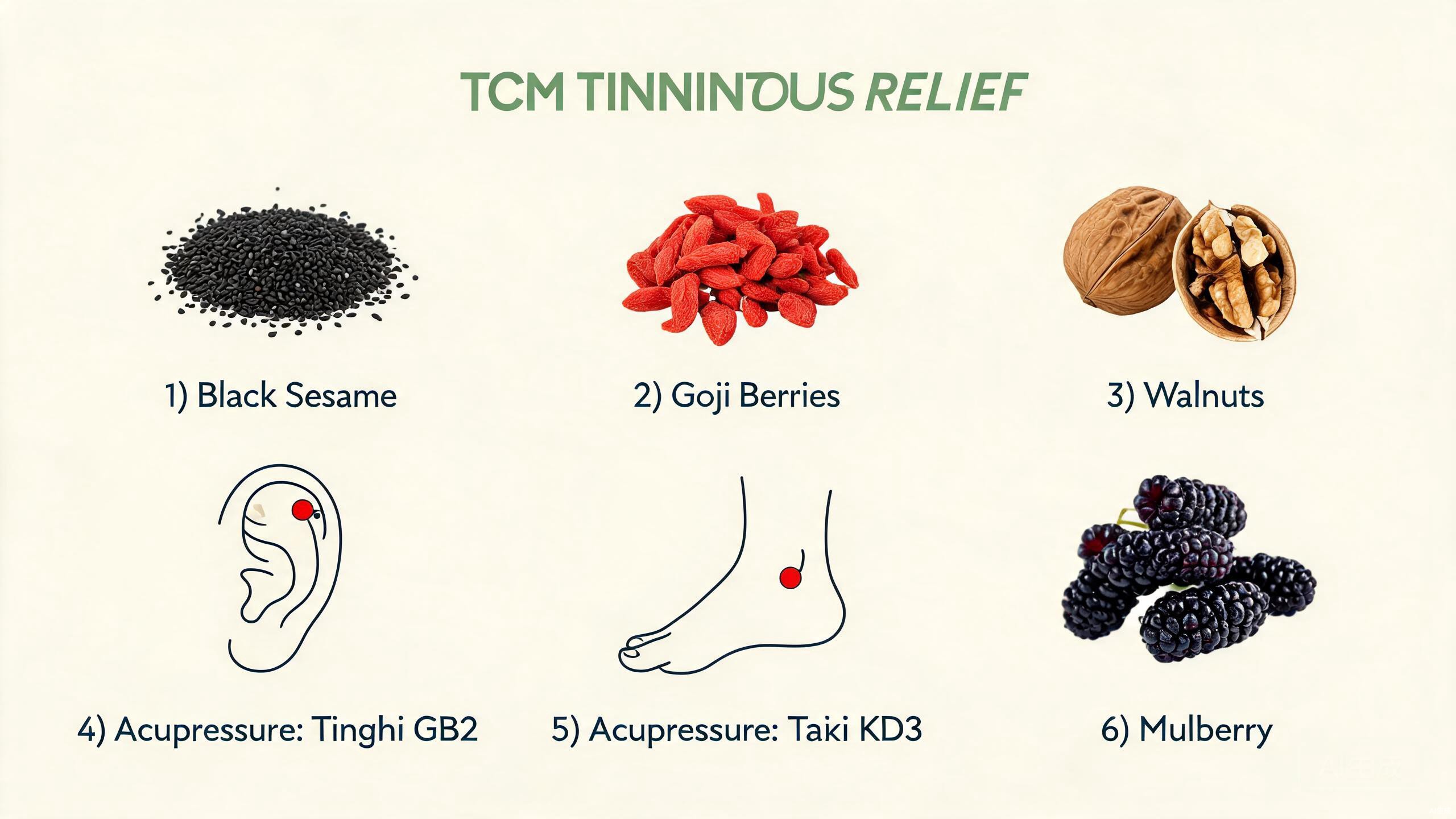
Key Takeaways
- TCM views tinnitus through four main patterns: kidney deficiency, liver-gallbladder fire, phlegm-turbidity accumulation, and qi and blood insufficiency.
- The kidneys "open into the ears" in TCM theory — making kidney-nourishing foods central to traditional ear health support.
- Black bean and walnut soup is the classic kidney-tonifying recipe for slow-onset, low-pitched ringing.
- Goji and chrysanthemum tea addresses liver fire patterns marked by sudden, loud ringing with irritability.
- All ingredients in these recipes are available at Western supermarkets, Amazon, or iHerb.
This article is for wellness education only and is not medical advice. Tinnitus can be a symptom of underlying conditions that require medical evaluation. The food therapy recipes described here are traditional dietary practices, not treatments for any disease. If you experience persistent, sudden, or one-sided tinnitus, consult a qualified healthcare provider. Some herbs may interact with medications.
Tinnitus — the perception of ringing, buzzing, or humming in the ears without an external sound source — affects millions of people worldwide. While modern medicine explores causes ranging from noise damage to cardiovascular issues, Traditional Chinese Medicine (TCM) has understood tinnitus for over two thousand years through an entirely different lens. Rather than viewing it as an isolated ear problem, TCM sees tinnitus as a signal that one of several internal organ systems is out of balance.
This perspective is both humbling and empowering. It means that the food you eat, the rest you get, and the habits you cultivate may all play a role in supporting ear health. Below, we explore how TCM understands tinnitus and share five traditional food therapy recipes — using ingredients you can find at Western supermarkets, Amazon, or iHerb — that have been used for generations to support the body's natural balance.
How TCM Understands Tinnitus
In TCM theory, the ears are considered the "opening" of the kidney organ system. The classical text Huangdi Neijing (Yellow Emperor's Inner Canon), written over 2,000 years ago, states: "The kidney qi communicates with the ears; when the kidneys are harmonious, the ears can hear the five sounds." This means that the health of the kidneys — which in TCM govern growth, reproduction, bones, and the body's deepest energy reserves — is intimately connected to hearing.
However, the kidneys are not the only organ involved. TCM identifies several distinct patterns that may give rise to tinnitus, each requiring a different dietary and lifestyle approach. Understanding which pattern matches your experience is the first step in choosing the right food therapy.
The Four Main TCM Patterns of Tinnitus
TCM does not treat all tinnitus the same way. Instead, it distinguishes between patterns based on the quality of the sound, the speed of onset, accompanying symptoms, and the person's overall constitution. Here are the four most commonly recognized patterns:
- Kidney Essence Deficiency — The most common pattern, especially in older adults. Ringing is low-pitched, gradual in onset, and worse with fatigue. Accompanied by lower back soreness, knee weakness, frequent urination at night, and forgetfulness. This is the pattern most responsive to kidney-nourishing foods like black beans, walnuts, and sesame.
- Liver-Gallbladder Fire Rising — Ringing is sudden, loud, and high-pitched, often triggered by stress or anger. Accompanied by irritability, headache, red face, bitter taste in the mouth, and possibly dizziness. This pattern calls for cooling, liver-calming foods like chrysanthemum and celery.
- Phlegm-Turbidity Accumulation — Ringing is muffled or blocked, as if the ear is stuffed. Accompanied by a feeling of heaviness, chest oppression, sticky phlegm, and a thick tongue coating. This pattern requires foods that transform dampness and phlegm, such as tangerine peel and coix seed.
- Qi and Blood Insufficiency — Ringing is mild but persistent, worse after exertion or menstruation. Accompanied by fatigue, pale complexion, dizziness, and poor sleep. This pattern benefits from blood-building foods like red dates, longan, and goji berries.
If you are new to TCM concepts like qi, blood, and organ systems, our guide to qi, blood, and body fluids provides helpful background. For understanding how TCM views the body's organ networks, see our zang-fu organs guide.
Recipe 1: Black Bean, Walnut and Pork Bone Soup
TCM pattern: Kidney essence deficiency (slow-onset, low-pitched ringing, worse with fatigue)
Traditional function: Tonify kidney essence, benefit the ears, strengthen the lower back
Ingredient Properties
Black beans ( hei dou) are sweet in flavor and neutral in nature. They enter the spleen and kidney channels. In TCM, black-colored foods are associated with the kidney organ system (the kidney corresponds to the water element and the color black in five-element theory). Black beans are traditionally used to nourish kidney yin, activate blood, and support overall vitality.
Walnuts ( hei tao ren) are sweet and warm. They enter the kidney, lung, and large intestine channels. Walnuts are one of the most important kidney-tonifying foods in TCM food therapy. They are traditionally said to "benefit the brain" — and because the brain is considered the "sea of marrow" governed by the kidneys, what nourishes the kidneys also nourishes the brain and, by extension, the ears.
Pork bones ( particularly marrow bones) are sweet and neutral. In TCM food therapy, bone broths and bone-based soups are valued for their ability to nourish marrow and strengthen the bones — both functions governed by the kidneys. The slow simmering extracts nutrients that are deeply building.
Preparation
Ingredients: 1/2 cup dried black beans (soaked overnight), 30 grams walnut halves (about 10 walnuts), 1 lb pork marrow or soup bones, 6 cups water, 3 slices fresh ginger, a pinch of salt.
Method: Blanch the pork bones in boiling water for 5 minutes, then rinse. Combine all ingredients in a pot with 6 cups of water. Bring to a boil, then reduce to a low simmer. Cover and cook for 2 hours, until the beans are very soft and the broth is rich and dark. Add salt to taste. Drink 1 bowl daily, ideally in the late afternoon or early evening.
Precautions
This soup is warming and building, making it best suited for deficiency patterns. If you have active liver fire (signs include red face, irritability, and a rapid pulse), choose a cooling recipe instead. Walnuts are rich in oil; if you have loose stools, reduce the quantity. Black beans can cause bloating in sensitive individuals — soaking them thoroughly and cooking with ginger helps reduce this effect.
Dried black beans are available in every Western supermarket. Walnuts can be found in the baking aisle or bought in bulk on Amazon. Pork soup bones are available at most butcher shops and Asian markets. If pork bones are unavailable, substitute with beef marrow bones for a similarly nourishing result.
Recipe 2: Goji and Chrysanthemum Tea
TCM pattern: Liver-gallbladder fire rising (sudden, loud ringing with irritability and headache)
Traditional function: Nourish liver and kidney yin, clear liver heat, calm the mind
Ingredient Properties
Goji berries ( gou qi zi) are sweet and neutral. They enter the liver and kidney channels. Goji berries are one of the most popular TCM tonic foods, traditionally used to nourish liver blood, enrich kidney yin, and benefit the eyes. Because the liver opens into the eyes and the kidneys open into the ears, goji berries are uniquely positioned to support both organ systems connected to sensory health.
Chrysanthemum flowers ( ju hua) are sweet, bitter, and slightly cold. They enter the lung and liver channels. Chrysanthemum is the premier herb for clearing liver heat and calming liver fire. In TCM, when liver fire rises upward — often from stress, anger, or overwork — it can manifest as ringing in the ears, headaches, and red eyes. Chrysanthemum gently cools this fire without being harshly cold.
Preparation
Ingredients: 1 tablespoon dried goji berries (about 15 grams), 5 to 8 dried chrysanthemum flowers, 2 cups hot water (90°C).
Method: Rinse the goji berries and chrysanthemum flowers briefly. Place in a teapot or mug and pour hot water over them. Cover and steep for 5 to 7 minutes. The resulting tea is a pale golden color with a delicate floral scent and a slight sweetness from the goji. Drink 1 to 2 cups daily. The softened goji berries can be eaten after drinking.
Precautions
Chrysanthemum is cooling by nature. If you tend to feel cold, have a weak digestive system, or experience diarrhea after cold foods, use fewer chrysanthemum flowers or add a slice of ginger to balance the cooling effect. Avoid this tea if you are taking blood-thinning medication without consulting your healthcare provider, as goji berries may interact with warfarin. For a detailed guide, see our chrysanthemum tea guide and our goji tea guide.
Recipe 3: Mulberry and Goji Drink
TCM pattern: Liver and kidney yin deficiency (ringing with dryness, dizziness, and premature graying)
Traditional function: Nourish yin, enrich blood, benefit the ears
Ingredient Properties
Mulberries ( sang shen) are sweet, sour, and cold. They enter the heart, liver, and kidney channels. In TCM, mulberries are considered one of the finest yin-nourishing fruits. They are traditionally used to enrich blood, nourish kidney yin, and moisten dryness. Mulberries are also associated with darkening hair and supporting vision — both signs of healthy kidney and liver function. Dried mulberries are readily available and retain the nourishing properties of fresh ones.
Goji berries complement mulberries by adding liver blood nourishment and kidney yin support. Together, they form a gentle but potent yin-building combination that addresses the gradual depletion underlying chronic tinnitus.
Preparation
Ingredients: 2 tablespoons dried mulberries, 1 tablespoon dried goji berries, 3 cups water, optional: 1 teaspoon honey.
Method: Rinse the dried mulberries and goji berries. Combine with 3 cups of water in a small pot. Bring to a boil, then reduce heat and simmer gently for 10 minutes. Strain into a cup and add honey if desired. Drink warm, once daily, preferably in the afternoon. The berries can be eaten after drinking.
Precautions
Mulberries are cooling and moistening. If you have a tendency toward loose stools or internal dampness (signs include a heavy feeling, thick tongue coating, and sluggishness), use this drink in moderation. Diabetics should monitor blood sugar, as mulberries contain natural sugars. Avoid adding honey if you have damp-heat patterns. Dried mulberries are available on Amazon and iHerb.
Recipe 4: Gastrodia Fish Head Soup
TCM pattern: Liver wind rising (ringing with dizziness, vertigo, or headache)
Traditional function: Calm the liver, extinguish wind, relieve dizziness
Ingredient Properties
Gastrodia elata ( tian ma) is sweet and neutral. It enters the liver channel. Tian ma is one of the most important herbs in TCM for "extinguishing wind" — a concept that refers to internal movement patterns such as dizziness, vertigo, tremors, and ringing that come and go unpredictably. It is traditionally used when liver yang rises excessively, causing upward symptoms like tinnitus with vertigo.
Fish head ( particularly carp or salmon head) is a traditional pairing with tian ma in Chinese cuisine. Fish head is rich in omega-3 fatty acids and, in TCM terms, is considered nourishing to the brain and supportive of the kidney-water that helps anchor liver-yang. The combination of tian ma and fish head is one of the most famous traditional recipes for dizziness and tinnitus associated with liver patterns.
Preparation
Ingredients: 15 grams dried gastrodia slices ( tian ma), 1 large fish head (carp or salmon), 6 cups water, 5 slices fresh ginger, 2 scallions, 1 tablespoon cooking wine (optional), salt to taste.
Method: Soak the dried gastrodia slices in warm water for 30 minutes until softened. Cut the fish head in half and pan-fry briefly with ginger until lightly golden (this reduces fishiness). Transfer to a pot, add the soaked gastrodia, ginger, scallions, and water. Bring to a boil, then simmer for 1 hour until the broth is milky and rich. Add salt to taste. Drink 1 bowl, 2 to 3 times per week.
Precautions
Dried gastrodia (tian ma) is available on Amazon and iHerb, though quality varies — look for reputable TCM herb suppliers. This soup is specifically for liver wind patterns (dizziness, vertigo with tinnitus) and is not ideal for simple kidney deficiency without dizziness. If you have a bleeding disorder or are taking anticoagulants, consult your healthcare provider, as tian ma may have mild blood-thinning effects. Pan-frying fish produces smoke; ensure adequate ventilation.
Recipe 5: Walnut Black Sesame Paste
TCM pattern: Kidney essence deficiency with brain fatigue (ringing with poor memory, hair thinning, lower back weakness)
Traditional function: Tonify kidney essence, benefit the brain, nourish hair
Ingredient Properties
Black sesame seeds ( hei zhi ma) are sweet and neutral. They enter the liver and kidney channels. Black sesame is one of the most deeply nourishing foods in TCM, traditionally used to enrich kidney yin, nourish blood, moisten the intestines, and darken hair. Like black beans, black sesame's color connects it to the kidney organ system in five-element theory.
Walnuts complement black sesame by adding warmth and kidney-tonifying strength. Together, this combination addresses the deep depletion that underlies chronic, gradual tinnitus — especially when accompanied by signs of aging such as gray hair, memory decline, and lower back weakness.
Preparation
Ingredients: 1 cup black sesame seeds, 1/2 cup walnut halves, 2 tablespoons honey, 1/4 cup water.
Method: Toast the black sesame seeds in a dry pan over low heat for 3 to 5 minutes until fragrant, stirring constantly to prevent burning. Toast the walnuts separately until lightly golden. Allow both to cool. Grind the toasted sesame and walnuts together in a blender or food processor until they form a smooth paste, adding water as needed. Transfer to a jar. To serve, mix 2 tablespoons of the paste with hot water and stir in honey to taste. Drink 1 cup daily, preferably in the morning.
Precautions
This paste is rich and oily. If you have a weak digestive system, loose stools, or a tendency toward dampness, start with a small amount (1 tablespoon) and increase gradually. Black sesame paste can be stored in the refrigerator for up to 2 weeks. Toasting requires patience — sesame seeds burn quickly and become bitter. Diabetics should use less honey or substitute with a small amount of stevia. For more on black sesame's benefits, see our TCM anti-aging foods guide.
Comparison of the Five Remedies
| Recipe | TCM Pattern | Key Function | Best For | When to Drink |
|---|---|---|---|---|
| Black Bean, Walnut & Pork Bone Soup | Kidney essence deficiency | Tonify kidney, benefit ears | Slow, low ringing with fatigue | Late afternoon |
| Goji & Chrysanthemum Tea | Liver-gallbladder fire | Clear liver heat, nourish yin | Sudden, loud ringing with irritability | Afternoon |
| Mulberry & Goji Drink | Liver & kidney yin deficiency | Nourish yin, enrich blood | Ringing with dryness, dizziness | Afternoon |
| Gastrodia Fish Head Soup | Liver wind rising | Calm liver, extinguish wind | Ringing with vertigo | Lunch, 2-3x/week |
| Walnut Black Sesame Paste | Kidney essence deficiency | Tonify kidney, benefit brain | Chronic ringing with memory issues | Morning |
Lifestyle Practices to Support Ear Health
Food therapy is most effective when supported by matching lifestyle habits. TCM offers several specific recommendations for supporting ear health:
- Protect the kidneys through rest. In TCM, the kidneys are the body's deepest energy reserve and are easily depleted by overwork, insufficient sleep, and chronic stress. Going to bed before 11 PM is traditionally recommended, as the hours before midnight are considered especially restorative for kidney yin.
- Avoid excessive loud noise. This is a universal recommendation, but in TCM terms, loud sounds are said to "scatter the spirit" and disturb the delicate qi of the ears. Use ear protection in noisy environments.
- Manage stress and anger. In TCM, anger and frustration directly affect the liver, and liver fire rising is a common pattern in tinnitus. Practices like qigong for stress and meditation can help keep liver qi flowing smoothly.
- Keep the ears warm. In TCM, the ears are vulnerable to "wind-cold" invasion, especially in colder months. Wearing a hat or ear coverings in cold, windy weather is a simple traditional practice.
- Massage the ears daily. Gently rubbing the ears with the palms for 1 to 2 minutes morning and evening is a traditional practice said to stimulate ear qi and promote circulation. See our TCM self-massage guide for more techniques.
- Limit caffeine and alcohol. Both are considered "hot" in TCM and can aggravate liver fire patterns, potentially worsening tinnitus. If your ringing worsens after coffee or wine, this is a sign to reduce intake.
In TCM, winter is the season associated with the kidneys. This makes winter an especially important time to nourish the kidneys through warming foods and adequate rest. See our TCM winter wellness guide for seasonal practices that support kidney health and, by extension, ear health.
Precautions and When to Seek Help
While these food therapy recipes are gentle and traditionally safe for most adults, the following precautions apply:
- Medical evaluation is essential. Tinnitus can be a symptom of conditions ranging from earwax buildup to cardiovascular disease to acoustic neuroma. If tinnitus is new, sudden, one-sided, or accompanied by hearing loss, dizziness, or facial weakness, see an ENT specialist promptly.
- Pulsatile tinnitus. If the ringing sounds like a heartbeat or pulse, this may indicate a vascular issue and requires immediate medical evaluation. Food therapy is not appropriate for this type.
- Medication interactions. Goji berries may interact with blood thinners. Gastrodia may have mild blood-pressure-lowering effects. If you take prescription medications, consult your healthcare provider before adding new herbs to your routine.
- Pregnancy. Some herbs, including gastrodia, are traditionally avoided during pregnancy. Consult your healthcare provider.
- Not a substitute. These recipes are complementary dietary practices. They are not intended to treat, cure, or prevent any disease. Always keep your healthcare provider informed.
Frequently Asked Questions
Can TCM cure tinnitus?
TCM does not claim to cure tinnitus. Tinnitus is a complex symptom with many possible causes, some of which require medical evaluation. TCM food therapy and practices are traditionally used to support overall ear health and address underlying patterns such as kidney deficiency or liver fire. They are complementary wellness approaches, not a replacement for professional medical care.
Why does TCM connect the kidneys to the ears?
In TCM theory, the kidneys "open into the ears." This means that the health of the kidney organ system is believed to be reflected in the ears. When kidney essence or yin is depleted through aging, overwork, or chronic illness, it may manifest as ringing in the ears or hearing changes. This is why many traditional tinnitus remedies focus on nourishing the kidneys with foods like black beans, walnuts, and black sesame.
What is the best TCM food for tinnitus?
There is no single best food, because the right choice depends on the underlying TCM pattern. For kidney deficiency tinnitus (slow onset, low ringing, worse with fatigue), black bean and walnut soup is traditionally recommended. For liver fire tinnitus (sudden, loud ringing, with irritability), goji and chrysanthemum tea is more appropriate. Matching the food to the pattern is a core principle of TCM food therapy.
How long does it take for TCM food therapy to work for tinnitus?
TCM food therapy is a gentle, gradual approach. It may take several weeks of consistent daily practice to notice changes, especially for chronic patterns like kidney deficiency. Tinnitus is a complex symptom and food therapy alone may not resolve it. If ringing is persistent, one-sided, or accompanied by hearing loss or dizziness, consult an ENT specialist promptly.
The Bottom Line
TCM offers a unique and thoughtful perspective on tinnitus — one that sees the ears not as isolated organs, but as reflections of the body's deepest energetic reserves. By understanding whether your ringing reflects kidney depletion, liver fire, phlegm accumulation, or blood deficiency, you can choose foods that may support the underlying balance. The five recipes in this guide use accessible ingredients from Western supermarkets, Amazon, and iHerb, making them practical for daily life.
However, food therapy is not a quick fix, and it is never a substitute for medical care. If tinnitus is new, sudden, or concerning, your first step should always be a professional medical evaluation. Use these traditional recipes as complementary dietary habits, with your healthcare provider's knowledge and guidance.
This article is for educational and informational purposes only and is not a substitute for professional medical advice, diagnosis, or treatment. These statements have not been evaluated by the FDA. Always consult a qualified healthcare provider before beginning any new wellness practice, especially if you are pregnant, nursing, taking medication, or have a medical condition. Read our full disclaimer →