Key Takeaways
- TCM views varicose veins through the patterns of qi deficiency with blood stasis, damp-heat descending, and prolonged standing or sitting causing qi and blood to stagnate in the legs.
- Five traditional food therapy recipes — from black fungus celery salad to hawthorn salvia tea — use ingredients available at Western supermarkets, Amazon, or iHerb.
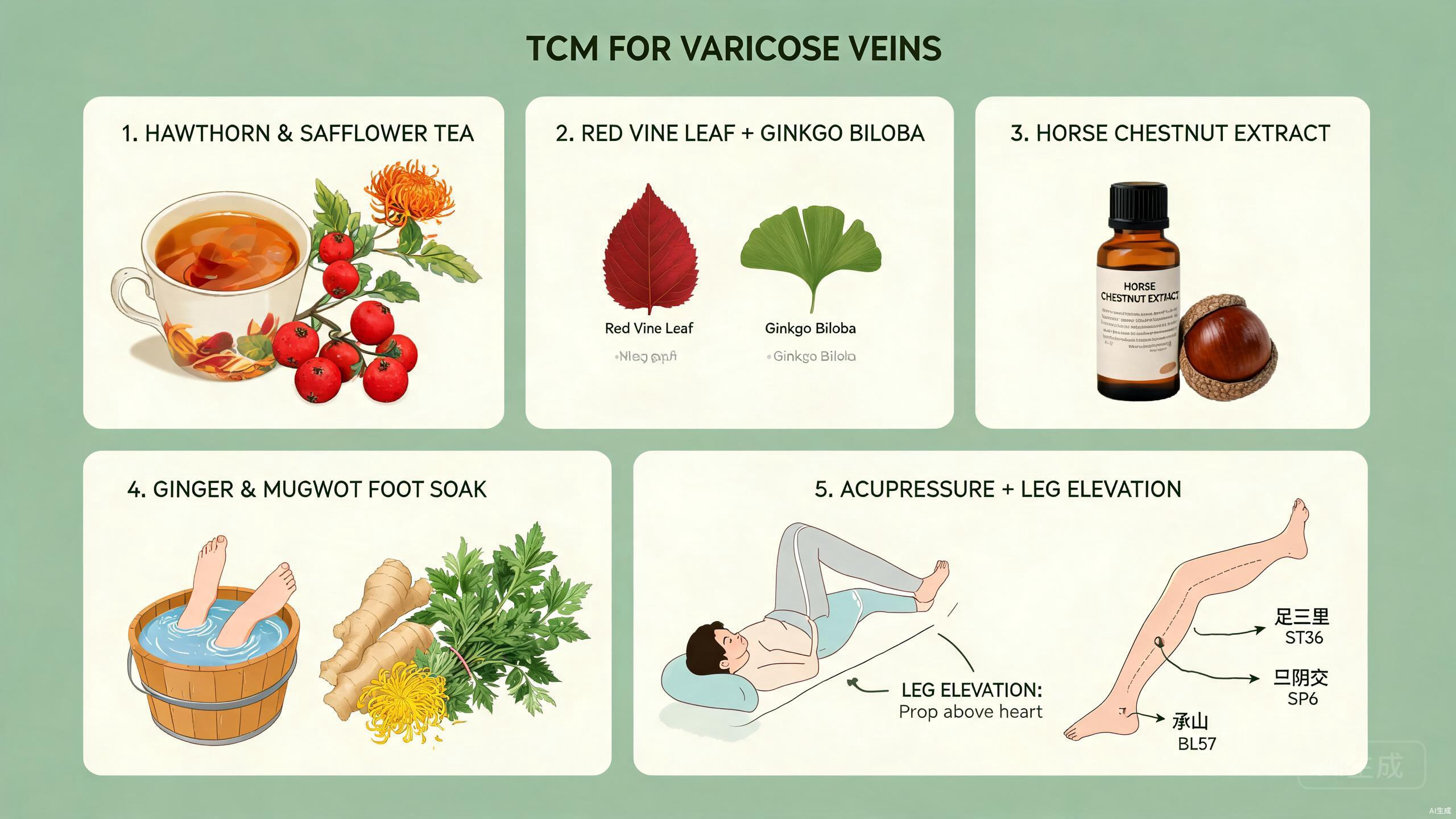
- Four acupressure points — Yinlingquan (SP9), Weizhong (BL40), Chengshan (BL57), and Zusanli (ST36) — are traditionally used to promote circulation, drain dampness, and support leg wellness.
- Self-massage should always be performed from the foot upward toward the heart, and should be avoided during acute inflammation, thrombophlebitis, or when skin ulcers are present.
- These are traditional wellness practices, not a treatment for any medical condition. Varicose veins require evaluation by a qualified healthcare provider.
This article is for educational purposes only and is not medical advice. The foods, teas, and practices described here are traditional wellness practices rooted in Chinese culture. They are not a substitute for professional medical care, diagnosis, or treatment. Varicose veins can sometimes indicate underlying venous disease that may require medical or surgical treatment. Complications such as deep vein thrombosis (DVT), thrombophlebitis, skin ulcers, or bleeding require prompt evaluation by a qualified healthcare provider. Never massage directly over varicose veins, areas of inflammation, or blood clots. Never stop, delay, or replace prescribed treatment based on information in this article. Some foods and herbs may interact with medications — always inform your doctor about everything you consume. These statements have not been evaluated by the FDA and are not intended to diagnose, treat, cure, or prevent any disease. Read our full disclaimer →
Varicose veins — those twisted, enlarged veins that most commonly appear on the legs — affect millions of people worldwide. They can cause aching, heaviness, swelling, and a feeling of fatigue in the legs, especially after prolonged standing. While medical treatments ranging from compression stockings to minimally invasive procedures are available and effective, many people seek natural approaches to support overall leg wellness. Traditional Chinese Medicine (TCM) offers a rich tradition of food therapy, acupressure, and self-massage that may complement conventional care.
In TCM, varicose veins are not viewed as a problem of the veins alone. Instead, they are understood as a sign of qi deficiency with blood stasis, damp-heat descending into the lower body, and the effects of prolonged standing or sitting on the flow of qi and blood. The five recipes, four acupressure points, and self-massage technique below come from this tradition. All ingredients are available at Western supermarkets, Asian markets, Amazon, or iHerb.
If you are new to TCM concepts, our introduction to Traditional Chinese Medicine and guide to the Zang-Fu organ systems are helpful starting points. For related circulatory concerns, see our guides on TCM for blood circulation and TCM for leg cramps.
How TCM Views Varicose Veins
Traditional Chinese Medicine describes varicose veins through the interplay of three key concepts: qi deficiency, blood stasis, and damp-heat. Understanding these patterns helps explain why TCM recommends specific foods and practices for leg wellness.
Qi deficiency with blood stasis is the primary pattern. In TCM, the Spleen governs the muscles and vessels and is responsible for "holding blood in the vessels." When Spleen qi is strong, blood stays within the vessels and circulates properly. When Spleen qi is weak — due to poor diet, overwork, worry, or aging — it cannot hold blood effectively, and blood begins to pool, especially in the lower extremities where gravity naturally pulls it downward. Over time, this pooled blood becomes stagnant (blood stasis), and the veins enlarge and twist. This is the TCM explanation for the physical appearance of varicose veins.
Prolonged standing or sitting is a major contributing factor in TCM theory. When you stand or sit for long periods without moving, qi and blood stagnate in the legs. This stagnation damages the vessels over time, contributing to the development of varicose veins. TCM texts have warned against the harms of prolonged standing for centuries — a insight that modern medicine has confirmed through the understanding of venous pooling.
Damp-heat descending is a secondary pattern that can worsen existing varicose veins. In TCM, damp-heat — a combination of internal dampness (fluid accumulation) and heat — has a tendency to settle in the lower body. When damp-heat accumulates in the legs, it damages the vessels and surrounding tissues, causing inflammation, swelling, skin discoloration, and in severe cases, skin ulcers. This pattern is associated with the more advanced complications of chronic venous insufficiency.
TCM identifies three primary patterns associated with varicose veins:
- Qi Deficiency with Blood Stasis (Qi Xu Xue Yu) — the most common pattern. Signs include visible varicose veins, a feeling of heaviness and fatigue in the legs, worsening after standing, pale complexion, fatigue, and a tendency toward bruising. This pattern reflects weak Spleen qi that cannot hold blood in the vessels. See our TCM for digestion guide for more on Spleen patterns.
- Damp-Heat Descending (Shi Re Xia Zhu) — damp-heat settles in the lower body, causing inflammation and damage. Signs include redness, warmth, swelling, and a feeling of heaviness or burning in the legs. The skin may appear discolored or irritated. This pattern is associated with more advanced venous disease. See our summer heat clearing foods guide for related information.
- Cold-Damp Obstruction (Han Shi Zu Zhi) — cold and dampness obstruct the channels, causing poor circulation. Signs include cold legs, aching that worsens in cold or damp weather, and a feeling of heaviness. This pattern is less common but may be seen in people with a cold constitution who stand for long periods in cold environments.
Understanding these patterns helps explain why TCM recommends different foods for different situations. The recipes below address these patterns through invigorating blood circulation, strengthening the Spleen, and clearing damp-heat.
5 Food Therapy Recipes for Leg Wellness
Each recipe below is matched to a specific aspect of the TCM understanding of varicose veins. All ingredients are available at Western supermarkets, Asian markets, Amazon, or iHerb.
1. Black Fungus and Celery Salad (黑木耳芹菜凉拌)
Best for: Qi deficiency with blood stasis — general circulation support
TCM nature and flavor: Black fungus (hei mu er): sweet, neutral. Enters the Stomach, Large Intestine, and Liver channels. Celery (qin cai): sweet, bitter, cool. Enters the Liver and Stomach channels.
Traditional use: Black fungus (also called wood ear mushroom) is one of TCM's most valued foods for blood circulation. It is traditionally used to invigorate blood, stop bleeding, and nourish the blood vessels. In Chinese culture, black fungus is a staple food for people with circulatory concerns, valued for its ability to "cleanse the blood vessels" and reduce platelet aggregation. Celery is traditionally used to clear heat, lower blood pressure, and drain dampness. Together, this refreshing salad supports blood circulation, clears mild heat, and provides fiber and nutrients that support vascular wellness. Modern nutrition recognizes black fungus as rich in iron, polysaccharides, and dietary fiber.
Ingredients:
- 20 grams dried black fungus (wood ear mushroom) — available on Amazon, iHerb, and Asian markets
- 2 stalks celery
- 1 small carrot, julienned (optional)
- 1 clove garlic, minced
- 1 tablespoon rice vinegar
- 1 teaspoon sesame oil
- A pinch of sea salt
Preparation: Soak the dried black fungus in warm water for 30 to 60 minutes until it expands and softens. Rinse thoroughly and remove any tough parts. Cut into thin strips. Blanch in boiling water for 2 minutes, then rinse with cold water and drain. Cut the celery into thin slices and blanch briefly if desired. In a bowl, combine the black fungus, celery, and carrot. Mix the garlic, vinegar, sesame oil, and salt to make a dressing. Toss the salad with the dressing. Serve as a side dish, 3 to 4 times per week. For more on circulation-supporting foods, see our TCM for blood circulation guide.
Precautions: Black fungus has mild blood-thinning properties. If you take blood thinners (warfarin, aspirin), consult your healthcare provider before consuming it regularly. Ensure the black fungus is thoroughly soaked and cooked — raw or improperly prepared black fungus can cause digestive upset.
2. Hawthorn and Salvia Tea (山楂丹参茶)
Best for: Blood stasis with poor circulation — aching, heaviness, visible veins
TCM nature and flavor: Hawthorn (shan zha): sour, sweet, slightly warm. Enters the Spleen, Stomach, and Liver channels. Salvia (dan shen): bitter, slightly cold. Enters the Heart, Pericardium, and Liver channels.
Traditional use: This is one of the most important TCM tea combinations for blood stasis. Hawthorn is traditionally used to invigorate blood, resolve stasis, and improve digestion. It is one of the most commonly used herbs for cardiovascular wellness in TCM, valued for its ability to improve blood flow and reduce stagnation. Salvia (red sage root) is one of TCM's premier blood-invigorating and stasis-resolving herbs. It is traditionally used to promote blood circulation, resolve blood stasis, and clear heat. Together, they form a powerful tea for improving circulation in the legs and throughout the body. This combination is particularly relevant for varicose veins where blood stasis is the primary pattern.
Ingredients:
- 10 grams dried hawthorn berries (shan zha) — available on Amazon or iHerb
- 5 grams dried salvia root slices (dan shen) — available on Amazon or iHerb
- 3 cups water
- Optional: a small amount of honey to taste
Preparation: Rinse the hawthorn and salvia. In a pot, combine all ingredients with water. Bring to a boil, then reduce heat and simmer gently for 15 to 20 minutes. Strain into a cup. Drink 1 to 2 cups per day, preferably in the morning or afternoon. The tea has a tart, slightly bitter flavor with a warming finish. The herbs can be re-steeped once. For more on hawthorn, see our guide to TCM for high cholesterol.
Precautions: Both hawthorn and salvia have blood-thinning properties. If you take blood thinners (warfarin, aspirin, clopidogrel), consult your healthcare provider before using this tea. Salvia is traditionally avoided during pregnancy. Hawthorn may interact with heart medications. See our herbal tea safety guide for general guidance.
Dried hawthorn berries (shan zha) are small, red, and tart, available on Amazon and iHerb. They are widely used in TCM for digestion and circulation. Dried salvia root (dan shen) is a reddish-brown root slice available on Amazon and iHerb. It is one of the most important blood-invigorating herbs in TCM. Both should be purchased from reputable suppliers to ensure quality and safety.
3. Rose Tea (玫瑰花茶)
Best for: Qi stagnation with blood stasis — stress-related circulatory issues
TCM nature and flavor: Rose (mei gui hua): sweet, slightly bitter, warm. Enters the Liver and Spleen channels.
Traditional use: In TCM, the Liver governs the smooth flow of qi throughout the body, and emotional stress causes liver qi to stagnate. When liver qi stagnates, blood circulation also becomes impaired — this is a key mechanism in the development of varicose veins that worsen with stress. Rose is traditionally used to soothe the Liver, regulate qi, invigorate blood, and relieve emotional tension. For varicose veins related to or worsened by stress, rose tea provides a gentle, aromatic way to support both emotional and circulatory wellness. The tea is also simply pleasant to drink, making it easy to incorporate into a daily routine.
Ingredients:
- 5 to 6 dried rose buds (food-grade, unsprayed) — available on Amazon or iHerb
- 2 cups hot water (90°C / 195°F)
- Optional: a small amount of honey or rock sugar to taste
Preparation: Place the rose buds in a cup or teapot. Pour hot water over them, cover, and steep for 5 to 8 minutes. Strain and drink warm. Enjoy 1 to 2 cups per day, preferably in the morning or afternoon. The tea has a delicate, floral aroma and a mild, slightly sweet flavor. For a related guide, see our herbal tea for anxiety guide.
Precautions: Rose is generally safe and gentle. Avoid during pregnancy in large amounts. If you have allergies to roses or related plants, do not use. Always use food-grade, unsprayed rose buds.
4. Coix Seed Porridge (薏苡仁粥)
Best for: Damp-heat descending — swelling, heaviness, inflammation
TCM nature and flavor: Coix seed (yi yi ren / Job's tears): sweet, bland, slightly cool. Enters the Spleen, Lung, and Kidney channels.
Traditional use: When varicose veins are accompanied by swelling, a feeling of heaviness, or signs of inflammation (redness, warmth), damp-heat is often involved. Coix seed is one of TCM's most important dampness-draining grains, traditionally used to strengthen the Spleen, drain dampness, clear heat, and promote urination. By reducing internal dampness, coix seed helps reduce the fluid accumulation and inflammation that can worsen varicose veins. This porridge is also a gentle, nourishing food that supports the Spleen's overall ability to manage fluids and hold blood in the vessels.
Ingredients:
- 1/2 cup dried coix seed (Job's tears) — available on Amazon or iHerb
- 1/2 cup white rice (short or medium grain)
- 5 cups water
- A pinch of sea salt
Preparation: Soak the coix seed for 2 to 4 hours. Rinse the rice. In a pot, combine the soaked coix seed, rice, and water. Bring to a boil, then reduce heat and simmer for 40 to 50 minutes, stirring occasionally, until the porridge is thick and creamy. Add salt to taste. Eat 1 bowl per day, ideally at breakfast, 3 to 5 times per week. For more on coix seed, see our dampness-removing foods guide.
Precautions: Coix seed is cooling. If you have a cold constitution with cold extremities and diarrhea, add 3 slices of fresh ginger. Coix seed is traditionally avoided in large amounts during pregnancy.
5. Kiwi and Walnut Snack (猕猴桃核桃)
Best for: Supporting vascular wellness — daily nutritional support
TCM nature and flavor: Kiwi: sweet, sour, cold. Enters the Stomach and Bladder channels. Walnut (he tao ren): sweet, warm. Enters the Kidney, Lung, and Large Intestine channels.
Traditional use: While not a traditional Chinese recipe per se, this snack combines ingredients that align well with TCM principles for vascular wellness. Kiwi is rich in vitamin C, which is essential for the production of collagen — the structural protein that gives blood vessels their strength and elasticity. In TCM terms, kiwi's cooling nature helps clear mild heat, while its sweet-sour flavor supports digestion. Walnuts are traditionally used in TCM to tonify the Kidney, strengthen the lower back, and moisten the intestines. The Kidney system governs the bones and marrow and is related to the lower body, making walnuts relevant for leg wellness. Together, this simple snack provides nutrients that support vascular health from a modern nutritional perspective while aligning with TCM's emphasis on nourishing the Kidney and clearing heat.
Ingredients:
- 1 fresh kiwi
- 5 to 6 walnuts (shelled, raw or lightly toasted)
Preparation: Simply peel and eat the kiwi with the walnuts as a daily snack, ideally in the morning or afternoon. For more on walnuts, see our TCM for men's vitality guide.
Precautions: Kiwi is cooling — if you have a cold constitution or diarrhea, eat in moderation. Some people are allergic to kiwi — if you experience itching or swelling of the mouth, discontinue use. Walnuts are calorie-dense — eat in moderation if you are watching your weight.
Four Acupressure Points for Leg Wellness
In addition to food therapy, TCM uses acupressure to support circulation, drain dampness, and promote leg wellness. The four points below are traditionally used for varicose veins and related leg concerns. They are simple to find and can be pressed daily as part of a wellness routine.
Important: Never press directly on or over varicose veins. Press only on the acupressure points described, which are located on healthy tissue away from visible veins. Do not perform acupressure during acute inflammation, thrombophlebitis, or when skin ulcers are present.
1. Yinlingquan (SP9) — The "Yin Mound Spring"
Location: On the inner lower leg, just below the knee, behind the inner edge of the shin bone (tibia).
How to find it: Run your hand along the inner edge of your shin bone from the ankle upward. Just below the knee, you will feel a depression behind the shin bone. The point is in this depression.
How to press: Using your thumb, press into the point at a slight angle toward the shin bone. Apply moderate pressure for 2 to 3 minutes on each leg. This point is often tender, especially in people with fluid retention.
Traditional use: Yinlingquan is the most important point on the Spleen meridian for draining dampness and promoting urination. For varicose veins with swelling and heaviness, SP9 helps reduce the fluid accumulation that worsens the condition.
2. Weizhong (BL40) — The "Middle of the Crook"
Location: At the midpoint of the back of the knee, in the crease of the popliteal fossa (the hollow behind the knee).
How to find it: Sit with your knee slightly bent. The point is in the center of the crease at the back of your knee.
How to press: Using your thumbs, press gently into the point for 1 to 2 minutes on each leg. Use gentle pressure — this area is sensitive and contains important blood vessels.
Traditional use: Weizhong is the command point of the Bladder meridian and is traditionally used to invigorate blood circulation in the lower back and legs, relieve pain, and clear heat. For varicose veins, BL40 helps promote blood flow from the legs back toward the heart.
Precautions: Use very gentle pressure. If you feel a pulse under your fingers, reduce pressure. Do not press on visible varicose veins in this area.
3. Chengshan (BL57) — The "Supporting Mountain"
Location: On the back of the lower leg, in the center of the calf muscle, roughly midway between the back of the knee and the ankle.
How to find it: Stand on your toes or flex your foot. The point is at the apex of the V-shaped muscle bulge in the center of your calf. When you relax the muscle, it becomes a depression.
How to press: Using your thumb or the pads of two fingers, press firmly into the point for 2 to 3 minutes on each leg. This point is usually quite tender, especially in people with leg fatigue or cramping.
Traditional use: Chengshan is traditionally used to relax the sinews, promote blood circulation in the legs, relieve leg pain and cramping, and reduce swelling. For varicose veins, BL57 helps relieve the aching, heaviness, and fatigue that often accompany the condition. It is also one of the most important points for leg cramps. See our TCM for leg cramps guide for more.
4. Zusanli (ST36) — The "Leg Three Miles"
Location: On the outer lower leg, about 3 cun (approximately four finger-widths) below the kneecap, one finger-width to the outside of the shin bone.
How to find it: Place four fingers below the bottom of your kneecap, on the outer side of the shin. The point is at the level of the bottom finger.
How to press: Using your thumb or the pads of two fingers, press firmly into the point for 2 to 3 minutes on each leg.
Traditional use: Zusanli is the most important tonification point in TCM, traditionally used to strengthen the Spleen and Stomach, tonify qi, and support overall vitality. For varicose veins rooted in Spleen qi deficiency, ST36 addresses the root cause by building the Spleen's ability to hold blood in the vessels.
For a simple daily routine, press Yinlingquan (SP9) and Zusanli (ST36) on both legs for 2 to 3 minutes each in the morning. In the evening, gently press Weizhong (BL40) and Chengshan (BL57) for 1 to 2 minutes each. Always press gently, especially around the back of the knee. Consistency matters more than duration. For more guidance, see our acupressure safety guide.
Self-Massage for Leg Wellness
In addition to acupressure, TCM recommends gentle self-massage to support venous return and promote circulation in the legs. The key principle is that massage should always be performed in the direction of the heart — from the feet upward toward the torso. This follows the natural direction of venous blood flow and helps support the body's own circulatory mechanisms.
How to Perform Leg Self-Massage
Position: Sit comfortably with your legs slightly elevated (resting on a pillow or ottoman).
Technique:
- Step 1: Begin at the ankle. Using both hands, gently stroke the leg upward from the ankle to the knee. Use the palms of your hands with light to moderate pressure. Repeat 10 to 15 times on each leg.
- Step 2: Move to the calf. Using a gentle kneading motion with both hands, massage the calf muscle from the ankle upward to the knee. Use moderate pressure. Repeat for 2 to 3 minutes on each leg.
- Step 3: Move to the thigh. Using the same upward stroking motion, massage from the knee to the upper thigh. Repeat 10 to 15 times on each leg.
- Step 4: Finish by gently pressing the acupressure points described above for 1 to 2 minutes each.
Frequency: Once daily, ideally in the evening after a warm bath or shower when the muscles are relaxed.
Do not massage during acute phases — including active inflammation, thrombophlebitis, deep vein thrombosis (DVT), or when skin ulcers, open wounds, or bleeding are present. Never massage directly over varicose veins or areas that are red, warm, swollen, or painful. If you are unsure whether massage is safe for you, consult your healthcare provider before starting. If you experience sudden leg pain, swelling, warmth, or redness, seek immediate medical attention, as these may indicate a blood clot.
Lifestyle Tips for Leg Wellness
TCM is a whole-person system. Foods, acupressure, and massage work best when combined with supportive daily habits. The following practices are emphasized in classical TCM for leg and vascular wellness:
- Avoid prolonged standing or sitting. In TCM, both positions cause qi and blood to stagnate in the legs. If you must stand or sit for long periods, take breaks every 30 to 60 minutes to walk, stretch, or elevate your legs. Gentle calf raises (rising onto your toes) help pump blood upward.
- Wear medical compression stockings. Compression stockings are the most effective non-surgical treatment for varicose veins and are fully compatible with TCM principles. They provide external support that helps the veins return blood to the heart, similar to what TCM aims to achieve through strengthening Spleen qi. Consult your healthcare provider for the right compression level.
- Elevate your legs. When resting or sleeping, elevate your legs above the level of your heart for 15 to 30 minutes. This allows gravity to assist venous return and reduces pooling.
- Exercise regularly. Walking, swimming, cycling, tai chi, and qigong all promote the calf muscle pump that helps return blood from the legs to the heart. Aim for 30 minutes of moderate exercise most days. Avoid high-impact activities that strain the legs.
- Maintain a healthy weight. Excess weight increases pressure on the veins in the legs and contributes to venous insufficiency. A balanced diet and regular exercise support both weight management and vascular wellness.
- Keep your legs warm. TCM considers cold a major cause of qi and blood stagnation. Keep your legs and feet warm, especially in cold weather. Avoid sitting with cold air conditioning blowing directly on your legs.
- Avoid crossing your legs. Crossing your legs restricts blood flow and increases pressure in the veins. Sit with your feet flat on the floor or slightly elevated.
For more on how TCM understands circulation, see our guide to qi, blood, and body fluids and TCM for blood circulation.
Comparison of the Five Recipes
| Recipe | TCM Pattern | Key Action | Frequency |
|---|---|---|---|
| Black Fungus & Celery Salad | Qi Def. + Blood Stasis | Invigorate blood, clear heat, support vessels | 3 to 4 times per week |
| Hawthorn & Salvia Tea | Blood Stasis (primary) | Invigorate blood, resolve stasis | 1 to 2 cups daily |
| Rose Tea | Qi Stagnation + Blood Stasis | Soothe Liver, regulate qi, invigorate blood | 1 to 2 cups daily |
| Coix Seed Porridge | Damp-Heat Descending | Drain dampness, clear heat, strengthen Spleen | 1 bowl daily, 3 to 5 times per week |
| Kiwi & Walnut Snack | Daily nutritional support | Nourish Kidney, clear heat, support vessels | 1 serving daily |
Frequently Asked Questions
What does TCM say about varicose veins?
In Traditional Chinese Medicine, varicose veins are understood through the concept of qi and blood stagnation. The Spleen governs the vessels and holds blood in the vessels; when Spleen qi is deficient, blood cannot be held properly and pools in the lower extremities. Prolonged standing or sitting causes qi and blood to stagnate in the legs. Additionally, damp-heat can descend into the lower body, damaging the vessels. TCM food therapy traditionally uses ingredients like black fungus, hawthorn, salvia, rose, and coix seed to invigorate blood circulation, strengthen the Spleen, and clear damp-heat. These are traditional wellness practices, not medical treatments. For a deeper understanding, see our zang-fu organ guide.
Which TCM foods may help with varicose veins?
Five traditional TCM food therapy recipes for varicose veins include black fungus and celery salad, hawthorn and salvia tea, rose tea, coix seed porridge, and kiwi with walnuts. These recipes use ingredients like dried black fungus, celery, hawthorn berries, salvia root, dried rose buds, coix seed, kiwi, and walnuts that are available at Western supermarkets, Asian markets, Amazon, or iHerb. The salad and tea recipes address blood stasis, the rose tea addresses stress-related qi stagnation, and the coix seed porridge addresses damp-heat. They are traditional wellness foods, not treatments for any medical condition.
Can acupressure and massage help with varicose veins?
TCM acupressure on points like Yinlingquan (SP9), Weizhong (BL40), Chengshan (BL57), and Zusanli (ST36) is traditionally used to promote circulation, drain dampness, and support leg wellness. Self-massage from the foot upward toward the heart may help support venous return. However, acupressure and massage are not appropriate during acute phases such as inflammation, thrombophlebitis, or when skin ulcers are present. Never massage directly over varicose veins or areas of inflammation. Consult your healthcare provider before starting any self-massage routine. See our acupressure safety guide for general precautions.
What lifestyle changes help prevent varicose veins in TCM?
In TCM, the key lifestyle changes for preventing varicose veins include avoiding prolonged standing or sitting, wearing medical compression stockings as recommended by a doctor, elevating the legs when resting, and engaging in regular moderate exercise like walking, tai chi, or swimming. Keeping the legs warm, avoiding crossing the legs, and maintaining a healthy weight are also emphasized. These are traditional wellness suggestions, not medical advice. Always consult your healthcare provider for proper evaluation and treatment of varicose veins. See our guides on TCM for blood circulation and TCM for leg cramps for related topics.
Precautions and When to Seek Help
While TCM food therapy, acupressure, and self-massage may support general leg wellness, varicose veins can sometimes indicate or lead to serious conditions that require professional evaluation:
- Seek immediate medical attention if you experience sudden leg pain, swelling, warmth, or redness, as these may indicate deep vein thrombosis (DVT) — a blood clot that requires emergency treatment. Also seek immediate care if a varicose vein bleeds, or if you develop a skin ulcer near the ankle.
- See your doctor if you experience worsening pain, swelling, skin changes (discoloration, thickening, or itching near the ankles), or if varicose veins are affecting your quality of life. These may indicate chronic venous insufficiency that requires medical treatment.
- Medication interactions. If you take blood thinners (warfarin, aspirin, clopidogrel) or blood pressure medication, consult your healthcare provider before regularly consuming blood-invigorating foods and herbs (black fungus, hawthorn, salvia), as they may enhance the effects of your medication.
- Do not massage during acute inflammation, thrombophlebitis, DVT, or when skin ulcers or open wounds are present. Massage in these conditions can dislodge clots or worsen inflammation.
- Not a substitute. TCM food therapy is complementary. It sits alongside — never in place of — professional medical care, including compression therapy, medical procedures, and surgical treatment when needed.
For related topics, see our guides on TCM for blood circulation, TCM for leg cramps, and TCM for water retention.
The Bottom Line
Traditional Chinese Medicine offers a gentle, food-based tradition for supporting leg wellness and circulation. By understanding whether your varicose veins are rooted in Spleen qi deficiency with blood stasis, damp-heat descending, or stress-related qi stagnation, you can choose foods and teas that work with your body's specific needs. Black fungus and celery salad invigorates blood and supports the vessels. Hawthorn and salvia tea resolves blood stasis and improves circulation. Rose tea soothes the Liver and regulates qi. Coix seed porridge drains dampness and reduces swelling. And kiwi with walnuts provides daily nutritional support for vascular wellness. Paired with four acupressure points — Yinlingquan (SP9), Weizhong (BL40), Chengshan (BL57), and Zusanli (ST36) — gentle upward self-massage, and lifestyle habits like avoiding prolonged standing, wearing compression stockings, and regular exercise, these traditional practices form a whole-person approach to leg wellness.
But they are traditions — not treatments, and not a replacement for medical care. Varicose veins require evaluation by a qualified healthcare provider, especially when accompanied by pain, swelling, skin changes, or other symptoms. Use these traditional practices only as complementary wellness habits, alongside your doctor's guidance.
This article shares traditional wellness practices for educational purposes only. It is not a substitute for medical advice, diagnosis, or treatment. The foods, teas, and acupressure practices described here are not intended to treat, cure, or prevent any disease, including but not limited to varicose veins, chronic venous insufficiency, deep vein thrombosis, thrombophlebitis, or venous ulcers. If you have varicose veins — especially with pain, swelling, skin changes, or bleeding — consult your healthcare provider promptly for proper evaluation. Never massage directly over varicose veins, areas of inflammation, or suspected blood clots. These statements have not been evaluated by the FDA. Never stop or adjust prescribed treatment without your doctor's explicit guidance. Read our full disclaimer →