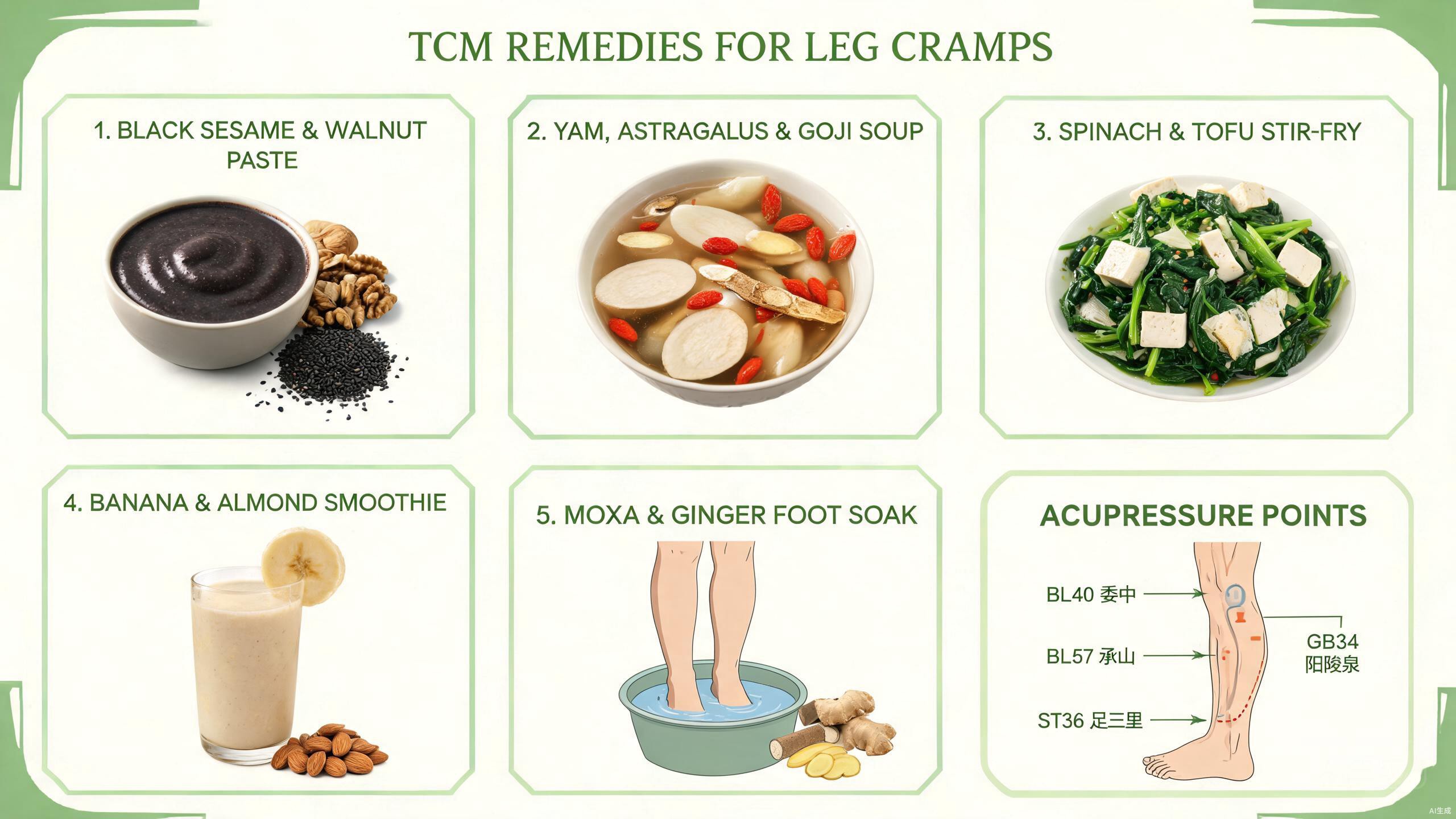
Key Takeaways
- TCM views leg cramps through the Liver and Kidney organ systems — the Liver governs the tendons and stores blood, while the Kidneys govern the bones; liver blood deficiency and liver-kidney depletion are the most common patterns associated with nighttime cramping.
- Four traditional food therapy recipes — from black sesame walnut porridge to banana almond smoothie — use ingredients rich in calcium, magnesium, and potassium, available at Western supermarkets, Amazon, or iHerb.
- A warming herbal foot soak with moxa, safflower, cassia twig, and lycopodium may support circulation and relax tendons before sleep.
- Four acupressure points — Chengshan (BL57), Zusanli (ST36), Yanglingquan (GB34), and Weizhong (BL40) — are traditionally used to relax muscles and move qi and blood through the legs.
- These are traditional wellness practices, not a treatment for any medical condition. Persistent or severe cramping requires evaluation by a qualified healthcare provider.
This article is for educational purposes only and is not medical advice. The foods, teas, and practices described here are traditional wellness practices rooted in Chinese culture. They are not a substitute for professional medical care, diagnosis, or treatment. Leg cramps can sometimes indicate underlying medical conditions including mineral deficiencies, poor circulation, nerve compression, diabetes, thyroid disorders, or vascular disease. These require proper evaluation by a qualified healthcare provider. Never stop, delay, or replace prescribed treatment based on information in this article. Some foods and herbs may interact with medications — always inform your doctor about everything you consume. These statements have not been evaluated by the FDA and are not intended to diagnose, treat, cure, or prevent any disease. Read our full disclaimer →
Leg cramps — those sudden, intense muscle contractions that jolt you awake in the middle of the night — are a remarkably common experience, especially among older adults. A charley horse can leave the calf muscle sore and tender for hours afterward, disrupting sleep and affecting quality of life. While occasional cramps are usually harmless, frequent or severe cramping warrants a conversation with your healthcare provider to rule out underlying causes. For those looking to complement their wellness routine, Traditional Chinese Medicine (TCM) offers a rich tradition of food therapy, herbal foot soaks, and acupressure practices that may support muscle and tendon comfort.
In TCM, leg cramps are not simply a muscle problem. They are understood through the interplay of the Liver, which governs the tendons and stores blood, and the Kidneys, which govern the bones and produce marrow. When liver blood is insufficient — due to aging, overwork, poor nutrition, or blood loss — the tendons lose their nourishment and become prone to spasms. When cold and dampness lodge in the meridians, qi and blood stagnate, causing painful contraction. The four recipes and practices below use foods that have been enjoyed for generations to nourish blood, strengthen the liver and kidneys, and provide the minerals — calcium, magnesium, and potassium — that modern nutrition associates with muscle function. All ingredients are available at Western supermarkets, Asian markets, Amazon, or iHerb.
If you are new to TCM concepts, our guide to the Zang-Fu organ systems and overview of qi, blood, and body fluids are helpful starting points. For related musculoskeletal topics, see our guides to TCM for bone and joint health and TCM for joint pain.
How TCM Views Leg Cramps
Traditional Chinese Medicine understands leg cramps through three interconnected principles: the relationship between the Liver and tendons, the relationship between the Kidneys and bones, and the influence of cold and dampness on the meridians.
The Liver governs the tendons (Gan Zhu Jin). This is the single most important TCM concept for understanding leg cramps. In TCM theory, the Liver stores blood and ensures that blood is distributed to the tendons, ligaments, and muscles during periods of activity and rest. When liver blood is abundant, the tendons are supple, flexible, and well-nourished. When liver blood is deficient — whether from aging, chronic stress, overwork, poor digestion, or blood loss — the tendons lose their nourishment. They become dry, tight, and prone to spasms. This is why leg cramps often worsen at night: in TCM physiology, blood returns to the liver for storage and regeneration during sleep. If liver blood is already deficient, the tendons receive even less nourishment during the night, making cramps more likely to strike after you have been lying still for hours.
The Kidneys govern the bones and produce marrow (Shen Zhu Gu Sheng Sui). The Kidney system stores essence (jing) and is the foundation of the body's structural integrity. In TCM, the Liver and Kidneys share a close relationship — they are often described as having the "same source." Liver blood deficiency and kidney essence deficiency frequently develop together, especially as we age. When both are depleted, the entire musculoskeletal system — bones, joints, tendons, and muscles — suffers. This pattern is sometimes called liver and kidney deficiency and is the traditional explanation for the age-related increase in leg cramps, joint stiffness, and lower back weakness.
Cold and dampness in the meridians. Not all leg cramps are caused by deficiency. When the legs are exposed to cold — sleeping in a cold room, air conditioning blowing on bare legs, or sitting on a cold surface — cold can invade the meridians and cause qi and blood to contract and stagnate. In TCM, cold causes contraction (like water freezing into ice), while heat causes expansion. A sudden cold invasion can trigger an acute cramp. Chronic dampness — from a diet heavy in cold, raw, or greasy foods, or from living in a humid environment — can also obstruct the meridians over time, making cramps more frequent.
TCM identifies four primary patterns associated with leg cramps:
- Liver Blood Deficiency (Gan Xue Xu) — the most common pattern. Signs include cramps that worsen at night or after exertion, dry eyes, brittle nails, muscle twitching or numbness, pale complexion, and scanty or light periods in women. Often seen in older adults, after blood loss, or with poor nutrition.
- Liver and Kidney Deficiency (Gan Shen Kui Xu) — an age-related pattern where both systems are depleted. Signs include nighttime leg cramps, lower back soreness, knee weakness, dry hair, dizziness, and tinnitus. Often seen in people over 50.
- Cold-Damp in the Meridians (Han Shi Zu Luo) — cold and dampness obstruct the leg meridians. Signs include cramps triggered or worsened by cold, a feeling of heaviness or coldness in the legs, and pain that improves with warmth. Often triggered by exposure to cold or damp environments.
- Qi and Blood Stagnation (Qi Zhi Xue Yu) — qi and blood fail to circulate smoothly through the legs. Signs include cramps with a fixed, sharp pain, a feeling of tightness or fullness, and symptoms that worsen with stress or inactivity and improve with movement. Often related to prolonged sitting or emotional stress.
Understanding these patterns helps explain why TCM recommends different foods for different situations. The recipes below are matched to the patterns they traditionally address.
4 Food Therapy Recipes for Leg Cramp Relief
Each recipe below is matched to a specific TCM pattern. Choose the one that best fits your situation, and use it consistently for two to four weeks. All ingredients are available at Western supermarkets, Asian markets, Amazon, or iHerb.
1. Black Sesame Walnut Porridge (黑芝麻核桃粥)
Best for: Liver blood deficiency and liver-kidney deficiency
TCM nature and flavor: Black sesame (hei zhi ma): sweet, neutral. Enters the Liver and Kidney channels. Walnut (he tao ren): sweet, warm. Enters the Kidney, Lung, and Large Intestine channels.
Traditional use: This is one of the most classic TCM food therapy combinations for nourishing liver blood and kidney essence. Black sesame is traditionally used to nourish the liver and kidneys, enrich the blood, and moisten the intestines. Its deep black color is associated with the Water element and the Kidney system in TCM's five-element theory. Walnuts are traditionally used to strengthen the kidneys, warm the lungs, and moisten the intestines; their brain-like shape has long been associated with marrow and brain health. Together, this porridge addresses the root of tendon nourishment by enriching the blood and strengthening the kidneys. Modern nutrition recognizes both ingredients as rich sources of magnesium, calcium, and healthy fats — minerals directly relevant to muscle function.
Ingredients:
- 30 grams (about 3 tablespoons) black sesame seeds — available at supermarkets, Amazon, or iHerb
- 20 grams (about 2 tablespoons) walnut halves, roughly chopped
- 1/2 cup white rice (short or medium grain)
- 5 cups water
- A pinch of sea salt
- Optional: 1 teaspoon honey or maple syrup
Preparation: Lightly toast the black sesame seeds in a dry skillet over low heat for 2 to 3 minutes until fragrant, stirring constantly to prevent burning. Grind the toasted sesame seeds in a blender, food processor, or with a mortar and pestle until they form a paste. Rinse the rice. In a pot, combine the rice, water, and ground sesame paste. Bring to a boil, then reduce heat and simmer for 30 to 40 minutes, stirring occasionally, until the porridge is thick and creamy. Add the chopped walnuts in the last 5 minutes of cooking. Add salt and optional sweetener to taste. Eat 1 bowl per day, ideally in the morning or evening. For more on black sesame's blood-nourishing properties, see our TCM for anemia guide.
Precautions: Black sesame is generally safe and gentle. If you have loose stools or diarrhea, reduce the amount, as sesame is mildly moistening to the intestines. Walnuts are warming; if you have heat signs (dry mouth, constipation, irritability), use a smaller portion.
2. Yam Astragalus Goji Soup (山药黄芪枸杞汤)
Best for: Liver-kidney deficiency with fatigue and low energy
TCM nature and flavor: Chinese yam (shan yao): sweet, neutral. Enters the Spleen, Lung, and Kidney channels. Astragalus (huang qi): sweet, warm. Enters the Spleen and Lung channels. Goji berries (gou qi zi): sweet, neutral. Enters the Liver and Kidney channels.
Traditional use: This soup combines three of TCM's most valued tonic foods into a gentle, nourishing blend. Chinese yam is one of the most versatile tonic foods, traditionally used to tonify the spleen, nourish the lung, and support the kidney simultaneously. It is rich in complex carbohydrates, potassium, and magnesium. Astragalus is one of TCM's premier qi-tonifying herbs, traditionally used to lift spleen qi, support energy, and improve the body's ability to transport nutrients. Goji berries nourish liver blood and kidney yin and are rich in minerals and antioxidants. Together, this soup addresses the digestive root of blood production (through astragalus and yam strengthening the spleen) while directly nourishing the liver and kidneys (through yam and goji). It is ideal for people whose cramps come with fatigue, low energy, and a feeling of weakness.
Ingredients:
- 1 cup fresh Chinese yam, peeled and cubed (or 30 grams dried yam slices from Amazon/iHerb)
- 15 grams (about 5 to 6 slices) dried astragalus root — available on Amazon or iHerb
- 10 grams (about 1 tablespoon) dried goji berries — available on Amazon or iHerb
- 4 cups vegetable or chicken broth (low sodium)
- 3 slices fresh ginger
- A pinch of sea salt
Preparation: Rinse the astragalus slices. In a pot, combine the astragalus, ginger, and broth. Bring to a boil, then reduce heat and simmer for 20 minutes to extract the astragalus. Add the cubed Chinese yam and simmer for another 15 minutes until the yam is tender but not falling apart. Add the goji berries in the last 5 minutes (they cook quickly and lose their benefits if overcooked). Remove the astragalus slices before serving (they are fibrous and not meant to be eaten). Add salt to taste. Drink 1 bowl of broth and eat the yam and goji, 2 to 3 times per week. For more on these ingredients, see our astragalus soup guide and goji tea guide.
Precautions: Astragalus is warming and tonifying. Avoid if you have an acute infection, fever, or active inflammation, as TCM considers it inappropriate to "tonify" during acute illness. If you take immunosuppressant medication, consult your doctor. See our herbal tea safety guide for general guidance.
3. Spinach Tofu Soup (菠菜豆腐汤)
Best for: Liver blood deficiency with mineral needs (calcium, magnesium, potassium)
TCM nature and flavor: Spinach (bo cai): sweet, cool. Enters the Liver, Stomach, and Large Intestine channels. Tofu (dou fu): sweet, cool. Enters the Spleen, Stomach, and Large Intestine channels.
Traditional use: Spinach is one of the most accessible blood-nourishing vegetables in both TCM and Western nutrition. In TCM, it is traditionally used to nourish the blood, moisten the intestines, and calm the liver. Its rich green color is associated with the Liver and Wood element. Tofu is traditionally used to clear heat, benefit qi, and support the spleen and stomach. From a modern nutritional perspective, spinach is an excellent source of magnesium and potassium, while tofu provides calcium and protein — all minerals directly involved in muscle contraction and relaxation. The combination of a blood-nourishing vegetable with a protein-rich, calcium-dense food makes this a simple, everyday soup for supporting tendon wellness. Ginger is added to balance the cooling nature of both ingredients.
Ingredients:
- 4 cups fresh spinach, washed and trimmed (or 2 cups frozen spinach)
- 8 oz firm or extra-firm tofu, cut into small cubes
- 4 cups vegetable or chicken broth (low sodium)
- 4 slices fresh ginger
- 1 teaspoon sesame oil
- A pinch of sea salt
- Optional: a few drops of soy sauce
Preparation: If using fresh spinach, blanch it in boiling water for 30 seconds, then rinse with cold water and squeeze out excess water. This reduces the oxalic acid content, which can otherwise interfere with calcium absorption. Cut the blanched spinach into segments. In a pot, bring the broth and ginger to a boil. Add the tofu cubes and simmer for 5 minutes. Add the spinach and simmer for another 2 to 3 minutes. Drizzle with sesame oil and add salt and optional soy sauce to taste. Drink 1 bowl per day, ideally at lunch or dinner. This soup is light and can be enjoyed regularly.
Precautions: Both spinach and tofu are cooling. If you have a cold constitution with cold hands and feet, diarrhea, or abdominal pain after cold foods, add extra ginger or enjoy this soup less frequently. People with a history of calcium oxalate kidney stones should blanch the spinach (as described) to reduce oxalate content and may wish to consult their healthcare provider about dietary oxalate.
4. Banana Almond Smoothie (香蕉杏仁奶昔)
Best for: Mineral replenishment (potassium, magnesium, calcium) and quick nourishment
TCM nature and flavor: Banana (xiang jiao): sweet, cold. Enters the Spleen and Stomach channels. Almonds (nan xing ren / sweet almonds): sweet, neutral. Enters the Lung and Large Intestine channels. Milk: sweet, neutral. Enters the Heart, Lung, and Stomach channels.
Traditional use: While bananas and almonds are not native to ancient Chinese medicine, they have been readily adopted into modern TCM food therapy because their nutritional profile perfectly matches the needs of muscle and tendon health. Bananas are traditionally considered to clear heat, moisten the intestines, and provide quick energy. They are one of the richest dietary sources of potassium, a mineral essential for muscle contraction and nerve signaling. Almonds are traditionally used to moisten the lungs and intestines and are rich in magnesium and calcium. Milk is considered a gentle, nourishing tonic in TCM, providing fluids and minerals. This smoothie is a practical, Western-friendly option for those who want a quick, mineral-rich beverage, especially after exercise or as an evening snack.
Ingredients:
- 1 ripe banana
- 20 grams (about 2 tablespoons) almonds — whole, slivered, or almond butter
- 1 cup milk (dairy, almond milk, or oat milk)
- Optional: 1 teaspoon honey or maple syrup
- Optional: 1/2 teaspoon cinnamon (warming, balances the cold nature of banana)
Preparation: If using whole almonds, soak them in warm water for 10 minutes and remove the skins for a smoother texture (optional). Place all ingredients in a blender and blend until smooth and creamy. Drink immediately, 1 glass per day. This is best enjoyed at room temperature or slightly warm rather than ice-cold, as TCM favors warm or room-temperature foods for optimal digestion. If you prefer warmth, gently heat the milk before blending (do not boil). Enjoy in the morning, as a post-workout replenishment, or about an hour before bed.
Precautions: Bananas are cold in nature according to TCM. If you have a cold constitution, add cinnamon or ginger, or enjoy this smoothie less frequently. People with diabetes should monitor blood sugar, as bananas are relatively high in natural sugars. If you are lactose intolerant, use almond or oat milk.
The four recipes above are rich in three minerals that modern nutrition considers essential for muscle function: calcium (tofu, almonds, milk), magnesium (black sesame, spinach, almonds, Chinese yam), and potassium (banana, spinach, Chinese yam). This alignment between TCM's blood-and-kidney-nourishing foods and modern mineral science is one reason these traditional recipes have endured for centuries. For more on how TCM understands the body's building blocks, see our guide to qi, blood, and body fluids.
Traditional Herbal Foot Soak: Moxa Safflower Cassia Blend (艾叶红花桂枝泡脚方)
In TCM, the feet are considered the "second heart" — a region where many meridians converge and where qi and blood can be influenced directly. A warm foot soak before bed is one of the most beloved and accessible TCM self-care practices, traditionally used to warm the meridians, promote circulation, relax the tendons, and draw energy downward for better sleep. For leg cramps — especially those caused or worsened by cold — a warming herbal foot soak can be particularly effective.
Moxa Safflower Cassia Foot Soak
Best for: Cold-damp in the meridians, qi and blood stagnation, and general tendon relaxation before sleep
TCM nature and flavor: Moxa / mugwort (ai ye): bitter, warm. Enters the Liver, Spleen, and Kidney channels. Safflower (hong hua): acrid, warm. Enters the Heart and Liver channels. Cassia twig / cinnamon twig (gui zhi): acrid, sweet, warm. Enters the Heart, Lung, and Bladder channels. Lycopodium / club moss (shen jin cao): bitter, warm. Enters the Liver channel.
Traditional use: This is a classic TCM foot soak formula for muscle and tendon relaxation. Moxa (mugwort leaf) is traditionally used to warm the meridians, stop bleeding, and dispel cold; it is the same herb used in moxibustion therapy. Safflower is traditionally used to invigorate blood circulation and remove stagnation, helping to break through blocked qi and blood in the leg meridians. Cassia twig is traditionally used to warm the meridians, promote circulation to the extremities, and relieve muscle tension. Lycopodium — literally called "tendon-relaxing herb" in Chinese (shen jin cao) — is traditionally used to relax the tendons and unblock the meridians, making it a specific herb for muscle spasms and joint stiffness. Together, this combination warms, moves, and relaxes — ideal for cold-induced cramps or chronic stagnation.
Ingredients:
- 20 grams dried moxa / mugwort leaf (ai ye) — available on Amazon or iHerb
- 10 grams dried safflower (hong hua) — available on Amazon or iHerb
- 15 grams cassia twig / cinnamon twig (gui zhi) — available on Amazon or iHerb
- 15 grams lycopodium / club moss (shen jin cao) — available on Amazon or iHerb
- A large pot or foot bath tub
- Enough hot water to cover the ankles
Preparation: Place all four dried herbs in a large pot with about 2 liters (8 cups) of water. Bring to a boil, then reduce heat and simmer for 15 to 20 minutes to extract the herbs. The water will turn a deep amber-brown color and release a warm, herbal aroma. Pour the herbal decoction into a foot bath tub and add enough hot water to reach a comfortable temperature (about 40 to 42°C / 104 to 108°F — warm but not scalding). Soak your feet and lower calves for 15 to 20 minutes, ideally 30 to 60 minutes before bed. You may add more hot water during the soak to maintain the temperature. Use this foot soak 3 to 4 times per week. For more on foot soaks, see our TCM foot soak guide and mugwort foot soak guide.
Precautions: Do not use this foot soak if you are pregnant — safflower and moxa are traditionally contraindicated during pregnancy as they may stimulate blood circulation to the uterus. Do not soak if you have open wounds, skin infections, or severe varicose veins on the feet or legs. If you have diabetes or peripheral neuropathy with reduced sensation, test the water temperature carefully with a thermometer to avoid burns. Avoid soaking within 30 minutes of a meal. If you feel dizzy or lightheaded, stop the soak immediately.
Four Acupressure Points for Leg Cramp Relief
In addition to food therapy and foot soaks, TCM uses acupressure — the practice of applying steady pressure to specific points on the body — to support the meridians that run through the legs. The four points below are traditionally used to relax tendons, move qi and blood, and ease cramping. They are simple to find and can be pressed daily as part of a wellness routine.
1. Chengshan (BL57) — The "Mountain-Supporting" Point
Location: On the back of the calf, in the depression formed when the calf muscle is flexed, approximately midway between the back of the knee and the heel.
How to find it: Stand or sit with your foot flexed upward (toes toward you). You will see the calf muscle bulge. The point sits in the V-shaped depression just below the center of the calf muscle belly. Press gently — this point is often quite tender, especially when cramps are active.
How to press: Using your thumb, press into the point at a moderate angle toward the shin bone. Hold for 1 to 2 minutes while breathing slowly. You may feel a radiating sensation down the calf or toward the heel — this is normal. Use moderate pressure; never press hard enough to cause sharp pain.
Traditional use: Chengshan is one of the most important points for relaxing the tendons and muscles of the calf, activating qi and blood circulation, and easing leg cramps. It is traditionally used for calf spasms, lower leg fatigue, and heaviness in the legs. For leg cramp relief, this is often the first point to press when a cramp strikes.
Precautions: Use gentle to moderate pressure. This point can be very tender — do not press aggressively. If you have a blood clot (DVT) or varicose veins in the calf, avoid deep pressure and consult your doctor.
2. Zusanli (ST36) — The "Leg Three Miles" Point
Location: On the outer lower leg, about 3 cun (approximately four finger-widths) below the lower edge of the kneecap, one finger-width to the outside of the shin bone (tibia).
How to find it: Place your hand on your knee with your fingers pointing downward. The point is level with the lower edge of your pinky finger, just outside the shin bone. Press gently — you should feel a slight ache or soreness.
How to press: Using your thumb or index finger, press into the point at a slight angle toward the shin bone. Apply moderate pressure for 2 to 3 minutes on each leg. This point is often tender in people with digestive weakness or fatigue.
Traditional use: Zusanli is arguably the most famous acupressure point in all of TCM. It is traditionally used to tonify spleen and stomach qi, strengthen the body, support digestion and absorption of nutrients, and benefit the legs. Its name, "Leg Three Miles," reflects the traditional belief that pressing this point gives a tired person the energy to walk another three miles. For leg cramps, ST36 supports the body's ability to absorb the minerals and nutrients needed for muscle function — it addresses the digestive root of blood and qi production. See our guide to acupressure safety for general precautions.
Precautions: Generally safe for daily use. Avoid pressing too hard if the point is very tender. Not to be confused with the nearby point Shangjuxu (ST37).
3. Yanglingquan (GB34) — The "Yang Mound Spring"
Location: On the outer side of the lower leg, in the depression just below the head of the fibula (the smaller shin bone on the outside of the leg), slightly in front of and below the knee.
How to find it: Bend your knee slightly. Feel for the bony knob on the outside of your lower leg, just below the knee joint — this is the head of the fibula. Yanglingquan sits in the depression just below and slightly in front of this knob.
How to press: Using your thumb, press into the depression at a slight upward angle. Apply moderate pressure for 1 to 2 minutes on each leg. You may feel an ache that radiates down the outer leg.
Traditional use: Yanglingquan is the influential point of the tendons and sinews — a designation that makes it one of the most important points in TCM for any tendon or muscle problem. It is traditionally used to relax the tendons, ease muscle spasms, and promote smooth movement of the joints. For leg cramps, this point directly addresses the Liver's governance of the tendons, making it a key point for relaxing tight, spasming muscles.
Precautions: Use gentle to moderate pressure. The area around the fibula head can be sensitive. Avoid pressing directly on the bone.
4. Weizhong (BL40) — The "Middle of the Crook"
Location: At the midpoint of the back of the knee, in the crease (popliteal crease) where the leg bends.
How to find it: Sit or stand with your knee slightly bent. Feel for the horizontal crease at the back of the knee. Weizhong sits at the exact center of this crease, between the two tendons you can feel on either side.
How to press: Using your thumbs (reaching around to the back of the knee) or while seated with the leg extended, press gently into the point. Apply light to moderate pressure for 1 to 2 minutes. Do not press hard — this area contains important blood vessels and nerves.
Traditional use: Weizhong is one of the most important points on the Bladder meridian, which runs the entire length of the back of the leg. It is traditionally used to invigorate blood circulation in the lower back and legs, relax the lower back and leg muscles, and ease acute muscle spasms. In TCM, there is a saying: "For lower back pain, press Weizhong." For leg cramps that involve the back of the thigh and calf, this point helps move stagnant qi and blood through the entire posterior leg.
Precautions: Use light pressure only — the popliteal area contains the popliteal artery and nerve. Do not press hard. If you have a history of blood clots (DVT) in the leg, deep vein issues, or popliteal aneurysm, avoid this point and consult your doctor. For more on safe acupressure practices, see our acupressure safety guide.
For a simple daily routine, press Zusanli (ST36) for 2 to 3 minutes on each leg in the morning to support energy and nutrient absorption. In the evening, press Chengshan (BL57), Yanglingquan (GB34), and Weizhong (BL40) for 1 to 2 minutes each, ideally after the herbal foot soak when the meridians are warm and open. Consistency matters more than duration — daily gentle pressure over several weeks is more effective than occasional long sessions.
Lifestyle Tips for Leg Cramp Prevention
TCM is a whole-person system. Foods, foot soaks, and acupressure work best when combined with supportive daily habits. The following areas are emphasized in classical TCM for muscle and tendon health:
- Stretch your calves before bed. This is one of the simplest and most effective habits for preventing nighttime leg cramps. Stand facing a wall, place your hands on the wall, and step one foot back. Keep the back leg straight with the heel on the floor, and lean forward until you feel a stretch in the calf. Hold for 20 to 30 seconds on each leg. Do this 2 to 3 times per leg, every night before sleep.
- Keep your legs and feet warm. In TCM, cold is a primary cause of muscle contraction and cramping. Avoid sleeping with bare legs exposed to cold air or air conditioning. Wear warm socks or light leggings to bed, especially in cold weather or air-conditioned rooms. Avoid sitting on cold surfaces. A warm foot soak before bed warms the meridians and draws energy downward for restful sleep.
- Stay hydrated with warm fluids. TCM favors warm or room-temperature beverages over ice-cold drinks, which are believed to weaken the spleen and slow digestion. Drink warm water, herbal teas, or broths throughout the day. See our congee guide for warming, hydrating options. Adequate hydration supports healthy muscle function and helps the body transport minerals.
- Exercise moderately and regularly. TCM values consistency over intensity. Walking, tai chi, gentle qigong, swimming, and cycling are all excellent for keeping qi and blood flowing through the legs. Aim for 30 minutes of moderate movement most days. Avoid sudden, intense exercise without warming up, as this can trigger cramps. Always stretch after exercise.
- Massage your calves regularly. Gentle self-massage of the calves, especially before bed, helps move qi and blood through the muscles. Use your hands to knead the calf from the ankle upward toward the knee. You can use a small amount of warming oil (a few drops of ginger or cinnamon essential oil diluted in a carrier oil) to enhance the warming effect. See our TCM self-massage guide for more techniques.
- Manage stress and emotions. In TCM, the Liver is the organ most affected by stress, frustration, and anger. Emotional stress causes liver qi to stagnate, which can affect the tendons the Liver governs. Building in genuine rest, practicing relaxation, and maintaining social connection all help qi flow smoothly. See our guide to a calm mind and meditation guide for practical starting points.
For more on how TCM understands the body's musculoskeletal system, see our guides to TCM for bone and joint health, TCM for joint pain, and TCM for lower back pain.
Comparison of the Four Recipes
| Recipe | TCM Pattern | Key Action | Frequency |
|---|---|---|---|
| Black Sesame Walnut Porridge | Liver Blood & Kidney Def. | Nourish blood, strengthen kidneys | 1 bowl daily |
| Yam Astragalus Goji Soup | Deficiency with fatigue | Tonify qi, nourish liver & kidney | 2 to 3 times per week |
| Spinach Tofu Soup | Liver Blood Def. (minerals) | Nourish blood, provide minerals | 1 bowl daily |
| Banana Almond Smoothie | Mineral replenishment | Replenish potassium, magnesium, calcium | 1 glass daily |
Frequently Asked Questions
What does TCM say about leg cramps?
In Traditional Chinese Medicine, the Liver governs the tendons and stores blood, while the Kidneys govern the bones and produce marrow. Leg cramps — especially at night — are most commonly attributed to liver blood deficiency failing to nourish the tendons, or liver and kidney deficiency that develops with age. Cold and dampness lodging in the leg meridians can also cause qi and blood to contract and stagnate, triggering acute cramps. TCM food therapy traditionally uses blood-nourishing and kidney-strengthening foods like black sesame, walnuts, and Chinese yam. These are traditional wellness practices, not medical treatments. For a deeper understanding, see our zang-fu organ guide.
Which Chinese medicine foods may support leg cramp relief?
Four traditional TCM food therapy recipes for leg cramp relief include black sesame walnut porridge, yam astragalus goji soup, spinach tofu soup, and banana almond smoothie. These recipes use ingredients rich in calcium, magnesium, and potassium — minerals directly involved in muscle contraction and relaxation. A traditional herbal foot soak with moxa, safflower, cassia twig, and lycopodium may also support circulation and relax tendons. All ingredients are available at Western supermarkets, Asian markets, Amazon, or iHerb. They are traditional wellness foods, not treatments for any medical condition.
Can TCM acupressure help with leg cramps?
TCM acupressure on points like Chengshan (BL57) on the calf, Zusanli (ST36) below the knee, Yanglingquan (GB34) on the outer leg, and Weizhong (BL40) behind the knee is traditionally used to relax tendons, move qi and blood through the legs, and ease cramping. Gentle, regular pressure on these points may complement overall wellness. Yanglingquan (GB34) is particularly notable as the influential point for all tendons and sinews. However, acupressure is not a treatment for underlying disease. If you experience severe, persistent, or worsening cramps, consult your healthcare provider. See our acupressure safety guide for general precautions.
Why do leg cramps happen at night according to TCM?
In TCM theory, blood returns to the liver at night for storage and regeneration. If liver blood is already deficient, the tendons and muscles receive even less nourishment during this resting period, making nighttime cramps more likely. Cold temperatures — such as air conditioning blowing on bare legs or sleeping in a cold room — can also cause qi and blood to contract and stagnate, triggering cramps. TCM recommends keeping the legs warm, gentle calf stretching before bed, blood-nourishing foods, and a warming foot soak. These concepts are traditional and should not replace evaluation by a qualified healthcare provider, as nighttime cramping can also indicate mineral deficiencies, poor circulation, nerve compression, or vascular issues.
Precautions and When to Seek Help
While TCM food therapy, foot soaks, and acupressure may support general wellness, leg cramps can sometimes indicate underlying medical conditions that require professional evaluation:
- Seek prompt medical attention if you experience severe, sudden leg pain with swelling, redness, or warmth in one leg, as these may indicate a blood clot (deep vein thrombosis, DVT), which is a medical emergency.
- See your doctor if you experience frequent or worsening leg cramps that disrupt sleep, or cramps accompanied by numbness, tingling, weakness, or changes in skin color. These may indicate nerve compression, peripheral artery disease, diabetes, thyroid disorders, or mineral deficiencies that need proper diagnosis.
- Medication review. Certain medications — including diuretics, statins, blood pressure medications, and osteoporosis drugs — can cause leg cramps as a side effect. If you take prescription medications and experience new or worsening cramps, discuss this with your doctor. Do not stop any medication without guidance.
- Mineral deficiencies. Persistent cramps may be a sign of low calcium, magnesium, potassium, or vitamin D levels. Your healthcare provider can order simple blood tests to check these levels and recommend supplementation if needed.
- Not a substitute. TCM food therapy is complementary. It sits alongside — never in place of — professional medical care.
For related topics, see our guides on TCM for bone and joint health, TCM for joint pain, and TCM for lower back pain.
The Bottom Line
Traditional Chinese Medicine offers a gentle, food-based tradition for supporting muscle and tendon comfort. By understanding whether your leg cramps are rooted in liver blood deficiency, liver-kidney depletion, cold-damp in the meridians, or qi and blood stagnation, you can choose foods and practices that work with your body's specific needs. Black sesame walnut porridge and yam astragalus goji soup nourish blood and strengthen the kidneys. Spinach tofu soup and banana almond smoothie replenish the minerals — calcium, magnesium, and potassium — that muscles need to function. A warming herbal foot soak with moxa, safflower, cassia twig, and lycopodium relaxes tendons and moves stagnant qi and blood. Four acupressure points — Chengshan (BL57), Zusanli (ST36), Yanglingquan (GB34), and Weizhong (BL40) — directly address the meridians of the legs. Paired with lifestyle habits like calf stretching before bed, keeping the legs warm, and gentle regular exercise, these traditional practices form a whole-person approach to leg cramp wellness.
But they are traditions — not treatments, and not a replacement for medical care. Persistent or severe leg cramping requires evaluation by a qualified healthcare provider. Use these traditional practices only as complementary wellness habits, alongside your doctor's guidance.
This article shares traditional wellness practices for educational purposes only. It is not a substitute for medical advice, diagnosis, or treatment. The foods, teas, foot soaks, and acupressure practices described here are not intended to treat, cure, or prevent any disease. If you have leg cramps that are severe, persistent, or accompanied by swelling, redness, numbness, or weakness, consult your healthcare provider promptly for proper evaluation. These statements have not been evaluated by the FDA. Never stop or adjust prescribed treatment without your doctor's explicit guidance. Read our full disclaimer →