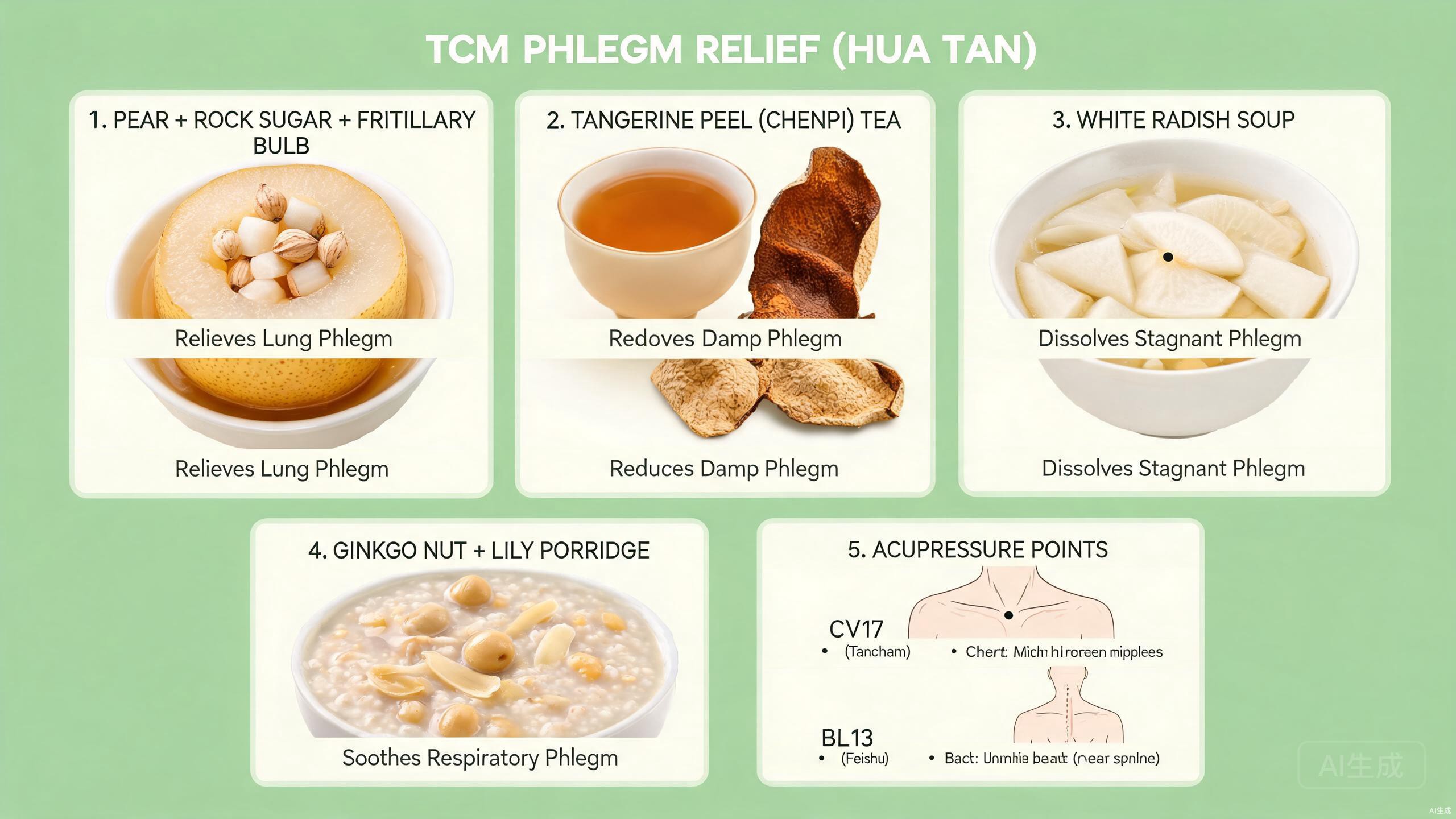
Key Takeaways
- TCM views phlegm through the principle that "the Spleen is the source of phlegm, and the Lung is the container of phlegm" — phlegm originates from Spleen weakness and accumulates in the Lungs.
- TCM distinguishes between cold phlegm (white, clear, watery) and heat phlegm (yellow, thick, sticky), each requiring different food therapy approaches.
- Five traditional food therapy recipes — from tangerine peel poria tea to pear fritillaria syrup — use ingredients available at Western supermarkets, Amazon, or iHerb.
- Five acupressure points — Fenglong (ST40), Zusanli (ST36), Tiantu (CV22), Feishu (BL13), and Tanzhong (CV17) — are traditionally used to resolve phlegm, strengthen the Spleen and Lung, and support respiratory comfort.
- These are traditional wellness practices, not a treatment for any medical condition. Persistent cough, phlegm with blood, or difficulty breathing require evaluation by a qualified healthcare provider.
This article is for educational purposes only and is not medical advice. The foods, teas, and practices described here are traditional wellness practices rooted in Chinese culture. They are not a substitute for professional medical care, diagnosis, or treatment. Phlegm and cough can indicate serious medical conditions including respiratory infections (bacterial or viral), asthma, COPD, bronchitis, pneumonia, lung cancer, or tuberculosis. These require proper evaluation by a qualified healthcare provider. Never stop, delay, or replace prescribed treatment based on information in this article. Some foods and herbs may interact with medications — always inform your doctor about everything you consume. These statements have not been evaluated by the FDA and are not intended to diagnose, treat, cure, or prevent any disease. Read our full disclaimer →
Phlegm — that sticky, uncomfortable substance that accumulates in the throat and chest — is one of the most common respiratory concerns. Whether it accompanies a cold, lingers after a respiratory infection, or appears as a chronic companion, phlegm can cause coughing, throat clearing, chest congestion, and general discomfort. While over-the-counter medications are widely available, many people seek natural approaches that work with the body's own processes. Traditional Chinese Medicine (TCM) offers a sophisticated understanding of phlegm and a rich tradition of food therapy and acupressure that may support respiratory comfort.
In TCM, phlegm is not simply mucus produced by the respiratory system. It is understood as a pathological substance that forms when the Spleen cannot properly transform fluids and the Lung cannot properly disperse and descend qi. The five recipes and five acupressure points below come from this tradition. All ingredients are available at Western supermarkets, Asian markets, Amazon, or iHerb.
If you are new to TCM concepts, our introduction to Traditional Chinese Medicine and guide to the Zang-Fu organ systems are helpful starting points. For related respiratory concerns, see our guides on TCM for cough relief and TCM for cold and flu.
How TCM Views Phlegm
Traditional Chinese Medicine has one of the most sophisticated understand of phlegm of any traditional medical system. The classical TCM texts contain a famous saying that captures the essence of the TCM approach: "The Spleen is the source of phlegm, and the Lung is the container of phlegm" (pi wei sheng tan zhi yuan, fei wei zhu tan zhi qi). This single sentence contains the entire TCM theory of phlegm.
The Spleen as the source of phlegm: In TCM, the Spleen is responsible for transforming and transporting fluids. When the Spleen is strong, fluids are processed efficiently, and the body remains balanced. When the Spleen is weak — due to poor diet (especially raw, cold, sweet, or greasy foods), overwork, worry, or chronic illness — it cannot properly transform fluids. Instead of being distributed and excreted, fluids accumulate as internal dampness. Over time, this dampness condenses and thickens into phlegm (tan), a sticky, obstructive substance that can travel throughout the body. This is why TCM says the Spleen is the source — phlegm is born in the digestive system, not the respiratory system. See our TCM for digestion guide for more on Spleen patterns.
The Lung as the container of phlegm: In TCM, the Lung governs qi and respiration. Its natural function is to disperse and descend — sending qi downward and outward, and keeping the respiratory passages clear. When phlegm forms in the Spleen, it travels upward (following the natural upward movement of Spleen qi) and lodges in the Lungs, where it obstructs the downward flow of Lung qi. This causes coughing, wheezing, chest congestion, and the production of sputum. The Lung becomes the "container" because it is where the phlegm accumulates and becomes noticeable. This is why TCM treatment of phlegm always addresses both the Spleen (the source) and the Lung (the container).
TCM also recognizes that phlegm can take different forms depending on whether it is combined with cold or heat. This distinction is critical for choosing the right food therapy.
Cold Phlegm vs. Heat Phlegm
Cold Phlegm (Han Tan) forms when the body's warming energy (yang) is insufficient, or when cold and dampness accumulate. Signs include:
- White, clear, or watery phlegm that is easy to cough up
- Cough that worsens with cold and improves with warmth
- Clear, watery nasal discharge
- Pale complexion, cold hands and feet
- Chest tightness, feeling of heaviness
- Thin, white tongue coating
Cold phlegm is traditionally treated with warming and drying ingredients that warm the Spleen, dry dampness, and help the Lung disperse qi. Key ingredients include ginger, tangerine peel, and dried tangerine peel (chen pi). See our TCM ginger medicine guide for more on warming foods.
Heat Phlegm (Re Tan) forms when heat accumulates in the Lung, often from a viral or bacterial infection, or from consuming too many spicy, greasy, or heating foods. The heat "cooks" the fluids, turning them into thick, sticky phlegm. Signs include:
- Yellow, green, or brown phlegm that is thick and sticky
- Difficulty coughing up phlegm
- Cough that may be dry and hacking, or productive with thick sputum
- Sore throat, thirst, dark urine
- Possibly fever, red face
- Yellow, thick tongue coating
Heat phlegm is traditionally treated with cooling and moistening ingredients that clear lung heat, moisten the lung, and help dissolve and expel thick phlegm. Key ingredients include pear, Sichuan fritillaria, and loquat. See our TCM for cough relief guide for more.
Understanding whether your phlegm is cold or hot is the most important step in choosing the right food therapy. Using warming ingredients for heat phlegm, or cooling ingredients for cold phlegm, can worsen the condition.
5 Food Therapy Recipes for Phlegm Relief
Each recipe below is matched to a specific type of phlegm. Choose the recipe that best fits your situation, and use it consistently for several days to a week. All ingredients are available at Western supermarkets, Asian markets, Amazon, or iHerb.
1. Tangerine Peel and Poria Tea (二陈茶)
Best for: Cold phlegm and chronic phlegm-dampness — white, watery phlegm with chest fullness
TCM nature and flavor: Tangerine peel (chen pi): acrid, bitter, warm. Enters the Spleen and Lung channels. Poria (fu ling): sweet, bland, neutral. Enters the Heart, Spleen, and Kidney channels. Licorice (gan cao): sweet, neutral. Enters all twelve channels.
Traditional use: This tea is inspired by the famous TCM formula Er Chen Tang (Two Aged Decoction), one of the most important classical formulas for resolving phlegm. The name "two aged" refers to the two main ingredients — aged tangerine peel and aged pinellia — both of which become more effective with age. In this simplified food therapy version, tangerine peel is traditionally used to regulate qi, resolve phlegm, and strengthen the Spleen. Poria is used to drain dampness, strengthen the Spleen, and calm the mind. Licorice harmonizes the other ingredients and supports the Spleen. Together, they address both the source (Spleen dampness) and the container (Lung phlegm), making this tea ideal for cold phlegm and chronic phlegm-dampness patterns.
Ingredients:
- 6 grams dried tangerine peel (chen pi) — available on Amazon or iHerb
- 10 grams dried poria slices (fu ling) — available on Amazon or iHerb
- 3 grams dried licorice root (gan cao) — available on Amazon or iHerb
- 3 cups water
Preparation: Rinse all ingredients. In a pot, combine with water. Bring to a boil, then reduce heat and simmer gently for 15 to 20 minutes. Strain into a cup. Drink 1 to 2 cups per day, preferably warm. The tea has a warm, aromatic, slightly bitter flavor. For more on tangerine peel, see our tangerine peel tea guide.
Precautions: Tangerine peel is warming — if you have heat phlegm (yellow, thick phlegm), do not use this recipe. Licorice should not be used long-term in large amounts, as it can cause water retention and raise blood pressure. If you take blood pressure medication or diuretics, consult your healthcare provider. See our herbal tea safety guide for general guidance.
2. Poria and Tangerine Peel Porridge (茯苓陈皮粥)
Best for: Spleen deficiency with chronic phlegm — daily support for phlegm prevention
TCM nature and flavor: Poria: sweet, bland, neutral. Tangerine peel: acrid, bitter, warm. Rice: sweet, neutral.
Traditional use: While the tea above is for active phlegm, this porridge is for long-term prevention and Spleen strengthening. Since TCM teaches that "the Spleen is the source of phlegm," strengthening the Spleen is the most fundamental approach to preventing phlegm from forming. This porridge combines poria (to drain dampness and strengthen the Spleen), tangerine peel (to regulate qi and resolve phlegm), and rice (to nourish and strengthen the Spleen) in a gentle, daily food that supports the body's natural fluid management. Eating this porridge regularly helps the Spleen transform fluids more efficiently, reducing the dampness that would otherwise condense into phlegm.
Ingredients:
- 15 grams dried poria slices (fu ling) — available on Amazon or iHerb
- 5 grams dried tangerine peel (chen pi)
- 50 grams white rice (short or medium grain)
- 5 cups water
- A pinch of sea salt
Preparation: Rinse the poria and tangerine peel. Rinse the rice. In a pot, combine all ingredients with water. Bring to a boil, then reduce heat and simmer for 40 to 50 minutes until the porridge is thick and creamy. Add salt to taste. Eat 1 bowl per day, ideally at breakfast, for 1 to 2 weeks as a preventive measure. For more on the art of healing porridge, see our congee guide.
Precautions: This porridge is gentle and suitable for most people. If you have heat phlegm, use caution — the warming tangerine peel may not be ideal. In that case, reduce the tangerine peel to 2 to 3 grams.
Dried tangerine peel (chen pi) is made by drying the peel of mature tangerines. In TCM, the peel is considered more effective when aged — the name chen pi literally means "aged peel." You can make your own by saving organic tangerine peels and drying them in a cool, airy place for several weeks, or purchase pre-dried peel from Amazon or iHerb. Poria (fu ling) is a medicinal mushroom that grows on pine roots, available as white slices on Amazon and iHerb.
3. White Radish and Ginger Drink (萝卜生姜饮)
Best for: Cold phlegm with chest congestion — white phlegm, chest fullness, poor digestion
TCM nature and flavor: White radish (luo bo / daikon): sweet, pungent, cool. Enters the Lung and Stomach channels. Fresh ginger: acrid, warm. Enters the Lung, Spleen, and Stomach channels.
Traditional use: White radish (daikon) is one of TCM's most valued foods for the Lung and digestive system. It is traditionally used to resolve phlegm, direct qi downward, and aid digestion. Despite being slightly cool in nature, its downward-directing and phlegm-resolving properties make it effective for both cold and heat phlegm when combined appropriately. In this recipe, the warming ginger balances the radish's slight coolness, making the drink suitable for cold phlegm. The combination of radish (which resolves phlegm and directs qi downward) and ginger (which warms the middle and dispels cold) is a classic folk remedy for chest congestion with white phlegm.
Ingredients:
- 100 grams white radish (daikon), peeled and sliced
- 3 slices fresh ginger
- 3 cups water
- Optional: a small amount of honey or brown sugar to taste
Preparation: In a pot, combine the radish, ginger, and water. Bring to a boil, then reduce heat and simmer for 15 to 20 minutes until the radish is soft. Strain and drink warm. Drink 1 to 2 cups per day. You can also eat the cooked radish. For more on ginger, see our TCM ginger medicine guide.
Precautions: White radish is slightly cooling. If you have a very cold constitution, add extra ginger. White radish is traditionally said to reduce the effectiveness of tonic herbs like ginseng — avoid consuming them at the same time.
4. Pear and Fritillaria Syrup (川贝雪梨膏)
Best for: Heat phlegm and dry cough — yellow, thick phlegm, dry throat, thirst
TCM nature and flavor: Sichuan fritillaria bulb (chuan bei mu): bitter, sweet, slightly cold. Enters the Lung and Heart channels. Asian pear (xue li): sweet, sour, cool. Enters the Lung and Stomach channels. Rock sugar: sweet, neutral.
Traditional use: This is perhaps the most famous TCM food therapy recipe for heat phlegm and dry cough. Sichuan fritillaria (chuan bei mu) is one of TCM's most important phlegm-resolving and lung-moistening herbs. It is traditionally used to clear lung heat, resolve phlegm, moisten the lung, and stop cough. Its slightly cold nature makes it ideal for heat-type phlegm, and its moistening quality makes it especially valuable for dry cough with thick, sticky phlegm. Asian pear is traditionally used to clear lung heat, generate fluids, and moisten dryness. Rock sugar provides sweetness and helps moisten the lung. Together, they form a soothing syrup that cools, moistens, and helps dissolve thick, sticky phlegm. This recipe is particularly valuable for the lingering dry cough that often follows a respiratory infection.
Ingredients:
- 3 to 5 grams Sichuan fritillaria bulb powder (chuan bei mu) — available on Amazon or iHerb
- 1 large Asian pear (or substitute with Bosc pear)
- 20 grams rock sugar (or substitute with honey after cooking)
- 1/2 cup water
Preparation: Wash the pear, cut off the top (about 1/4), and scoop out the core to create a hollow. Fill the hollow with the fritillaria powder and rock sugar. Replace the top of the pear. Place the pear in a small bowl and add water to the bowl. Steam in a steamer for 30 to 40 minutes until the pear is very soft. Eat the pear and drink the syrup. Alternatively, you can slice the pear, combine with fritillaria and rock sugar in a pot with water, and simmer for 20 minutes. Consume 1 serving per day for 3 to 5 days. For more on respiratory wellness, see our TCM for cough relief guide and TCM throat care guide.
Precautions: This recipe is for heat phlegm and dry cough only — do not use for cold phlegm (white, watery phlegm with cold signs), as the cooling nature will worsen cold conditions. Sichuan fritillaria is generally safe but should not be used during pregnancy in large amounts. If you cannot find fritillaria, pear alone with rock sugar is still beneficial for moistening the lung.
Sichuan fritillaria bulb (chuan bei mu) is a small, white, pearl-like bulb from the Fritillaria plant, native to Sichuan province in China. It is available as whole bulbs or powder on Amazon and iHerb. Look for "Chuan Bei Mu" or "Fritillaria cirrhosa" to ensure you get the correct variety. Asian pears (also called Korean pears, apple pears, or sand pears) are round, crisp, and juicy, available at most supermarkets and Asian markets. If unavailable, Bosc or Bartlett pears can substitute.
5. Stir-Fried Radish Seed Drink (炒莱菔子饮)
Best for: Phlegm with digestive congestion — phlegm accompanied by bloating and poor digestion
TCM nature and flavor: Radish seed (lai fu zi): sweet, pungent, neutral. Enters the Spleen, Stomach, and Lung channels.
Traditional use: This recipe addresses the TCM principle that "the Spleen is the source of phlegm" from a unique angle. Radish seeds (lai fu zi) are traditionally used to resolve phlegm, direct qi downward, and aid digestion. They are particularly valued when phlegm is accompanied by digestive symptoms — bloating, belching, poor appetite, and a feeling of fullness in the chest and abdomen. In TCM, when the digestive system is congested, qi cannot flow downward properly, and this congestion contributes to phlegm formation. Radish seeds help clear this congestion from both the digestive and respiratory systems simultaneously. Stir-frying the seeds before use enhances their warming, qi-moving properties and reduces their tendency to cause nausea.
Ingredients:
- 10 grams radish seeds (lai fu zi) — available on Amazon or iHerb
- 2 cups water
Preparation: First, stir-fry the radish seeds in a dry pan over medium heat for 3 to 5 minutes until fragrant and slightly golden, stirring constantly. This enhances their effectiveness and digestibility. In a pot, combine the stir-fried seeds with water. Bring to a boil, then reduce heat and simmer for 15 minutes. Strain and drink warm. Drink 1 cup, 1 to 2 times per day, for 3 to 5 days.
Precautions: Radish seeds are generally safe but may cause mild digestive discomfort in some people. If you experience gas or bloating, reduce the amount. Radish seeds are traditionally said to reduce the effectiveness of ginseng — avoid consuming them together.
Five Acupressure Points for Phlegm Relief
In addition to food therapy, TCM uses acupressure to resolve phlegm, strengthen the Spleen and Lung, and support respiratory comfort. The five points below are traditionally used for phlegm and related respiratory concerns. They are simple to find and can be pressed daily.
1. Fenglong (ST40) — The "Abundant Bulge"
Location: On the outer lower leg, about 2 cun (approximately three finger-widths) below the knee, on the outer side of the shin bone, in the muscle just outside the tibia.
How to find it: Place three fingers below the outer bump of your knee, on the outer side of the shin. The point is in the muscle bulge just outside the shin bone, at the level of the bottom finger.
How to press: Using your thumb, press firmly into the point for 2 to 3 minutes on each leg. This point is often quite tender, especially in people with phlegm-dampness.
Traditional use: Fenglong is the most important phlegm-resolving point in all of TCM. It is the "luo-connecting" point of the Stomach meridian and is traditionally used to resolve phlegm, drain dampness, and calm the mind. TCM texts describe ST40 as the point that can "resolve phlegm anywhere in the body" — whether phlegm is in the lungs, the stomach, or the mind (mental fogginess from "phlegm misting the mind"). For respiratory phlegm, ST40 is the primary point.
2. Zusanli (ST36) — The "Leg Three Miles"
Location: On the outer lower leg, about 3 cun (approximately four finger-widths) below the kneecap, one finger-width to the outside of the shin bone.
How to find it: Place four fingers below the bottom of your kneecap, on the outer side of the shin. The point is at the level of the bottom finger.
How to press: Using your thumb or the pads of two fingers, press firmly into the point for 2 to 3 minutes on each leg.
Traditional use: Zusanli is the most important tonification point in TCM, traditionally used to strengthen the Spleen and Stomach, tonify qi, and support overall vitality. For phlegm, ST36 addresses the root cause — Spleen weakness — by building the Spleen's ability to transform fluids and prevent dampness from condensing into phlegm. The name "Leg Three Miles" comes from the tradition that pressing this point could help a tired traveler walk another three miles.
3. Tiantu (CV22) — The "Heavenly Projection"
Location: At the center of the suprasternal fossa — the small hollow at the base of the throat, just above the sternum (breastbone).
How to find it: Feel for the V-shaped notch at the top of your breastbone, at the base of your throat. The point is in the center of this hollow.
How to press: Using your index finger, press gently downward and inward into the hollow. Hold for 1 to 2 minutes while breathing slowly. Use gentle pressure — this is a sensitive area.
Traditional use: Tiantu is traditionally used to regulate lung qi, resolve phlegm, and relieve cough and wheezing. It is particularly useful when phlegm is stuck in the throat or chest and cannot be coughed up. CV22 helps open the airway and promote the downward flow of lung qi.
Precautions: Use very gentle pressure. Do not press hard on this area. If you feel discomfort or coughing, reduce pressure.
4. Feishu (BL13) — The "Lung Shu"
Location: On the upper back, about 1.5 cun (approximately two finger-widths) to the side of the spine, at the level of the 3rd thoracic vertebra (approximately level with the top of the shoulder blade).
How to find it: This point is on the upper back and is best pressed by a partner. Find the prominent vertebra at the base of the neck (C7). Move down two more vertebrae. The point is about two finger-widths to the side of the spine at this level.
How to press: Have a partner use their thumbs to press both points simultaneously for 2 to 3 minutes. Alternatively, use a tennis ball against a wall to apply pressure to the area.
Traditional use: Feishu is the back-shu point of the Lung and is the most important point on the back for regulating lung qi, resolving phlegm, and supporting respiratory function. For phlegm in the lungs, BL13 directly supports the Lung's ability to disperse and descend qi, helping it clear phlegm naturally.
5. Tanzhong (CV17) — The "Chest Center"
Location: On the midline of the chest, at the level of the 4th intercostal space — midway between the two nipples (for men) or at the center of the sternum at the level of the 4th rib (for women).
How to find it: Find the sternum (breastbone) in the center of your chest. The point is on the midline, approximately at the level where the 4th rib meets the sternum. It is often tender when pressed.
How to press: Using the pad of your middle finger or the heel of your palm, press gently inward on the point. Hold for 2 to 3 minutes while breathing deeply into the chest.
Traditional use: Tanzhong is the front-mu (alarm) point of the Pericardium and the meeting point of the Conception Vessel with the Spleen, Kidney, Small Intestine, and Triple Burner meridians. It is traditionally used to regulate qi, open the chest, resolve phlegm, and calm the mind. For phlegm causing chest tightness, congestion, or emotional distress, CV17 helps open the chest and promote the smooth flow of qi.
For a simple daily routine, press Fenglong (ST40) and Zusanli (ST36) on both legs for 2 to 3 minutes each in the morning — these address the root (Spleen) and the phlegm directly. Press Tiantu (CV22) for 1 to 2 minutes and Tanzhong (CV17) for 2 to 3 minutes when you feel phlegm in the throat or chest. Have a partner press Feishu (BL13) for 2 to 3 minutes in the evening, or use a tennis ball against a wall. Consistency matters more than duration. For more guidance, see our acupressure safety guide.
Lifestyle and Dietary Tips for Phlegm
TCM is a whole-person system. Foods and acupressure work best when combined with supportive daily habits. The following practices are emphasized in classical TCM for managing phlegm:
- Avoid raw, cold, sweet, and greasy foods. In TCM, these are the primary dietary causes of phlegm. Raw and cold foods weaken the Spleen. Sweet foods create dampness. Greasy foods are difficult to digest and contribute to phlegm formation. Favor warm, cooked, easily digested foods — soups, stews, porridges, and steamed vegetables. See our congee guide for warming options.
- Distinguish cold from heat. The most important dietary principle for phlegm is matching your food to your type of phlegm. For cold phlegm (white, watery), use warming foods like ginger, tangerine peel, and warming soups. For heat phlegm (yellow, thick), use cooling, moistening foods like pear, fritillaria, and cooling teas. Using the wrong type can worsen the condition.
- Stay hydrated with warm liquids. Warm water and herbal teas help thin phlegm and support the Lung's dispersing function. Avoid ice-cold drinks, which shock the Spleen and worsen phlegm.
- Exercise moderately. In TCM, gentle movement promotes the flow of qi and helps the Lung disperse and descend qi. Walking, tai chi, qigong, and gentle breathing exercises are ideal. Avoid vigorous exercise when you have active respiratory symptoms.
- Keep warm, especially the neck, chest, and upper back. TCM considers cold wind a major external cause of respiratory problems. The neck and upper back are particularly vulnerable. Wear a scarf in cold or windy weather. See our TCM for cold and flu guide for more on external pathogens.
- Manage stress and emotions. In TCM, worry weakens the Spleen (the source of phlegm), and grief and sadness weaken the Lung (the container of phlegm). Managing stress and emotions supports both systems. See our herbal tea for anxiety guide and meditation guide for practical starting points.
For more on how TCM understands respiratory health, see our guide to qi, blood, and body fluids and TCM breathing techniques.
Comparison of the Five Recipes
| Recipe | Phlegm Type | Key Action | Frequency |
|---|---|---|---|
| Tangerine Peel & Poria Tea | Cold Phlegm | Warm Spleen, resolve phlegm, drain dampness | 1 to 2 cups daily |
| Poria & Tangerine Peel Porridge | Prevention (Spleen Def.) | Strengthen Spleen, prevent phlegm formation | 1 bowl daily |
| White Radish & Ginger Drink | Cold Phlegm | Resolve phlegm, direct qi downward, warm middle | 1 to 2 cups daily |
| Pear & Fritillaria Syrup | Heat Phlegm / Dry Cough | Clear lung heat, moisten lung, dissolve thick phlegm | 1 serving daily |
| Stir-Fried Radish Seed Drink | Phlegm + Digestive Congestion | Resolve phlegm, direct qi downward, aid digestion | 1 to 2 cups daily |
Frequently Asked Questions
What does TCM say about phlegm?
In Traditional Chinese Medicine, there is a famous saying: "The Spleen is the source of phlegm, and the Lung is the container of phlegm." This means that phlegm originates from a weak Spleen that cannot properly transform fluids, leading to internal dampness that condenses into phlegm. The Lung, which governs the downward flow of qi and respiratory function, becomes the storage place for this phlegm. TCM also distinguishes between cold phlegm (white, clear, watery, worse with cold) and heat phlegm (yellow, thick, sticky, worse with heat), each requiring different food therapy approaches. Cold phlegm is treated with warming, drying ingredients like ginger and tangerine peel, while heat phlegm is treated with cooling, moistening ingredients like pear and fritillaria. These are traditional wellness concepts, not medical diagnoses. For a deeper understanding, see our zang-fu organ guide.
Which TCM foods may help with phlegm?
Five traditional TCM food therapy recipes for phlegm include tangerine peel and poria tea (er chen tea), poria and tangerine peel porridge, white radish and ginger drink, pear and fritillaria syrup (chuan bei xue li gao), and stir-fried radish seed drink. These recipes use ingredients like dried tangerine peel, poria, white radish, fresh ginger, Sichuan fritillaria bulb, Asian pear, rock sugar, and radish seeds that are available at Western supermarkets, Asian markets, Amazon, or iHerb. Cold phlegm is traditionally addressed with warming ingredients like ginger and tangerine peel, while heat phlegm is addressed with cooling ingredients like pear and fritillaria. The key is matching the recipe to the correct type of phlegm. They are traditional wellness foods, not treatments for any medical condition.
Can acupressure help with phlegm and cough?
TCM acupressure on points like Fenglong (ST40) on the outer leg, Zusanli (ST36) below the knee, Tiantu (CV22) at the base of the throat, Feishu (BL13) on the upper back, and Tanzhong (CV17) on the chest is traditionally used to resolve phlegm, strengthen the Spleen and Lung, and support respiratory comfort. Fenglong (ST40) is considered the most important phlegm-resolving point in TCM, described in classical texts as able to "resolve phlegm anywhere in the body." However, acupressure is not a treatment for respiratory infections, asthma, COPD, or other medical conditions. If you experience persistent cough, phlegm with blood, difficulty breathing, or fever, consult your healthcare provider promptly. See our acupressure safety guide for general precautions.
How do you distinguish cold phlegm from heat phlegm in TCM?
In TCM, cold phlegm is characterized by white or clear, thin, watery phlegm that is easy to cough up. It may be accompanied by cold symptoms like chills, clear nasal discharge, a pale complexion, and a preference for warm drinks. Cold phlegm is traditionally treated with warming, drying ingredients like ginger, tangerine peel, and dried tangerine peel. Heat phlegm is characterized by yellow or green, thick, sticky phlegm that is difficult to cough up. It may be accompanied by heat symptoms like fever, sore throat, thirst, dark urine, and a red face. Heat phlegm is traditionally treated with cooling, moistening ingredients like pear, fritillaria, and loquat. Using the wrong type of food therapy — warming foods for heat phlegm, or cooling foods for cold phlegm — can worsen the condition. These are traditional diagnostic concepts, not medical diagnoses, and should not replace evaluation by a qualified healthcare provider. See our TCM for cold and flu guide and TCM for cough relief guide for related information.
Precautions and When to Seek Help
While TCM food therapy and acupressure may support general respiratory comfort, phlegm and cough can indicate serious medical conditions that require professional evaluation:
- Seek prompt medical attention if you cough up blood or bloody phlegm, experience severe shortness of breath or wheezing, have chest pain, or develop a high fever. These may indicate pneumonia, bronchitis, asthma exacerbation, or other serious conditions.
- See your doctor if you experience persistent cough or phlegm lasting more than two weeks, phlegm that changes color (especially to green, brown, or rusty), night sweats, unexplained weight loss, or persistent hoarseness. These may indicate chronic respiratory infection, tuberculosis, COPD, or lung cancer that needs proper diagnosis.
- Medication interactions. If you take blood pressure medication, diuretics, or blood thinners, consult your healthcare provider before regularly consuming licorice root (which can raise blood pressure and cause water retention) or other herbal ingredients.
- Not for infants and young children. Some ingredients, especially honey and certain herbs, are not suitable for children under 1 year. Always consult a pediatrician before using food therapy for children.
- Not a substitute. TCM food therapy is complementary. It sits alongside — never in place of — professional medical care, including antibiotics, inhalers, and other prescribed treatments.
For related topics, see our guides on TCM for cough relief, TCM for cold and flu, and TCM throat care.
The Bottom Line
Traditional Chinese Medicine offers a sophisticated, food-based tradition for supporting respiratory comfort and resolving phlegm. The foundational principle — "the Spleen is the source of phlegm, and the Lung is the container" — guides the entire approach: strengthen the Spleen to prevent phlegm from forming, and support the Lung to help it clear phlegm that has already accumulated. By distinguishing between cold phlegm (white, watery, needing warming, drying ingredients) and heat phlegm (yellow, thick, needing cooling, moistening ingredients), you can choose the right foods for your specific situation. Tangerine peel and poria tea resolves cold phlegm and drains dampness. White radish and ginger drink directs phlegm downward and warms the middle. Pear and fritillaria syrup cools and moistens for heat phlegm and dry cough. And the porridge and radish seed drink support the Spleen and digestion for long-term prevention. Paired with five acupressure points — Fenglong (ST40), Zusanli (ST36), Tiantu (CV22), Feishu (BL13), and Tanzhong (CV17) — and lifestyle habits like avoiding raw, cold, sweet, and greasy foods, these traditional practices form a whole-person approach to respiratory wellness.
But they are traditions — not treatments, and not a replacement for medical care. Persistent cough, phlegm with blood, or difficulty breathing require evaluation by a qualified healthcare provider. Use these traditional practices only as complementary wellness habits, alongside your doctor's guidance.
This article shares traditional wellness practices for educational purposes only. It is not a substitute for medical advice, diagnosis, or treatment. The foods, teas, and acupressure practices described here are not intended to treat, cure, or prevent any disease, including but not limited to respiratory infections, bronchitis, pneumonia, asthma, COPD, tuberculosis, or lung cancer. If you have persistent cough, phlegm with blood, difficulty breathing, chest pain, or fever — consult your healthcare provider promptly for proper evaluation. These statements have not been evaluated by the FDA. Never stop or adjust prescribed treatment without your doctor's explicit guidance. Read our full disclaimer →