Key Takeaways
- TCM views motion sickness through the Spleen and Stomach organ systems, with spleen deficiency, phlegm-dampness accumulation, and failure of clear yang to rise being the core patterns.
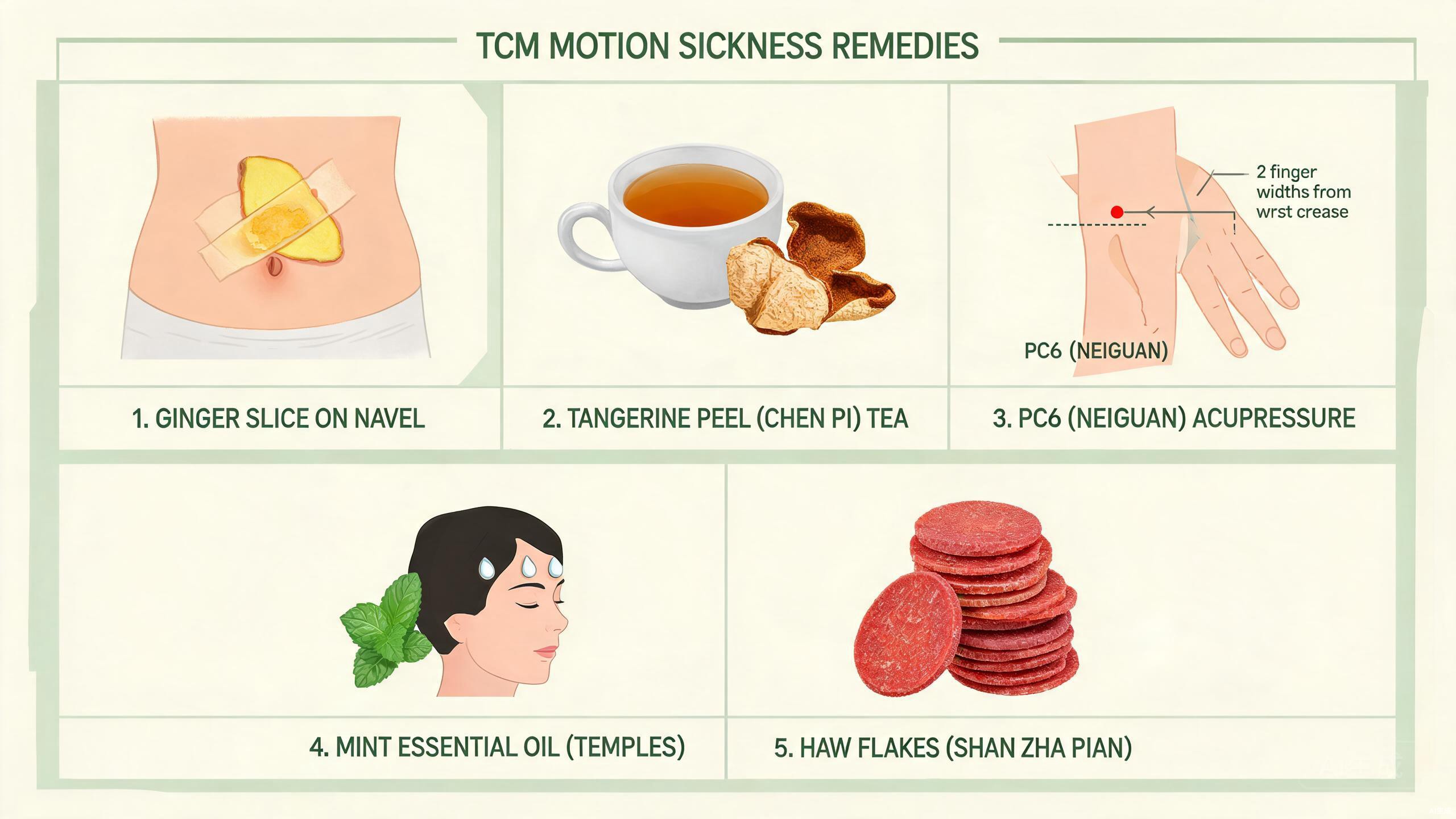
- Four traditional food therapy recipes — from tangerine peel ginger mint tea to a ginger navel patch — use ingredients available at Western supermarkets, Amazon, or iHerb.
- Four acupressure points — Neiguan (PC6), Hegu (LI4), Zusanli (ST36), and Quchi (LI11) — are traditionally used to calm the stomach, regulate qi, and ease nausea.
- Simple travel habits — avoiding eating too much or too little before departure, keeping the air flowing, and pressing acupressure points early — may make journeys more comfortable.
- These are traditional wellness practices, not a treatment for any medical condition. Persistent or severe symptoms require evaluation by a qualified healthcare provider.
This article is for educational purposes only and is not medical advice. The foods, teas, and practices described here are traditional wellness practices rooted in Chinese culture. They are not a substitute for professional medical care, diagnosis, or treatment. Motion sickness is usually harmless, but severe or persistent nausea, dizziness, or vomiting can sometimes indicate other conditions such as inner ear disorders, migraine, or gastrointestinal disease. These require evaluation by a qualified healthcare provider. Never stop, delay, or replace prescribed treatment based on information in this article. Some foods and herbs may interact with medications — always inform your doctor about everything you consume. These statements have not been evaluated by the FDA and are not intended to diagnose, treat, cure, or prevent any disease. Read our full disclaimer →
Whether it is a winding mountain road, a rolling boat, or a long-haul flight, motion sickness can turn an exciting journey into a miserable one. The familiar symptoms — nausea, dizziness, cold sweats, and sometimes vomiting — affect millions of travelers every year. While over-the-counter medications are widely available, many people seek natural approaches that do not cause drowsiness or other side effects. Traditional Chinese Medicine (TCM) offers a rich tradition of food therapy, acupressure, and travel habits that may help support the body through the challenges of motion.
In TCM, motion sickness is not viewed as a disease of the inner ear alone. Instead, it is understood as a disruption of the Spleen and Stomach systems, with phlegm-dampness accumulating and clear yang qi failing to rise properly. The four recipes and four acupressure points below come from this tradition. All ingredients are available at Western supermarkets, Asian markets, Amazon, or iHerb.
If you are new to TCM concepts, our introduction to Traditional Chinese Medicine and guide to the Zang-Fu organ systems are helpful starting points. For related digestive concerns, see our guides on TCM for digestion and acupressure for nausea.
How TCM Views Motion Sickness
Traditional Chinese Medicine does not isolate motion sickness as a single condition. Instead, it understands the symptoms — nausea, dizziness, vomiting, cold sweats, and fatigue — as the result of three interconnected patterns involving the Spleen, Stomach, and the flow of qi.
The Spleen in TCM is the central organ of digestion. It is responsible for transforming and transporting — taking in food and drink, extracting the useful nutrients, and sending the waste downward. When the Spleen is strong, fluids are processed efficiently, and the head receives clear, fresh energy (clear yang qi). When the Spleen is weak, it cannot manage fluids properly, and internal dampness begins to accumulate. Over time, this dampness can condense into phlegm, a sticky, obstructive substance that can travel upward and cause dizziness and nausea.
The Stomach is the partner organ to the Spleen. In TCM, the Stomach's natural direction is downward — it receives food and sends it downward for processing. When the body is subjected to the rocking, rolling, or swaying of travel, this downward flow can be disrupted. Stomach qi rebels upward, causing nausea and vomiting. This is why TCM describes motion sickness as a form of stomach qi counterflow (wei qi shang ni).
Clear yang failing to rise is the third key pattern. In TCM, the Spleen sends clear, light energy (clear yang) upward to the head to nourish the brain and senses. When phlegm-dampness blocks this upward flow, the head feels foggy, dizzy, and heavy. This is the TCM explanation for the characteristic dizziness and disorientation of motion sickness.
TCM identifies three primary patterns associated with motion sickness:
- Spleen Deficiency with Dampness (Pi Xu Shi Sheng) — the most common pattern. A weak Spleen cannot manage fluids, leading to internal dampness. Signs include a tendency toward nausea with even mild motion, fatigue, loose stools, a pale complexion, and a feeling of heaviness. People with this pattern may also be prone to general digestive sensitivity. See our guide to TCM for digestion for more on spleen-related patterns.
- Phlegm-Dampness Obstruction (Tan Shi Zu Zhi) — dampness has condensed into phlegm, which obstructs the upward flow of clear yang. Signs include dizziness, a foggy or heavy head, nausea with a sensation of fullness in the chest and stomach, and sometimes vomiting of clear fluid. People with this pattern often feel worse in humid weather or after eating greasy foods.
- Qi Counterflow (Qi Ni) — the stomach's downward flow is disrupted by the physical motion of travel, causing qi to rebel upward. Signs include sudden nausea and vomiting during travel, often with belching or a sour taste. This pattern may occur even in people with relatively strong digestion when the motion is intense.
Understanding these patterns helps explain why TCM recommends different foods and practices for different situations. The recipes below address these patterns through warming the middle burner, resolving phlegm, regulating qi, and strengthening the Spleen.
4 Food Therapy Recipes for Motion Sickness
Each recipe below is matched to a specific aspect of the TCM understanding of motion sickness. Some are best used before or during travel, while others are meant for daily Spleen strengthening to build long-term resilience. All ingredients are available at Western supermarkets, Asian markets, Amazon, or iHerb.
1. Tangerine Peel Ginger Mint Tea (陈皮生姜薄荷茶)
Best for: Acute motion sickness — nausea, dizziness, chest fullness during travel
TCM nature and flavor: Tangerine peel (chen pi): acrid, bitter, warm. Enters the Spleen and Lung channels. Fresh ginger (sheng jiang): acrid, warm. Enters the Lung, Spleen, and Stomach channels. Mint (bo he): acrid, cool. Enters the Lung and Liver channels.
Traditional use: This is one of the most classic TCM tea combinations for travel nausea. Tangerine peel is traditionally used to regulate qi, resolve phlegm, and strengthen the Spleen. It has a warm, aromatic quality that helps move stuck qi in the chest and stomach. Fresh ginger is perhaps the most important TCM herb for nausea — it is traditionally used to warm the middle burner, disperse cold, and direct stomach qi downward. Mint adds a cooling, lifting quality that helps clear the head and soothe the Liver. Together, this tea addresses all three patterns of motion sickness: it resolves phlegm-dampness, warms the Spleen, and lifts clear yang to the head.
Ingredients:
- 5 grams dried tangerine peel (chen pi) — available on Amazon or iHerb (or use the peel of one organic tangerine, dried)
- 3 grams dried mint leaves (or 5 to 6 fresh mint leaves)
- 3 slices fresh ginger (about the size of a coin)
- 2 cups water
- Optional: a small amount of honey to taste
Preparation: Rinse the tangerine peel and ginger. In a small pot, combine all ingredients with water. Bring to a boil, then reduce heat and simmer gently for 5 to 10 minutes. If using fresh mint, add it in the last 2 minutes. Strain into a thermos for travel. Sip warm, half a cup at a time, starting 30 minutes before departure and continuing during the journey. The tea has a warm, aromatic, slightly spicy flavor with a refreshing mint finish. For more on tangerine peel, see our tangerine peel tea guide, and for more on ginger, see our TCM ginger medicine guide.
Precautions: Tangerine peel is warming. If you have signs of internal heat (dry mouth, constipation, red face), reduce the amount. Mint is cooling and should not be used in excess by people with a cold constitution. This tea is best consumed warm, not cold.
2. Ginger Navel Patch (生姜贴敷法)
Best for: Acute motion sickness prevention — apply before travel
TCM nature and flavor: Fresh ginger: acrid, warm. Enters the Lung, Spleen, and Stomach channels.
Traditional use: This is a simple but powerful folk technique passed down through generations. The navel (shen que, or "Spirit Gateway") is an important TCM point — it is the center of the abdomen and the place where the Conception Vessel (Ren Mai) connects to the body's deepest energy. In TCM, the navel is considered a gateway to the Spleen and Stomach. Applying warm ginger to the navel is traditionally used to warm the middle burner, disperse cold, regulate stomach qi, and stop nausea. The warmth and active compounds of ginger are absorbed through the thin skin of the navel, providing a gentle, continuous effect during travel. This method is particularly useful for children or anyone who cannot drink tea during travel.
Ingredients:
- 1 slice fresh ginger (about the size and thickness of a coin)
- 1 adhesive bandage or medical tape
Preparation: Cut a thin slice of fresh ginger. Gently crush it slightly to release its juices. Place the ginger slice directly over the navel and secure it with a bandage or medical tape. Apply 30 minutes to 1 hour before departure and leave in place during travel. You should feel a gentle, warming sensation. If the skin becomes irritated or uncomfortable, remove immediately. For children, use a smaller piece and check the skin every 30 minutes.
Precautions: Do not apply to broken or irritated skin. If you have sensitive skin, test on the inside of the wrist first. Remove immediately if you feel burning or discomfort. Do not use if you are allergic to ginger or adhesives.
3. Chinese Yam Porridge (山药粥)
Best for: Daily Spleen strengthening — building resilience to motion sickness over time
TCM nature and flavor: Chinese yam (shan yao): sweet, neutral. Enters the Spleen, Lung, and Kidney channels.
Traditional use: While the first two recipes address acute symptoms, this porridge is for long-term prevention. Chinese yam is one of TCM's most gentle and versatile tonic foods, traditionally used to tonify the Spleen, nourish the Lung, and support the Kidney simultaneously. For motion sickness, the key action is Spleen tonification — by strengthening the Spleen's ability to transform and transport fluids, Chinese yam helps reduce the internal dampness and phlegm that make a person prone to travel nausea. Eating this porridge regularly in the weeks before a long journey is a traditional way to "build the body's foundation" against motion sickness.
Ingredients:
- 1/2 cup white rice (short or medium grain)
- 1 cup fresh Chinese yam, peeled and cubed (or 30 grams dried yam slices from Amazon/iHerb)
- 5 cups water
- Optional: 3 dried red dates (jujubes), pitted, for sweetness and Spleen support
- A pinch of sea salt
Preparation: Rinse the rice. If using dried yam slices, soak for 30 minutes. In a pot, combine rice, yam, red dates (if using), and water. Bring to a boil, then reduce heat and simmer for 40 to 50 minutes, stirring occasionally, until the porridge is thick and creamy. Add salt to taste. Eat 1 bowl per day, ideally at breakfast, for 2 to 4 weeks before a long journey. The porridge is mild, slightly sweet, and very comforting. For more on Chinese yam, see our yam congee guide.
Precautions: Chinese yam is neutral and safe for most people. If you are prone to constipation, drink plenty of water alongside it. If you have a cold or flu with fever, wait until recovered before using tonic foods.
Fresh Chinese yam (also called Chinese yam, shan yao, or nagaimo) is available at Asian markets and some Western supermarkets. It looks like a long, thin, hairy root with white flesh inside. Dried yam slices are widely available on Amazon and iHerb. When peeling fresh yam, some people experience mild skin irritation — wearing gloves prevents this. See our congee guide for more on the art of making healing porridge.
4. Dried Plum Candy (话梅含服)
Best for: Quick nausea relief during travel
TCM nature and flavor: Dried sour plum (hua mei): sour, sweet, warm. Enters the Liver, Spleen, and Large Intestine channels.
Traditional use: In Chinese culture, carrying dried sour plums (hua mei) during travel is a centuries-old tradition. The sour taste of the plum is traditionally used to astringe and收敛, which means it helps hold things in place — in this case, calming the upward rebellion of stomach qi. The sour flavor also stimulates the production of saliva and digestive juices, which helps settle the stomach when it is producing excess phlegm or acid. The sweetness provides quick energy, which is helpful when motion sickness causes fatigue. Holding a dried plum in the mouth and slowly sucking it is one of the simplest and most effective traditional remedies for travel nausea.
Ingredients:
- 2 to 3 dried sour plums (hua mei) — available on Amazon, iHerb, and Asian markets
Preparation: Simply hold one dried plum in the mouth and suck slowly. Do not eat the pit. Use as needed during travel. Alternatively, you can prepare a quick drink by steeping 2 dried plums in a cup of warm water for 10 minutes. For a related guide, see our everyday TCM kitchen remedies.
Precautions: Dried plums are preserved with salt and sugar, so they can be high in sodium. If you have high blood pressure or are on a sodium-restricted diet, use sparingly. The sour flavor may not be suitable for people with stomach ulcers or acid reflux — see our TCM for acid reflux guide for alternatives.
Four Acupressure Points for Motion Sickness
In addition to food therapy, TCM uses acupressure — the practice of applying steady pressure to specific points on the body — to support the organ systems involved in motion sickness. The four points below are traditionally used to calm the stomach, regulate qi, resolve phlegm, and ease nausea. They are simple to find and can be pressed before and during travel.
1. Neiguan (PC6) — The "Inner Gate"
Location: On the inner side of the forearm, 2 cun (approximately three finger-widths) above the wrist crease, between the two tendons.
How to find it: Place three fingers across the inside of your wrist, starting from the wrist crease. The point lies just below the top edge of your third finger, between the two visible tendons in the center of the forearm.
How to press: Using your thumb, press firmly into the point between the tendons. Apply steady, moderate pressure for 1 to 2 minutes on each wrist. You may feel a dull ache or a sensation radiating toward your fingers — this is normal. This is the most widely studied acupressure point for nausea and is the basis of commercial acupressure wristbands.
Traditional use: Neiguan is the master point for the Pericardium meridian and is traditionally used to calm the heart, regulate stomach qi, and stop nausea and vomiting. It is considered the single most important point for motion sickness in TCM. Pressing it before travel and during symptoms may help settle the stomach.
2. Hegu (LI4) — The "Joining Valley"
Location: On the back of the hand, in the fleshy webbing between the thumb and index finger.
How to find it: Hold your hand with the thumb and index finger close together. The point is at the highest point of the muscle bulge between the two fingers. Press firmly — you should feel a strong, almost achy sensation.
How to press: Using the thumb of the opposite hand, press firmly into the point for 1 to 2 minutes on each hand. The pressure should be firm enough to feel a distinct ache but not painful.
Traditional use: Hegu is the most commonly used point on the Large Intestine meridian and is traditionally used to regulate qi, relieve pain, and promote circulation. For motion sickness, it helps regulate the overall flow of qi and is particularly useful when headaches or facial tension accompany the nausea.
Precautions: Hegu (LI4) is strictly contraindicated during pregnancy — it is well documented in TCM to stimulate uterine contractions. Never press LI4 if you are pregnant.
3. Zusanli (ST36) — The "Leg Three Miles"
Location: On the outer lower leg, about 3 cun (approximately four finger-widths) below the kneecap, one finger-width to the outside of the shin bone (tibia).
How to find it: Place four fingers below the bottom of your kneecap, on the outer side of the shin. The point is at the level of the bottom finger, just outside the shin bone. You may feel a slight depression.
How to press: Using your thumb or the pads of two fingers, press firmly into the point for 2 to 3 minutes on each leg. This point is often tender, especially in people with digestive weakness — the tenderness itself indicates the Spleen and Stomach may benefit from strengthening.
Traditional use: Zusanli is the most important tonification point in all of TCM, traditionally used to strengthen the Spleen and Stomach, tonify qi, and support overall vitality. For motion sickness, regular pressing of ST36 helps build the Spleen's resilience over time, making the body less susceptible to travel nausea. The name "Leg Three Miles" comes from the tradition that pressing this point could help a tired traveler walk another three miles.
4. Quchi (LI11) — The "Pool at the Crook"
Location: At the outer end of the elbow crease, when the arm is bent at a right angle.
How to find it: Bend your elbow to 90 degrees. The point is at the outer (thumb side) end of the crease that forms. Press firmly — you should feel a distinct ache.
How to press: Using the thumb of the opposite hand, press firmly into the point for 1 to 2 minutes on each arm. This point is usually quite sensitive, so moderate pressure is sufficient.
Traditional use: Quchi is the command point of the Large Intestine meridian and is traditionally used to clear heat, regulate qi, and support the skin and immune system. For motion sickness, it is particularly useful when there is a feeling of heat, sweating, or agitation accompanying the nausea — it helps clear the excess heat that can accompany intense motion sickness episodes.
For a simple travel routine, press Neiguan (PC6) on both wrists for 1 to 2 minutes each before departure. During travel, if symptoms begin, press Neiguan again and hold Hegu (LI4) on one hand. For long-term prevention, press Zusanli (ST36) on both legs for 2 to 3 minutes each evening for two to four weeks before a long journey. Consistency matters more than duration — daily gentle pressure over several weeks is more effective than occasional long sessions. For more guidance, see our acupressure safety guide and acupressure for nausea guide.
Lifestyle Tips for Travel Comfort
TCM is a whole-person system. Foods and acupressure work best when combined with supportive travel habits. The following practices are emphasized in classical TCM for preventing and easing motion sickness:
- Avoid eating too much or too little before travel. In TCM, both extremes disrupt the Spleen and Stomach. Eating too much creates a heavy load that the body cannot manage during motion, while traveling on an empty stomach weakens the Spleen. Eat a light, warm, easily digested meal about 1 to 2 hours before departure. Avoid greasy, heavy, or very sweet foods. A bowl of congee or porridge is ideal.
- Keep the air flowing. In TCM, fresh air helps qi circulate. Stuffy, warm environments cause qi to stagnate, which can worsen nausea. If possible, sit near a window or air vent. Avoid strong odors, perfumes, or food smells, which can trigger the upward rebellion of stomach qi.
- Position yourself wisely. Sit where motion is least felt — over the wing of a plane, in the front cabin of a boat, or in the front seat of a car. Look at the horizon or a distant fixed point to help the body orient. Avoid reading or looking at screens during motion, as the conflicting signals to the brain worsen symptoms.
- Stay warm, especially the abdomen and neck. TCM considers cold an enemy of the Spleen and Stomach. A cold draft on the neck or abdomen can trigger stomach qi counterflow. Bring a light scarf or shawl, especially on planes and air-conditioned vehicles. A warm ginger foot soak the evening before travel may also help warm the body.
- Manage stress and anxiety. In TCM, worry and overthinking weaken the Spleen, while fear and anxiety cause qi to descend — the opposite of what the Spleen needs. Practice relaxation before and during travel. Deep, slow breathing from the abdomen helps regulate qi. See our herbal tea for anxiety guide for calming options.
- Sip warm liquids. Cold drinks can shock the Spleen and worsen nausea. Sip warm water, ginger tea, or the tangerine peel ginger mint tea described above. Avoid ice-cold beverages during travel.
For more on how TCM understands the body's energy systems, see our guide to qi, blood, and body fluids.
Comparison of the Four Recipes
| Recipe | TCM Pattern | Key Action | Timing |
|---|---|---|---|
| Tangerine Peel Ginger Mint Tea | Phlegm-Dampness + Qi Counterflow | Regulate qi, resolve phlegm, warm middle | 30 min before and during travel |
| Ginger Navel Patch | Spleen/Stomach Cold + Qi Counterflow | Warm middle, disperse cold, stop nausea | 1 hour before and during travel |
| Chinese Yam Porridge | Spleen Deficiency | Tonify Spleen, build resilience | Daily for 2 to 4 weeks before travel |
| Dried Plum Candy | Qi Counterflow (acute) | Astringe, stimulate digestion, settle stomach | As needed during travel |
Frequently Asked Questions
What does TCM say about motion sickness?
In Traditional Chinese Medicine, motion sickness is understood through the Spleen and Stomach organ systems. The Spleen is responsible for transforming and transporting fluids and nutrients, while the Stomach receives and digests food. When the Spleen is weak, it cannot properly manage fluids, leading to internal dampness and phlegm. During travel, the body's movement disrupts the upward flow of clear yang qi, and phlegm-dampness rises upward, causing nausea, dizziness, and vomiting. TCM food therapy traditionally uses ingredients like tangerine peel, ginger, and mint to regulate qi, resolve phlegm, and warm the middle burner. These are traditional wellness practices, not medical treatments. For a deeper understanding, see our zang-fu organ guide.
Which TCM foods may help with motion sickness?
Four traditional TCM food therapy recipes for motion sickness include tangerine peel ginger mint tea, a ginger navel patch applied to the navel, Chinese yam porridge for daily Spleen strengthening, and dried sour plums (hua mei) held in the mouth for quick nausea relief. These recipes use ingredients like dried tangerine peel, fresh ginger, mint, Chinese yam, and dried sour plums that are available at Western supermarkets, Asian markets, Amazon, or iHerb. The tea and navel patch are best for acute symptoms during travel, while the yam porridge builds long-term resilience. They are traditional wellness foods, not treatments for any medical condition.
Can acupressure help with motion sickness?
TCM acupressure on points like Neiguan (PC6) on the inner wrist and Zusanli (ST36) below the knee is traditionally used to regulate stomach qi, calm nausea, and support digestion. Gentle, regular pressure on these points before and during travel may complement overall comfort. Neiguan (PC6) in particular is one of the most widely studied acupressure points for nausea and is the basis of commercial acupressure wristbands. However, acupressure is not a treatment for any disease. If you experience severe or persistent symptoms, consult your healthcare provider. See our acupressure safety guide for general precautions.
How should I prepare for travel to avoid motion sickness in TCM?
In TCM, preparation for travel involves strengthening the Spleen and Stomach before departure. Avoid eating too much or too little before traveling, as both extremes disrupt digestion. Favor warm, easily digested foods like congee or porridge. Keep the vehicle well-ventilated, avoid reading while in motion, and sip warm ginger tea during the journey. Pressing Neiguan (PC6) on the wrist before symptoms begin may also help. For long journeys, eating Chinese yam porridge daily for two to four weeks before departure may build the Spleen's resilience. These are traditional wellness suggestions, not medical advice. See our TCM for digestion guide for more on Spleen health.
Precautions and When to Seek Help
While TCM food therapy and acupressure may support general travel comfort, motion sickness symptoms can sometimes indicate other conditions that require professional evaluation:
- Seek medical attention if you experience severe vomiting that prevents keeping any fluids down, signs of dehydration (dry mouth, dark urine, dizziness when standing), or symptoms that persist long after travel has ended.
- See your doctor if you develop dizziness, nausea, or vertigo that occurs without travel, or that is accompanied by hearing changes, ringing in the ears, or vision problems. These may indicate inner ear disorders, vestibular conditions, or neurological issues that need proper diagnosis. See our guide to TCM for dizziness for related information.
- Medication interactions. If you take prescription medications, particularly for blood pressure, diabetes, or digestive conditions, consult your healthcare provider before regularly consuming ginger in therapeutic amounts, as it may interact with blood thinners and other medications.
- Pregnancy. If you are pregnant, avoid Hegu (LI4) acupressure entirely, as it is traditionally known to stimulate uterine contractions. Neiguan (PC6) is generally considered safe during pregnancy for nausea, but consult your healthcare provider first.
- Not a substitute. TCM food therapy is complementary. It sits alongside — never in place of — professional medical care.
For related topics, see our guides on TCM for digestion, acupressure for nausea, and TCM ginger medicine.
The Bottom Line
Traditional Chinese Medicine offers a gentle, food-based tradition for supporting travel comfort. By understanding whether your motion sickness is rooted in Spleen deficiency, phlegm-dampness obstruction, or simple qi counterflow from the motion itself, you can choose foods and teas that work with your body's specific needs. Tangerine peel ginger mint tea resolves phlegm and regulates qi during travel. The ginger navel patch warms the middle burner and calms the stomach. Chinese yam porridge strengthens the Spleen over time for long-term resilience. And dried sour plums provide quick, portable relief when nausea strikes. Paired with four acupressure points — Neiguan (PC6), Hegu (LI4), Zusanli (ST36), and Quchi (LI11) — and travel habits like eating light warm meals, keeping the air flowing, and staying warm, these traditional practices form a whole-person approach to travel wellness.
But they are traditions — not treatments, and not a replacement for medical care. Severe or persistent symptoms require evaluation by a qualified healthcare provider. Use these traditional practices only as complementary wellness habits, alongside your doctor's guidance.
This article shares traditional wellness practices for educational purposes only. It is not a substitute for medical advice, diagnosis, or treatment. The foods, teas, and acupressure practices described here are not intended to treat, cure, or prevent any disease, including but not limited to motion sickness, vertigo, vestibular disorders, or gastrointestinal conditions. If you experience severe or persistent symptoms, consult your healthcare provider promptly for proper evaluation. These statements have not been evaluated by the FDA. Never stop or adjust prescribed treatment without your doctor's explicit guidance. Read our full disclaimer →