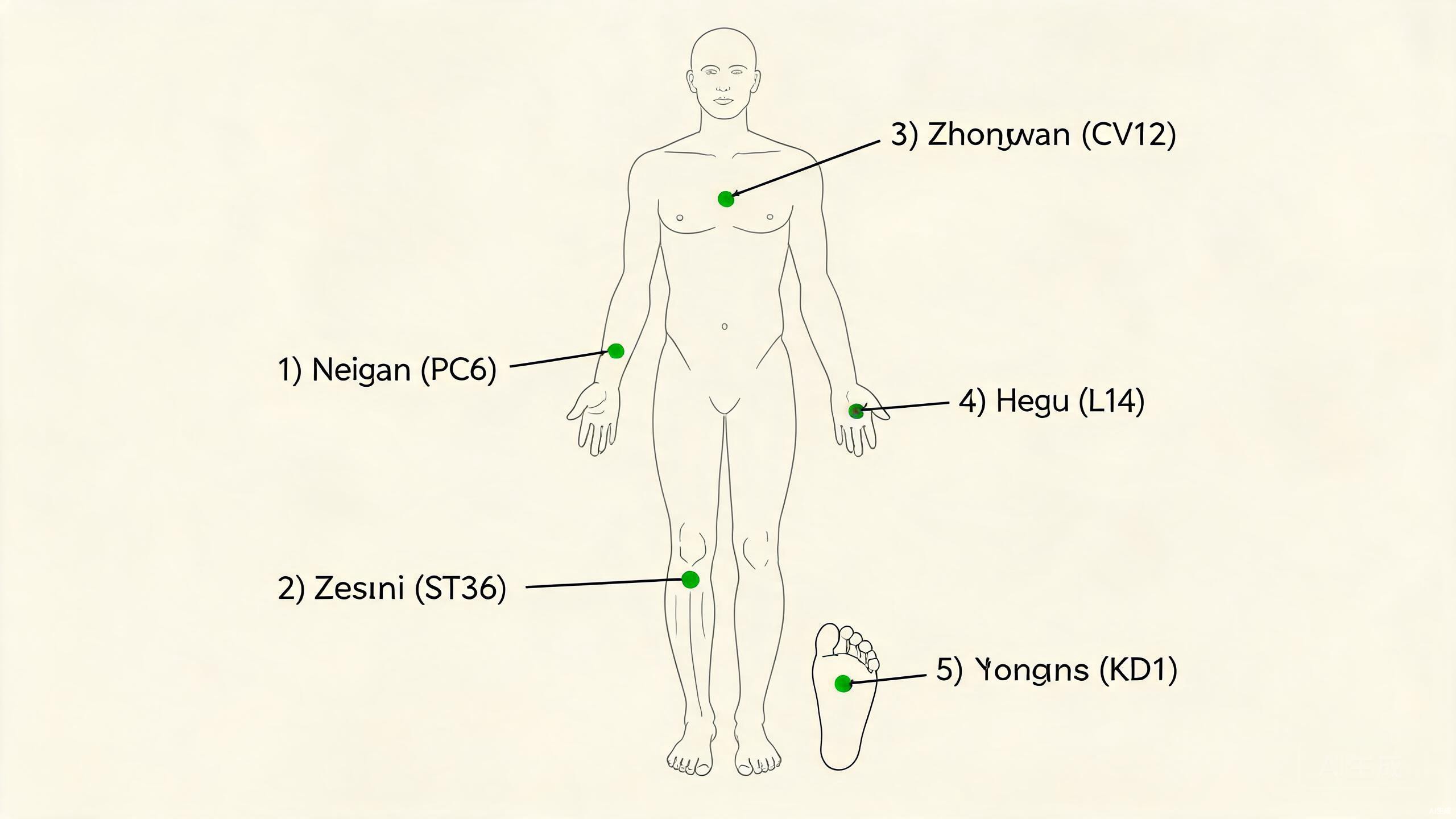
Key Takeaways
- TCM views nausea as rebellious stomach qi — when energy that should descend instead rises upward.
- Neiguan (PC6) on the inner forearm is the most widely studied acupressure point for nausea and vomiting.
- Zusanli (ST36) and Zhongwan (CV12) regulate stomach qi and support digestion from different angles.
- Pregnant women should avoid Hegu (LI4) and Sanyinjiao (SP6), as these points are traditionally contraindicated during pregnancy.
- Acupressure is a complementary practice — persistent or severe nausea requires medical evaluation.
This article is for wellness education only and is not medical advice. Acupressure is a complementary practice, not a replacement for professional medical care. If you experience persistent nausea, vomiting, dehydration, or nausea during pregnancy, consult your healthcare provider. Pregnant women should avoid certain acupressure points — always check with your doctor before use. These statements have not been evaluated by the FDA. TCM products and practices are not intended to diagnose, treat, cure, or prevent any disease.
Nausea is one of the most universally unpleasant sensations — whether it comes from motion sickness, morning sickness, stress, or something you ate. While over-the-counter medications can help, many people seek a natural, drug-free option they can use anywhere, at any moment. This is where acupressure for nausea shines. By applying firm pressure to specific points on the body, you may be able to calm your stomach quickly and discreetly.
Traditional Chinese Medicine (TCM) has used acupressure for nausea and vomiting for over two thousand years. Modern research has taken particular interest in one point — Neiguan (PC6) — which has been studied extensively for postoperative nausea, motion sickness, and pregnancy-related nausea. Here, we explore five key acupressure points for nausea and how to use them safely.
How Acupressure Works for Nausea
In TCM theory, nausea occurs when stomach qi rebels upward. Under normal conditions, stomach energy is supposed to descend — moving food downward through the digestive tract. When this downward flow is disrupted — by illness, stress, poor diet, motion, or pregnancy — the energy reverses direction and rises, producing the sensation of nausea and the urge to vomit.
Acupressure works by stimulating specific points along the body's meridian channels to help restore the natural downward flow of stomach qi. Different points address nausea from different causes: some calm the stomach directly, others regulate the digestive system as a whole, and others draw rebellious energy downward from the head and upper body. If you are new to TCM concepts, our acupressure for digestion guide provides helpful background.
5 Acupressure Points for Nausea Relief
1. Neiguan (PC6) — Inner Gate
Pinyin: Neiguan • Code: PC6 • Location: On the inner forearm, three finger-widths (approximately 2 cun) above the wrist crease, between the two tendons (palmaris longus and flexor carpi radialis).
How to press: Use your thumb to apply firm, steady pressure perpendicular to the skin. Press deeply until you feel a dull ache or mild soreness — this is the "deqi" sensation that indicates the point is being activated. Hold for 1 to 3 minutes, breathing slowly and deeply.
Best for: The most classic and well-researched point for nausea of all types — motion sickness, morning sickness, postoperative nausea, and nausea from chemotherapy. This is the point used in clinical acupressure wristband studies.
For a deeper dive into this remarkable point, see our complete Neiguan (PC6) guide.
You can press Neiguan on either arm — or both simultaneously if the nausea is intense. Many travelers wear elastic wristbands that apply continuous pressure to PC6 during flights or boat trips.
2. Zusanli (ST36) — Leg Three Miles
Pinyin: Zusanli • Code: ST36 • Location: On the outer lower leg, approximately one hand-width (4 cun) below the kneecap, and one finger-width lateral to the shin bone (tibial crest). You will often feel a slight depression in the muscle here.
How to press: Use your thumb or index finger to press firmly into the muscle. Apply moderate-to-strong pressure, kneading in small circular motions. Hold for 2 to 3 minutes on each leg.
Best for: Nausea accompanied by digestive weakness — bloating, poor appetite, fatigue after eating, or nausea from overeating. Zusanli is one of the most important tonification points in all of TCM, traditionally used to strengthen the spleen and stomach.
Learn more in our detailed Zusanli (ST36) guide.
3. Zhongwan (CV12) — Middle Cavity
Pinyin: Zhongwan • Code: CV12 • Location: On the midline of the abdomen, halfway between the lower border of the sternum (breastbone) and the navel. This is approximately 4 cun above the belly button.
How to press: Lie down or sit comfortably. Use two or three fingers (not the thumb, as the abdominal wall is softer) to press gently but firmly inward and slightly downward. Hold for 2 to 3 minutes with steady, gentle pressure. Do not press forcefully on a full stomach.
Best for: Nausea centered in the stomach area, especially after meals, acid regurgitation, or a feeling of fullness and distention. Zhongwan is the front-mu point of the stomach — the gathering point where stomach energy concentrates on the abdomen.
4. Hegu (LI4) — Joining Valley
Pinyin: Hegu • Code: LI4 • Location: On the hand, in the fleshy webbing between the thumb and index finger. Press at the highest point of the muscle bulge when you bring your thumb and index finger together.
How to press: Use the thumb of your opposite hand to press firmly into the point, angling toward the index finger bone. Hold for 1 to 2 minutes on each hand. The sensation should be a strong, slightly achy pressure.
Best for: Nausea triggered by head and face issues — headaches, migraines, sinus congestion, or dental problems. Hegu is the most widely used point on the Large Intestine meridian and is traditionally the primary point for issues of the head and face.
Caution: Hegu (LI4) is contraindicated during pregnancy. It is traditionally believed to promote uterine contractions. If you are pregnant, do not press this point. See our Hegu (LI4) guide for more details.
5. Yongquan (KD1) — Gushing Spring
Pinyin: Yongquan • Code: KD1 • Location: On the sole of the foot, in the depression that appears when the toes are curled — approximately at the junction of the front third and back two-thirds of the foot.
How to press: Use your thumb to press firmly into the sole. Because the foot sole is thick-skinned, you may need stronger pressure than on other points. Press and knead for 2 to 3 minutes on each foot. Alternatively, roll a tennis ball under your foot over the point.
Best for: Nausea with a sensation of energy rising to the head — dizziness, headaches, ringing in the ears, or nausea from anger and stress. Yongquan is the lowest point on the body and is traditionally used to draw rebellious qi downward, anchoring rising energy.
For more on this grounding point, see our Yongquan (KD1) guide.
Quick Comparison: 5 Nausea Points at a Glance
| Point | Location | Main Function | Press Time | Best For |
|---|---|---|---|---|
| Neiguan (PC6) | Inner forearm, 2" above wrist | Calms stomach, stops vomiting | 1–3 min | All nausea types |
| Zusanli (ST36) | Lower leg, below knee | Strengthens digestion | 2–3 min | Weak digestion, post-meal |
| Zhongwan (CV12) | Abdomen, above navel | Regulates stomach qi | 2–3 min | Stomach-centered nausea |
| Hegu (LI4) | Hand, thumb-web | Clears head/face issues | 1–2 min | Headache-related nausea |
| Yongquan (KD1) | Sole of foot | Draws qi downward | 2–3 min | Rising energy, dizziness |
Acupressure for Specific Types of Nausea
Morning Sickness
For nausea during pregnancy, Neiguan (PC6) is the safest and most studied point. It is the basis for acupressure wristbands commonly used by pregnant women. Apply gentle pressure for 1 to 2 minutes on each wrist, repeating as needed throughout the day. Avoid Hegu (LI4) and Sanyinjiao (SP6), as both are traditionally contraindicated during pregnancy. Always consult your obstetrician before starting any acupressure routine. For related guidance, see our acupressure for menstrual cramps guide for safe point selection.
Motion Sickness
For travel-related nausea, start pressing Neiguan (PC6) before symptoms begin — ideally 10 to 15 minutes before departure. Combine it with Yongquan (KD1) to help ground your energy and reduce the dizzy, floating sensation that often accompanies motion sickness. Breathe slowly and fix your gaze on a stable horizon point.
Stress-Induced Nausea
When anxiety or emotional stress triggers nausea, the pattern is often liver qi invading the stomach. Use Neiguan (PC6) to calm the stomach and Yongquan (KD1) to draw rising stress energy downward. Add slow, deep breathing — inhale for 4 counts, exhale for 6 — to activate the parasympathetic nervous system. See our acupressure safety guide for general precautions.
Post-Meal Nausea
For nausea after eating, Zusanli (ST36) and Zhongwan (CV12) are the most effective combination. Press Zhongwan first to settle the stomach directly, then Zusanli to support overall digestive function. Avoid lying flat immediately after eating — stay upright or take a gentle walk.
Combining Acupressure with TCM Teas
Acupressure and herbal tea work synergistically in TCM — the tea works internally while the pressure works on the meridian system. Two teas are especially valued for nausea:
- Ginger tea — Fresh ginger warms the stomach and is traditionally used for all types of nausea, especially motion sickness and morning sickness. See our complete ginger tea guide.
- Tangerine peel tea (Chen Pi) — Aged tangerine peel moves stagnant qi and reduces bloating and fullness. It pairs well with ginger for nausea with digestive stagnation. See our tangerine peel tea guide.
For a cup of warm ginger tea while pressing Neiguan (PC6) is one of the simplest and most effective TCM combinations for quick nausea relief.
Safety and Precautions
- Pregnancy contraindications: Avoid Hegu (LI4) and Sanyinjiao (SP6) during pregnancy. These points are traditionally believed to stimulate uterine contractions. Stick to Neiguan (PC6) with gentle pressure.
- Pressure intensity: Press firmly but not painfully. You should feel a dull ache or soreness ("deqi"), not sharp pain. If a point feels too tender, reduce pressure or stop.
- Avoid open wounds: Do not press on areas with cuts, bruises, burns, or skin infections.
- Not a substitute for medical care: If nausea is severe, persistent, accompanied by high fever, severe abdominal pain, signs of dehydration, or lasts more than 24 to 48 hours, seek medical attention immediately.
- Medication: Acupressure is complementary. Do not stop prescribed anti-nausea medication without consulting your doctor.
For comprehensive safety guidelines, see our acupressure safety guide. You can also explore more points in our full acupressure index.
The Bottom Line
Acupressure for nausea is one of the most practical, accessible tools in the TCM toolkit. You carry these points with you everywhere — no equipment, no herbs, no preparation needed. Whether you are on a bumpy flight, in your first trimester, or recovering from a stressful day, a few minutes of mindful pressure on the right point may help your stomach qi settle back into its natural downward flow. Start with Neiguan (PC6), the most proven point, and experiment with the others to find what works best for your body. As with all TCM practices, consistency and gentle attention yield the best results over time.