Key Takeaways
- TCM views fatty liver through three intertwined patterns: liver qi stagnation with impaired dispersion, spleen deficiency with dampness, and phlegm-dampness with blood stasis obstructing the liver.
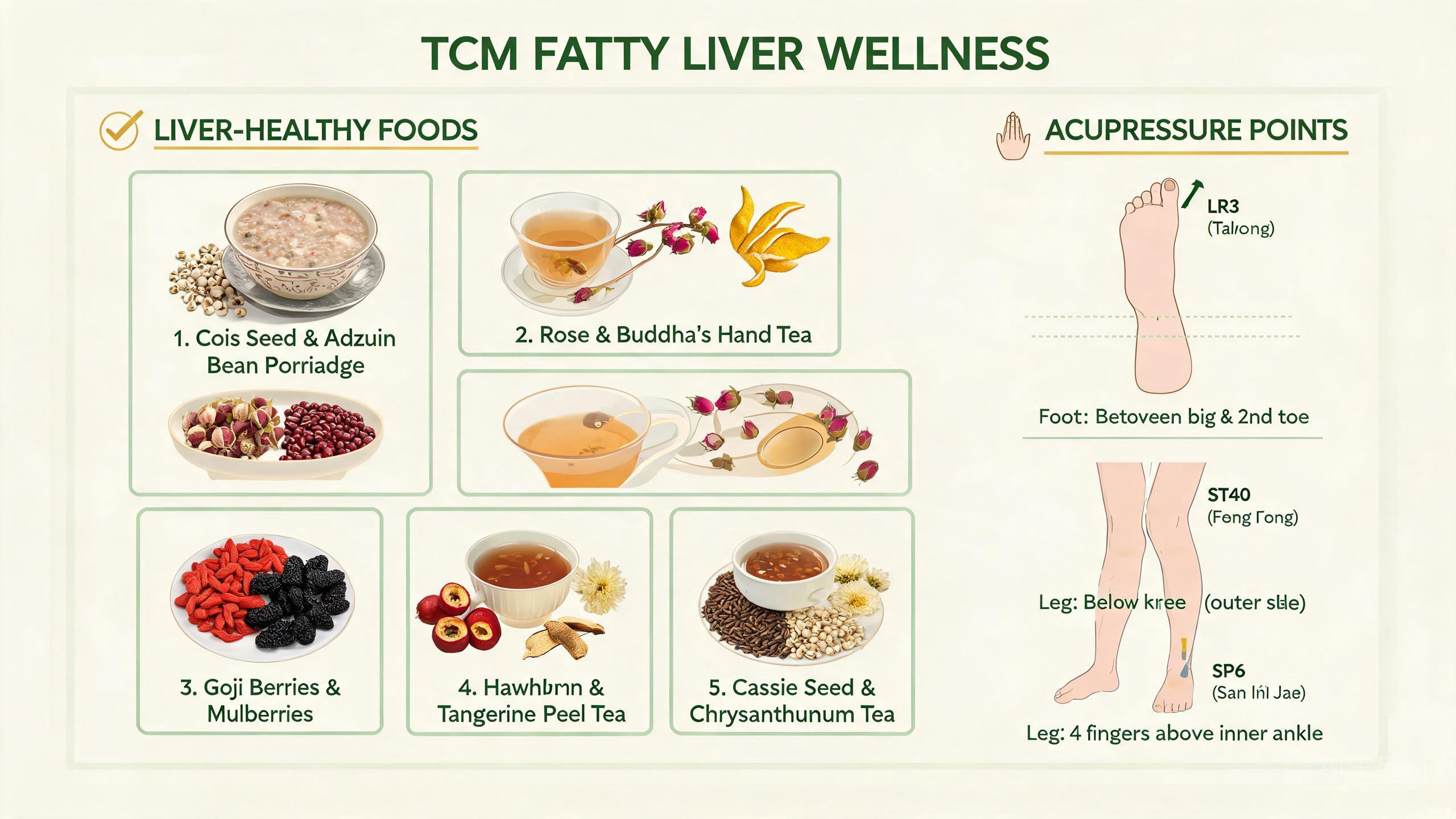
- Five traditional food therapy recipes — from coix seed adzuki bean porridge to cassia seed chrysanthemum tea — use ingredients available at Western supermarkets, Amazon, or iHerb.
- Three acupressure points, Taichong (LR3), Fenglong (ST40), and Sanyinjiao (SP6), are traditionally used to soothe liver qi, resolve phlegm, and strengthen the spleen.
- The dietary principle of three lows and one high — low sugar, low fat, low salt, high fiber — combined with avoiding alcohol, forms the foundation of TCM dietary guidance for liver wellness.
- These are traditional wellness practices, not a treatment for fatty liver disease. Elevated liver enzymes or known liver conditions require professional medical evaluation.
This article is for educational purposes only and is not medical advice. The foods, teas, and practices described here are traditional wellness practices rooted in Chinese culture. They are not a substitute for professional medical care, diagnosis, or treatment. Fatty liver disease (including NAFLD and NASH) can progress to serious conditions including liver fibrosis, cirrhosis, and liver failure. These require proper diagnosis and ongoing medical management. Never stop, delay, or replace prescribed treatment based on information in this article. Some foods and herbs may interact with medications — always inform your doctor about everything you consume. These statements have not been evaluated by the FDA and are not intended to diagnose, treat, cure, or prevent any disease. Read our full disclaimer →
Fatty liver disease has become one of the most common liver conditions worldwide, closely linked to modern diets high in sugar, refined carbohydrates, and unhealthy fats. While the liver has a remarkable capacity to regenerate, persistent fat accumulation can lead to inflammation, scarring, and long-term damage. Medical evaluation and lifestyle modification are essential — but Traditional Chinese Medicine (TCM) also offers a rich tradition of food therapy that may support liver wellness as part of a balanced approach.
In TCM, the liver is far more than a physical organ. It is responsible for the smooth flow of qi and emotions, the storage of blood, and the regulation of digestion. When the liver's function is impaired — by stress, poor diet, or emotional suppression — the entire system suffers. The five recipes below use foods and teas that have been enjoyed for generations to soothe liver qi, drain dampness, and support healthy liver function. All ingredients are available at Western supermarkets, Asian markets, Amazon, or iHerb.
If you are new to TCM concepts, our guide to the Zang-Fu organ systems and spring liver foods guide are helpful starting points. For related topics, see our guides on TCM for cholesterol and TCM for blood sugar.
How TCM Views Fatty Liver
Traditional Chinese Medicine does not use the term "fatty liver" in its classical texts, but the patterns of imbalance that correspond to this condition have been recognized for centuries. TCM understands fatty liver through the interplay of three organ systems — the Liver, Spleen, and Kidney — and the pathological substances that accumulate when these systems are out of balance.
The Liver system governs the smooth flow of qi throughout the body. In TCM, the liver is compared to a general — it plans, directs, and ensures that energy moves freely. When liver qi flows smoothly, digestion, emotions, and circulation all function well. When liver qi stagnates — due to stress, frustration, anger, or emotional suppression — the flow becomes blocked. This stagnation impairs the liver's ability to disperse and distribute fats and fluids, leading to accumulation. Over time, stagnant qi generates heat, and heat "cooks" the fluids into phlegm and dampness.
The Spleen system is responsible for transforming food into usable energy and transporting fluids. When the spleen is weak — from poor diet, overthinking, or irregular eating habits — it cannot properly process fats and fluids. Instead of being utilized, these substances accumulate as dampness and phlegm. In TCM, the spleen and liver have a close relationship: when liver qi stagnates, it "overacts" on the spleen, further weakening digestion. This creates a vicious cycle where poor digestion leads to more dampness, which further blocks liver function.
TCM identifies three primary patterns associated with fatty liver:
- Liver Qi Stagnation with Impaired Dispersion (Gan Qi Yu Jie) — the most common early-stage pattern. Stress, frustration, and emotional suppression cause liver qi to stagnate, impairing the liver's ability to disperse fats and fluids. Signs include irritability, mood swings, distension or fullness in the chest and ribs, belching, and a feeling of a lump in the throat. This pattern is often the starting point from which the other patterns develop.
- Spleen Deficiency with Dampness (Pi Xu Shi Sheng) — a weak spleen cannot properly transform and transport fluids, leading to internal dampness that accumulates in the body and liver. Signs include fatigue, bloating after eating, loose stools, a feeling of heaviness, a pale complexion, and a thick greasy tongue coating. This pattern is closely related to poor dietary habits and overconsumption of sweet, greasy, or cold foods. See our water retention guide for more on dampness patterns.
- Phlegm-Dampness and Blood Stasis (Tan Shi Yu Zu) — the most advanced pattern. When dampness and phlegm persist over time, they obstruct the liver's blood circulation, leading to blood stasis. This corresponds to more advanced fatty liver with inflammation and fibrosis. Signs include a firm or enlarged liver, dull pain in the right upper abdomen, dark or purplish tongue, and spider-like blood vessels on the skin. This pattern requires professional medical care.
Understanding these patterns helps explain why TCM recommends different foods for different stages and types of fatty liver. The recipes below are grouped by the pattern they traditionally address.
5 Food Therapy Recipes for Liver Wellness
Each recipe below is matched to a specific TCM pattern. Choose the one that best fits your situation, and use it consistently for two to four weeks. All ingredients are available at Western supermarkets, Asian markets, Amazon, or iHerb.
1. Coix Seed and Adzuki Bean Porridge with Tangerine Peel (薏米赤小豆粥)
Best for: Spleen deficiency with dampness
TCM nature and flavor: Coix seed (yi yi ren / Job's tears): sweet, bland, slightly cool. Enters the Spleen, Lung, and Kidney channels. Adzuki bean (chi xiao dou): sweet, sour, neutral. Enters the Heart and Small Intestine channels. Tangerine peel (chen pi): bitter, spicy, warm. Enters the Spleen and Lung channels.
Traditional use: This is perhaps the most famous TCM food therapy combination for draining dampness. Coix seed is traditionally used to drain dampness, strengthen the spleen, and promote urination. Adzuki bean is traditionally used to promote urination, reduce swelling, and resolve dampness — it is particularly valued for moving dampness out of the body. Tangerine peel (chen pi) regulates qi, strengthens the spleen, and transforms phlegm, adding warmth and movement to balance the cooling nature of the beans. Together, they form a gentle, daily porridge that addresses the root of dampness accumulation.
Ingredients:
- 1/2 cup dried coix seed (Job's tears) — available on Amazon or iHerb
- 1/2 cup dried adzuki beans — available at most supermarkets, Amazon, or iHerb
- 1/4 cup white or brown rice
- 1 piece (about 3 grams) dried tangerine peel (chen pi) — available on Amazon or iHerb, or use organic orange peel
- 5 cups water
Preparation: Soak the coix seed and adzuki beans for 4 to 6 hours (or overnight). In a pot, combine all ingredients with water. Bring to a boil, then reduce heat and simmer for 45 to 60 minutes until the beans and coix seed are soft and the porridge is thick. Remove the tangerine peel before serving. Eat 1 bowl per day, ideally in the morning. For more on coix seed, see our dampness-removing foods guide, and for tangerine peel, see our tangerine peel tea guide.
Precautions: Coix seed is slightly cooling. If you have a cold constitution, add a slice of fresh ginger. Coix seed is traditionally avoided in large amounts during pregnancy.
2. Rose and Buddha's Hand Tea (玫瑰佛手茶)
Best for: Liver qi stagnation (stress-related pattern)
TCM nature and flavor: Rose (mei gui hua): sweet, slightly bitter, warm. Enters the Liver and Spleen channels. Buddha's hand (fo shou): spicy, bitter, sour, warm. Enters the Liver, Spleen, and Lung channels.
Traditional use: This fragrant tea directly addresses the emotional and stress-related dimension of fatty liver. Rose is traditionally used to soothe liver qi, regulate emotions, and promote blood circulation. In TCM, rose is considered one of the most important flowers for emotional wellness — it gently moves stuck liver qi without being harsh or depleting. Buddha's hand (a citrus fruit shaped like an open hand) is traditionally used to soothe the liver, regulate qi, and resolve phlegm. Together, they form a tea that gently unblocks liver qi stagnation — the starting point of many fatty liver patterns — while also supporting digestion and emotional balance.
Ingredients:
- 1 tablespoon dried rose buds — available on Amazon, iHerb, or tea shops (ensure food-grade)
- 2 to 3 grams dried Buddha's hand slices (fo shou) — available on Amazon or iHerb (substitute with 1 strip dried tangerine peel if unavailable)
- 2 cups hot water (90°C / 195°F)
- Optional: a small amount of honey to taste
Preparation: Place the rose buds and Buddha's hand slices in a teapot. Pour hot water over them, cover, and steep for 5 to 8 minutes. Strain and drink warm. Enjoy 1 to 2 cups per day, preferably in the afternoon or during stressful periods. The tea has a delicate, floral, and slightly citrus aroma. For more on rose, see our herbal tea for anxiety guide.
Precautions: Rose and Buddha's hand are warming and moving. Avoid during pregnancy. If you have yin deficiency with dryness (dry mouth, dry eyes, night sweats), use sparingly and add a few goji berries to balance the warming nature.
3. Goji and Mulberry Porridge with Black Sesame (枸杞桑葚粥)
Best for: Liver and kidney yin deficiency (nourishing pattern)
TCM nature and flavor: Goji berries (gou qi zi): sweet, neutral. Enters the Liver and Kidney channels. Mulberry (sang shen): sweet, sour, cold. Enters the Heart, Liver, and Kidney channels. Black sesame (hei zhi ma): sweet, neutral. Enters the Liver and Kidney channels.
Traditional use: When fatty liver has progressed to a point where liver yin is depleted — often after years of stress, poor diet, or in older adults — the approach shifts from moving to nourishing. Goji berries are traditionally used to nourish liver and kidney yin, benefit essence, and brighten the eyes. Mulberry is traditionally used to nourish yin and blood, and moisten the intestines — it is deeply tonifying for the liver. Black sesame nourishes liver and kidney, and moistens the intestines. Together, they form a nourishing porridge that supports the liver's regenerative capacity.
Ingredients:
- 1/4 cup dried goji berries — available on Amazon or iHerb
- 1/4 cup dried mulberries — available on Amazon or iHerb
- 1/2 cup white rice
- 1 tablespoon black sesame seeds — available at most supermarkets, Amazon, or iHerb
- 4 cups water
Preparation: Rinse the rice, goji berries, and mulberries. In a pot, combine rice, mulberries, and water. Bring to a boil, then reduce heat and simmer for 30 minutes. Add the goji berries and black sesame seeds in the last 10 minutes (goji berries cook quickly and can become mushy if overcooked). Stir well. Eat 1 bowl per day, ideally in the morning or evening. For more on goji berries, see our goji tea guide.
Precautions: This is a nourishing porridge. If you have active damp-heat (thick greasy tongue coating, bloating, sticky feeling), use the dampness-draining recipes first. Goji berries may interact with blood thinners — consult your doctor if you take warfarin or similar medications.
4. Hawthorn and Tangerine Peel Tea (山楂陈皮茶)
Best for: Phlegm-dampness with food stagnation
TCM nature and flavor: Hawthorn (shan zha): sour, sweet, slightly warm. Enters the Spleen, Stomach, and Liver channels. Tangerine peel (chen pi): bitter, spicy, warm. Enters the Spleen and Lung channels.
Traditional use: Hawthorn is one of TCM's most important herbs for digesting fats and resolving food stagnation. It is traditionally used to promote digestion, disperse food accumulation, and invigorate blood circulation — particularly for fatty meats and greasy foods. Modern research has shown interest in hawthorn's potential to support healthy lipid metabolism. Tangerine peel (chen pi) regulates qi, transforms phlegm, and strengthens the spleen. Together, they form a tea that directly addresses the phlegm-dampness pattern: hawthorn breaks down accumulated fats while tangerine peel moves the qi and resolves phlegm.
Ingredients:
- 10 to 15 grams dried hawthorn slices (shan zha) — available on Amazon or iHerb
- 1 piece (about 3 grams) dried tangerine peel (chen pi) — available on Amazon or iHerb
- 2 cups water
- Optional: a small amount of honey to taste
Preparation: Rinse the hawthorn and tangerine peel. In a pot, combine with water and bring to a boil. Reduce heat and simmer for 10 to 15 minutes. Strain and drink warm. Enjoy 1 to 2 cups per day, preferably after meals (especially after a rich or fatty meal). The tea has a tart, fruity, and slightly bitter flavor. For more on hawthorn, see our TCM for cholesterol guide.
Precautions: Hawthorn is generally safe as a food but may interact with heart medications (especially digoxin and blood pressure drugs). If you take prescription cardiac medications, consult your healthcare provider before using hawthorn regularly. Avoid on an empty stomach if you have gastric ulcers.
5. Cassia Seed and Chrysanthemum Tea (决明子菊花茶)
Best for: Liver heat with eye symptoms (damp-heat pattern)
TCM nature and flavor: Cassia seed (jue ming zi): sweet, bitter, salty, slightly cold. Enters the Liver and Large Intestine channels. Chrysanthemum (ju hua): sweet, bitter, slightly cold. Enters the Liver and Lung channels.
Traditional use: When liver qi stagnation has generated heat — a common progression in fatty liver — the approach shifts to clearing liver heat. Cassia seed is traditionally used to clear liver heat, brighten the eyes, and moisten the intestines. In TCM, the eyes are the "window" of the liver, and liver heat often manifests as red, dry, or bloodshot eyes. Chrysanthemum is traditionally used to dispel wind-heat, clear liver heat, and brighten the eyes. Together, they form a cooling tea that clears liver heat while also supporting bowel movements (cassia seed has a gentle laxative effect), which helps the body eliminate accumulated waste.
Ingredients:
- 1 tablespoon roasted cassia seeds (jue ming zi) — available on Amazon or iHerb
- 1 teaspoon dried chrysanthemum flowers — available on Amazon, iHerb, or tea shops
- 2 cups hot water (90°C / 195°F)
- Optional: a small amount of honey to taste
Preparation: Place the roasted cassia seeds and chrysanthemum in a teapot. Pour hot water over them, cover, and steep for 8 to 10 minutes. Strain and drink warm. Enjoy 1 to 2 cups per day, preferably in the afternoon. The tea has a light, floral, and slightly nutty flavor. For more on chrysanthemum, see our TCM for dry eyes guide.
Precautions: Both ingredients are cooling. Avoid if you have a cold constitution with diarrhea. Cassia seed has a mild laxative effect — reduce the amount if you experience loose stools. Avoid during pregnancy.
Three Acupressure Points for Liver Wellness
In addition to food therapy, TCM uses acupressure to support the organ systems involved in liver health. The three points below are traditionally used to soothe liver qi, resolve phlegm-dampness, and strengthen the spleen. They are simple to find and can be pressed daily as part of a wellness routine.
1. Taichong (LR3) — The "Supreme Rushing" Point
Location: On the top of the foot, in the webbing between the first and second toes, about 1 to 2 inches up from the base of the toes.
How to find it: Sit comfortably and remove shoes. Between your big toe and second toe, there is a natural valley. Slide your finger up from the webbing between the toes until you feel a tender spot — usually where the bones of the two toes meet. This is Taichong (LR3).
How to press: Using your thumb, press firmly into the point for 1 to 2 minutes on each foot. You can also pinch the point between your thumb and index finger from both sides of the foot. This point is often quite tender, especially in people who are under stress — the tenderness indicates liver qi stagnation that benefits from regular pressing.
Traditional use: Taichong is the source point of the Liver meridian and one of the most important points for soothing liver qi, regulating emotions, and clearing liver heat. It is traditionally used for irritability, stress, chest and rib distension, and headaches related to liver qi stagnation. For liver wellness, LR3 is the primary point for addressing the root pattern of liver qi stagnation that underlies fatty liver.
Precautions: Avoid pressing Taichong if you have open wounds or infections on the foot. Use moderate pressure.
2. Fenglong (ST40) — The "Bountiful Bulge" Phlegm Point
Location: On the outer lower leg, about 8 cun (roughly mid-calf) above the ankle, two finger-widths lateral to the shin bone (tibia).
How to find it: From the outer ankle bone, measure up about 8 finger-widths along the outer side of the shin bone. Move two finger-widths to the outside (away from the shin). You should feel a slight muscle bulge when you flex your foot — this is Fenglong (ST40).
How to press: Using your thumb or index finger, press firmly into the point for 2 to 3 minutes on each leg. This point is often tender in people with phlegm-dampness accumulation.
Traditional use: Fenglong is known as the luo-connecting point of the Stomach meridian and is considered the premier point in all of TCM for resolving phlegm and dampness. It is traditionally used to transform phlegm, clear dampness, and calm the mind. For fatty liver wellness, ST40 addresses the phlegm-dampness pattern by helping the body metabolize and eliminate accumulated dampness and fats.
Precautions: Generally safe for daily use. Avoid on broken or injured skin.
3. Sanyinjiao (SP6) — The "Three Yin Intersection"
Location: On the inner lower leg, about 3 cun (approximately four finger-widths) above the highest point of the inner ankle bone, just behind the inner edge of the shin bone (tibia).
How to find it: Place four fingers together across the inside of your leg, with the bottom finger resting on the top of your inner ankle bone. The point lies just behind the shin bone at the level of the top edge of your fourth finger.
How to press: Using your thumb, press into the point at a slight angle toward the shin bone. Apply moderate pressure for 2 to 3 minutes on each leg.
Traditional use: Sanyinjiao is the meeting point of three major Yin meridians — the Spleen, Kidney, and Liver. It is traditionally used to strengthen the spleen, nourish the liver and kidneys, and promote blood circulation. For liver wellness, SP6 addresses both the spleen deficiency that allows dampness to form and the liver qi stagnation that impairs function. It is a versatile point that supports multiple root causes simultaneously.
Precautions: Sanyinjiao (SP6) is strictly contraindicated during pregnancy — it is well documented in TCM to stimulate uterine contractions. Never press SP6 if you are pregnant or trying to conceive.
For a simple daily routine: in the morning, press Taichong (LR3) on both feet for 1 to 2 minutes each while sitting on the edge of your bed. In the evening, press Fenglong (ST40) on both legs for 2 to 3 minutes, then Sanyinjiao (SP6) on both legs for 2 to 3 minutes. Consistency matters more than duration. For more guidance, see our acupressure safety guide.
Dietary Principles: Three Lows and One High
TCM dietary guidance for liver wellness can be summarized in a memorable principle known in Chinese nutrition as san di yi gao — "three lows and one high":
- Low sugar. In TCM, excessive sweets generate dampness and weaken the spleen. Modern science confirms that excess sugar (especially fructose) drives fat accumulation in the liver. Avoid sugary drinks, desserts, and processed foods with added sugars. Natural sweetness from fruits and a small amount of honey is preferable.
- Low fat. Greasy, fried, and heavily processed fats burden the liver and spleen. Favor lean proteins, plant-based fats (olive oil, nuts, seeds), and steamed or lightly cooked foods. Avoid deep-fried foods, fatty meats, and processed snack foods.
- Low salt. Excessive salt intake is linked to fluid retention and metabolic strain. Use herbs, spices, and natural flavors instead of heavy salt. TCM also considers overly salty foods to burden the kidneys, which in turn affects liver-kidney balance.
- High fiber. Fiber supports healthy digestion and elimination, helping the body remove waste and maintain balanced blood sugar. Whole grains, vegetables, legumes, and fruits are all excellent sources. In TCM, high-fiber foods like coix seed, adzuki beans, and vegetables also help drain dampness.
Above all, avoid alcohol. In TCM, alcohol is considered the most damp-heat-generating substance. It directly burdens the liver and spleen, generates internal heat, and promotes dampness accumulation. For anyone concerned about liver wellness, eliminating or strictly limiting alcohol is the single most important dietary change. See our detox and cleansing guide for more on supporting the body's natural elimination processes.
For practical guidance on warming, easy-to-digest meals, see our congee guide and TCM for digestion guide.
Comparison of the Five Recipes
| Recipe | TCM Pattern | Key Action | Frequency |
|---|---|---|---|
| Coix Seed Adzuki Bean Porridge | Spleen Def. + Dampness | Drain dampness, strengthen spleen | 1 bowl daily |
| Rose Buddha's Hand Tea | Liver Qi Stagnation | Soothe liver qi, regulate emotions | 1 to 2 cups daily |
| Goji Mulberry Porridge | Liver-Kidney Yin Def. | Nourish yin, support regeneration | 1 bowl daily |
| Hawthorn Tangerine Peel Tea | Phlegm-Dampness + Stasis | Digest fats, transform phlegm | 1 to 2 cups daily |
| Cassia Seed Chrysanthemum Tea | Liver Heat | Clear liver heat, brighten eyes | 1 to 2 cups daily |
Frequently Asked Questions
What does TCM say about fatty liver?
In Traditional Chinese Medicine, fatty liver is understood through the Liver, Spleen, and Kidney organ systems. The three primary patterns are liver qi stagnation with impaired dispersion (stress-related), spleen deficiency with dampness accumulation (dietary), and phlegm-dampness with blood stasis (advanced). TCM food therapy traditionally uses ingredients like coix seed, adzuki bean, hawthorn, cassia seed, and tangerine peel to drain dampness, move qi, and support liver function. These are traditional wellness practices, not medical treatments. For a deeper understanding, see our zang-fu organ guide.
Which Chinese medicine foods may support liver wellness?
Five traditional TCM food therapy recipes for liver wellness include coix seed adzuki bean porridge with tangerine peel, rose buddha's hand tea, goji mulberry porridge with black sesame, hawthorn tangerine peel tea, and cassia seed chrysanthemum tea. These recipes use ingredients available at Western supermarkets, Asian markets, Amazon, or iHerb. Dampness-draining recipes (coix seed, adzuki bean) are best for spleen deficiency patterns, while rose tea addresses liver qi stagnation and hawthorn tea targets phlegm-dampness. They are traditional wellness foods, not treatments for fatty liver disease.
Can TCM acupressure help with fatty liver?
TCM acupressure on points like Taichong (LR3) on the foot, Fenglong (ST40) on the lower leg, and Sanyinjiao (SP6) on the inner leg is traditionally used to soothe liver qi, resolve phlegm-dampness, and strengthen the spleen. Gentle, regular pressure on these points may complement overall wellness. However, acupressure is not a treatment for fatty liver disease. If you have elevated liver enzymes or known liver conditions, consult your healthcare provider for proper evaluation and management. See our acupressure safety guide for general precautions.
What dietary principles does TCM recommend for fatty liver?
TCM dietary principles for liver wellness emphasize what Chinese nutrition calls "three lows and one high": low sugar, low fat, low salt, and high fiber. TCM also strongly recommends avoiding alcohol, which directly generates damp-heat and burdens the liver. Favor warm, cooked, easily digested foods like congee, soups, and steamed vegetables. Avoid raw, cold, greasy, and excessively sweet foods that weaken the spleen and generate dampness. These principles align closely with modern dietary guidance for metabolic health. For practical recipes, see our congee guide.
Precautions and When to Seek Help
While TCM food therapy and acupressure may support general wellness, fatty liver disease can progress to serious conditions that require professional evaluation:
- Seek medical evaluation if you have elevated liver enzymes (ALT, AST), known fatty liver disease, or symptoms such as persistent right upper abdominal pain, jaundice (yellowing of skin or eyes), unexplained fatigue, or easy bruising. These may indicate liver inflammation, fibrosis, or more serious conditions.
- Regular monitoring. If you have risk factors for fatty liver (obesity, type 2 diabetes, high cholesterol, metabolic syndrome, or heavy alcohol use), discuss liver function testing and imaging (ultrasound or FibroScan) with your healthcare provider.
- Medication interactions. Hawthorn may interact with heart medications (digoxin, beta-blockers, blood pressure drugs). Cassia seed has mild blood-pressure-lowering and laxative effects. Goji berries may interact with blood thinners. Consult your healthcare provider before adding these regularly if you take prescription medications.
- Avoid alcohol entirely. If you have any liver concern, eliminating alcohol is essential. No amount of food therapy can compensate for continued alcohol intake.
- Not a substitute. TCM food therapy is complementary. It sits alongside — never in place of — professional medical care.
For related topics, see our guides on TCM for cholesterol, TCM for blood sugar, and TCM for weight loss.
The Bottom Line
Traditional Chinese Medicine offers a food-based tradition for supporting liver wellness that complements — but never replaces — medical care. By understanding whether your pattern is rooted in liver qi stagnation, spleen deficiency with dampness, or phlegm-dampness with blood stasis, you can choose foods and teas that work with your body's specific needs. Coix seed adzuki bean porridge drains dampness and strengthens the spleen. Rose buddha's hand tea soothes liver qi and regulates emotions. Goji mulberry porridge nourishes liver and kidney yin. Hawthorn tangerine peel tea digests fats and transforms phlegm. And cassia seed chrysanthemum tea clears liver heat and brightens the eyes. Paired with three acupressure points — Taichong (LR3), Fenglong (ST40), and Sanyinjiao (SP6) — and the dietary principle of three lows and one high (low sugar, low fat, low salt, high fiber) with complete avoidance of alcohol, these traditional practices form a whole-person approach to liver wellness.
But they are traditions — not treatments, and not a replacement for medical care. Fatty liver disease requires evaluation and management by a qualified healthcare provider. Use these traditional practices only as complementary wellness habits, alongside your doctor's guidance.
This article shares traditional wellness practices for educational purposes only. It is not a substitute for medical advice, diagnosis, or treatment. The foods, teas, and acupressure practices described here are not intended to treat, cure, or prevent any disease, including fatty liver disease (NAFLD/NASH), liver fibrosis, cirrhosis, or liver cancer. If you have liver symptoms — including abdominal pain, jaundice, fatigue, or elevated liver enzymes — consult your healthcare provider promptly for proper evaluation. These statements have not been evaluated by the FDA. Never stop or adjust prescribed treatment without your doctor's explicit guidance. Read our full disclaimer →