Key Takeaways
- TCM views dark circles through the Liver and Kidney organ systems, with liver blood deficiency and kidney essence deficiency being the primary patterns — the under-eye area loses nourishment and circulation becomes stagnant.
- Five traditional recipes — from angelica date egg tea to black sesame walnut milk — use ingredients available at Western supermarkets, Amazon, or iHerb.
- Four acupressure points — Ganshu (BL18), Xuehai (SP10), Cuanzhu (BL2), and Taiyang (EX-HN5) — are traditionally used to support liver blood and promote local circulation around the eyes.
- Sleep is the most important factor — TCM considers late nights the primary cause of dark circles, as the Liver restores blood between 1:00 AM and 3:00 AM.
- These are traditional wellness practices, not a treatment for any medical condition. Dark circles may indicate allergies, thyroid issues, or other conditions requiring professional evaluation.
This article is for educational purposes only and is not medical advice. The foods, teas, and practices described here are traditional wellness practices rooted in Chinese culture. They are not a substitute for professional medical care, diagnosis, or treatment. Dark circles can result from many causes — including genetics, allergies (allergic shiners), thin skin, pigmentation disorders, dehydration, thyroid conditions, and sleep deprivation — that require proper medical evaluation. Never stop, delay, or replace prescribed treatment based on information in this article. Some foods and herbs may interact with medications — always inform your doctor about everything you consume. These statements have not been evaluated by the FDA and are not intended to diagnose, treat, cure, or prevent any disease. Read our full disclaimer →
Dark circles under the eyes are one of the most common cosmetic concerns, and they can make a person look tired, older, or unwell even when they feel fine. While many people reach for concealers and eye creams, Traditional Chinese Medicine (TCM) takes a different approach — looking beneath the surface to understand what the under-eye area reveals about the body's internal state.
In TCM, the area under the eyes is closely connected to the Kidney system, while the eyes themselves are governed by the Liver. Dark circles are seen as a sign that liver blood and kidney essence are insufficient, and that qi and blood circulation in the eye area has become stagnant. The five recipes below use foods and teas that have been enjoyed for generations to nourish blood and essence, strengthen the spleen, and support the circulation that keeps the under-eye area vibrant. All ingredients are available at Western supermarkets, Asian markets, Amazon, or iHerb.
If you are new to TCM concepts, our introduction to Traditional Chinese Medicine and guide to the Zang-Fu organ systems are helpful starting points. For related topics, see our guides on TCM for eye health and TCM for skin wellness.
How TCM Views Dark Circles
Traditional Chinese Medicine sees the under-eye area as a diagnostic window that reflects the health of the Liver and Kidney systems. Understanding this connection is the key to appreciating why certain foods and practices are traditionally recommended for under-eye wellness.
The Kidney governs the area under the eyes. In TCM, the Kidney system is associated with the lower face, particularly the area beneath the eyes. The Kidneys store essence (jing), which is the foundational substance of life, growth, and reproduction. When kidney essence is abundant, the under-eye area is full, firm, and bright. When kidney essence is depleted — from aging, overwork, chronic stress, inadequate sleep, or constitutional weakness — the under-eye area loses its support and vitality. The skin may appear thin, darkened, or sunken. In TCM facial diagnosis, pronounced dark circles, especially with a sunken or hollowed appearance, are considered a classic sign of kidney essence deficiency.
The Liver stores blood and opens into the eyes. The Liver system is responsible for storing blood and ensuring its smooth distribution throughout the body, including to the eyes. When liver blood is abundant, the eyes are bright and the surrounding skin is well-nourished. When liver blood is deficient — from poor sleep, excessive screen time, poor nutrition, emotional stress, or blood loss — the delicate skin around the eyes loses its supply of nourishing blood. The result is a pale, darkened, or sallow appearance under the eyes. The TCM principle jiu shi shang xue ("prolonged looking exhausts blood") is directly relevant here: the sustained visual focus of modern screen life depletes liver blood, contributing to dark circles.
Qi and blood stagnation creates the darkened color. Even when liver blood and kidney essence are sufficient, dark circles can appear if the circulation of qi and blood around the eyes becomes stagnant. In TCM, stagnation — whether from stress, fatigue, cold, or poor sleep — causes blood to pool and darken in the thin-skinned under-eye area. This is why dark circles often worsen after poor sleep, during stressful periods, or in cold weather: all of these factors promote stagnation.
TCM identifies several patterns associated with dark circles:
- Liver Blood Deficiency (Gan Xue Xu) — the most common pattern. Signs include dark circles with a pale or sallow complexion, dry eyes, blurred vision (especially in the evening), brittle nails, dry skin, scanty menstruation, and difficulty falling asleep. Often related to poor sleep, poor nutrition, excessive screen time, or blood loss. See our guide to TCM for anemia for more on blood deficiency.
- Kidney Essence Deficiency (Shen Jing Bu Zu) — deep, persistent dark circles with a sunken or hollowed appearance. Signs include dark circles that are long-standing, premature graying of hair, lower back and knee weakness, frequent urination, poor memory, and low energy. Often seen in older adults or after chronic overwork. See our yin and yang guide for more on kidney patterns.
- Spleen Qi Deficiency with Dampness (Pi Xu Shi Sheng) — dark circles accompanied by puffiness or swelling under the eyes. Signs include under-eye bags, fatigue after eating, bloating, loose stools, and a feeling of heaviness. The spleen cannot properly transform fluids, leading to dampness that settles under the eyes. Often related to a diet high in cold, sweet, or damp-producing foods. See our TCM for water retention guide for more on dampness.
- Qi and Blood Stagnation (Qi Zhi Xue Yu) — dark circles with a purplish or dark reddish tint. Signs include dark circles that worsen with stress, fatigue, or cold, along with a feeling of tightness around the eyes. Often related to emotional stress, poor sleep, or insufficient movement. See our qi, blood, and body fluids guide for more.
Understanding these patterns helps explain why TCM recommends different foods for different situations. The recipes below are matched to the patterns they traditionally address.
5 Food Therapy Recipes for Under-Eye Wellness
Each recipe below is matched to a specific TCM pattern. Choose the one that best fits your situation, and use it consistently for two to four weeks. All ingredients are available at Western supermarkets, Asian markets, Amazon, or iHerb.
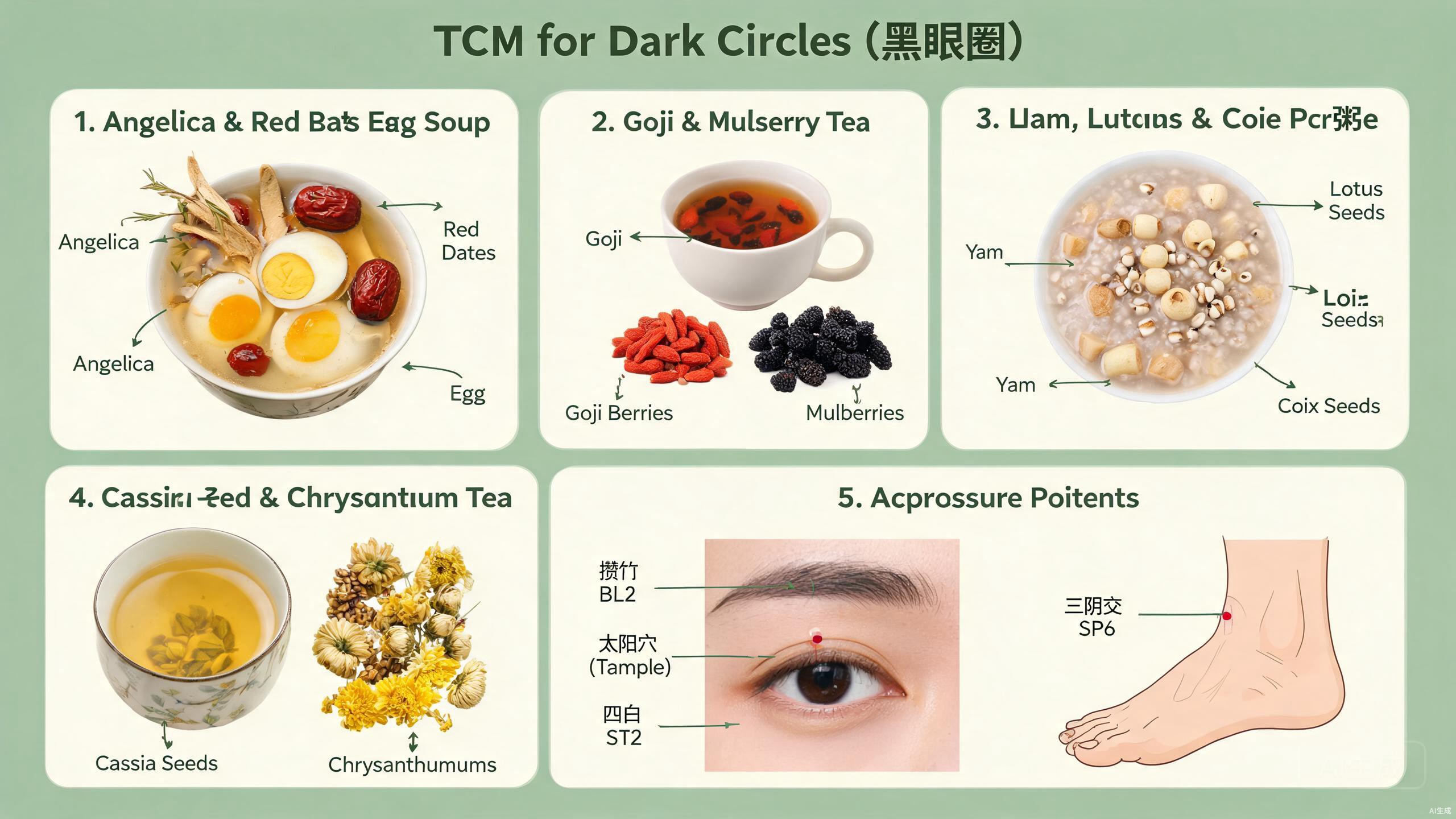
1. Angelica Date Egg Tea (当归红枣鸡蛋茶)
Best for: Liver blood deficiency
TCM nature and flavor: Angelica root (dang gui / dong quai): sweet, pungent, warm. Enters the Heart, Liver, and Spleen channels. Red dates (hong zao / jujube): sweet, warm. Enters the Spleen and Stomach channels. Egg: neutral, sweet. Brown sugar: sweet, warm.
Traditional use: This is one of the most beloved blood-nourishing recipes in Chinese home cooking, particularly associated with women's wellness but beneficial for anyone with liver blood deficiency. Angelica root (dong quai) is one of TCM's premier blood-tonifying herbs, traditionally used to nourish and invigorate blood, warm the channels, and support circulation. Red dates support qi and blood production. The egg provides protein and nourishment, while brown sugar adds warmth and is traditionally used in TCM to invigorate blood and dispel stasis. Together, this sweet, warming tea deeply nourishes liver blood, making it ideal for dark circles accompanied by pale complexion, dry eyes, and fatigue. See our guide to TCM for anemia for related recipes.
Ingredients:
- 10 grams sliced dried angelica root (dang gui) — available on Amazon or iHerb (search "dong quai" or "dang gui")
- 6 to 8 dried red dates (jujubes), pitted
- 1 whole egg
- 1 tablespoon brown sugar (or to taste)
- 12 oz water
Preparation: Rinse the angelica root and red dates. In a pot, combine angelica, red dates, and water. Bring to a boil, then reduce heat and simmer for 20 minutes. In a separate pot, boil the egg for 7 to 8 minutes until hard-boiled. Peel the egg and add it to the angelica-date tea. Simmer for another 5 to 10 minutes so the egg absorbs the flavors. Add brown sugar and stir until dissolved. Drink the tea warm and eat the egg and dates. Enjoy 2 to 3 times per week, preferably in the morning or early afternoon. The tea is sweet, warming, and aromatic.
Precautions: Angelica root may interact with blood thinners (warfarin) — consult your doctor if you take anticoagulant medication. Avoid during pregnancy and during heavy menstrual flow. If you have signs of internal heat (fever, sore throat, dry mouth), reduce or avoid this recipe temporarily.
2. Goji Mulberry Porridge (枸杞桑葚粥)
Best for: Liver and Kidney yin deficiency (dark circles with dry eyes and poor sleep)
TCM nature and flavor: Goji berries (gou qi zi): sweet, neutral. Enters the Liver and Kidney channels. Mulberry (sang shen): sweet, sour, cold. Enters the Heart, Liver, and Kidney channels. Rice: sweet, neutral. Enters the Spleen and Stomach channels.
Traditional use: This porridge addresses both liver blood and kidney essence — the two systems most directly connected to dark circles. Goji berries are traditionally used to nourish liver and kidney yin, support essence, and brighten the eyes. Mulberries are deeply valued in TCM for nourishing yin and blood, supporting the kidneys, and moistening dryness — their dark color is traditionally associated with their ability to nourish the kidney system. Together in a simple porridge, they provide gentle, daily nourishment for the deficiency pattern that underlies many cases of dark circles. This recipe is ideal for those whose dark circles are accompanied by dry eyes, poor sleep, and a general sense of depletion. For more on goji, see our goji tea guide.
Ingredients:
- 15 grams dried goji berries (about 1.5 tablespoons)
- 15 grams dried mulberries (about 1.5 tablespoons) — available on Amazon or iHerb
- 1/2 cup white rice (short or medium grain) or rolled oats
- 5 cups water
- Optional: a small amount of honey to taste
Preparation: Rinse the rice. In a pot, combine rice and water. Bring to a boil, then reduce heat and simmer for 25 minutes, stirring occasionally. Add the goji berries and mulberries in the last 10 minutes (they cook quickly and lose nutrients if overcooked). The porridge is ready when it is thick and creamy. Add honey if desired. Eat 1 bowl per day, ideally in the morning or as a light dinner. For more on porridge, see our congee guide and yam congee guide.
Precautions: This is a gentle, nourishing porridge suitable for most people. Mulberries are cooling; if you have a cold constitution with loose stools, reduce the amount or add a slice of fresh ginger. Goji berries may interact with blood thinners — consult your doctor if you take anticoagulant medication.
3. Yam Lotus Seed Coix Porridge (山药莲子薏米粥)
Best for: Spleen qi deficiency with dampness (dark circles with under-eye puffiness)
TCM nature and flavor: Chinese yam (shan yao): sweet, neutral. Enters the Spleen, Lung, and Kidney channels. Lotus seed (lian zi: sweet, astringent, neutral. Enters the Spleen, Kidney, and Heart channels. Coix seed (yi yi ren / Job's tears): sweet, bland, slightly cool. Enters the Spleen, Lung, and Kidney channels.
Traditional use: When dark circles are accompanied by puffiness or bags under the eyes, the underlying pattern is often spleen deficiency with dampness. In TCM, the Spleen is responsible for transforming and transporting fluids. When spleen qi is weak, fluids accumulate as dampness, which has a tendency to settle in the lower body — including under the eyes. This porridge addresses the root by strengthening the spleen and draining dampness simultaneously. Chinese yam is one of TCM's most gentle and versatile tonic foods, traditionally used to tonify the spleen, nourish the lung, and support the kidney. Lotus seed is traditionally used to strengthen the spleen, stop diarrhea, and calm the mind. Coix seed (Job's tears) is traditionally used to drain dampness, strengthen the spleen, and promote urination. Together, this porridge is ideal for the puffiness-type pattern.
Ingredients:
- 15 grams fresh Chinese yam, peeled and diced (or 10 grams dried yam slices from Amazon/iHerb)
- 15 grams dried lotus seeds (with core removed for milder flavor) — available on Amazon or iHerb
- 30 grams dried coix seed (Job's tears) — available on Amazon or iHerb
- 1/2 cup white rice (short or medium grain)
- 5 cups water
- A pinch of sea salt
Preparation: Soak the coix seed and lotus seeds for 2 to 4 hours until softened (this significantly reduces cooking time). Rinse the rice. In a pot, combine rice, soaked coix seed, lotus seeds, yam, and water. Bring to a boil, then reduce heat and simmer for 40 to 50 minutes until all ingredients are tender and the porridge is thick. Add salt to taste. Eat 1 bowl per day, ideally in the morning. The porridge is mild, slightly nutty, and easy to digest. For more on coix seed, see our dampness-removing foods guide.
Precautions: This is a gentle, balanced porridge suitable for most people. Coix seed is traditionally avoided in large amounts during pregnancy. If you have constipation, lotus seeds' astringent nature may worsen it — reduce the amount or omit.
4. White Atractylodes Yam Porridge (白术山药粥)
Best for: Spleen qi deficiency (dark circles with fatigue and poor digestion)
TCM nature and flavor: White atractylodes (bai zhu): bitter, sweet, warm. Enters the Spleen and Stomach channels. Chinese yam (shan yao): sweet, neutral. Enters the Spleen, Lung, and Kidney channels. Rice: sweet, neutral. Enters the Spleen and Stomach channels.
Traditional use: White atractylodes is one of TCM's most important spleen-qi-tonifying herbs, traditionally used to strengthen the spleen, dry dampness, and support fluid metabolism. It is particularly relevant when dark circles are rooted in a weak digestive system that cannot produce enough qi and blood to nourish the under-eye area. Combined with Chinese yam, which gently tonifies the spleen, lung, and kidney simultaneously, this porridge addresses the root of the deficiency pattern. This recipe is ideal for those whose dark circles are accompanied by poor appetite, bloating after eating, loose stools, and general fatigue — signs that the spleen is not converting food into the qi and blood the body needs.
Ingredients:
- 10 grams sliced dried white atractylodes (bai zhu) — available on Amazon or iHerb
- 15 grams fresh Chinese yam, peeled and diced (or 10 grams dried yam slices)
- 1/2 cup white rice (short or medium grain)
- 5 cups water
- A pinch of sea salt
Preparation: First, make a decoction: simmer the white atractylodes in 2 cups of water for 20 minutes, then strain and reserve the liquid. In a separate pot, combine the rice, Chinese yam, the reserved atractylodes liquid, and additional water (about 3 cups). Bring to a boil, then reduce heat and simmer for 30 to 40 minutes until the porridge is thick and the yam is tender. Add salt to taste. Eat 1 bowl per day, ideally in the morning. The porridge is mild and slightly earthy. For more on Chinese yam, see our yam congee guide.
Precautions: White atractylodes is warm and drying. If you have signs of yin deficiency (dry mouth, dry skin, night sweats), use in moderation or add additional yam. Avoid if you have an acute fever or infection. Generally safe for most people in food-therapy amounts.
5. Black Sesame Walnut Milk (黑芝麻核桃奶)
Best for: Kidney essence deficiency (dark circles with premature graying and lower back weakness)
TCM nature and flavor: Black sesame (hei zhi ma): sweet, neutral. Enters the Liver and Kidney channels. Walnut (he tao ren): sweet, warm. Enters the Kidney, Lung, and Large Intestine channels. Milk: sweet, neutral. Enters the Heart, Lung, and Stomach channels.
Traditional use: In TCM, there is a principle that like nourishes like — dark-colored foods are traditionally associated with nourishing the kidney system. Black sesame is one of the most revered kidney-nourishing foods in TCM, traditionally used to nourish liver and kidney yin, support essence, and darken the hair. Walnuts are traditionally used to tonify kidney yang, warm the lungs, and moisten the intestines. Together, they form a deeply nourishing combination that addresses kidney essence deficiency — the pattern behind deep, persistent dark circles with a sunken appearance. This recipe is particularly valued for its association with supporting hair color and skin vitality, both of which reflect kidney essence health. Made into a warm, nutty milk, it is a comforting daily beverage.
Ingredients:
- 2 tablespoons black sesame seeds — available at supermarkets, Amazon, or iHerb
- 2 tablespoons walnuts (about 6 to 8 halves)
- 8 oz milk (dairy or plant-based such as oat or almond milk)
- 1 teaspoon honey or maple syrup (optional)
Preparation: Toast the black sesame seeds in a dry skillet over low heat for 2 to 3 minutes until fragrant, stirring constantly to prevent burning. Lightly toast the walnuts as well. Place the toasted sesame seeds, walnuts, and milk in a blender and blend until smooth and creamy. Strain through a fine mesh sieve if you prefer a smoother texture (optional). Warm the mixture gently in a small pot — do not boil. Add honey or maple syrup to taste. Drink 1 cup per day, preferably in the morning or evening. The drink is rich, nutty, and deeply comforting. For a dairy-free version, use oat milk or almond milk. For more on black sesame and beauty, see our TCM skin wellness guide and TCM anti-aging foods guide.
Precautions: Black sesame and walnuts are gentle and suitable for most people. Walnuts are warming; if you have signs of internal heat, use in moderation. If you have a nut or seed allergy, do not use this recipe. If you monitor your blood sugar, adjust the sweetener accordingly or omit it.
Four Acupressure Points for Under-Eye Wellness
In addition to food therapy, TCM uses acupressure to support the organ systems connected to under-eye wellness and to promote local circulation. The four points below are traditionally used to nourish liver blood, invigorate circulation, and support the area around the eyes. They are simple to find and can be pressed daily as part of a wellness routine.
1. Ganshu (BL18) — The "Liver Shu"
Location: On the upper back, about 1.5 cun (approximately two finger-widths) to the side of the spine, at the level between the 9th and 10th thoracic vertebrae — roughly at the level of the lower shoulder blade.
How to find it: This point is on the back, so it is best found with help or by using a tool. Find the bottom of your shoulder blade. The point is roughly at that level, about two finger-widths from the spine. You can lean back against a wall with a tennis ball placed on the point to apply pressure.
How to press: Because this point is on the back, the easiest way to stimulate it is to lean against a tennis ball or massage ball placed on the point, or have a partner press gently with their thumbs. Apply steady pressure for 2 to 3 minutes on each side. Alternatively, rub the upper back area briskly with both palms until warm. This can be done daily.
Traditional use: Ganshu is the "back-shu" point of the Liver, meaning it is the point on the back where liver energy is most directly accessible. It is traditionally used to nourish liver blood, regulate liver qi, and support the eyes. For dark circles rooted in liver blood deficiency, BL18 addresses the source directly by supporting the liver's blood-storing function. It is also traditionally used for stress, irritability, and eye fatigue — all signs of liver imbalance. See our acupressure safety guide for general precautions.
Precautions: Use gentle pressure on the back. If you have acute back pain, sciatica, or spinal issues, consult your healthcare provider before applying pressure to this area.
2. Xuehai (SP10) — The "Sea of Blood"
Location: On the inner thigh, about 2 cun (approximately three finger-widths) above the top of the kneecap, on the bulge of the inner thigh muscle (vastus medialis).
How to find it: Sit with your knee bent. Place the palm of your hand over your kneecap with your fingers pointing up the thigh. The point is located at the tip of your thumb, on the inner side of the thigh, where the muscle bulges. Pressing here often reveals a tender spot.
How to press: Using your thumb or the heel of your hand, press firmly into the point. Hold for 2 to 3 minutes on each leg. Apply moderate to firm pressure. This point is often tender, especially in people with blood deficiency. You can also use small circular motions. Press on both legs daily.
Traditional use: Xuehai literally means "Sea of Blood," and it is one of the most important points in TCM for anything related to blood. It is traditionally used to invigorate blood circulation, nourish blood, and support blood production. For dark circles, SP10 addresses both the deficiency (by supporting blood production) and the stagnation (by promoting circulation) that contribute to the darkened appearance. It is also traditionally used for skin conditions, menstrual issues, and blood-related imbalances — all of which connect to the liver blood that nourishes the under-eye area. See our guide to qi, blood, and body fluids for more context.
Precautions: Generally safe for daily use. Avoid pressing with excessive force if you have a thigh injury, varicose veins, or bruising in the area.
3. Cuanzhu (BL2) — The "Bamboo Drill"
Location: At the inner end of the eyebrow, in a small depression on the supraorbital notch, directly above the inner corner of the eye.
How to find it: Feel along the inner end of your eyebrow, near the bridge of your nose. You will find a small notch or depression where the bone curves. Press gently — you may feel a slight tenderness or a deep ache radiating upward.
How to press: Using your thumbs or index fingers, press gently but firmly into the point. Hold for 30 seconds to 1 minute while breathing slowly. Use light to moderate pressure — the area around the eyes is delicate. You can also use small circular motions. Repeat 3 to 5 times per session.
Traditional use: Cuanzhu is one of the most important points for eye wellness in TCM. It is traditionally used to dispel wind-heat, support vision, and ease eye strain. Because of its location directly above the inner eye, it is particularly relevant for frontal eye fatigue, tension around the brow, and the heavy, tired sensation that contributes to dark circles. By promoting local circulation, pressing this point may help reduce the stagnation that darkens the under-eye area. See our guide to TCM self-massage for more techniques.
Precautions: Always use clean hands before pressing points near the eyes. Never press directly on the eyeball. Use gentle pressure only.
4. Taiyang (EX-HN5) — The "Sun Point"
Location: In the depression about one finger-width behind the midpoint of the line connecting the outer end of the eyebrow and the outer corner of the eye, in the temple area.
How to find it: Place your index finger at the outer corner of your eye. Move it about one finger-width backward toward your ear. You will feel a small depression in the temporal bone — this is Taiyang. Pressing here often reveals a tender spot, especially after long periods of concentration or poor sleep.
How to press: Using your index or middle fingers, press both temples simultaneously with gentle, steady pressure. Hold for 30 seconds to 1 minute. You can also use slow, small circular motions. This point is excellent for relieving tension that builds up from squinting or prolonged focus. Repeat 3 to 5 times per session.
Traditional use: Taiyang is an extra point widely used in TCM and Chinese folk massage. It is traditionally used to relieve headaches, calm the mind, and ease eye strain. For under-eye wellness, it helps release the tension that accumulates in the temples from sustained visual focus and poor sleep — both major contributors to dark circles. The gentle, rhythmic pressure on the temples also promotes overall relaxation of the facial muscles, which supports healthy circulation around the eyes. See our gua sha for face guide for complementary facial techniques.
Precautions: Use gentle pressure — the temple area has many blood vessels close to the surface. If you feel dizzy or uncomfortable, stop immediately.
For a simple daily routine: start by rubbing your palms together until warm, then gently press them over your closed eyes for 30 seconds to relax the eye area. Next, press Cuanzhu (BL2) for 30 seconds on each side, then Taiyang (EX-HN5) for 30 seconds on both sides simultaneously. In the evening, press Xuehai (SP10) on both legs for 2 to 3 minutes each, and lean back against a tennis ball on Ganshu (BL18) for 2 to 3 minutes. The entire routine takes about 10 minutes and supports under-eye wellness from both local and systemic angles. Consistency matters more than duration — daily gentle practice over several weeks is more effective than occasional long sessions.
Lifestyle Tips for Under-Eye Wellness
TCM is a whole-person system. Foods and acupressure work best when combined with supportive daily habits. In fact, TCM texts emphasize that sleep and lifestyle are more important than any food for maintaining under-eye vitality. The following areas are emphasized in classical TCM for dark circles:
- Prioritize sleep — this is the most important factor. In TCM, the Liver system is most active in restoring blood between 1:00 AM and 3:00 AM. Chronic late nights directly deplete liver blood, and the under-eye area is one of the first places this shows. Going to bed before 11:00 PM allows the body to enter deep rest before this crucial restoration period. No food or acupressure can compensate for chronic sleep deprivation. See our TCM insomnia types guide and meditation guide for better sleep practices.
- Practice the 20-20-20 rule. Every 20 minutes of screen work, look at something 20 feet (about 6 meters) away for at least 20 seconds. Prolonged visual focus depletes liver blood, which contributes to dark circles. This simple practice gives the eyes and the liver system a chance to recover throughout the day.
- Stay hydrated with warm fluids. TCM views dark circles as partly a reflection of poor fluid distribution. Drink warm or room-temperature water throughout the day. Avoid excessive cold drinks, which weaken the spleen and promote dampness that can settle under the eyes. See our qi, blood, and body fluids guide for more.
- Eat warm, nourishing foods. A diet of warm, cooked, easily digested foods — soups, stews, porridges, and steamed vegetables — supports the spleen's ability to produce qi and blood. Avoid excessive cold, raw, or overly sweet foods, which weaken digestion and promote dampness. See our congee guide for warming, nourishing options.
- Manage stress and emotions. In TCM, stress, frustration, and anger cause liver qi to stagnate, which blocks the smooth flow of blood to the eyes and face. The dark circles that worsen during stressful periods are a direct manifestation of this pattern. Building in genuine rest, relaxation practices, and emotional balance all help qi and blood flow smoothly. See our herbal tea for anxiety guide for practical starting points.
- Protect the eye area. Use sunscreen around the eyes to prevent pigmentation changes. Wear sunglasses to reduce squinting. Consider a silk or satin pillowcase to reduce friction and pressure on the delicate under-eye skin. A cool compress (not ice) can help reduce morning puffiness by promoting gentle circulation.
- Avoid excessive salt and alcohol. Both can contribute to fluid retention and puffiness under the eyes. In TCM, alcohol introduces damp-heat into the body, which can worsen stagnation around the eyes. Moderation is key.
For more on how TCM understands the body's energy systems, see our guide to qi, blood, and body fluids and our yin and yang guide.
Comparison of the Five Recipes
| Recipe | TCM Pattern | Key Action | Frequency |
|---|---|---|---|
| Angelica Date Egg Tea | Liver Blood Deficiency | Nourish blood, invigorate circulation | 2 to 3 times per week |
| Goji Mulberry Porridge | Liver & Kidney Yin Def. | Nourish yin, blood, and essence | 1 bowl daily |
| Yam Lotus Seed Coix Porridge | Spleen Def. + Dampness | Strengthen spleen, drain dampness | 1 bowl daily |
| White Atractylodes Yam Porridge | Spleen Qi Deficiency | Tonify spleen qi, support digestion | 1 bowl daily |
| Black Sesame Walnut Milk | Kidney Essence Deficiency | Nourish kidney essence, darken hair | 1 cup daily |
Frequently Asked Questions
What does TCM say about dark circles under the eyes?
In Traditional Chinese Medicine, dark circles under the eyes are most commonly attributed to liver blood deficiency and kidney essence deficiency. The Liver stores blood and opens into the eyes, while the Kidneys store essence and govern the area beneath the eyes. When liver blood is insufficient or kidney essence is depleted, the delicate skin under the eyes loses nourishment, and qi and blood stagnation creates the darkened appearance. Other patterns include spleen deficiency with dampness (puffy dark circles) and qi and blood stagnation (purplish dark circles). TCM food therapy traditionally uses angelica root, red dates, goji berries, black sesame, and walnuts to nourish blood and essence. These are traditional wellness practices, not medical treatments. For a deeper understanding, see our zang-fu organ guide.
Which Chinese medicine foods may support under-eye wellness?
Five traditional TCM food therapy recipes for under-eye wellness include angelica date egg tea, goji mulberry porridge, yam lotus seed coix porridge, white atractylodes yam porridge, and black sesame walnut milk. These recipes use ingredients available at Western supermarkets, Asian markets, Amazon, or iHerb. Blood-nourishing recipes (angelica, goji, mulberry) are best for deficiency-type patterns, while dampness-draining recipes (yam, lotus seed, coix) are best for puffiness-type patterns. They are traditional wellness foods, not treatments for any medical condition.
Can TCM acupressure help with dark circles?
TCM acupressure on points like Ganshu (BL18) on the back, Xuehai (SP10) on the inner thigh, Cuanzhu (BL2) at the inner eyebrow, and Taiyang (EX-HN5) at the temples is traditionally used to nourish liver blood, invigorate circulation, and promote local blood flow around the eyes. Gentle, regular pressure on these points may complement overall wellness. However, acupressure is not a treatment for dark circles caused by allergies, pigmentation disorders, genetics, or structural factors such as thin skin or deep tear troughs. If dark circles are persistent, worsening, or accompanied by swelling, itching, or other symptoms, consult your healthcare provider. See our acupressure safety guide for general precautions.
Does lack of sleep cause dark circles in TCM?
Yes. In TCM, staying up late is considered one of the primary causes of dark circles. The Liver system is most active in restoring blood between 1:00 AM and 3:00 AM, and chronic late nights deplete liver blood and kidney yin. When liver blood is deficient, the under-eye area loses nourishment and dark circles appear. TCM recommends going to bed before 11:00 PM to allow the body to enter deep rest before this crucial restoration period. Combined with nourishing foods and acupressure, improving sleep is considered the single most important step for under-eye wellness. See our TCM insomnia types guide for practical sleep guidance.
Precautions and When to Seek Help
While TCM food therapy and acupressure may support general wellness, dark circles can indicate underlying medical conditions that require professional evaluation:
- Allergies. "Allergic shiners" — dark circles caused by nasal congestion from allergies — are a common medical cause. If your dark circles are accompanied by sneezing, itching, a runny nose, or sinus congestion, consult an allergist for proper evaluation.
- Thyroid conditions. Both hypothyroidism and hyperthyroidism can cause changes in the skin around the eyes, including darkening and puffiness. If dark circles are accompanied by weight changes, fatigue, hair changes, or temperature sensitivity, ask your doctor to check your thyroid function.
- Dehydration and nutrition. Severe dehydration and nutritional deficiencies (particularly iron deficiency anemia) can contribute to dark circles. If you suspect a deficiency, consult your healthcare provider for proper testing.
- Dermatological conditions. Some dark circles are caused by excess melanin production (post-inflammatory hyperpigmentation) or by naturally thin skin that reveals the blood vessels beneath. A dermatologist can evaluate whether treatments such as topical retinoids, vitamin C, or laser therapy may be appropriate.
- Medication interactions. If you take blood thinners (warfarin), hormone therapy, or immunosuppressants, consult your healthcare provider before adding angelica root, goji berries, or white atractylodes to your routine.
- Pregnancy precautions. Angelica root (dong quai) is traditionally contraindicated during pregnancy. Always consult your healthcare provider before using any herbal remedies during pregnancy.
- Not a substitute. TCM food therapy is complementary. It sits alongside — never in place of — professional medical care.
For related topics, see our guides on TCM for eye health, TCM for anemia, and TCM for skin wellness.
The Bottom Line
Traditional Chinese Medicine offers a gentle, food-based tradition for supporting under-eye wellness. By understanding whether your pattern is rooted in liver blood deficiency, kidney essence deficiency, spleen deficiency with dampness, or qi and blood stagnation, you can choose foods and practices that work with your body's specific needs. Angelica date egg tea deeply nourishes liver blood. Goji mulberry porridge addresses both liver and kidney yin. Yam lotus seed coix porridge strengthens the spleen and drains the dampness that causes puffiness. White atractylodes yam porridge tonifies spleen qi for better blood production. And black sesame walnut milk nourishes kidney essence for deep, long-term support. Paired with four acupressure points — Ganshu (BL18), Xuehai (SP10), Cuanzhu (BL2), and Taiyang (EX-HN5) — and lifestyle habits like prioritizing sleep before 11:00 PM, practicing the 20-20-20 rule, managing stress, and eating warm nourishing foods, these traditional practices form a whole-person approach to under-eye wellness.
But they are traditions — not treatments, and not a replacement for medical care. Dark circles may indicate allergies, thyroid issues, anemia, or other conditions requiring professional evaluation. Use these traditional practices only as complementary wellness habits, alongside your doctor's guidance.
This article shares traditional wellness practices for educational purposes only. It is not a substitute for medical advice, diagnosis, or treatment. The foods, teas, and acupressure practices described here are not intended to treat, cure, or prevent any disease, including but not limited to allergic shiners, pigmentation disorders, thyroid conditions, anemia, or any dermatological condition. If you have persistent or worsening dark circles, or if they are accompanied by swelling, itching, pain, or other concerning symptoms, consult your healthcare provider promptly for proper evaluation. These statements have not been evaluated by the FDA. Never stop or adjust prescribed treatment without your doctor's explicit guidance. Read our full disclaimer →