Key Takeaways
- TCM teaches that the Heart stores the shen (spirit) — when the shen is calm and well-anchored, sleep comes naturally.
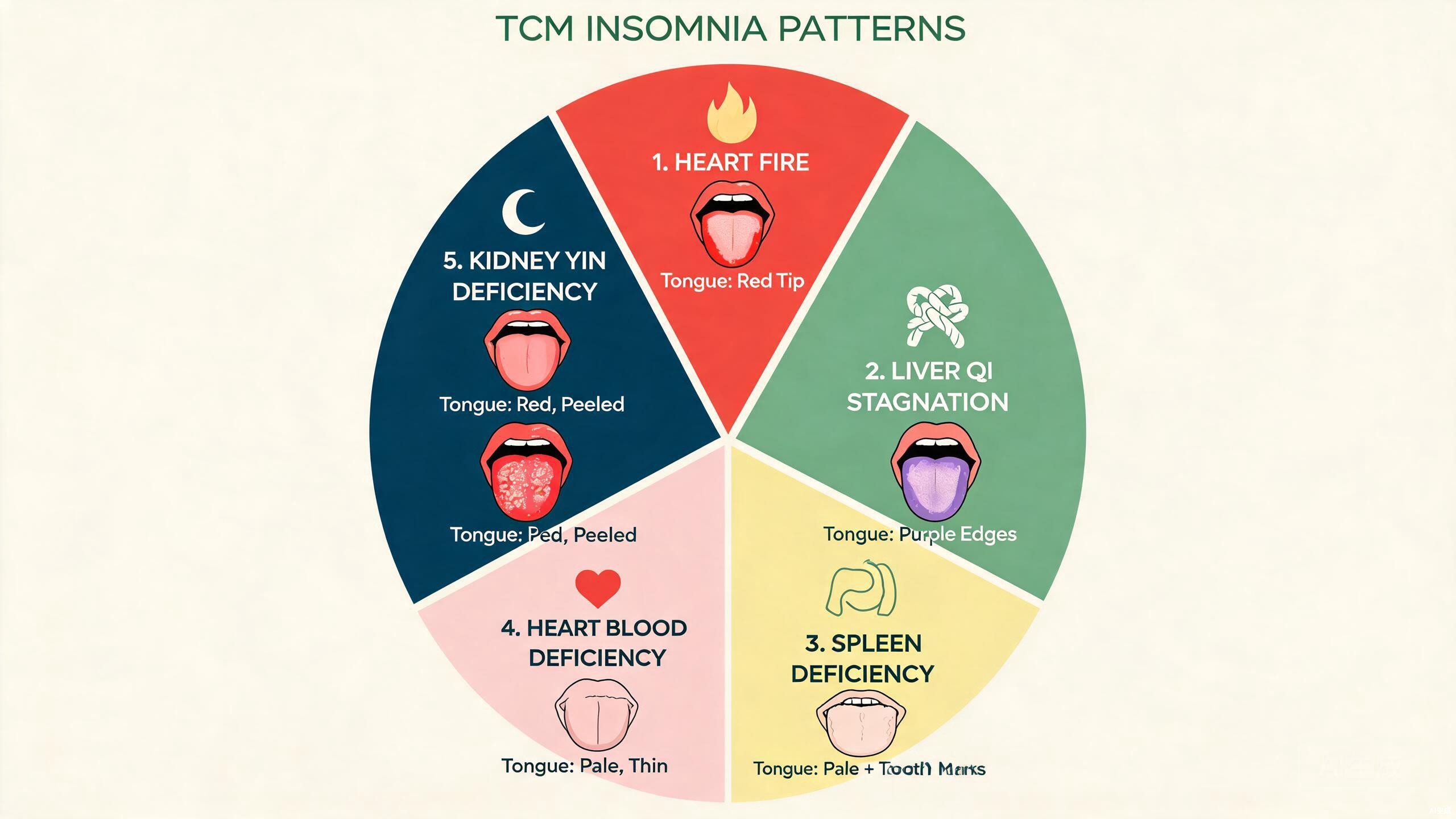
- Five common patterns disturb sleep: Heart Fire, Liver Qi Stagnation, Spleen Deficiency, Heart Blood Deficiency, and Kidney Yin Deficiency.
- Each organ "stores" a part of the spirit — Liver stores the hun, Spleen the yi, Kidney the zhi — and each disturbance produces a different kind of insomnia.
- The time you wake and how it feels are the fastest clues to your pattern.
- Matching the remedy (tea, point, food) to the pattern — not a one-size-fits-all fix — is the core idea. See our deeper guide to TCM insomnia types.
This guide is for wellness education only and is not medical advice. The practices described are complementary and are not a replacement for professional care. If you live with chronic or worsening insomnia, talk with your healthcare provider. Some herbs may interact with sleep medications. Read our full disclaimer →
If you have ever lain awake wondering why sleep feels effortless for some people and impossible for you, Traditional Chinese Medicine (TCM) offers a refreshingly specific answer. Rather than approaching all sleeplessness as one problem, TCM asks which organ is involved and how it is disturbed. The result is a map of five common insomnia patterns — each with its own signature, its own time of night, and its own supportive practices.
This article is the entry point to our sleep series. It explains the organ-and-spirit theory behind the patterns so the practical guides that follow — acupressure, herbal teas, food, and ritual — make sense. If you are new to TCM altogether, our introduction to TCM and guide to yin and yang are good companions.
The Spirit That Sleeps: How TCM Understands Rest
In TCM, sleep is not simply the brain switching off. It is the shen — the spirit, the aspect of consciousness housed by the Heart — settling quietly into its nest at night. When the shen is calm and well-nourished, sleep arrives on its own. When the shen is disturbed, sleep becomes shallow, delayed, or broken.
Here is the part that surprises many readers: the Heart is not the only organ involved in sleep. TCM describes five spirits, each stored by a different organ:
- Heart stores the shen (神) — overall spirit and consciousness; the seat of restful sleep.
- Liver stores the hun (魂) — the ethereal soul, linked to dreaming, movement, and the smooth flow of emotion.
- Spleen stores the yi (意) — the intellect, responsible for thinking, worry, and concentration.
- Lung stores the po (魄) — the corporeal soul, tied to instinct and grief.
- Kidney stores the zhi (志) — the will, rooted in the body's deepest reserves.
When any of these is agitated — by heat, stagnation, or deficiency — the corresponding aspect of sleep suffers. A racing mind points one way; vivid, agitated dreams another; looping worry yet another. This is why two people who "can't sleep" may need completely different support.
Excess versus deficiency: the first fork in the road
TCM also asks whether the disturbance is excess (too much heat, stagnation, or activity) or deficient (not enough blood, yin, or qi to anchor the spirit). Excess patterns tend to feel loud and agitated — a hot, racing mind. Deficient patterns feel empty and fragile — light sleep, easy waking, daytime fatigue. Knowing this shapes every remedy that follows.
Pattern 1: Heart Fire — The Racing, Overheated Mind
What it feels like: you lie down and your mind simply will not switch off. Thoughts race, your face feels warm, and sleep feels just out of reach.
Heart Fire is an excess pattern. Heat accumulates in the Heart and flares upward, agitating the shen so it cannot settle. It often follows overwork, strong emotions, or stimulating food and drink late in the day.
Signature clues
- Time: trouble falling asleep.
- Body: agitation, a red face, thirst, mouth ulcers or a bitter taste, vivid dreams.
- Tongue: a red tip, often with a yellow coating.
Supportive direction
The traditional approach is to clear heat and calm the spirit. Lotus plumule tea (Lian Zi Xin) is the classic choice — brew 1 to 2 grams for 5 minutes. For a gentler alternative, chrysanthemum tea. The calming point Shenmen (HT7), on the outer wrist crease, is traditionally pressed for 1 to 2 minutes per wrist before bed.
Pattern 2: Liver Qi Stagnation — Stewing Over the Day
What it feels like: you cannot fall asleep because your mind replays the day's frustrations. A tell-tale sign is waking between 1 and 3 a.m. — the Liver's time on the TCM body clock.
Stress interrupts the Liver's job of keeping energy (qi) flowing smoothly. When qi stagnates, the hun — the Liver's spirit, associated with dreaming and movement — grows restless. The result is a mind that loops instead of rests. Our article on dreams and organ health explores this link further.
Signature clues
- Time: trouble falling asleep and/or waking 1–3 a.m.
- Body: irritability, sighing, a tight chest, sometimes a bitter taste.
- Tongue: often normal, sometimes slightly purplish, with a thin white coating.
Supportive direction
The goal is to move stagnant Liver qi and release tension. Rose tea is the traditional brew — steep 3 to 5 grams of dried rose buds for 5 to 7 minutes. The point Taichong (LR3), between the big and second toes, is pressed firmly for 1 to 2 minutes per foot. Slow movement helps too — see our guide to qigong for sleep.
Pattern 3: Spleen Deficiency — The Looping, Worried Mind
What it feels like: overthinking keeps you awake. The mind loops over tasks, lists, and worries, and the body feels heavy and tired even before sleep.
The Spleen stores the yi — the intellect. When the Spleen is weak, from irregular eating, cold raw foods, or too much mental work, the yi cannot settle. Instead of resting, the mind rehearses tomorrow.
Signature clues
- Time: difficulty falling asleep as the mind loops; light, easily disturbed sleep.
- Body: fatigue on waking, bloating, loose stools, a heavy feeling.
- Tongue: pale, possibly swollen with teeth-marked edges, thin white coating.
Supportive direction
Warm and strengthen the Spleen. Ginger and red date tea — 3 thin ginger slices simmered with 2 to 3 pitted red dates for 10 minutes — is traditional. The point Zusanli (ST36), below the knee on the outer shin, is the classic point for digestion and energy. Avoid cold or iced drinks in the evening.
Pattern 4: Heart Blood Deficiency — Light, Anxious Sleep
What it feels like: shallow sleep, easy startling, and waking with palpitations or anxiety. You sleep, but it does not feel restorative.
In TCM, blood anchors the shen. When Heart blood is insufficient — from overwork, poor nutrition, blood loss, or long worry — the spirit lacks a "nest" to rest in and drifts, producing light, anxious sleep.
Signature clues
- Time: light, broken sleep; waking easily and startled.
- Body: palpitations, anxiety, poor memory, dizziness, a pale complexion.
- Tongue: pale and thin.
Supportive direction
Nourish Heart blood and anchor the shen. Sour date seed tea (Suan Zao Ren) — lightly crush 10 to 15 grams and simmer for 15 minutes, drinking 1 to 2 hours before bed — is the most important spirit-calming herb in TCM. Longan is a gentler alternative. Shenmen (HT7) or Neiguan (PC6) support the Heart directly.
Pattern 5: Kidney Yin Deficiency — Early Waking with Heat
What it feels like: you fall asleep fine but wake very early — often 3 to 5 a.m. or before dawn — hot, restless, and unable to return to sleep.
Yin is the body's cooling, moistening aspect. When Kidney yin is low — common with aging, chronic overwork, or after illness — internal heat rises at night, producing the classic picture of waking hot and restless in the small hours. The Kidney stores the zhi (will); depleted reserves leave you wired but tired.
Signature clues
- Time: difficulty staying asleep; early waking.
- Body: night sweats, hot flashes, a dry mouth at night, tinnitus, lower-back ache.
- Tongue: red with little or no coating, sometimes peeled (a "mirror" tongue).
Supportive direction
Nourish Kidney yin and draw heat downward. A goji and chrysanthemum blend, or lily bulb tea (simmer 10 to 15 grams of dried lily bulb for 10 minutes), is traditional. The point Yongquan (KD1), on the sole of the foot, is pressed or massaged for 2 to 3 minutes before bed to draw rising heat down. Avoid warming, drying herbs like ginger in the evening for this pattern.
Quick Comparison: Which Pattern Is Yours?
The clearest clues are usually when you wake and how it feels, supported by the tongue.
| Pattern | Feels like | Time | Tongue | Classic support |
|---|---|---|---|---|
| Heart Fire | Racing, hot mind | Can't fall asleep | Red tip, yellow coat | Lotus plumule tea; HT7 |
| Liver Qi Stagnation | Frustrated, looping | 1–3 a.m. waking | Normal / slightly purple | Rose tea; LR3 |
| Spleen Deficiency | Worried, heavy | Looping at bedtime | Pale, teeth marks | Ginger + red date; ST36 |
| Heart Blood Deficiency | Light, anxious sleep | Broken, startled | Pale, thin | Sour date seed; HT7 |
| Kidney Yin Deficiency | Hot, early waking | 3–5 a.m. / pre-dawn | Red, little coat | Lily bulb / goji; KD1 |
Practical Next Steps
Once you have a sense of your pattern, choose one tea and one point that match it, and practice for two weeks. Layer in the basics that help every pattern:
- Sleep before 11 p.m. — the hours before midnight build yin and blood on the TCM body clock. Our article on the TCM body clock explains why this window matters.
- Eat warm, light evening meals. Heavy, cold, or late meals burden the Spleen. See our TCM food guide for sleep.
- Try a warm foot soak. Drawing energy downward settles the spirit — see our foot soak ritual.
- Build a calming bedroom. Environment shapes the shen — see our TCM sleep environment guide.
When to See a Practitioner
Gentle self-care may support many people through occasional sleepless nights, but some situations call for professional guidance. Consider consulting a qualified TCM practitioner or your healthcare provider if insomnia has lasted more than three weeks, is steadily worsening, or comes with significant daytime fatigue, low mood, anxiety, chest pain, or severe night sweats. A qualified practitioner can assess your individual pattern and recommend a personalized approach.
Frequently Asked Questions
What are the five TCM insomnia patterns?
The five common patterns are Heart Fire, Liver Qi Stagnation, Spleen Deficiency, Heart Blood Deficiency, and Kidney Yin Deficiency. Each involves a different organ that stores a part of the spirit, so the remedy — tea, food, acupressure point — differs for each. Identifying the pattern is the first step in TCM sleep care.
Which organ stores the spirit (shen) in TCM?
The Heart stores the shen, the aspect of spirit responsible for consciousness and restful sleep. The Liver stores the hun (ethereal soul), the Spleen stores the yi (intellect), and the Kidney stores the zhi (will). When any is disturbed, sleep can suffer in a characteristic way.
How do I know which insomnia pattern I have?
Two clues are most useful: the time you wake and how it feels. Waking between 1 and 3 a.m. with a racing, frustrated mind points to the Liver; early-morning waking with night sweats suggests Kidney Yin Deficiency; worry-driven looping suggests the Spleen. The tongue color and coating add confirmation. A qualified practitioner can confirm.
Can I combine acupressure and herbal tea for sleep?
Yes — many people pair a pattern-matched tea with one or two acupressure points before bed. Gentle self-care is generally safe, but if you take prescription sleep medication, consult your healthcare provider before adding herbs such as sour date seed, which may add to a sedative effect.
The Bottom Line
Not all sleeplessness is the same. Before reaching for a remedy, ask which pattern fits: a hot, racing mind points one way; an early-morning wake with night sweats another; worry-driven looping yet another. The organ that stores the spirit tells you where to look, the time you wake tells you when, and the tongue confirms. Match the remedy to the pattern, practice patiently, and the rest of this series will give you the tools.
This article is for educational and informational purposes only and is not a substitute for professional medical advice, diagnosis, or treatment. Always consult a qualified healthcare provider before beginning any new wellness practice, especially if you are pregnant, nursing, taking medication, or have a medical condition. Read our full disclaimer →