Key Takeaways
- TCM views acne through three primary patterns: lung heat, damp-heat accumulation, and liver fire, each with distinct facial locations and characteristics.
- Five traditional food therapy recipes — from chrysanthemum honeysuckle tea to winter melon lotus leaf porridge — use ingredients available at Western supermarkets, Amazon, or iHerb.
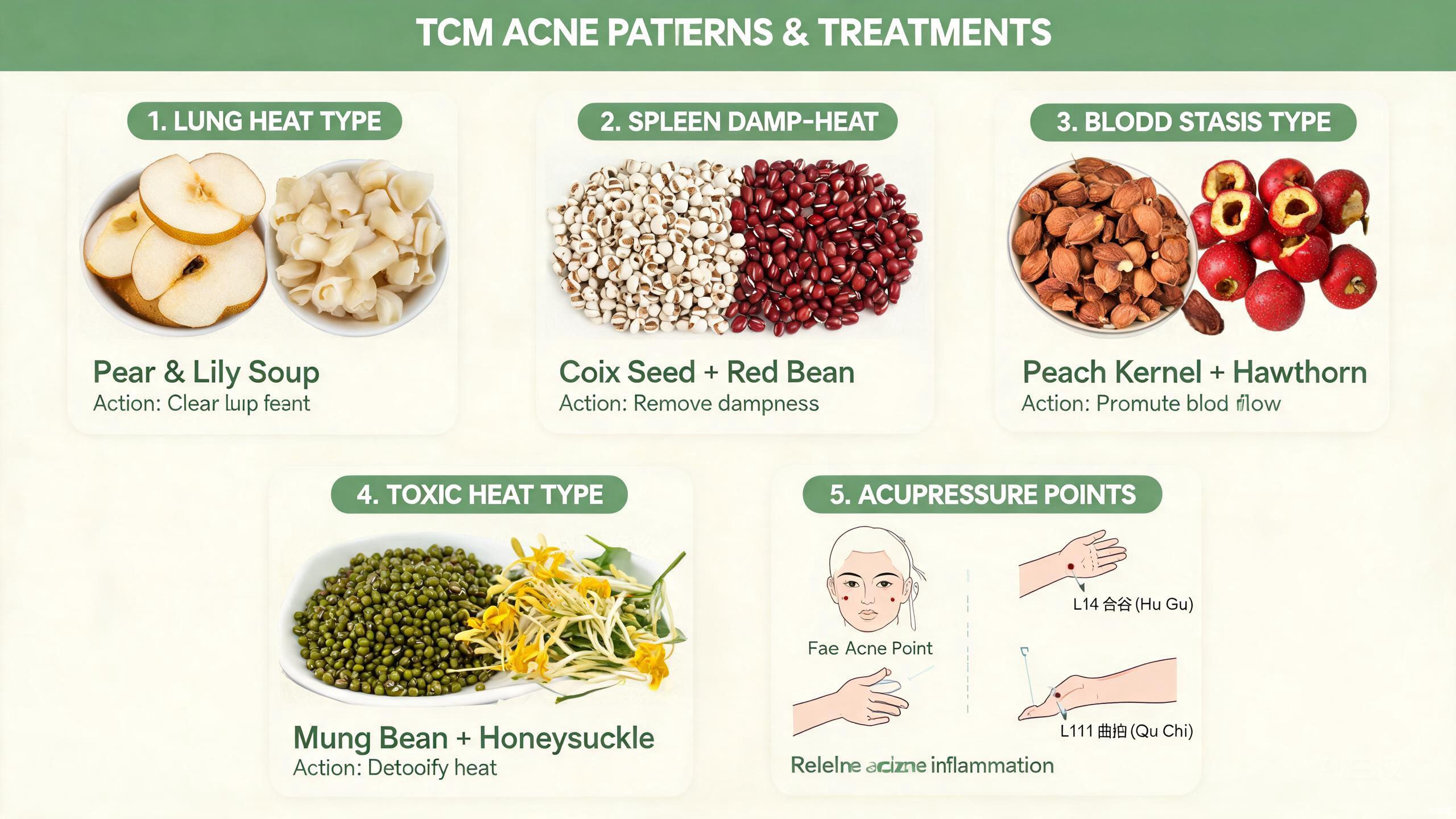
- Three acupressure points, Hegu (LI4), Zusanli (ST36), and Quchi (LI11), are traditionally used to clear heat, strengthen digestion, and support skin wellness.
- Avoiding sweets, milk tea, fried foods, spicy foods, and fawu (inflammation-provoking foods) is considered just as important as adding beneficial foods.
- These are traditional wellness practices, not a treatment for acne. Severe, cystic, or scarring acne requires evaluation by a dermatologist.
This article is for educational purposes only and is not medical advice. The foods, teas, and practices described here are traditional wellness practices rooted in Chinese culture. They are not a substitute for professional medical care, diagnosis, or treatment. Acne can range from mild to severe, and severe or cystic acne can cause permanent scarring. It may also be a sign of underlying hormonal conditions that require medical evaluation. Never stop, delay, or replace prescribed treatment based on information in this article. Some foods and herbs may interact with medications — always inform your doctor about everything you consume. These statements have not been evaluated by the FDA and are not intended to diagnose, treat, cure, or prevent any disease. Read our full disclaimer →
Acne is one of the most common skin concerns worldwide, affecting people of all ages — not just teenagers. While modern dermatology offers effective treatments, many people seek complementary approaches that address the internal factors contributing to breakouts. Traditional Chinese Medicine (TCM) has viewed skin health as a reflection of internal balance for thousands of years, offering food therapy and self-care practices that may support clear skin as part of a holistic approach.
In TCM, the skin is not seen as an isolated surface but as a mirror of the internal organs. The face, in particular, is considered a map: different zones correspond to different organ systems, and the location, color, and type of acne provide clues about the underlying imbalance. The five recipes below use foods and teas that have been enjoyed for generations to clear heat, drain dampness, and soothe the liver — the three primary patterns associated with acne. All ingredients are available at Western supermarkets, Asian markets, Amazon, or iHerb.
If you are new to TCM concepts, our guide to the Zang-Fu organ systems and TCM for skin health guide are helpful starting points. For related topics, see our TCM eczema diet guide and scar and blemish reduction guide.
How TCM Views Acne
Traditional Chinese Medicine classifies acne under the broader category of fei feng fen cu (lung wind acne) or fen ci (facial thorns), terms that have appeared in Chinese medical texts for centuries. TCM understands acne as the result of heat and dampness accumulating in the body and rising to the surface of the skin. The Lung, Stomach, and Liver organ systems are most commonly involved.
The Lung system governs the skin and body hair. In TCM, the lungs "open into" the skin and regulate the pores. When lung heat accumulates — from external heat, respiratory issues, or emotional stress — it rises to the face, particularly the forehead and nose area. This is why TCM often connects acne on the forehead to lung heat.
The Stomach and its paired organ, the Spleen, are responsible for digestion. When the stomach accumulates heat — from spicy, greasy, or sweet foods — this heat rises along the stomach meridian to the face, particularly the cheeks and around the mouth. Dampness from a weak spleen combines with this heat to create damp-heat, the most common pattern for oily, inflamed acne.
The Liver regulates the smooth flow of qi and emotions. When liver qi stagnates from stress and generates fire, this heat rises to the face along the liver meridian, affecting the sides of the face, jawline, and temples. This pattern often explains adult acne that worsens with stress or hormonal fluctuations.
TCM identifies three primary acne patterns:
- Lung Heat (Fei Re) — acne appears primarily on the forehead and nose, with red papules, a dry mouth, and sometimes a sore throat. Breakouts may worsen with respiratory issues or constipation. The tongue typically has a red tip with a thin yellow coating. This pattern is common in teenagers and those exposed to dry, hot environments.
- Damp-Heat Accumulation (Shi Re Yun Jie) — the most common pattern. Acne is red, inflamed, oily, and may include pustules or cysts, primarily on the cheeks, chin, and chest. The skin is excessively oily, and breakouts worsen with greasy or sweet foods. The tongue typically has a thick, greasy yellow coating. This pattern reflects the combination of spleen weakness (generating dampness) and stomach heat (generating heat). See our dampness-removing foods guide for more on this concept.
- Liver Fire (Gan Huo) — acne appears on the sides of the face, jawline, and temples, and worsens significantly with stress, anger, or before menstruation. Breakouts are often deep, red, and tender. Accompanying signs include irritability, a bitter taste in the mouth, dry eyes, and premenstrual symptoms. This pattern is common in adult women and is closely related to PMS patterns.
Understanding these patterns helps explain why TCM recommends different foods for different types of acne. The recipes below are grouped by the pattern they traditionally address.
5 Food Therapy Recipes for Clear Skin
Each recipe below is matched to a specific TCM pattern. Choose the one that best fits your situation, and use it consistently for two to four weeks. All ingredients are available at Western supermarkets, Asian markets, Amazon, or iHerb.
1. Chrysanthemum Honeysuckle Loquat Leaf Tea (菊花金银花枇杷叶茶)
Best for: Lung heat pattern
TCM nature and flavor: Chrysanthemum (ju hua): sweet, bitter, slightly cold. Enters the Liver and Lung channels. Honeysuckle (jin yin hua): sweet, cold. Enters the Lung, Stomach, and Heart channels. Loquat leaf (pi pa ye): bitter, neutral. Enters the Lung and Stomach channels.
Traditional use: This tea combines three of TCM's most valued heat-clearing ingredients for the upper body. Chrysanthemum is traditionally used to dispel wind-heat, clear liver heat, and brighten the eyes. Honeysuckle is one of TCM's most important heat-clearing and detoxifying herbs, traditionally used to clear heat, resolve toxins, and reduce inflammation in the skin and respiratory system. Loquat leaf is traditionally used to clear lung heat, resolve phlegm, and direct qi downward. Together, they form a cooling tea that directly addresses lung heat rising to the face — ideal for forehead acne with redness and inflammation.
Ingredients:
- 1 teaspoon dried chrysanthemum flowers — available on Amazon, iHerb, or tea shops
- 1 teaspoon dried honeysuckle flowers (jin yin hua) — available on Amazon or iHerb
- 2 to 3 grams dried loquat leaves (pi pa ye) — available on Amazon or iHerb
- 2 cups hot water (90°C / 195°F)
- Optional: a small amount of honey to taste
Preparation: Place all ingredients in a teapot. Pour hot water over them, cover, and steep for 8 to 10 minutes. Strain and drink warm. Enjoy 1 to 2 cups per day, preferably in the morning or afternoon. The tea has a light, floral, and slightly bitter flavor. For more on chrysanthemum, see our TCM for dry eyes guide.
Precautions: All three ingredients are cooling. Avoid if you have a cold constitution, chronic diarrhea, or during menstruation (reduce to half the amount). Honeysuckle is quite cold in nature — do not exceed the recommended amount.
2. Adzuki Bean and Coix Seed Winter Melon Soup (赤小豆薏米冬瓜汤)
Best for: Damp-heat pattern (oily, inflamed acne)
TCM nature and flavor: Adzuki bean (chi xiao dou): sweet, sour, neutral. Enters the Heart and Small Intestine channels. Coix seed (yi yi ren): sweet, bland, slightly cool. Enters the Spleen, Lung, and Kidney channels. Winter melon (dong gua): sweet, mild, cool. Enters the Lung, Spleen, and Bladder channels.
Traditional use: This is the classic TCM food therapy combination for damp-heat. Adzuki bean is traditionally used to promote urination, reduce swelling, and resolve dampness and toxins. Coix seed drains dampness, strengthens the spleen, and clears heat. Winter melon clears heat, promotes urination, and reduces swelling. Together, they address both the dampness (excess oil, pustules) and the heat (redness, inflammation) that characterize the damp-heat acne pattern. This soup helps the body eliminate damp-heat through urination, reducing the internal environment that feeds acne.
Ingredients:
- 1/2 cup dried adzuki beans — available at most supermarkets, Amazon, or iHerb
- 1/2 cup dried coix seed (Job's tears) — available on Amazon or iHerb
- 2 cups winter melon, peeled and cubed (zucchini or chayote can substitute)
- 5 cups water
- 3 slices fresh ginger
- A pinch of sea salt
Preparation: Soak the adzuki beans and coix seed for 4 to 6 hours. In a pot, combine the soaked beans, coix seed, water, and ginger. Bring to a boil, then reduce heat and simmer for 40 minutes. Add the winter melon and simmer for another 15 to 20 minutes until tender. Add salt to taste. Drink 1 bowl per day, preferably at lunch. For more on coix seed, see our dampness-removing foods guide.
Precautions: This soup is cooling. If you have a cold constitution, add extra ginger. Coix seed is traditionally avoided in large amounts during pregnancy.
3. Rose and Ophiopus Tea (玫瑰麦冬水)
Best for: Liver fire pattern (stress-related acne)
TCM nature and flavor: Rose (mei gui hua): sweet, slightly bitter, warm. Enters the Liver and Spleen channels. Ophiopus (mai dong): sweet, slightly bitter, slightly cold. Enters the Heart, Lung, and Stomach channels.
Traditional use: This tea addresses the emotional and stress-related dimension of acne. Rose is traditionally used to soothe liver qi, regulate emotions, and promote blood circulation — it gently moves stuck liver qi that generates fire. Ophiopus (the tuber of dwarf lilyturf) is traditionally used to nourish yin, moisten the lungs, and clear heart heat. The combination is elegant: rose moves liver qi to address the root cause, while ophiopus nourishes the yin that has been damaged by liver fire and prevents the tea from being too drying. This is particularly suited for adult acne that worsens with stress or before menstruation.
Ingredients:
- 1 tablespoon dried rose buds — available on Amazon, iHerb, or tea shops (ensure food-grade)
- 10 to 15 pieces dried ophiopus tuber (mai dong) — available on Amazon or iHerb
- 2 cups hot water (90°C / 195°F)
- Optional: a small amount of honey to taste
Preparation: Place the rose buds and ophiopus in a teapot. Pour hot water over them, cover, and steep for 8 to 10 minutes. Strain and drink warm. Enjoy 1 to 2 cups per day, preferably in the afternoon or during stressful periods. The tea has a delicate floral aroma with a slightly sweet, moistening aftertaste.
Precautions: Rose is warming and moving — avoid during pregnancy and heavy menstrual periods. Ophiopus is moistening; if you have dampness (thick greasy tongue coating, bloating), reduce the amount.
4. Mung Bean and Coix Seed Porridge (绿豆薏米粥)
Best for: General heat and dampness (daily maintenance)
TCM nature and flavor: Mung bean (lu dou): sweet, cold. Enters the Heart and Stomach channels. Coix seed (yi yi ren): sweet, bland, slightly cool. Enters the Spleen, Lung, and Kidney channels.
Traditional use: This simple porridge is one of the most popular summer foods in China, valued for its ability to clear heat, detoxify, and drain dampness simultaneously. Mung bean is traditionally used to clear summer heat, resolve toxins, and reduce skin inflammation. Coix seed drains dampness and strengthens the spleen. Together, they form a gentle, everyday food that addresses both the heat and dampness underlying most acne patterns. This porridge is ideal as a daily maintenance food during acne-prone periods.
Ingredients:
- 1/2 cup dried mung beans — available at most supermarkets, Amazon, or iHerb
- 1/2 cup dried coix seed (Job's tears) — available on Amazon or iHerb
- 1/4 cup white rice
- 5 cups water
- 3 slices fresh ginger (to balance the cold nature)
Preparation: Soak the mung beans and coix seed for 2 to 4 hours. In a pot, combine all ingredients with water. Bring to a boil, then reduce heat and simmer for 45 to 60 minutes until the beans are soft and the porridge is thick. Eat 1 bowl per day, ideally in the morning or at lunch. For more on mung beans, see our mung bean congee guide and our summer heat-clearing foods guide.
Precautions: This porridge is cooling. If you have a cold constitution with diarrhea or cold extremities, add extra ginger or reduce the portion. Coix seed is traditionally avoided in large amounts during pregnancy.
5. Winter Melon and Lotus Leaf Porridge (冬瓜荷叶粥)
Best for: Damp-heat with oily skin and weight concerns
TCM nature and flavor: Winter melon (dong gua): sweet, mild, cool. Enters the Lung, Spleen, and Bladder channels. Lotus leaf (he ye): bitter, astringent, neutral. Enters the Heart, Liver, and Spleen channels.
Traditional use: Lotus leaf is one of TCM's most interesting ingredients for skin and metabolic wellness. It is traditionally used to clear summer heat, resolve dampness, and "lift" the clear yang. In TCM, the lotus leaf's ability to lift yang is relevant for acne because stagnant damp-heat tends to sink and accumulate; the lotus leaf helps move it upward and out. Combined with winter melon, which clears heat and promotes urination, this porridge addresses damp-heat acne while also supporting healthy weight management — a common concern for those with damp-heat patterns.
Ingredients:
- 1/2 cup white rice
- 1 cup winter melon, peeled and cubed
- 1 dried lotus leaf (about 5 to 10 grams) — available on Amazon or iHerb
- 4 cups water
- A pinch of sea salt
Preparation: Rinse the rice. In a pot, combine the rice, water, and dried lotus leaf. Bring to a boil, then reduce heat and simmer for 30 minutes. Remove and discard the lotus leaf. Add the winter melon and simmer for another 15 minutes until tender. Add salt to taste. Eat 1 bowl per day, ideally in the morning. The porridge has a mild, slightly earthy flavor from the lotus leaf.
Precautions: Lotus leaf is generally safe as a food. If you have a cold constitution, add a slice of ginger. Avoid during pregnancy.
Three Acupressure Points for Clear Skin
In addition to food therapy, TCM uses acupressure to support the organ systems involved in skin health. The three points below are traditionally used to clear heat, strengthen digestion, and promote the elimination of toxins through proper channels. They are simple to find and can be pressed daily as part of a wellness routine.
1. Hegu (LI4) — The "Joining Valley"
Location: On the back of the hand, in the webbing between the thumb and index finger, at the highest point of the muscle when the thumb and index finger are brought together.
How to find it: Hold one hand with the thumb and index finger pressed together. With your other thumb, press into the fleshy mound between the thumb and index finger, near the base. You should feel a distinct soreness or ache — this is Hegu (LI4).
How to press: Using your opposite thumb, press firmly into the point for 1 to 2 minutes on each hand. You can also squeeze the point between your thumb and index finger from both sides. The pressure should be firm but not painful.
Traditional use: Hegu is the most famous point on the Large Intestine meridian and is traditionally used to clear heat, expel wind, and regulate the face and head. As the "command point" of the face and mouth, it is traditionally used for facial skin conditions, headaches, toothaches, and throat issues. For acne wellness, LI4 helps clear heat from the face and promote the elimination of waste through the large intestine.
Precautions: Hegu (LI4) is strictly contraindicated during pregnancy — it is well documented in TCM to stimulate uterine contractions and induce labor. Never press LI4 if you are pregnant.
2. Zusanli (ST36) — The "Leg Three Miles"
Location: On the outer lower leg, about 3 cun (approximately four finger-widths) below the kneecap, one finger-width lateral to the shin bone (tibia).
How to find it: Place your hand on your knee with fingers pointing downward. The point is just below the kneecap, slightly to the outside of the shin bone. You can often feel a small depression or muscle band under your fingers.
How to press: Using your thumb or index finger, press firmly into the point for 2 to 3 minutes on each leg. You can also rub the area in small circles. This is an excellent daily wellness point.
Traditional use: Zusanli is arguably the most famous acupressure point in all of TCM. It is traditionally used to strengthen the spleen and stomach, tonify qi and blood, and support overall vitality. For acne wellness, ST36 addresses the spleen and stomach weakness that generates damp-heat — the most common acne pattern. A strong digestive system properly transforms food and eliminates waste, reducing the dampness and heat that rise to the face as acne.
Precautions: Very safe for daily use. Avoid on broken or injured skin.
3. Quchi (LI11) — The "Pool at the Crook"
Location: At the outer end of the elbow crease, on the thumb side, when the elbow is bent at 90 degrees.
How to find it: Bend your elbow to 90 degrees. On the outer (thumb) side of the elbow crease, you will feel a depression at the end of the crease. This is Quchi (LI11). Pressing here usually produces a noticeable ache.
How to press: Using your opposite thumb, press firmly into the point for 1 to 2 minutes on each arm. You can also massage the area in small circles.
Traditional use: Quchi is the "sea" point of the Large Intestine meridian and is traditionally used to clear heat, resolve toxins, and dispel wind from the skin. It is one of the most important points in TCM for skin conditions, including acne, rashes, and inflammatory skin issues. For acne wellness, LI11 helps clear the systemic heat that manifests as red, inflamed breakouts, and supports the large intestine's role in eliminating waste.
Precautions: Generally safe. Avoid on broken or injured skin.
For a simple daily routine: in the morning, press Hegu (LI4) on both hands for 1 to 2 minutes each. At midday, press Quchi (LI11) on both arms for 1 to 2 minutes. In the evening, press Zusanli (ST36) on both legs for 2 to 3 minutes each. Consistency matters more than duration. For more guidance, see our acupressure safety guide and acupressure for common symptoms.
Foods to Avoid for Acne Wellness
In TCM, what you avoid is just as important as what you eat. The following food categories are considered the primary dietary triggers for acne:
- Sweets and sugary foods. In TCM, excessive sweets generate dampness and heat. This includes not only candies and desserts but also sugary drinks, milk tea (a major culprit in modern diets), sweetened coffee drinks, and processed foods with hidden sugars. Modern science confirms that high-glycemic diets increase sebum production and inflammation.
- Fried and greasy foods. These directly introduce damp-heat into the body. Deep-fried foods, fast food, and heavily processed snacks burden the spleen and stomach, generating the damp-heat that rises to the face as oily, inflamed acne.
- Spicy foods. Chili, pepper, and other heating spices generate internal heat. While moderate use of warming spices can be beneficial in cold weather, excessive spicy food aggravates heat-type acne, particularly the lung heat and liver fire patterns.
- Fawu (inflammation-provoking foods). TCM classifies certain foods as fawu — foods that "provoke" or worsen inflammatory conditions. Common fawu for acne include lamb, shrimp, crab, mango, lychee, longan, and sometimes chicken. These are not universally harmful but may trigger breakouts in susceptible individuals.
- Dairy. While not traditionally emphasized in classical TCM (dairy was not common in ancient China), modern TCM practitioners often recommend reducing dairy, especially milk, for acne. TCM considers milk to be dampness-generating, and modern research links dairy (particularly skim milk) to acne.
Instead, favor light, cooling, and dampness-draining foods: cucumber, watermelon, celery, mung beans, lotus root, leafy greens, and the recipes above. For more on dietary principles, see our TCM for digestion guide and congee guide.
Comparison of the Five Recipes
| Recipe | TCM Pattern | Key Action | Frequency |
|---|---|---|---|
| Chrysanthemum Honeysuckle Loquat Leaf Tea | Lung Heat | Clear lung heat, detoxify | 1 to 2 cups daily |
| Adzuki Bean Coix Winter Melon Soup | Damp-Heat | Drain dampness, clear heat | 1 bowl daily |
| Rose Ophiopus Tea | Liver Fire | Soothe liver qi, nourish yin | 1 to 2 cups daily |
| Mung Bean Coix Porridge | General Heat + Dampness | Clear heat, drain dampness | 1 bowl daily |
| Winter Melon Lotus Leaf Porridge | Damp-Heat (with oiliness) | Clear heat, resolve dampness, lift yang | 1 bowl daily |
Frequently Asked Questions
What does TCM say about acne?
In Traditional Chinese Medicine, acne is understood through the Lung, Stomach, and Liver organ systems. TCM identifies three primary patterns: lung heat (forehead acne, dry mouth), damp-heat (oily, inflamed, pustular acne on cheeks and chin), and liver fire (stress-related acne on jawline and temples). TCM food therapy traditionally uses ingredients like chrysanthemum, honeysuckle, mung bean, coix seed, and adzuki bean to clear heat, drain dampness, and soothe the liver. These are traditional wellness practices, not medical treatments. For a deeper understanding, see our zang-fu organ guide and TCM for skin health guide.
Which Chinese medicine foods may help with acne?
Five traditional TCM food therapy recipes for skin wellness include chrysanthemum honeysuckle loquat leaf tea, adzuki bean coix winter melon soup, rose ophiopus tea, mung bean coix porridge, and winter melon lotus leaf porridge. These recipes use ingredients available at Western supermarkets, Asian markets, Amazon, or iHerb. Heat-clearing recipes (chrysanthemum, honeysuckle, mung bean) are best for heat-type acne, while dampness-draining recipes (coix seed, adzuki bean, winter melon) address oily, damp-heat patterns. Rose ophiopus tea is ideal for stress-related acne. They are traditional wellness foods, not treatments for any medical condition.
Can TCM acupressure help with acne?
TCM acupressure on points like Hegu (LI4) on the hand, Zusanli (ST36) below the knee, and Quchi (LI11) at the elbow crease is traditionally used to clear heat, strengthen the spleen and digestion, and support skin wellness. Gentle, regular pressure on these points may complement overall wellness. However, acupressure is not a treatment for acne. If you have severe, cystic, or scarring acne, consult a dermatologist for proper evaluation and treatment. See our acupressure safety guide for general precautions.
What foods should I avoid for acne according to TCM?
TCM recommends avoiding foods that generate heat and dampness: sweets and sugary foods (including milk tea and sugary drinks), fried and greasy foods, spicy foods, and what TCM calls "fawu" or inflammation-provoking foods (lamb, shrimp, mango, lychee). TCM also suggests reducing dairy, which is considered dampness-generating. Instead, favor light, cooling foods like cucumber, watermelon, mung beans, lotus root, and leafy greens. These principles align with modern dietary guidance linking high-glycemic and dairy-heavy diets to acne. For more, see our sugar reduction guide.
Precautions and When to Seek Help
While TCM food therapy and acupressure may support general skin wellness, acne can range from mild to severe:
- See a dermatologist if you have severe, cystic, or nodular acne; acne that is leaving scars or dark marks; or acne that does not respond to over-the-counter treatments. These forms of acne may require prescription medications (topical retinoids, antibiotics, or isotretinoin) to prevent permanent scarring.
- Consider hormonal evaluation if you are an adult woman with acne along the jawline, chin, or neck that worsens before menstruation, especially if accompanied by irregular periods, hair growth, or weight changes. These may indicate hormonal conditions like PCOS that require medical management. See our TCM for PMS guide.
- Watch for infection. If acne becomes very painful, hot, or rapidly spreading, it may indicate a bacterial infection requiring medical treatment.
- Medication interactions. If you take prescription acne medications (especially isotretinoin/Accutane), inform your dermatologist before adding any herbal teas or supplements, as some may interact or add to the burden on the liver.
- Not a substitute. TCM food therapy is complementary. It sits alongside — never in place of — professional dermatological care.
For related topics, see our guides on TCM for skin health, TCM eczema diet, and scar and blemish reduction.
The Bottom Line
Traditional Chinese Medicine offers a food-based tradition for supporting clear skin that complements — but never replaces — dermatological care. By understanding whether your acne is rooted in lung heat, damp-heat accumulation, or liver fire, you can choose foods and teas that work with your body's specific needs. Chrysanthemum honeysuckle loquat leaf tea clears lung heat. Adzuki bean coix winter melon soup drains damp-heat. Rose ophiopus tea soothes liver fire. Mung bean coix porridge provides daily heat-clearing maintenance. And winter melon lotus leaf porridge resolves damp-heat while lifting the clear yang. Paired with three acupressure points — Hegu (LI4), Zusanli (ST36), and Quchi (LI11) — and the dietary discipline of avoiding sweets, fried foods, spicy foods, and fawu, these traditional practices form a whole-person approach to skin wellness.
But they are traditions — not treatments, and not a replacement for dermatological care. Severe, cystic, or scarring acne requires evaluation by a qualified dermatologist. Use these traditional practices only as complementary wellness habits, alongside your doctor's guidance.
This article shares traditional wellness practices for educational purposes only. It is not a substitute for medical advice, diagnosis, or treatment. The foods, teas, and acupressure practices described here are not intended to treat, cure, or prevent any disease, including acne vulgaris, cystic acne, or any other skin condition. If you have severe, painful, or scarring acne, consult a dermatologist promptly for proper evaluation. These statements have not been evaluated by the FDA. Never stop or adjust prescribed treatment without your doctor's explicit guidance. Read our full disclaimer →