Key Takeaways
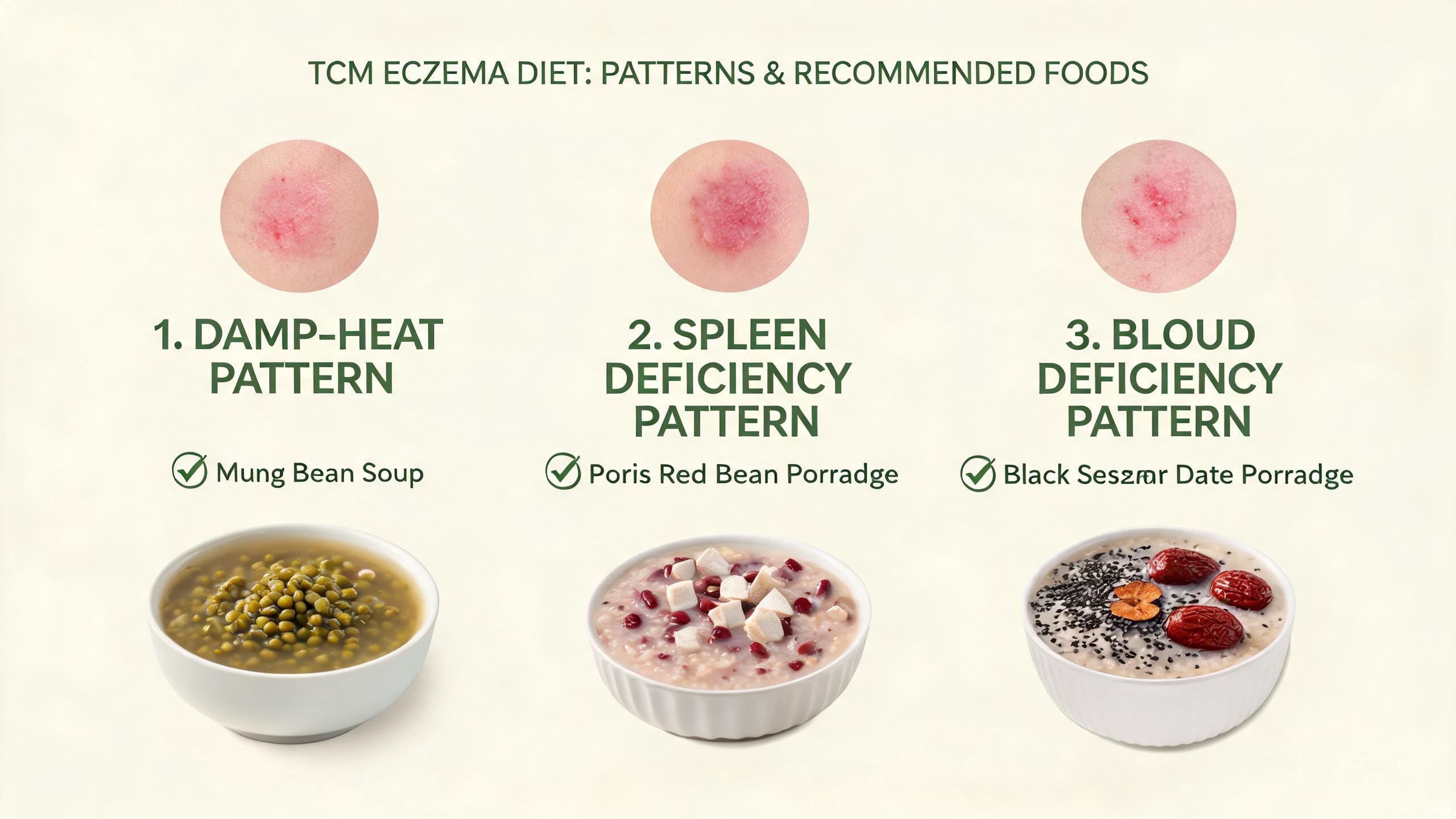
- TCM views eczema through three primary patterns: damp-heat affecting the skin, spleen deficiency with dampness, and blood deficiency with wind-dryness — each requiring a different food therapy approach.
- Five traditional recipes — from mung bean soup to black sesame date porridge — use ingredients available at Western supermarkets, Amazon, or iHerb.
- Damp-heat type eczema (red, oozing, itchy) calls for heat-clearing foods like mung beans and purslane, while blood deficiency type (dry, flaky) needs nourishing foods like black sesame and red dates.
- TCM traditionally advises avoiding fa wu (trigger foods) — spicy foods, seafood, beef, lamb, and alcohol — which may aggravate skin conditions.
- These are traditional wellness practices, not a treatment for eczema. Skin symptoms require evaluation by a qualified healthcare provider or dermatologist.
This article is for educational purposes only and is not medical advice. The foods, teas, and practices described here are traditional wellness practices rooted in Chinese culture. They are not a substitute for professional medical care, diagnosis, or treatment. Eczema (atopic dermatitis) is a medical condition that can cause significant discomfort, skin infections, and complications if not properly managed. Symptoms — including severe itching, oozing, crusting, widespread rash, or signs of infection (fever, pus, spreading redness) — require evaluation by a qualified healthcare provider or dermatologist. Never stop, delay, or replace prescribed treatment based on information in this article. Some foods and herbs may interact with medications or trigger allergic reactions — always inform your doctor about everything you consume. These statements have not been evaluated by the FDA and are not intended to diagnose, treat, cure, or prevent any disease. Read our full disclaimer →
Eczema — with its redness, itching, oozing, and flaking — is one of the most common skin concerns worldwide. While modern dermatology manages eczema with topical treatments and trigger avoidance, Traditional Chinese Medicine (TCM) offers a complementary food therapy tradition that views skin health as a reflection of internal balance. The skin, in TCM, is connected to the lungs, spleen, and blood — and what you eat directly affects how your skin looks and feels.
In TCM, eczema is understood through three primary patterns: damp-heat affecting the skin (湿热蕴肤), spleen deficiency with dampness accumulation (脾虚湿蕴), and blood deficiency with wind-dryness (血虚风燥). Each pattern produces distinct symptoms and calls for different foods. The five recipes below are matched to these patterns, using foods traditionally valued for clearing heat, draining dampness, strengthening the spleen, and nourishing the blood. All ingredients are available at Western supermarkets, Asian markets, Amazon, or iHerb.
If you are new to TCM concepts, our introduction to Traditional Chinese Medicine and guide to the Zang-Fu organ systems are helpful starting points. For related skin topics, see our guide to TCM for skin health.
How TCM Views Eczema
Traditional Chinese Medicine does not use the term "eczema" but recognizes the condition through classical names like shi chuang (damp sore) and jin yin chuang (wet money sore), which describe the oozing, crusting nature of the lesions. According to Chinese clinical TCM literature, three patterns are most commonly associated with eczema:
1. Damp-Heat Type (湿热型)
This is the most common pattern during acute eczema flare-ups. Heat and dampness accumulate beneath the skin, causing inflammation and fluid to weep from the lesions. Signs include red patches, small blisters, oozing fluid, and intense itching. The skin feels warm to the touch, and the lesions may crust over. This pattern is often triggered by eating spicy, greasy, or sweet foods, by emotional stress, or by hot, humid weather. Damp-heat type eczema often appears on the face, hands, and skin folds.
2. Spleen Deficiency Type (脾虚型)
When the spleen is weak, it cannot properly transform and transport fluids, leading to internal dampness that surfaces through the skin. Signs include skin that is pale or dull in color, with clear or thin oozing fluid (rather than thick or yellow). The lesions may be less red but are persistent and slow to heal. Accompanying signs include poor appetite, fatigue, loose stools, and bloating after eating. This pattern is common in children and in adults with chronic digestive weakness. For more on the spleen's role, see our TCM for digestion guide.
3. Blood Deficiency Type (血虚型)
In TCM, blood nourishes and moistens the skin. When blood is deficient — from chronic illness, aging, poor nutrition, or prolonged spleen weakness — the skin loses its moisture and the "wind" of dryness stirs, causing itching. Signs include dry, rough, flaky skin with fine scaling, itching that worsens at night, and skin that looks thin or dull. The lesions are chronic and may thicken over time (lichenification). This pattern is common in chronic, long-standing eczema and in older adults. For more on blood nourishment, see our blood-nourishing foods guide.
Understanding these three patterns is essential because the same food can help or harm depending on the type. For example, cooling mung beans are ideal for damp-heat type eczema but may be too cooling for someone with spleen deficiency. Conversely, nourishing black sesame is perfect for blood deficiency but may feel heavy for someone with active damp-heat oozing. The recipes below are matched to each pattern.
5 Food Therapy Recipes for Skin Wellness
Each recipe below is matched to a specific TCM pattern. Choose the one that best fits your situation, and use it consistently for two to four weeks. All ingredients are available at Western supermarkets, Asian markets, Amazon, or iHerb.
1. Mung Bean Soup (绿豆汤)
Best for: Damp-heat type eczema (red, oozing, itchy lesions)
TCM nature and flavor: Mung bean (lu dou): sweet, cold. Enters the Heart and Stomach channels.
Traditional use: Mung bean is one of TCM's most valued heat-clearing and detoxifying foods. It is traditionally used to clear summer heat, resolve toxicity, and cool the blood. For damp-heat type eczema with red, inflamed, oozing lesions, mung bean soup provides gentle internal cooling that may support the body's natural balance. In Chinese households, mung bean soup is a staple summer food, consumed to prevent heat-related conditions. Modern nutrition recognizes mung beans as a source of protein, fiber, and antioxidants.
Ingredients:
- 1/2 cup dried mung beans — widely available at supermarkets, Amazon, or iHerb
- 4 cups water
- Optional: a small amount of rock sugar or honey to taste
Preparation: Rinse the mung beans. In a pot, combine the beans and water. Bring to a boil, then reduce heat and simmer for 30 to 40 minutes until the beans are soft and the liquid turns slightly green and cloudy. For a lighter, more cooling effect, strain and drink just the liquid. For a more nourishing version, blend the beans into the liquid. Add a small amount of rock sugar or honey if desired. Drink 1 bowl per day, preferably in the morning or midday (not on an empty stomach if you have sensitive digestion). For more on mung beans, see our mung bean congee guide.
Precautions: Mung beans are cold in nature. Avoid if you have a cold constitution with diarrhea, or during the menstrual period if you tend toward cold. If the soup feels too cooling, add 2 to 3 slices of fresh ginger.
2. Winter Melon Coix Porridge (冬瓜薏米粥)
Best for: Damp-heat and spleen deficiency with dampness (transitional pattern)
TCM nature and flavor: Winter melon (dong gua): sweet, mild, cool. Enters the Lung, Spleen, and Bladder channels. Coix seed (yi yi ren / Job's tears): sweet, bland, slightly cool. Enters the Spleen, Lung, and Kidney channels. Rice: sweet, neutral. Enters the Spleen and Stomach channels.
Traditional use: This porridge bridges the damp-heat and spleen deficiency patterns. Winter melon clears heat and promotes urination, helping to drain damp-heat from the body. Coix seed drains dampness and strengthens the spleen, addressing the root of chronic dampness. Rice provides a gentle, easily digested base that supports the spleen. Together, this porridge is ideal for eczema where dampness is the central issue — whether from acute damp-heat or chronic spleen weakness producing internal dampness.
Ingredients:
- 1/2 cup winter melon, peeled and diced (available at Asian markets; zucchini can substitute)
- 1/4 cup dried coix seed (Job's tears) — available on Amazon or iHerb
- 1/2 cup white rice (short or medium grain)
- 5 cups water
- A pinch of sea salt
Preparation: Soak the coix seed for 2 to 4 hours. Rinse the rice. In a pot, combine the rice, soaked coix seed, and water. Bring to a boil, then reduce heat and simmer for 30 minutes. Add the winter melon and cook for another 15 minutes until the porridge is thick and the melon is translucent. Add salt to taste. Eat 1 bowl per day, ideally in the morning. For more on congee-style cooking, see our congee guide.
Precautions: Coix seed is traditionally avoided in large amounts during pregnancy. Both ingredients are mildly cooling; add ginger if you have a cold constitution.
3. Poria Red Bean Porridge (茯苓赤小豆粥)
Best for: Spleen deficiency type eczema (pale skin, thin oozing, fatigue)
TCM nature and flavor: Poria (fu ling): sweet, bland, neutral. Enters the Heart, Spleen, and Kidney channels. Adzuki bean (chi xiao dou): sweet, sour, neutral. Enters the Heart and Small Intestine channels. Rice: sweet, neutral.
Traditional use: This porridge targets the root of spleen-deficiency eczema by strengthening the spleen and draining dampness simultaneously. Poria is a medicinal mushroom traditionally used to drain dampness, strengthen the spleen, and calm the mind. Adzuki bean is traditionally used to drain dampness, reduce swelling, and support healthy fluid metabolism. Together with rice, this porridge provides gentle, sustained nourishment for the digestive system — which in TCM is the foundation of healthy skin. This recipe is particularly suited for children and adults with chronic, low-grade eczema accompanied by digestive weakness.
Ingredients:
- 15 grams dried poria slices or powder (fu ling) — available on Amazon or iHerb
- 1/4 cup dried adzuki beans — available at Asian markets, Amazon, or iHerb
- 1/2 cup white rice
- 5 cups water
- A pinch of sea salt
Preparation: Soak the adzuki beans for 3 to 4 hours. Rinse the rice. In a pot, combine the rice, soaked adzuki beans, poria, and water. Bring to a boil, then reduce heat and simmer for 45 to 60 minutes until the beans are very soft and the porridge is thick. Add salt to taste. Eat 1 bowl per day, ideally in the morning or at lunch. The poria can be left in the porridge (it is edible) or strained out.
Precautions: Poria is generally gentle and neutral. If you take immunosuppressant medication or diuretics, consult your healthcare provider. Adzuki beans and poria are both draining; ensure you stay well hydrated.
Dried poria (fu ling) is available in slices or powder on Amazon and iHerb. It is a white, mildly sweet medicinal mushroom with a neutral flavor that blends easily into porridges and soups. Adzuki beans (small red beans) are available at Asian markets, Amazon, and iHerb — they are different from regular red kidney beans. For more on dampness-draining foods, see our dampness-removing foods guide.
4. Black Sesame Date Porridge (黑芝麻红枣粥)
Best for: Blood deficiency type eczema (dry, flaky, chronically itchy skin)
TCM nature and flavor: Black sesame (hei zhi ma): sweet, neutral. Enters the Liver and Kidney channels. Red dates (hong zao / jujubes): sweet, warm. Enters the Spleen and Stomach channels. Rice: sweet, neutral.
Traditional use: When eczema has become chronic and the skin is dry, thin, and flaky, the TCM approach shifts from clearing to nourishing. Black sesame is one of the most important blood-nourishing and kidney-tonifying foods in TCM, traditionally used to nourish blood, moisturize dryness, and support the skin and hair. Red dates (jujubes) tonify the spleen, nourish blood, and harmonize the digestive system. Together, this porridge provides deep nourishment for the blood and skin — addressing the underlying deficiency that allows wind-dryness to stir. Modern nutrition recognizes black sesame as a source of healthy fats, vitamin E, and minerals.
Ingredients:
- 2 tablespoons black sesame seeds — widely available at supermarkets, Amazon, or iHerb
- 6 dried red dates (jujubes), pitted — available at Asian markets, Amazon, or iHerb
- 1/2 cup white rice
- 5 cups water
- A pinch of sea salt
Preparation: Lightly toast the black sesame seeds in a dry pan for 2 to 3 minutes until fragrant, then grind coarsely (optional but improves nutrient absorption). Rinse the rice and red dates. In a pot, combine the rice, red dates, and water. Bring to a boil, then reduce heat and simmer for 40 minutes until the porridge is thick. Stir in the ground black sesame seeds in the last 5 minutes. Add salt to taste. Eat 1 bowl per day, ideally in the morning or evening. For more on blood-nourishing foods, see our blood-nourishing foods guide.
Precautions: This is a nourishing, warming porridge. If you have active damp-heat (red, oozing lesions), clear the heat first with recipes 1 or 5 before using this nourishing porridge. Red dates are sweet; if you have blood sugar concerns, use fewer dates. See our blood sugar guide for more.
5. Fresh Purslane Soup (鲜马齿苋汤)
Best for: Damp-heat type eczema with oozing and crusting
TCM nature and flavor: Purslane (ma chi xian): sour, cold. Enters the Large Intestine and Liver channels. Garlic: pungent, warm. Enters the Spleen, Stomach, and Lung channels.
Traditional use: Purslane is one of TCM's most valued heat-clearing and detoxifying wild vegetables. It is traditionally used to clear damp-heat, cool the blood, and reduce skin inflammation. For eczema with red, oozing, crusted lesions, purslane's cooling and detoxifying nature is particularly relevant. In Chinese folk medicine, fresh purslane is also applied topically as a poultice for skin conditions, but the internal soup is the more common food therapy approach. A small amount of garlic adds flavor and provides a gentle warming counterbalance to purslane's cold nature.
Ingredients:
- 1 cup fresh purslane (or 30 grams dried purslane) — available on Amazon or iHerb; fresh purslane may be found at farmers' markets
- 2 cloves garlic, minced
- 4 cups vegetable or chicken broth (low sodium)
- 1 teaspoon sesame oil or olive oil
- A pinch of sea salt
Preparation: If using fresh purslane, wash thoroughly and chop roughly. If using dried purslane, soak for 20 minutes. In a pot, heat the oil and saute the garlic briefly until fragrant (30 seconds). Add the broth and bring to a boil. Add the purslane and simmer for 10 minutes until tender. Add salt to taste. Drink 1 bowl per day, ideally at lunch. Fresh purslane can also be foraged in many regions, but only harvest from pesticide-free areas.
Precautions: Purslane is cold in nature. Avoid if you have a cold constitution, chronic diarrhea, or during pregnancy. If the soup feels too cooling, add extra garlic or a slice of ginger to balance it.
Comparison of the Five Recipes
| Recipe | TCM Pattern | Key Action | Frequency |
|---|---|---|---|
| Mung Bean Soup | Damp-Heat (acute) | Clear heat, detoxify, cool blood | 1 bowl daily |
| Winter Melon Coix Porridge | Damp-Heat + Spleen Def. | Clear heat, drain dampness, strengthen spleen | 1 bowl daily |
| Poria Red Bean Porridge | Spleen Deficiency | Strengthen spleen, drain dampness | 1 bowl daily |
| Black Sesame Date Porridge | Blood Deficiency | Nourish blood, moisturize skin | 1 bowl daily |
| Fresh Purslane Soup | Damp-Heat (oozing) | Clear heat, detoxify, cool blood | 1 bowl daily |
Dietary Restrictions: Understanding Fa Wu (Trigger Foods)
A distinctive feature of TCM dietary guidance for skin conditions is the concept of fa wu (发物) — foods that are traditionally believed to "stir up" or trigger disease. In TCM, certain foods are thought to generate wind, heat, or dampness that can worsen skin conditions like eczema. While this concept predates modern allergy science, it overlaps with many known dietary triggers for inflammatory skin conditions. TCM traditionally advises people with eczema to avoid or limit the following:
- Spicy foods — chili, pepper, curry, and other pungent spices generate internal heat that can worsen redness and itching.
- Seafood — especially shrimp, crab, and shellfish, which TCM classifies as generating wind and dampness. Many people with eczema report flare-ups after seafood.
- Beef and lamb — considered warm and heating in TCM; may aggravate damp-heat patterns. Chicken and pork are generally considered gentler.
- Alcohol — generates damp-heat and impairs spleen function; one of the most important triggers to avoid during flare-ups.
- Excessive raw, cold, and greasy foods — weaken the spleen and generate dampness, which can surface through the skin.
Not everyone reacts to all of these foods. TCM encourages individualized observation — notice which foods seem to correlate with flare-ups and adjust accordingly. For more on TCM dietary principles, see our hot vs. cold constitution guide and dampness-removing foods guide.
Frequently Asked Questions
What does TCM say about eczema?
In Traditional Chinese Medicine, eczema is understood through three primary patterns: damp-heat affecting the skin (red, oozing, itchy lesions), spleen deficiency with dampness (pale skin, thin clear fluid, fatigue), and blood deficiency with wind-dryness (dry, flaky, chronically itchy skin). Each pattern requires a different food therapy approach — clearing heat for damp-heat type, strengthening the spleen for spleen deficiency type, and nourishing the blood for blood deficiency type. TCM also emphasizes avoiding fa wu (trigger foods) like spicy foods, seafood, beef, lamb, and alcohol. These are traditional wellness concepts, not medical diagnoses. For a deeper understanding, see our zang-fu organ guide.
Which Chinese medicine foods may support skin wellness for eczema?
Five traditional TCM food therapy recipes for eczema include mung bean soup, winter melon coix porridge, poria red bean porridge, black sesame date porridge, and fresh purslane soup. These recipes use ingredients available at Western supermarkets, Asian markets, Amazon, or iHerb. Heat-clearing recipes (mung bean, purslane) are best for damp-heat type eczema with red, oozing lesions. The spleen-strengthening recipes (poria red bean, winter melon coix) address chronic dampness. The blood-nourishing recipe (black sesame date) is ideal for dry, chronic eczema. They are traditional wellness foods, not treatments for eczema or any medical condition.
What foods should people with eczema avoid according to TCM?
In TCM, foods classified as fa wu (trigger foods) are traditionally discouraged for eczema, including spicy foods (chili, pepper, curry), seafood (especially shrimp and crab), beef, lamb, alcohol, and other foods considered to generate damp-heat or stir up wind. TCM also recommends avoiding excessive raw, cold, and greasy foods that weaken the spleen and generate dampness. Not everyone reacts to all of these foods — TCM encourages individualized observation. These are traditional dietary guidelines, not medical prescriptions. Always consult your healthcare provider or dermatologist before making significant dietary changes.
Can mung beans help with eczema?
Mung beans are one of the most commonly used TCM foods for clearing heat and detoxifying the body. They are traditionally recommended for damp-heat type eczema characterized by red, inflamed, oozing lesions. Mung bean soup is a simple, cooling food that may support overall skin wellness during acute flare-ups. However, mung beans are cold in nature and may not be suitable for spleen deficiency or blood deficiency type eczema. Mung beans are a traditional wellness food, not a treatment for eczema. Consult your healthcare provider before making dietary changes, especially if you have a diagnosed skin condition. For more, see our mung bean congee guide.
Precautions and When to Seek Help
While TCM food therapy may support general wellness, eczema is a medical condition that requires professional evaluation and management:
- See a dermatologist for proper diagnosis and treatment. Eczema can resemble other skin conditions (psoriasis, contact dermatitis, fungal infections) that require different approaches.
- Seek prompt medical attention if you experience signs of skin infection — increased pain, swelling, warmth, pus, yellow crusting, fever, or spreading redness. Eczema lesions can become infected, especially with bacteria like Staphylococcus aureus.
- Severe or widespread eczema may require prescription topical or systemic medications. Do not discontinue prescribed treatments without your doctor's guidance.
- Food allergies. Some of the ingredients in these recipes (especially sesame, seafood-adjacent foods) can themselves be allergens. If you have known food allergies, check all ingredients carefully before use.
- Not a substitute. TCM food therapy is complementary. It sits alongside — never in place of — professional medical care.
For related topics, see our guides on TCM for skin health, blood-nourishing foods, and dampness-removing foods.
The Bottom Line
Traditional Chinese Medicine offers a nuanced, pattern-based approach to skin wellness that complements — but never replaces — medical dermatology. By understanding whether your eczema is rooted in damp-heat, spleen deficiency, or blood deficiency, you can choose foods that work with your body's specific needs. Mung bean soup and purslane soup clear heat and detoxify for acute, red, oozing flare-ups. Winter melon coix porridge and poria red bean porridge strengthen the spleen to address the root of chronic dampness. And black sesame date porridge deeply nourishes the blood for dry, chronic, flaky skin. Paired with the TCM guidance to avoid trigger foods (spicy, seafood, beef, lamb, alcohol) and to support digestion with warm, cooked, easily digested meals, these traditional practices form a whole-person approach to skin wellness.
But they are traditions — not treatments, and not a replacement for medical care. Eczema requires evaluation and management by a qualified healthcare provider or dermatologist. Use these traditional practices only as complementary wellness habits, alongside your doctor's guidance.
This article shares traditional wellness practices for educational purposes only. It is not a substitute for medical advice, diagnosis, or treatment. The foods, teas, and practices described here are not intended to treat, cure, or prevent any disease, including eczema, atopic dermatitis, contact dermatitis, or skin infections. If you have skin symptoms — including severe itching, oozing, crusting, widespread rash, or signs of infection — consult your healthcare provider or dermatologist promptly for proper evaluation. Some ingredients may be allergens; check all foods carefully if you have known allergies. These statements have not been evaluated by the FDA. Never stop or adjust prescribed treatment without your doctor's explicit guidance. Read our full disclaimer →