Key Takeaways
- TCM divides under-eye concerns into two categories: puffiness (eye bags), primarily linked to the Spleen and dampness accumulation; and dark color, primarily linked to the Kidney (essence) and Liver (blood).
- The Kidney governs the area beneath the eyes; the Liver opens into the eyes. Liver blood deficiency and kidney essence deficiency are the most common patterns behind dark circles.
- Eye bags are most often a sign of Spleen Qi deficiency with dampness — the Spleen cannot properly transform fluids, which settle under the eyes.
- The Chinamaxxing toolkit for the under-eye area includes chilled jade rolling, Gua Sha lymphatic drainage, acupressure, Kidney and Spleen nourishing foods, and sleep before 11 PM.
- These are traditional wellness practices — not treatments for medical conditions. Dark circles and eye bags can indicate allergies, thyroid issues, or kidney disease — always consult a healthcare provider for persistent or concerning changes.
This article is for educational purposes only and is not medical advice. The practices described are traditional wellness practices rooted in Chinese culture. They are not intended to diagnose, treat, cure, or prevent any disease. Eye bags and dark circles can result from genetics, allergies, thyroid disease, kidney disease, pigmentation disorders, medication side effects, and other medical conditions. Always consult a qualified healthcare provider for persistent or concerning symptoms. Read our full disclaimer →
Eye bags and dark circles are perhaps the most universal beauty concern — and the reason the Chinamaxxing eye care toolkit has gone viral. Western beauty culture typically addresses them with concealers, caffeine creams, and under-eye patches. TCM takes a fundamentally different approach: it asks what the under-eye area is telling you about the body's internal state. The answer, in TCM, involves three organ systems — the Kidney, the Liver, and the Spleen — and understanding which one is involved is the key to choosing the right practices.
This guide covers the TCM root-cause analysis of eye bags and dark circles, the tools and techniques of the Chinamaxxing eye care routine, and a practical daily protocol. For a food-therapy focused approach, see our detailed TCM for dark circles guide. For foundational concepts, see our Zang-Fu organ guide.
TCM Root Causes: Three Organ Systems
TCM distinguishes between eye bags (puffiness) and dark circles (color), though they often appear together. Each is linked to a different primary organ system.
1. The Kidney — Dark Color and Sunken Appearance
In TCM, the Kidney system governs the area beneath the eyes. The Kidneys store essence (Jing) — the body's foundational substance. When kidney essence is abundant, the under-eye area is full, firm, and bright. When essence is depleted — from aging, overwork, chronic stress, or inadequate sleep — the under-eye area loses its support: skin appears thin, darkened, or sunken. Deep, persistent dark circles with a hollowed look are the classic sign of kidney essence deficiency. See our yin and yang guide for Kidney theory.
2. The Liver — Dark Color and Dryness
The Liver stores Blood and opens into the eyes. When liver blood is abundant, the eyes are bright and the surrounding skin is nourished. When liver blood is deficient — from poor sleep, excessive screen time, stress, or poor nutrition — the delicate under-eye skin loses its blood supply and appears darkened, pale, or sallow. The TCM principle "prolonged looking exhausts blood" directly connects modern screen life to dark circles. The Liver is most active between 1 AM and 3 AM, so late nights are a primary cause. See our liver qi stagnation guide.
3. The Spleen — Puffiness and Eye Bags
Eye bags are most commonly a Spleen issue. The Spleen is responsible for transforming and transporting fluids. When Spleen Qi is weak — from a diet high in cold, raw, or sweet foods, from overthinking, or from irregular eating — fluids accumulate as dampness, which has a tendency to settle in the lower body, including under the eyes. The result is morning puffiness and visible eye bags. Spleen Qi deficiency with dampness is the pattern behind puffy under-eyes. See our spleen health guide and edema diet guide.
The Chinamaxxing Eye Care Toolkit
1. Chilled Jade Roller — Morning Depuffing
The jade roller's small end is designed for the under-eye area. Chilled in the refrigerator, its cooling, gentle pressure moves lymphatic fluid and reduces morning puffiness. Roll very lightly from the inner corner outward to the temple, 3 strokes per side. The weight of the roller itself is enough pressure. See our jade roller guide for full technique. Search "jade roller" on Amazon.
2. Gua Sha Lymphatic Drainage
For deeper puffiness, Gua Sha is more effective than the jade roller. Using the smallest notched edge of a Gua Sha stone with facial oil, sweep very gently from the inner under-eye outward to the temple, then down to the collarbone. Always begin with neck drainage strokes first. See our Gua Sha for facial puffiness guide and our Gua Sha for face guide.
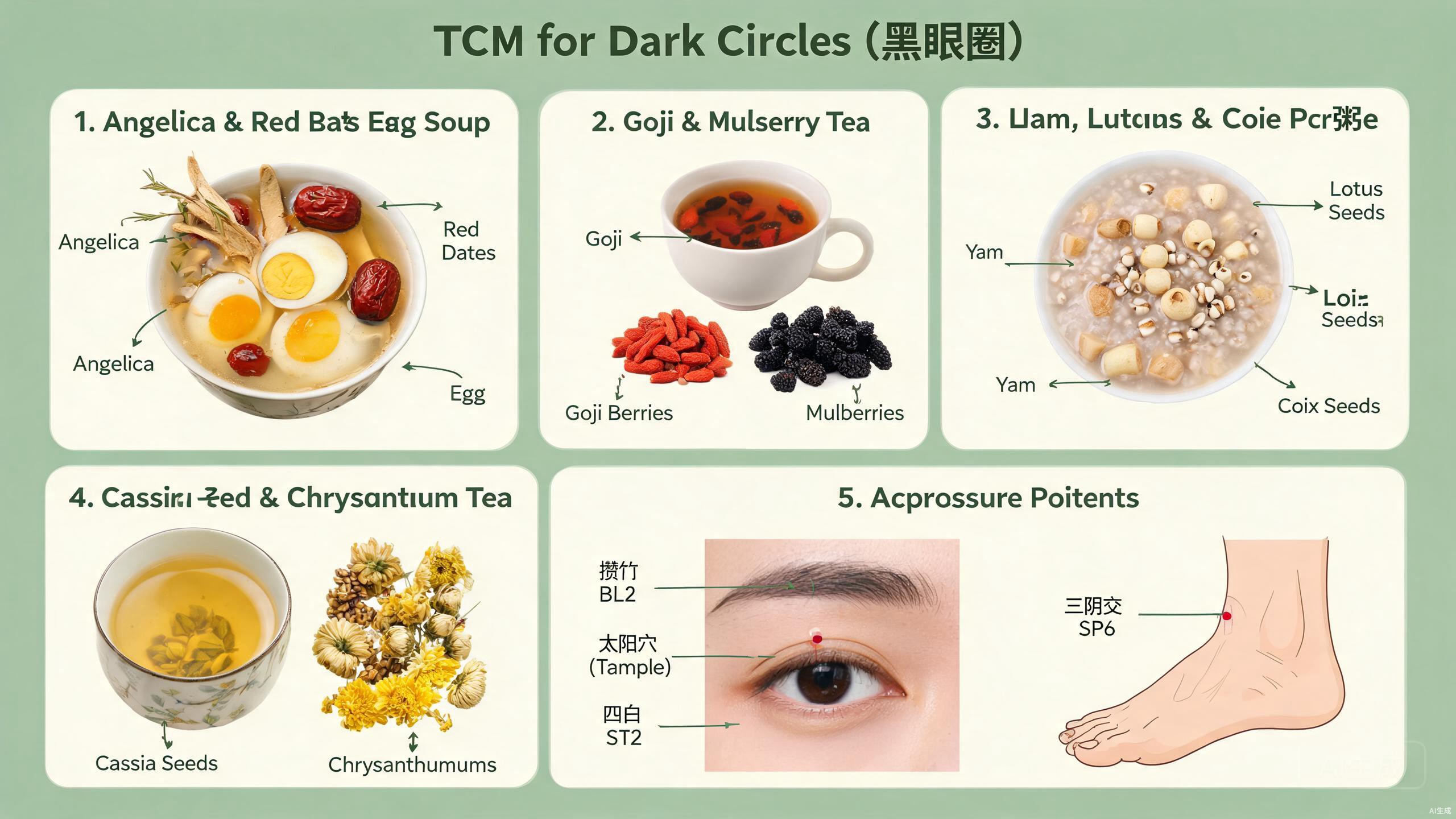
3. Acupressure Points for the Eye Area
- Cuanzhu (BL2) — at the inner end of the eyebrow. Press gently for 30 seconds per side. Dispels wind-heat and supports vision.
- Sibai (ST2) — below the eye in the infraorbital notch. Press very gently for 20 seconds per side. Supports the Stomach channel that crosses the cheek — relevant for the Spleen/dampness pattern.
- Taiyang (EX-HN5) — at the temples. Press with circular motions for 30 seconds per side. Relieves eye strain and temporal tension.
- Fengchi (GB20) — at the base of the skull. Press for 30 seconds per side. Supports blood flow to the head. See our acupressure for headache guide.
4. Internal Support: Foods for Each Pattern
For dark circles (Kidney/Liver deficiency), include blood-and-essence nourishing foods:
- Black sesame and walnuts — nourish kidney essence.
- Goji berries and mulberries — nourish liver and kidney yin.
- Red dates — support blood production.
For eye bags (Spleen/dampness), include dampness-draining foods:
- Chinese yam and lotus seeds — strengthen the Spleen.
- Coix seed (Job's tears) — drain dampness.
- Warm, cooked foods — soups, porridges, steamed vegetables — instead of cold, raw, or sweet foods that weaken the Spleen.
See our TCM for dark circles guide for full recipes and our anti-aging foods guide for kidney-nourishing recipes.
A Daily Protocol for the Under-Eye Area
Morning (3 minutes): After cleansing, apply serum. Use a chilled jade roller: 5 downward strokes on each side of the neck, then 3 light outward strokes under each eye. Press Cuanzhu (BL2) and Taiyang (EX-HN5) for 30 seconds each.
Evening (5 minutes): After applying facial oil, do Gua Sha neck drainage (5 strokes per side), then gentle under-eye sweeps (3 per side). Press Sibai (ST2) and Fengchi (GB20) for 30 seconds each.
Daily: Sip warm water throughout the day. Eat warm, cooked foods. Include kidney-nourishing or dampness-draining foods depending on your pattern. Be in bed before 11 PM.
When Eye Bags and Dark Circles Signal a Medical Issue
It is essential to understand that TCM wellness practices are not a substitute for medical evaluation. Eye bags and dark circles can signal:
- Allergies — "allergic shiners" from nasal congestion are a common cause of dark circles. If accompanied by sneezing, itching, or congestion, see an allergist.
- Thyroid disease — both hypo- and hyperthyroidism can affect the eye area. If accompanied by weight changes, fatigue, or temperature sensitivity, ask your doctor to check thyroid function.
- Kidney disease — persistent, pronounced under-eye puffiness can be a sign of kidney dysfunction, especially with ankle swelling or changes in urination. Seek medical evaluation.
- Iron deficiency anemia — a common cause of pale, darkened under-eyes. Simple blood testing can diagnose this. See our TCM for anemia guide.
- Medication side effects — some medications cause fluid retention or skin pigmentation changes.
If eye bags or dark circles are sudden, persistent, worsening, or accompanied by other symptoms, consult a healthcare provider. TCM practices are complementary — never a replacement for medical care.
Frequently Asked Questions
What do eye bags mean in TCM?
In TCM, eye bags (puffiness under the eyes) are most commonly attributed to Spleen Qi deficiency with dampness. The Spleen is responsible for transforming and transporting fluids; when it is weak, fluids accumulate as dampness and settle under the eyes. This is often related to a diet high in cold, raw, or sweet foods, overthinking, and irregular eating. Eye bags are distinct from dark circles (color), which are more commonly linked to Kidney essence deficiency and Liver blood deficiency. TCM addresses eye bags by strengthening the Spleen and draining dampness through foods like Chinese yam, lotus seeds, and coix seed.
What do dark circles mean in TCM?
TCM attributes dark circles primarily to Kidney essence deficiency and Liver blood deficiency. The Kidney governs the area beneath the eyes; when essence is depleted, the skin appears thin and darkened. The Liver stores Blood and opens into the eyes; when liver blood is deficient from poor sleep, stress, or screen time, the under-eye skin loses nourishment. Qi and blood stagnation from stress or cold can also cause a purplish darkening. TCM food therapy traditionally uses black sesame, walnuts, goji berries, and red dates to nourish kidney essence and liver blood.
Can jade rolling and Gua Sha help with eye bags?
Chilled jade rolling and gentle Gua Sha lymphatic drainage can help reduce morning puffiness by moving lymphatic fluid away from the under-eye area. The cooling property of jade is valued in TCM for clearing mild heat and calming inflammation. However, these are wellness practices that address the symptom (fluid accumulation), not the root cause (Spleen deficiency). For lasting results, combine external practices with internal support: warm, cooked, Spleen-strengthening foods and adequate sleep. These practices do not treat eye bags caused by allergies, thyroid disease, or kidney issues — consult a healthcare provider for persistent concerns.
Does sleep affect eye bags and dark circles in TCM?
Yes, profoundly. TCM considers sleep the most important factor for under-eye wellness. The Liver restores Blood between 1 AM and 3 AM; chronic late nights directly deplete liver blood, causing dark circles. The Gallbladder time (11 PM to 1 AM) is when the body should enter deep rest. Going to bed before 11 PM is the single most important habit for under-eye vitality. No food, tool, or practice can compensate for chronic sleep deprivation. See our TCM sleep body clock guide and insomnia types guide for practical sleep guidance.
The Bottom Line
The Chinamaxxing approach to eye bags and dark circles is a model of TCM's diagnostic sophistication: it distinguishes puffiness (Spleen, dampness) from color (Kidney essence, Liver blood), and addresses each with targeted practices. The jade roller and Gua Sha provide external support for lymphatic drainage and circulation; acupressure activates the meridians that traverse the eye area; and food therapy nourishes the internal organs whose health is reflected beneath the eyes. Above all, sleep before 11 PM remains the non-negotiable foundation.
But these are traditions — not treatments. Eye bags and dark circles can signal allergies, thyroid disease, kidney issues, anemia, or other medical conditions. Always consult a healthcare provider for persistent or concerning changes. The TCM approach is complementary: it supports overall wellness alongside, never in place of, professional medical care.
This article is for educational and informational purposes only and is not a substitute for professional medical advice, diagnosis, or treatment. Always consult a qualified healthcare provider before beginning any new wellness practice, especially if you are pregnant, nursing, taking medication, or have a medical condition. Read our full disclaimer →