Key Takeaways
- TCM does not seek to "reverse" aging — it seeks to nourish essence (Jing), Qi, and Blood so the body ages with vitality. The goal is youthful vitality, not the erasure of years.
- The Kidney system stores essence (Jing), the body's foundational reserves. The Spleen produces Qi and Blood from food. The Lung governs the skin. Anti-aging in TCM means supporting all three.
- Seven practices form the core: facial Gua Sha, jade rolling, facial acupressure, Kidney-nourishing foods, Lung-supporting breathing, Qi Gong movement, and sleep alignment.
- Consistency is the TCM way. Daily 10-minute practices over months yield more than occasional intensive treatments.
- These are traditional wellness practices — not medical treatments. They complement, never replace, professional healthcare.
This article is for educational purposes only and is not medical advice. The practices described are traditional wellness practices rooted in Chinese culture. They are not intended to diagnose, treat, cure, or prevent any disease or signs of aging. If you have a medical condition, take medication, are pregnant, or have concerns about age-related health, consult a qualified healthcare provider before beginning any new practice. Read our full disclaimer →
The Chinamaxxing movement has brought an unexpected idea to Western beauty culture: aging well is not about erasing years — it is about nourishing vitality. Traditional Chinese Medicine does not frame aging as an enemy to be defeated. Instead, it focuses on preserving Jing (essence), nurturing Qi (vital energy), and maintaining the smooth flow of Blood, so that the body ages with resilience, clarity, and radiance.
This is a fundamentally different mindset from the "anti-aging" narrative that dominates Western beauty marketing. In TCM, the face and body are reflections of internal health. A radiant complexion, strong hair, clear eyes, and supple skin are all outward signs of abundant Qi, Blood, and essence. The seven practices below are the traditional methods for cultivating that internal abundance — now embraced by a global audience.
For TCM foundations, see our introduction to Traditional Chinese Medicine, our Zang-Fu organ guide, and our Qi, Blood, and body fluids guide.
The TCM Theory of Aging
TCM locates the aging process in three core systems:
- The Kidney stores essence (Jing). Jing is the foundational substance of life, inherited from our parents and depleted over time. The Kidneys govern growth, reproduction, bones, hair, and the area under the eyes. As Kidney essence naturally declines with age, signs like graying hair, lower back weakness, drier skin, and reduced vitality appear. The TCM principle "the Kidney manifests in the hair" (肾其华在发) directly connects kidney health to hair vitality. See our yin and yang guide and TCM hair growth guide.
- The Spleen produces Qi and Blood. The Spleen transforms food into the Qi and Blood that nourish every tissue. When Spleen function is strong, the complexion is rosy and the muscles are toned. When it is weak, the face may look pale or sallow and energy flags. "When Qi and Blood are abundant, the complexion is rosy and radiant" (气血充盈则面色红润) is a foundational TCM beauty principle. See our spleen health guide.
- The Lung governs the skin and body hair (肺主皮毛). The Lung disperses Qi and fluids to the skin surface. Strong Lung Qi means moist, resilient skin. Weak Lung Qi contributes to dryness, dullness, and reduced skin barrier function.
The seven practices below directly support these three systems — externally through tools and touch, internally through food, breath, and movement.
The Seven Practices
1. Facial Gua Sha — Circulation and Lymphatic Support
The foundation of the Chinamaxxing facial routine. Using a smooth stone (rose quartz or Bian stone, available on Amazon) with facial oil, glide the tool outward and downward across the face with light pressure. This supports microcirculation, encourages lymphatic drainage, and releases tension in the facial muscles. Practice 3 to 5 times per week, 5 to 10 minutes per session. See our complete Gua Sha for face guide for the step-by-step routine.
2. Jade Rolling — Morning Depuffing and Cooling
The jade roller is the morning companion to Gua Sha. Its cooling, gentle rolling action moves lymphatic fluid and supports surface circulation. The TCM principle that jade is a cooling stone makes it especially suitable for morning puffiness and mild redness. Roll daily for 5 minutes after applying serum. See our TCM skin wellness guide for complementary practices.
3. Facial Acupressure — Supporting the Meridians
The face is traversed by six primary meridians. Gentle, consistent pressure on key points supports the flow of Qi and Blood. Three essential points:
- Yintang (EX-HN3) — between the eyebrows. Press gently for 1 minute to calm the mind and release forehead tension. See our Yintang guide.
- Taiyang (EX-HN5) — at the temples. Press with small circular motions for 30 seconds per side to ease eye strain and temporal tension.
- Sibai (ST2) — below the eye, in the infraorbital foramen. Press gently for 30 seconds per side to support the under-eye area and the Stomach meridian that crosses the cheek.
Practice daily as part of your morning or evening routine. See our acupressure safety guide for general precautions.
4. Kidney-Nourishing Foods — Supporting Essence from Within
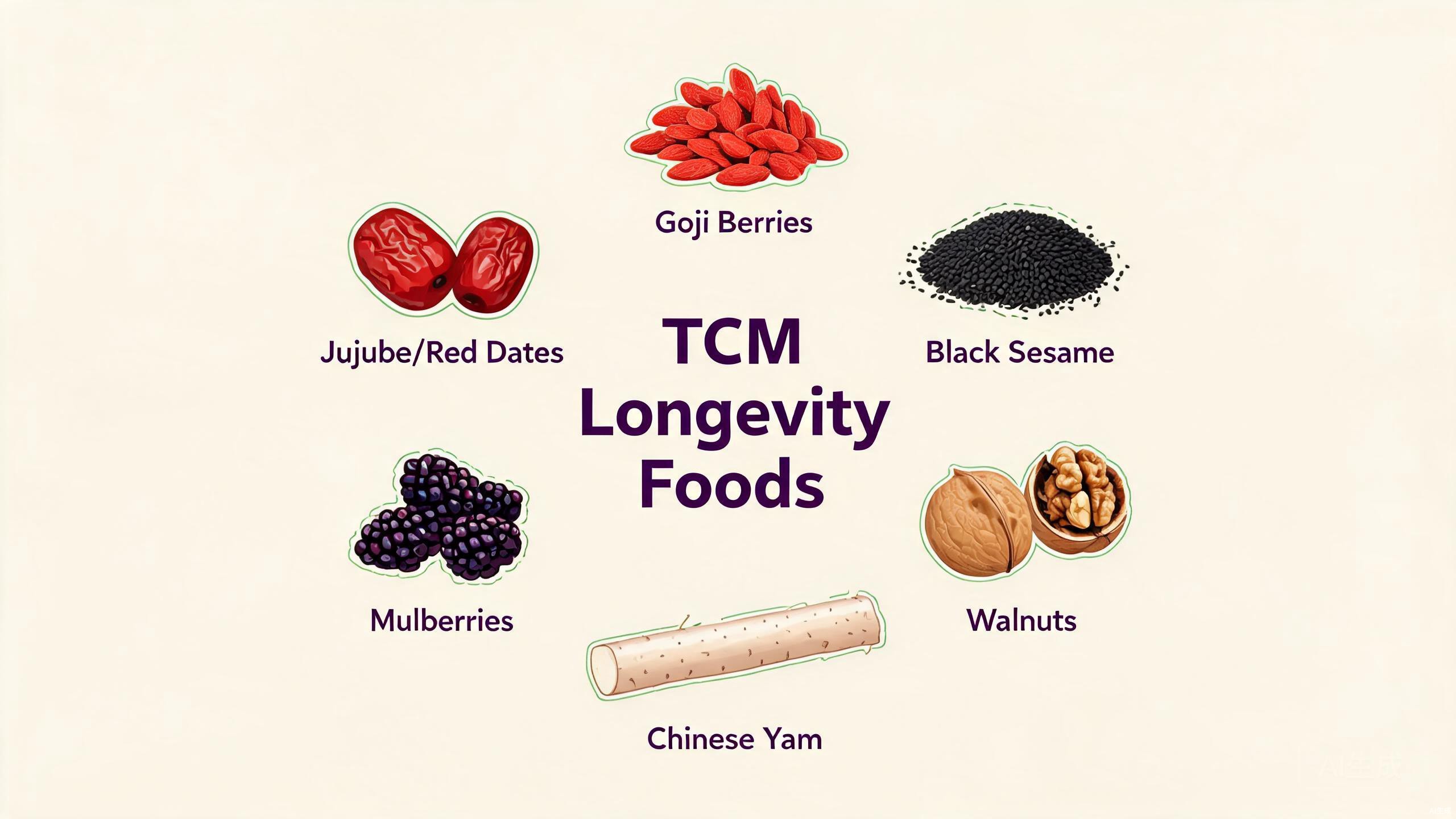
Since the Kidney stores essence, foods that nourish Kidney Jing are central to TCM anti-aging. Traditionally recommended foods (all available on Amazon or at Asian markets):
- Black sesame — traditionally used to nourish kidney and liver yin and darken the hair.
- Walnuts — traditionally used to tonify kidney yang and support the brain.
- Goji berries — traditionally used to nourish liver and kidney yin and brighten the eyes.
- Black beans and mulberries — dark-colored foods traditionally associated with kidney nourishment.
See our TCM anti-aging foods guide for recipes and detailed guidance.
5. Lung-Supporting Breathing — Feeding the Skin
Because the Lung governs the skin, breathing exercises that strengthen Lung Qi directly benefit the complexion. The simplest practice: abdominal breathing for 5 minutes daily. Sit comfortably, place one hand on your abdomen, and breathe slowly so the belly rises on the inhale and falls on the exhale. This strengthens the Lung's dispersing function and calms the Shen (spirit). For more structured practice, see our TCM breathing techniques guide and breathing for calm guide.
6. Qi Gong Movement — Circulating Qi Throughout the Body
Qi Gong is the TCM system of gentle movement, breath, and intention. It circulates Qi throughout the meridians, supporting every organ system. The Eight Brocades (Ba Duan Jin) is the most accessible form — eight movements that take 10 to 15 minutes. Two movements are particularly relevant for anti-aging: "Two Hands Hold Up the Sky" (supports the Triple Burner and overall Qi flow) and "Sway the Tail to Calm Fire" (supports the Kidney). Practice daily. See our Eight Brocades guide and Qi Gong for stress guide.
7. Sleep Alignment — The Body Clock
TCM views sleep as the most powerful anti-aging practice of all. The TCM body clock (organ clock) assigns specific hours to each organ system's peak activity. Two are critical for anti-aging:
- 11 PM to 1 AM — Gallbladder time. Falling asleep before 11 PM allows the body to enter deep rest and begin its nightly restoration.
- 1 AM to 3 AM — Liver time. The Liver restores and stores Blood during these hours. Chronic late nights directly deplete liver blood, which shows on the face as dullness and dark circles.
Going to bed before 11 PM is, in TCM terms, the single most important anti-aging habit. See our TCM sleep body clock guide and TCM insomnia types guide.
Morning (10 minutes): Jade roll, then 3 acupressure points (Yintang, Taiyang, Sibai). Evening (15 minutes): Gua Sha, then 5 minutes of abdominal breathing. Throughout the day: sip warm water, eat warm nourishing foods including kidney-nourishing ingredients, and do 10 minutes of Eight Brocades Qi Gong. In bed by 10:30 PM. Consistency over weeks is the TCM way — small daily practices compound into visible vitality.
Frequently Asked Questions
What is the TCM approach to anti-aging?
TCM does not seek to reverse aging. It focuses on nourishing the three systems most involved in the aging process: the Kidney (which stores essence and governs hair, bones, and the under-eye area), the Spleen (which produces Qi and Blood that nourish the complexion), and the Lung (which governs the skin). The goal is youthful vitality — abundant Qi, Blood, and essence — rather than the erasure of years. Seven core practices support these systems: facial Gua Sha, jade rolling, facial acupressure, kidney-nourishing foods, lung-supporting breathing, Qi Gong movement, and sleep alignment.
Which TCM foods support anti-aging?
TCM traditionally recommends foods that nourish Kidney essence, including black sesame, walnuts, goji berries, black beans, and mulberries. These dark-colored foods are traditionally associated with kidney nourishment through the principle that "like nourishes like." Foods that support Spleen Qi and Blood production — such as Chinese yam, red dates, and lotus seeds — are also important for maintaining a rosy, radiant complexion. See our TCM anti-aging foods guide for recipes.
Does sleep really matter for anti-aging in TCM?
Yes. In TCM, sleep is considered the most powerful anti-aging practice. The TCM body clock assigns 11 PM to 1 AM to the Gallbladder and 1 AM to 3 AM to the Liver. The Liver restores and stores Blood during its peak hours. Chronic late nights directly deplete liver blood, which manifests as dullness, dark circles, and dry skin. Going to bed before 11 PM allows the body to enter deep rest before this crucial restoration period. No food, tool, or practice can compensate for chronic sleep deprivation.
Can Gua Sha and jade rolling help with aging skin?
Facial Gua Sha and jade rolling are traditional practices that support circulation, lymphatic drainage, and facial muscle relaxation. With consistent use, many people notice improved tone, reduced puffiness, and a healthier glow. However, these are wellness practices, not medical treatments. They do not reverse aging, change skin structure, or replace dermatological care. They are best used as part of a whole-person routine that includes nourishing food, adequate sleep, and stress management.
The Bottom Line
The Chinamaxxing approach to anti-aging is, at its heart, a return to a holistic worldview: the face reflects the body, and the body reflects how we live. The seven practices — Gua Sha, jade rolling, acupressure, kidney-nourishing foods, breathing, Qi Gong, and sleep alignment — are not isolated beauty hacks. They are interconnected traditions that support the Kidney, Spleen, and Lung systems, the three pillars of TCM aging theory. Practiced consistently, they cultivate the abundant Qi, Blood, and essence that TCM considers the true foundation of youthful vitality.
But they are traditions — not treatments, and not a replacement for professional medical care. If you have age-related health concerns, consult a qualified healthcare provider. The TCM approach to aging is not about fighting time; it is about living so well that time leaves a gentler mark.
This article is for educational and informational purposes only and is not a substitute for professional medical advice, diagnosis, or treatment. Always consult a qualified healthcare provider before beginning any new wellness practice, especially if you are pregnant, nursing, taking medication, or have a medical condition. Read our full disclaimer →