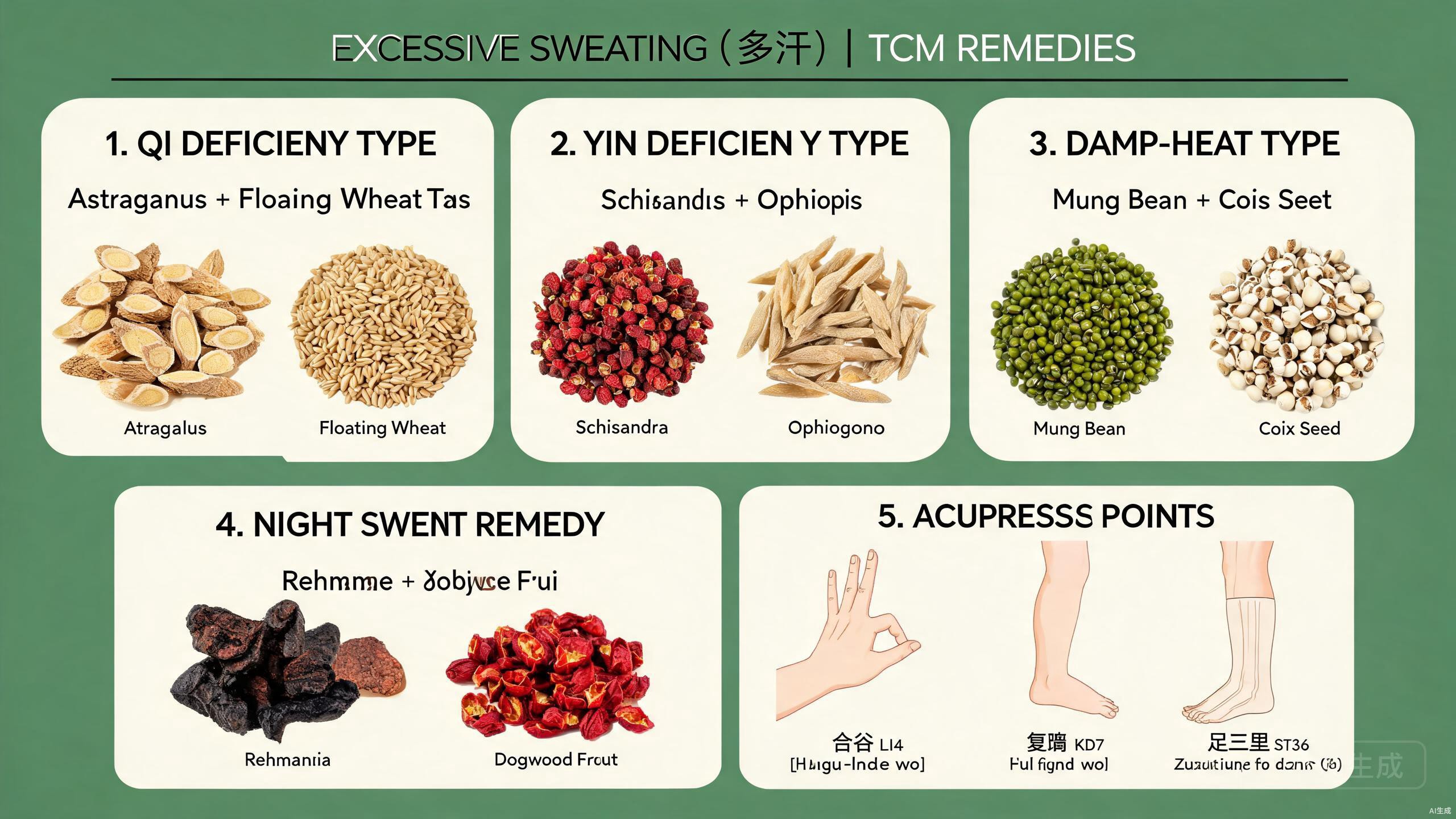
Key Takeaways
- TCM views excessive sweating through four patterns: qi deficiency spontaneous sweating (daytime, worsens with activity), yin deficiency night sweating (during sleep), damp-heat internal accumulation (heavy, sticky sweat), and nutritive-defensive qi disharmony (inconsistent sweating with temperature sensitivity).
- In TCM theory, sweat is the fluid of the Heart, and the Lungs govern the skin and body surface where sweating occurs — both organ systems are central to understanding perspiration.
- Five traditional food therapy recipes — from yam date millet porridge to silver ear lily duck soup — use ingredients available at Western supermarkets, Asian markets, Amazon, or iHerb.
- Three acupressure points — Hegu (LI4), Fuliu (KD7), and Zusanli (ST36) — are traditionally used to regulate sweating, tonify qi, and nourish yin.
- These are traditional wellness practices, not a treatment for any medical condition. Excessive sweating accompanied by weight loss, palpitations, or fever requires prompt medical evaluation.
This article is for educational purposes only and is not medical advice. The foods, teas, and practices described here are traditional wellness practices rooted in Chinese culture. They are not a substitute for professional medical care, diagnosis, or treatment. Excessive sweating can be a symptom of underlying medical conditions including hyperthyroidism, diabetes, infections (including tuberculosis and endocarditis), hormonal changes (such as menopause), certain cancers, anxiety disorders, or medication side effects. Night sweats especially can indicate serious conditions that require prompt medical evaluation. Never stop, delay, or replace prescribed treatment based on information in this article. Some foods and herbs may interact with medications — always inform your doctor about everything you consume. These statements have not been evaluated by the FDA and are not intended to diagnose, treat, cure, or prevent any disease. Read our full disclaimer →
Sweating is a natural and essential function — it is how the body regulates temperature and eliminates heat. But when sweating becomes excessive — drenching the sheets at night, soaking through shirts during the day, or occurring with minimal exertion — it can be uncomfortable, embarrassing, and disruptive to daily life. While some sweating is normal during exercise, in hot weather, or during emotional stress, excessive or inappropriate sweating often signals that the body's internal temperature regulation is out of balance. Traditional Chinese Medicine (TCM) offers a nuanced framework for understanding why some people sweat too much — and how food therapy, acupressure, and lifestyle practices may help restore balance.
In TCM, sweat is not merely a byproduct of overheating. It is considered the fluid of the Heart, and the process of sweating is governed by the interplay of several organ systems. The Lungs govern the skin and body surface — where sweat is released — while the Heart controls the blood vessels and sweat glands. The nutritive qi (ying qi) and defensive qi (wei qi) circulate in the body's interior and exterior respectively, and their harmonious relationship is what keeps sweat appropriately contained. When this delicate balance is disrupted — by qi deficiency, yin deficiency, damp-heat, or nutritive-defensive disharmony — excessive sweating results. The five recipes below use foods that have been enjoyed for generations to tonify qi, nourish yin, clear heat, and regulate the body's temperature. All ingredients are available at Western supermarkets, Asian markets, Amazon, or iHerb.
If you are new to TCM concepts, our guide to the Zang-Fu organ systems and overview of qi, blood, and body fluids are helpful starting points. For related topics, see our guides to TCM insomnia types and TCM for night urination.
How TCM Views Excessive Sweating
Traditional Chinese Medicine understands excessive sweating through four interconnected patterns. The distinction between daytime and nighttime sweating is the most fundamental diagnostic dividing line in TCM — it points to entirely different underlying mechanisms and requires different food therapy approaches.
Sweat is the fluid of the Heart (Han Wei Xin Zhi Ye). This foundational TCM concept means that the Heart system governs sweat. In TCM, the Heart stores the spirit (shen) and controls the blood vessels, and sweat is understood as the fluid that "leaks" from the vessels when the Heart's holding function is compromised. This is why emotional stress, anxiety, and fright — which disturb the Heart — can trigger sweating. It also explains why chronic excessive sweating can, over time, deplete the Heart and lead to fatigue, palpitations, and poor sleep. The Heart's relationship with sweat is central to all sweating patterns.
The Lungs govern the skin and body surface (Fei Zhu Pi Mao). The Lungs are responsible for dispersing wei qi (defensive qi) to the skin, where it controls the opening and closing of the pores. When lung qi is strong, the pores open appropriately to release heat (during exercise or in hot weather) and close to retain warmth (in cold weather). When lung qi is weak, the pores become "loose" — they cannot properly close, and sweat leaks inappropriately. This is the traditional explanation for spontaneous sweating: the body's surface defenses are too weak to contain the fluids.
Nutritive and defensive qi (Ying Wei). In TCM, ying qi (nutritive qi) circulates within the vessels and nourishes the internal organs, while wei qi (defensive qi) circulates outside the vessels and protects the body's surface. In health, these two forces work in harmony: wei qi opens the pores to release heat when needed, and ying qi provides the nourishment that keeps the body resilient. When their relationship is disharmonious — often from recovery after illness, hormonal changes, or chronic stress — the body cannot properly regulate sweating. This "ying-wei disharmony" is a classic TCM pattern for inconsistent, temperature-sensitive sweating.
TCM identifies four primary patterns associated with excessive sweating:
- Qi Deficiency Spontaneous Sweating (Qi Xu Zi Han) — the most common pattern for daytime sweating. Signs include sweating during the day that worsens with activity or exertion, a tendency to feel fatigued and short of breath, a low voice, a pale complexion, a tendency to catch colds easily, and sweating that may increase with mild stress. The pores are "loose" because lung and spleen qi are too weak to hold them closed. Often seen in people with chronic fatigue, after illness, or with a constitutionally weak digestive system.
- Yin Deficiency Night Sweating (Yin Xu Dao Han) — the classic pattern for nighttime sweating. Signs include sweating during sleep that stops upon waking, a feeling of heat in the palms, soles, and chest (called "five-palm heat"), a dry mouth and throat (especially at night), restlessness, difficulty falling asleep, and possibly a low-grade afternoon fever. Yin (the body's cooling, moistening aspect) is deficient, allowing internal "empty fire" to rise and force sweat out at night. Often seen in menopause, after chronic illness, or with aging. See our guide to TCM insomnia types for related sleep patterns.
- Damp-Heat Internal Accumulation (Shi Re Nei Yun) — a pattern of heavy, sticky sweating. Signs include sweating that feels greasy or sticky, a heavy feeling in the body, a bitter or sticky taste in the mouth, dark or strong-smelling urine, and possibly skin issues such as acne or rashes. Damp-heat accumulates internally and forces sweat out. Often triggered by a diet high in greasy, spicy, or alcoholic foods, or by living in a hot, humid environment.
- Nutritive-Defensive Disharmony (Ying Wei Bu Tiao) — a pattern of inconsistent, temperature-sensitive sweating. Signs include sweating that comes and goes, sensitivity to both cold and heat, sweating with mild temperature changes, and possibly a lingering recovery from a recent illness. The body cannot properly coordinate the opening and closing of pores. Often seen after viral illness, during seasonal transitions, or with chronic stress.
Understanding these patterns helps explain why TCM recommends different foods for different situations — qi-tonifying foods for deficiency sweating, yin-nourishing foods for night sweats, and heat-clearing foods for damp-heat patterns.
5 Food Therapy Recipes for Body Temperature Balance
Each recipe below is matched to a specific TCM pattern. Choose the one that best fits your situation, and use it consistently for two to four weeks. All ingredients are available at Western supermarkets, Asian markets, Amazon, or iHerb. The distinction between daytime (qi deficiency) and nighttime (yin deficiency) sweating is the most important guide for recipe selection.
1. Yam Date Millet Porridge (山药大枣小米粥)
Best for: Qi deficiency spontaneous sweating (daytime)
TCM nature and flavor: Chinese yam (shan yao): sweet, neutral. Enters the Spleen, Lung, and Kidney channels. Red dates / jujubes (da zao): sweet, warm. Enters the Spleen and Stomach channels. Millet (xiao mi): sweet, neutral. Enters the Spleen and Stomach channels.
Traditional use: This is a gentle, nourishing daily porridge that addresses the root of qi deficiency sweating. Chinese yam is one of the most versatile tonic foods, traditionally used to tonify the spleen, nourish the lung, and support the kidney simultaneously. By strengthening the spleen (the source of qi) and the lungs (which govern the skin and pores), yam directly addresses the weakness that allows sweat to leak inappropriately. Red dates are traditionally used to tonify the spleen, nourish the blood, and calm the mind — they are one of the most widely used qi and blood tonics in Chinese daily cooking. Millet is one of the most easily digested grains in TCM, traditionally used to nourish the spleen and stomach and build qi. Together, this porridge strengthens the digestive and respiratory foundations that control sweating. It is ideal as a daily breakfast for people whose sweating comes with fatigue and low energy.
Ingredients:
- 1/2 cup yellow millet — available at supermarkets, Amazon, or iHerb
- 50 grams (about 1 cup) fresh Chinese yam, peeled and cubed (or 20 grams dried yam slices)
- 6 to 8 dried red dates (jujubes), pitted — available on Amazon or iHerb
- 6 cups water
- A pinch of sea salt
Preparation: Rinse the millet. If using dried yam slices, soak them for 15 minutes. In a pot, combine the millet, Chinese yam, red dates, and water. Bring to a boil, then reduce heat and simmer for 30 to 40 minutes, stirring occasionally, until the porridge is thick and the yam is tender. Add salt to taste. Eat 1 bowl per day, ideally in the morning. The porridge is mild, slightly sweet, and very comforting. For more on Chinese yam, see our yam congee guide, and for red dates, see our red date congee guide.
Precautions: This porridge is gentle and suitable for daily use. Red dates are warming; if you have heat signs (dry mouth, constipation), use fewer dates.
2. Floating Wheat Tea (浮小麦茶)
Best for: Both spontaneous sweating and night sweats (general excessive sweating)
TCM nature and flavor: Floating wheat (fu xiao mai): sweet, cool. Enters the Heart channel.
Traditional use: Floating wheat is one of TCM's most specific remedies for excessive sweating. The name comes from the traditional method of preparing it: wheat grains that float when placed in water are separated and used, as they are believed to have a lighter, more upward-floating nature that makes them particularly effective for "lifting" and containing sweat. Floating wheat is traditionally used to tonify qi, nourish the heart, and stop excessive sweating. It directly addresses the Heart's relationship with sweat — by nourishing the Heart and stabilizing its holding function, floating wheat helps the body retain fluids appropriately. This simple tea is used in TCM for both spontaneous daytime sweating and nighttime sweating, making it a versatile choice when the specific pattern is unclear. It is also remarkably gentle and safe for regular use.
Ingredients:
- 30 grams (about 3 tablespoons) floating wheat (fu xiao mai) — available on Amazon or iHerb (search "fu xiao mai" or "floating wheat")
- 3 cups water
- Optional: 5 dried red dates (jujubes), pitted, for additional qi tonification
Preparation: Rinse the floating wheat. In a pot, combine the wheat, optional red dates, and water. Bring to a boil, then reduce heat and simmer for 15 to 20 minutes. Strain into a cup. Drink 1 to 2 cups per day, preferably in the morning and afternoon. The tea is mild, slightly sweet, and very gentle. For a stronger effect, you can simmer for up to 30 minutes. The wheat can be re-steeped once more. Floating wheat can also be purchased pre-packaged as a tea from some TCM suppliers.
Precautions: Floating wheat is very gentle and generally safe for regular use. If you have gluten sensitivity or celiac disease, consult your healthcare provider before using wheat-based products, even in tea form.
3. Three Seed Tea (三仁汤)
Best for: Damp-heat internal accumulation (heavy, sticky sweating)
TCM nature and flavor: Apricot kernel (xing ren): bitter, slightly warm. Enters the Lung and Large Intestine channels. Cardamom (bai dou kou): acrid, warm. Enters the Lung, Spleen, and Stomach channels. Coix seed / Job's tears (yi yi ren): sweet, bland, slightly cool. Enters the Spleen, Lung, and Kidney channels.
Traditional use: Three Seed Tea is inspired by the classical TCM formula "San Ren Tang," traditionally used to clear damp-heat, promote the smooth flow of qi, and resolve dampness. When excessive sweating is caused by damp-heat accumulating internally — producing heavy, sticky sweat with a feeling of bodily heaviness — the approach shifts from tonifying to clearing. Apricot kernel is traditionally used to open the lungs and disperse qi, helping the body ventilate and release damp-heat through the respiratory system. Cardamom is traditionally used to warm and transform dampness in the spleen and stomach, addressing the digestive root of dampness production. Coix seed is traditionally used to drain dampness, clear heat, and strengthen the spleen, promoting the elimination of damp-heat through urination. Together, this tea addresses damp-heat sweating from multiple angles. It is best for the damp-heat pattern and not appropriate for deficiency-type sweating.
Ingredients:
- 10 grams (about 1 tablespoon) dried apricot kernels (xing ren) — available on Amazon or iHerb (note: use sweet apricot kernels, not bitter ones, which contain amygdalin)
- 6 grams (about 1 teaspoon) dried cardamom pods (bai dou kou) — available on Amazon or iHerb
- 15 grams (about 1 tablespoon) dried coix seed (Job's tears) — available on Amazon or iHerb
- 3 cups water
Preparation: Lightly crush the cardamom pods to release their aroma. Rinse all ingredients. In a pot, combine the apricot kernels, cardamom, coix seed, and water. Bring to a boil, then reduce heat and simmer for 20 minutes. Strain into a cup. Drink 1 to 2 cups per day, preferably in the morning and afternoon. The tea has a warm, aromatic, slightly pungent flavor. Use for 1 to 2 weeks during periods of heavy, damp-heat sweating. For more on coix seed, see our TCM for water retention guide.
Precautions: This tea is for damp-heat patterns only — do not use for qi deficiency or yin deficiency sweating, as its drying nature may worsen deficiency. Apricot kernels should be sweet (not bitter) varieties — bitter apricot kernels contain amygdalin, which can be toxic in large amounts. Avoid during pregnancy. If you have a dry constitution (dry skin, dry throat, constipation), avoid this tea.
4. Codonopsis Astragalus Chicken Soup (党参黄芪炖鸡)
Best for: Qi deficiency spontaneous sweating with significant fatigue
TCM nature and flavor: Codonopsis (dang shen): sweet, neutral. Enters the Spleen and Lung channels. Astragalus (huang qi): sweet, warm. Enters the Spleen and Lung channels. Chicken: sweet, warm. Enters the Spleen and Stomach channels.
Traditional use: This is a classic qi-tonifying soup that combines two of TCM's most important tonic herbs with nourishing chicken. Codonopsis is traditionally used to tonify the spleen and lung qi, nourish the blood, and support the body's vital energy. It is often described as a gentler, more affordable alternative to ginseng, with similar qi-tonifying effects but a milder nature. Astragalus is arguably the most important herb in TCM for strengthening wei qi (defensive qi) and "securing the exterior" — tightening the body's surface so that sweat cannot leak inappropriately. The combination of codonopsis and astragalus is one of the most classic pairings in TCM for qi deficiency, particularly for symptoms involving the lungs and the body's surface. Chicken provides gentle, warming nourishment that supports the spleen and stomach. Together, this soup is ideal for people whose spontaneous sweating is accompanied by significant fatigue, shortness of breath, and a generally weak constitution.
Ingredients:
- 15 grams (about 5 to 6 slices) dried codonopsis root (dang shen) — available on Amazon or iHerb
- 15 grams (about 5 to 6 slices) dried astragalus root (huang qi) — available on Amazon or iHerb
- 1 whole chicken (about 3 to 4 lbs) or 1.5 lb chicken pieces with bone
- 6 dried red dates (jujubes), pitted
- 4 slices fresh ginger
- 8 cups water
- A pinch of sea salt
Preparation: Blanch the chicken in boiling water for 5 minutes, then rinse. In a large pot, combine the chicken, codonopsis, astragalus, red dates, ginger, and water. Bring to a boil, then reduce heat and simmer for 60 to 90 minutes until the chicken is very tender and the broth is rich. Remove the codonopsis and astragalus slices before serving (they are fibrous and not meant to be eaten). Add salt to taste. Drink 1 bowl of broth and eat the chicken, 2 to 3 times per week. The broth is rich, mild, and deeply nourishing. For more on astragalus, see our astragalus soup guide and astragalus tea guide.
Precautions: Both codonopsis and astragalus are warming and tonifying. Avoid if you have an acute infection, fever, or active inflammation, as TCM considers it inappropriate to "tonify" during acute illness. If you take immunosuppressant medication or blood pressure medication, consult your doctor. See our herbal tea safety guide for general guidance.
5. Silver Ear Lily Duck Soup (银耳百合鸭汤)
Best for: Yin deficiency night sweats (with heat signs)
TCM nature and flavor: Tremella mushroom (yin er / silver ear): sweet, neutral. Enters the Lung and Stomach channels. Lily bulb (bai he): sweet, slightly cold. Enters the Heart and Lung channels. Duck: sweet, slightly cold. Enters the Lung, Spleen, and Kidney channels.
Traditional use: This is a classic yin-nourishing soup specifically suited to the yin deficiency pattern. Tremella mushroom is one of TCM's most prized yin-nourishing and moistening foods, traditionally used to nourish lung yin, moisten the lungs, and generate fluids. Its gelatinous texture is believed to directly replenish the body's fluids. Lily bulb is traditionally used to nourish lung and heart yin, moisten the lungs, and calm the mind — valuable for the restlessness and sleep disruption that accompany night sweats. Duck is the key ingredient that distinguishes this soup from the qi-tonifying chicken soup above. In TCM, duck is considered cooling and yin-nourishing — it is the preferred meat for people with internal heat and yin deficiency, in contrast to chicken, which is warming and better for qi deficiency. Together, this soup provides deep yin nourishment to address the root of night sweats — the deficiency of cooling, moistening fluids that allows "empty fire" to rise and force sweat out at night. It is ideal for people whose night sweats come with a dry mouth, restlessness, and a feeling of heat in the palms and soles.
Ingredients:
- 15 grams (about 1/2 cup) dried tremella mushroom — available on Amazon or iHerb
- 30 grams (about 2 tablespoons) dried lily bulb (bai he) — available on Amazon or iHerb
- 1 whole duck (about 3 to 4 lbs) or 1.5 lb duck pieces with bone — available at Asian markets or well-stocked supermarkets
- 4 slices fresh ginger
- 8 cups water
- A pinch of sea salt
Preparation: Soak the dried tremella in warm water for 1 to 2 hours until fully expanded. Trim off the hard yellow base and tear into small florets. Soak the dried lily bulb for 15 minutes. Blanch the duck in boiling water for 5 minutes, then rinse. In a large pot, combine the duck, ginger, and water. Bring to a boil, then reduce heat and simmer for 60 minutes. Add the tremella and lily bulb, and simmer for another 30 minutes until the duck is tender and the broth is rich. Add salt to taste. Drink 1 bowl of broth and eat the duck, tremella, and lily, 2 to 3 times per week. The broth is mild, nourishing, and slightly gelatinous from the tremella. If duck is unavailable, this soup can be made with pork ribs, though it will be slightly less cooling.
Precautions: This soup is cooling and yin-nourishing. If you have a cold constitution (cold hands and feet, loose stools, preference for warm drinks), this soup may be too cooling — in that case, add extra ginger or choose the codonopsis astragalus chicken soup (recipe 4) instead. If you have excessive dampness or phlegm, use less frequently.
The most important question for choosing the right recipe is: when do you sweat? If you sweat during the day, especially with activity, and feel fatigued — this is likely qi deficiency spontaneous sweating. Choose recipes 1 (yam date millet porridge), 2 (floating wheat tea), and 4 (codonopsis astragalus chicken soup). If you sweat during sleep and wake to find your clothes or sheets damp, with a feeling of heat — this is likely yin deficiency night sweating. Choose recipes 2 (floating wheat tea) and 5 (silver ear lily duck soup). If your sweat is heavy, sticky, and accompanied by a feeling of bodily heaviness — this may be damp-heat. Choose recipe 3 (three seed tea). When in doubt, floating wheat tea (recipe 2) is the most versatile and gentle option for all types of excessive sweating.
Three Acupressure Points for Sweating Regulation
In addition to food therapy, TCM uses acupressure to regulate sweating, tonify qi, and nourish yin. The three points below are traditionally used to address the body's temperature regulation from different angles. They are simple to find and can be pressed daily as part of a wellness routine.
1. Hegu (LI4) — The "Joining Valley"
Location: On the back of the hand, in the webbing between the thumb and index finger, at the highest point of the muscle when the thumb and index finger are brought together.
How to find it: Bring your thumb and index finger together. You will see a bulge of muscle at the base of the thumb and index finger. The point is at the highest point of this bulge, between the two bones. Press gently — this point is often quite sensitive.
How to press: Using the thumb of your opposite hand, press into the point at a 45-degree angle toward the index finger bone. Apply moderate pressure for 1 to 2 minutes on each hand. You should feel a strong, aching sensation that may radiate up the arm.
Traditional use: Hegu is one of the most famous and widely used acupressure points in all of TCM. It is the command point of the face and mouth, but it is also traditionally used to regulate sweating, release the exterior, and promote circulation. For sweating concerns, Hegu is traditionally used to help the body's surface regulate the opening and closing of pores — it is relevant for both spontaneous sweating and sweating associated with external wind-cold. It is also widely used for headaches, facial pain, and as a general regulating point.
Precautions: Hegu (LI4) is strictly contraindicated during pregnancy — it is well documented in TCM to stimulate uterine contractions and is traditionally used to induce labor. Never press Hegu if you are pregnant. See our acupressure safety guide for general precautions.
2. Fuliu (KD7) — The "Returning Creek"
Location: On the inner lower leg, about 2 cun (approximately three finger-widths) above the highest point of the inner ankle bone, in the depression just in front of the Achilles tendon.
How to find it: Place three fingers together across the inside of your leg, with the bottom finger resting on the top of your inner ankle bone. The point lies in the small depression just in front of the Achilles tendon, at the level of the top edge of your third finger.
How to press: Using your thumb, press into the point at a slight angle toward the shin bone. Apply moderate pressure for 2 to 3 minutes on each leg. You may feel a dull ache that radiates up or down the leg.
Traditional use: Fuliu is the classic acupressure point in TCM for nourishing kidney yin and addressing night sweats. In TCM, the Kidney is the root of yin — it stores the essence that generates the body's cooling, moistening fluids. When kidney yin is deficient, "empty fire" rises and forces sweat out at night. Fuliu directly nourishes kidney yin, helping to replenish the cooling fluids and settle the empty fire. It is traditionally used for night sweats, the "five-palm heat" (heat in palms, soles, and chest), dry mouth, and the general pattern of yin deficiency with heat. This point is the yin-deficiency counterpart to the qi-tonifying points used for daytime sweating.
Precautions: Generally safe for daily use. Use moderate pressure — the area around the ankle can be tender. Avoid pressing directly on the Achilles tendon itself.
3. Zusanli (ST36) — The "Leg Three Miles"
Location: On the outer lower leg, about 3 cun (approximately four finger-widths) below the lower edge of the kneecap, one finger-width to the outside of the shin bone (tibia).
How to find it: Place your hand on your knee with your fingers pointing downward. The point is level with the lower edge of your pinky finger, just outside the shin bone. Press gently — you should feel a slight ache or soreness.
How to press: Using your thumb or index finger, press into the point at a slight angle toward the shin bone. Apply moderate pressure for 2 to 3 minutes on each leg. This point is often tender in people with digestive weakness or fatigue.
Traditional use: Zusanli is arguably the most famous acupressure point in all of TCM. It is traditionally used to tonify spleen and stomach qi, strengthen the body, support digestion and absorption of nutrients, and benefit the legs. Its name, "Leg Three Miles," reflects the traditional belief that pressing this point gives a tired person the energy to walk another three miles. For excessive sweating rooted in qi deficiency, ST36 supports the body's ability to produce and distribute qi — addressing the digestive root of qi production. By strengthening the spleen and stomach, ST36 helps the body absorb the nutrients needed to build the qi that holds sweat in. It is the key point for the qi deficiency spontaneous sweating pattern. See our acupressure safety guide for general precautions.
Precautions: Generally safe for daily use. Avoid pressing too hard if the point is very tender. Not to be confused with the nearby point Shangjuxu (ST37).
For a simple daily routine, press Zusanli (ST36) for 2 to 3 minutes on each leg in the morning to support qi production. In the evening, press Fuliu (KD7) for 2 to 3 minutes on each leg to nourish yin, and Hegu (LI4) for 1 to 2 minutes on each hand to regulate the body's surface. For daytime (qi deficiency) sweating, emphasize Zusanli and Hegu. For nighttime (yin deficiency) sweating, emphasize Fuliu and Hegu. Consistency matters more than duration — daily gentle pressure over several weeks is more effective than occasional long sessions.
Lifestyle Tips for Temperature Balance
TCM is a whole-person system. Foods and acupressure work best when combined with supportive daily habits. The following areas are emphasized in classical TCM for body temperature regulation:
- Avoid overexertion. In TCM, excessive physical and mental exertion depletes qi and yin — the two substances whose deficiency most commonly causes excessive sweating. Balance activity with adequate rest. If your sweating worsens with fatigue, this is a sign to slow down. See our guide to a calm mind for stress management.
- Stay hydrated with warm fluids. Excessive sweating depletes the body's fluids. Replenish with warm water, herbal teas, and broths rather than ice-cold drinks, which TCM considers harmful to the spleen. Adequate hydration also helps the body regulate temperature more efficiently. See our congee guide for hydrating, nourishing options.
- Layer clothing for temperature flexibility. If your sweating is temperature-sensitive (ying-wei disharmony), dress in layers that you can easily add or remove. Avoid heavy, non-breathable fabrics. Natural fibers like cotton, linen, and bamboo allow the skin to breathe.
- Practice gentle, regular exercise. TCM values consistency over intensity. Walking, tai chi, and qigong support qi circulation and build the body's resilience without excessive depleting. Avoid sudden, intense workouts that trigger heavy sweating if you are already prone to excessive perspiration. See our breathing techniques guide for gentle practices.
- Manage stress and emotions. In TCM, the Heart governs sweat, and emotional stress — anxiety, worry, and overthinking — directly disturbs the Heart. Emotional sweating (sweating with stress, nervousness, or public speaking) is a Heart-related pattern. Building in genuine rest, practicing relaxation, and maintaining social connection all help calm the Heart and regulate sweating. See our meditation guide and herbal tea for anxiety guide for practical starting points.
- Avoid spicy, greasy, and alcohol-heavy foods. In TCM, these foods generate internal heat and dampness — the root of the damp-heat sweating pattern. If your sweat is heavy, sticky, or accompanied by a feeling of bodily heaviness, reducing these foods is one of the most impactful changes you can make. Favor a diet of warm, cooked, easily digested foods — soups, stews, porridges, and steamed vegetables.
Comparison of the Five Recipes
| Recipe | TCM Pattern | Key Action | Frequency |
|---|---|---|---|
| Yam Date Millet Porridge | Qi Deficiency (daytime) | Tonify qi, strengthen spleen | 1 bowl daily |
| Floating Wheat Tea | All sweating patterns | Nourish heart, stop sweating | 1 to 2 cups daily |
| Three Seed Tea | Damp-Heat (sticky sweat) | Clear damp-heat, drain dampness | 1 to 2 cups daily, 1 to 2 weeks |
| Codonopsis Astragalus Chicken | Qi Deficiency with fatigue | Tonify qi, secure the exterior | 2 to 3 times per week |
| Silver Ear Lily Duck Soup | Yin Deficiency (night sweats) | Nourish yin, clear empty fire | 2 to 3 times per week |
Frequently Asked Questions
What does TCM say about excessive sweating?
In Traditional Chinese Medicine, sweat is considered the fluid of the Heart, and the Lungs govern the skin and body surface where sweating occurs. Excessive sweating is classified into two main types: spontaneous sweating during the day (qi deficiency, where the body's surface is too weak to hold sweat in), and night sweats during sleep (yin deficiency, where internal "empty fire" forces sweat out at night). Damp-heat accumulating in the body and disharmony between the nutritive and defensive qi are also recognized patterns. TCM food therapy traditionally uses qi-tonifying foods like astragalus and codonopsis for daytime sweating, and yin-nourishing foods like lily, tremella, and duck for night sweats. Floating wheat is a specific traditional remedy for all types of excessive sweating. These are traditional wellness practices, not medical treatments. For a deeper understanding, see our zang-fu organ guide.
Which Chinese medicine foods may support body temperature balance?
Five traditional TCM food therapy recipes for excessive sweating include yam date millet porridge, floating wheat tea, three seed tea, codonopsis astragalus chicken soup, and silver ear lily duck soup. These recipes use ingredients available at Western supermarkets, Asian markets, Amazon, or iHerb. Qi-tonifying recipes (yam, codonopsis, astragalus) address daytime spontaneous sweating, while yin-nourishing recipes (tremella, lily, duck) address night sweats. Floating wheat is a specific traditional remedy for excessive sweating that works for both patterns. Three seed tea clears damp-heat for heavy, sticky sweating. They are traditional wellness foods, not treatments for any medical condition.
Can TCM acupressure help with excessive sweating?
TCM acupressure on points like Hegu (LI4) on the hand, Fuliu (KD7) on the inner leg, and Zusanli (ST36) below the knee is traditionally used to regulate sweating, tonify qi, and nourish yin. Hegu (LI4) is traditionally used to regulate the opening and closing of pores, while Fuliu (KD7) is the classic point for nourishing kidney yin to address night sweats, and Zusanli (ST36) tonifies the spleen and stomach qi for daytime sweating. Gentle, regular pressure on these points may complement overall wellness. However, acupressure is not a treatment for underlying medical conditions that cause excessive sweating. If you experience severe or persistent sweating, consult your healthcare provider. Note that Hegu (LI4) is strictly contraindicated during pregnancy. See our acupressure safety guide for general precautions.
When should I see a doctor for excessive sweating?
You should see a healthcare provider if excessive sweating is new, sudden, or severe, especially if accompanied by unintended weight loss, heart palpitations, heat intolerance, fever, night sweats that soak through clothing, or sweating that disrupts sleep and daily life. These may indicate underlying medical conditions including hyperthyroidism (overactive thyroid), diabetes, infections (including tuberculosis and endocarditis), hormonal changes (such as menopause), certain cancers, anxiety disorders, or medication side effects. Night sweats in particular can be a sign of serious conditions that require prompt medical evaluation. These conditions require proper medical diagnosis and treatment. TCM food therapy is complementary and should never replace professional medical evaluation. For more on related conditions, see our guides to TCM insomnia types and TCM for night urination.
Precautions and When to Seek Help
While TCM food therapy and acupressure may support general wellness, excessive sweating can be a symptom of underlying medical conditions that require professional evaluation:
- Seek prompt medical attention if excessive sweating is accompanied by chest pain, shortness of breath, dizziness, or fainting, as these may indicate a cardiovascular emergency.
- See your doctor if you experience new, sudden, or worsening excessive sweating, especially with unintended weight loss, heart palpitations, heat intolerance, fever, or night sweats that soak through clothing. These may indicate hyperthyroidism, diabetes, infections (including tuberculosis), hormonal changes (such as menopause), certain cancers, or medication side effects.
- Medication review. Many medications — including antidepressants, blood pressure medications, diabetes medications, and hormonal treatments — can cause excessive sweating as a side effect. If you take prescription medications and experience new or worsening sweating, discuss this with your doctor. Do not stop any medication without guidance.
- Hyperhidrosis. If you have primary hyperhidrosis (excessive sweating without an identifiable medical cause), a dermatologist or specialist can offer treatments including prescription antiperspirants, medications, and other therapies. TCM food therapy may complement but not replace these treatments.
- Not a substitute. TCM food therapy is complementary. It sits alongside — never in place of — professional medical care, including proper diagnosis and treatment.
For related topics, see our guides on TCM insomnia types, TCM for night urination, and TCM for water retention.
The Bottom Line
Traditional Chinese Medicine offers a nuanced, food-based tradition for supporting body temperature balance and addressing excessive sweating. By understanding whether your sweating is rooted in qi deficiency (daytime, activity-related, with fatigue), yin deficiency (nighttime, with heat and dryness), damp-heat (heavy, sticky, with bodily heaviness), or nutritive-defensive disharmony (inconsistent, temperature-sensitive), you can choose foods that work with your body's specific pattern. Yam date millet porridge and codonopsis astragalus chicken soup tonify the qi that holds sweat in during the day. Silver ear lily duck soup nourishes the yin that cools the body and settles empty fire at night. Floating wheat tea is a versatile, gentle remedy for all types of excessive sweating. Three seed tea clears damp-heat for heavy, sticky sweat. Three acupressure points — Hegu (LI4), Fuliu (KD7), and Zusanli (ST36) — regulate the body's surface, nourish kidney yin, and strengthen digestive qi respectively. Paired with lifestyle habits like avoiding overexertion, staying hydrated with warm fluids, managing stress, and reducing spicy and greasy foods, these traditional practices form a whole-person approach to temperature regulation.
But they are traditions — not treatments, and not a replacement for medical care. Excessive sweating, especially when new, sudden, or accompanied by other symptoms, requires evaluation by a qualified healthcare provider. Use these traditional practices only as complementary wellness habits, alongside your doctor's guidance.
This article shares traditional wellness practices for educational purposes only. It is not a substitute for medical advice, diagnosis, or treatment. The foods, teas, and acupressure practices described here are not intended to treat, cure, or prevent any disease, including hyperthyroidism, diabetes, hyperhidrosis, infections, hormonal disorders, or any other medical condition that may cause excessive sweating. If you experience new, sudden, or severe sweating — especially with weight loss, palpitations, fever, or night sweats — consult your healthcare provider promptly for proper evaluation. These statements have not been evaluated by the FDA. Never stop or adjust prescribed treatment without your doctor's explicit guidance. Read our full disclaimer →